

The DOI matches its Crossref record; 89 of the 89 references it cites were found in a registry or an index.
The BACH1/Nrf2 Axis in Brain in Down Syndrome and Transition to Alzheimer Disease-Like Neuropathology and Dementia
Abstract
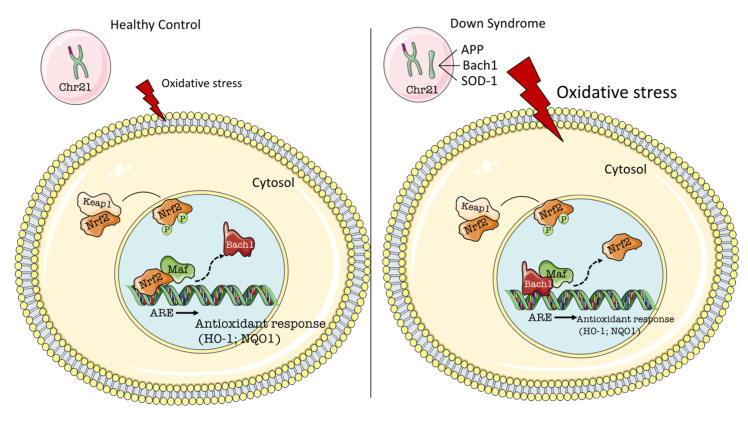
Down syndrome (DS) is the most common genetic cause of intellectual disability that is associated with an increased risk to develop early-onset Alzheimer-like dementia (AD). The brain neuropathological features include alteration of redox homeostasis, mitochondrial deficits, inflammation, accumulation of both amyloid beta-peptide oligomers and senile plaques, as well as aggregated hyperphosphorylated tau protein-containing neurofibrillary tangles, among others. It is worth mentioning that some of the triplicated genes encoded are likely to cause increased oxidative stress (OS) conditions that are also associated with reduced cellular responses. Published studies from our laboratories propose that increased oxidative damage occurs early in life in DS population and contributes to age-dependent neurodegeneration. This is the result of damaged, oxidized proteins that belong to degradative systems, antioxidant defense system, neuronal trafficking. and energy metabolism. This review focuses on a key element that regulates redox homeostasis, the transcription factor Nrf2, which is negatively regulated by BACH1, encoded on chromosome 21. The role of the Nrf2/BACH1 axis in DS is under investigation, and the effects of triplicated BACH1 on the transcriptional regulation of Nrf2 are still unknown. In this review, we discuss the physiological relevance of BACH1/Nrf2 signaling in the brain and how the dysfunction of this system affects the redox homeostasis in DS neurons and how this axis may contribute to the transition of DS into DS with AD neuropathology and dementia. Further, some of the evidence collected in AD regarding the potential contribution of BACH1 to neurodegeneration in DS are also discussed.
Overview
The claims and statistics of this paper haven’t been checked yet.
Run the check — free, no account needed. It reads the open-access text and checks the sources it cites.
Integrity signals
Registry
Cites
Statistics
Figures
Verification
Claims the paper makes
The claims and statistics of this paper haven’t been checked yet.
Run the check — free, no account needed. It reads the open-access text and checks the sources it cites.
Claims other papers make about this one
Each is checked against this paper’s own text: does it say what the citing paper says it does?
In the citing paper
“Motifs for BACH1 - a TF associated with impaired Ts21 antioxidant defenses (28) - were significantly enriched (adj. p < 0.01) in accessible chromatin of ExN, microglia, and oligodendrocyte lineage cells (Fig. 2G), with TF footprinting confirming elevated BACH1 activity in these populations (Fig. 2H).”
From Molecular and cellular processes disrupted in the early postnatal Down syndrome prefrontal cortex (2026) · cites this paper as [28]
Self-check
Percentages, sums and reported differences re-computed from the paper’s own numbers.
The self-check needs the paper’s full text.
Citations
Cites
Bartel (2004) · doi:10.1016/s0092-8674(04)00045-5 · Cited by 34,714
How mitochondria produce reactive oxygen species
Murphy, M. P. (2009) · Biochemical Journal · doi:10.1042/bj20081386 · Cited by 8,207
Mitochondrial Reactive Oxygen Species (ROS) and ROS-Induced ROS Release
Zorov, D. B., Juhaszova, M., & Sollott, S. J. (2014) · Physiological Reviews · doi:10.1152/physrev.00026.2013 · Cited by 5,383
Mitochondrial formation of reactive oxygen species
Turrens, J. F. (2003) · The Journal of Physiology · doi:10.1113/jphysiol.2003.049478 · Cited by 5,084
THE HEME OXYGENASE SYSTEM:A Regulator of Second Messenger Gases
Maines, M. D. (1997) · The Annual Review of Pharmacology and Toxicology · doi:10.1146/annurev.pharmtox.37.1.517 · Cited by 2,501
Oxidative stress, dysfunctional glucose metabolism and Alzheimer disease
Butterfield, D. A., & Halliwell, B. (2019) · Nature Reviews Neuroscience · doi:10.1038/s41583-019-0132-6 · Cited by 1,954 · cited 4×
“The role of OS in the development and progression of AD in the general population has been extensively discussed in several review papers [8,40,41].”
BackgroundResultInfluentialSelf-citationOxidative Damage Is the Earliest Event in Alzheimer Disease
Nunomura, A., Perry, G., Aliev, G., Hirai, K., Takeda, A., Balraj, E. K., Jones, P. K., Ghanbari, H., Wataya, T., Shimohama, S., et al. (2001) · Journal of Neuropathology & Experimental Neurology · doi:10.1093/jnen/60.8.759 · Cited by 1,885
Reactive oxygen species in living systems: Source, biochemistry, and role in human disease
Halliwell, B. B. (1991) · The American Journal of Medicine · doi:10.1016/0002-9343(91)90279-7 · Cited by 1,838
Oxidative stress response and Nrf2 signaling in aging
Zhang, H., Davies, K. J. A., & Forman, H. J. (2015) · Free Radical Biology and Medicine · doi:10.1016/j.freeradbiomed.2015.05.036 · Cited by 804
Expression of Nrf2 in Neurodegenerative Diseases
Ramsey, C. P., Glass, C. A., Montgomery, M. B., Lindl, K. A., Ritson, G. P., Chia, L. A., Hamilton, R. L., Chu, C. T., & Jordan-Sciutto, K. L. (2007) · Journal of Neuropathology and Experimental Neurology · doi:10.1097/nen.0b013e31802d6da9 · Cited by 760
Cited by
Molecular and cellular processes disrupted in the early postnatal Down syndrome prefrontal cortex
Risgaard, R. D., Hanthanan Arachchilage, K., Knaack, S. A., Hosseini, M., Chen, R. J., Kumarage, P., Schmidt, D. K., Huang, X., Sheng, J., Wang, C. J., et al. (2026) · Science · doi:10.1126/science.aea1549 · Cited by 12
Metadata
- Authors
- Perluigi, M., Tramutola, A., Pagnotta, S., Barone, E., & Butterfield, D. A.
- Affiliations
- Department of Biochemical Sciences, Sapienza University of Rome, 00185 Rome, Italy
- Department of Chemistry, University of Kentucky, Lexington, KY 40506, USA
- Venue
- Antioxidants
- Publisher
- MDPI AG
- Published
- 2020-08-21
- Volume
- 9
- Issue
- 9
- Pages
- 779
- ISSN
- 2076-3921
- PMC
- PMC7554729
- Cited by
- 39
- References
- 89
- Language
- en
- Funders
- National Institutes of Health (AG055596-01A1)
About these checks
Registry, retraction, Cites and statistics results are computed, not judged, with one exception: a printed reference that no index lists is read once by a model before it counts as a citation error. Claims are extracted by a model and kept only when their quote appears verbatim in the text; each cited source is then checked, with a model’s help, for whether it says what the claim relies on. Those verdicts can be wrong — read the claim’s quote and the cited source before relying on one.
Statistics and arithmetic are recomputed, not judged.
Confidence bands are shown only for fields calibrated on our annotated test set. None is calibrated yet, so no band is shown.
What counts as a claim ›How we measure confidence ›How we check this ›
Are you an author, or do you see a problem with this page? Request a review
Data sources
Bibliographic data: Semantic Scholar, OpenAlex, Crossref.
Contains information from the Semantic Scholar Academic Graph Datasets, made available under the ODC Attribution License (ODC-BY 1.0).
Semantic Scholar’s data is described in: Kinney, R., et al. (2023). The Semantic Scholar Open Data Platform. arXiv:2301.10140.
