

The DOI matches its Crossref record; 89 of the 89 references it cites were found in a registry or an index.
The BACH1/Nrf2 Axis in Brain in Down Syndrome and Transition to Alzheimer Disease-Like Neuropathology and Dementia
Abstract
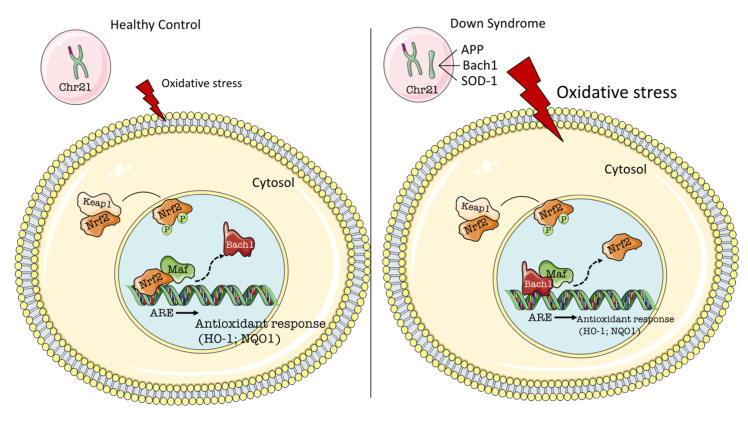
Down syndrome (DS) is the most common genetic cause of intellectual disability that is associated with an increased risk to develop early-onset Alzheimer-like dementia (AD). The brain neuropathological features include alteration of redox homeostasis, mitochondrial deficits, inflammation, accumulation of both amyloid beta-peptide oligomers and senile plaques, as well as aggregated hyperphosphorylated tau protein-containing neurofibrillary tangles, among others. It is worth mentioning that some of the triplicated genes encoded are likely to cause increased oxidative stress (OS) conditions that are also associated with reduced cellular responses. Published studies from our laboratories propose that increased oxidative damage occurs early in life in DS population and contributes to age-dependent neurodegeneration. This is the result of damaged, oxidized proteins that belong to degradative systems, antioxidant defense system, neuronal trafficking. and energy metabolism. This review focuses on a key element that regulates redox homeostasis, the transcription factor Nrf2, which is negatively regulated by BACH1, encoded on chromosome 21. The role of the Nrf2/BACH1 axis in DS is under investigation, and the effects of triplicated BACH1 on the transcriptional regulation of Nrf2 are still unknown. In this review, we discuss the physiological relevance of BACH1/Nrf2 signaling in the brain and how the dysfunction of this system affects the redox homeostasis in DS neurons and how this axis may contribute to the transition of DS into DS with AD neuropathology and dementia. Further, some of the evidence collected in AD regarding the potential contribution of BACH1 to neurodegeneration in DS are also discussed.
Overview
The claims and statistics of this paper haven’t been checked yet.
Run the check — free, no account needed. It reads the open-access text and checks the sources it cites.
Integrity signals
Registry
Cites
Statistics
Figures
Verification
Claims the paper makes
The claims and statistics of this paper haven’t been checked yet.
Run the check — free, no account needed. It reads the open-access text and checks the sources it cites.
Claims other papers make about this one
Each is checked against this paper’s own text: does it say what the citing paper says it does?
In the citing paper
“Motifs for BACH1 - a TF associated with impaired Ts21 antioxidant defenses (28) - were significantly enriched (adj. p < 0.01) in accessible chromatin of ExN, microglia, and oligodendrocyte lineage cells (Fig. 2G), with TF footprinting confirming elevated BACH1 activity in these populations (Fig. 2H).”
From Molecular and cellular processes disrupted in the early postnatal Down syndrome prefrontal cortex (2026) · cites this paper as [28]
Self-check
Percentages, sums and reported differences re-computed from the paper’s own numbers.
The self-check needs the paper’s full text.
Citations
Cites
Bartel (2004) · doi:10.1016/s0092-8674(04)00045-5 · Cited by 34,714
How mitochondria produce reactive oxygen species
Murphy, M. P. (2009) · Biochemical Journal · doi:10.1042/bj20081386 · Cited by 8,207
Mitochondrial Reactive Oxygen Species (ROS) and ROS-Induced ROS Release
Zorov, D. B., Juhaszova, M., & Sollott, S. J. (2014) · Physiological Reviews · doi:10.1152/physrev.00026.2013 · Cited by 5,383
Mitochondrial formation of reactive oxygen species
Turrens, J. F. (2003) · The Journal of Physiology · doi:10.1113/jphysiol.2003.049478 · Cited by 5,084
THE HEME OXYGENASE SYSTEM:A Regulator of Second Messenger Gases
Maines, M. D. (1997) · The Annual Review of Pharmacology and Toxicology · doi:10.1146/annurev.pharmtox.37.1.517 · Cited by 2,501
Oxidative stress, dysfunctional glucose metabolism and Alzheimer disease
Butterfield, D. A., & Halliwell, B. (2019) · Nature Reviews Neuroscience · doi:10.1038/s41583-019-0132-6 · Cited by 1,954 · cited 4×
“The role of OS in the development and progression of AD in the general population has been extensively discussed in several review papers [8,40,41].”
BackgroundResultInfluentialSelf-citationOxidative Damage Is the Earliest Event in Alzheimer Disease
Nunomura, A., Perry, G., Aliev, G., Hirai, K., Takeda, A., Balraj, E. K., Jones, P. K., Ghanbari, H., Wataya, T., Shimohama, S., et al. (2001) · Journal of Neuropathology & Experimental Neurology · doi:10.1093/jnen/60.8.759 · Cited by 1,885
Reactive oxygen species in living systems: Source, biochemistry, and role in human disease
Halliwell, B. B. (1991) · The American Journal of Medicine · doi:10.1016/0002-9343(91)90279-7 · Cited by 1,838
Oxidative stress response and Nrf2 signaling in aging
Zhang, H., Davies, K. J. A., & Forman, H. J. (2015) · Free Radical Biology and Medicine · doi:10.1016/j.freeradbiomed.2015.05.036 · Cited by 804
Expression of Nrf2 in Neurodegenerative Diseases
Ramsey, C. P., Glass, C. A., Montgomery, M. B., Lindl, K. A., Ritson, G. P., Chia, L. A., Hamilton, R. L., Chu, C. T., & Jordan-Sciutto, K. L. (2007) · Journal of Neuropathology and Experimental Neurology · doi:10.1097/nen.0b013e31802d6da9 · Cited by 760
Apoptosis and increased generation of reactive oxygen species in Down's syndrome neurons in vitro
Busciglio, J., & Yankner, B. A. (1995) · Nature · doi:10.1038/378776a0 · Cited by 741
Oyake, T., Itoh, K., Motohashi, H., Hayashi, N., Hoshino, H., Nishizawa, M., Yamamoto, M., & Igarashi, K. (1996) · Molecular and Cellular Biology · doi:10.1128/mcb.16.11.6083 · Cited by 656
Hemoprotein Bach1 regulates enhancer availability of heme oxygenase‐1 gene
Sun, J., Hoshino, H., Takaku, K., Nakajima, O., Muto, A., Suzuki, H., Tashiro, S., Takahashi, S., Shibahara, S., Alam, J., et al. (2002) · The EMBO Journal · doi:10.1093/emboj/cdf516 · Cited by 637
Anandatheerthavarada, H. K., Biswas, G., Robin, M.-A., & Avadhani, N. G. (2003) · The Journal of Cell Biology · doi:10.1083/jcb.200207030 · Cited by 571
Ogawa, K., Sun, J., Taketani, S., Nakajima, O., Nishitani, C., Sassa, S., Hayashi, N., Yamamoto, M., Shibahara, S., Fujita, H., et al. (2001) · The EMBO Journal · doi:10.1093/emboj/20.11.2835 · Cited by 532
Butterfield, D. A., Swomley, A. M., & Sultana, R. (2013) · Antioxidants & Redox Signaling · doi:10.1089/ars.2012.5027 · Cited by 526
Self-citationDiscovery of the Negative Regulator of Nrf2, Keap1: A Historical Overview
Itoh, K., Mimura, J., & Yamamoto, M. P. (2010) · Antioxidants and Redox Signaling · doi:10.1089/ars.2010.3222 · Cited by 524
Oxidative Stress in Neurodegenerative Diseases: From a Mitochondrial Point of View
Cenini, G., Lloret, A., & Cascella, R. (2019) · Oxidative Medicine and Cellular Longevity · doi:10.1155/2019/2105607 · Cited by 499
McMahon, M., Thomas, N., Itoh, K., Yamamoto, M., & Hayes, J. D. (2006) · Journal of Biological Chemistry · doi:10.1074/jbc.m601119200 · Cited by 485
Montine, T. J., Neely, M. D., Quinn, J. F., Beal, M. F., Markesbery, W. R., Roberts, L. J., & Morrow, J. D. (2002) · Free Radical Biology and Medicine · doi:10.1016/s0891-5849(02)00807-9 · Cited by 453
Dhakshinamoorthy, S., Jain, A. K., Bloom, D. A., & Jaiswal, A. K. (2005) · Journal of Biological Chemistry · doi:10.1074/jbc.m500166200 · Cited by 414
Butterfield, D. A., & Boyd-Kimball, D. (2018) · Journal of Alzheimer’s Disease · doi:10.3233/jad-170543 · Cited by 403
Self-citationSun, J., Brand, M., Zenke, Y., Tashiro, S., Groudine, M., & Igarashi, K. (2004) · Proceedings of the National Academy of Sciences · doi:10.1073/pnas.0308083100 · Cited by 364
Brain oxidative stress in a triple-transgenic mouse model of Alzheimer disease
Resende, R., Moreira, P. I., Proença, T., Deshpande, A., Busciglio, J., Pereira, C., & Oliveira, C. R. (2008) · Free Radical Biology and Medicine · doi:10.1016/j.freeradbiomed.2008.03.012 · Cited by 343
Mao, P., & Reddy, P. H. (2011) · Biochimica et Biophysica Acta (BBA) - Molecular Basis of Disease · doi:10.1016/j.bbadis.2011.08.005 · Cited by 313
Neural roles for heme oxygenase: Contrasts to nitric oxide synthase
Barañano, D. E., & Snyder, S. H. (2001) · Proceedings of the National Academy of Sciences · doi:10.1073/pnas.191351298 · Cited by 294
Aging in Down Syndrome and the Development of Alzheimer's Disease Neuropathology
Head, E., T. Lott, I., M. Wilcock, D., & A. Lemere, C. (2015) · Current Alzheimer Research · doi:10.2174/1567205012666151020114607 · Cited by 289
Shaping the Nrf2-ARE-related pathways in Alzheimer’s and Parkinson’s diseases
Fão, L., Mota, S. I., & Rego, A. C. (2019) · Ageing Research Reviews · doi:10.1016/j.arr.2019.100942 · Cited by 285
Nuclear factor erythroid 2-related factor 2 protects against beta amyloid
Kanninen, K., Malm, T. M., Jyrkkänen, H.-K., Goldsteins, G., Keksa-Goldsteine, V., Tanila, H., Yamamoto, M., Ylä-Herttuala, S., Levonen, A.-L., & Koistinaho, J. (2008) · Molecular and Cellular Neuroscience · doi:10.1016/j.mcn.2008.07.010 · Cited by 255
Heme regulates gene expression by triggering Crm1‐dependent nuclear export of Bach1
Suzuki, H., Tashiro, S., Hira, S., Sun, J., Yamazaki, C., Zenke, Y., Ikeda‐Saito, M., Yoshida, M., & Igarashi, K. (2004) · The EMBO Journal · doi:10.1038/sj.emboj.7600248 · Cited by 240
Neurological phenotypes for Down syndrome across the life span
Lott, I. T. (2012) · Progress in Brain Research · doi:10.1016/b978-0-444-54299-1.00006-6 · Cited by 225
Sultana, R., Perluigi, M., & Butterfield, D. A. (2009) · Acta Neuropathologica · doi:10.1007/s00401-009-0517-0 · Cited by 215
Self-citationThe sinister face of heme oxygenase-1 in brain aging and disease
Schipper, H. M., Song, W., Tavitian, A., & Cressatti, M. (2018) · Progress in Neurobiology · doi:10.1016/j.pneurobio.2018.06.008 · Cited by 208
Valenti, D., Lidia de, B. A. R. I., Filippis, B. D., Henrion‐Caude, A., & Vacca, R. A. (2014) · Neuroscience & Biobehavioral Reviews · doi:10.1016/j.neubiorev.2014.01.012 · Cited by 205
Warnatz, H.-J., Schmidt, D., Manke, T., Piccini, I., Sultan, M., Borodina, T. A., Balzereit, D., Wruck, W., Солдатов, А. В., Vingron, M., et al. (2011) · Journal of Biological Chemistry · doi:10.1074/jbc.m111.220178 · Cited by 195
Oxidative Stress and Down Syndrome: A Route toward Alzheimer-Like Dementia
Marzia Perluigi, A., & Butterfield, D. A. (2011) · Current Gerontology and Geriatrics Research · doi:10.1155/2012/724904 · Cited by 190
Self-citationAdaptive Downregulation of Mitochondrial Function in Down Syndrome
Helguera, P. R., Seiglie, J., Rodríguez, J. A., Hanna, M., Helguera, G. F., & Busciglio, J. A. (2013) · Cell Metabolism · doi:10.1016/j.cmet.2012.12.005 · Cited by 184
Bach1: Function, Regulation, and Involvement in Disease
Zhang, X., Guo, J., Wei, X., Niu, C., Jia, M., Li, Q., & Meng, D. (2018) · Oxidative Medicine and Cellular Longevity · doi:10.1155/2018/1347969 · Cited by 184
Oxidative stress involving changes in Nrf2 and ER stress in early stages of Alzheimer's disease
Mota, S. I., Costa, R. O., Ferreira, I. L., Santana, I., Caldeira, G. L., Padovano, C., Fonseca, A. C., Baldeiras, I., Cunha, C., Letra, L., et al. (2015) · Biochimica et Biophysica Acta (BBA) - Molecular Basis of Disease · doi:10.1016/j.bbadis.2015.03.015 · Cited by 183
Kapitulnik, J., & Maines, M. D. (2009) · Trends in Pharmacological Sciences · doi:10.1016/j.tips.2008.12.003 · Cited by 178
Cadmium Induces Nuclear Export of Bach1, a Transcriptional Repressor of Heme Oxygenase-1 Gene
Suzuki, H., Tashiro, S., Sun, J., Doi, H., Satomi, S., & Igarashi, K. (2003) · Journal of Biological Chemistry · doi:10.1074/jbc.m306764200 · Cited by 172
Redox Proteomics in Selected Neurodegenerative Disorders: From Its Infancy to Future Applications
Butterfield, D. A., Marzia Perluigi, A., Reed, T. T., Muharib, T., Hughes, C. P., Robinson, R. A. S., & Rukhsana Sultana, A. (2011) · Antioxidants and Redox Signaling · doi:10.1089/ars.2011.4109 · Cited by 171
Self-citationMatz, P. G., Turner, C. P., Weinstein, P. R., Massa, S. M., Panter, S. S., & Sharp, F. R. (1996) · Brain Research · doi:10.1016/0006-8993(95)01511-6 · Cited by 164
The heme oxygenase system and its functions in the brain.
Maines, M. D. (2000) · PubMed · Cited by 158
Increased MAP kinase activity in Alzheimer's and Down syndrome but not in schizophrenia human brain
SWATTON, J. E., Sellers, L. A., Faull, R. L. M., Holland, A. J., Iritani, S., & Bahn, S. (2004) · European Journal of Neuroscience · doi:10.1111/j.0953-816x.2004.03365.x · Cited by 158
Brain heme oxygenase isoenzymes and nitric oxide synthase are co-localized in select neurons
Vincent, S. R., Das, S., & Maines, M. D. (1994) · Neuroscience · doi:10.1016/0306-4522(94)90018-3 · Cited by 146
Conti, A. M. F., Fabbrini, F., D'Agostino, P., Negri, R., Greco, D., Genesio, R., D'Armiento, M. R., Olla, C., Paladini, D., Zannini, M., et al. (2007) · BMC Genomics · doi:10.1186/1471-2164-8-268 · Cited by 143
Oxidative stress: A bridge between Down's syndrome and Alzheimer's disease
Zana, M., Janka, Z., & Kalman, J. L. (2006) · Neurobiology of Aging · doi:10.1016/j.neurobiolaging.2006.03.008 · Cited by 140
Kaspar, J. W., & Jaiswal, A. K. (2009) · Journal of Biological Chemistry · doi:10.1074/jbc.m109.040022 · Cited by 140
Domenico, F. D., Coccia, R., Cocciolo, A., Murphy, M. P., Cenini, G., Head, E., Butterfield, D. A., Giorgi, A., Schininà, M. E., Mancuso, C., et al. (2013) · Biochimica et Biophysica Acta (BBA) - Molecular Basis of Disease · doi:10.1016/j.bbadis.2013.04.013 · Cited by 133
Self-citationValenti, D., Manente, G. A., Moro, L., Marra, E., & Vacca, R. A. (2011) · Biochemical Journal · doi:10.1042/bj20101908 · Cited by 133
Down syndrome and beta-amyloid deposition
Head, E., & Lott, I. T. (2004) · Current Opinion in Neurology · doi:10.1097/00019052-200404000-00003 · Cited by 129
Barone, E., Di Domenico, F., Mancuso, C., & Butterfield, D. A. (2014) · Neurobiology of Disease · doi:10.1016/j.nbd.2013.09.018 · Cited by 127
Self-citationCenini, G., Dowling, A. L. S., Beckett, T. L., Barone, E., Mancuso, C., Murphy, M. P., LeVine, H., Lott, I. T., Schmitt, F. A., Butterfield, D. A., et al. (2011) · Biochimica et Biophysica Acta (BBA) - Molecular Basis of Disease · doi:10.1016/j.bbadis.2011.10.001 · Cited by 127
Self-citationHeme Oxygenase and Its Products in the Nervous System
Mancuso, C. (2004) · Antioxidants and Redox Signaling · doi:10.1089/ars.2004.6.878 · Cited by 122
Simón, A., Schiapparelli, L., Colocho, P. E. S., Cuadrado‐Tejedor, M., Escribano, L., de Maturana, R. L., Río, J. D., Pérez‐Mediavilla, A., & Frechilla, D. (2008) · Neurobiology of Disease · doi:10.1016/j.nbd.2008.11.005 · Cited by 112
Butterfield, D. A., Domenico, F. D., Swomley, A. M., Head, E., & Marzia Perluigi, A. (2014) · Biochemical Journal · doi:10.1042/bj20140772 · Cited by 112
Self-citationDown Syndrome: Advances in Molecular Biology and the Neurosciences
Capone, G. T. (2001) · Journal of Developmental & Behavioral Pediatrics · doi:10.1097/00004703-200102000-00007 · Cited by 110
Tramutola, A., Domenico, F. D., Barone, E., Marzia Perluigi, A., & Butterfield, D. A. (2016) · Oxidative Medicine and Cellular Longevity · doi:10.1155/2016/2756068 · Cited by 110
Self-citationRedox proteomics and amyloid β-peptide: Insights into Alzheimer disease
Butterfield, D. A., & Boyd‐Kimball, D. (2019) · Journal of Neurochemistry · doi:10.1111/jnc.14589 · Cited by 105
Self-citationMitochondria as pharmacological targets in Down syndrome
Valenti, D., Braidy, N., Rasmo, D. D., Signorile, A., Rossi, L., Atanasov, A. G., Volpicella, M., Henrion‐Caude, A., Nabavi, S. M., & Vacca, R. A. (2017) · Free Radical Biology and Medicine · doi:10.1016/j.freeradbiomed.2017.08.014 · Cited by 101
Domenico, F. D., Pupo, G., Tramutola, A., Giorgi, A., Schininà, M. E., Coccia, R., Head, E., Butterfield, D. A., & Marzia Perluigi, A. (2014) · Free Radical Biology and Medicine · doi:10.1016/j.freeradbiomed.2014.03.027 · Cited by 98
Self-citationKa, S., Bang, I. H., Bae, E. J., & Park, B. (2017) · The FASEB Journal · doi:10.1096/fj.201700098rr · Cited by 97
Balcz, B., Kirchner, L., Cairns, N. J., Fountoulakis, M., & Lübec, G. (2001) · Springer eBooks · doi:10.1007/978-3-7091-6262-0_15 · Cited by 89
Multiple evidence for an early age pro-oxidant state in Down Syndrome patients
Pallardó, F. V., Degan, P., d’Ischia, M., Kelly, F. J., Zatterale, A., Calzone, R., Castello, G., Fernández‐Delgado, R., Dunster, C., Lloret, A., et al. (2006) · Biogerontology · doi:10.1007/s10522-006-9002-5 · Cited by 81
Tudor, C., Lerner‐Marmarosh, N., Engelborghs, Y., Gibbs, P., & Maines, M. D. (2008) · Biochemical Journal · doi:10.1042/bj20080018 · Cited by 79
Di Domenico, F., Pupo, G., Mancuso, C., Barone, E., Paolini, F., Arena, A., Blarzino, C., Schmitt, F. A., Head, E., Butterfield, D. A., et al. (2015) · Journal of Alzheimer’s Disease · doi:10.3233/jad-141254 · Cited by 75
Self-citationIncreased amyloid β protein levels in children and adolescents with Down syndrome
Mehta, P. D., Capone, G. T., Jewell, A., & Freedland, R. L. (2007) · Journal of the Neurological Sciences · doi:10.1016/j.jns.2006.12.010 · Cited by 72
Pratic, D., Iuliano, L., Amerio, G., Tang, L. X., Rokach, J., Sabatino, G., & Violi, F. (2000) · Annals of Neurology · doi:10.1002/1531-8249(200011)48:5<795::aid-ana15>3.0.co;2-# · Cited by 69
Global hypermethylation in fetal cortex of Down syndrome due to DNMT3L overexpression
Lu, J., Mccarter, M., Lian, G., Esposito, G., Capoccia, E., Delli-Bovi, L. C., Hecht, J. L., & Sheen, V. L. (2016) · Human Molecular Genetics · doi:10.1093/hmg/ddw043 · Cited by 66
Marzia Perluigi, A., Domenico, F. D., & Butterfield, D. A. (2013) · PROTEOMICS - CLINICAL APPLICATIONS · doi:10.1002/prca.201300066 · Cited by 59
Self-citationNeophobia, NQO1 and SIRT1 as premorbid and prodromal indicators of AD in 3xTg-AD mice
Torres–Lista, V., Parrado‐Fernández, C., Alvarez-Montón, I., Frontiñán-Rubio, J., Durán‐Prado, M., Peinado, J. R., Johansson, B. A., Alcain, F. J., & Giménez‐Llort, L. (2014) · Behavioural Brain Research · doi:10.1016/j.bbr.2014.04.055 · Cited by 56
Disturbance of redox homeostasis in Down Syndrome: Role of iron dysmetabolism
Barone, E., Arena, A., Head, E., Butterfield, D. A., & Marzia Perluigi, A. (2017) · Free Radical Biology and Medicine · doi:10.1016/j.freeradbiomed.2017.07.009 · Cited by 55
Self-citationBarone, E., Head, E., Butterfield, D. A., & Perluigi, M. (2017) · Free Radical Biology and Medicine · doi:10.1016/j.freeradbiomed.2016.10.508 · Cited by 53
Self-citationDevelopmental expression of heme oxygenase-1 (HSP32) in rat brain: an immunocytochemical study
Bergeron, M., Ferriero, D. M., & Sharp, F. R. (1998) · Developmental Brain Research · doi:10.1016/s0165-3806(97)00169-7 · Cited by 51
Tramutola, A., Di Domenico, F., Barone, E., Arena, A., Giorgi, A., di Francesco, L., Schininà, M. E., Coccia, R., Head, E., Butterfield, D. A., et al. (2017) · Antioxidants & Redox Signaling · doi:10.1089/ars.2016.6686 · Cited by 49
Self-citationKöglsberger, S., Cordero-Maldonado, M. L., Antony, P. M. A., Forster, J. I., Garcia, P., Buttini, M., Crawford, A. D., & Glaab, E. (2016) · Molecular Neurobiology · doi:10.1007/s12035-016-0299-z · Cited by 47
Piras, S., Furfaro, A. L., Brondolo, L., Passalacqua, M., Marinari, U. M., Pronzato, M. A., & Nitti, M. (2017) · Scientific Reports · doi:10.1038/s41598-017-08095-7 · Cited by 44
Kanno, H., Ozawa, H., Dohi, Y., Sekiguchi, A., Igarashi, K., & Itoi, E. (2009) · Journal of Neurotrauma · doi:10.1089/neu.2008.0667 · Cited by 43
Sun, X., Li, X., Ma, S., Guo, Y., & Li, Y. (2018) · Biochemical and Biophysical Research Communications · doi:10.1016/j.bbrc.2018.10.182 · Cited by 40
Heme Oxygenase-1 in Central Nervous System Malignancies
Sferrazzo, G., Rosa, M. D., Barone, E., Volti, G. L., Musso, N., Tibullo, D., & Barbagallo, I. A. (2020) · Journal of Clinical Medicine · doi:10.3390/jcm9051562 · Cited by 36
Self-citationmicroRNA 155 up regulation in the CNS is strongly correlated to Down's syndrome dementia
Tili, E., Mezache, L., Michaille, J., Amann, V., Williams, J. M., Vandiver, P., Quiñónez, M., Fadda, P., Mikhail, A. A., & Nuovo, G. J. (2018) · Annals of Diagnostic Pathology · doi:10.1016/j.anndiagpath.2018.03.006 · Cited by 33
Shim, K.-S., Ferrando-Miguel, R., & Lübec, G. (2003) · Journal of neural transmission. Supplementum · doi:10.1007/978-3-7091-6721-2_3 · Cited by 31
Insulin resistance in Alzheimer disease: Is heme oxygenase-1 an Achille's heel?
Barone, E., & Butterfield, D. A. (2015) · Neurobiology of Disease · doi:10.1016/j.nbd.2015.02.013 · Cited by 30
Self-citationNakaso, K., Kitayama, M., Fukuda, H., Kimura, K., Yanagawa, T., Ishii, T., Nakashima, K., & Yamada, K. (2000) · Neuroscience Letters · doi:10.1016/s0304-3940(00)00836-3 · Cited by 26
Overexpression of transcription factor BACH1 in fetal Down Syndrome brain
Ferrando-Miguel, R., Cheon, M. S., Yang, J., & Lübec, G. (2003) · Journal of neural transmission. Supplementum · doi:10.1007/978-3-7091-6721-2_17 · Cited by 25
Regulation of heme oxygenase-1 by transcription factor Bach1 in the mouse brain
Sakoda, E., Igarashi, K., Sun, J., Kurisu, K., & Tashiro, S. (2008) · Neuroscience Letters · doi:10.1016/j.neulet.2008.04.082 · Cited by 23
Dementia Therapy Targeting Tau
Buée, L. (2019) · Advances in experimental medicine and biology · doi:10.1007/978-981-32-9358-8_30 · Cited by 18
Characterization of 5-hydroxytryptamine binding sites in the plasma membrane of pig blood platelets
Hoffmann, D., & Wesemann, W. (1985) · Journal of Neural Transmission · doi:10.1007/bf01251913 · Cited by 12
Cited by
Molecular and cellular processes disrupted in the early postnatal Down syndrome prefrontal cortex
Risgaard, R. D., Hanthanan Arachchilage, K., Knaack, S. A., Hosseini, M., Chen, R. J., Kumarage, P., Schmidt, D. K., Huang, X., Sheng, J., Wang, C. J., et al. (2026) · Science · doi:10.1126/science.aea1549 · Cited by 12
Metadata
- Authors
- Perluigi, M., Tramutola, A., Pagnotta, S., Barone, E., & Butterfield, D. A.
- Affiliations
- Department of Biochemical Sciences, Sapienza University of Rome, 00185 Rome, Italy
- Department of Chemistry, University of Kentucky, Lexington, KY 40506, USA
- Venue
- Antioxidants
- Publisher
- MDPI AG
- Published
- 2020-08-21
- Volume
- 9
- Issue
- 9
- Pages
- 779
- ISSN
- 2076-3921
- PMC
- PMC7554729
- Cited by
- 39
- References
- 89
- Language
- en
- Funders
- National Institutes of Health (AG055596-01A1)
About these checks
Registry, retraction, Cites and statistics results are computed, not judged, with one exception: a printed reference that no index lists is read once by a model before it counts as a citation error. Claims are extracted by a model and kept only when their quote appears verbatim in the text; each cited source is then checked, with a model’s help, for whether it says what the claim relies on. Those verdicts can be wrong — read the claim’s quote and the cited source before relying on one.
Statistics and arithmetic are recomputed, not judged.
Confidence bands are shown only for fields calibrated on our annotated test set. None is calibrated yet, so no band is shown.
What counts as a claim ›How we measure confidence ›How we check this ›
Are you an author, or do you see a problem with this page? Request a review
Data sources
Bibliographic data: Semantic Scholar, OpenAlex, Crossref.
Contains information from the Semantic Scholar Academic Graph Datasets, made available under the ODC Attribution License (ODC-BY 1.0).
Semantic Scholar’s data is described in: Kinney, R., et al. (2023). The Semantic Scholar Open Data Platform. arXiv:2301.10140.
