

Transfer Learning Algorithm of P300-EEG Signal Based on XDAWN Spatial Filter and Riemannian Geometry Classifier
Open accessThe DOI matches its Crossref record; 39 of the 39 references it cites were found in a registry or an index; 2 of the 15 sources its claims cite were checked for support.
Abstract
The electroencephalogram (EEG) signal in the brain–computer interface (BCI) has suffered great cross-subject variability. The BCI system needs to be retrained before each time it is used, which is a waste of resources and time. Thus, it is difficult to generalize a fixed classification method for all subjects. Therefore, the transfer learning method proposed in this article, which combines XDAWN spatial filter and Riemannian Geometry classifier (RGC), can achieve offline cross-subject transfer learning in the P300-speller paradigm. The XDAWN spatial filter is used to enhanced the P300 components in the raw signal as well as reduce its dimensions. Then, the Riemannian Geometry Mean (RGM) is used as the reference matrix to perform the affine transformation of the symmetric positive definite (SPD) covariance matrix calculated from the filtered signal, which makes the data from different subjects comparable. Finally, the RGC is used to obtain the result of transfer learning experiments. The proposed algorithm was evaluated on two datasets (Dataset I from real patients and Dataset II from the laboratory). By comparing with two state-of-the-art and classic algorithms in the current BCI field, Ensemble of Support Vector Machine (E-SVM) and Stepwise Linear Discriminant Analysis (SWLDA), the maximum averaged area under the receiver operating characteristic curve (AUC) score of our algorithm reached 0.836, proving the potential of our proposed algorithm.
Overview
CoChat Summary
TL;DR
The paper proposes an offline cross-subject transfer learning method for P300-EEG that combines an XDAWN spatial filter with a Riemannian Geometry classifier, using each subject’s Riemannian Geometry mean to affine-transform SPD covariance matrices so data from different subjects become comparable. Across two P300-speller datasets, the method outperformed E-SVM and SWLDA, reaching a maximum average AUC of 0.836.
Key findings
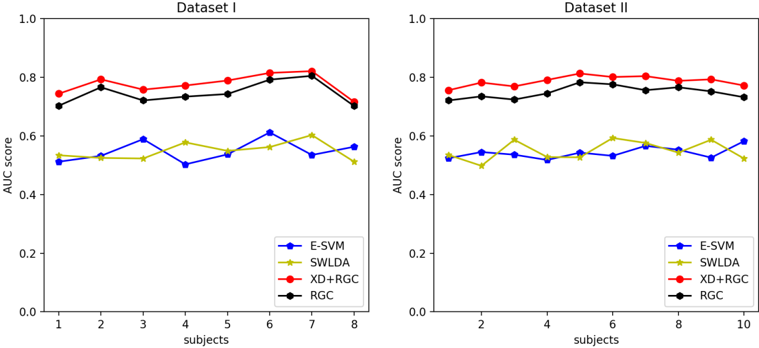
- In one-to-one transfer learning, XDAWN + RGC achieved average AUC 0.776 on Dataset I (max 0.821) and 0.787 on Dataset II (max 0.813), compared with E-SVM averages of 0.547 and 0.542 and SWLDA averages of 0.548 and 0.552.
- In all-to-one transfer learning, XDAWN + RGC achieved average AUC 0.836 on Dataset I (max 0.879) and 0.830 on Dataset II (max 0.865), compared with E-SVM averages of 0.636 and 0.650 and SWLDA averages of 0.655 and 0.660.
- XDAWN + RGC also improved slightly over RGC alone in both experiments; for example, all-to-one Dataset I RGC averaged 0.800 versus 0.836 for XDAWN + RGC.
- Visualization of two subjects per dataset showed that after affine transformation, SPD covariance matrices were more concentrated and consistent in spatial distribution.
Methods
- Dataset I was a public P300-speller dataset from eight ALS subjects, with 420 samples per subject (70 P300, 350 non-P300), 8 channels, 256 Hz sampling, and 0.1–30 Hz bandpass filtering. Dataset II was collected from 10 healthy subjects (five men, five women), with 1200 samples per subject (30 P300, 1170 non-P300), 32 channels, 250 Hz sampling, and 0.1–60 Hz bandpass filtering.
- Preprocessing selected 0–0.5 s after flashing, applied a fifth-order Butterworth 0.1–20 Hz bandpass filter, and downsampled to 34 Hz.
- The algorithm applies XDAWN spatial filtering to enhance P300 components and reduce dimensions, computes SPD covariance matrices, affine-transforms them using each subject’s Riemannian Geometry mean as reference, maps them onto the Riemannian manifold, and classifies by minimum Riemannian distance to class means. Experiments used one-to-one leave-one-subject-out transfer and all-to-one leave-one-out transfer with Bootstrap Aggregating voting; performance was measured by AUC due to class imbalance.
Limitations
- The paper does not present a dedicated limitations section; it states that future work will focus on a more robust BCI transfer learning algorithm that can be used online, indicating the current method is offline.
- Evident from the text: evaluation is limited to offline cross-subject transfer within two P300-speller datasets, with no online or real-time validation reported.
- Evident from the text: transfer learning is defined as training on Subject A and testing on Subject B from the same dataset, so cross-dataset generalization is not tested; sample sizes are also limited to 8 ALS subjects in Dataset I and 10 healthy subjects in Dataset II.
Model-written summary. Check it against the paper before relying on it.
Integrity signals
Registry
Cites
Statistics
Figures




Verification
Claims the paper makes
2 Valid · 1 Not valid · 9 Not checked · 27 Own results and interpretations
A result the paper reports from its own data — it cites no other source for it, so there is none to check. The quote shows it is in the paper.
In the paper
“It can be seen in Figure 7 that our method is still stable overall”
plain- Asserted: passes — The authors put it forward as true.
- Checkable: passes — It can be checked against evidence.
- Load-bearing: passes — The paper’s conclusions depend on it.
- Based: passes — The paper gives a reason why it holds.
A result the paper reports from its own data — it cites no other source for it, so there is none to check. The quote shows it is in the paper.
In the paper
“By comparing with two state-of-the-art and classic algorithms in the current BCI field, Ensemble of Support Vector Machine (E-SVM) and Stepwise Linear Discriminant Analysis (SWLDA), the maximum averaged area under the receiver operating characteristic curve (AUC) score of our algorithm reached 0.836, proving the potential of our proposed algorithm.”
plain- Asserted: passes — The authors put it forward as true.
- Checkable: passes — It can be checked against evidence.
- Load-bearing: passes — The paper’s conclusions depend on it.
- Based: passes — The paper gives a reason why it holds.
In the paper
“In addition, the BCI system requires a long calibration phase before each time it is used because, to achieve a good performance, every subject’s BCI system needs to be trained by their own EEG signals and cannot use other’s EEG signals [11].”
What the sources say
- Not checked — no full text of the sourcecites [11] Lotte, F. Signal Processing Approaches to Minimize or Suppress Calibration Time in Oscillatory Activity-Based Brain–Computer Interfaces. Proc. IEEE 2015 , 103 , 871–890. [CrossRef] source
plainstates a cause- Asserted: passes — The authors put it forward as true.
- Checkable: passes — It can be checked against evidence.
- Load-bearing: passes — The paper’s conclusions depend on it.
- Based: passes — The paper gives a reason why it holds.
None of the sources cited for this claim have been checked yet.
In the paper
“The electroencephalogram (EEG) signal in the brain–computer interface (BCI) has suffered great cross-subject variability.”
- Also stated in: § Transfer Learning Algorithm of P300-EEG Signal Based on XDAWN Spatial Filter and Riemannian Geometry Classifier · plain
“One of the main reasons hindering the widespread use of BCI systems is the variability of EEG signals [1,9].”
What the sources say
- Not matchedcites [1] Clerc, M. Brain Computer Interfaces, Principles and Practise. Biomed. Eng. Online 2013 , 12 , 1–4.
We searched by its title and found no matching paper.
- Not checked — no full text of the sourcecites [9] Blankertz, B.; Sannelli, C.; Halder, S.; Hammer, E.M.; Kübler, A.; Müller, K.R.; Curio, G.; Dickhaus, T. Neurophysiological predictor of SMR-based BCI performance. Neuroimage 2010 , 51 , 1303–1309. [CrossRef] source
plain- Asserted: passes — The authors put it forward as true.
- Checkable: passes — It can be checked against evidence.
- Load-bearing: passes — The paper’s conclusions depend on it.
- Based: passes — The paper gives a reason why it holds.
- Also stated in: § Transfer Learning Algorithm of P300-EEG Signal Based on XDAWN Spatial Filter and Riemannian Geometry Classifier · plain
In the paper
“Due to the variability, the feature space distribution of the EEG signal collected from different subjects or different sessions are inconsistent [10].”
What the sources say
- Not checked — no full text of the sourcecites [10] Clerc, M.; Daucé, E.; Mattout, J. Adaptive Methods in Machine Learning ; John Wiley & Sons: Hoboken, NJ, USA, 2016. source
plainstates a cause- Asserted: passes — The authors put it forward as true.
- Checkable: passes — It can be checked against evidence.
- Load-bearing: passes — The paper’s conclusions depend on it.
- Based: passes — The paper gives a reason why it holds.
15 more claims
Create a free account to see all 39 claims and every source verdict.
- It may state two separate claims as one. 12
- Probably not a substantial claim. 9
Claims other papers make about this one
Each is checked against this paper’s own text: does it say what the citing paper says it does?
The cited source says what the claim attributes to it.
In the citing paper
“xDAWN spatial filtering [13] with Riemannian geometry (xDAWN+RG) features also perform well cross-subject [14], [15] but lack obvious physiological interpretation [8].”
From ERP-XTTN: interpretable prototype-guided cross-attention for cross-subject ERP classification (2026) · cites this paper as [14]
Self-check
Percentages, sums and reported differences re-computed from the paper’s own numbers.
Each contradiction between two passages listed here was confirmed by an independent check.
Rated minor: it would not touch a result — a value no result rests on, a p-value that stays on the same side of the significance level, or a conflict that is clerical, resolved elsewhere in the paper, or outside its own findings.
In the paper
§ Transfer Learning Algorithm of P300-EEG Signal Based on XDAWN Spatial Filter and Riemannian Geometry Classifier
“The EEG signal containing the P300 component is expressed as X ∈ Rn×d, where n represents the feature dimension and d represents the number of channels of the EEG signal.”
§ Transfer Learning Algorithm of P300-EEG Signal Based on XDAWN Spatial Filter and Riemannian Geometry Classifier
“We need to find the projections W ∈ Rn× f ,where f represents the number of filters for projection. The data filtered by this filter are ˜ X = XW .”
Rated minor: it would not touch a result — a value no result rests on, a p-value that stays on the same side of the significance level, or a conflict that is clerical, resolved elsewhere in the paper, or outside its own findings.
In the paper
§ Transfer Learning Algorithm of P300-EEG Signal Based on XDAWN Spatial Filter and Riemannian Geometry Classifier
“Therefore, the signal can be given by X = DT A + N, and the enhanced P300 signal we try to find can be expressed as XW = DAW + NW .”
§ Transfer Learning Algorithm of P300-EEG Signal Based on XDAWN Spatial Filter and Riemannian Geometry Classifier
“The position of the P300 component in the P300 signal can be given by D ∈ Re×n through the Toeplitz matrix.”
Rated minor: it would not touch a result — a value no result rests on, a p-value that stays on the same side of the significance level, or a conflict that is clerical, resolved elsewhere in the paper, or outside its own findings.
In the paper
§ ∑
“We trained k classifiers for k subjects (one subject for one classifier), and the final result was voted by all classifiers, that is, the result receiving the largest number of votes.”
§ ∑
“1. Leave one subject’s data Xi (i = 1, 2, . . . k ) for testing purpose. 2. for s in k-1:”
Citations
Cites
Pan, S. J., & Yang, Q. (2010) · IEEE Transactions on Knowledge and Data Engineering · doi:10.1109/tkde.2009.191 · Cited by 23,387 · cited 1×
“In the field of machine learning, transfer learning is defined as the ability to use the knowledge learned in a previous task or domain in a new task or domain [12].”
BackgroundBreiman, L. (1996) · Machine Learning · doi:10.1007/bf00058655 · Cited by 16,325 · cited 1×
“BA method was proposed by Breiman et al. [30] and is often used in BCI [31,32].”
MethodUpdating P300: An integrative theory of P3a and P3b
Polich, J. (2007) · Clinical Neurophysiology · doi:10.1016/j.clinph.2007.04.019 · Cited by 7,919 · cited 1×
“Many different types of EEG signals can be used in BCI field, such as steady state visual evoked potential (SSVEP) [5], motor imagery (MI) [6], and P300 [7].”
BackgroundAUC: A misleading measure of the performance of predictive distribution models
Lobo, J. M., Jiménez‐Valverde, A., & Real, R. (2008) · Global Ecology and Biogeography · doi:10.1111/j.1466-8238.2007.00358.x · Cited by 3,499 · cited 1×
“Due to the unbalance of the samples classes, we used the area under the receiver operating characteristic curve (AUC) [33] as our performance metric.”
MethodNeuronal ensemble control of prosthetic devices by a human with tetraplegia
Hochberg, L. R., Serruya, M. D., Friehs, G. M., Mukand, J. A., Saleh, M., Caplan, A. H., Branner, A., Chen, D., Penn, R. D., & Donoghue, J. P. (2006) · Nature · doi:10.1038/nature04970 · Cited by 3,295 · cited 1×
“Therefore, BCI has a wide range of uses in patients with disabilities, such as patients with severe neuromuscular disease or interlocking symptoms [3,4].”
BackgroundFarwell, L. A., & Donchin, E. (1988) · Electroencephalography and Clinical Neurophysiology · doi:10.1016/0013-4694(88)90149-6 · Cited by 3,228
BCI2000: A General-Purpose Brain-Computer Interface (BCI) System
Schalk, G., McFarland, D. J., Hinterberger, T., Birbaumer, N., & Wolpaw, J. R. (2004) · IEEE Transactions on Biomedical Engineering · doi:10.1109/tbme.2004.827072 · Cited by 3,024
A review of classification algorithms for EEG-based brain–computer interfaces: A 10 year update
Lotte, F., Bougrain, L., Cichocki, A., Clerc, M., Congedo, M., Rakotomamonjy, A., & Yger, F. (2018) · Journal of Neural Engineering · doi:10.1088/1741-2552/aab2f2 · Cited by 2,239 · cited 1×
“If the data dimension is too large, the Riemannian Geometry method will perform many calculations, which is time-consuming and causes statistical deviations [22].”
MethodMotor imagery and direct brain-computer communication
Pfurtscheller, G., & Neuper, C. (2001) · Proceedings of the IEEE · doi:10.1109/5.939829 · Cited by 1,990 · cited 1×
“Many different types of EEG signals can be used in BCI field, such as steady state visual evoked potential (SSVEP) [5], motor imagery (MI) [6], and P300 [7].”
BackgroundOptimization Algorithms on Matrix Manifolds
Absil, P.-A., Mahony, R., & Sepulchre, R. (2008) · Princeton University Press eBooks · doi:10.1515/9781400830244 · Cited by 1,840
Research works printed but not linked: 4
- Clerc, M. Brain Computer Interfaces, Principles and Practise. Biomed. Eng. Online 2013 , 12 , 1–4.
- Lang, S. Differential and Riemannian Manifolds ; Springer: Berlin, Germany, 2012; p. 160.
- Blankertz, B.; Dornhege, G.; Müller, K.R.; Schalk, G.; Krusienski, D.; Wolpaw, J.R.; Schlogl, A.; Graimann, B.; Pfurtscheller, G.; Chiappa, S.; et al. Results of the BCI Competition III. In BCI Meeting ; Elsevier: Amsterdam, The Netherlands, 2005.
- 2007 , 17 , 145–151. [CrossRef]
Cited by
A review on transfer learning in EEG signal analysis
Wan, Z., Yang, R., Huang, M., Zeng, N., & Liu, X. (2021) · Neurocomputing · doi:10.1016/j.neucom.2020.09.017 · Cited by 468
Review of brain encoding and decoding mechanisms for EEG-based brain–computer interface
Xu, L., Xu, M., Jung, T., & Ming, D. (2021) · Cognitive Neurodynamics · doi:10.1007/s11571-021-09676-z · Cited by 112
“Li et al. (2020) validated the xDAWN algorithm combined with Riemannian whitening for P300 datasets.”
MethodThe classification of EEG-based wink signals: A CWT-Transfer Learning pipeline
Kumar, J. L. M., Rashid, M., Musa, R. M., et al. (2021) · ICT Express · doi:10.1016/j.icte.2021.01.004 · Cited by 43
CNN With Large Data Achieves True Zero-Training in Online P300 Brain-Computer Interface
Lee, J., Won, K., Kwon, M., Jun, S. C., & Ahn, M. (2020) · IEEE Access · doi:10.1109/access.2020.2988057 · Cited by 40
“The low performance of SWLDA_ZT is in accordance with previous studies which also used SWLDA_ZT as a baseline to compare with [63].”
ResultMoctezuma, L. A., & Molinas, M. (2020) · Scientific Reports · doi:10.1038/s41598-020-72051-1 · Cited by 40
Generative modeling and augmentation of EEG signals using improved diffusion probabilistic models
Torma, S., & Szegletes, L. (2025) · Journal of Neural Engineering · doi:10.1088/1741-2552/ada0e4 · Cited by 44
“Similarly, evoked potential decoding models can benefit from using xDAWN feature covariates (XCov) [45, 46].”
Gao, W., Huang, W., Li, M., Gu, Z., Pan, J., Yu, T., Yu, Z. L., & Li, Y. (2023) · IEEE Transactions on Neural Systems and Rehabilitation Engineering · doi:10.1109/tnsre.2023.3259991 · Cited by 32
“Riemannian geometry methods affine transform the covariance matrices of different subjects to center them with respect to a reference covariance matrix and then classify them using minimum-distance-to-mean (MDM) classifiers [21], [22], [23], [24].”
MethodRNeuMark: A Riemannian EEG Analysis Framework for Neuromarketing
Georgiadis, K., Kalaganis, F. P., Oikonomou, V. P., Nikolopoulos, S., Laskaris, N., & Kompatsiaris, I. Y. (2022) · Brain Informatics · doi:10.1186/s40708-022-00171-7 · Cited by 34
Liu, W., Tang, Z., Lv, F., & Chen, X. (2022) · Measurement Science and Technology · doi:10.1088/1361-6501/ac9ad3 · Cited by 27
“Unlike other articles that require the same distribution for S D and T D [59, 60], the data distribution of T D is different from that of S D in this study.”
Spatial filtering based on Riemannian distance to improve the generalization of ErrP classification
Cruz, A., Pires, G., & Nunes, U. (2021) · Neurocomputing · doi:10.1016/j.neucom.2021.10.078 · Cited by 22
Brain–Computer Interface—A Brain-in-the-Loop Communication System
Gao, X., Wang, Y., Chen, X., Liu, B., & Gao, S. (2025) · Proceedings of the IEEE · doi:10.1109/jproc.2025.3600389 · Cited by 32
“The Riemannian geometry classifier (RGC) is a successful application that maps raw data directly to a geometrical space quantified by a suitable metric [204], [205], [206].”
A Calibration-free Approach to Implementing P300-based Brain–computer Interface
Huang, Z., Guo, J., Zheng, W., Wu, Y., Lin, Z., & Zheng, H. (2022) · Cognitive Computation · doi:10.1007/s12559-021-09971-1 · Cited by 19
“[19] demonstrated that the combination of xDAWN spatial filter and Riemannian Geometry Mean can make the data from different subjects comparable, and has the potential to generalize a fixed classification method.”
MethodChau, J. M., Achanccaray, D., Villota, E., & Chevallier, S. (2020) · IEEE Transactions on Neural Systems and Rehabilitation Engineering · doi:10.1109/tnsre.2020.3043418 · Cited by 19
Transfer Learning in Motor Imagery Brain Computer Interface: A Review
Li, M., & Xu, D. (2022) · Journal of Shanghai Jiaotong University (Science) · doi:10.1007/s12204-022-2488-4 · Cited by 21
Ni, Z., Xu, J., Wu, Y., Li, M., Xu, G., & Xu, B. (2022) · IEEE Transactions on Neural Systems and Rehabilitation Engineering · doi:10.1109/tnsre.2022.3150007 · Cited by 18
Single-Option P300-BCI Performance Is Affected by Visual Stimulation Conditions
Peguero, J. D. C., Mendoza-Montoya, O., & Antelis, J. M. (2020) · Sensors · doi:10.3390/s20247198 · Cited by 17
Kueper, N., Kim, S. K., & Kirchner, E. A. (2024) · Scientific Reports · doi:10.1038/s41598-024-65910-8 · Cited by 21
Kshirsagar, G. B., & Londhe, N. D. (2022) · IEEE Transactions on Systems Man and Cybernetics Systems · doi:10.1109/tsmc.2022.3156861 · Cited by 16
“To tackle these problems, compressing the deep models [37], [38] and transfer learning (TL) [39], [40] was proposed in the recent past.”
BackgroundMulti-Time and Multi-Band CSP Motor Imagery EEG Feature Classification Algorithm
Yang, J. L., Ma, Z., & Shen, T. (2021) · Applied Sciences · doi:10.3390/app112110294 · Cited by 14
Spatial-Temporal Neural Network for P300 Detection
Zhang, Z., Yu, X., Rong, X., & Iwata, M. (2021) · IEEE Access · doi:10.1109/access.2021.3132024 · Cited by 14
“Of these, the combination of XDAWN and RGC is perhaps the most potent approach for P300 detection [19], which exhibits a strong generalization capability for variable EEG signals.”
BackgroundMotor task-to-task transfer learning for motor imagery brain-computer interfaces
Gwon, D., & Ahn, M. (2024) · NeuroImage · doi:10.1016/j.neuroimage.2024.120906 · Cited by 20
Mind wandering state detection during video-based learning via EEG
Tang, S., Liang, Y., & Li, Z. (2023) · Frontiers in Human Neuroscience · doi:10.3389/fnhum.2023.1182319 · Cited by 18
“The Riemannian geometry-based approach has achieved state-of-the-art results on various EEG-based BCI, for example, for BCI based on motor imagery (Zanini et al., 2018; Chu et al., 2020), P300 (Li et al., 2020), and SSVEP (Chevallier et al., 2020).”
A Transfer Learning Method based on VGG-16 Convolutional Neural Network for MI Classification
Li, M., & Xu, D. (2021) · Chinese Control and Decision Conference (CCDC) · doi:10.1109/ccdc52312.2021.9602818 · Cited by 13
Kwon, H., & Lee, S. (2022) · Neurocomputing · doi:10.1016/j.neucom.2022.06.089 · Cited by 13
Riemannian geometry-based transfer learning for reducing training time in c-VEP BCIs
Ying, J., Wei, Q., & Zhou, X. (2022) · Scientific Reports · doi:10.1038/s41598-022-14026-y · Cited by 18
“As for P300-based BCI, Li et al. 29 proposed a transfer learning algorithm that combines XDAWN spatial filter and Riemannian geometry classifier.”
MethodGao, C., Uchitomi, H., & Miyake, Y. (2023) · Brain Sciences · doi:10.3390/brainsci13091326 · Cited by 12
“In the beta band, the lower frequency range (13–20 Hz) is typically associated with attention, cognitive processing, and emotion regulation, whereas the higher frequency range (20–30 Hz) tends towards motor control and perception [45].”
BackgroundHong, X., Cai, Y., Chen, Z., Huang, R., & Zhang, B. (2024) · Smart Materials and Structures · doi:10.1088/1361-665x/ada09a · Cited by 10
EEG Motor Imagery Classification by Feature Extracted Deep 1D-CNN and Semi-Deep Fine-Tuning
Taghizadeh, M., Vaez, F., & Faezipour, M. (2024) · IEEE Access · doi:10.1109/access.2024.3430838 · Cited by 14
“Second, feature transfer is used to transfer knowledge by identifying the standard features between the source and target domains [47], [48], [49].”
MethodA Novel Guided Box Filter Based on Hybrid Optimization for Medical Image Denoising
Gautam, D., Khare, K., & Shrivastava, B. P. (2023) · Applied Sciences · doi:10.3390/app13127032 · Cited by 7
Wu, H., & Wu, D. (2022) · Brain Science Advances · doi:10.26599/bsa.2022.9050001 · Cited by 7
“xDAWN is a spatial filtering approach that can find a transformation to improve the signal-to-noise ratio (SNR) of the ERP signal and reduce the dimension of the data [25].”
BackgroundVukelić, M., Bui, M., Vorreuther, A., & Lingelbach, K. (2023) · Frontiers in Neuroergonomics · doi:10.3389/fnrgo.2023.1274730 · Cited by 9
EEGNet-based multi-source domain filter for BCI transfer learning
Li, M., Li, J., Song, Z., Deng, H., Xu, J., Xu, G., & Liao, W. (2023) · Medical & Biological Engineering & Computing · doi:10.1007/s11517-023-02967-z · Cited by 7
A systematic review of EEG-based Imagined Speech decoding
Jin, Z., Li, D., & Huang, S. (2025) · Applied Soft Computing · doi:10.1016/j.asoc.2025.113563 · Cited by 9
Dimitriadis, S. I. (2024) · Computers in Biology and Medicine · doi:10.1016/j.compbiomed.2024.108862 · Cited by 8
“These methods have been investigated in the last decade mainly in the brain-computer interface (BCI) society [72,73,77,70,102 – 106] with the geometric manipulations of SCM representations of functional connectivity graphs enriching our understanding about brain functionality.”
Mortier, S., Turkeš, R., Winne, J. D., Ransbeeck, W. V., Botteldooren, D. B., Devos, P., Latré, S., Leman, M., & Verdonck, T. (2023) · Sensors · doi:10.3390/s23239588 · Cited by 6
“Additionally, we want to explore other ways to enable CS generalization, for example, using transfer learning [77,78].”
MethodAn Adaptive-Load Classifier Based on Cognitive Load Similarity
Song, Z., Li, M., Wu, L., Wu, Y., Xu, G., Lin, F., & Liao, W. (2023) · IEEE Sensors Journal · doi:10.1109/jsen.2023.3299086 · Cited by 5
“[17] used the Riemannian geometry mean as the reference matrix to perform the affine transformation of the symmetric positive define covariance matrix calculated”
MethodTransfer Learning for P300 Brain-Computer Interfaces by Joint Alignment of Feature Vectors
Altindış, F., Banerjee, A., Phlypo, R., Yılmaz, B., & Congedo, M. (2023) · IEEE Journal of Biomedical and Health Informatics · doi:10.1109/jbhi.2023.3299837 · Cited by 9
“Unlike the conventional one-to-one domain adaptation or its cascaded manyto-one versions that usually employ voting strategies (majority or weighted) on multiple classifiers each being trained with a different source domain [23], [24], [26], [27], [28], in group learning a single classifier is trained and tested with…”
BackgroundMethodResultInfluentialExploiting Approximate Joint Diagonalization for Covariance Estimation in Imagined Speech Decoding
Kalaganis, F. P., Georgiadis, K., Oikonomou, V. P., Nikolopoulos, S., Laskaris, N., & Kompatsiaris, I. Y. (2023) · Lecture notes in computer science · doi:10.1007/978-3-031-43075-6_35 · Cited by 7
P300 ERP System Utilizing Wireless Visual Stimulus Presentation Devices
Sasatake, Y., & Matsushita, K. (2025) · Sensors · doi:10.3390/s25123592 · Cited by 5
“For example, Li et al. reported an AUC (area under the curve)—a machine learning performance metric ranging from 0 to 1, where 1 indicates perfect classification—of approximately 0.836, while Krzemi´nski et al. reported a classification performance of 81.2% based on accuracy [34,35].”
InfluentialTask-relevant stimulus design improves P300-based brain–computer interfaces
Kim, J., Cho, Y. S., & Kim, S.-P. (2024) · Journal of Neural Engineering · doi:10.1088/1741-2552/ada0e3 · Cited by 2
“It also points to the effectiveness of the xDAWN process and RG approach in transfer learning as shown by previous reports [14].”
BnSepCNN: Convolutional Neural Network for P300 Detection
Liu, M., & Beyette, F. R. (2023) · IEEE International Conference on Pattern Recognition and Machine Learning (PRML) · doi:10.1109/prml59573.2023.10348232 · Cited by 4
“This issue significantly impacts the widespread adoption of P300-based Brain-Computer Interfaces (BCIs), making generalization of models a prominent research focus [19-20].”
BackgroundAn adaptive cross-class transfer learning framework with two-level alignment
Xu, D., Sun, Y.-J., & Li, M. (2023) · Biomedical Signal Processing and Control · doi:10.1016/j.bspc.2023.105155 · Cited by 3
AEP: An adaptive ensemble P300-BCI classifier based on user-feedback and knowledge-transfer
Huang, Z., Chen, Q., Chen, X., Zheng, W., Lin, Z., & Luo, T.-J. (2025) · Applied Intelligence · doi:10.1007/s10489-025-06612-0 · Cited by 3
A Plug-and-Play P300-Based BCI With Zero-Training Application
Kim, J., & Kim, S.-P. (2025) · IEEE Transactions on Neural Systems and Rehabilitation Engineering · doi:10.1109/tnsre.2025.3603979 · Cited by 5
“Furthermore, there is substantial inter-subject variability in P300 responses due to differences in attention, fatigue, and cognitive engagement, which complicates the design of generalized models [33], [34], [35], [36].”
Efficient Brain-Computer Interface for Attention Detection in Health Care Industry
Sharmila, M., Manjula, M., Yogesh, B. M., Keerthana, S., Vijayakumar, P., & Selvam, N. (2023) · International Conference on Self Sustainable Artificial Intelligence Systems (ICSSAS) · doi:10.1109/icssas57918.2023.10331655 · Cited by 3
“Although non-invasive BCIs offer a lower level of spatial and temporal resolution than invasive BCIs, they are typically safer and less expensive [15] [16].”
BackgroundAydemir, Ö., Saka, K., & Öztürk, M. (2021) · Computer Methods in Biomechanics & Biomedical Engineering · doi:10.1080/10255842.2021.2022127 · Cited by 2
“Due to its low set-up cost and easy implementation, BCI applications widely use EEG signals, which are generally either recorded motor imagery or event related P300 signals (Farwell and Donchin 1988; Sellers et al. 2006; Arican and Polat 2019; Li et al. 2020).”
BackgroundP300 Spatiotemporal Prior-Based Transformer-CNN for Auxiliary Diagnosis of PTSD
Tan, L., Fang, H., Ding, P., Wang, F., Wei, Y., & Fu, Y. (2025) · Brain Sciences · doi:10.3390/brainsci15101124 · Cited by 2
“In the spatiotemporal feature extraction of multi-channel EEG, traditional methods such as common spatial pattern and xDAWN primarily focus on spatial filtering, with relatively limited modeling of temporal structures [22].”
Self-citationMany-to-Many Transfer Learning on Motor Imagery BCI
Altindış, F., Yılmaz, B., & Congedo, M. (2024) · International Conference on Decision Aid Sciences and Applications (DASA) · doi:10.1109/dasa63652.2024.10836450 · Cited by 2
Cross-Subject Deep Transfer Models for Evoked Potentials in Brain-Computer Interface
Mello, C., Weingart, T. B., & Rudd, E. M. (2022) · Proceedings - International Conference on Pattern Recognition/Proceedings/International Conference on Pattern Recognition · doi:10.1109/icpr56361.2022.9956463 · Cited by 1
“with EEG data: EEG is noisy, non-linear and highly nonstationary [2], [3], and ERP varies spatially and temporally between different mental tasks as well as across users [4], [5].”
BackgroundLibert, A., Kerchove, A. V. D., Wittevrongel, B., & Hulle, M. M. V. (2022) · Journal of Neural Engineering · doi:10.1088/1741-2552/ac636a · Cited by 4
“…results in BCI transfer learning have been achieved using Riemannian Geometry and reference EEG signals to transform data from two separate sessions into a common space [51, 57–59], Riemannian geometry has also been used to improve the covariance matrix estimation for beamforming applications [60].”
MethodInteractive reinforcement learning and error-related potential classification for implicit feedback
Choo, S., & Nam, C. S. (2022) · Elsevier eBooks · doi:10.1016/b978-0-323-85648-5.00005-0 · Cited by 1
Bayesian Signal Matching for Transfer Learning in ERP-Based Brain Computer Interface
Ma, T., Huggins, J. E., & Kang, J. (2025) · Journal of the American Statistical Association · doi:10.1080/01621459.2025.2563189 · Cited by 3
Gargiulo, L., Fullin, A., Arpaïa, P., Luca, M. D., Girolamo, C. I. D., Moccaldi, N., Congedo, M., & Blasiis, P. D. (2026) · Annals of Biomedical Engineering · doi:10.1007/s10439-026-04311-6
Toward zero-calibration MEG brain-computer interfaces based on event-related fields
Kim, D., Yoo, M.-A., Choi, S.-I., Kim, M., & Kim, S.-P. (2025) · Biomedical Engineering Letters · doi:10.1007/s13534-025-00503-6
“In fact, EEG BCIs have benefited from spatial filters and Riemannian geometric approach to achieve reliable zero-calibration [25, 26].”
A Plug-and-Play P300-Based BCI with Calibration-Free ApplicationPreprint
Kim, J., & Kim, S.-P. (2025) · bioRxiv (Cold Spring Harbor Laboratory) · doi:10.1101/2025.05.21.655021
“On the signal processing side, recent advances such as xDAWN spatial filtering [29], Riemannian geometry-based features [22], and deep learning classifiers [30] have also shown promise in improving performance across users.”
Sun, X., Chu, Y., Luo, Y., & Zhao, X. (2024) · International Conference on Mechatronics and Machine Vision in Practice (M2VIP) · doi:10.1109/m2vip62491.2024.10745999
Task-Relevant Stimulus Design Improves P300-Based Brain-Computer InterfacesPreprint
Kim, J., Cho, Y. S., & Kim, S.-P. (2024) · bioRxiv (Cold Spring Harbor Laboratory) · doi:10.1101/2024.05.01.592004
Signal Enhancement and Dimensionality Reduction by XDAWN and Compressive Sensing Models
Liu, J., & Hu, Y. D. (2024) · International Conference on Consumer Electronics and Computer Engineering (ICCECE) · doi:10.1109/iccece61317.2024.10504162
“On the other hand, the XDAWN algorithm has demonstrated greater effectiveness in enhancing specific event-related components in EEG signals[10].”
MethodSpecial Issue on Image Processing Techniques for Biomedical Applications
Ruberto, C. D., Loddo, A., & Putzu, L. (2022) · Applied Sciences · doi:10.3390/app122010338
ERP-XTTN: interpretable prototype-guided cross-attention for cross-subject ERP classification
Genevier Wyman, C., & Hirshfield, L. (2026) · Journal of Neural Engineering · doi:10.1088/1741-2552/ae9f95
“…patterns, but their interpretability rests on a fixed decision rule rather than trial-specific evidence for each classification. xDAWN spatial filtering [13] with Riemannian geometry (xDAWN + RG) features also perform well cross-subject [14, 15] but lack obvious physiological interpretation [8].”
Metadata
- Authors
- Li, F., Xia, Y., Wang, F., Zhang, D., Li, X., & He, F.
- Affiliations
- Changsha University of Science and Technology (CN)
- South China Normal University (CN)
- Corresponding author
- Wang, Fei
- Venue
- Applied Sciences
- Publisher
- MDPI AG
- Published
- 2020-03-05
- Volume
- 10
- Issue
- 5
- Pages
- 1804
- ISSN
- 2076-3417 (ISSN-L)
- OpenAlex
- W3009134349
- Cited by
- 64
- References
- 38
- Citations by year
- 2026: 5 · 2025: 8 · 2024: 11 · 2023: 15 · 2022: 13 · 2021: 7 · 2020: 5
- FWCI
- 4.78
- Type
- journal article
- Language
- en
- Open access
- gold
- dx.doi.org
- Licence
- Locations
- Applied Sciences (publishedVersion, cc-by)
- DOAJ (DOAJ: Directory of Open Access Journals) (submittedVersion, cc-by-sa)
- Funders
- National Natural Science Foundation of China (61906019)
- Natural Science Foundation of Hunan Province (2019JJ50649)
- Scientific Research Fund of Hunan Provincial Education Department (18C0238 and 19B004)
- "Double First-class" International Cooperation and Development Scientific Research Project of Changsha University of Science and Technology (2018IC25)
- Young Teacher Growth Plan Project of Changsha University of Science and Technology (2019QJCZ076)
- Topics
- Life Sciences › Neuroscience › Cognitive Neuroscience › EEG and Brain-Computer Interfaces
- Physical Sciences › Computer Science › Human-Computer Interaction › Gaze Tracking and Assistive Technology
- Physical Sciences › Computer Science › Artificial Intelligence › Emotion and Mood Recognition
- Keywords
- P300, EEG, brain-computer interface, cross-subject transfer learning, P300 speller, cross-subject variability
About these checks
Registry, retraction, Cites and statistics results are computed, not judged, with one exception: a printed reference that no index lists is read once by a model before it counts as a citation error. Claims are extracted by a model and kept only when their quote appears verbatim in the text; each cited source is then checked, with a model’s help, for whether it says what the claim relies on. Those verdicts can be wrong — read the claim’s quote and the cited source before relying on one.
The claim verdicts this report counts are experimental: their accuracy is not yet measured.
A language model drew the claims from the paper on 2026-10-07, under version 3 of the claim definition (model deepseek-v4.1-flash, prompt extract-v3).
A second model labelled each claim on 2026-10-07 (model jev-1.13-20260917, definition revision gold-guideline-v0.2).
Statistics and arithmetic are recomputed, not judged.
Confidence bands are shown only for fields calibrated on our annotated test set. None is calibrated yet, so no band is shown.
What counts as a claim ›How we measure confidence ›How we check this ›
Are you an author, or do you see a problem with this page? Request a review
Data sources
Bibliographic data: Semantic Scholar, OpenAlex, Crossref.
Contains information from the Semantic Scholar Academic Graph Datasets, made available under the ODC Attribution License (ODC-BY 1.0).
Semantic Scholar’s data is described in: Kinney, R., et al. (2023). The Semantic Scholar Open Data Platform. arXiv:2301.10140.
