

The DOI matches its Crossref record; 4 of the 4 references it cites were found in a registry or an index.
Characterization of Demolition Construction Waste Containing Asbestos, and the Release of Fibrous Dust Particles
Abstract
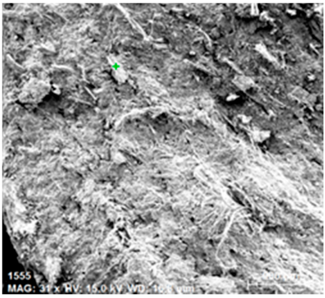
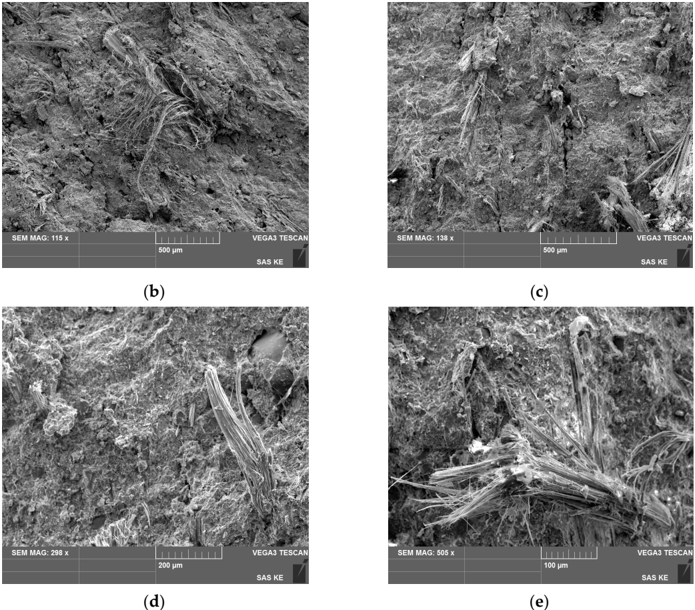
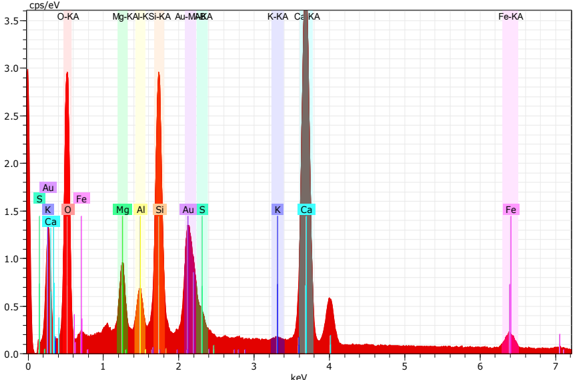
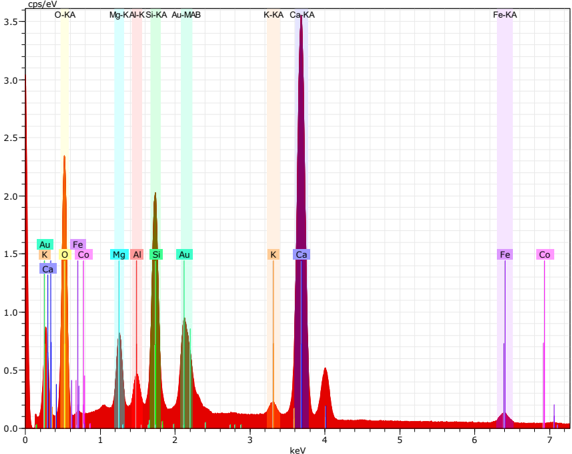
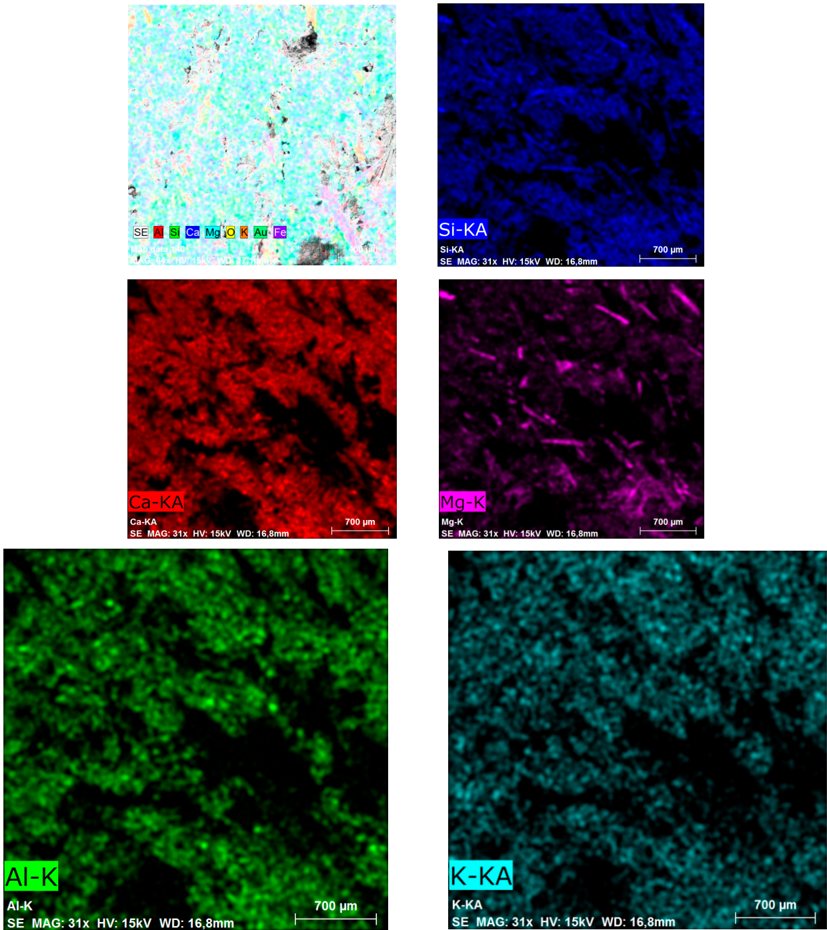
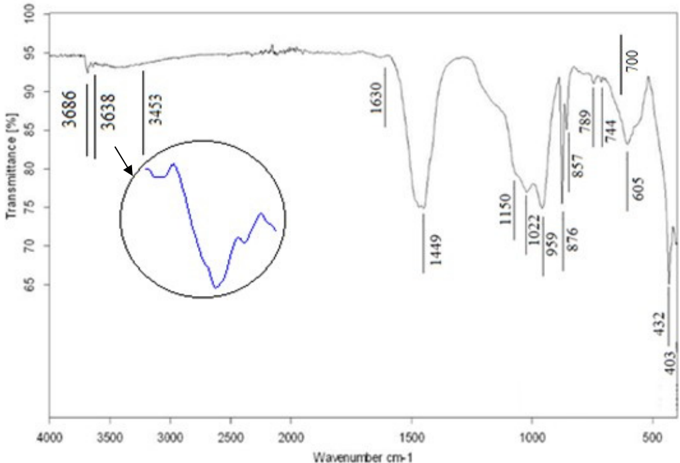
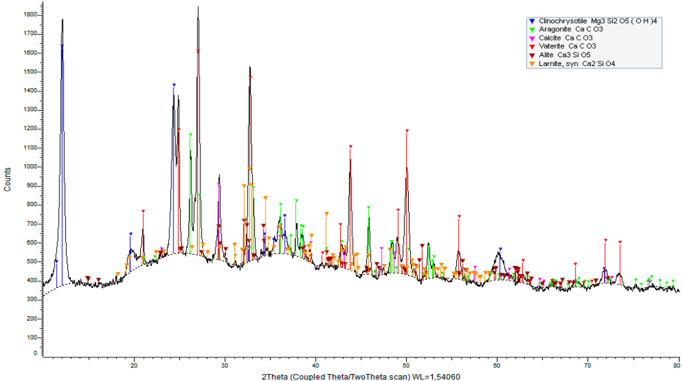
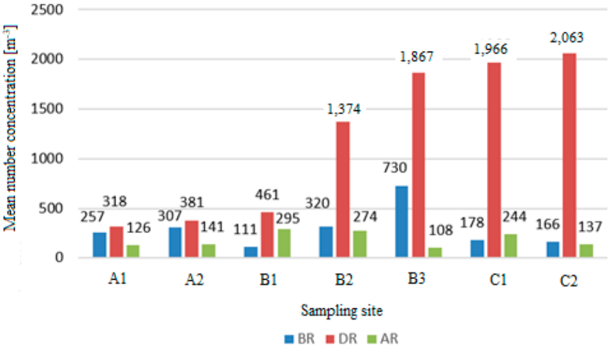
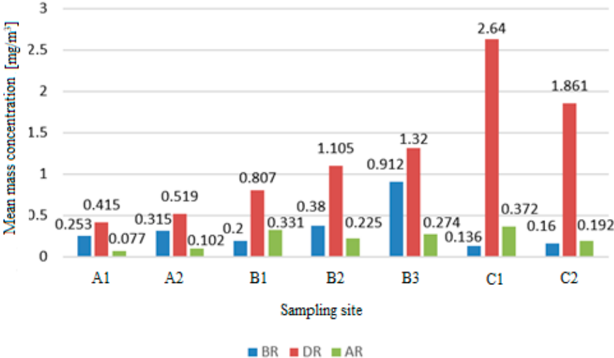
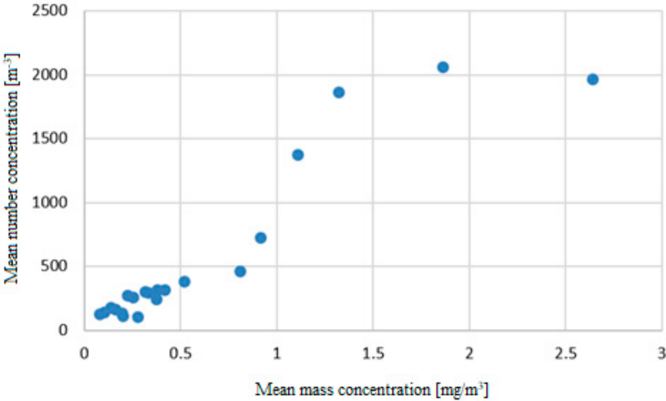
This paper focuses on the characterization of demolition construction waste containing asbestos fibers and the monitoring of fibrous dust released from asbestos–cement products (ACPs) during their removal from a three-story industrial building. Asbestos-containing products removal was carried out according to a demolition management system in terms of protection of workers. The results of a chemical analysis, X-ray diffraction analysis, infrared analysis and scanning electron microscopy of demolition waste samples confirmed the same material quality of asbestos–cement (AC) elements used throughout the building. In addition, a MgO/SiO2 ratio corresponding to a serpentine silicate mineral of chrysotile was detected by means of X-ray fluorescence analysis. Also, crystalline phase calcium silicates and calcium carbonates from the cement matrix were identified in the AC waste. The relatively large differences in the elemental analysis between the sample area and the individual points found by energy-dispersive X-ray spectroscopic mapping are related to the composition heterogeneity. The highest content of magnesium occurs where asbestos fibers predominate in the cement matrix. The measured number concentrations of asbestos fibers before, during, and after asbestos–cement products removal were compared to outdoor concentrations. Indoor concentrations of asbestos fibers during the removal of AC materials did not exceed the permissible limit for a working environment (1000 fibers per one m3), except in three spots out of all the working sites inside the building. A relationship between the number and mass concentrations of asbestos dust is shown.
Overview
The claims and statistics of this paper haven’t been checked yet.
Run the check — free, no account needed. It reads the open-access text and checks the sources it cites.
Integrity signals
Registry
Cites
Statistics
Figures
Verification
Claims the paper makes
The claims and statistics of this paper haven’t been checked yet.
Run the check — free, no account needed. It reads the open-access text and checks the sources it cites.
Claims other papers make about this one
Each is checked against this paper’s own text: does it say what the citing paper says it does?
In the citing paper
“Some previous studies have found low levels of ambient asbestos fibres (<0.01 fibres/cm3 [f/cm3]) during the demolition of residential dwellings (Perkins et al. 2008; Neitzel et al. 2020; Stevulova et al. 2020);”
From Measurements of airborne asbestos fibres during refurbishing (2023) · cites this paper as Stevulova et al. 2020
Self-check
Percentages, sums and reported differences re-computed from the paper’s own numbers.
The self-check needs the paper’s full text.
Citations
Cites
Pathology of Asbestos-Associated Diseases
(2014) · doi:10.1007/978-3-642-41193-9 · Cited by 199
Boulanger, G., Andujar, P., Pairon, J.-C., Billon-Galland, M.-A., Dion, C., Dumortier, P., Brochard, P., Sobaszek, A., Bartsch, P., Paris, C., et al. (2014) · Environmental Health · doi:10.1186/1476-069x-13-59 · Cited by 176
The health risk of chrysotile asbestos
Bernstein, D. M. (2014) · Current Opinion in Pulmonary Medicine · doi:10.1097/mcp.0000000000000064 · Cited by 57
Environmental asbestos pollution — Situation in Poland
Szeszenia-Dąbrowska, N., Sobala, W., Świątkowska, B., Stroszejn-Mrowca, G., & Wilczyńska, U. (2012) · International Journal of Occupational Medicine and Environmental Health · doi:10.2478/s13382-012-0003-0 · Cited by 27
Research works printed but not linked: 41
- Abelmann, 2015, Historical ambient airborne asbestos concentrations in the United States—An analysis of published and unpublished literature (1960s–2000s), Inhal. Toxicol., 27, 754, 10.3109/08958378.2015.1118172 · DOI
- 2016, Medical monitoring of asbestos-exposed workers: Experience from Poland, Bull. World. Health Organ., 94, 599, 10.2471/BLT.15.159426 · DOI
- Baur, 2015, How conflicted authors undermine the World Health Organization (WHO) campaign to stop all use of asbestos: Spotlight on studies showing that chrysotile is carcinogenic and facilitates other non-cancer asbestos-related diseases, Int. J. Occup. Environ. Health, 21, 176, 10.1179/2049396714Y.0000000105 · DOI
- (Official Journal of the European Communities, 1999). Commission Directive 1999/77/EC of 26 July 1999, Official Journal of the European Communities.
- Li, 2014, Asbestos and asbestos waste management in the Asian-Pacific region: Trends, challenges and solutions, J. Clean. Prod., 81, 218, 10.1016/j.jclepro.2014.06.022 · DOI
- Baur, 2016, Collegium Ramazzini: Comments on the 2014 Helsinki consensus report on asbestos, Am. J. Ind. Med., 59, 591, 10.1002/ajim.22595 · DOI
- Marsili, D., Terracini, B., Santana, V.S., Ramos-Bonilla, J.P., Pasetto, R., Mazzeo, A., Loomis, D., Comba, P., and Algranti, E. (2016). Prevention of asbestos-related disease in countries currently using asbestos. Int. J. Environ. Res. Public Health, 13. · DOI
- 2006, Ceramic fibres—Properties, use, effects on respiratory system, Czech Occup. Med., 4, 203
- Bobst, S. (2017). The history of risk assessment within OSHA and ACGIH: Asbestos case study. History of Risk Assessment in Toxicology, A Volume in History of Toxicology and Environmental Health, Elsevier. · DOI
- 2012, Exposure to respirable asbestos fibers at various stage of asbestos removal work, Med. Pr., 63, 191
- Neitzel, 2020, Measurement of asbestos emissions associated with demolition of abandoned residential dwellings, Sci. Total Environ., 722, 137891, 10.1016/j.scitotenv.2020.137891 · DOI · Paper page
- Sakol, 2019, Air pollution during asbestos removal, Pol. J. Environ. Stud., 28, 1
- Lange, 2002, Airborne exposure concentrations during asbestos abatement of ceiling and wall plaster, Bull. Environ. Contam. Toxicol., 69, 712, 10.1007/s00128-002-0119-1 · DOI
- Perkins, 2007, Asbestos release from whole-building demolition of buildings with asbestos-containing material, J. Occup. Environ. Hyg., 4, 889, 10.1080/15459620701691023 · DOI · Paper page
- Brown, 1987, Asbestos exposure during renovation and demolition of asbestos cement clad buildings, Am. Ind. Hyg. Assoc. J., 48, 478, 10.1080/15298668791385075 · DOI · Paper page
- Obminski, 2020, The effectiveness of asbestos stabilizers during abrasion of asbestos-cement sheets, Constr. Build. Mater., 249, 118767, 10.1016/j.conbuildmat.2020.118767 · DOI
- Kinney, 1994, Aiborne fiber levels during asbestos operations and maitance work in a large office building, Appl. Occup. Environ. Hyg., 9, 825, 10.1080/1047322X.1994.10388417 · DOI
- Suzuki, 2005, Short, thin asbestos fibers contribute to the development of human malignant mesothelioma: Pathological evidence, Int. J. Hyg. Environ. Health, 208, 201, 10.1016/j.ijheh.2005.01.015 · DOI · Paper page
- Hashim, 2014, Occupational and environmental exposures and cancers in developing countries, Ann. Glob. Health, 80, 393, 10.1016/j.aogh.2014.10.002 · DOI
- Kratzke, 2018, Asbestos-related disease, J. Radiol. Nurs., 37, 21, 10.1016/j.jradnu.2017.12.003 · DOI
- Pukkala, 2017, Cancer incidence in asbestos-exposed workers: An update on four Finnish cohorts, Saf. Health Work, 8, 169, 10.1016/j.shaw.2016.11.003 · DOI
- Takala, 2015, Eliminating occupational cancer, Ind. Health, 53, 307, 10.2486/indhealth.53-307 · DOI
- Gilham, 2018, Current asbestos exposure and future mesothelioma risks in Britain: The Inhaled Particles Study (TIPS), Int. J. Epidemiol., 47, 1745, 10.1093/ije/dyx276 · DOI
- Felten, 2014, Changes of mesothelin and osteopontin levels over time in formerly asbestos-exposed power industry workers, Int. Arch. Occup. Environ. Health, 87, 195, 10.1007/s00420-013-0853-1 · DOI
- Kim, 2017, Optimal management program for asbestos containing building materials to be available in the event of a disaster, Waste Manag., 64, 272, 10.1016/j.wasman.2017.03.042 · DOI
- Baek, 2016, Determination of the essential activity elements of an asbestos management system in the event of a disaster and their prioritization, J. Clean. Prod., 137, 414, 10.1016/j.jclepro.2016.07.117 · DOI
- Paglietti, 2016, Classification and management of asbestos-containing waste: European legislation and the Italian experience, Waste Manag., 50, 130, 10.1016/j.wasman.2016.02.014 · DOI
- Pacheco-Torgal, F., Ding, Y., Colangelo, F., Tuladhar, R., and Koutamanis, A. (2020). Detection and classification of asbestos and other contminnts in C&DW by advenced Technologies. Advances in Construction and Demolition Waste Recycling. Management, Processing and Environmental Assessment, Elsevier.
- 2015, Health risk associated with airborne asbestos, Environ. Monit. Assess., 187, 428, 10.1007/s10661-015-4614-3 · DOI
- Witek, 2017, Neutralisation of asbestos-containing waste by melting in an arc-resistance furnace, Waste Manag., 69, 336, 10.1016/j.wasman.2017.08.017 · DOI
- Viani, 2013, Crystal chemistry of cement–asbestos, Am. Miner., 98, 1095, 10.2138/am.2013.4347 · DOI
- Kusiorowski, 2014, The potential use of cement-asbestos waste in the ceramic masses destined for sintered wall clay brick manufacture, Ceram. Int., 40, 11995, 10.1016/j.ceramint.2014.04.037 · DOI
- Tomasetti, 2020, Emission of fibres and atmospheric pollutants from the thermal treatment of asbestos containing waste (ACW), J. Clean. Prod., 268, 122179, 10.1016/j.jclepro.2020.122179 · DOI
- Anbalagan, 2010, Spectroscopic characterization of natural chrysotile, Vib. Spectrosc., 52, 122, 10.1016/j.vibspec.2009.11.007 · DOI
- Wypych, 2003, Covalent grafting of phenylphosphonate groups onto layered silica derived from in situ-leached chrysotile fibers, J. Mater. Chem., 13, 304, 10.1039/b210370b · DOI
- Zaharaki, 2010, Use of analytical techniques for identification of inorganic polymer gel composition, J. Mater. Sci., 4, 2715, 10.1007/s10853-010-4257-2 · DOI
- Colangelo, 2011, Treatment and recycling of asbestos-cement containing waste, J. Hazard. Mater., 195, 391, 10.1016/j.jhazmat.2011.08.057 · DOI
- Jovanovski, 2007, Minerals from Macedonia. Part XIX. Vibrational spectroscopy as identification tool for some sheet silicate minerals, J. Mol. Struct., 318, 834
- Nakagaki, 2006, Catalytic activity in oxidation reactions of anionic iron (III) porphyrins immobilized on raw and grafted chrysotile, Int. J. Braz. Chem. Soc., 17, 1672, 10.1590/S0103-50532006000800027 · DOI
- Accardo, 2014, Diffuse reflectance infrared fourier transform spectroscopy for the determination of asbestos species in bulk building materials, Materials, 7, 457, 10.3390/ma7010457 · DOI
- Felleto, 2017, A comparison of paralle dust and fibre measurements of airborne chrysotile asbestos in a large mine and processing factories in the Russian Federation, Int. J. Hyg. Environ. Health, 220, 857, 10.1016/j.ijheh.2017.04.001 · DOI
Cited by
Sorted by citations
Measurements of airborne asbestos fibres during refurbishing
Ervik, T. K., Hammer, S. E., Skaugset, N. P., & Graff, P. (2023) · Annals of Work Exposures and Health · doi:10.1093/annweh/wxad041 · Cited by 14
Metadata
- Authors
- Stevulova, N., Estokova, A., Holub, M., Singovszka, E., & Csach, K.
- Affiliations
- Faculty of Civil Engineering, Technical University of Kosice, Vysokoskolska 4, 042 00 Kosice, Slovakia
- Institute of Experimental Physics of the Slovak Academy of Sciences, Watsonova 47, 043 53 Kosice, Slovakia
- Venue
- Applied Sciences
- Publisher
- MDPI AG
- Published
- 2020-06-11
- Volume
- 10
- Issue
- 11
- Pages
- 4048
- ISSN
- 2076-3417
- Cited by
- 22
- References
- 4
- Language
- en
About these checks
Registry, retraction, Cites and statistics results are computed, not judged, with one exception: a printed reference that no index lists is read once by a model before it counts as a citation error. Claims are extracted by a model and kept only when their quote appears verbatim in the text; each cited source is then checked, with a model’s help, for whether it says what the claim relies on. Those verdicts can be wrong — read the claim’s quote and the cited source before relying on one.
Statistics and arithmetic are recomputed, not judged.
Confidence bands are shown only for fields calibrated on our annotated test set. None is calibrated yet, so no band is shown.
What counts as a claim ›How we measure confidence ›How we check this ›
Are you an author, or do you see a problem with this page? Request a review
How to cite
Cite CoChat for the checks on this page, and the paper for its own findings.
- This page
- CoChat. (2026). Citation check: Characterization of Demolition Construction Waste Containing Asbestos, and the Release of Fibrous Dust Particles. https://app.cochat.ai/papers/10.3390/app10114048
- The paper
- Stevulova, N., Estokova, A., Holub, M., Singovszka, E., & Csach, K. (2020). Characterization of Demolition Construction Waste Containing Asbestos, and the Release of Fibrous Dust Particles. Applied Sciences. https://doi.org/10.3390/app10114048
