

A Novel Artificial Neural Network to Predict Compressive Strength of Recycled Aggregate Concrete
Open accessThe DOI matches its Crossref record; 54 of the 54 references it cites were found in a registry or an index; none of the 17 sources its claims cite is checked for support yet.
Abstract
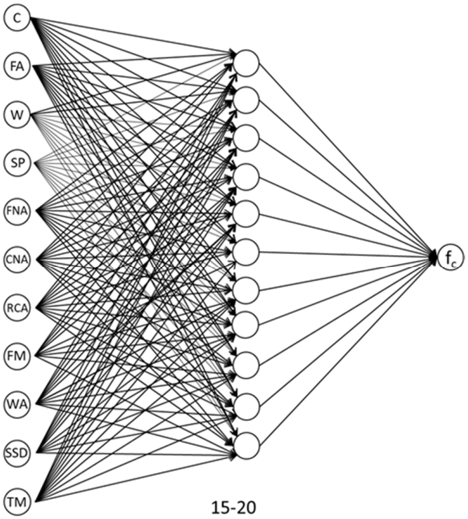
Most regulations only allow the use of the coarse fraction of recycled concrete aggregate (RCA) for the manufacture of new concrete, although the heterogeneity of RCA makes it difficult to predict the compressive strength of concrete, which is an obstacle to the incorporation of RCA in concrete production. The compressive strength of recycled aggregate concrete is closely related to the dosage of its constituents. This article proposes a novel artificial neural network (ANN) model to predict the 28-day compressive strength of recycled aggregate concrete. The ANN used in this work has 11 neurons in the input layer: the mass of cement, fly ash, water, superplasticizer, fine natural aggregate, coarse natural or recycled aggregate, and their properties, such as: sand fineness modulus of sand, water absorption capacity, saturated surface dry density of the coarse aggregate mix and the maximum particle size. Two training methods were used for the ANN combining 15 and 20 hidden layers: Levenberg–Marquardt (LM) and Bayesian Regularization (BR). A database with 177 mixes selected from 15 studies incorporating RCA were selected, with the aim of having an underlying set of data heterogeneous enough to demonstrate the efficiency of the proposed approach, even when data are heterogeneous and noisy, which is the main finding of this work.
Overview
CoChat Summary
TL;DR
The paper proposes an 11-input artificial neural network to predict 28-day compressive strength of recycled aggregate concrete using 177 mixes from 15 studies. Bayesian Regularization with 20 hidden layers performed best, with MAE 1.58, RMSE 2.34, and R All 0.98526, outperforming LM variants and classical regression methods.
Key findings
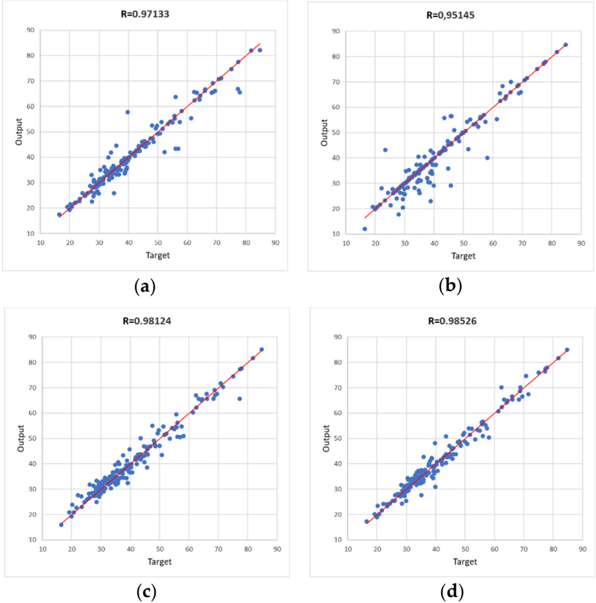
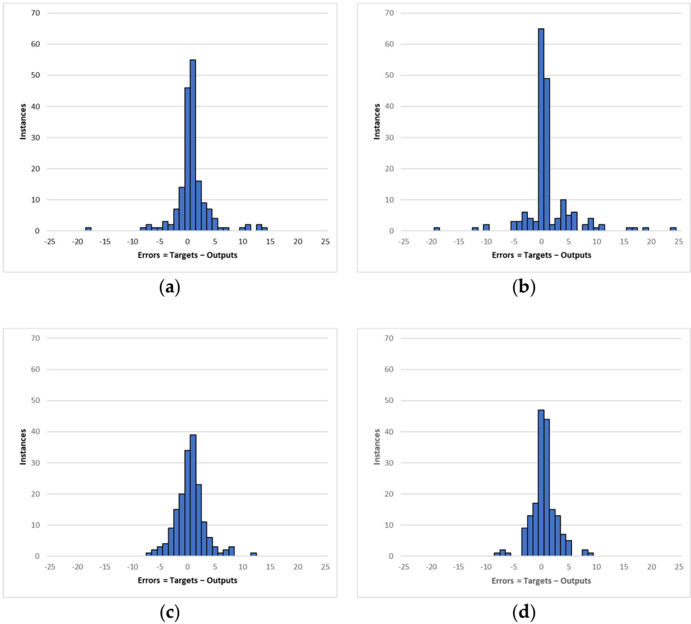
- BR-20 was best for all calculated metrics: MAE 1.58, Std. Dev. 2.35, MAPE 4.12, RMSE 2.34, R Training 0.98999, R All 0.98526; 170 of 177 predictions (96.05%) fell within −3 to +5 units of target data.
- Other ANN trainings: BR-15 had MAE 1.87, RMSE 2.64, R All 0.98124; LM-15 had MAE 1.79, RMSE 3.27, R All 0.97133; LM-20 had MAE 2.20, RMSE 4.50, R All 0.95145.
- ANN outperformed GPR (MAE 2.793, RMSE 3.5018, R All 0.9487), SVM (MAE 2.8591, RMSE 3.5099, R All 0.9487), and LR (MAE 3.1391, RMSE 3.6435, R All 0.9434).
- Simplified ANNs were worse than the complete ANN; removing maximum particle size (TM) gave similar results (MAE 1.72, RMSE 2.37, R All 0.98486), but the authors state this difference was not enough to simplify the model substantially.
Methods
- Database: 177 concrete mixes selected from 15 studies incorporating RCA; the only output was 28-day compressive strength, and all results were converted into equivalent 15 × 30 cm cylindrical compressive strength.
- ANN: 11 input neurons (cement, fly ash, water, superplasticizer, fine natural aggregate, coarse natural or recycled aggregate, fineness modulus of fine natural aggregate, water absorption, saturated surface dry density, maximum particle size) and 1 output neuron; four trainings combined 15 and 20 hidden layers with Levenberg-Marquardt (LM) and Bayesian Regularization (BR); data were split into 123 training (70%), 27 validation (15%), and 27 testing (15%) datapoints.
- Analysis: MAE, standard deviation, MAPE, RMSE, and R²; compared with Gaussian Process Regression (Matern 5/2), Support-Vector Machines, and Linear Regression; simplified ANNs tested by unifying cement + fly ash, removing superplasticizer, removing fineness modulus, and removing maximum particle size.
Limitations
- Stated limitations: Not stated in the paper.
- Evident from text: The model is built from a heterogeneous and noisy literature database of 177 mixes from 15 studies, with only 28-day compressive strength as output and no independent new experimental validation reported; simplified ANN tests show removing inputs generally worsens accuracy, and eliminating TM only gives similar results without substantially simplifying the model.
Model-written summary. Check it against the paper before relying on it.
Integrity signals
Registry
Cites
Statistics
Figures
Verification
Claims the paper makes
0 Valid · 2 Not valid · 16 Not checked · 82 Own results and interpretations
A result the paper reports from its own data — it cites no other source for it, so there is none to check. The quote shows it is in the paper.
In the paper
“| SVM | 2.8591 | 3.5099 | 0.9487 |”
§ A Novel Artificial Neural Network to Predict Compressive Strength of Recycled Aggregate Concrete > 4. Conclusions
plainstates an association- Asserted: passes — The authors put it forward as true.
- Checkable: passes — It can be checked against evidence.
- Load-bearing: unclear — It is unclear whether the paper’s conclusions depend on it.
- Based: passes — The paper gives a reason why it holds.
A result the paper reports from its own data — it cites no other source for it, so there is none to check. The quote shows it is in the paper.
In the paper
“In all the new cases tested, the results are worse than those obtained with the complete ANN.”
§ A Novel Artificial Neural Network to Predict Compressive Strength of Recycled Aggregate Concrete > 3. Results and Discussion
plain- Asserted: passes — The authors put it forward as true.
- Checkable: passes — It can be checked against evidence.
- Load-bearing: passes — The paper’s conclusions depend on it.
- Based: passes — The paper gives a reason why it holds.
A result the paper reports from its own data — it cites no other source for it, so there is none to check. The quote shows it is in the paper.
In the paper
“| GPR | 2.793 | 3.5018 | 0.9487 |”
§ A Novel Artificial Neural Network to Predict Compressive Strength of Recycled Aggregate Concrete > 4. Conclusions
plain- Asserted: passes — The authors put it forward as true.
- Checkable: passes — It can be checked against evidence.
- Load-bearing: unclear — It is unclear whether the paper’s conclusions depend on it.
- Based: passes — The paper gives a reason why it holds.
A result the paper reports from its own data — it cites no other source for it, so there is none to check. The quote shows it is in the paper.
In the paper
“| BR-20 | 1.58 | 2.35 | 4.12 | 2.34 | 0.98999 | 0.98526 |”
§ A Novel Artificial Neural Network to Predict Compressive Strength of Recycled Aggregate Concrete > 4. Conclusions
plain- Asserted: passes — The authors put it forward as true.
- Checkable: passes — It can be checked against evidence.
- Load-bearing: passes — The paper’s conclusions depend on it.
- Based: passes — The paper gives a reason why it holds.
A result the paper reports from its own data — it cites no other source for it, so there is none to check. The quote shows it is in the paper.
In the paper
“| LM-15 | 1.79 | 3.26 | 4.46 | 3.27 | 0.99618 | 0.97133 |”
§ A Novel Artificial Neural Network to Predict Compressive Strength of Recycled Aggregate Concrete > 4. Conclusions
plain- Asserted: passes — The authors put it forward as true.
- Checkable: passes — It can be checked against evidence.
- Load-bearing: passes — The paper’s conclusions depend on it.
- Based: passes — The paper gives a reason why it holds.
73 more claims
Create a free account to see all 100 claims and to verify the 17 references still open.
- It may state two separate claims as one. 8
- Probably not a substantial claim. 18
Self-check
Percentages, sums and reported differences re-computed from the paper’s own numbers.
Each contradiction between two passages listed here was confirmed by an independent check.
Rated minor: it would not touch a result — a value no result rests on, a p-value that stays on the same side of the significance level, or a conflict that is clerical, resolved elsewhere in the paper, or outside its own findings.
In the paper
§ A Novel Artificial Neural Network to Predict Compressive Strength of Recycled Aggregate Concrete > 3. Results and Discussion
“The test carried out with 20 hidden layers and Bayesian Regularization training method has been shown to be the best for all the metrics calculated.”
§ A Novel Artificial Neural Network to Predict Compressive Strength of Recycled Aggregate Concrete > 4. Conclusions
“| LM-20 | 2.20 | 4.45 | 6.11 | 4.50 | 0.99734 | 0.95145 | | BR-15 | 1.87 | 2.65 | 4.95 | 2.64 | 0.98895 | 0.98124 | | BR-20 | 1.58 | 2.35 | 4.12 | 2.34 | 0.98999 | 0.98526 |”
Citations
Cites
Study on the influence of attached mortar content on the properties of recycled concrete aggregate
de Juan, M. S., & Gutiérrez, P. A. (2009) · Construction and Building Materials · doi:10.1016/j.conbuildmat.2008.04.012 · Cited by 1,109
Poon, C. S., Shui, Z. H., & Lam, L. (2004) · Construction and Building Materials · doi:10.1016/j.conbuildmat.2004.03.005 · Cited by 1,053
Poon, C. S., Shui, Z. H., Lam, L., Fok, H., & Kou, S. C. (2004) · Cement and Concrete Research · doi:10.1016/s0008-8846(03)00186-8 · Cited by 915
Durability of recycled aggregate concrete – A review
Guo, H., Shi, C., Guan, X., Zhu, J., Ding, Y., Ling, T.-C., Zhang, H., & Wang, Y. (2018) · Cement and Concrete Composites · doi:10.1016/j.cemconcomp.2018.03.008 · Cited by 829
Use of recycled concrete aggregate in high-strength concrete
Limbachiya, M. C., Leelawat, T., & Dhir, R. K. (2000) · Materials and Structures · doi:10.1007/bf02480538 · Cited by 714
Influence of recycled aggregates on mechanical properties of HS/HPC
Ajdukiewicz, A., & Kliszczewicz, A. (2002) · Cement and Concrete Composites · doi:10.1016/s0958-9465(01)00012-9 · Cited by 678
Kou, S.-C., Poon, C.-S., & Agrela, F. (2011) · Cement and Concrete Composites · doi:10.1016/j.cemconcomp.2011.05.009 · Cited by 667
Bayesian Regularization of Neural Networks
Burden, F., & Winkler, D. (2008) · Methods in Molecular Biology™ · doi:10.1007/978-1-60327-101-1_3 · Cited by 621
Neural network design for engineering applications
Rafiq, M. Y., Bugmann, G., & Easterbrook, D. J. (2001) · Computers & Structures · doi:10.1016/s0045-7949(01)00039-6 · Cited by 587
Poon, C.-S., Azhar, S., Anson, M., & Wong, Y.-L. (2001) · Cement and Concrete Research · doi:10.1016/s0008-8846(01)00580-4 · Cited by 521
Research works printed but not linked: 1
- Bonopera, M.; Chang, K.C. Elastic modulus of prestressed and reinforced concrete beams in Taiwan under dynamic flexural loading. J. Chin. Inst. Civ. Hydraul. Eng. 2021, 33, 83-92. [CrossRef]
Cited by
Gao, Y. N., Wang, J., & Xu, X. (2024) · Automation in Construction · doi:10.1016/j.autcon.2024.105380 · Cited by 138
Beskopylny, A. N., Stel’makh, S. A., Shcherban’, E. M., Маилян, Л. Р., Meskhi, B., Razveeva, I., Chernil'nik, A. A., & Beskopylny, N. (2022) · Applied Sciences · doi:10.3390/app122110864 · Cited by 131
Nguyen, T.-D., Cherif, R., Mahieux, P.-Y., Lux, J., Aït‐Mokhtar, A., & Bastidas‐Arteaga, E. (2023) · Journal of Building Engineering · doi:10.1016/j.jobe.2023.105929 · Cited by 94
Data-driven multicollinearity-aware multi-objective optimisation of green concrete mixes
Shamsabadi, E. A., Salehpour, M., Zandifaez, P., & Dias‐da‐Costa, D. (2023) · Journal of Cleaner Production · doi:10.1016/j.jclepro.2023.136103 · Cited by 82
de‐Prado‐Gil, J., Martínez‐García, R., Jagadesh, P., Juan-Valdés, A., Alonso, M. I. G., & Palencia, C. (2023) · Ain Shams Engineering Journal · doi:10.1016/j.asej.2023.102548 · Cited by 55
de‐Prado‐Gil, J., Palencia, C., Jagadesh, P., & Martínez‐García, R. (2022) · Materials · doi:10.3390/ma15155232 · Cited by 42
Stel’makh, S. A., Shcherban’, E. M., Beskopylny, A. N., Маилян, Л. Р., Meskhi, B., Razveeva, I., Kozhakin, A., & Beskopylny, N. (2022) · Materials · doi:10.3390/ma15196740 · Cited by 35
de‐Prado‐Gil, J., Zaid, O., Palencia, C., & Martínez‐García, R. (2022) · Mathematics · doi:10.3390/math10132245 · Cited by 32
Kumari, P., Paruthi, S., Alyaseen, A., Khan, A. H., & Jijja, A. (2024) · Cleaner Materials · doi:10.1016/j.clema.2024.100263 · Cited by 28
Strength and self-healing behavior of bacteria biocomposite concrete in soil exposure condition
Rajesh, A., & Sumathi, A. (2023) · Structures · doi:10.1016/j.istruc.2023.105673 · Cited by 27
Accelerated Carbonation of Vibro-Compacted Porous Concrete for Eco-Friendly Precast Elements
Merino-Lechuga, A. M., González-Caro, Á., Ledesma, E. F., Jiménez, J. R., Fernández, J. M., & Suescum-Morales, D. (2023) · Materials · doi:10.3390/ma16082995 · Cited by 26
Self-citationLiu, X., Jing, H., & Yan, P. (2023) · Journal of Cleaner Production · doi:10.1016/j.jclepro.2023.136660 · Cited by 25
Das, P., Kashem, A. M., Rahat, J. U., & Karim, R. (2024) · Multiscale and Multidisciplinary Modeling Experiments and Design · doi:10.1007/s41939-024-00409-3 · Cited by 16
Fereidouni, P., Seyedkazemi, A., Kutanaei, S. S., & Davoudi‐Kia, A. (2025) · Results in Engineering · doi:10.1016/j.rineng.2025.104891 · Cited by 15
Development of Bio-healing Fiber Composite Concrete at Different Curing Conditions
Rajesh, A., & Sumathi, A. (2024) · Arabian Journal for Science and Engineering · doi:10.1007/s13369-023-08622-x · Cited by 14
Badesire, P. C., Cesare, N. D., Vu, X. H., & Bishweka, C. (2025) · Materials Today Communications · doi:10.1016/j.mtcomm.2025.114219 · Cited by 12
A Bayesian Network Framework to Predict Compressive Strength of Recycled Aggregate Concrete
Nguyen, T.-D., Cherif, R., Mahieux, P.-Y., & Bastidas‐Arteaga, E. (2025) · Journal of Composites Science · doi:10.3390/jcs9020072 · Cited by 12
Jabar, A. B., & Pradeep, T. (2023) · Matéria (Rio de Janeiro) · doi:10.1590/1517-7076-rmat-2023-0102 · Cited by 12
Nikmehr, B., Kafle, B., & Al-Ameri, R. (2024) · Recycling · doi:10.3390/recycling9050073 · Cited by 11
da Silva, S. R., Borges, P. M., Tošić, N. D., & Andrade, J. J. D. O. (2026) · Sustainability · doi:10.3390/su18062759 · Cited by 10
Multiple AI predictive models for compressive strength of recycled aggregate concrete
Ebid, A. M., Ulloa, N. A., Onyelowe, K. C., Rodríguez, M., Andrade-Valle, A. I., & Villacrés, A. N. Z. (2024) · Cogent Engineering · doi:10.1080/23311916.2024.2385621 · Cited by 10
Daniel, C. (2025) · Australian Journal of Structural Engineering · doi:10.1080/13287982.2025.2471714 · Cited by 6
Çağlar, H. (2026) · Scientific Reports · doi:10.1038/s41598-026-47921-9 · Cited by 5
Cheng, M., & Khasani, R. R. (2024) · Construction and Building Materials · doi:10.1016/j.conbuildmat.2024.137482 · Cited by 5
Kojic, N. S., & Milošević, B. (2026) · Technologies · doi:10.3390/technologies14080474 · Cited by 4
Use of artificial intelligence to predict the performance of recycled aggregate concrete
Nguyen, T.-D., Cherif, R., Mahieux, P.-Y., Lux, J., & Bastidas‐Arteaga, E. (2025) · Elsevier eBooks · doi:10.1016/b978-0-443-23962-5.00017-7 · Cited by 4
Optimization of recycled aggregate concrete mix using design of experiments and machine learning
Badesire, P. C., Cesare, N. D., Vu, X. H., & Bishweka, C. (2025) · Innovative Infrastructure Solutions · doi:10.1007/s41062-025-02175-8 · Cited by 4
Anbazhagan, R., Elakkiya, K., & Sumathi, A. (2026) · Innovative Infrastructure Solutions · doi:10.1007/s41062-026-02696-w · Cited by 3
ALTUNCI, Y. T. (2025) · Processes · doi:10.3390/pr13072130 · Cited by 3
Tipu, R. K., & Paruthi, S. (2026) · Iranian Journal of Science and Technology Transactions of Civil Engineering · doi:10.1007/s40996-026-02188-y · Cited by 2
Nguyen, T.-D. (2024) · theses.fr (ABES) · doi:10.70675/a7460281ze130z4e60z90f5zbdc0bdc4e8b7 · Cited by 1
Ajir, K., Toufigh, V., & Ghaemian, M. (2026) · Journal of Testing and Evaluation · doi:10.1520/jte20240256 · Cited by 1
Prediction of Compressive Strength of Recycled Aggregate Concrete Using Hybrid Decision Tree Models
Wang, C. (2024) · Applied Mathematics and Nonlinear Sciences · doi:10.2478/amns-2024-3554 · Cited by 1
Efficient Method for Creep Behavior of Recycled Aggregate Concrete using CEMDN-CNN and LSTM
Dandale, M. N., Raju, V. B., Kumar, A., Sarode, G. C., Sekhar, S. C., & Lakineni, P. K. (2025) · International Conference on Data Science and Information System (ICDSIS) · doi:10.1109/icdsis65355.2025.11070760 · Cited by 1
Milošević, B., Kojic, N. S., & Kragović, M. (2026) · Journal of Composites Science · doi:10.3390/jcs10080379
Gil, J. D. P. (2023) · Buleria (Universidad de León) · doi:10.18002/10612/16696
de Freitas, L. G. M. L., & Galio, A. F. (2024) · OBSERVATÓRIO DE LA ECONOMÍA LATINOAMERICANA · doi:10.55905/oelv22n10-071
Zhang, C., Tang, Y., & Fu, H. (2026) · Scientific Reports · doi:10.1038/s41598-026-68942-4
Gil, J. D. P., Martínez‐García, R., Baladrón-Blanco, V., Palencia, C., Gutiérrez-Rodriguez, P., Lozano-Arias, J., Fernández-Órdas, J. F., & Fraile-Fernández, F. J. (2025) · Journal of Advanced Research in Computing and Applications. · doi:10.37934/arca.38.1.1222
AKINTUNDE, O. P., Snyman, J., Ackerman, C. E., & Kupolati, W. K. (2025) · Research on Engineering Structures and Materials · doi:10.17515/resm2025-1218ma1006rv
Metadata
- Authors
- Suescum-Morales, D., Salas-Morera, L., Jiménez, J. R., & García-Hernández, L.
- Affiliations
- University of Córdoba (ES)
- Área de Proyectos de Ingeniería, Escuela Politécnica Superior de Córdoba, Campus de Rabanales, Universidad de Córdoba, 14071 Córdoba, Spain
- Venue
- Applied Sciences
- Publisher
- MDPI AG
- Published
- 2021-11-22
- Volume
- 11
- Issue
- 22
- Pages
- 11077
- ISSN
- 2076-3417 (ISSN-L)
- OpenAlex
- W3215223608
- Cited by
- 40
- References
- 54
- Citations by year
- 2026: 8 · 2025: 10 · 2024: 10 · 2023: 8 · 2022: 4
- FWCI
- 2.31
- Type
- journal article
- Language
- en
- Open access
- gold
- doi.org
- Licence
- Locations
- Applied Sciences (publishedVersion, cc-by)
- DOAJ (DOAJ: Directory of Open Access Journals) (submittedVersion)
- Universidad de Córdoba Insitutional Repository (Universidad de Córdoba) (submittedVersion, cc-by)
- Funders
- Ministerio de Educación, Cultura y Deporte
- Topics
- Physical Sciences › Engineering › Building and Construction › Recycled Aggregate Concrete Performance
- Physical Sciences › Engineering › Civil and Structural Engineering › Innovative concrete reinforcement materials
- Physical Sciences › Engineering › Civil and Structural Engineering › Concrete and Cement Materials Research
- Keywords
- recycled aggregate concrete, recycled concrete aggregate, compressive strength prediction, artificial neural networks, 28-day compressive strength, Levenberg-Marquardt training, Bayesian regularization, water absorption capacity, concrete mix design
About these checks
Registry, retraction, Cites and statistics results are computed, not judged, with one exception: a printed reference that no index lists is read once by a model before it counts as a citation error. Claims are extracted by a model and kept only when their quote appears verbatim in the text; each cited source is then checked, with a model’s help, for whether it says what the claim relies on. Those verdicts can be wrong — read the claim’s quote and the cited source before relying on one.
A language model drew the claims from the paper on 2026-11-27, under version 3 of the claim definition (model deepseek-v4.1-flash, prompt extract-v3).
A second model labelled each claim on 2026-11-27 (model jev-1.13-20260917, definition revision gold-guideline-v0.2).
Statistics and arithmetic are recomputed, not judged.
Confidence bands are shown only for fields calibrated on our annotated test set. None is calibrated yet, so no band is shown.
What counts as a claim ›How we measure confidence ›How we check this ›
Are you an author, or do you see a problem with this page? Request a review
Data sources
Bibliographic data: Semantic Scholar, OpenAlex, Crossref.
Contains information from the Semantic Scholar Academic Graph Datasets, made available under the ODC Attribution License (ODC-BY 1.0).
Semantic Scholar’s data is described in: Kinney, R., et al. (2023). The Semantic Scholar Open Data Platform. arXiv:2301.10140.
