

A Novel Artificial Neural Network to Predict Compressive Strength of Recycled Aggregate Concrete
Open accessThe DOI matches its Crossref record; 54 of the 54 references it cites were found in a registry or an index; none of the 17 sources its claims cite is checked for support yet.
Abstract
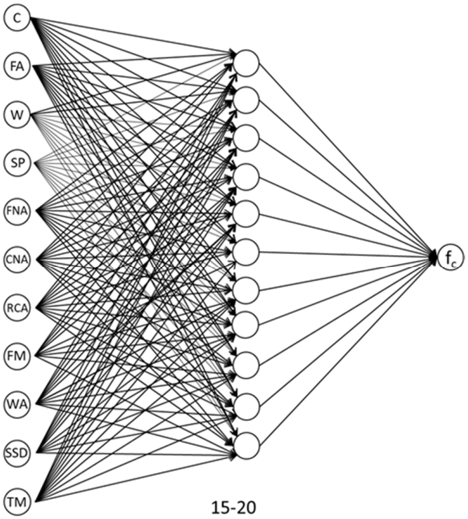
Most regulations only allow the use of the coarse fraction of recycled concrete aggregate (RCA) for the manufacture of new concrete, although the heterogeneity of RCA makes it difficult to predict the compressive strength of concrete, which is an obstacle to the incorporation of RCA in concrete production. The compressive strength of recycled aggregate concrete is closely related to the dosage of its constituents. This article proposes a novel artificial neural network (ANN) model to predict the 28-day compressive strength of recycled aggregate concrete. The ANN used in this work has 11 neurons in the input layer: the mass of cement, fly ash, water, superplasticizer, fine natural aggregate, coarse natural or recycled aggregate, and their properties, such as: sand fineness modulus of sand, water absorption capacity, saturated surface dry density of the coarse aggregate mix and the maximum particle size. Two training methods were used for the ANN combining 15 and 20 hidden layers: Levenberg–Marquardt (LM) and Bayesian Regularization (BR). A database with 177 mixes selected from 15 studies incorporating RCA were selected, with the aim of having an underlying set of data heterogeneous enough to demonstrate the efficiency of the proposed approach, even when data are heterogeneous and noisy, which is the main finding of this work.
Overview
CoChat Summary
TL;DR
The paper proposes an 11-input artificial neural network to predict 28-day compressive strength of recycled aggregate concrete using 177 mixes from 15 studies. Bayesian Regularization with 20 hidden layers performed best, with MAE 1.58, RMSE 2.34, and R All 0.98526, outperforming LM variants and classical regression methods.
Key findings
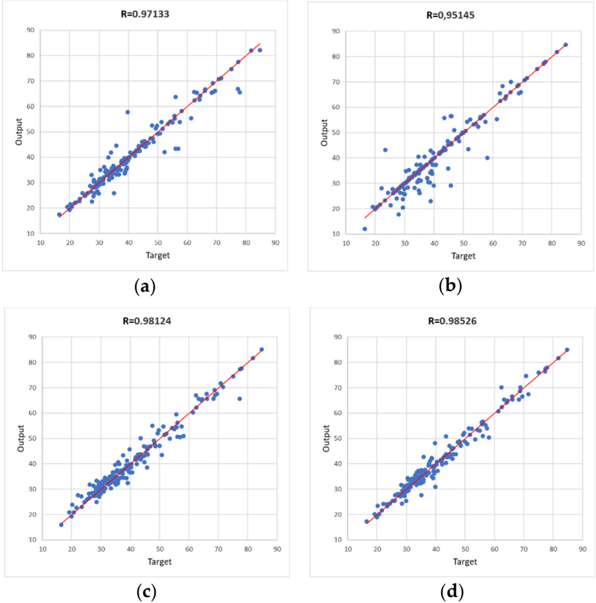
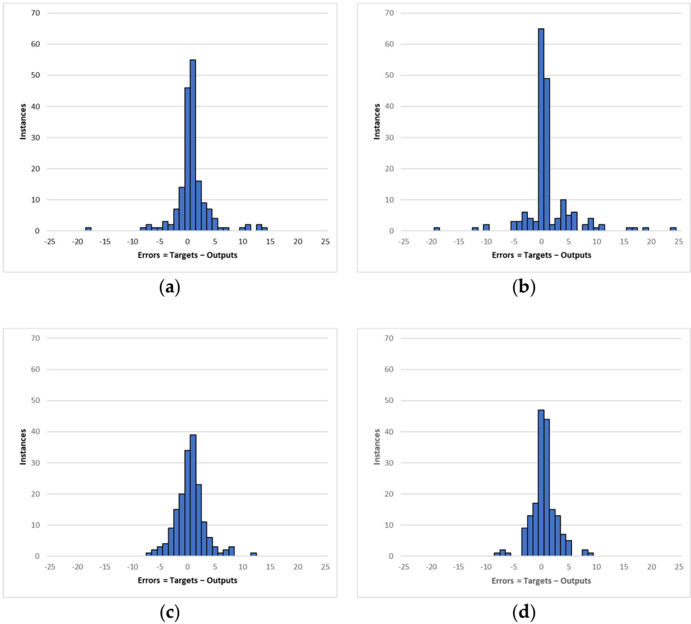
- BR-20 was best for all calculated metrics: MAE 1.58, Std. Dev. 2.35, MAPE 4.12, RMSE 2.34, R Training 0.98999, R All 0.98526; 170 of 177 predictions (96.05%) fell within −3 to +5 units of target data.
- Other ANN trainings: BR-15 had MAE 1.87, RMSE 2.64, R All 0.98124; LM-15 had MAE 1.79, RMSE 3.27, R All 0.97133; LM-20 had MAE 2.20, RMSE 4.50, R All 0.95145.
- ANN outperformed GPR (MAE 2.793, RMSE 3.5018, R All 0.9487), SVM (MAE 2.8591, RMSE 3.5099, R All 0.9487), and LR (MAE 3.1391, RMSE 3.6435, R All 0.9434).
- Simplified ANNs were worse than the complete ANN; removing maximum particle size (TM) gave similar results (MAE 1.72, RMSE 2.37, R All 0.98486), but the authors state this difference was not enough to simplify the model substantially.
Methods
- Database: 177 concrete mixes selected from 15 studies incorporating RCA; the only output was 28-day compressive strength, and all results were converted into equivalent 15 × 30 cm cylindrical compressive strength.
- ANN: 11 input neurons (cement, fly ash, water, superplasticizer, fine natural aggregate, coarse natural or recycled aggregate, fineness modulus of fine natural aggregate, water absorption, saturated surface dry density, maximum particle size) and 1 output neuron; four trainings combined 15 and 20 hidden layers with Levenberg-Marquardt (LM) and Bayesian Regularization (BR); data were split into 123 training (70%), 27 validation (15%), and 27 testing (15%) datapoints.
- Analysis: MAE, standard deviation, MAPE, RMSE, and R²; compared with Gaussian Process Regression (Matern 5/2), Support-Vector Machines, and Linear Regression; simplified ANNs tested by unifying cement + fly ash, removing superplasticizer, removing fineness modulus, and removing maximum particle size.
Limitations
- Stated limitations: Not stated in the paper.
- Evident from text: The model is built from a heterogeneous and noisy literature database of 177 mixes from 15 studies, with only 28-day compressive strength as output and no independent new experimental validation reported; simplified ANN tests show removing inputs generally worsens accuracy, and eliminating TM only gives similar results without substantially simplifying the model.
Model-written summary. Check it against the paper before relying on it.
Integrity signals
Registry
Cites
Statistics
Figures
Verification
Claims the paper makes
0 Valid · 2 Not valid · 16 Not checked · 82 Own results and interpretations
A result the paper reports from its own data — it cites no other source for it, so there is none to check. The quote shows it is in the paper.
In the paper
“| SVM | 2.8591 | 3.5099 | 0.9487 |”
§ A Novel Artificial Neural Network to Predict Compressive Strength of Recycled Aggregate Concrete > 4. Conclusions
plainstates an association- Asserted: passes — The authors put it forward as true.
- Checkable: passes — It can be checked against evidence.
- Load-bearing: unclear — It is unclear whether the paper’s conclusions depend on it.
- Based: passes — The paper gives a reason why it holds.
A result the paper reports from its own data — it cites no other source for it, so there is none to check. The quote shows it is in the paper.
In the paper
“In all the new cases tested, the results are worse than those obtained with the complete ANN.”
§ A Novel Artificial Neural Network to Predict Compressive Strength of Recycled Aggregate Concrete > 3. Results and Discussion
plain- Asserted: passes — The authors put it forward as true.
- Checkable: passes — It can be checked against evidence.
- Load-bearing: passes — The paper’s conclusions depend on it.
- Based: passes — The paper gives a reason why it holds.
A result the paper reports from its own data — it cites no other source for it, so there is none to check. The quote shows it is in the paper.
In the paper
“| GPR | 2.793 | 3.5018 | 0.9487 |”
§ A Novel Artificial Neural Network to Predict Compressive Strength of Recycled Aggregate Concrete > 4. Conclusions
plain- Asserted: passes — The authors put it forward as true.
- Checkable: passes — It can be checked against evidence.
- Load-bearing: unclear — It is unclear whether the paper’s conclusions depend on it.
- Based: passes — The paper gives a reason why it holds.
A result the paper reports from its own data — it cites no other source for it, so there is none to check. The quote shows it is in the paper.
In the paper
“| BR-20 | 1.58 | 2.35 | 4.12 | 2.34 | 0.98999 | 0.98526 |”
§ A Novel Artificial Neural Network to Predict Compressive Strength of Recycled Aggregate Concrete > 4. Conclusions
plain- Asserted: passes — The authors put it forward as true.
- Checkable: passes — It can be checked against evidence.
- Load-bearing: passes — The paper’s conclusions depend on it.
- Based: passes — The paper gives a reason why it holds.
A result the paper reports from its own data — it cites no other source for it, so there is none to check. The quote shows it is in the paper.
In the paper
“| LM-15 | 1.79 | 3.26 | 4.46 | 3.27 | 0.99618 | 0.97133 |”
§ A Novel Artificial Neural Network to Predict Compressive Strength of Recycled Aggregate Concrete > 4. Conclusions
plain- Asserted: passes — The authors put it forward as true.
- Checkable: passes — It can be checked against evidence.
- Load-bearing: passes — The paper’s conclusions depend on it.
- Based: passes — The paper gives a reason why it holds.
73 more claims
Create a free account to see all 100 claims and to verify the 17 references still open.
- It may state two separate claims as one. 8
- Probably not a substantial claim. 18
Self-check
Percentages, sums and reported differences re-computed from the paper’s own numbers.
Each contradiction between two passages listed here was confirmed by an independent check.
Rated minor: it would not touch a result — a value no result rests on, a p-value that stays on the same side of the significance level, or a conflict that is clerical, resolved elsewhere in the paper, or outside its own findings.
In the paper
§ A Novel Artificial Neural Network to Predict Compressive Strength of Recycled Aggregate Concrete > 3. Results and Discussion
“The test carried out with 20 hidden layers and Bayesian Regularization training method has been shown to be the best for all the metrics calculated.”
§ A Novel Artificial Neural Network to Predict Compressive Strength of Recycled Aggregate Concrete > 4. Conclusions
“| LM-20 | 2.20 | 4.45 | 6.11 | 4.50 | 0.99734 | 0.95145 | | BR-15 | 1.87 | 2.65 | 4.95 | 2.64 | 0.98895 | 0.98124 | | BR-20 | 1.58 | 2.35 | 4.12 | 2.34 | 0.98999 | 0.98526 |”
Citations
Cites
Study on the influence of attached mortar content on the properties of recycled concrete aggregate
de Juan, M. S., & Gutiérrez, P. A. (2009) · Construction and Building Materials · doi:10.1016/j.conbuildmat.2008.04.012 · Cited by 1,109
Poon, C. S., Shui, Z. H., & Lam, L. (2004) · Construction and Building Materials · doi:10.1016/j.conbuildmat.2004.03.005 · Cited by 1,053
Poon, C. S., Shui, Z. H., Lam, L., Fok, H., & Kou, S. C. (2004) · Cement and Concrete Research · doi:10.1016/s0008-8846(03)00186-8 · Cited by 915
Durability of recycled aggregate concrete – A review
Guo, H., Shi, C., Guan, X., Zhu, J., Ding, Y., Ling, T.-C., Zhang, H., & Wang, Y. (2018) · Cement and Concrete Composites · doi:10.1016/j.cemconcomp.2018.03.008 · Cited by 829
Use of recycled concrete aggregate in high-strength concrete
Limbachiya, M. C., Leelawat, T., & Dhir, R. K. (2000) · Materials and Structures · doi:10.1007/bf02480538 · Cited by 714
Influence of recycled aggregates on mechanical properties of HS/HPC
Ajdukiewicz, A., & Kliszczewicz, A. (2002) · Cement and Concrete Composites · doi:10.1016/s0958-9465(01)00012-9 · Cited by 678
Kou, S.-C., Poon, C.-S., & Agrela, F. (2011) · Cement and Concrete Composites · doi:10.1016/j.cemconcomp.2011.05.009 · Cited by 667
Bayesian Regularization of Neural Networks
Burden, F., & Winkler, D. (2008) · Methods in Molecular Biology™ · doi:10.1007/978-1-60327-101-1_3 · Cited by 621
Neural network design for engineering applications
Rafiq, M. Y., Bugmann, G., & Easterbrook, D. J. (2001) · Computers & Structures · doi:10.1016/s0045-7949(01)00039-6 · Cited by 587
Poon, C.-S., Azhar, S., Anson, M., & Wong, Y.-L. (2001) · Cement and Concrete Research · doi:10.1016/s0008-8846(01)00580-4 · Cited by 521
Prediction of compressive strength of recycled aggregate concrete using artificial neural networks
Duan, Z. H., Kou, S. C., & Poon, C. S. (2013) · Construction and Building Materials · doi:10.1016/j.conbuildmat.2012.04.063 · Cited by 509
Influence of Fly Ash as Cement Replacement on the Properties of Recycled Aggregate Concrete
Kou, S. C., Poon, C. S., & Chan, D. (2007) · Journal of Materials in Civil Engineering · doi:10.1061/(asce)0899-1561(2007)19:9(709 · Cited by 494
Life-cycle inventory analysis of concrete production: A critical review
Petek Gursel, A., Masanet, E., Horvath, A., & Stadel, A. (2014) · Cement and Concrete Composites · doi:10.1016/j.cemconcomp.2014.03.005 · Cited by 451
Strength and durability of concrete containing recycled concrete aggregates
Thomas, J., Thaickavil, N. N., & Wilson, P. M. (2018) · Journal of Building Engineering · doi:10.1016/j.jobe.2018.05.007 · Cited by 445
A study on high strength concrete prepared with large volumes of low calcium fly ash
Poon, C. S., Lam, L., & Wong, Y. L. (2000) · Cement and Concrete Research · doi:10.1016/s0008-8846(99)00271-9 · Cited by 410
Gholampour, A., Gandomi, A. H., & Ozbakkaloglu, T. (2016) · Construction and Building Materials · doi:10.1016/j.conbuildmat.2016.10.114 · Cited by 380
The influence of the use of recycled aggregates on the compressive strength of concrete: a review
Silva, R. V., de Brito, J., & Dhir, R. K. (2015) · European Journal of Environmental and Civil Engineering · doi:10.1080/19648189.2014.974831 · Cited by 366
Effect of Fly Ash and Silica Fume on Compressive and Fracture Behaviors of Concrete
Lam, L., Wong, Y. L., & Poon, C. S. (1998) · Cement and Concrete Research · doi:10.1016/s0008-8846(97)00269-x · Cited by 329
Özcan, F., Atiş, C. D., Karahan, O., Uncuoğlu, E., & Tanyıldızı, H. (2009) · Advances in Engineering Software · doi:10.1016/j.advengsoft.2009.01.005 · Cited by 309
RILEM Technical Committee TC-242-MDC (Zdeněk P. Bažant, C. (2015) · Materials and Structures · doi:10.1617/s11527-014-0485-2 · Cited by 304
Influence of recycled aggregate on slump and bleeding of fresh concrete
Poon, C. S., Kou, S.-C., & Lam, L. (2006) · Materials and Structures · doi:10.1617/s11527-006-9192-y · Cited by 266
Concrete with fine recycled aggregates: a review
Evangelista, L., & de Brito, J. (2014) · European Journal of Environmental and Civil Engineering · doi:10.1080/19648189.2013.851038 · Cited by 253
Tam, V. W. Y., Soomro, M., & Evangelista, A. C. J. (2021) · Construction and Building Materials · doi:10.1016/j.conbuildmat.2021.123066 · Cited by 233
Physical properties and mechanical behaviour of concrete made with recycled aggregates and fly ash
Lima, C., Caggiano, A., Faella, C., Martinelli, E., Pepe, M., & Realfonzo, R. (2013) · Construction and Building Materials · doi:10.1016/j.conbuildmat.2013.04.051 · Cited by 231
Cartuxo, F., de Brito, J., Evangelista, L., Jiménez, J. R., & Ledesma, E. F. (2015) · Construction and Building Materials · doi:10.1016/j.conbuildmat.2015.03.119 · Cited by 230
Self-citationChopra, P., Sharma, R. K., & Kumar, M. (2016) · Advances in Materials Science and Engineering · doi:10.1155/2016/7648467 · Cited by 205
Moradi, M. J., Khaleghi, M., Salimi, J., Farhangi, V., & Ramezanianpour, A. M. (2021) · Measurement · doi:10.1016/j.measurement.2021.109790 · Cited by 199
Lippiatt, N., Ling, T.-C., & Pan, S.-Y. (2020) · Journal of Building Engineering · doi:10.1016/j.jobe.2019.101062 · Cited by 189
Sarıdemir, M. (2009) · Advances in Engineering Software · doi:10.1016/j.advengsoft.2008.12.008 · Cited by 175
Kou, S.-C., & Poon, C. S. (2008) · Magazine of Concrete Research · doi:10.1680/macr.2007.00052 · Cited by 166
Multi-criteria optimization of recycled aggregate concrete mixes
Rashid, K., Rehman, M. U., de Brito, J., & Ghafoor, H. (2020) · Journal of Cleaner Production · doi:10.1016/j.jclepro.2020.124316 · Cited by 146
Castelli, M., Vanneschi, L., & Silva, S. (2013) · Expert Systems with Applications · doi:10.1016/j.eswa.2013.06.037 · Cited by 145
Nazari, A., & Riahi, S. (2011) · Materials Science and Engineering: A · doi:10.1016/j.msea.2010.11.070 · Cited by 120
González-Taboada, I., González-Fonteboa, B., Martínez-Abella, F., & Pérez-Ordóñez, J. L. (2016) · Construction and Building Materials · doi:10.1016/j.conbuildmat.2015.12.136 · Cited by 118
Development of a new ecological concrete with CO2 emissions below zero
Higuchi, T., Morioka, M., YOSHIOKA, I., & Yokozeki, K. (2014) · Construction and Building Materials · doi:10.1016/j.conbuildmat.2014.01.029 · Cited by 117
An ANN Model for Predicting the Compressive Strength of Concrete
Lin, C.-J., & Wu, N.-J. (2021) · Applied Sciences · doi:10.3390/app11093798 · Cited by 92
Congro, M., Monteiro, V. M. D. A., Brandão, A. L. T., dos Santos, B. F., Roehl, D. D. M., & Silva, F. D. A. (2021) · Construction and Building Materials · doi:10.1016/j.conbuildmat.2021.124502 · Cited by 84
Prediction model for compressive strength of basic concrete mixture using artificial neural networks
Kostić, S., & Vasović, D. (2014) · Neural Computing and Applications · doi:10.1007/s00521-014-1763-1 · Cited by 82
Gandomi, A. H., Alavi, A. H., Kazemi, S., & Gandomi, M. (2014) · Automation in Construction · doi:10.1016/j.autcon.2014.02.007 · Cited by 80
Suescum-Morales, D., Kalinowska-Wichrowska, K., Fernández, J. M., & Jiménez, J. R. (2021) · Journal of CO2 Utilization · doi:10.1016/j.jcou.2021.101461 · Cited by 66
Self-citationSarıdemir, M. (2013) · Materials & Design (1980-2015) · doi:10.1016/j.matdes.2013.10.073 · Cited by 64
Duan, S., Liao, H., Ma, Z., Cheng, F., Li, F., Gao, H., & Yang, H. (2018) · Construction and Building Materials · doi:10.1016/j.conbuildmat.2018.08.035 · Cited by 62
Gandomi, A. H., Alavi, A. H., Gandomi, M., & Kazemi, S. (2016) · Measurement · doi:10.1016/j.measurement.2016.10.024 · Cited by 51
Matar, P., & Barhoun, J. (2020) · Journal of Building Engineering · doi:10.1016/j.jobe.2020.101521 · Cited by 46
Nazari, A. (2012) · Materials & Design (1980-2015) · doi:10.1016/j.matdes.2012.07.012 · Cited by 41
Pore size distribution of high performance metakaolin concrete
Poon, C. S., Kou, S.-C., & Lam, L. (2002) · Journal of Wuhan University of Technology-Mater Sci Ed · doi:10.1007/bf02852633 · Cited by 38
Deterioration and Recovery of Metakaolin Blended Concrete Subjected to High Temperature
Poon, C. S., & Azhar, S. (2003) · Fire Technology · doi:10.1023/a:1021775110075 · Cited by 34
A feasibility study on the utilization of r-FA in SCC
Poon, C. S., & Ho, D. W. S. (2004) · Cement and Concrete Research · doi:10.1016/j.cemconres.2004.02.013 · Cited by 34
Effect of a Time Dependent Concrete Modulus of Elasticity on Prestress Losses in Bridge Girders
Singh, B. P., Yazdani, N., & Ramírez, G. (2013) · International Journal of Concrete Structures and Materials · doi:10.1007/s40069-013-0037-0 · Cited by 30
Real-scale applications of recycled aggregate concrete
Silva, R. V., Jiménez, J. R., Agrela, F., & de Brito, J. (2018) · Elsevier eBooks · doi:10.1016/b978-0-08-102480-5.00021-x · Cited by 28
Self-citationSHRINKAGE & MODULUS OF ELASTICITY IN CONCRETE WITH RECYCLED AGGREGATES
Schoppe, B. M. (2011) · DigitalCommons - CalPoly (California State Polytechnic University) · doi:10.15368/theses.2011.62 · Cited by 25
Patil, S. V., Balakrishna Rao, K., & Nayak, G. (2023) · Journal of Engineering, Design and Technology · doi:10.1108/jedt-07-2021-0373 · Cited by 21
Kou, S.-C., & Poon, C. S. (2012) · PolyU Institutional Research Archive (Hong Kong Polytechnic University) · Cited by 13
Agrela, F., Alaejos, P., Thomas, C., Rueda, J., Silva, R. V., Moreno-Juez, J., Sanjuán, M. A., de Brito, J., & Sánchez de Rojas, M. I. (2021) · Waste and Byproducts in Cement-Based Materials · doi:10.1016/b978-0-12-820549-5.00001-2 · Cited by 5
Research works printed but not linked: 1
- Bonopera, M.; Chang, K.C. Elastic modulus of prestressed and reinforced concrete beams in Taiwan under dynamic flexural loading. J. Chin. Inst. Civ. Hydraul. Eng. 2021, 33, 83-92. [CrossRef]
Cited by
Gao, Y. N., Wang, J., & Xu, X. (2024) · Automation in Construction · doi:10.1016/j.autcon.2024.105380 · Cited by 138
Beskopylny, A. N., Stel’makh, S. A., Shcherban’, E. M., Маилян, Л. Р., Meskhi, B., Razveeva, I., Chernil'nik, A. A., & Beskopylny, N. (2022) · Applied Sciences · doi:10.3390/app122110864 · Cited by 131
Nguyen, T.-D., Cherif, R., Mahieux, P.-Y., Lux, J., Aït‐Mokhtar, A., & Bastidas‐Arteaga, E. (2023) · Journal of Building Engineering · doi:10.1016/j.jobe.2023.105929 · Cited by 94
Data-driven multicollinearity-aware multi-objective optimisation of green concrete mixes
Shamsabadi, E. A., Salehpour, M., Zandifaez, P., & Dias‐da‐Costa, D. (2023) · Journal of Cleaner Production · doi:10.1016/j.jclepro.2023.136103 · Cited by 82
de‐Prado‐Gil, J., Martínez‐García, R., Jagadesh, P., Juan-Valdés, A., Alonso, M. I. G., & Palencia, C. (2023) · Ain Shams Engineering Journal · doi:10.1016/j.asej.2023.102548 · Cited by 55
Metadata
- Authors
- Suescum-Morales, D., Salas-Morera, L., Jiménez, J. R., & García-Hernández, L.
- Affiliations
- University of Córdoba (ES)
- Área de Proyectos de Ingeniería, Escuela Politécnica Superior de Córdoba, Campus de Rabanales, Universidad de Córdoba, 14071 Córdoba, Spain
- Venue
- Applied Sciences
- Publisher
- MDPI AG
- Published
- 2021-11-22
- Volume
- 11
- Issue
- 22
- Pages
- 11077
- ISSN
- 2076-3417 (ISSN-L)
- OpenAlex
- W3215223608
- Cited by
- 40
- References
- 54
- Citations by year
- 2026: 8 · 2025: 10 · 2024: 10 · 2023: 8 · 2022: 4
- FWCI
- 2.31
- Type
- journal article
- Language
- en
- Open access
- gold
- doi.org
- Licence
- Locations
- Applied Sciences (publishedVersion, cc-by)
- DOAJ (DOAJ: Directory of Open Access Journals) (submittedVersion)
- Universidad de Córdoba Insitutional Repository (Universidad de Córdoba) (submittedVersion, cc-by)
- Funders
- Ministerio de Educación, Cultura y Deporte
- Topics
- Physical Sciences › Engineering › Building and Construction › Recycled Aggregate Concrete Performance
- Physical Sciences › Engineering › Civil and Structural Engineering › Innovative concrete reinforcement materials
- Physical Sciences › Engineering › Civil and Structural Engineering › Concrete and Cement Materials Research
- Keywords
- recycled aggregate concrete, recycled concrete aggregate, compressive strength prediction, artificial neural networks, 28-day compressive strength, Levenberg-Marquardt training, Bayesian regularization, water absorption capacity, concrete mix design
About these checks
Registry, retraction, Cites and statistics results are computed, not judged, with one exception: a printed reference that no index lists is read once by a model before it counts as a citation error. Claims are extracted by a model and kept only when their quote appears verbatim in the text; each cited source is then checked, with a model’s help, for whether it says what the claim relies on. Those verdicts can be wrong — read the claim’s quote and the cited source before relying on one.
A language model drew the claims from the paper on 2026-11-27, under version 3 of the claim definition (model deepseek-v4.1-flash, prompt extract-v3).
A second model labelled each claim on 2026-11-27 (model jev-1.13-20260917, definition revision gold-guideline-v0.2).
Statistics and arithmetic are recomputed, not judged.
Confidence bands are shown only for fields calibrated on our annotated test set. None is calibrated yet, so no band is shown.
What counts as a claim ›How we measure confidence ›How we check this ›
Are you an author, or do you see a problem with this page? Request a review
Data sources
Bibliographic data: Semantic Scholar, OpenAlex, Crossref.
Contains information from the Semantic Scholar Academic Graph Datasets, made available under the ODC Attribution License (ODC-BY 1.0).
Semantic Scholar’s data is described in: Kinney, R., et al. (2023). The Semantic Scholar Open Data Platform. arXiv:2301.10140.
