

A Generic Automated Surface Defect Detection Based on a Bilinear Model
Open accessThe DOI matches its Crossref record; 32 of the 33 references it cites were found in a registry or an index.
Abstract
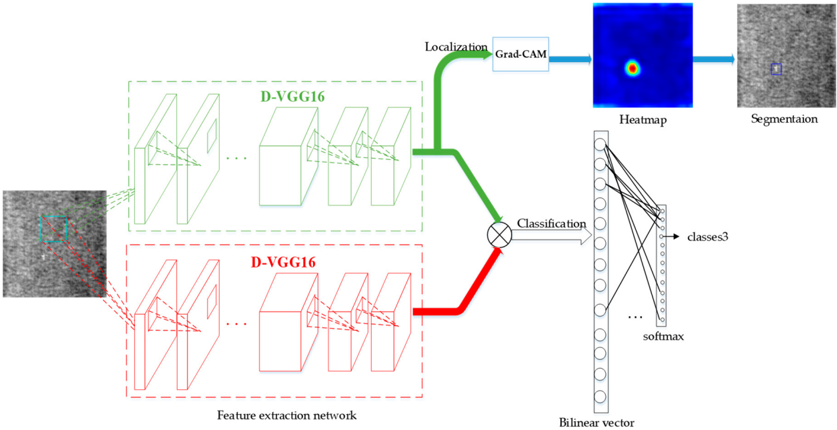
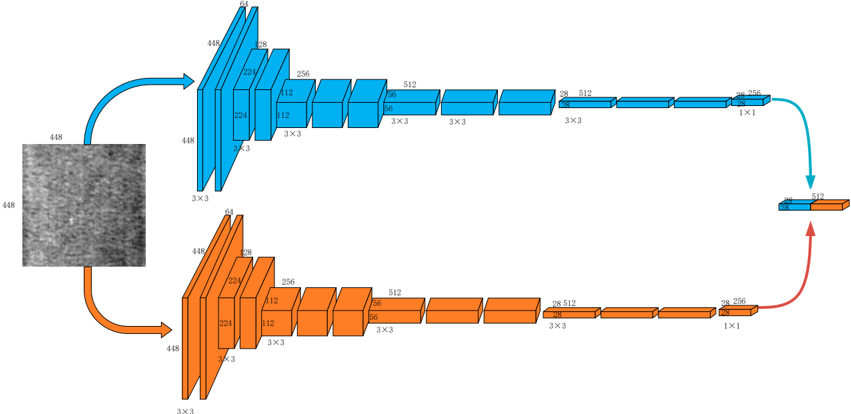
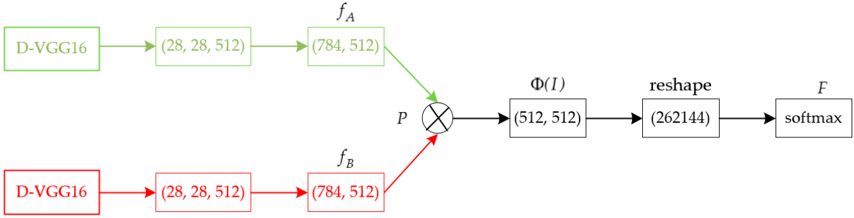
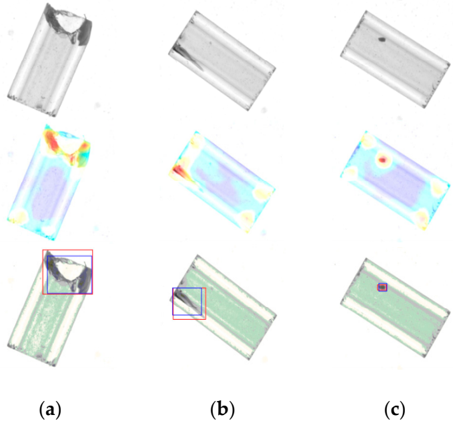
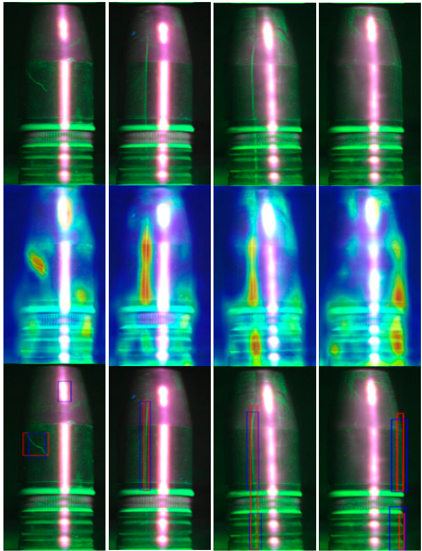
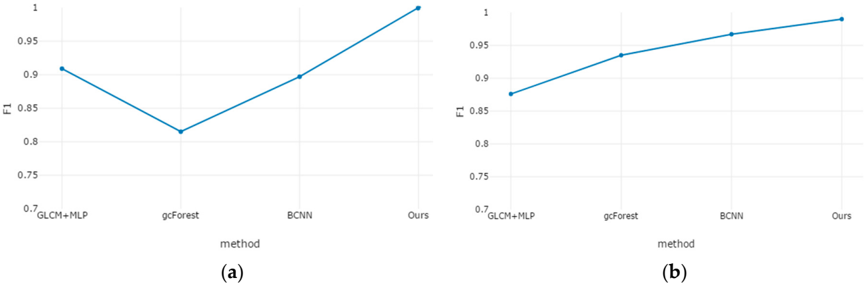
Aiming at the problems of complex texture, variable interference factors and large sample acquisition in surface defect detection, a generic method of automated surface defect detection based on a bilinear model was proposed. To realize the automatic classification and localization of surface defects, a new Double-Visual Geometry Group16 (D-VGG16) is firstly designed as feature functions of the bilinear model. The global and local features fully extracted from the bilinear model by D-VGG16 are output to the soft-max function to realize the automatic classification of surface defects. Then the heat map of the original image is obtained by applying Gradient-weighted Class Activation Mapping (Grad-CAM) to the output features of D-VGG16. Finally, the defects in the original input image can be located automatically after processing the heat map with a threshold segmentation method. The training process of the proposed method is characterized by a small sample, end-to-end, and is weakly-supervised. Furthermore, experiments are performed on two public and two industrial datasets, which have different defective features in texture, shape and color. The results show that the proposed method can simultaneously realize the classification and localization of defects with different defective features. The average precision of the proposed method is above 99% on the four datasets, and is higher than the known latest algorithms.
Overview
The claims and statistics of this paper haven’t been checked yet.
Free: it reads the open-access text and checks the first 5 claims that cite a source we can check. Create a free account to check every claim.
Integrity signals
Registry
Cites
Statistics
Figures

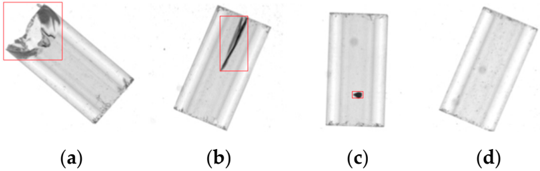
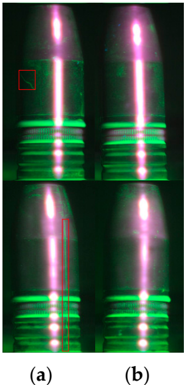
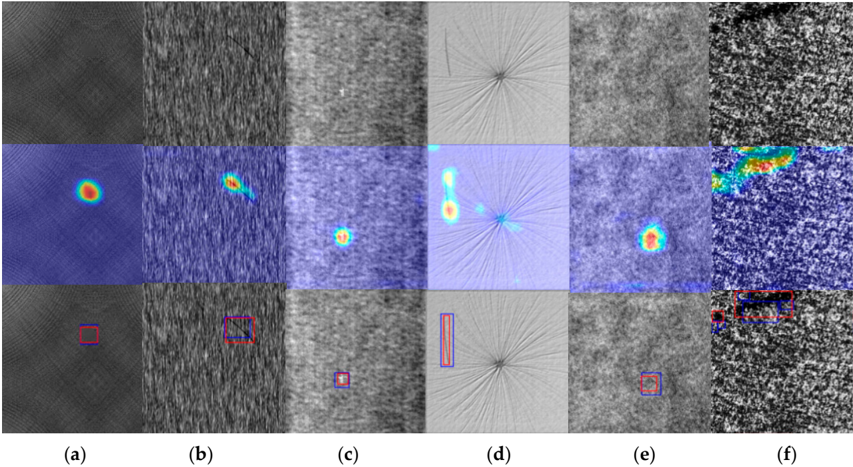
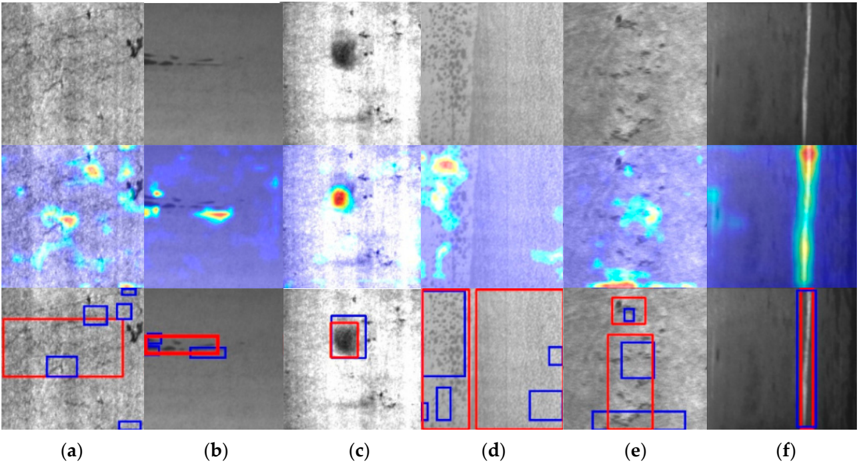
Verification
Claims the paper makes
The claims and statistics of this paper haven’t been checked yet.
Free: it reads the open-access text and checks the first 5 claims that cite a source we can check. Create a free account to check every claim.
Self-check
Percentages, sums and reported differences re-computed from the paper’s own numbers.
The self-check needs the paper’s full text.
Citations
Cites
Very Deep Convolutional Networks for Large-Scale Image Recognition
Simonyan, K., & Zisserman, A. (2014) · arXiv · doi:10.48550/arxiv.1409.1556 · Cited by 114,148
Adam: A Method for Stochastic Optimization
Kingma, D. P., & Ba, J. (2014) · arXiv · doi:10.48550/arxiv.1412.6980 · Cited by 98,946
Faster R-CNN: Towards Real-Time Object Detection with Region Proposal Networks
Ren, S., He, K., Girshick, R., & Sun, J. (2017) · IEEE Transactions on Pattern Analysis and Machine Intelligence · doi:10.1109/tpami.2016.2577031 · Cited by 73,472
Faster R-CNN: Towards Real-Time Object Detection with Region Proposal Networks
Ren, S., He, K., Girshick, R., & Sun, J. (2015) · arXiv · doi:10.48550/arxiv.1506.01497 · Cited by 70,812
ImageNet: A large-scale hierarchical image database
Deng, J., Dong, W., Socher, R., Li, L.-J., Li, K., & Fei-Fei, L. (2009) · 2009 IEEE Conference on Computer Vision and Pattern Recognition · doi:10.1109/cvpr.2009.5206848 · Cited by 65,333
A Threshold Selection Method from Gray-Level Histograms
Otsu, N. (1979) · IEEE Transactions on Systems, Man, and Cybernetics · doi:10.1109/tsmc.1979.4310076 · Cited by 43,398
(2016) · Cited by 31,590
Grad-CAM: Visual Explanations from Deep Networks via Gradient-Based Localization
Selvaraju, R. R., Cogswell, M., Das, A., Vedantam, R., Parikh, D., & Batra, D. (2017) · 2017 IEEE International Conference on Computer Vision (ICCV) · doi:10.1109/iccv.2017.74 · Cited by 24,513
SSD: Single Shot MultiBox Detector
Liu, W., Anguelov, D., Erhan, D., Szegedy, C., Reed, S., Fu, C.-Y., & Berg, A. C. (2016) · Lecture Notes in Computer Science · doi:10.1007/978-3-319-46448-0_2 · Cited by 22,128
Multiresolution gray-scale and rotation invariant texture classification with local binary patterns
Ojala, T., Pietikainen, M., & Maenpaa, T. (2002) · IEEE Transactions on Pattern Analysis and Machine Intelligence · doi:10.1109/tpami.2002.1017623 · Cited by 15,398
Research works printed but not linked: 5
- Santoyo, 2019, Reconocimiento de patrones y evaluación del daño generado en aceros de baja aleación a partir del procesamiento digital de imágenes e inteligencia artificial, DYNA Ing. Ind., 94, 357
- Lin, M., Chen, Q., and Yan, S. (2013, January 2–4). Network in network. Proceedings of the International Conference on Learning Representations (ICLR), Scottsdale, AZ, USA.
- Yosinski, J., Clune, J., Bengio, Y., and Lipson, H. How transferable are features in deep neural networks? In Proceedings of the Advances in Neural Information Processing Systems, Montreal, QC, Canada, 8–13 December 2014; pp.
- Ostu, 1975, A threshold selection method from gray-histogram, IEEE Trans. Syst. Man Cybern., 9, 62
- Song, 2014, Automatic recognition of surface defects on hot-rolled steel strip using scattering convolution network, J. Comput. Inf. Syst., 10, 3049
Cited by
Automated Visual Defect Detection for Flat Steel Surface: A Survey
Luo, Q., Fang, X., Liu, L., Yang, C., & Sun, Y. (2020) · IEEE Transactions on Instrumentation and Measurement · doi:10.1109/tim.2019.2963555 · Cited by 559
Deep CNN-based visual defect detection: Survey of current literature
Jha, S. B., & Babiceanu, R. F. (2023) · Computers in Industry · doi:10.1016/j.compind.2023.103911 · Cited by 224
Steel Surface Defect Recognition: A Survey
Wen, X., Shan, J., He, Y., & Song, K. (2022) · Coatings · doi:10.3390/coatings13010017 · Cited by 210
Research Progress of Automated Visual Surface Defect Detection for Industrial Metal Planar Materials
Fang, X., Luo, Q., Zhou, B., Li, C., & Tian, L. (2020) · Sensors · doi:10.3390/s20185136 · Cited by 160
A lightweight detector based on attention mechanism for aluminum strip surface defect detection
Ma, Z., Li, Y., Huang, M., Huang, Q., Cheng, J., & Tang, S. Y. (2021) · Computers in Industry · doi:10.1016/j.compind.2021.103585 · Cited by 131
Metadata
- Authors
- Zhou, F., Liu, G., Xu, F., & Deng, H.
- Affiliations
- Southwest University of Science and Technology (CN)
- Corresponding author
- Liu, Guihua
- Venue
- Applied Sciences
- Publisher
- MDPI AG
- Published
- 2019-08-03
- Volume
- 9
- Issue
- 15
- Pages
- 3159
- ISSN
- 2076-3417 (ISSN-L)
- OpenAlex
- W2965258271
- Semantic Scholar
- 08b361036d68c16a57a1b17e0d623ef10a02d4ee
- Cited by
- 47
- References
- 33
- Citations by year
- 2026: 2 · 2025: 4 · 2024: 7 · 2023: 7 · 2022: 8 · 2021: 10 · 2020: 8 · 2019: 1
- FWCI
- 4.98
- Type
- journal article
- Language
- en
- Open access
- gold
- dx.doi.org
- Licence
- Locations
- Applied Sciences (publishedVersion, cc-by)
- DOAJ (DOAJ: Directory of Open Access Journals) (submittedVersion)
- Funders
- National Natural Science Foundation of China (11602292, 61701421, 61601381)
- Topics
- Physical Sciences › Engineering › Industrial and Manufacturing Engineering › Industrial Vision Systems and Defect Detection
- Physical Sciences › Engineering › Mechanical Engineering › Non-Destructive Testing Techniques
- Physical Sciences › Engineering › Civil and Structural Engineering › Infrastructure Maintenance and Monitoring
- Keywords
- surface defect detection, bilinear model, Grad-CAM, heatmaps, defect localization, defect classification, weakly supervised learning, end-to-end learning, thresholding, industrial inspection
About these checks
Registry, retraction, Cites and statistics results are computed, not judged, with one exception: a printed reference that no index lists is read once by a model before it counts as a citation error. Claims are extracted by a model and kept only when their quote appears verbatim in the text; each cited source is then checked, with a model’s help, for whether it says what the claim relies on. Those verdicts can be wrong — read the claim’s quote and the cited source before relying on one.
Statistics and arithmetic are recomputed, not judged.
Confidence bands are shown only for fields calibrated on our annotated test set. None is calibrated yet, so no band is shown.
What counts as a claim ›How we measure confidence ›How we check this ›
Are you an author, or do you see a problem with this page? Request a review
How to cite
Cite CoChat for the checks on this page, and the paper for its own findings.
- This page
- CoChat. (2026). Citation check: A Generic Automated Surface Defect Detection Based on a Bilinear Model. https://app.cochat.ai/papers/10.3390/app9153159
- The paper
- Zhou, F., Liu, G., Xu, F., & Deng, H. (2019). A Generic Automated Surface Defect Detection Based on a Bilinear Model. Applied Sciences. https://doi.org/10.3390/app9153159
Data sources
Bibliographic data: Semantic Scholar, OpenAlex, Crossref.
Contains information from the Semantic Scholar Academic Graph Datasets, made available under the ODC Attribution License (ODC-BY 1.0).
Semantic Scholar’s data is described in: Kinney, R., et al. (2023). The Semantic Scholar Open Data Platform. arXiv:2301.10140.
