

Online State of Health Estimation of Lithium-Ion Batteries Based on Charging Process and Long Short-Term Memory Recurrent Neural Network
Open accessThe DOI matches its Crossref record; 38 of the 38 references it cites were found in a registry or an index.
Abstract
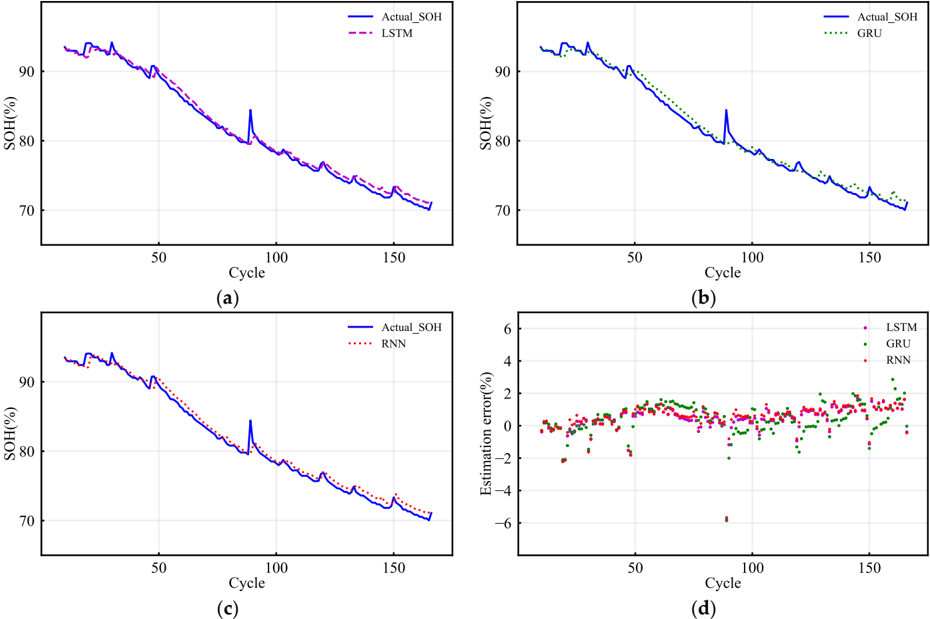
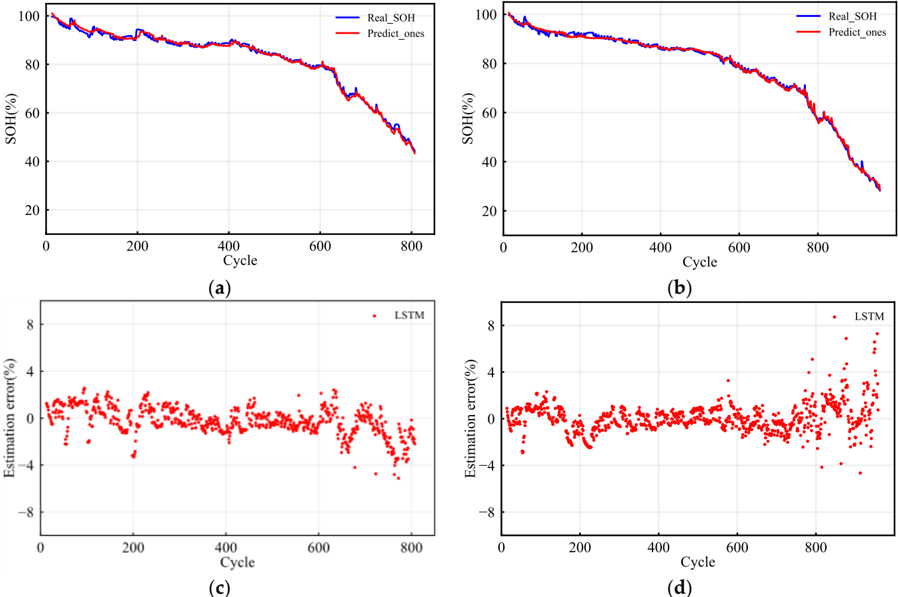
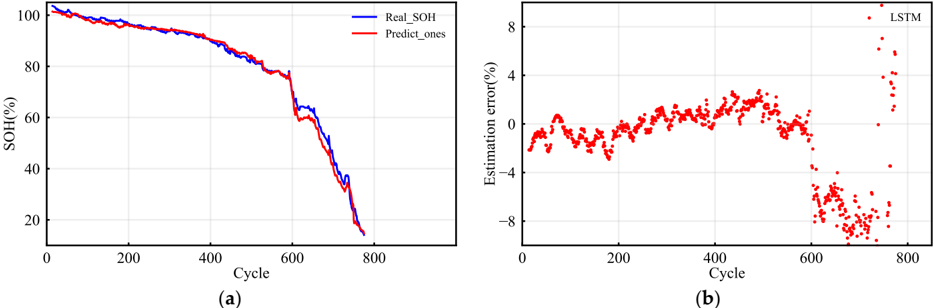
Accurate state of health (SOH) estimation is critical to the operation, maintenance, and replacement of lithium-ion batteries (LIBs), which have penetrated almost every aspect of our life. This paper introduces a new approach to accurately estimate the SOH for rechargeable lithium-ion batteries based on the corresponding charging process and long short-term memory recurrent neural network (LSTM-RNN). In order to learn the mapping function without employing battery models and filtering techniques, the LSTM-RNN is initially fed into the health indicators (HIs) extracted from the charging process and trained to encode the dependencies of the related data sequence. Subsequently, the trained LSTM-RNN can properly estimate online SOHs of LIBs using extracted HIs. We experiment on two public datasets for model construction, validation, and comparison. Conclusively, the trained LSTM-RNN achieves an overall root mean square error (RMSE) lower than 1% on the cases with the same discharging current rate and an RMSE of 1.1198% above 80% SOH on another testing case that underwent a different discharging current rate.
Overview
The claims and statistics of this paper haven’t been checked yet.
Free: it reads the open-access text and checks the first 5 claims that cite a source we can check. Create a free account to check every claim.
Integrity signals
Registry
Cites
Statistics
Figures
Verification
Claims the paper makes
The claims and statistics of this paper haven’t been checked yet.
Free: it reads the open-access text and checks the first 5 claims that cite a source we can check. Create a free account to check every claim.
Claims other papers make about this one
Each is checked against this paper’s own text: does it say what the citing paper says it does?
The source backs part of the claim, not all of it — or backs it for a different population, condition or comparison.
In the citing paper
“The direct capacity measurement method (the remaining capacity measurement) for SOH estimation is one of the most straightforward and most accurate methods if the battery's current is measured accurately to count the columns and if the measurements are performed under a controlled set of parameters, such as temperature.”
From An Electrochemical Impedance Spectrum-Based State of Health Differential Indicator with Reduced Sensitivity to Measurement Errors for Lithium–Ion Batteries (2024) · cites this paper as [5]
Experimental — accuracy not yet measured
Self-check
Percentages, sums and reported differences re-computed from the paper’s own numbers.
The self-check needs the paper’s full text.
Citations
Cites
Adam: A Method for Stochastic Optimization
Kingma, D. P., & Ba, J. (2014) · arXiv · doi:10.48550/arxiv.1412.6980 · Cited by 98,946
On the difficulty of training recurrent neural networks
Pascanu, R., Mikolov, T., & Bengio, Y. (2012) · arXiv · doi:10.48550/arxiv.1211.5063 · Cited by 4,310
Understanding LSTM -- a tutorial into Long Short-Term Memory Recurrent Neural NetworksPreprint
Staudemeyer, R. C., & Morris, E. R. (2019) · arXiv (Cornell University) · doi:10.48550/arxiv.1909.09586 · Cited by 1,687
Ng, K. S., Moo, C.-S., Chen, Y.-P., & Hsieh, Y.-C. (2009) · Applied Energy · doi:10.1016/j.apenergy.2008.11.021 · Cited by 1,636
Jaguemont, J., Boulon, L., & Dubé, Y. (2016) · Applied Energy · doi:10.1016/j.apenergy.2015.11.034 · Cited by 1,188
He, W., Williard, N., Osterman, M., & Pecht, M. (2011) · Journal of Power Sources · doi:10.1016/j.jpowsour.2011.08.040 · Cited by 1,105
Battery Management System: An Overview of Its Application in the Smart Grid and Electric Vehicles
Rahimi-Eichi, H., Ojha, U., Baronti, F., & Chow, M.-Y. (2013) · IEEE Industrial Electronics Magazine · doi:10.1109/mie.2013.2250351 · Cited by 960
Han, X., Ouyang, M., Lu, L., Li, J., Zheng, Y., & Li, Z. (2014) · Journal of Power Sources · doi:10.1016/j.jpowsour.2013.11.029 · Cited by 822
A review on prognostics and health monitoring of Li-ion battery
Zhang, J., & Lee, J. (2011) · Journal of Power Sources · doi:10.1016/j.jpowsour.2011.03.101 · Cited by 792
A review on electric vehicle battery modelling: From Lithium-ion toward Lithium–Sulphur
Fotouhi, A., Auger, D. J., Propp, K., Longo, S., & Wild, M. (2016) · Renewable and Sustainable Energy Reviews · doi:10.1016/j.rser.2015.12.009 · Cited by 780
Gaussian process regression for forecasting battery state of health
Richardson, R. R., Osborne, M. A., & Howey, D. A. (2017) · Journal of Power Sources · doi:10.1016/j.jpowsour.2017.05.004 · Cited by 732
An ensemble model for predicting the remaining useful performance of lithium-ion batteries
Xing, Y., Ma, E. W. M., Tsui, K.-L., & Pecht, M. (2013) · Microelectronics Reliability · doi:10.1016/j.microrel.2012.12.003 · Cited by 673
Li, J., Adewuyi, K., Lotfi, N., Landers, R. G., & Park, J. (2018) · Applied Energy · doi:10.1016/j.apenergy.2018.01.011 · Cited by 623
Recent Advances in Recurrent Neural Networks
Salehinejad, H., Sankar, S., Barfett, J., Colak, E., & Valaee, S. (2017) · arXiv (Cornell University) · doi:10.48550/arxiv.1801.01078 · Cited by 562
Feng, X., Weng, C., He, X., Han, X., Lu, L., Ren, D., & Ouyang, M. (2019) · IEEE Transactions on Vehicular Technology · doi:10.1109/tvt.2019.2927120 · Cited by 505
Seaman, A., Dao, T.-S., & McPhee, J. (2014) · Journal of Power Sources · doi:10.1016/j.jpowsour.2014.01.057 · Cited by 453
Gaussian Process Regression for In Situ Capacity Estimation of Lithium-Ion Batteries
Richardson, R. R., Birkl, C. R., Osborne, M. A., & Howey, D. A. (2019) · IEEE Transactions on Industrial Informatics · doi:10.1109/tii.2018.2794997 · Cited by 407
Remmlinger, J., Buchholz, M., Meiler, M., Bernreuter, P., & Dietmayer, K. (2011) · Journal of Power Sources · doi:10.1016/j.jpowsour.2010.08.035 · Cited by 392
A fast estimation algorithm for lithium-ion battery state of health
Tang, X., Zou, C., Yao, K., Chen, G., Liu, B., He, Z., & Gao, F. (2018) · Journal of Power Sources · doi:10.1016/j.jpowsour.2018.06.036 · Cited by 336
Estimation of Battery State of Health Using Probabilistic Neural Network
Lin, H.-T., Liang, T.-J., & Chen, S.-M. (2013) · IEEE Transactions on Industrial Informatics · doi:10.1109/tii.2012.2222650 · Cited by 327
Guha, A., & Patra, A. (2018) · IEEE Transactions on Transportation Electrification · doi:10.1109/tte.2017.2776558 · Cited by 318
Liu, D., Zhou, J., Liao, H., Peng, Y., & Peng, X. (2015) · IEEE Transactions on Systems, Man, and Cybernetics: Systems · doi:10.1109/tsmc.2015.2389757 · Cited by 313
Xiong, R., Tian, J., Mu, H., & Wang, C. (2017) · Applied Energy · doi:10.1016/j.apenergy.2017.05.124 · Cited by 283
Bartlett, A., Marcicki, J., Onori, S., Rizzoni, G., Yang, X. G., & Miller, T. (2015) · IEEE Transactions on Control Systems Technology · doi:10.1109/tcst.2015.2446947 · Cited by 244
Prada, E., Di Domenico, D., Creff, Y., Bernard, J., Sauvant-Moynot, V., & Huet, F. (2013) · Journal of The Electrochemical Society · doi:10.1149/2.053304jes · Cited by 242
Choi, S., & Wang, G. (2018) · Advanced Materials Technologies · doi:10.1002/admt.201700376 · Cited by 214
Online State-of-Health Estimation of VRLA Batteries Using State of Charge
Shahriari, M., & Farrokhi, M. (2013) · IEEE Transactions on Industrial Electronics · doi:10.1109/tie.2012.2186771 · Cited by 190
Bi, J., Zhang, T., Yu, H., & Kang, Y. (2016) · Applied Energy · doi:10.1016/j.apenergy.2016.08.138 · Cited by 187
Yalçın, S., Panchal, S., & Herdem, M. S. (2022) · International Journal of Heat and Mass Transfer · doi:10.1016/j.ijheatmasstransfer.2022.123486 · Cited by 133
Xie, Y., Li, W., Hu, X., Tran, M., Panchal, S., Fowler, M. W., Zhang, Y., & Liu, K. (2022) · IEEE Transactions on Industrial Electronics · doi:10.1109/tie.2022.3199905 · Cited by 118
Self-citationZhao, L., Wang, Y., & Cheng, J. (2019) · Applied Sciences · doi:10.3390/app9091890 · Cited by 78
Kausthubharam, K., Koorata, P. K., Panchal, S., Fraser, R. A., & Fowler, M. W. (2022) · Journal of Energy Storage · doi:10.1016/j.est.2022.104908 · Cited by 60
Distance to empty soft sensor for ford escape electric vehicle
Sekhar, R., Shah, P., Panchal, S., Fowler, M. W., & Fraser, R. A. (2022) · Results in Control and Optimization · doi:10.1016/j.rico.2022.100168 · Cited by 60
Lin, H., Kang, L., Xie, D., Linghu, J., & Li, J. (2022) · Batteries · doi:10.3390/batteries8040029 · Cited by 54
Self-citationPhysics-Based SoH Estimation for Li-Ion Cells
Iurilli, P., Brivio, C., Carrillo, R. E., & Wood, V. C. (2022) · Batteries · doi:10.3390/batteries8110204 · Cited by 53
Ossai, C. I., & Raghavan, N. (2017) · Batteries · doi:10.3390/batteries3040032 · Cited by 23
Wang, J., Deng, Z., Li, J., Peng, K., Xu, L., Guan, G., & Abudula, A. (2022) · Batteries · doi:10.3390/batteries8100134 · Cited by 20
Online Identification of VLRA Battery Model Parameters Using Electrochemical Impedance Spectroscopy
Olarte, J., de Ilarduya, J. M., Zulueta, E., Ferret, R., Garcia-Ortega, J., & López-Guede, J. M. (2022) · Batteries · doi:10.3390/batteries8110238 · Cited by 12
Research works printed but not linked: 2
- Chaoran, L.; Fei, X.; Yaxiang, F. An approach to lithium-ion battery SOH estimation based on convolutional neural network. Trans. China Electrotech. Soc. 2020, 35, 4106-4119. [CrossRef]
- Liu, H.; Wang, P.; Cheng, Z. A Novel Method Based on Encoder-Decoder Framework for Li-Ion Battery State of Health Estimation. Proc. CSEE 2021, 5, 1851-1859. [CrossRef]
Cited by
Edge–cloud collaborative estimation lithium-ion battery SOH based on MEWOA-VMD and Transformer
Chen, Y., Huang, X., He, Y., Zhang, S., & Cai, Y. (2024) · Journal of Energy Storage · doi:10.1016/j.est.2024.113388 · Cited by 93
Liu, C., Li, H., Li, K., Wu, Y., & Lv, B. (2025) · Energies · doi:10.3390/en18061463 · Cited by 85
Zhou, J., Wang, S., Cao, W., Xie, Y., & Fernández, C. (2024) · Electrochimica Acta · doi:10.1016/j.electacta.2024.144146 · Cited by 74
Sylvestrin, G. R., Maciel, J. N., Amorim, M. L. M., Carmo, J. P., Afonso, J. A., Lopes, S. F., & Ando, O. H. (2025) · Energies · doi:10.3390/en18030746 · Cited by 75
Recent Progress of Deep Learning Methods for Health Monitoring of Lithium-Ion Batteries
Madani, S. S., Ziebert, C., Vahdatkhah, P., & Sadrnezhaad, S. K. (2024) · Batteries · doi:10.3390/batteries10060204 · Cited by 61
Metadata
- Authors
- Liu, K., Kang, L., & Xie, D.
- Affiliations
- South China University of Technology (CN)
- Corresponding author
- Liu, Kang
- Venue
- Batteries
- Publisher
- MDPI AG
- Published
- 2023-01-30
- Volume
- 9
- Issue
- 2
- Pages
- 94
- ISSN
- 2313-0105 (ISSN-L)
- OpenAlex
- W4318499316
- Cited by
- 45
- References
- 35
- Citations by year
- 2026: 12 · 2025: 10 · 2024: 18 · 2023: 5
- FWCI
- 3.27
- Type
- journal article
- Language
- en
- Open access
- gold
- doi.org
- Licence
- Locations
- Batteries (publishedVersion, cc-by)
- DOAJ (DOAJ: Directory of Open Access Journals) (submittedVersion, cc-by-sa)
- Funders
- Guangdong Basic and Applied Basic Research Foundation (2022A1515140009)
- Topics
- Physical Sciences › Engineering › Automotive Engineering › Battery Modeling and Management
- Physical Sciences › Engineering › Electrical and Electronic Engineering › Advancements in Battery Materials
- Physical Sciences › Engineering › Control and Systems Engineering › Control Systems and Identification
- Keywords
- lithium-ion batteries, state of health estimation, charging process, long short-term memory, recurrent neural networks, health indicators, battery degradation, model-free estimation
About these checks
Registry, retraction, Cites and statistics results are computed, not judged, with one exception: a printed reference that no index lists is read once by a model before it counts as a citation error. Claims are extracted by a model and kept only when their quote appears verbatim in the text; each cited source is then checked, with a model’s help, for whether it says what the claim relies on. Those verdicts can be wrong — read the claim’s quote and the cited source before relying on one.
Statistics and arithmetic are recomputed, not judged.
Confidence bands are shown only for fields calibrated on our annotated test set. None is calibrated yet, so no band is shown.
What counts as a claim ›How we measure confidence ›How we check this ›
Are you an author, or do you see a problem with this page? Request a review
Data sources
Bibliographic data: Semantic Scholar, OpenAlex, Crossref.
Contains information from the Semantic Scholar Academic Graph Datasets, made available under the ODC Attribution License (ODC-BY 1.0).
Semantic Scholar’s data is described in: Kinney, R., et al. (2023). The Semantic Scholar Open Data Platform. arXiv:2301.10140.
