

Effects of Tai-Chi and Running Exercises on Cardiorespiratory Fitness and Biomarkers in Sedentary Middle-Aged Males: A 24-Week Supervised Training Study
Open accessThe DOI matches its Crossref record; 39 of the 39 references it cites were found in a registry or an index; none of the 40 sources its claims cite is checked for support yet.
Abstract
This study examined the effectiveness of Tai-Chi and running exercises on cardiorespiratory fitness and biomarkers in sedentary middle-aged adults under 24 weeks of supervised training. Methods Thirty-six healthy middle-aged adults (55.6 ± 5.3 yr) were randomly assigned into Tai-Chi, running and control groups. During a 24-week training period, the Tai-Chi and running groups were asked to perform exercises for 60 min/day and 5 days/week, which were supervised by Tai-Chi and running instructors throughout. Resting heart rate, lean mass, blood pressure and blood lipids were measured, and cardiorespiratory fitness (VO2max, Vmax and Peak heart rate) was assessed at the baseline and the 12- and 24-week interventions. Results Compared to the no-exercise control group, both the Tai-Chi and running groups significantly decreased resting heart rate, diastolic blood pressure and cardiorespiratory fitness and increased lean mass across the training session (p < 0.05). Compared to the Tai-Chi group, the running group showed greater improvement in VO2max and Vmax (p < 0.05) and reduced triglyceride and low-density lipoprotein cholesterol (p < 0.05). Conclusion Both Tai-Chi and running exercise showed beneficial effects on cardiorespiratory fitness and enhanced health-related outcomes in middle-aged adults. Although Tai-Chi exercises were less effective in VO2max than running, Tai-Chi may be considered as a plausible alternative to running exercises that can be achieved in the indoor-based setting.
Overview
CoChat Summary
TL;DR
In sedentary middle-aged Chinese males, 24 weeks of supervised moderate-intensity Tai-Chi or running improved cardiorespiratory fitness, resting heart rate, diastolic blood pressure, and lean mass relative to no-exercise control. Running produced greater VO2max/Vmax gains and reduced TG and LDL-C, while Tai-Chi was less effective for VO2max but may be a plausible indoor alternative.
Key findings
- Both exercise groups improved vs control: resting HR decreased (Tai-Chi 13.8 ± 2.3 b/min; running 3.7 ± 1.5 b/min, printed as −3.7 ± 1.5 b/min), DBP decreased (Tai-Chi 7.5 ± 3.2 mmHg; running 8.0 ± 2.2 mmHg), and lean mass increased; control remained unchanged.
- VO2max increased in both groups at 12 and 24 weeks: Tai-Chi 5.4 ± 0.9 then 7.6 ± 1.1 mL/kg/min; running 5.2 ± 0.8 then 11.2 ± 0.9 mL/kg/min; running was greater than Tai-Chi at 24 weeks (p < 0.001). Vmax increased by 0.8 ± 0.2 and 1.4 ± 0.3 km/h in Tai-Chi, and 1.3 ± 0.2 and 1.9 ± 0.3 km/h in running at 12/24 weeks.
- Running reduced TG (−0.27 ± 0.06 mmol/L at 12 weeks; −0.33 ± 0.06 mmol/L at 24 weeks) and LDL-C (−0.37 ± 0.18 mmol/L at 12 weeks; −0.46 ± 0.18 mmol/L at 24 weeks); control LDL-C increased from baseline to 24 weeks (p < 0.05). No significant interactions were found for TC, HDL-C, or FBG (all p > 0.05).
- Steps/day and self-reported dietary carbohydrate, protein, and fat intakes increased in both exercise groups at 12 and 24 weeks vs baseline, while control remained unchanged.
Methods
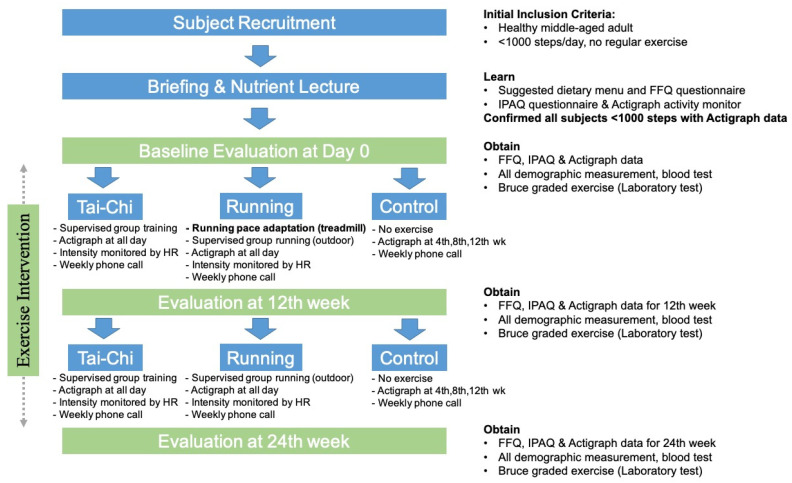
- Randomized supervised training study: 45 sedentary middle-aged male adults recruited; 36 completed 24 weeks (Tai-Chi n = 10, running n = 14, control n = 12; age 55.6 ± 5.3 yr; <1000 steps/day). Exercise groups trained 60 min/day, 5 days/week for 24 weeks (7200 min/120 h) at 66–74% HRmax (110–130 b/min), corresponding to 50–60% VO2max; running speed 5.8–7.2 km/h and step frequency 150–158 step/min; Tai-Chi was Chen style at about 60–65 steps/min.
- Outcomes measured at baseline, 12, and 24 weeks: resting HR, blood pressure, body composition (InBody), blood lipids (TG, TC, HDL-C, LDL-C, FBG), and cardiorespiratory fitness via Bruce protocol (VO2max, Vmax, HRpeak); physical activity by IPAQ/Actigraph and diet by FFQ.
- Analysis: two-way (3 exercise × 3 time) repeated-measures ANOVA with Bonferroni or Dunnett T3 post hoc; alpha 0.05; normality by Shapiro–Wilk, sphericity by Mauchly/Geisser, variance by Levene.
Limitations
- Stated: only middle-aged Chinese males were recruited, so results may not generalize to females or Western participants; small sample size from one city; some dropouts despite monetary incentive, supervision, and training diaries; other daily-life confounders (food intake, physical activity) could influence metabolic outcomes.
- Evident: the abstract and conclusion contain wording that says exercise “decreased … cardiorespiratory fitness,” whereas the results report VO2max increased in both exercise groups; this inconsistency should be noted when interpreting the summary.
- Evident: group sizes after dropout were small (n = 10–14 per group), and the text does not report blinding or intention-to-treat analysis.
Model-written summary. Check it against the paper before relying on it.
Integrity signals
Registry
Cites
Statistics
Figures
Verification
Claims the paper makes
0 Valid · 0 Not valid · 22 Not checked · 96 Own results and interpretations
A result the paper reports from its own data — it cites no other source for it, so there is none to check. The quote shows it is in the paper.
In the paper
“The simple main effect revealed that the maximal MET achieved in Bruce protocol was increased but PRE score was decreased across the training in the Tai-Chi and running groups (p < 0.05), but it remained similar across training times in the control group.”
§ Effects of Tai-Chi and Running Exercises on Cardiorespiratory Fitness and Biomarkers in Sedentary Middle-Aged Males: A 24-Week Supervised Training Study > 3. Results > 3.5. Cardiorespiratory Fitness
plainstates a cause- Asserted: passes — The authors put it forward as true.
- Checkable: passes — It can be checked against evidence.
- Load-bearing: unclear — It is unclear whether the paper’s conclusions depend on it.
- Based: passes — The paper gives a reason why it holds.
A result the paper reports from its own data — it cites no other source for it, so there is none to check. The quote shows it is in the paper.
In the paper
“Although an increasing trend of LDL-C was found in the control group from baseline to 24 weeks (p < 0.05), there was a continual decline in the running group by −0.37 ± 0.18 mmol/L (p = 0.048) in 12-week and −0.46 ± 0.18 mmol/L (p = 0.020) at 24-week intervention.”
§ Effects of Tai-Chi and Running Exercises on Cardiorespiratory Fitness and Biomarkers in Sedentary Middle-Aged Males: A 24-Week Supervised Training Study > 3. Results > 3.4. Blood Parameters
plain- Asserted: passes — The authors put it forward as true.
- Checkable: passes — It can be checked against evidence.
- Load-bearing: unclear — It is unclear whether the paper’s conclusions depend on it.
- Based: passes — The paper gives a reason why it holds.
A result the paper reports from its own data — it cites no other source for it, so there is none to check. The quote shows it is in the paper.
In the paper
“There was an interaction between group and time in DBP (p = 0.006), but not in SBP (p > 0.05).”
§ Effects of Tai-Chi and Running Exercises on Cardiorespiratory Fitness and Biomarkers in Sedentary Middle-Aged Males: A 24-Week Supervised Training Study > 3. Results > 3.3. Blood Pressure
plainstates an association- Asserted: passes — The authors put it forward as true.
- Checkable: passes — It can be checked against evidence.
- Load-bearing: unclear — It is unclear whether the paper’s conclusions depend on it.
- Based: passes — The paper gives a reason why it holds.
A result the paper reports from its own data — it cites no other source for it, so there is none to check. The quote shows it is in the paper.
In the paper
“There were significant differences in Vmax between the two exercise groups in the 12-week (p = 0.019), but not the 24-week, intervention (p > 0.05).”
§ Effects of Tai-Chi and Running Exercises on Cardiorespiratory Fitness and Biomarkers in Sedentary Middle-Aged Males: A 24-Week Supervised Training Study > 3. Results > 3.5. Cardiorespiratory Fitness
plain- Asserted: passes — The authors put it forward as true.
- Checkable: passes — It can be checked against evidence.
- Load-bearing: unclear — It is unclear whether the paper’s conclusions depend on it.
- Based: passes — The paper gives a reason why it holds.
A result the paper reports from its own data — it cites no other source for it, so there is none to check. The quote shows it is in the paper.
In the paper
“The TG concentration decreased in the running group after 12 weeks of intervention (−0.27 ± 0.06 mmol/L, p < 0.001), and this decrease continued until the end of 24 weeks (−0.33 ± 0.06 mmol/L, p < 0.001).”
§ Effects of Tai-Chi and Running Exercises on Cardiorespiratory Fitness and Biomarkers in Sedentary Middle-Aged Males: A 24-Week Supervised Training Study > 3. Results > 3.4. Blood Parameters
plainstates a cause- Asserted: passes — The authors put it forward as true.
- Checkable: passes — It can be checked against evidence.
- Load-bearing: unclear — It is unclear whether the paper’s conclusions depend on it.
- Based: passes — The paper gives a reason why it holds.
62 more claims
Create a free account to see all 118 claims and to verify the 40 references still open.
- It may state two separate claims as one. 34
- Probably not a substantial claim. 32
Self-check
Percentages, sums and reported differences re-computed from the paper’s own numbers.
Each contradiction between two passages listed here was confirmed by an independent check.
Rated minor: it would not touch a result — a value no result rests on, a p-value that stays on the same side of the significance level, or a conflict that is clerical, resolved elsewhere in the paper, or outside its own findings.
In the paper
§ Effects of Tai-Chi and Running Exercises on Cardiorespiratory Fitness and Biomarkers in Sedentary Middle-Aged Males: A 24-Week Supervised Training Study > Abstract
“Compared to the no-exercise control group, both the Tai-Chi and running groups significantly decreased resting heart rate, diastolic blood pressure and cardiorespiratory fitness and increased lean mass across the training session (p < 0.05).”
§ Effects of Tai-Chi and Running Exercises on Cardiorespiratory Fitness and Biomarkers in Sedentary Middle-Aged Males: A 24-Week Supervised Training Study > 3. Results > 3.5. Cardiorespiratory Fitness
“The analysis also revealed that VO2max (mL/kg/min) increased in both exercise intervention groups, while in the control group, the VO2max remained unchanged throughout the 24-week study period, p < 0.001).”
Citations
Cites
Garber, C. E., Blissmer, B., Deschenes, M. R., Franklin, B. A., Lamonte, M. J., Lee, I.-M., Nieman, D. C., & Swain, D. P. (2011) · Medicine & Science in Sports & Exercise · doi:10.1249/mss.0b013e318213fefb · Cited by 9,319 · cited 5×
“Tai-Chi has been shown to induce health related benefits, which include improved aerobic capacity and body composition [6], reduced risk potentials of chronic diseases [10–12], reduced blood pressure [13], and better dynamic balance [14,15] and muscular strength [14,16].”
BackgroundMethodInfluentialKodama, S. (2009) · JAMA · doi:10.1001/jama.2009.681 · Cited by 3,035
Tai chi and postural stability in patients with Parkinson's disease
Li, F., Harmer, P., Fitzgerald, K., Eckstrom, E., Stock, R., Galver, J., Maddalozzo, G., & Batya, S. S. (2012) · New England Journal of Medicine · doi:10.1056/nejmoa1107911 · Cited by 890
Murphy, M. H., Nevill, A. M., Murtagh, E. M., & Holder, R. L. (2007) · Preventive Medicine · doi:10.1016/j.ypmed.2006.12.008 · Cited by 333
Balance control, flexibility, and cardiorespiratory fitness among older Tai Chi practitioners
Hong, Y., Li, J. X., & Robinson, P. D. (2000) · British Journal of Sports Medicine · doi:10.1136/bjsm.34.1.29 · Cited by 332
12-month Tai Chi training in the elderly: its effect on health fitness
LAN, C., LAI, J.-S., CHEN, S.-Y., & WONG, M.-K. (1998) · Medicine & Science in Sports & Exercise · doi:10.1097/00005768-199803000-00003 · Cited by 288
Midgley, A. W., McNaughton, L. R., & Wilkinson, M. (2006) · Sports Medicine · doi:10.2165/00007256-200636020-00003 · Cited by 283
Barlow, C. E., LaMonte, M. J., FitzGerald, S. J., Kampert, J. B., Perrin, J. L., & Blair, S. N. (2006) · American Journal of Epidemiology · doi:10.1093/aje/kwj019 · Cited by 191
Tai Chi Chuan in Medicine and Health Promotion
Lan, C., Chen, S.-Y., Lai, J.-S., & Wong, A. M.-K. (2013) · Evidence-Based Complementary and Alternative Medicine · doi:10.1155/2013/502131 · Cited by 188
The Effect of Tai Chi Exercise on Blood Pressure: A Systematic Review
Yeh, G. Y., Wang, C., Wayne, P. M., & Phillips, R. S. (2008) · Preventive Cardiology · doi:10.1111/j.1751-7141.2008.07565.x · Cited by 185
Lai, J., Lan, C., Wong, M., & Teng, S. (1995) · Journal of the American Geriatrics Society · doi:10.1111/j.1532-5415.1995.tb07397.x · Cited by 171
The Effectiveness of Tai Chi Exercise in Improving Aerobic Capacity: An Updated Meta-Analysis
Taylor-Piliae, R. E. (2008) · Medicine and Sport Science · doi:10.1159/000134283 · Cited by 145
Dose response between total volume of physical activity and health and fitness
OJA, P. (2001) · Medicine and Science in Sports and Exercise · doi:10.1097/00005768-200106001-00011 · Cited by 144
Adiposity, physical fitness and incident diabetes: The physical activity longitudinal study
Katzmarzyk, P. T., Craig, C. L., & Gauvin, L. (2007) · Diabetologia · doi:10.1007/s00125-006-0554-3 · Cited by 97
Thomas, G. N., Hong, A. W. L., Tomlinson, B., Lau, E., Lam, C. W. K., Sanderson, J. E., & Woo, J. (2005) · Clinical Endocrinology · doi:10.1111/j.1365-2265.2005.02398.x · Cited by 93
The Effectiveness of Tai Chi Exercise in Improving Aerobic Capacity: A Meta-Analysis
Taylor-Piliae, R. E., & Froelicher, E. S. (2004) · The Journal of Cardiovascular Nursing · doi:10.1097/00005082-200401000-00009 · Cited by 91
Kline, C. E., Sui, X., Hall, M. H., Youngstedt, S. D., Blair, S. N., Earnest, C. P., & Church, T. S. (2012) · BMJ Open · doi:10.1136/bmjopen-2012-001044 · Cited by 87
Tai chi in patients with heart failure with preserved ejection fraction
Yeh, G. Y., Wood, M. J., Wayne, P. M., Quilty, M. T., Stevenson, L. W., Davis, R. B., Phillips, R. S., & Forman, D. E. (2013) · Congestive Heart Failure · doi:10.1111/chf.12005 · Cited by 82
Impaired cardiac function among obese adolescents: Effect of aerobic interval training
Ingul, C. B., Tjonna, A. E., Stolen, T. O., Stoylen, A., & Wisloff, U. (2010) · Archives of Pediatrics & Adolescent Medicine · doi:10.1001/archpediatrics.2010.158 · Cited by 80
Schmidt, J. F., Hansen, P. R., Andersen, T. R., Andersen, L. J., Hornstrup, T., Krustrup, P., & Bangsbo, J. (2014) · Scandinavian Journal of Medicine & Science in Sports · doi:10.1111/sms.12217 · Cited by 67
The Food Frequency Questionnaire
Willett, W. C., & Hu, F. B. (2007) · Cancer Epidemiology, Biomarkers & Prevention · doi:10.1158/1055-9965.epi-06-0843 · Cited by 65
Reduced training frequencies and maintenance of increased aerobic power
HICKSON, R. C., & ROSENKOETTER, M. A. (1981) · Medicine & Science in Sports & Exercise · doi:10.1249/00005768-198101000-00011 · Cited by 60
Stability limits, single-leg jump, and body awareness in older Tai Chi practitioners
Gyllensten, A. L., Hui-Chan, C. W. Y., & Tsang, W. W. N. (2010) · Archives of Physical Medicine and Rehabilitation · doi:10.1016/j.apmr.2009.10.009 · Cited by 56
(2011) · PubMed · Cited by 55
FIELDING, R. A., FRONTERA, W. R., HUGHES, V. A., FISHER, E. C., & EVANS, W. J. (1997) · Medicine & Science in Sports & Exercise · doi:10.1097/00005768-199708000-00018 · Cited by 53
Xu, D. Q., Li, J. X., & Hong, Y. (2006) · British Journal of Sports Medicine · doi:10.1136/bjsm.2005.019273 · Cited by 50
Dalleck, L. C., Allen, B. A., Hanson, B. A., Borresen, E. C., Erickson, M. E., & De Lap, S. L. (2009) · Journal of Women's Health · doi:10.1089/jwh.2008.0790 · Cited by 47
Hui, S. S., Xie, Y. J., Woo, J., & Kwok, T. C. Y. (2016) · Complementary Therapies in Medicine · doi:10.1016/j.ctim.2016.05.006 · Cited by 40
Tai Chi chuan exercise for patients with cardiovascular disease
Lan, C., Chen, S.-Y., Wong, M.-K., & Lai, J. S. (2013) · Evidence-Based Complementary and Alternative Medicine · doi:10.1155/2013/983208 · Cited by 39
Left ventricular function after exercise training in young men
Rodrigues, A. C. T., de Melo Costa, J., Alves, G. B., Ferreira da Silva, D., Picard, M. H., Andrade, J. L., Mathias, W., & Negrão, C. E. (2006) · The American Journal of Cardiology · doi:10.1016/j.amjcard.2005.10.055 · Cited by 37
T'ai chi for the treatment of osteoarthritis: a systematic review and meta-analysis
Kang, J. W., Lee, M. S., Posadzki, P., & Ernst, E. (2011) · BMJ Open · doi:10.1136/bmjopen-2010-000035 · Cited by 36
Sun, W., Ma, X., Wang, L., Zhang, C., Song, Q., Gu, H., & Mao, D. (2018) · Motor Control · doi:10.1123/mc.2017-0055 · Cited by 34
Tsai, J.-C., Liu, J.-C., Kao, C.-C., Tomlinson, B., Kao, P.-F., Chen, J.-W., & Chan, P. (2002) · American Journal of Hypertension · doi:10.1016/s0895-7061(02)02273-2 · Cited by 33
Melling, C. W. J., Grisé, K. N., Hasilo, C. P., Fier, B., Milne, K. J., Karmazyn, M., & Noble, E. G. (2013) · Diabetes & Metabolism · doi:10.1016/j.diabet.2013.02.004 · Cited by 23
Ou, Y.-C., Chuang, H.-H., Li, W.-C., Tzeng, I.-S., & Chen, J.-Y. (2017) · Archives of Gerontology and Geriatrics · doi:10.1016/j.archger.2017.04.006 · Cited by 15
Mossavar-Rahmani, Y., Hua, S., Qi, Q., Strizich, G., Sotres-Alvarez, D., Talavera, G. A., Evenson, K. R., Gellman, M. D., Stoutenberg, M., Castañeda, S. F., et al. (2020) · BMC Public Health · doi:10.1186/s12889-020-09497-5 · Cited by 15
Effects of Tai Chi on fall risk factors: A meta-analysis
Park, M., & Song, R. (2013) · Journal of Korean Academy of Nursing · doi:10.4040/jkan.2013.43.3.341 · Cited by 13
Brien, S. E., Janssen, I., & Katzmarzyk, P. T. (2007) · Applied Physiology, Nutrition, and Metabolism · doi:10.1139/h06-090 · Cited by 11
Lee, L. Y. K., Chong, Y. L., Li, N. Y., Li, M. C., Lin, L. N., Wong, L. Y., Wong, B. K., Yip, W. P., Hon, C. H., Chung, P. K., et al. (2013) · Stress and Health · doi:10.1002/smi.2435 · Cited by 9
Research works printed but not linked: 2
- American College of Sports Medicine ACSM’s Guidelines for Exercise Testing and Prescription 8th ed. Lippincott Williams & Wilmins Philadelphia, PA, USA 2014
- Yang Y. Wang G. He M. Pan X. Wang Z. China Food Composition (Book 1) 6th ed. Beijing Medical University Press Beijing, China 2018
Cited by
Son, W.-H., Park, H., Jeon, B. H., & Ha, M. (2023) · Scientific Reports · doi:10.1038/s41598-023-47403-2 · Cited by 43
Yang, J., Du, Y. N., Shen, H., Shujie, R., Liu, Z., Zheng, D., Shi, Q., Li, Y., & Wei, G. (2022) · International Journal of Environmental Research and Public Health · doi:10.3390/ijerph191610284 · Cited by 35
The Impact of Excessive Body Weight and Foot Pronation on Running Kinetics: A Cross-Sectional Study
Jafarnezhadgero, A., Jahangirpour, A., Parsa, H., Sajedi, H., Granacher, U., & Oliveira, A. S. (2023) · Sports Medicine - Open · doi:10.1186/s40798-023-00663-8 · Cited by 15
Zhao, W., Ju, H., & Zhu, K.-T. (2024) · The Aging Male · doi:10.1080/13685538.2023.2282977 · Cited by 12
Wang, Y., Wang, H., Chen, Y., Xu, N., Lee, W. C. C., & Lam, W. (2022) · International Journal of Environmental Research and Public Health · doi:10.3390/ijerph19148295 · Cited by 10
Self-citation
Metadata
- Authors
- Wang, Y., Guo, X., Liu, L., Xie, M., & Lam, W.-K.
- Affiliations
- Harbin Institute of Technology (CN)
- Beijing Sport University (CN)
- University of International Business and Economics (CN)
- National Institute of Sports Medicine, Beijing 100062, China
- Renmin University of China (CN)
- Corresponding author
- Wang, Yi
- Lam, Wing-Kai
- Venue
- Biology
- Publisher
- MDPI AG
- Published
- 2022-02-26
- Volume
- 11
- Issue
- 3
- Pages
- 375
- ISSN
- 2079-7737 (ISSN-L)
- PMC
- PMC8945567
- OpenAlex
- W4214605069
- Semantic Scholar
- ce2650720fdfbc9231c722943bf2e1a6de6e53f7
- Cited by
- 22
- References
- 39
- Citations by year
- 2026: 4 · 2025: 4 · 2024: 4 · 2023: 6 · 2022: 4
- FWCI
- 2.36
- Type
- journal article
- Language
- en
- Open access
- gold
- doi.org
- Licence
- Locations
- Biology (publishedVersion, cc-by)
- PubMed (publishedVersion)
- PubMed Central (publishedVersion, cc-by)
- DOAJ (DOAJ: Directory of Open Access Journals) (submittedVersion, cc-by-sa)
- Funders
- Key Projects in the National Science & Technology Pillar Program (2012BAK21B00)
- Health Qigong Management Center of General Administration of China (QG2016026)
- Fundamental Research Funds for the Central Universities (2018GJ019)
- Topics
- Health Sciences › Medicine › Physiology (medical) › Cardiovascular and exercise physiology
- Health Sciences › Medicine › Public Health, Environmental and Occupational Health › Physical Activity and Health
- Health Sciences › Medicine › Physiology (medical) › Exercise and Physiological Responses
- Keywords
- Tai Chi, running, cardiorespiratory fitness, VO2max, sedentary middle-aged adults, resting heart rate, blood pressure, serum lipids, triglycerides, LDL cholesterol, lean body mass, exercise training, supervised exercise
About these checks
Registry, retraction, Cites and statistics results are computed, not judged, with one exception: a printed reference that no index lists is read once by a model before it counts as a citation error. Claims are extracted by a model and kept only when their quote appears verbatim in the text; each cited source is then checked, with a model’s help, for whether it says what the claim relies on. Those verdicts can be wrong — read the claim’s quote and the cited source before relying on one.
A language model drew the claims from the paper on 2026-11-19, under version 3 of the claim definition (model deepseek-v4.1-flash, prompt extract-v3).
A second model labelled each claim on 2026-11-19 (model jev-1.13-20260917, definition revision gold-guideline-v0.2).
Statistics and arithmetic are recomputed, not judged.
Confidence bands are shown only for fields calibrated on our annotated test set. None is calibrated yet, so no band is shown.
What counts as a claim ›How we measure confidence ›How we check this ›
Are you an author, or do you see a problem with this page? Request a review
Data sources
Bibliographic data: Semantic Scholar, OpenAlex, Crossref.
Contains information from the Semantic Scholar Academic Graph Datasets, made available under the ODC Attribution License (ODC-BY 1.0).
Semantic Scholar’s data is described in: Kinney, R., et al. (2023). The Semantic Scholar Open Data Platform. arXiv:2301.10140.
