

Mechanisms of Hormonal, Genetic, and Temperature Regulation of Germ Cell Proliferation, Differentiation, and Death During Spermatogenesis
Open accessThe DOI matches its Crossref record; 233 of the 235 references it cites were found in a registry or an index; none of the 275 sources its claims cite is checked for support yet.
Abstract
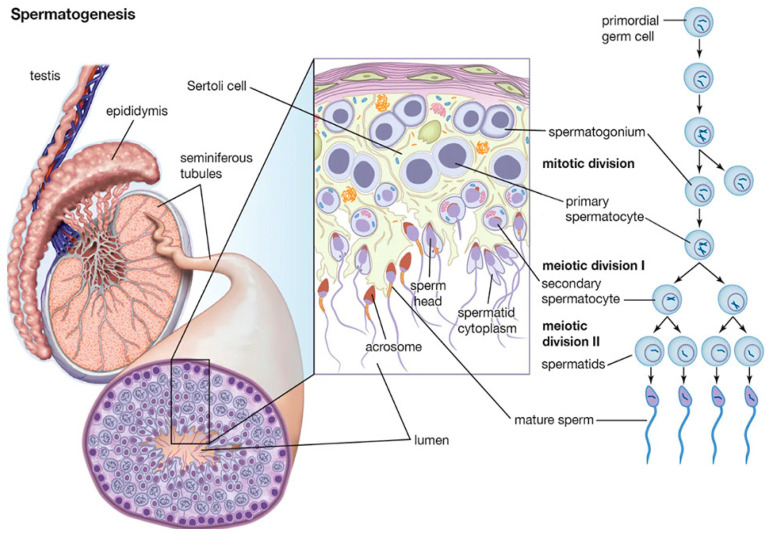
Spermatogenesis is a complex and highly regulated process involving the proliferation, differentiation, and apoptosis of germ cells. This process is controlled by various hormonal, genetic, and environmental factors, including temperature. In hormonal regulation, follicle-stimulating hormone (FSH), luteinizing hormone (LH), and testosterone (T) are essential for correct spermatogenesis development from the early stages and spermatogonia proliferation to germ cell maturation. Other hormones, like inhibin and activin, finely participate tuning the process of spermatogenesis. Genetic regulation involves various transcription factors, such as SOX9, SRY, and DMRT1, which are crucial for the development and maintenance of the testis and germ cells. MicroRNAs (miRNAs) play a significant role by regulating gene expression post-transcriptionally. Epigenetic modifications, including DNA methylation, histone modifications, and chromatin remodelling, are also vital. Temperature regulation is another critical aspect, with the testicular temperature maintained around 2–4 °C below body temperature, essential for efficient spermatogenesis. Heat shock proteins (HSPs) protect germ cells from heat-induced damage by acting as molecular chaperones, ensuring proper protein folding and preventing the aggregation of misfolded proteins during thermal stress. Elevated testicular temperature can impair spermatogenesis, increasing germ cell apoptosis and inducing oxidative stress, DNA damage, and the disruption of the blood–testis barrier, leading to germ cell death and impaired differentiation. The cellular mechanisms of germ cell proliferation, differentiation, and death include the mitotic divisions of spermatogonia to maintain the germ cell pool and produce spermatocytes. Spermatocytes undergo meiosis to produce haploid spermatids, which then differentiate into mature spermatozoa. Apoptosis, or programmed cell death, ensures the removal of defective germ cells and regulates the germ cell population. Hormonal imbalance, genetic defects, and environmental stress can trigger apoptosis during spermatogenesis. Understanding these mechanisms is crucial for addressing male infertility and developing therapeutic interventions. Advances in molecular biology and genetics continue to uncover the intricate details of how spermatogenesis is regulated at multiple levels, providing new insights and potential targets for treatment.
Overview
CoChat Summary
TL;DR
This review synthesizes hormonal, genetic/epigenetic, and temperature regulation of spermatogenesis, covering germ cell proliferation, differentiation, and apoptosis. It highlights HPG-axis hormones, transcription factors and non-coding RNAs, heat-shock proteins, and emerging areas such as in vitro spermatogenesis, environmental threats, and the gut–testis axis.
Key findings
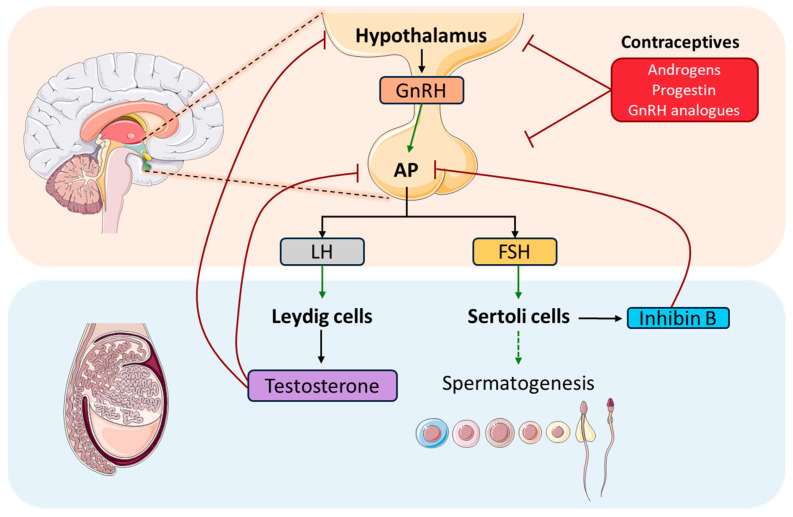
- Hormonal control via the HPG axis: FSH acts on Sertoli cells and supports spermatogonia/spermatocyte proliferation but cannot produce spermatids without testosterone; LH stimulates Leydig cells to produce testosterone. FSH-R knockout mice remain fertile, whereas LH-R deletion reduces serum and testis testosterone and impairs spermatogenesis completion.
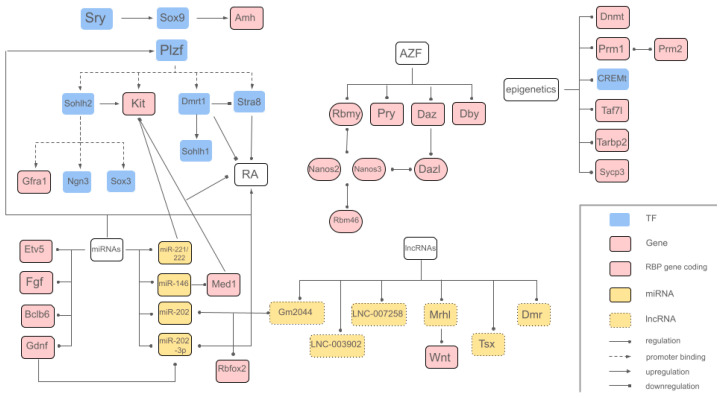
- Genetic/epigenetic regulation involves SRY/SOX9, PLZF, SOHLH2, STRA8, DMRT1, DAZL, CREM, miRNAs (e.g., miR-146, miR-221/222, miR-202-3p), lncRNAs, piRNAs, circRNAs, m6A, DNA methylation, and protamination. Knockout examples include Plzf mutants being infertile with testicular degeneration, Dazl knockout causing infertility in both sexes, and Rbm46 knockout showing testicular atrophy and spermatid loss.
- Temperature: testicular temperature is maintained around 2–4 °C below body temperature (abstract; Section 4 says 2–8 °C below core), and an increase of just 1.5–2 °C can inhibit spermatogenesis. Heat stress increases ROS, DNA damage, apoptosis, autophagy, and blood–testis barrier disruption; HSP70-2-deficient male mice are infertile due to meiotic arrest in prophase I.
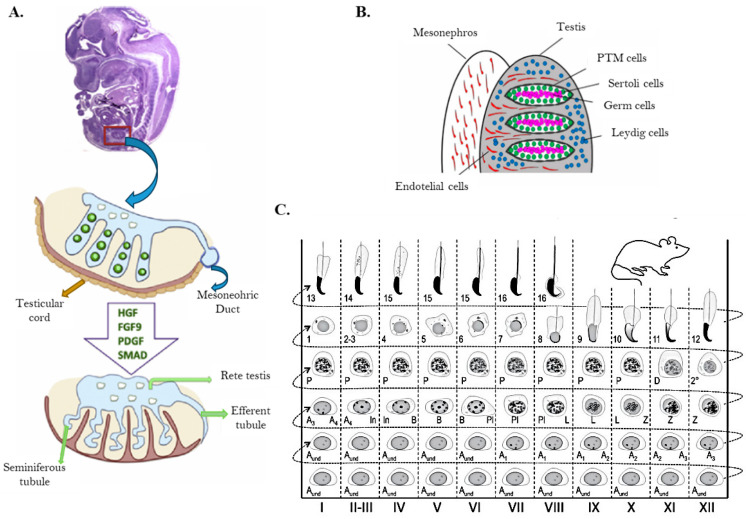
- Cellular/apoptotic regulation: up to 75% of germ cells are lost during spermatogonia development; the seminiferous epithelium cycle is divided into 14 stages in rats and 16 stages in mice; apoptosis removes defective or excess germ cells.
Methods
- Narrative review; no primary data, sample, or systematic search strategy is described.
- Synthesizes cited literature on hormonal, genetic/epigenetic, and temperature regulation, with tables and figures summarizing selected factors.
- Main analysis is qualitative integration of findings across animal models and human clinical observations.
Limitations
- The paper does not state a limitations section. Evident limitations: as a narrative review, it lacks a systematic search or inclusion criteria and focuses on “the most relevant and/or extensively studied” genes/hormones, so coverage is selective.
- Many mechanistic findings come from animal models (mice, rats, etc.) and may not fully translate to humans; the text notes uncertainties, e.g., whether the gonocyte-to-spermatogonia pathway is mouse-specific or general in mammals remains uncertain, and PRL/PRLR knockout results are not conclusive.
- Some areas are described as less explored or needing more research (e.g., circRNA function in spermatogenesis, diet effects, in vitro spermatogenesis protocols).
Model-written summary. Check it against the paper before relying on it.
Integrity signals
Registry
Cites
Statistics
Figures
Verification
Claims the paper makes
0 Valid · 11 Not valid · 194 Not checked · 78 Own results and interpretations
A statement the paper makes itself — it cites no source for it, so there is none to check. The quote shows it is in the paper.
In the paper
“FSH is also necessary for spermatogonia to differentiate into primary spermatocytes.”
§ Mechanisms of Hormonal, Genetic, and Temperature Regulation of Germ Cell Proliferation, Differentiation, and Death During Spermatogenesis > 2. Hormonal Regulation in Spermatogenesis
plainstates a cause- Asserted: passes — The authors put it forward as true.
- Checkable: passes — It can be checked against evidence.
- Load-bearing: unclear — It is unclear whether the paper’s conclusions depend on it.
- Based: passes — The paper gives a reason why it holds.
A statement the paper makes itself — it cites no source for it, so there is none to check. The quote shows it is in the paper.
In the paper
“Moreover, FSH stimulation, via FSH receptor (FSH-R) binding in Sertoli cells, activates the canonical cAMP/PKA pathway, leading to the secretion of various growth factors, such as stem cell factor (SCF) and c-kit ligand that support the survival, proliferation, and differentiation of germ cells.”
§ Mechanisms of Hormonal, Genetic, and Temperature Regulation of Germ Cell Proliferation, Differentiation, and Death During Spermatogenesis > 2. Hormonal Regulation in Spermatogenesis
plainstates a cause- Asserted: passes — The authors put it forward as true.
- Checkable: passes — It can be checked against evidence.
- Load-bearing: passes — The paper’s conclusions depend on it.
- Based: passes — The paper gives a reason why it holds.
A statement the paper makes itself — it cites no source for it, so there is none to check. The quote shows it is in the paper.
In the paper
“It regulates the meiotic entry by inhibiting Activin A (which promotes DNA synthesis in spermatocytes) and activating its counteracting factors Inhibin B and IL-6 (via PKC dependent pathway).”
§ Mechanisms of Hormonal, Genetic, and Temperature Regulation of Germ Cell Proliferation, Differentiation, and Death During Spermatogenesis > 2. Hormonal Regulation in Spermatogenesis
plainstates a cause- Asserted: passes — The authors put it forward as true.
- Checkable: passes — It can be checked against evidence.
- Load-bearing: unclear — It is unclear whether the paper’s conclusions depend on it.
- Based: passes — The paper gives a reason why it holds.
None of the sources cited for this claim have been checked yet.
In the paper
“Additionally, in order to promote spermatocyte survival, FSH signalling was described inhibiting both intrinsic and extrinsic apoptotic pathways through the expression of Galectin-3 [17,18].”
§ Mechanisms of Hormonal, Genetic, and Temperature Regulation of Germ Cell Proliferation, Differentiation, and Death During Spermatogenesis > 2. Hormonal Regulation in Spermatogenesis
What the sources say
- Not checked yetcites [17] Li L. Lin W. Wang Z. Huang R. Xia H. Li Z. Deng J. Ye T. Huang Y. Yang Y. Hormone Regulation in Testicular Development and Function Int. J. Mol. Sci. 2024 25 5805 10.3390/ijms25115805 38891991 PMC11172568 source
- Not checked yetcites [18] Wang J.-M. Li Z.-F. Yang W.-X. What Does Androgen Receptor Signaling Pathway in Sertoli Cells During Normal Spermatogenesis Tell Us? Front. Endocrinol. 2022 13 838858 10.3389/fendo.2022.838858 PMC8908322 35282467 source
hedgedstates a cause- Asserted: passes — The authors put it forward as true.
- Checkable: passes — It can be checked against evidence.
- Load-bearing: unclear — It is unclear whether the paper’s conclusions depend on it.
- Based: passes — The paper gives a reason why it holds.
The paper states this without a source or data behind it here, so there is nothing to check it against. The quote shows it is in the paper.
In the paper
“In hormonal regulation, follicle-stimulating hormone (FSH), luteinizing hormone (LH), and testosterone (T) are essential for correct spermatogenesis development from the early stages and spermatogonia proliferation to germ cell maturation.”
§ Mechanisms of Hormonal, Genetic, and Temperature Regulation of Germ Cell Proliferation, Differentiation, and Death During Spermatogenesis > Abstract
plainstates a cause- Asserted: passes — The authors put it forward as true.
- Checkable: passes — It can be checked against evidence.
- Load-bearing: passes — The paper’s conclusions depend on it.
- Based: unclear — It is unclear why the paper says it holds.
124 more claims
Create a free account to see all 283 claims and to verify the 274 references still open.
- Probably not a substantial claim. 67
- It may state two separate claims as one. 105
Self-check
Percentages, sums and reported differences re-computed from the paper’s own numbers.
Each contradiction between two passages listed here was confirmed by an independent check.
Rated major: it would touch a result — a value a result rests on, reported and recomputed p-values on opposite sides of the significance level, two passages that conflict with no sign which is right, or a cited work retracted before this paper was published.
In the paper
§ Mechanisms of Hormonal, Genetic, and Temperature Regulation of Germ Cell Proliferation, Differentiation, and Death During Spermatogenesis > 2. Hormonal Regulation in Spermatogenesis
“FSH is also necessary for spermatogonia to differentiate into primary spermatocytes.”
§ Mechanisms of Hormonal, Genetic, and Temperature Regulation of Germ Cell Proliferation, Differentiation, and Death During Spermatogenesis > 2. Hormonal Regulation in Spermatogenesis
“FSH is not essential to maintain fertility”
Rated minor: it would not touch a result — a value no result rests on, a p-value that stays on the same side of the significance level, or a conflict that is clerical, resolved elsewhere in the paper, or outside its own findings.
In the paper
§ Mechanisms of Hormonal, Genetic, and Temperature Regulation of Germ Cell Proliferation, Differentiation, and Death During Spermatogenesis > 5. Cellular Mechanisms of Proliferation and Differentiation of Germ Cells > 5.1. Phases of Spermatogenesis
“When spermatogenesis is finished, it is followed by spermiation”
§ Mechanisms of Hormonal, Genetic, and Temperature Regulation of Germ Cell Proliferation, Differentiation, and Death During Spermatogenesis > 5. Cellular Mechanisms of Proliferation and Differentiation of Germ Cells > 5.1. Phases of Spermatogenesis
“The last step of spermiogenesis is spermiation”
Rated minor: it would not touch a result — a value no result rests on, a p-value that stays on the same side of the significance level, or a conflict that is clerical, resolved elsewhere in the paper, or outside its own findings.
In the paper
§ Mechanisms of Hormonal, Genetic, and Temperature Regulation of Germ Cell Proliferation, Differentiation, and Death During Spermatogenesis > 4. Regulation by Temperature
“Moreover, changes in gamete during spermatogenesis caused by heat stress do not compromise viability”
§ Mechanisms of Hormonal, Genetic, and Temperature Regulation of Germ Cell Proliferation, Differentiation, and Death During Spermatogenesis > 4. Regulation by Temperature
“after heat stress, a high amount of germ cells can carry out the complete development into abnormal morphological spermatozoa with damaged DNA avoiding apoptosis, which leads to a reduction in viability or motility”
Citations
Cites
Bole-Feysot, C., Goffin, V., Edery, M., Binart, N., & Kelly, P. A. (1998) · Endocrine Reviews · doi:10.1210/edrv.19.3.0334 · Cited by 1,938
Generation and reproductive phenotypes of mice lacking estrogen receptor β
Krege, J. H., Hodgin, J. B., Couse, J. F., Enmark, E., Warner, M., Mahler, J. F., Sar, M., Korach, K. S., Gustafsson, J.-Å., & Smithies, O. (1998) · Proceedings of the National Academy of Sciences · doi:10.1073/pnas.95.26.15677 · Cited by 1,691
DEFINITION OF THE STAGES OF THE CYCLE OF THE SEMINIFEROUS EPITHELIUM IN THE RAT
Leblond, C. P., & Clermont, Y. (1952) · Annals of the New York Academy of Sciences · doi:10.1111/j.1749-6632.1952.tb26576.x · Cited by 1,679
Cdks, cyclins and CKIs: roles beyond cell cycle regulation
Lim, S., & Kaldis, P. (2013) · Development · doi:10.1242/dev.091744 · Cited by 1,487
Essential role for de novo DNA methyltransferase Dnmt3a in paternal and maternal imprinting
Kaneda, M., Okano, M., Hata, K., Sado, T., Tsujimoto, N., Li, E., & Sasaki, H. (2004) · Nature · doi:10.1038/nature02633 · Cited by 1,387
Schulz, R. W., de França, L. R., Lareyre, J.-J., LeGac, F., Chiarini-Garcia, H., Nobrega, R. H., & Miura, T. (2010) · General and Comparative Endocrinology · doi:10.1016/j.ygcen.2009.02.013 · Cited by 1,202
Linking Long Noncoding RNA Localization and Function
Chen, L.-L. (2016) · Trends in Biochemical Sciences · doi:10.1016/j.tibs.2016.07.003 · Cited by 1,052
Essential role of Plzf in maintenance of spermatogonial stem cells
Costoya, J. A., Hobbs, R. M., Barna, M., Cattoretti, G., Manova, K., Sukhwani, M., Orwig, K. E., Wolgemuth, D. J., & Pandolfi, P. P. (2004) · Nature Genetics · doi:10.1038/ng1367 · Cited by 952
Fisher, C. R., Graves, K. H., Parlow, A. F., & Simpson, E. R. (1998) · Proceedings of the National Academy of Sciences · doi:10.1073/pnas.95.12.6965 · Cited by 867 · cited 1×
“Additionally, the disruption of Cyp19 gene coding for aromatase (ArKO mice) results in decreased fertility in males of advancing age [29].”
Spermatogenesis: The Commitment to Meiosis
Griswold, M. D. (2016) · Physiological Reviews · doi:10.1152/physrev.00013.2015 · Cited by 825
Cited by
Adapting Crops to Rising Temperatures: Understanding Heat Stress and Plant Resilience Mechanisms
Kumar, A., Muthuramalingam, P., Kumar, R., Tiwari, S., Verma, L., Park, S., & Shin, H. (2025) · International Journal of Molecular Sciences · doi:10.3390/ijms262110426 · Cited by 49
Role of Redox-Induced Protein Modifications in Spermatozoa in Health and Disease
Onochie, C., Evi, K., & O’Flaherty, C. (2025) · Antioxidants · doi:10.3390/antiox14060720 · Cited by 26
Reductive stress and the role of antioxidants in male infertility: a narrative review
Moustakli, E., Christopoulos, P., Potiris, A., Zikopoulos, A., Matsas, A., Arkoulis, I., Mavrogianni, D., Drakaki, Ε., Zachariou, A., Drakakis, P., et al. (2025) · Archives of Gynecology and Obstetrics · doi:10.1007/s00404-025-08184-3 · Cited by 25
Dhikhirullahi, O., & Zhang, Z. (2025) · Systems Biology in Reproductive Medicine · doi:10.1080/19396368.2025.2548492 · Cited by 24
Sengupta, P., Dutta, S., Jallo, M. K. I., Rosas, I. M., & Roychoudhury, S. (2026) · Current Issues in Molecular Biology · doi:10.3390/cimb48010117 · Cited by 21
Metadata
- Authors
- Maroto, M., Torvisco, S. N., García-Merino, C., Fernández-González, R., & Pericuesta, E.
- Affiliations
- Consejo Superior de Investigaciones Científicas (ES)
- University College Dublin (IE)
- National Institute for Agricultural and Food Research and Technology (INIA-CSIC), 28040 Madrid, Spain
- Corresponding author
- Pericuesta, Eva
- Venue
- Biomolecules
- Publisher
- MDPI AG
- Published
- 2025-03-29
- Volume
- 15
- Issue
- 4
- Pages
- 500
- ISSN
- 2218-273X (ISSN-L)
- PMC
- PMC12025078
- OpenAlex
- W4409001421
- Semantic Scholar
- 8bed72deefcf7a65919d5e5b1254ae804cfecf7f
- Cited by
- 92
- References
- 233
- Citations by year
- 2026: 67 · 2025: 24
- FWCI
- 7.80
- Type
- journal article
- Language
- en
- Open access
- gold
- doi.org
- Licence
- Locations
- Biomolecules (publishedVersion, cc-by)
- Preprints.org (submittedVersion, cc-by)
- PubMed Central (publishedVersion, cc-by)
- PubMed (publishedVersion)
- DIGITAL.CSIC (Spanish National Research Council (CSIC)) (submittedVersion)
- DOAJ (DOAJ: Directory of Open Access Journals) (submittedVersion)
- Topics
- Health Sciences › Medicine › Reproductive Medicine › Sperm and Testicular Function
- Health Sciences › Medicine › Reproductive Medicine › Reproductive Biology and Fertility
- Life Sciences › Biochemistry, Genetics and Molecular Biology › Physiology › Reproductive biology and impacts on aquatic species
- Keywords
- spermatogenesis, germ cell proliferation, germ cell differentiation, germ cell apoptosis, follicle-stimulating hormone, luteinizing hormone, testosterone, inhibin, activin, SOX9, SRY, DMRT1, microRNA, epigenetic regulation, DNA methylation, histone modifications, chromatin remodeling, testicular temperature, heat shock proteins, blood-testis barrier, oxidative stress, male infertility, meiosis
- MeSH terms
- Animals, Cell Differentiation, Germ Cells, Hormones, Humans, Male, Spermatogenesis, Temperature, Testis, Apoptosis, Cell Proliferation
About these checks
Registry, retraction, Cites and statistics results are computed, not judged, with one exception: a printed reference that no index lists is read once by a model before it counts as a citation error. Claims are extracted by a model and kept only when their quote appears verbatim in the text; each cited source is then checked, with a model’s help, for whether it says what the claim relies on. Those verdicts can be wrong — read the claim’s quote and the cited source before relying on one.
A language model drew the claims from the paper on 2026-11-27, under version 3 of the claim definition (model deepseek-v4.1-flash, prompt extract-v3).
A second model labelled each claim on 2026-11-27 (model jev-1.13-20260917, definition revision gold-guideline-v0.2).
Statistics and arithmetic are recomputed, not judged.
Confidence bands are shown only for fields calibrated on our annotated test set. None is calibrated yet, so no band is shown.
What counts as a claim ›How we measure confidence ›How we check this ›
Are you an author, or do you see a problem with this page? Request a review
Data sources
Bibliographic data: Semantic Scholar, OpenAlex, Crossref.
Contains information from the Semantic Scholar Academic Graph Datasets, made available under the ODC Attribution License (ODC-BY 1.0).
Semantic Scholar’s data is described in: Kinney, R., et al. (2023). The Semantic Scholar Open Data Platform. arXiv:2301.10140.
