

The DOI matches its Crossref record; 107 of the 110 references it cites were found in a registry or an index.
DOT1L and H3K79 Methylation in Transcription and Genomic Stability
Open accessAbstract
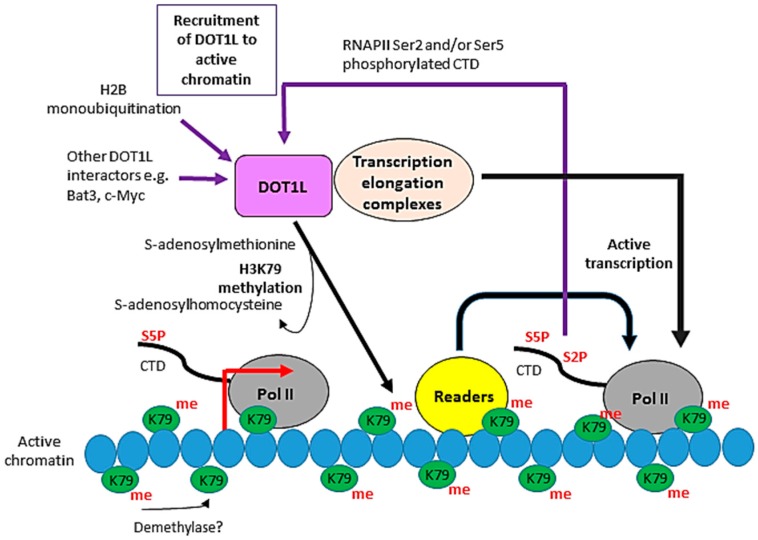
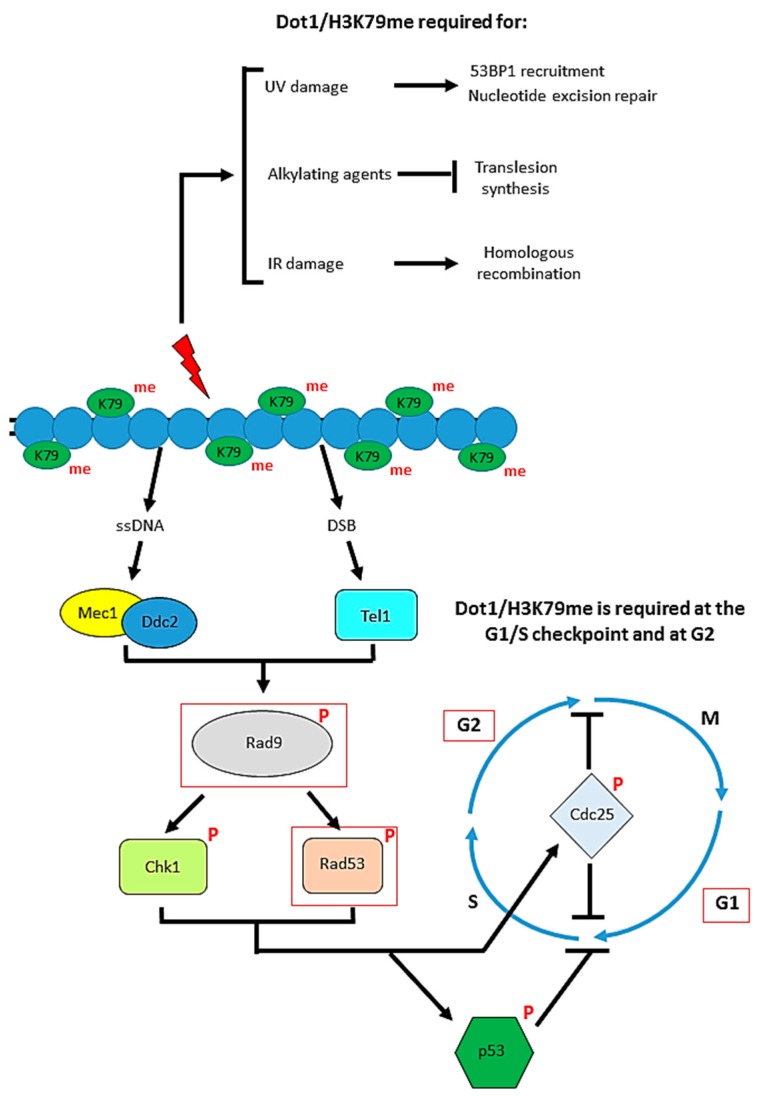
The organization of eukaryotic genomes into chromatin provides challenges for the cell to accomplish basic cellular functions, such as transcription, DNA replication and repair of DNA damage. Accordingly, a range of proteins modify and/or read chromatin states to regulate access to chromosomal DNA. Yeast Dot1 and the mammalian homologue DOT1L are methyltransferases that can add up to three methyl groups to histone H3 lysine 79 (H3K79). H3K79 methylation is implicated in several processes, including transcription elongation by RNA polymerase II, the DNA damage response and cell cycle checkpoint activation. DOT1L is also an important drug target for treatment of mixed lineage leukemia (MLL)-rearranged leukemia where aberrant transcriptional activation is promoted by DOT1L mislocalisation. This review summarizes what is currently known about the role of Dot1/DOT1L and H3K79 methylation in transcription and genomic stability.
Overview
The claims and statistics of this paper haven’t been checked yet.
Run the check — free, no account needed. It reads the open-access text and checks the sources it cites.
Integrity signals
Registry
Cites
Statistics
Figures
Verification
Claims the paper makes
The claims and statistics of this paper haven’t been checked yet.
Run the check — free, no account needed. It reads the open-access text and checks the sources it cites.
Claims other papers make about this one
Each is checked against this paper’s own text: does it say what the citing paper says it does?
In the citing paper
“Although it is undeniable that histone modifications robustly modulate key cellular processes and there is compelling evidence for the role of histone methylation in DNA processes, as outlined above, it is difficult to formally prove a direct causative role of any histone modification in mammalian cells (see REF. 35 for discussion).”
From The roles of DNA, RNA and histone methylation in ageing and cancer (2019) · cites this paper as [35]
Self-check
Percentages, sums and reported differences re-computed from the paper’s own numbers.
The self-check needs the paper’s full text.
Citations
Cites
Crystal structure of the nucleosome core particle at 2.8 Å resolution
Luger, K., Mäder, A. W., Richmond, R. K., Sargent, D. F., & Richmond, T. J. (1997) · Nature · doi:10.1038/38444 · Cited by 9,466
The Role of Chromatin during Transcription
Li, B., Carey, M., & Workman, J. L. (2007) · Cell · doi:10.1016/j.cell.2007.01.015 · Cited by 3,503 · cited 1×
“These covalent modifications influence chromatin structure and function directly, by altering the interactions between nucleosomes, and indirectly, by affecting the recruitment of non-histone effector proteins, such as transcription factors, chromatin remodellers and DNA binding proteins to particular regions of chrom…”
BackgroundElective induction versus spontaneous labor after sonographic diagnosis of fetal macrosomia.
Combs, C. A., Singh, N. B., & Khoury, J. C. (1993) · PubMed · Cited by 2,463
Combinatorial patterns of histone acetylations and methylations in the human genome
Wang, Z., Zang, C., Rosenfeld, J. A., Schones, D. E., Barski, A., Cuddapah, S., Cui, K., Roh, T.-Y., Peng, W., Zhang, M. Q., et al. (2008) · Nature Genetics · doi:10.1038/ng.154 · Cited by 2,331 · cited 1×
“In human CD4+ T cells, chromatin immunoprecipitation followed by high-throughput sequencing (ChIP-Seq) studies have demonstrated that H3K79me2/me3 are strongly correlated with gene activity [40], while in Drosophila melanogaster chromatin immunoprecipitation followed by DNA microarray (ChIP-chip) has also demonstrated…”
BackgroundThe diverse functions of histone lysine methylation
Martin, C., & Zhang, Y. (2005) · Nature Reviews Molecular Cell Biology · doi:10.1038/nrm1761 · Cited by 2,157 · cited 2×
“One well-studied covalent histone modification is the methylation of lysine residue by histone lysine methyltransferases (KMTs) [6].”
BackgroundTwenty-Five Years of the Nucleosome, Fundamental Particle of the Eukaryote Chromosome
Kornberg, R. D., & Lorch, Y. (1999) · Cell · doi:10.1016/s0092-8674(00)81958-3 · Cited by 1,833
Genome Regulation by Polycomb and Trithorax Proteins
Schuettengruber, B., Chourrout, D., Vervoort, M., Leblanc, B., & Cavalli, G. (2007) · Cell · doi:10.1016/j.cell.2007.02.009 · Cited by 1,418 · cited 1×
“Polycomb and Trithorax are protein complexes involved in transcriptional regulation of numerous developmental genes [42], indicating that H3K79 methylation influences developmentally-regulated gene expression in metazoa.”
BackgroundConnecting microRNA Genes to the Core Transcriptional Regulatory Circuitry of Embryonic Stem Cells
Marson, A., Levine, S. S., Cole, M. F., Frampton, G. M., Brambrink, T., Johnstone, S. E., Guenther, M. G., Johnston, W. K., Wernig, M., Newman, J. J., et al. (2008) · Cell · doi:10.1016/j.cell.2008.07.020 · Cited by 1,405 · cited 1×
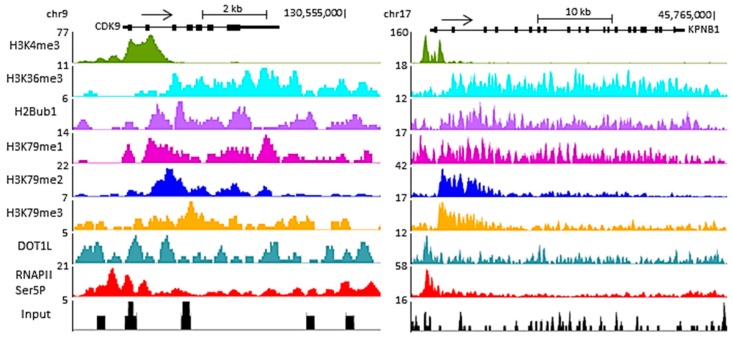
“H3K79me2 and H3K79me3 levels are highest immediately downstream of the transcription start site (TSS) and decrease gradually within the first intron [55,56].”
BackgroundJmjC-domain-containing proteins and histone demethylation
Klose, R. J., Kallin, E. M., & Zhang, Y. (2006) · Nature Reviews Genetics · doi:10.1038/nrg1945 · Cited by 1,290
MLL translocations, histone modifications and leukaemia stem-cell development
Krivtsov, A. V., & Armstrong, S. A. (2007) · Nature reviews. Cancer · doi:10.1038/nrc2253 · Cited by 1,290 · cited 1×
“As a result of chromosomal translocations, the N-terminus of MLL becomes fused in-frame to one of approximately 70 translocation partners [98].”
Background
Cited by
Sorted by citations
Items 201–211 of 211
The role of PRMT5-mediated methylation of steroid receptor in breast Cancer
Pham, T. H. (2022) · theses.fr (ABES) · doi:10.70675/f6e3d282z871dz4ffaz87bazb04f22d60d50
The signaling upstream of DOT1L-mediated H3K79 methylation
Chen, C., Wu, D., Lv, C., Zhu, P., Chen, Z., Li, Q., Li, J., Yang, J., & Zhang, J. (2026) · Epigenomics · doi:10.1080/17501911.2026.2665450
Raghavan, A. R., May, K., Subramanian, V. V., Blitzblau, H. G., Patel, N. J., Houseley, J. M., & Hochwagen, A. (2026) · eLife · doi:10.7554/elife.110189.2
Santos‐Fernández, R. L. D. L., Paz‐López, G., Niu, H., Álvarez‐Álvarez, I., Alberola, I. D., Sanabria‐Cabrera, J., Paz, M. V., González‐González, A., Stephens, C. M., Lucena, M. I., et al. (2026) · Research Square · doi:10.21203/rs.3.rs-9038512/v1
Ni, G., Ma, N., & Xu, J. (2026) · Frontiers in Molecular Biosciences · doi:10.3389/fmolb.2026.1801780
“The histone marker H3K79 has been established as a regulator of senescence (Kim et al., 2012), and is associated with active transcription (Wood et al., 2018).”
Sattarifard, H., Oyeyode, M., Prajapati, D., Duaqui, A., Kaur, G., Muker, I., Luo, W., Lakowski, T. M., & Davie, J. (2026) · International Journal of Molecular Sciences · doi:10.3390/ijms27156597
“The distribution of nucleosomes with histone PTMs associated with transcribed genes follows the order: H3K4me3 nucleosomes on either side of the transcription start site, followed by H2BK120ub and H3K79me2 along the gene body, and finally H3K36me3 along the gene body [21–23].”
Targeting DOT1L Epigenetic Moonlighting in MLL-Rearranged Leukemia
Gupta, D. G., Gupta, M., Othman, A. H., Memon, U. A., Schiltz, G. E., & Abdulkadir, S. A. (2026) · Cells · doi:10.3390/cells15151399
“Beyond its enzymatic function, DOT1L regulates diverse biological processes, including transcriptional elongation, cell cycle progression, DNA damage repair, and embryonic development, with constitutive loss resulting in embryonic lethality [89–94].”
Xia, D., Li, J., Zhou, X., Yu, C., & Yang, S. (2026) · Molecular Genetics and Genomics · doi:10.1007/s00438-026-02514-z
“H3K79me has shown a strong positive correlation with transcriptional activity (Wood et al. 2018, Huynh et al. 2023 ).”
BindingDB Entry 50009515: New Potent DOT1L Inhibitors for
BindingDB (2021) · UC San Diego · doi:10.7270/q2rv0s5t
Histone Lysine Methyltransferases in Kidney Development and Disease
Tian, X., Zhu, J., & Han, Z. (2026) · Current Issues in Molecular Biology · doi:10.3390/cimb48111127
Metadata
- Authors
- Wood, K., Tellier, M., & Murphy, S.
- Affiliations
- University of Manchester (GB)
- University of Oxford (GB)
- Corresponding author
- Tellier, Michael
- Murphy, Shona
- Venue
- Biomolecules
- Publisher
- MDPI AG
- Published
- 2018-02-27
- Volume
- 8
- Issue
- 1
- Pages
- 11
- ISSN
- 2218-273X (ISSN-L)
- PMC
- PMC5871980
- OpenAlex
- W2791712220
- Cited by
- 209
- References
- 110
- Citations by year
- 2026: 18 · 2025: 23 · 2024: 23 · 2023: 18 · 2022: 34 · 2021: 33 · 2020: 27 · 2019: 28 · 2018: 5
- FWCI
- 2.33
- Type
- journal article
- Language
- en
- Open access
- gold
- doi.org
- Licence
- Locations
- Biomolecules (publishedVersion, cc-by)
- Europe PMC (PubMed Central) (publishedVersion, cc-by)
- PubMed Central (publishedVersion, cc-by)
- PubMed (publishedVersion)
- DOAJ (DOAJ: Directory of Open Access Journals) (submittedVersion, cc-by-sa)
- Funders
- Wellcome Trust (WT106134AIA)
- Topics
- Life Sciences › Biochemistry, Genetics and Molecular Biology › Molecular Biology › Genomics and Chromatin Dynamics
- Life Sciences › Biochemistry, Genetics and Molecular Biology › Molecular Biology › Epigenetics and DNA Methylation
- Life Sciences › Biochemistry, Genetics and Molecular Biology › Molecular Biology › Cancer-related gene regulation
- Keywords
- DOT1L, H3K79 methylation, histone methyltransferase, chromatin organization, transcription elongation, RNA polymerase II, DNA damage response, cell cycle checkpoints, genome stability, MLL-rearranged leukemia, histone modifications
- MeSH terms
- Animals, Histones, Humans, Histone-Lysine N-Methyltransferase, Yeasts, Histone Code, Genomic Instability, Transcription Elongation, Genetic
About these checks
Registry, retraction, Cites and statistics results are computed, not judged, with one exception: a printed reference that no index lists is read once by a model before it counts as a citation error. Claims are extracted by a model and kept only when their quote appears verbatim in the text; each cited source is then checked, with a model’s help, for whether it says what the claim relies on. Those verdicts can be wrong — read the claim’s quote and the cited source before relying on one.
Statistics and arithmetic are recomputed, not judged.
Confidence bands are shown only for fields calibrated on our annotated test set. None is calibrated yet, so no band is shown.
What counts as a claim ›How we measure confidence ›How we check this ›
Are you an author, or do you see a problem with this page? Request a review
