

Medical Professional Enhancement Using Explainable Artificial Intelligence in Fetal Cardiac Ultrasound Screening
Open accessThe DOI matches its Crossref record; 73 of the 74 references it cites were found in a registry or an index.
Abstract
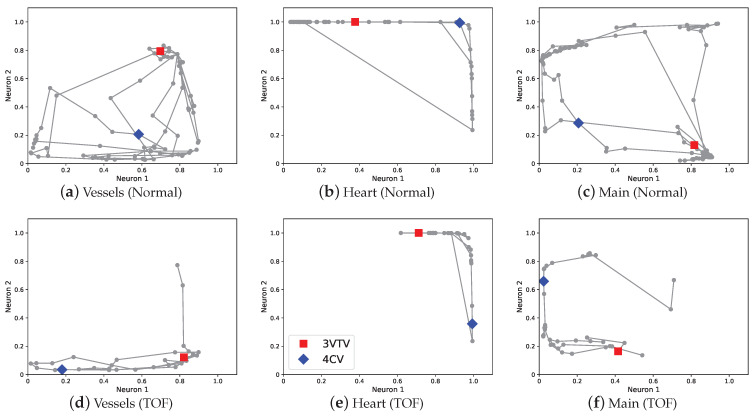
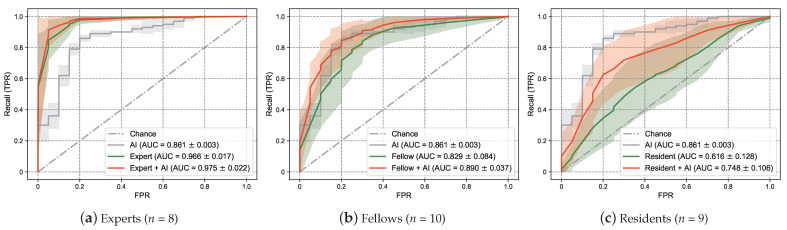
Diagnostic support tools based on artificial intelligence (AI) have exhibited high performance in various medical fields. However, their clinical application remains challenging because of the lack of explanatory power in AI decisions (black box problem), making it difficult to build trust with medical professionals. Nevertheless, visualizing the internal representation of deep neural networks will increase explanatory power and improve the confidence of medical professionals in AI decisions. We propose a novel deep learning-based explainable representation “graph chart diagram” to support fetal cardiac ultrasound screening, which has low detection rates of congenital heart diseases due to the difficulty in mastering the technique. Screening performance improves using this representation from 0.966 to 0.975 for experts, 0.829 to 0.890 for fellows, and 0.616 to 0.748 for residents in the arithmetic mean of area under the curve of a receiver operating characteristic curve. This is the first demonstration wherein examiners used deep learning-based explainable representation to improve the performance of fetal cardiac ultrasound screening, highlighting the potential of explainable AI to augment examiner capabilities.
Overview
The claims and statistics of this paper haven’t been checked yet.
Free: it reads the open-access text and checks the first 5 claims that cite a source we can check. Create a free account to check every claim.
Integrity signals
Registry
Cites
Statistics
Figures
Verification
Claims the paper makes
The claims and statistics of this paper haven’t been checked yet.
Free: it reads the open-access text and checks the first 5 claims that cite a source we can check. Create a free account to check every claim.
Claims other papers make about this one
Each is checked against this paper’s own text: does it say what the citing paper says it does?
The source backs part of the claim, not all of it — or backs it for a different population, condition or comparison.
In the citing paper
“In clinical settings, US is known to be time consuming and can require a substantial amount of training and experience for specific indications, such as fetal echocardiography or neurosonography [5,6,7].”
From Evolving the Era of 5D Ultrasound? A Systematic Literature Review on the Applications for Artificial Intelligence Ultrasound Imaging in Obstetrics and Gynecology (2023) · cites this paper as [7]
Experimental — accuracy not yet measuredThe source backs part of the claim, not all of it — or backs it for a different population, condition or comparison.
In the citing paper
“Furthermore, even with the assistance of AI methods, experienced sonographers were required for rechecking and the interpretation of results [7,51].”
From Evolving the Era of 5D Ultrasound? A Systematic Literature Review on the Applications for Artificial Intelligence Ultrasound Imaging in Obstetrics and Gynecology (2023) · cites this paper as [7]
Experimental — accuracy not yet measuredThe cited source says what the claim attributes to it.
In the citing paper
“the concept of ‘explainable AI’, which is used in the studies of Sakai et al. and Dong et al. [7,201].”
In the citing paper
“The results obtained following previous research using the DL method from fetal US images can help increase the detection of fetal heart abnormalities compared to human experts [10,17,18,24].”
From Deep Learning for Improving the Effectiveness of Routine Prenatal Screening for Major Congenital Heart Diseases (2022) · cites this paper as [18]
Self-check
Percentages, sums and reported differences re-computed from the paper’s own numbers.
The self-check needs the paper’s full text.
Citations
Cites
Gradient-based learning applied to document recognition
Lecun, Y., Bottou, L., Bengio, Y., & Haffner, P. (1998) · Proceedings of the IEEE · doi:10.1109/5.726791 · Cited by 58,805 · cited 1×
“Referring to previous studies [46–48], the image number of our training data is in the same order of data size as the MNIST dataset, which was sufficient to achieve enough performance in this study.”
ResultGrad-CAM: Visual Explanations from Deep Networks via Gradient-Based Localization
Selvaraju, R. R., Cogswell, M., Das, A., Vedantam, R., Parikh, D., & Batra, D. (2017) · 2017 IEEE International Conference on Computer Vision (ICCV) · doi:10.1109/iccv.2017.74 · Cited by 24,513
Reducing the dimensionality of data with neural networks
Hinton, G. E., & Salakhutdinov, R. R. (2006) · Science · doi:10.1126/science.1127647 · Cited by 20,928
YOLO9000: Better, Faster, Stronger
Redmon, J., & Farhadi, A. (2017) · 2017 IEEE Conference on Computer Vision and Pattern Recognition (CVPR) · doi:10.1109/cvpr.2017.690 · Cited by 19,892 · cited 1×
“We used only normal data from 134 normal cases (292 videos) to train DNNs explained in Section 2.2; 108 cases (247 videos) for object detection model YOLOv2 [45]; 60 cases (151 videos) for training the proposed auto-encoders.”
MethodInfluentialDermatologist-level classification of skin cancer with deep neural networks
Esteva, A., Kuprel, B., Novoa, R. A., Ko, J., Swetter, S. M., Blau, H. M., & Thrun, S. (2017) · Nature · doi:10.1038/nature21056 · Cited by 14,362
LIII. On lines and planes of closest fit to systems of points in space
Pearson, K. (1901) · The London, Edinburgh, and Dublin Philosophical Magazine and Journal of Science · doi:10.1080/14786440109462720 · Cited by 11,934 · cited 1×
“Therefore, TimeCluster compresses the dimensions using autoencoders and applies principal component analysis [51] or other projection methods to the intermediate representation.”
MethodRudin, C. (2019) · Nature Machine Intelligence · doi:10.1038/s42256-019-0048-x · Cited by 10,561 · cited 4×
“Because decisions (or AI score) and explanations are generated from the same process in interpretable models, consistency between explanations and decisions is high, and performance enhancement by adding explanations to decisions is most expected [20].”
BackgroundInfluentialHannun, A. Y., Rajpurkar, P., Haghpanahi, M., Tison, G. H., Bourn, C., Turakhia, M. P., & Ng, A. Y. (2019) · Nature Medicine · doi:10.1038/s41591-018-0268-3 · Cited by 3,148
Clinically applicable deep learning for diagnosis and referral in retinal disease
De Fauw, J., Ledsam, J. R., Romera-Paredes, B., Nikolov, S., Tomasev, N., Blackwell, S., Askham, H., Glorot, X., O’Donoghue, B., Visentin, D., et al. (2018) · Nature Medicine · doi:10.1038/s41591-018-0107-6 · Cited by 2,639
Machine Learning Interpretability: A Survey on Methods and Metrics
Carvalho, D. V., Pereira, E. M., & Cardoso, J. S. (2019) · Electronics · doi:10.3390/electronics8080832 · Cited by 1,842 · cited 1×
“One of the major obstacles is regarded as the “black box problem” of AI [4,6–8].”
Background
Research works printed but not linked: 1
- Goodfellow I. Bengio Y. Courville A. Deep Learning MIT Press Cambridge, MA, USA 2016
Cited by
ŞAHiN, E., Arslan, N. N., & Özdemir, D. (2025) · Neural Computing and Applications · doi:10.1007/s00521-024-10437-2 · Cited by 278
The Integration of Artificial Intelligence into Clinical Practice
Karalis, V. D. (2024) · Applied Biosciences · doi:10.3390/applbiosci3010002 · Cited by 255
“This screening process is known to have a relatively low rate of detecting congenital heart disease during the second-trimester stages, primarily due to the challenges associated with mastering the technique [128].”
BackgroundRecent Applications of Explainable AI (XAI): A Systematic Literature Review
Saarela, M., & Podgorelec, V. (2024) · Applied Sciences · doi:10.3390/app14198884 · Cited by 183
Explainable Artificial Intelligence and Cardiac Imaging: Toward More Interpretable Models
Salih, A. M., Galazzo, I. B., Gkontra, P., Lee, A. M., Lekadir, K., Raisi‐Estabragh, Z., & Petersen, S. E. (2023) · Circulation Cardiovascular Imaging · doi:10.1161/circimaging.122.014519 · Cited by 149
Use of artificial intelligence and deep learning in fetal ultrasound imaging
Ramirez Zegarra, R., & Ghi, T. (2023) · Ultrasound in Obstetrics & Gynecology · doi:10.1002/uog.26130 · Cited by 102
Metadata
- Authors
- Sakai, A., Komatsu, M., Komatsu, R., Matsuoka, R., Yasutomi, S., Dozen, A., Shozu, K., Arakaki, T., Machino, H., Asada, K., Kaneko, S., Sekizawa, A., & Hamamoto, R.
- Affiliations
- Tokyo Medical and Dental University (JP)
- RIKEN Center for Advanced Intelligence Project (JP)
- SHOWA Medical University (JP)
- Fujitsu (Japan) (JP)
- National Cancer Center Research Institute (JP)
- Corresponding author
- Komatsu, Masaaki
- Hamamoto, Ryuji
- ORCID
- Venue
- Biomedicines
- Publisher
- MDPI AG
- Published
- 2022-02-25
- Volume
- 10
- Issue
- 3
- Pages
- 551
- ISSN
- 2227-9059 (ISSN-L)
- PMC
- PMC8945208
- OpenAlex
- W4214574368
- Semantic Scholar
- 18920a1b5d8470490b4b947a0d211ca94993dc81
- Cited by
- 68
- References
- 74
- Citations by year
- 2026: 8 · 2025: 15 · 2024: 17 · 2023: 23 · 2022: 5
- FWCI
- 4.94
- Type
- journal article
- Language
- en
- Open access
- gold
- doi.org
- Licence
- Locations
- Biomedicines (publishedVersion, cc-by)
- PubMed Central (publishedVersion, cc-by)
- PubMed (publishedVersion)
- DOAJ (DOAJ: Directory of Open Access Journals) (submittedVersion)
- Funders
- Ministry of Education, Culture, Sports, Science and Technology (Advanced Integrated Intelligence Platform)
- Topics
- Physical Sciences › Computer Science › Artificial Intelligence › Explainable Artificial Intelligence (XAI)
- Health Sciences › Medicine › Health Informatics › Artificial Intelligence in Healthcare and Education
- Health Sciences › Health Professions › Health Information Management › Artificial Intelligence in Healthcare
- Keywords
- explainable AI, fetal echocardiography, deep learning, black box problem, diagnostic support tool, medical training
About these checks
Registry, retraction, Cites and statistics results are computed, not judged, with one exception: a printed reference that no index lists is read once by a model before it counts as a citation error. Claims are extracted by a model and kept only when their quote appears verbatim in the text; each cited source is then checked, with a model’s help, for whether it says what the claim relies on. Those verdicts can be wrong — read the claim’s quote and the cited source before relying on one.
Statistics and arithmetic are recomputed, not judged.
Confidence bands are shown only for fields calibrated on our annotated test set. None is calibrated yet, so no band is shown.
What counts as a claim ›How we measure confidence ›How we check this ›
Are you an author, or do you see a problem with this page? Request a review
Data sources
Bibliographic data: Semantic Scholar, OpenAlex, Crossref.
Contains information from the Semantic Scholar Academic Graph Datasets, made available under the ODC Attribution License (ODC-BY 1.0).
Semantic Scholar’s data is described in: Kinney, R., et al. (2023). The Semantic Scholar Open Data Platform. arXiv:2301.10140.
