

Facial Emotion Recognition in Children and Adolescents with Specific Learning Disorder
Open accessThe DOI matches its Crossref record; 44 of the 45 references it cites were found in a registry or an index; none of the 13 sources its claims cite is checked for support yet.
Abstract
Background: Some recent studies suggest that children and adolescents with different neurodevelopmental disorders perform worse in emotions recognition through facial expressions (ER) compared with typically developing peers. This impairment is also described in children with Specific Learning Disorders (SLD), compromising their scholastic achievement, social functioning, and quality of life. The purpose of our study is to evaluate ER skills in children and adolescents with SLD compared to a control group without learning disorders, and correlate them with intelligence and executive functions. Materials and Methods: Our work is a cross-sectional observational study. Sixty-three children and adolescents aged between 8 and 16 years, diagnosed with SLD, and 32 sex/age-matched controls without learning disorders were recruited. All participants were administered standardized neuropsychological tests, evaluating facial emotion recognition (NEPSY-II), executive functions (EpiTrack Junior), and intelligence profile (WISC-IV). Results: Emotion recognition mean score was significantly lower in the SLD group than in the controls group on the Mann–Whitney U test for unpaired samples (p < 0.001). The SLD group performed significantly lower than the control group in their abilities to identify neutral expressions, happiness, sadness, anger, and fear compared to controls (p < 0.001). ER scores were positively correlated to the executive functions scores. There was no correlation with the Total Intelligence Quotient scores but there is a significant positive correlation with Working Memory Index and Processing Speed Index measured by WISC.IV. Conclusion: Our study showed that children and adolescents with Specific Learning Disorders have facial emotion recognition impairment when compared with a group of peers without learning disorders. ER abilities were independent of their global intelligence but potentially related to executive functions.
Overview
CoChat Summary
## TL;DR
This cross-sectional study found that children and adolescents with Specific Learning Disorder (SLD) performed worse than age/sex-matched controls on facial emotion recognition, with 56% scoring below the NEPSY-II norm versus 0% of controls. Facial emotion recognition was positively correlated with executive function measures, but not with total IQ.
## Key findings
- In the SLD group, 35/63 (56%) scored below the NEPSY-II norm for emotion recognition (age-weighted score ≤ 4), compared with 0/32 (0%) controls.
- Mean NEPSY-II emotion recognition score was significantly lower in SLD than controls: 4.59 ± 2.52 vs 10.44 ± 1.00 (p < 0.001).
- Children with SLD performed significantly worse than controls in identifying happiness, sadness, anger, fear, disgust, and neutral expressions (p < 0.001 for all).
- Emotion recognition scores were positively correlated with EpiTrack Junior executive function scores (r = 0.729, p < 0.001), as well as WISC-IV Working Memory (r = 0.569, p < 0.001) and Processing Speed (r = 0.532, p < 0.001), but not with Total IQ (r = 0.046, p = 0.718).
## Methods
- Design: Cross-sectional observational study.
- Sample/data: 63 children and adolescents with SLD (aged 8–16 years, 34 male, 54%) and 32 age/sex-matched controls recruited at the Child Neuropsychiatry Unit of the University Hospital of Salerno from December 2017 to December 2019.
- Main analysis: Group comparisons used Mann–Whitney U tests and Chi-square tests; post hoc Kruskal–Wallis H-test; associations between emotion recognition, executive function, and IQ used Spearman rank correlations.
## Limitations
- The paper states that facial emotion recognition is “complex and difficult to quantify” and is “even more difficult to generalize to real-world contexts.”
- It states that the study does not take into account other aspects of social cognition, such as Theory of Mind, social decision-making, and moral cognition.
- The text makes evident that the sample is small and from a single hospital unit, which may limit generalizability; the paper also notes that the subtype analysis may be limited by low sample size.
Model-written summary. Check it against the paper before relying on it.
Integrity signals
Registry
Cites
Statistics
Figures
Verification
Claims the paper makes
0 Valid · 0 Not valid · 6 Not checked · 25 Own results and interpretations
A result the paper reports from its own data — it cites no other source for it, so there is none to check. The quote shows it is in the paper.
In the paper
“Emotion recognition mean score was significantly lower in the SLD group than in the controls group on the Mann–Whitney U test for unpaired samples (p < 0.001).”
- Also stated in: § 3.3. Emotion Recognition: Comparison between Groups and Correlation Analysis · plain
“The mean ER total scores also fell under the norm (<2 SD) for the SLD group (mean score 4.59 ± 2.52) while they were in the normal range for the control group (mean score 10.44 ± 1.00), and this difference was statistically significant to the Mann–Whitney U test for independent samples (p < 0.001; Table 2).”
§ Facial Emotion Recognition in Children and Adolescents with Specific Learning Disorder > Abstract
plainn = 3 ·- Asserted: passes — The authors put it forward as true.
- Checkable: passes — It can be checked against evidence.
- Load-bearing: passes — The paper’s conclusions depend on it.
- Based: passes — The paper gives a reason why it holds.
- Also stated in: § 3.3. Emotion Recognition: Comparison between Groups and Correlation Analysis · plain
A result the paper reports from its own data — it cites no other source for it, so there is none to check. The quote shows it is in the paper.
In the paper
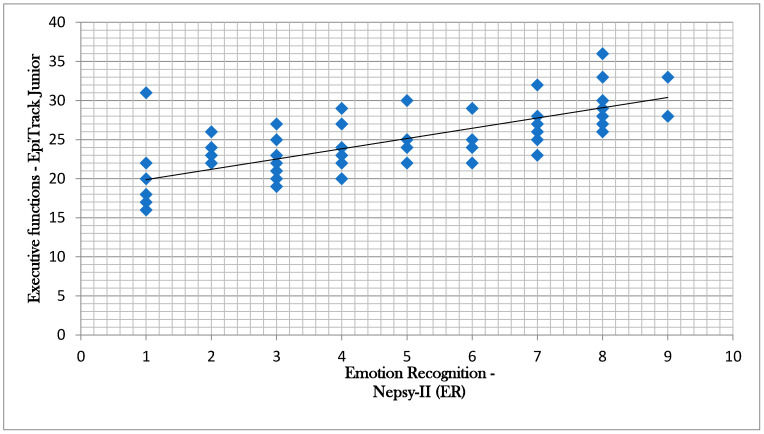
“The correlation analysis, carried out with the Spearman rank correlation test, showed significant positive correlations between ER scores and Epitrack Junior scores (r = 0.729, p < 0.001; Figure 1) in the SLD group.”
- Also stated in: § Abstract · plain
“ER scores were positively correlated to the executive functions scores.”
§ Facial Emotion Recognition in Children and Adolescents with Specific Learning Disorder > 3. Results > 3.3. Emotion Recognition: Comparison between Groups and Correlation Analysis
plainstates an associationn = 3- Asserted: passes — The authors put it forward as true.
- Checkable: passes — It can be checked against evidence.
- Load-bearing: passes — The paper’s conclusions depend on it.
- Based: passes — The paper gives a reason why it holds.
- Rests on an assumption not shown here.
- Also stated in: § Abstract · plain
A result the paper reports from its own data — it cites no other source for it, so there is none to check. The quote shows it is in the paper.
In the paper
“The ER scores positively correlated also with the Working Memory Index (r = 0.569, p < 0.001) and the Processing Speed Index (r = 0.532, p < 0.001), while there was no significant correlation with the Verbal Comprehension Index (r = 0.009, p = 0.944) and the Perceptual Reasoning Index (r = −0.121, p = 0.347).”
§ Facial Emotion Recognition in Children and Adolescents with Specific Learning Disorder > 3. Results > 3.3. Emotion Recognition: Comparison between Groups and Correlation Analysis
plainstates an association- Asserted: passes — The authors put it forward as true.
- Checkable: passes — It can be checked against evidence.
- Load-bearing: unclear — It is unclear whether the paper’s conclusions depend on it.
- Based: passes — The paper gives a reason why it holds.
A result the paper reports from its own data — it cites no other source for it, so there is none to check. The quote shows it is in the paper.
In the paper
“On the NEPSY-II ER (Emotional Recognition) subtest, 35/63 (56%) patients with SLD obtained a total score under the norm (age weighted score ≤ 4), against 0/32 (0%) controls.”
- Also stated in: § 4. Discussion · plain
“In particular, in our sample, 56% of children with SLD obtained an ER score below the norm against 0% of controls, as measured by the NEPSY-II test.”
§ Facial Emotion Recognition in Children and Adolescents with Specific Learning Disorder > 3. Results > 3.3. Emotion Recognition: Comparison between Groups and Correlation Analysis
plain- Asserted: passes — The authors put it forward as true.
- Checkable: passes — It can be checked against evidence.
- Load-bearing: passes — The paper’s conclusions depend on it.
- Based: passes — The paper gives a reason why it holds.
- Also stated in: § 4. Discussion · plain
A result the paper reports from its own data — it cites no other source for it, so there is none to check. The quote shows it is in the paper.
In the paper
“The ER scores positively correlated also with the Working Memory Index (r = 0.569, p < 0.001) and the Processing Speed Index (r = 0.532, p < 0.001), while there was no significant correlation with the Verbal Comprehension Index (r = 0.009, p = 0.944) and the Perceptual Reasoning Index (r = −0.121, p = 0.347).”
§ Facial Emotion Recognition in Children and Adolescents with Specific Learning Disorder > 3. Results > 3.3. Emotion Recognition: Comparison between Groups and Correlation Analysis
plainstates an association- Asserted: passes — The authors put it forward as true.
- Checkable: passes — It can be checked against evidence.
- Load-bearing: passes — The paper’s conclusions depend on it.
- Based: passes — The paper gives a reason why it holds.
10 more claims
Create a free account to see all 31 claims and every source verdict.
- It may state two separate claims as one. 12
- Probably not a substantial claim. 5
Self-check
Percentages, sums and reported differences re-computed from the paper’s own numbers.
Rated major: it would touch a result — a value a result rests on, reported and recomputed p-values on opposite sides of the significance level, two passages that conflict with no sign which is right, or a cited work retracted before this paper was published.
In the paper
“With regard to executive functions, 47/63 (75%) children with SLD obtained a score under the norm (<28), against 1/32 (0.03%) of the children of control group.”
§ Facial Emotion Recognition in Children and Adolescents with Specific Learning Disorder > 3. Results > 3.2. Executive Functions and Cognitive Profile
Reported 0.03 · recomputed 3.125
Citations
Cites
Diagnostic and Statistical Manual of Mental Disorders
American Psychiatric Association (2013) · doi:10.1176/appi.books.9780890425596 · Cited by 116,369
Diamond, A. (2013) · Annual Review of Psychology · doi:10.1146/annurev-psych-113011-143750 · Cited by 13,268
Social Cognitive Neuroscience: A Review of Core Processes
Lieberman, M. D. (2007) · Annual Review of Psychology · doi:10.1146/annurev.psych.58.110405.085654 · Cited by 2,010
Neural systems for recognizing emotion
Adolphs, R. (2002) · Current Opinion in Neurobiology · doi:10.1016/s0959-4388(02)00301-x · Cited by 1,933
Uniquely human social cognition
Saxe, R. (2006) · Current Opinion in Neurobiology · doi:10.1016/j.conb.2006.03.001 · Cited by 919 · cited 1×
“In recent years, increasing attention has been given to the evaluation of social cognition (SC) and social functioning in children and adolescents, as this aspect is an important predictor of future school, work, and social successes and is crucial for adaptive functioning and a good quality of life [1,2].”
BackgroundInnate and universal facial expressions: Evidence from developmental and cross-cultural research.
Izard, C. E. (1994) · Psychological Bulletin · doi:10.1037//0033-2909.115.2.288 · Cited by 856
Frith, C. D., & Frith, U. (2007) · Current Biology · doi:10.1016/j.cub.2007.05.068 · Cited by 759
The development of emotional face processing during childhood
Batty, M., & Taylor, M. J. (2006) · Developmental Science · doi:10.1111/j.1467-7687.2006.00480.x · Cited by 331
Facial emotion recognition in child psychiatry: A systematic review
Collin, L., Bindra, J., Raju, M., Gillberg, C., & Minnis, H. (2013) · Research in Developmental Disabilities · doi:10.1016/j.ridd.2013.01.008 · Cited by 182
Interpretation of Emotion From Facial Expressions in Children With and Without Learning Disabilities
Holder, H. B., & Kirkpatrick, S. W. (1991) · Journal of Learning Disabilities · doi:10.1177/002221949102400305 · Cited by 98 · cited 1×
“The authors also hypothesized that there were two SLD subgroups with different difficulties: the younger females with difficulty in interpreting the emotions and the older males who were rapid but often inaccurate [24].”
BackgroundNelson, E. E., McClure, E. B., Monk, C. S., Zarahn, E., Leibenluft, E., Pine, D. S., & Ernst, M. (2003) · Journal of Child Psychology and Psychiatry · doi:10.1111/1469-7610.00186 · Cited by 96
Airdrie, J. N., Langley, K., Thapar, A., & van Goozen, S. H. M. (2018) · Journal of the American Academy of Child & Adolescent Psychiatry · doi:10.1016/j.jaac.2018.04.016 · Cited by 87
Dimitrovsky, L., Spector, H., Levy-Shiff, R., & Vakil, E. (1998) · Journal of Learning Disabilities · doi:10.1177/002221949803100308 · Cited by 81
Perception of Nonverbal Emotion Cues by Children with Nonverbal Learning Disabilities
Petti, V. L., Voelker, S. L., Shore, D. L., & Hayman-Abello, S. E. (2003) · Journal of Developmental and Physical Disabilities · doi:10.1023/a:1021400203453 · Cited by 74
The Nature of Facial Emotion Recognition Impairments in Children on the Autism Spectrum
Shanok, N. A., Jones, N. A., & Lucas, N. N. (2019) · Child Psychiatry & Human Development · doi:10.1007/s10578-019-00870-z · Cited by 67
Oerlemans, A. M., Droste, K., van Steijn, D. J., de Sonneville, L. M. J., Buitelaar, J. K., & Rommelse, N. N. J. (2013) · Journal of Autism and Developmental Disorders · doi:10.1007/s10803-013-1807-x · Cited by 64
David, D. P., Soeiro‐de‐Souza, M. G., Moreno, R. A., & Bio, D. S. (2013) · Journal of Affective Disorders · doi:10.1016/j.jad.2013.09.027 · Cited by 63
Poletti, M. (2016) · Journal of Learning Disabilities · doi:10.1177/0022219414555416 · Cited by 61
Smirni, D., Turriziani, P., Mangano, G. R., Cipolotti, L., & Oliveri, M. (2015) · PLoS ONE · doi:10.1371/journal.pone.0144838 · Cited by 61
Helmstaedter, C., Schoof, K., Rossmann, T., Reuner, G., Karlmeier, A., & Kurlemann, G. (2010) · Epilepsy & Behavior · doi:10.1016/j.yebeh.2010.06.042 · Cited by 58 · cited 2×
“, 2010) in children and adolescents with epilepsy aged between 6 and 18 years [37].”
BackgroundMethodYang, C., Zhang, T., Li, Z., Heeramun-Aubeeluck, A., Liu, N., Huang, N., Zhang, J., He, L., Li, H., Tang, Y., et al. (2015) · BMC Psychiatry · doi:10.1186/s12888-015-0618-3 · Cited by 55
Bloom, E., & Heath, N. (2010) · Journal of Learning Disabilities · doi:10.1177/0022219409345014 · Cited by 54 · cited 1×
“In a more recent comparative study by Bloom and Heath (2010), the authors investigated the recognition and understanding of facial expressions of emotions in adolescents with general SLD and non-verbal SLD disorders compared to a control group [22].”
BackgroundŞahin, B., Karabekiroğlu, K., Bozkurt, A., Usta, M. B., Aydın, M., & Osmanlı, C. Ç. (2018) · Psychiatry Investigation · doi:10.30773/pi.2018.10.01 · Cited by 47
Facial emotion recognition in intellectual disabilities
Zaja, R. H., & Rojahn, J. (2008) · Current Opinion in Psychiatry · doi:10.1097/yco.0b013e328305e5fd · Cited by 43
Social cognition and executive functions in children and adolescents with focal epilepsy
Operto, F. F., Pastorino, G. M. G., Mazza, R., Bonaventura, C. D., Marotta, R., Pastorino, N., Matricardi, S., Verrottı, A., Carotenuto, M., & Roccella, M. (2020) · European Journal of Paediatric Neurology · doi:10.1016/j.ejpn.2020.06.019 · Cited by 43
Self-citationEmotional Intelligence in Children with Severe Sleep-Related Breathing Disorders
Operto, F. F., Precenzano, F., Bitetti, I., Lanzara, V., Fontana, M. L., Pastorino, G. M. G., Carotenuto, M., Pisani, F., Polito, A. N., Smirni, D., et al. (2019) · Behavioural Neurology · doi:10.1155/2019/6530539 · Cited by 39
Self-citationNeuro-Cognition and Social Cognition Elements of Social Functioning and Social Quality of Life
Hasson-Ohayon, I., Mashiach-Eizenberg, M., Arnon-Ribenfeld, N., Kravetz, S., & Roe, D. (2017) · Psychiatry Research · doi:10.1016/j.psychres.2017.09.004 · Cited by 34 · cited 1×
“On the other hand, deficit in SC can significantly contribute to psychosocial difficulties in both children and adults [9,10].”
BackgroundDecoding of Emotional Expressions in Children and Adolescents
Lenti, C., Lenti-Boero, D., & Giacobbe, A. (1999) · Perceptual and Motor Skills · doi:10.2466/pms.1999.89.3.808 · Cited by 34
Most, T., & Greenbank, A. (2000) · Learning Disabilities Research and Practice · doi:10.1207/sldrp1504_1 · Cited by 31
Faedda, N., Romani, M., Rossetti, S., Vigliante, M., Pezzuti, L., Cardona, F., & Guidetti, V. (2019) · Scandinavian Journal of Psychology · doi:10.1111/sjop.12562 · Cited by 31 · cited 1×
“Several studies support the evidence that WISC-IV intellectual functioning in children with SLD was characterized by a normal IQ with a significant discrepancy between general ability (Verbal Comprehension and Perceptual Reasoning Index) and cognitive proficiency (Working Memory Index and Processing Speed Index), whic…”
ResultFörster, K., Jörgens, S., Air, T., Bürger, C., Enneking, V., Redlich, R., Zaremba, D., Grotegerd, D., Dohm, K., Meinert, S., et al. (2018) · Psychiatry Research · doi:10.1016/j.psychres.2018.02.046 · Cited by 30
Smirni, D., Smirni, P., Di Martino, G., Operto, F. F., & Carotenuto, M. (2019) · Journal of Nervous & Mental Disease · doi:10.1097/nmd.0000000000000972 · Cited by 29
Self-citation(1995) · Learning Disabilities Research and Practice · Cited by 23
Reading–writing disorder in children with idiopathic epilepsy
Germanò, E., Gagliano, A., Arena, C., et al. (2020) · Epilepsy & Behavior · doi:10.1016/j.yebeh.2020.107118 · Cited by 21
Self-citationHurtado, M. M., Triviño, M., Arnedo, M., Roldán, G., & Tudela, P. (2016) · Psychiatry Research · doi:10.1016/j.psychres.2016.09.027 · Cited by 19 · cited 1×
“The correlation between executive functions and facial emotion recognition has been previously explored, and the results suggest a possible link between these two aspects in patients with different neurological and psychiatric conditions [43,44].”
Mangano, G. R., Oliveri, M., Turriziani, P., Smirni, D., Zhaoping, L., & Cipolotti, L. (2014) · Vision Research · doi:10.1016/j.visres.2014.02.002 · Cited by 19
Misunderstandings about Developmental Dyslexia: A Historical Overview
Smirni, P., Vetri, L., Misuraca, E., Cappadonna, M., Operto, F. F., Pastorino, G. M. G., & Marotta, R. (2020) · Pediatric Reports · doi:10.4081/pr.2020.8505 · Cited by 19
Self-citationSemrud-Clikeman, M., Fine, J. G., & Bledsoe, J. (2016) · Child Neuropsychology · doi:10.1080/09297049.2014.994487 · Cited by 18 · cited 1×
“The correlation between executive functions and facial emotion recognition has been previously explored, and the results suggest a possible link between these two aspects in patients with different neurological and psychiatric conditions [43,44].”
(2012) · IRIS Research product catalog (Sapienza University of Rome) · Cited by 16
Maire, J., Galéra, C., Roux, S., Bioulac, S., Bouvard, M. P., & Michel, G. (2018) · L Encéphale · doi:10.1016/j.encep.2018.01.006 · Cited by 14
Chapter 5. Specific Learning Disorder
Young, A., & Beitchman, J. H. (2014) · American Psychiatric Association Publishing eBooks · doi:10.1176/appi.books.9781585625048.gg05 · Cited by 13
Genova, H. M., Genualdi, A., Goverover, Y., Chiaravalloti, N. D., Marino, C., & Lengenfelder, J. (2017) · Social Neuroscience · doi:10.1080/17470919.2016.1173584 · Cited by 13 · cited 1×
“On the other hand, deficit in SC can significantly contribute to psychosocial difficulties in both children and adults [9,10].”
BackgroundQualitative and quantitative revaluation of specific learning disabilities: a multicentric study
Operto, F. F., Mazza, R., Buttiglione, M., et al. (2018) · Minerva Pediatrics · doi:10.23736/s0026-4946.18.05036-3 · Cited by 2
Self-citationReading and writing difficulties in third- and sixth-grade students: a cross-sectional survey
Operto, F. F., Esposito, D., Nicoletti, C., Corte, M. L., Duca, R. D., Viggiano, A., Pastorino, G. M. G., Aiello, S., Malianni, M., & Coppola, G. (2020) · Minerva Pediatrics · doi:10.23736/s0026-4946.20.05619-4 · Cited by 2
Self-citation
Cited by
Understanding Mental Health in Developmental Dyslexia: A Scoping Review
Wilmot, A., Hasking, P. A., Leitão, S., Hill, E., & Boyes, M. E. (2023) · International Journal of Environmental Research and Public Health · doi:10.3390/ijerph20021653 · Cited by 84
Social Cognition in Neurodevelopmental Disorders and Epilepsy
Pastorino, G. M. G., Operto, F. F., Padovano, C., Vivenzio, V., Scuoppo, C., Pastorino, N., Roccella, M., Vetri, L., Carotenuto, M., & Coppola, G. (2021) · Frontiers in Neurology · doi:10.3389/fneur.2021.658823 · Cited by 55
Self-citationDeep learning and spark architecture based intelligent brain tumor MRI image severity classification
Abirami, S., & Venkatesan, G. K. D. P. (2022) · Biomedical Signal Processing and Control · doi:10.1016/j.bspc.2022.103644 · Cited by 26
Bozkurt, A., Demirdöğen, E. Y., Çelik, M. K., & Akıncı, M. A. (2024) · PLoS ONE · doi:10.1371/journal.pone.0298468 · Cited by 27
Migraine and epilepsy: Social cognition skills in pediatric population
Operto, F. F., Scuoppo, C., Padovano, C., Vivenzio, V., Belfiore, G., Simone, V. D., Pistola, I., Rinaldi, R., Diaspro, G., Mazza, R., et al. (2022) · European Journal of Paediatric Neurology · doi:10.1016/j.ejpn.2022.01.011 · Cited by 14
Self-citation
Metadata
- Authors
- Operto, F. F., Pastorino, G. M. G., Stellato, M., Morcaldi, L., Vetri, L., Carotenuto, M., Viggiano, A., & Coppola, G.
- Affiliations
- University of Salerno (IT)
- University of Catania (IT)
- University of Palermo (IT)
- University of Campania "Luigi Vanvitelli" (IT)
- Corresponding author
- Operto, Francesca Felicia
- ORCID
- Venue
- Brain Sciences
- Publisher
- MDPI AG
- Published
- 2020-07-23
- Volume
- 10
- Issue
- 8
- Pages
- 473
- ISSN
- 2076-3425 (ISSN-L)
- PMC
- PMC7466138
- OpenAlex
- W3044841339
- Semantic Scholar
- d3fa0b1da0a2537048ee8d70c6c055ac1349f171
- Cited by
- 35
- References
- 45
- Citations by year
- 2026: 5 · 2025: 7 · 2024: 5 · 2023: 5 · 2022: 10 · 2021: 3
- FWCI
- 4.55
- Type
- journal article
- Language
- en
- Open access
- gold
- doi.org
- Licence
- Locations
- Brain Sciences (publishedVersion, cc-by)
- PubMed Central (publishedVersion, cc-by)
- PubMed (publishedVersion)
- DOAJ (DOAJ: Directory of Open Access Journals) (submittedVersion, cc-by-sa)
- Archivio Istituzionale della Ricerca - Università degli Studi della Campania "Luigi Vanvitelli" (submittedVersion)
- Topics
- Social Sciences › Psychology › Neuropsychology and Physiological Psychology › Developmental and Educational Neuropsychology
- Life Sciences › Neuroscience › Cognitive Neuroscience › Face Recognition and Perception
- Social Sciences › Psychology › Developmental and Educational Psychology › Reading and Literacy Development
- Keywords
- facial emotion recognition, specific learning disorders, executive function, intelligence, working memory, processing speed, children and adolescents, facial expressions
About these checks
Registry, retraction, Cites and statistics results are computed, not judged, with one exception: a printed reference that no index lists is read once by a model before it counts as a citation error. Claims are extracted by a model and kept only when their quote appears verbatim in the text; each cited source is then checked, with a model’s help, for whether it says what the claim relies on. Those verdicts can be wrong — read the claim’s quote and the cited source before relying on one.
A language model drew the claims from the paper on 2026-10-10, under version 3 of the claim definition (model deepseek-v4.1-flash, prompt extract-v3).
A second model labelled each claim on 2026-10-10 (model jev-1.13-20260917, definition revision gold-guideline-v0.2).
Statistics and arithmetic are recomputed, not judged.
Confidence bands are shown only for fields calibrated on our annotated test set. None is calibrated yet, so no band is shown.
What counts as a claim ›How we measure confidence ›How we check this ›
Are you an author, or do you see a problem with this page? Request a review
Data sources
Bibliographic data: Semantic Scholar, OpenAlex, Crossref.
Contains information from the Semantic Scholar Academic Graph Datasets, made available under the ODC Attribution License (ODC-BY 1.0).
Semantic Scholar’s data is described in: Kinney, R., et al. (2023). The Semantic Scholar Open Data Platform. arXiv:2301.10140.
