

Anti-Cholinesterase Combination Drug Therapy as a Potential Treatment for Alzheimer’s Disease
Open accessThe DOI matches its Crossref record; 50 of the 51 references it cites were found in a registry or an index.
Abstract
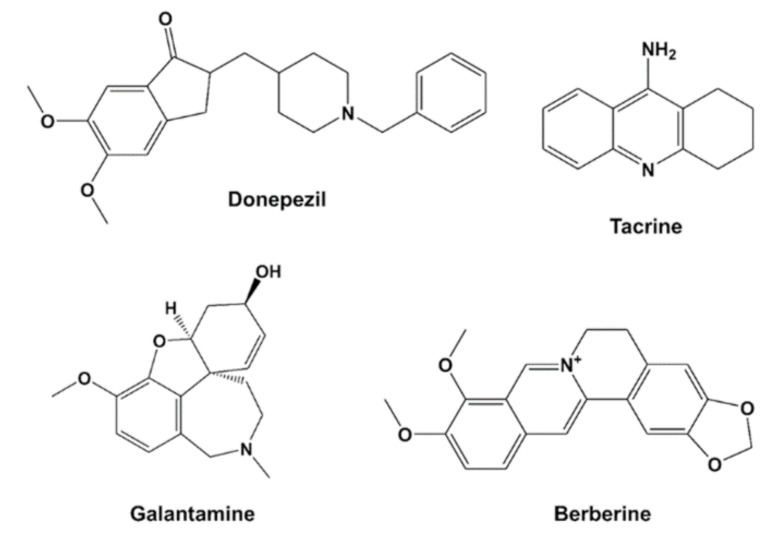
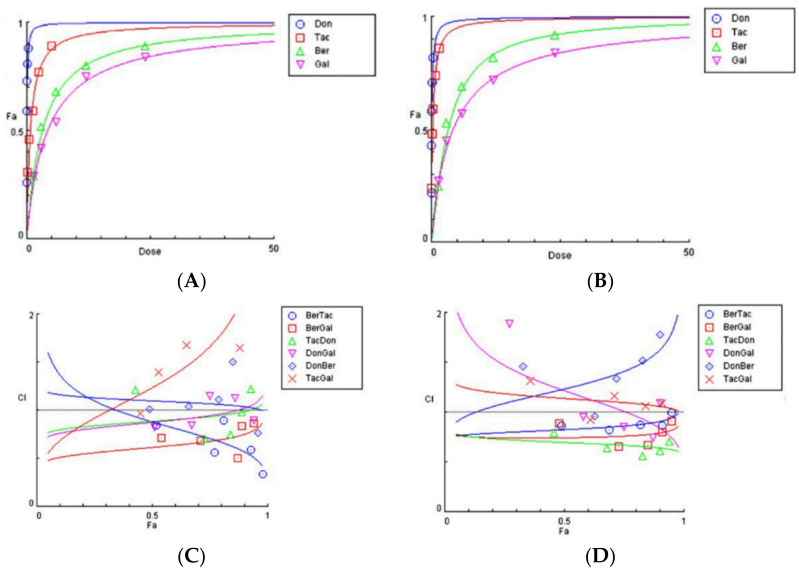
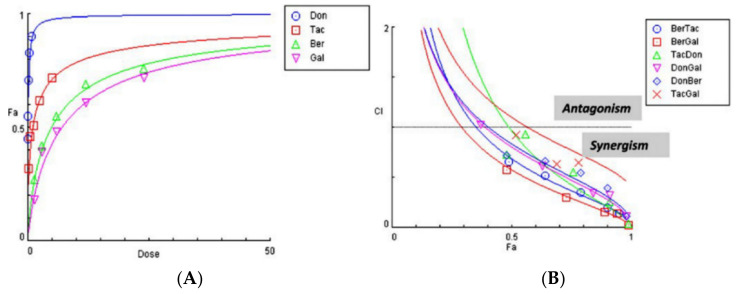
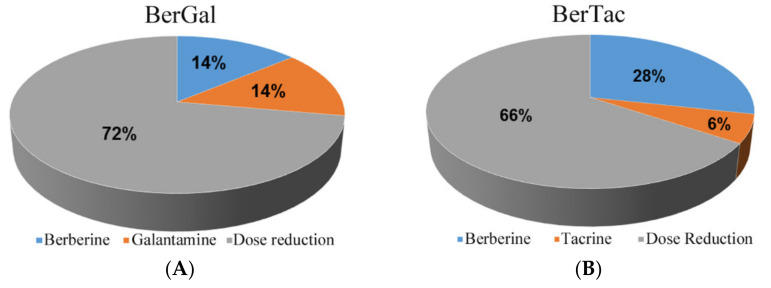
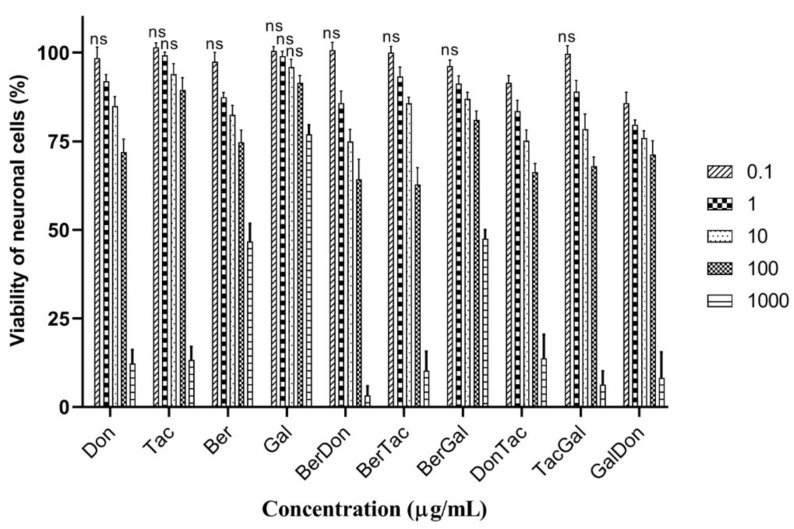
Alzheimer’s disease (AD) is a burgeoning social and healthcare problem. Cholinesterase inhibitors (ChEIs) are employed for symptomatic treatment of AD, but often elicit adverse drug reactions (ADRs). Herein, the potency of the ChEIs, donepezil, tacrine, berberine, and galantamine to inhibit human or Torpedo californica acetylcholinesterase (tcAChE) proteins were evaluated. The efficacy of dual-drug combinations to inhibit human AChE directly and within differentiated neurons was also quantified. ChEI potency was in the order: donepezil > tacrine > berberine > galantamine for both AChEs. Dual-drug combinations of berberine and tacrine (BerTac), berberine and galantamine (BerGal), and tacrine and donepezil (TacDon) all produced synergistic outcomes for AChE inhibition. Donepezil and berberine (DonBer) and tacrine and galantamine (TacGal) elicited antagonistic responses. Donepezil and galantamine (DonGal) was synergistic for human AChE but antagonistic for tcAChE. After application of dual-drug combinations to neuronal cells, BerTac, BerGal, DonGal, and DonBer all showed synergistic inhibition of AChE, TacDon additive, and TacGal antagonistic effects. BerGal produced the most potent synergism and reduced total drug dose by 72%. Individual ChEIs or dual-drug combinations were relatively non-toxic to neuronal cells, and only reduced cell viability at concentrations two–three orders of magnitude greater than that required to inhibit AChE. In summary, dual-drug combinations of ChEIs potentially represent a novel means of AD patient treatment, with reduced and more cost-effective drug dosing, and lowered likelihood of ADRs.
Overview
The claims and statistics of this paper haven’t been checked yet.
Free: it reads the open-access text and checks the first 5 claims that cite a source we can check. Create a free account to check every claim.
Integrity signals
Registry
Cites
Statistics
Figures
Verification
Claims the paper makes
The claims and statistics of this paper haven’t been checked yet.
Free: it reads the open-access text and checks the first 5 claims that cite a source we can check. Create a free account to check every claim.
Claims other papers make about this one
Each is checked against this paper’s own text: does it say what the citing paper says it does?
The source backs part of the claim, not all of it — or backs it for a different population, condition or comparison.
In the citing paper
“Furthermore, the combination use of appropriate cholinesterase inhibitors, such as donepezil (4) and galantamine (6), or the combination of cholinesterase inhibitors with other neurologic drugs, metal chelators, or antioxidants, may yield surprising effects in the management of cholinergic drugs in AD, including efficacy, tolerability, and safety.402,408”
From Recent advances in Alzheimer's disease: Mechanisms, clinical trials and new drug development strategies. (2024) · cites this paper as [408]
Experimental — accuracy not yet measured
Self-check
Percentages, sums and reported differences re-computed from the paper’s own numbers.
The self-check needs the paper’s full text.
Citations
Cites
A new and rapid colorimetric determination of acetylcholinesterase activity
Ellman, G. L., Courtney, K. D., Andres, V., & Featherstone, R. M. (1961) · Biochemical Pharmacology · doi:10.1016/0006-2952(61)90145-9 · Cited by 27,126 · cited 1×
“A microtiter plate version of the Ellman’s assay was used to determine the activity of human and Torpedo californica acetylcholinesterase enzymes [27].”
Method2016 Alzheimer's disease facts and figures
Alzheimer's Association (2016) · Alzheimer's & Dementia · doi:10.1016/j.jalz.2016.03.001 · Cited by 5,069
Acetylcholinesterase Inhibitors: Pharmacology and Toxicology
Colovic, M. B., Krstic, D. Z., Lazarevic-Pasti, T. D., Bondzic, A. M., & Vasic, V. M. (2013) · Current Neuropharmacology · doi:10.2174/1570159x11311030006 · Cited by 2,611
Nichols, E., Szoeke, C. E. I., Vollset, S. E., Abbasi, N., Abd-Allah, F., Abdela, J., Aichour, M. T. E., Akinyemi, R. O., Alahdab, F., Asgedom, S. W., et al. (2019) · The Lancet Neurology · doi:10.1016/s1474-4422(18)30403-4 · Cited by 2,412
Cholinesterase inhibitors for Alzheimer's disease
Birks, J. S. (2006) · Cochrane Database of Systematic Reviews · doi:10.1002/14651858.cd005593 · Cited by 1,906
Pathology of Neurodegenerative Diseases
Dugger, B. N., & Dickson, D. W. (2017) · Cold Spring Harbor Perspectives in Biology · doi:10.1101/cshperspect.a028035 · Cited by 1,665 · cited 2×
“The reduced cognition aligns with a loss of neuronal transmission and functionality, as well as a loss of neuronal mass [5,6].”
BackgroundThe hippocampus and memory: insights from spatial processing
Bird, C. M., & Burgess, N. (2008) · Nature Reviews Neuroscience · doi:10.1038/nrn2335 · Cited by 1,313 · cited 1×
“AD patients experience brain cortical atrophy primarily within the frontotemporal lobes, notably within the hippocampal and entorhinal cortex [5,6], consistent with the loss of cognitive function and memory attributed to these brain regions [7].”
BackgroundTerry, A. V., & Buccafusco, J. J. (2003) · The Journal of Pharmacology and Experimental Therapeutics · doi:10.1124/jpet.102.041616 · Cited by 1,159 · cited 1×
“A reduction of signaling from the neurotransmitter acetylcholine (ACh) led to the concept of a “cholinergic hypothesis” to explain some of the cognitive deficits experienced by AD patients [8,9].”
BackgroundThe cholinergic system in aging and neuronal degeneration
Schliebs, R., & Arendt, T. (2011) · Behavioural Brain Research · doi:10.1016/j.bbr.2010.11.058 · Cited by 1,047 · cited 1×
“A reduction of signaling from the neurotransmitter acetylcholine (ACh) led to the concept of a “cholinergic hypothesis” to explain some of the cognitive deficits experienced by AD patients [8,9].”
BackgroundBurns, A., & Iliffe, S. (2009) · BMJ · doi:10.1136/bmj.b158 · Cited by 859
Cited by
Zhang, J., Zhang, Y., Wang, J., Xia, Y., Zhang, J., & Chen, L. (2024) · Signal Transduction and Targeted Therapy · doi:10.1038/s41392-024-01911-3 · Cited by 1,138
Natural Alkaloids as Multi-Target Compounds towards Factors Implicated in Alzheimer’s Disease
Vrabec, R., Blunden, G., & Cahlíková, L. (2023) · International Journal of Molecular Sciences · doi:10.3390/ijms24054399 · Cited by 53
“The common source for in vitro tests with AChE is an eel, Electrophorus electricus (EeAChE), which, however, can provide divergent results in comparison to human AChE (hAChE) [7,20].”
BackgroundApplication of Marine Natural Products against Alzheimer’s Disease: Past, Present and Future
Hu, D., Jin, Y., Hou, X., Zhu, Y., Chen, D., Tai, J., Chen, Q., Shi, C., Ye, J., Wu, M., et al. (2023) · Marine Drugs · doi:10.3390/md21010043 · Cited by 53
“Thus, it could be used for new treatment of AD in the body from the view of barrier of blood-brain [55].”
BackgroundTherapeutic Potential of Targeting Mitochondria for Alzheimer’s Disease Treatment
Atlante, A., Amadoro, G., Latina, V., & Valenti, D. (2022) · Journal of Clinical Medicine · doi:10.3390/jcm11226742 · Cited by 41
Amat-ur-Rasool, H., Ahmed, M., Hasnain, S., Ahmed, A., & Carter, W. G. (2021) · Current Issues in Molecular Biology · doi:10.3390/cimb44010012 · Cited by 31
Self-citationALNasser, M. N., Mellor, I. R., & Carter, W. G. (2022) · Molecules · doi:10.3390/molecules27154891 · Cited by 31
“Hence, there is an unmet need to tackle disease aetiology, for example, through a multipronged treatment strategy [57,58].”
BackgroundSelf-citationKadi, I., Eltayb, W. A., Boufissiou, A., Benaceur, F., Bouchareb, A., Soltan, W. B., Baladehi, M. H., Kheniche, A., & Abdalla, M. (2023) · Journal of Molecular Structure · doi:10.1016/j.molstruc.2023.135562 · Cited by 26
Lü, J., Jiang, C., Schell, T. D., Joshi, M., Raman, J. D., & Xing, C. (2022) · The American Journal of Chinese Medicine · doi:10.1142/s0192415x2250063x · Cited by 19
Lai, G., Wu, H., Yang, K., Hu, K., Zhao, W., Chen, X., Li, J., Haifeng, W., Lv, Z., Xie, G., et al. (2025) · International Journal of Nanomedicine · doi:10.2147/ijn.s525960 · Cited by 21
“85 In a sporadic AD mouse model induced by intracerebroventricular injection of streptozotocin, BBR inhibited AChE activity and improved spatial learning and memory.”
Combination Therapy for the Treatment of Alzheimer’s Disease: Recent Progress and Future Prospects
Shirbhate, E., Patel, V. K., Tiwari, P., Kore, R., Veerasamy, R., Mishra, A., & Rajak, H. (2022) · Current Topics in Medicinal Chemistry · doi:10.2174/1568026622666220907114443 · Cited by 18
ALNasser, M. N., AlSaadi, A. M., Whitby, A., Kim, D., Mellor, I. R., & Carter, W. G. (2023) · Life · doi:10.3390/life13041019 · Cited by 17
“SH-SY5Y cells were differentiated according to published methods [53,54].”
MethodSelf-citationLi, Y., Liang, H., Lin, B., Yu, Y. Q., Wang, Y., Zhang, L., Cao, Y., & Guo, M. (2021) · Microchimica Acta · doi:10.1007/s00604-021-05044-0 · Cited by 15
Khan, U., Ahmad, M., Tuba, M., Naaz, R., Qayyum, F., Khatoon, S., Sanobar, Ahamad, S., Saquib, M., & Hussain, M. K. (2025) · European Journal of Medicinal Chemistry · doi:10.1016/j.ejmech.2025.118371 · Cited by 21
Moreira, N. C. D. S., Tamarozzi, E. R., Lima, J. E. B. D. F., Piassi, L. D. O., Carvalho, I., Passos, G. A. S., & Sakamoto‐Hojo, E. T. (2022) · International Journal of Molecular Sciences · doi:10.3390/ijms232314788 · Cited by 12
“Donepezil and tacrine were used as comparative control drugs at a concentration of 10 μM, as this concentration is the most commonly used in the literature [24].”
BackgroundMethodInfluentialTerpstra, K., GUTIERREZ, C. G., Gui, K., & Mirica, L. M. (2025) · ACS Chemical Neuroscience · doi:10.1021/acschemneuro.5c00493 · Cited by 13
Secoyanhusamine A, an Oxidatively Ring-Opened Isoquinoline Inner Salt From Corydalis yanhusuo
Wang, L., Xia, H., Wu, Y., Wang, Y., Lin, P., & Lin, S. H. (2022) · Frontiers in Chemistry · doi:10.3389/fchem.2021.831173 · Cited by 10
Vahid, Z. F., Eskandani, M., Dadashi, H., Vandghanooni, S., & Rashidi, M. (2024) · Heliyon · doi:10.1016/j.heliyon.2024.e40756 · Cited by 19
Wang, J., Li, J., Liu, K., Wang, S., Su, Q., Cheng, Y., Wang, Y., & Wang, Y. (2022) · Bioorganic & Medicinal Chemistry · doi:10.1016/j.bmc.2022.116651 · Cited by 9
Liu, X., Zhang, X., Wei, D., Liu, Z., & Yang, L. (2024) · Biosensors and Bioelectronics · doi:10.1016/j.bios.2024.117032 · Cited by 8
Aljadaan, A. M., AlSaadi, A. M., Shaikh, I. A., Whitby, A., Ray, A., Kim, D., & Carter, W. G. (2025) · Biomedicines · doi:10.3390/biomedicines13092148 · Cited by 13
“Hence, these phytochemicals had IC 50 values in the high nanomolar to low micromolar range, consistent with other studies that reported their in vitro efficacy values [52,64,65].”
Self-citationLi, W., Rang, Y., Liu, H., & Liu, C. (2023) · Phytotherapy Research · doi:10.1002/ptr.7908 · Cited by 8
Effect of Water Extract of Mangosteen Pericarp on Donepezil Pharmacokinetics in Mice
Bae, M., Han, S. Y., Kim, E. S., You, B. H., Kim, Y., Cho, J., Chin, Y., & Choi, Y. H. (2021) · Molecules · doi:10.3390/molecules26175246 · Cited by 7
“In addition, tissue distribution can provide information necessary to explain the mechanism of action considering the pharmacological target organ, and the increased concentration of a drug in the brain by co-treated compounds have been suggested as a potential therapy for the treatment of AD [35,58,59].”
BackgroundRole of pyridines as enzyme inhibitors in medicinal chemistry
Khan, K. M., Gillani, S. S., & Saleem, F. (2022) · Elsevier eBooks · doi:10.1016/b978-0-323-91221-1.00010-5 · Cited by 7
Adarvez‐Feresin, C. W., Ortiz, J. E., Piñeiro, M., Parravicini, O., Enriz, R. D., Garro, A., & Feresin, G. E. (2024) · Archiv der Pharmazie · doi:10.1002/ardp.202300581 · Cited by 7
Harnessing Essential Oils for Acetylcholinesterase Inhibition: A Literature Review
Asnaashari, S., Jahanban‐Esfahlan, A., & Amarowicz, R. (2025) · Phytotherapy Research · doi:10.1002/ptr.8512 · Cited by 7
Fadilah, F., Kezia, I., & Erlina, L. (2024) · Journal of Pharmacy & Pharmacognosy Research · doi:10.56499/jppres23.1715_12.2.204 · Cited by 6
Girgin, M., Tarbiat, S., Işık, S., & Kantarci-Carsibasi, N. (2024) · Journal of the Turkish Chemical Society Section A Chemistry · doi:10.18596/jotcsa.1367877 · Cited by 5
Koçancı, F. G., Eciroglu, H., & Yıldız, F. (2025) · Molecular Neurobiology · doi:10.1007/s12035-025-05149-0 · Cited by 3
“In a follow-up study, no toxic effects were observed at 0.1 μM, and significant reductions in viability occurred only at concentrations ≥ 100 μM [93].”
InfluentialTang, X., He, L., Li, S., Zhang, W., Wu, Z., & Hui, A. (2024) · Chemistry & Biodiversity · doi:10.1002/cbdv.202401931 · Cited by 3
Gezici, S., & Şekeroğlu, N. (2022) · Hacettepe University Journal of the Faculty of Pharmacy · doi:10.52794/hujpharm.1014770 · Cited by 2
Buranasudja, V., Vimolmangkang, S., Sanookpan, K., Aung, H. M., Nguyen, K. P., Le, A. T. P., Nguyen, N. H. T., Lê, A. T., Minh, K., & Nguyen, H. M. (2025) · Natural Product Research · doi:10.1080/14786419.2025.2547018 · Cited by 1
“In contrast, potent AchE inhibition is often associated with alkaloids such as berberine and galantamine, both of which are known to be effective inhibitors (Amat-Ur-Rasool et al. 2021).”
Wang, B., Li, Y., Yao, T., Shen, X., Li, H., Jiang, W., Li, X., & Zhu, Z. (2026) · RSC Medicinal Chemistry · doi:10.1039/d5md00963d · Cited by 3
Li, H., Wu, X., Wu, G., Guo, J., Nie, Z., & Sheng, Q. (2026) · Journal of Visualized Experiments · doi:10.3791/70432 · Cited by 2
Jiang, L., Yan, J., Liu, C., Dong, X., Shi, R., Ma, Q., Sun, S., & Sun, Y. (2026) · Biosensors and Bioelectronics · doi:10.1016/j.bios.2026.119140 · Cited by 1
Akramifard, H., Balafar, M. A., Razavi, S., & Ramli, A. R. (2021) · Preprints.org · doi:10.20944/preprints202103.0711.v1
Yukti, Sharma, A., Dhar, S., Ojha, R., & Prajapati, V. K. (2025) · Advances in protein chemistry and structural biology · doi:10.1016/bs.apcsb.2025.11.004
Recent Advances in Drug Development for the Management of Alzheimer’s Disease
Upadhyay, A., Singh, A. K., Jayaswal, N., Jaiswal, P., Singh, S. N., & Tewari, S. (2026) · BENTHAM SCIENCE PUBLISHERS eBooks · doi:10.2174/9798898814953126010014
Neuroprotective effect of berberine based on the Alzheimer’s disease model
Dębek-Kalinowska, K., Bebrysz, E., Palmi, J., Bartnik, P., Baran, J., Dunder, I., Koss, M., Biszewski, M., Drabik, A., & Ziomek, W. (2026) · Journal of Animal Science Biology and Bioeconomy · doi:10.24326/jasbb.2025.5583
Bayarsaikhan, E., Maciejewska‐Turska, M., Koval, M., Laskowski, T., Lasota, M., Urjin, O., Damdinjav, D., Gaweł‐Bęben, K., Kukula-Koch, W. A., & Khurelbat, D. (2026) · Molecules · doi:10.3390/molecules31132249
Pal, T., Mukherjee, S., Karati, D., Pahari, N., Hossain, C. M., & Naskar, S. (2026) · BENTHAM SCIENCE PUBLISHERS eBooks · doi:10.2174/9798898815646126010017
Koval, M., Lasota, M., Barańska, A., Skóra, B., ШЕВЕРА, М. В., Dvirna, T. S., Gaweł‐Bęben, K., & Kukula-Koch, W. A. (2026) · Molecules · doi:10.3390/molecules31183182
“Similar results from AChE inhibition were reported in an article comparing combined drug therapy for the treatment of Alzheimer’s disease and are comparable to those observed in our study [40].”
Kumar, N., Kushwaha, V. K., Singh, G., Ojha, S., Dash, A. K., & Shankar, G. (2026) · Bioorganic & Medicinal Chemistry · doi:10.1016/j.bmc.2026.118811
Zainuddin, M.-S., Wei, A. C., Bhuvanendran, S., & Azman, A. S. (2026) · Beni-Suef University Journal of Basic and Applied Sciences · doi:10.1186/s43088-026-00842-y
Metadata
- Authors
- Amat-ur-Rasool, H., Ahmed, M., Hasnain, S., & Carter, W. G.
- Affiliations
- University of Nottingham (GB)
- University of the Punjab (PK)
- Corresponding author
- Carter, Wayne G.
- Venue
- Brain Sciences
- Publisher
- MDPI AG
- Published
- 2021-02-02
- Volume
- 11
- Issue
- 2
- Pages
- 184
- ISSN
- 2076-3425 (ISSN-L)
- PMC
- PMC7913148
- OpenAlex
- W3128108545
- Cited by
- 43
- References
- 51
- Citations by year
- 2026: 10 · 2025: 8 · 2024: 6 · 2023: 6 · 2022: 9 · 2021: 4
- FWCI
- 3.65
- Type
- journal article
- Language
- en
- Open access
- gold
- doi.org
- Licence
- Locations
- Brain Sciences (publishedVersion, cc-by)
- PubMed Central (publishedVersion, cc-by)
- PubMed (publishedVersion)
- Repository@Nottingham (University of Nottingham) (publishedVersion, cc-by)
- Repository@Nottingham (University of Nottingham) (submittedVersion, cc-by)
- DOAJ (DOAJ: Directory of Open Access Journals) (submittedVersion, cc-by-sa)
- Funders
- Higher Education Commision, Pakistan (315-78152BS3-096, IRSIP No.1-8 /HEC/ HRD/2018/8570), NRPU Grant 8288)
- Commonwealth Scholarship Commission (PKCN-2018-267)
- Topics
- Health Sciences › Medicine › Pharmacology (medical) › Cholinesterase and Neurodegenerative Diseases
- Life Sciences › Neuroscience › Cellular and Molecular Neuroscience › Alzheimer's disease research and treatments
- Life Sciences › Pharmacology, Toxicology and Pharmaceutics › Toxicology › Pesticide Exposure and Toxicity
- Keywords
- Alzheimer's disease, cholinesterase inhibitors, combination therapy, acetylcholinesterase inhibition, donepezil, tacrine, berberine, galantamine, synergistic effect, antagonism, adverse drug reactions, neurons, Torpedo californica acetylcholinesterase, drug toxicity
About these checks
Registry, retraction, Cites and statistics results are computed, not judged, with one exception: a printed reference that no index lists is read once by a model before it counts as a citation error. Claims are extracted by a model and kept only when their quote appears verbatim in the text; each cited source is then checked, with a model’s help, for whether it says what the claim relies on. Those verdicts can be wrong — read the claim’s quote and the cited source before relying on one.
Statistics and arithmetic are recomputed, not judged.
Confidence bands are shown only for fields calibrated on our annotated test set. None is calibrated yet, so no band is shown.
What counts as a claim ›How we measure confidence ›How we check this ›
Are you an author, or do you see a problem with this page? Request a review
Data sources
Bibliographic data: Semantic Scholar, OpenAlex, Crossref.
Contains information from the Semantic Scholar Academic Graph Datasets, made available under the ODC Attribution License (ODC-BY 1.0).
Semantic Scholar’s data is described in: Kinney, R., et al. (2023). The Semantic Scholar Open Data Platform. arXiv:2301.10140.
