

The DOI matches its Crossref record; 53 of the 56 references it cites were found in a registry or an index; 12 of the 41 sources its claims cite were checked for support.
The effect of acceptance and commitment therapy for improving psychological well‐being in parents of individuals with autism spectrum disorders: A randomized controlled trial
Open accessAbstract
Background: Acceptance and Commitment Therapy (ACT) has been demonstrated as effective in improving psychological well‐being in several clinical domains, but there is no evidence regarding the parents of children with Autism Spectrum Disorder (ASD). Methods: In this randomized controlled trial, we evaluated the efficacy of the ACT matrix behavioral protocol in comparison to the Parent Training (PT) program, measuring several primary and secondary outcomes prior to and following treatments. Twelve parents were randomly and equally assigned to two demographically matched groups wherein individuals underwent 24 weekly meetings of ACT protocol (experimental group) or conventional PT (control group). Results: Parents enrolled in the ACT protocol demonstrated significant improvement in psychological flexibility, awareness states, personal values in everyday life, and parental stress, whereas reduced scores were elicited in parents’ perceptions of their child’s disruptive behaviors. Conclusions: The results of this randomized controlled trial, if repeated with a large number of subjects, could open the way to include ACT protocols in daily practice to support the development of new parenting skills. © 2021 by the authors. Licensee MDPI, Basel, Switzerland.
Overview
CoChat Summary
## TL;DR
This randomized controlled trial found that a 24-week ACT matrix protocol improved psychological flexibility and several well-being measures in parents of children with ASD more than parent training (PT). The study was small, but it suggests ACT may reduce parental stress and improve parents’ perceptions of child disruptive behavior.
## Key findings
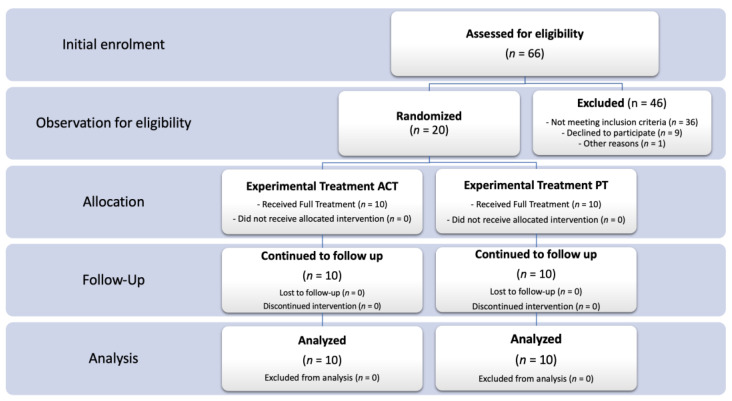
- Sample and follow-up: 20 parent pairs completed the study and were analyzed; the intervention lasted 24 weekly meetings of 90 minutes each over six months.
- Primary outcomes: Compared with PT, the ACT group showed significantly greater improvement in AAQ-II scores (U = 0.00, p < 0.001) and HSQ-ASD scores (U = 302, p = 0.005). The paper reports a 64% gain in AAQ-II total score and a 32% reduction in HSQ-ASD total score for the ACT group.
- Secondary outcomes: The ACT group also improved significantly in awareness states (MAAS), personal values in everyday life (VLQ), and parental stress (PSI/SF); the paper notes PSI/SF subscales were marginally significant on PD and CDI but not different on DC.
- Baseline comparability: Baseline outcome measures showed no significant differences between groups, except a marginal difference in HSQ-ASD total score (p = 0.056).
## Methods
- Design: Single-blind randomized controlled trial at the Messina unit of CNR-IRIB; parents were randomized by computer-generated code to ACT matrix protocol or PT.
- Sample: Families of children with ASD aged 4 to 10 years were recruited; 66 pairs were screened, 20 pairs met inclusion criteria and completed the study.
- Analysis: Pre/post changes were analyzed with non-parametric tests (Mann–Whitney U-tests and Wilcoxon signed-rank tests) with Šidák correction for multiple comparisons; the paper also mentions an ancillary analysis using repeated measures ANOVA and bias-corrected accelerated bootstrap.
## Limitations
- The paper states the sample size was small, which “may have accounted for the lack of significant improvement” in the non-parametric analysis.
- The control group’s lack of improvement on child disruptive behavior may reflect that PT focused on managing child behavior and did not offer tools to change parents’ perspective on diagnosis and functioning, which the authors present as a limitation of the control condition.
- Evident from the text: the study reports only pre/post outcomes and does not describe long-term follow-up, so durability of effects is not stated in the paper.
Model-written summary. Check it against the paper before relying on it.
Integrity signals
Registry
Cites
Statistics
Figures


Verification
Claims the paper makes
10 Valid · 0 Not valid · 9 Not checked · 41 Own results and interpretations
The cited sources support only part of this claim — read each source’s verdict below.
In the paper
“It has been widely demonstrated that raising a child with autism involves chronic challenges consistently associated with high levels of psychological distress [3,4,5,6].”
§ The Effect of Acceptance and Commitment Therapy for Improving Psychological Well-Being in Parents of Individuals with Autism Spectrum Disorders: A Randomized Controlled Trial > 1. Introduction
What the sources say
- Not checked — no full text of the sourcecites [3] Eikeseth, 2015, Stress in parents of children with autism participating in early and intensive behavioral intervention, Eur. J. Behav. Anal. source
- Partly supportedcites [4] Estes, 2009, Parenting stress and psychological functioning among mothers of preschool children with autism and developmental delay, Autism sourceExperimental — accuracy not yet measured
The Discussion reports higher mean parenting stress and psychological distress among mothers of preschool children with ASD than among mothers of children with developmental delay, and links child problem behavior with both outcomes. The study examined a cross-sectional relationship and says longitudinal research is needed, so it does not establish that these challenges or their association with distress are chronic; its findings also concern mothers rather than all caregivers. (LLM, conf=0.84)
- Not checked — no full text of the sourcecites [5] Grindle, 2009, Parents’ experiences of home-based applied behavior analysis programs for young children with autism, J. Autism Dev. Disord. source
- Not checked — no full text of the sourcecites [6] Hayes, 2013, The impact of parenting stress: A meta-analysis of studies comparing the experience of parenting stress in parents of children with and without autism spectrum disorder, J. Autism Dev. Disord. source
boostedstates an association- Asserted: passes — The authors put it forward as true.
- Checkable: passes — It can be checked against evidence.
- Load-bearing: passes — The paper’s conclusions depend on it.
- Based: passes — The paper gives a reason why it holds.
The cited sources support only part of this claim — read each source’s verdict below.
In the paper
“The chronic stress experienced by parents of children with ASD is reported to be greater than those experienced by parents of children with other disabilities, such as Down Syndrome, behavioral disorders, and Fragile X Syndrome [7,10,11]”
§ The Effect of Acceptance and Commitment Therapy for Improving Psychological Well-Being in Parents of Individuals with Autism Spectrum Disorders: A Randomized Controlled Trial > 1. Introduction
What the sources say
- Not checked — no full text of the sourcecites [7] Abbeduto, 2004, Psychological Well-Being and Coping in Mothers of Youths with Autism, Down Syndrome, or Fragile X Syndrome, Am. J. Ment. Retard. doi:10.1352/0895-8017(2004)109
- Partly supportedcites [10] Dabrowska, 2010, Parenting stress and coping styles in mothers and fathers of pre-school children with autism and Down syndrome, J. Intellect. Disabil. Res. sourceExperimental — accuracy not yet measured
The Discussion (pp. 266–280; exact page unavailable) reports higher stress among parents of preschool children with autism than among parents of children with Down syndrome, and broadly refers to comparisons with other disabilities. It does not establish the specific comparisons with behavioral disorders or Fragile X syndrome claimed in the citing sentence. (LLM, conf=0.88)
- Not checked — no full text of the sourcecites [11] Dumas, 1991, Parenting Stress, Child Behavior Problems, and Dysphoria in Parents of Children with Autism, Down Syndrome, Behavior Disorders, and Normal Development, Exceptionality source
plainstates an association- Asserted: passes — The authors put it forward as true.
- Checkable: passes — It can be checked against evidence.
- Load-bearing: unclear — It is unclear whether the paper’s conclusions depend on it.
- Based: passes — The paper gives a reason why it holds.
A result the paper reports from its own data — it cites no other source for it, so there is none to check. The quote shows it is in the paper.
In the paper
“A smaller improvement, and only significant before correction for multiple comparisons, was also present for HSQ-ASD in TG (Figure 3), U = 119, W = 329, Z = −2.18, p = 0.028, with a reduction of 32% in the total score, while for CG there was no change, U = 208, W = 428, Z = 0.488, p = 0.383.”
§ The Effect of Acceptance and Commitment Therapy for Improving Psychological Well-Being in Parents of Individuals with Autism Spectrum Disorders: A Randomized Controlled Trial > 3. Results > 3.2. ACT Versus PT Treatments
plain- Asserted: passes — The authors put it forward as true.
- Checkable: passes — It can be checked against evidence.
- Load-bearing: passes — The paper’s conclusions depend on it.
- Based: passes — The paper gives a reason why it holds.
A result the paper reports from its own data — it cites no other source for it, so there is none to check. The quote shows it is in the paper.
In the paper
“Nevertheless, the ancillary analysis using repeated measures ANOVA and bias-corrected accelerated bootstrap suggested a small but significant effect also for the experimental group.”
§ The Effect of Acceptance and Commitment Therapy for Improving Psychological Well-Being in Parents of Individuals with Autism Spectrum Disorders: A Randomized Controlled Trial > 4. Discussion > Limitations
hedged- Asserted: passes — The authors put it forward as true.
- Checkable: passes — It can be checked against evidence.
- Load-bearing: unclear — It is unclear whether the paper’s conclusions depend on it.
- Based: passes — The paper gives a reason why it holds.
A result the paper reports from its own data — it cites no other source for it, so there is none to check. The quote shows it is in the paper.
In the paper
“Furthermore, after the intervention, we found a significant improvement in TG on AAQ-II, U = 400, W = 610, Z = 5.42, p < 0.001 (Figure 3; Table 2), with a gain of 64% in the total score, and all parents in the group improved between 16 and 32 points (Table 3).”
§ The Effect of Acceptance and Commitment Therapy for Improving Psychological Well-Being in Parents of Individuals with Autism Spectrum Disorders: A Randomized Controlled Trial > 3. Results > 3.2. ACT Versus PT Treatments
plain- Asserted: passes — The authors put it forward as true.
- Checkable: passes — It can be checked against evidence.
- Load-bearing: unclear — It is unclear whether the paper’s conclusions depend on it.
- Based: passes — The paper gives a reason why it holds.
26 more claims
Create a free account to see all 60 claims and every source verdict.
- Probably not a substantial claim. 20
- It may state two separate claims as one. 15
- The quote only partly states this claim. 1
Statistics that don’t add up
Each reported p-value recomputed from its test statistic and degrees of freedom.
Rated minor: it would not touch a result — a value no result rests on, a p-value that stays on the same side of the significance level, or a conflict that is clerical, resolved elsewhere in the paper, or outside its own findings.
In the paper
“Z = 0.488, p = 0.383”
§ The Effect of Acceptance and Commitment Therapy for Improving Psychological Well-Being in Parents of Individuals with Autism Spectrum Disorders: A Randomized Controlled Trial > 3. Results > 3.2. ACT Versus PT Treatments
Reported p = .383 · recomputed p = .626
Statistics recomputed
Every reported test result, recomputed from its test statistic and degrees of freedom. A result shows as not adding up only once an independent check has confirmed it.
- Doesn’t add upz = 0.488reported p = .383 · recomputed p = .626
“Z = 0.488, p = .383”
- Consistentz = -1.9reported p = .056 · recomputed p = .057
“Z = −1.90, p = .056”
The paper states an exact rank test
- Consistentz = -5.51reported p < .001 · recomputed p < .001
“Z = −5.51, p < .001”
- Consistentz = 2.78reported p = .005 · recomputed p = .005
“Z = 2.78, p = .005”
- Consistentz = 5.42reported p < .001 · recomputed p < .001
“Z = 5.42, p < .001”
2 more recomputed tests
Create a free account to see every test the Stats check recomputed.
Self-check
Percentages, sums and reported differences re-computed from the paper’s own numbers.
Each contradiction between two passages listed here was confirmed by an independent check.
Rated minor: it would not touch a result — a value no result rests on, a p-value that stays on the same side of the significance level, or a conflict that is clerical, resolved elsewhere in the paper, or outside its own findings.
In the paper
§ The Effect of Acceptance and Commitment Therapy for Improving Psychological Well-Being in Parents of Individuals with Autism Spectrum Disorders: A Randomized Controlled Trial > 2. Materials and Methods > 2.9. Secondary Outcome Measures
“#### 2.9.3. Parental Stress Index/Short Form (PSI/SF)”
§ The Effect of Acceptance and Commitment Therapy for Improving Psychological Well-Being in Parents of Individuals with Autism Spectrum Disorders: A Randomized Controlled Trial > 4. Discussion
“whereas reduced scores were detected in the parents’ perception of their child’s disruptive behaviors (HSQ-ASD).”
Rated minor: it would not touch a result — a value no result rests on, a p-value that stays on the same side of the significance level, or a conflict that is clerical, resolved elsewhere in the paper, or outside its own findings.
In the paper
§ The Effect of Acceptance and Commitment Therapy for Improving Psychological Well-Being in Parents of Individuals with Autism Spectrum Disorders: A Randomized Controlled Trial > Abstract
“Twelve parents were randomly and equally assigned to two demographically matched groups”
§ The Effect of Acceptance and Commitment Therapy for Improving Psychological Well-Being in Parents of Individuals with Autism Spectrum Disorders: A Randomized Controlled Trial > 3. Results > 3.1. Clinical Enrollment
“Twenty pairs of parents completed all phases of the rehabilitation protocols and were included in the statistical analysis (Figure 2).”
Cited works that were retracted
Works this paper cites that were later retracted, from the retraction notices publishers deposit. Major when the notice came out before this paper was published.
A note, not an issue: for example, a cited work that was retracted only after this paper was published, which its authors could not have known.
In the paper
“Furthermore, the ACT intervention has also been shown to be effective in managing depression in individuals with physical disability [30].”
Cited work 10.1177/0269215520923135 · retracted 2025-06-05 · notice 10.1177/02692155251345412 · this paper published 2021-06-30
Citations
Cites
1 retracted
Zemestani, M., & Mozaffari, S. (2020) · Clinical Rehabilitation · doi:10.1177/0269215520923135 · Cited by 38 · cited 1×
“Furthermore, the ACT intervention has also been shown to be effective in managing depression in individuals with physical disability [30].”
BackgroundRetractedThe benefits of being present: Mindfulness and its role in psychological well-being
Brown, K. W., & Ryan, R. M. (2003) · Journal of Personality and Social Psychology · doi:10.1037/0022-3514.84.4.822 · Cited by 13,448 · cited 10×
“Matrix Group (n = 20) Parent Training Group (n = 20) Test Factor U W Z p-Value U W Z p-Value AAQ-II Total 400 610 5.42 0.001 * 221 431 0.577 0.583 HSQ-ASD SI 124 334 −2.06 0.040 208 418 0.217 0.841 DA 122 332 −2.10 0.035 232 442 0.881 0.383 Total 119 329 −2.18 0.028 $ 218 428 0.488 0.640 VLQ I 260 470 1.64 0.102 186 3…”
BackgroundInfluentialMerikangas, K. R., He, J.-P., Burstein, M., Swanson, S. A., Avenevoli, S., Cui, L., Benjet, C., Georgiades, K., & Swendsen, J. (2010) · Journal of the American Academy of Child & Adolescent Psychiatry · doi:10.1016/j.jaac.2010.05.017 · Cited by 6,278 · cited 1×
“ASD is a lifelong neurodevelopmental disorder characterized by core deficits in communication skills, maladaptive behaviors, and self-regulation impairments affecting the socio-relational performance of children, as well as that of their parents [1,2].”
Background(1999) · Cited by 5,934
Bond, F. W., Hayes, S. C., Baer, R. A., Carpenter, K. M., Guenole, N., Orcutt, H. K., Waltz, T., & Zettle, R. D. (2011) · Behavior Therapy · doi:10.1016/j.beth.2011.03.007 · Cited by 3,950 · cited 7×
“Matrix Group (n = 20) Parent Training Group (n = 20) Test Factor U W Z p-Value U W Z p-Value AAQ-II Total 400 610 5.42 0.001 * 221 431 0.577 0.583 HSQ-ASD SI 124 334 −2.06 0.040 208 418 0.217 0.841 DA 122 332 −2.10 0.035 232 442 0.881 0.383 Total 119 329 −2.18 0.028 $ 218 428 0.488 0.640 VLQ I 260 470 1.64 0.102 186 3…”
BackgroundMethodInfluentialFolkman, S., & Moskowitz, J. T. (2004) · Annual Review of Psychology · doi:10.1146/annurev.psych.55.090902.141456 · Cited by 3,485 · cited 1×
“Therefore, it is clear that family members of ASD children face three distinct challenges: understanding their children’s autism, managing their behavior, and reducing the stress caused by the behaviors themselves and social stigma [14].”
BackgroundHayes, S. A., & Watson, S. L. (2013) · Journal of Autism and Developmental Disorders · doi:10.1007/s10803-012-1604-y · Cited by 1,847 · cited 1×
“Otherwise, ACT is a contextual cognitive behavioral therapy that emphasizes processes of acceptance, awareness, and value-based strategies to address a wide range of psychological and behavioral health problems [6].”
BackgroundDabrowska, A., & Pisula, E. (2010) · Journal of Intellectual Disability Research · doi:10.1111/j.1365-2788.2010.01258.x · Cited by 900 · cited 2×
“The chronic stress experienced by parents of children with ASD is reported Brain Sci. 2021, 11, 880. https://doi.org/10.3390/brainsci11070880 https://www.mdpi.com/journal/brainsci Brain Sci. 2021, 11, 880 2 of 15 to be greater than those experienced by parents of children with other disabilities, such as Down Syndrome…”
BackgroundInfluentialEstes, A., Munson, J., Dawson, G., Koehler, E., Zhou, X.-H., & Abbott, R. (2009) · Autism · doi:10.1177/1362361309105658 · Cited by 865
Kogan, M. D., Strickland, B. B., Blumberg, S. J., Singh, G. K., Perrin, J. M., & van Dyck, P. C. (2008) · Pediatrics · doi:10.1542/peds.2008-1057 · Cited by 622
Research works printed but not linked: 1
- Star, J. (2016). The Essential Guide to the ACT Matrix: A Step-by-Step Approach to Using the ACT Matrix Model in Clinical Practice, Context Press.
Cited by
Psychological flexibility of parents of children with disabilities: A systematic literature review
Gur, A., & Reich, A. (2023) · Research in Developmental Disabilities · doi:10.1016/j.ridd.2023.104490 · Cited by 44
Li, S., Chen, Z., Yong, Y., Xie, J., & Li, Y. (2023) · Comprehensive Psychiatry · doi:10.1016/j.comppsych.2023.152426 · Cited by 39
Li, S. N., Chien, W. T., Lam, S. K. K., Chen, Z. Y., & Ma, X. (2024) · Research in Autism Spectrum Disorders · doi:10.1016/j.rasd.2024.102389 · Cited by 40
Ye, F., Lee, J. J., Xue, D., & Yu, D. S.-F. (2023) · JAMA Network Open · doi:10.1001/jamanetworkopen.2023.46216 · Cited by 23
Mo, S., Bu, F., Bao, S., & Yu, Z. (2024) · Clinical Psychology Review · doi:10.1016/j.cpr.2024.102508 · Cited by 20
Metadata
- Authors
- Marino, F., Failla, C., Chilà, P., Minutoli, R., Puglisi, A., Arnao, A. A., Pignolo, L., Presti, G., Pergolizzi, F., Moderato, P., Tartarisco, G., Ruta, L., Vagni, D., Cerasa, A., & Pioggia, G.
- Affiliations
- Institute for Biomedical Research and Innovation (IT)
- Università degli Studi di Enna Kore (IT)
- Istituto S.Anna Crotone (IT)
- IESCUM, European Institute for the Study of Human Behaviour, 43100 Parma, Italy
- IULM University (IT)
- Corresponding author
- Pioggia, Giovanni
- ORCID
- Venue
- Brain Sciences
- Publisher
- MDPI AG
- Published
- 2021-06-30
- Volume
- 11
- Issue
- 7
- Pages
- 880
- ISSN
- 2076-3425 (ISSN-L)
- PMC
- PMC8301771
- OpenAlex
- W3173990693
- Cited by
- 45
- References
- 56
- Citations by year
- 2026: 7 · 2025: 11 · 2024: 12 · 2023: 12 · 2022: 3
- FWCI
- 4.60
- Type
- journal article
- Language
- en
- Open access
- gold
- doi.org
- Licence
- Locations
- Brain Sciences (publishedVersion, cc-by)
- PubMed Central (publishedVersion, cc-by)
- PubMed (publishedVersion)
- DOAJ (DOAJ: Directory of Open Access Journals) (submittedVersion, cc-by-sa)
- Funders
- Sicilian Region of Italy (Assessorato Regionale delle Attività Produttive) (n. 08SR2620000204, entitled LAB@HOME - Una Casa Intelligente per l’Autismo, P.O. F.E.S.R. Sici-lia 2014/2020, Azione 1.1.5)
- Topics
- Social Sciences › Psychology › Clinical Psychology › Mindfulness and Compassion Interventions
- Social Sciences › Psychology › Clinical Psychology › Family and Disability Support Research
- Life Sciences › Neuroscience › Cognitive Neuroscience › Autism Spectrum Disorder Research
- Keywords
- acceptance and commitment therapy, autism spectrum disorder, parents of autistic children, psychological well-being, psychological flexibility, parental stress, parent training, parenting skills, personal values, child disruptive behavior
About these checks
Registry, retraction, Cites and statistics results are computed, not judged, with one exception: a printed reference that no index lists is read once by a model before it counts as a citation error. Claims are extracted by a model and kept only when their quote appears verbatim in the text; each cited source is then checked, with a model’s help, for whether it says what the claim relies on. Those verdicts can be wrong — read the claim’s quote and the cited source before relying on one.
The claim verdicts this report counts are experimental: their accuracy is not yet measured.
A language model drew the claims from the paper on 2026-10-11, under version 3 of the claim definition (model deepseek-v4.1-flash, prompt extract-v3).
A second model labelled each claim on 2026-10-11 (model jev-1.13-20260917, definition revision gold-guideline-v0.2).
Cited sources are checked with a language model’s help (gpt-6-sol).
Statistics and arithmetic are recomputed, not judged.
Confidence bands are shown only for fields calibrated on our annotated test set. None is calibrated yet, so no band is shown.
What counts as a claim ›How we measure confidence ›How we check this ›
Are you an author, or do you see a problem with this page? Request a review
How to cite
Cite CoChat for the checks on this page, and the paper for its own findings.
- This page
- CoChat. (2026). Citation check: The effect of acceptance and commitment therapy for improving psychological well‐being in parents of individuals with autism spectrum disorders: A randomized controlled trial. https://app.cochat.ai/papers/10.3390/brainsci11070880
- The paper
- Marino, F., Failla, C., Chilà, P., Minutoli, R., Puglisi, A., Arnao, A. A., Pignolo, L., Presti, G., Pergolizzi, F., Moderato, P., Tartarisco, G., Ruta, L., Vagni, D., Cerasa, A., & Pioggia, G. (2021). The effect of acceptance and commitment therapy for improving psychological well‐being in parents of individuals with autism spectrum disorders: A randomized controlled trial. Brain Sciences. https://doi.org/10.3390/brainsci11070880
Data sources
Bibliographic data: Semantic Scholar, OpenAlex, Crossref.
Contains information from the Semantic Scholar Academic Graph Datasets, made available under the ODC Attribution License (ODC-BY 1.0).
Semantic Scholar’s data is described in: Kinney, R., et al. (2023). The Semantic Scholar Open Data Platform. arXiv:2301.10140.
