

Coping Strategies, Anxiety and Depression in OCD and Schizophrenia: Changes during COVID-19
Open accessThe DOI matches its Crossref record; 31 of the 35 references it cites were found in a registry or an index; 9 of the 13 sources its claims cite were checked for support.
Abstract
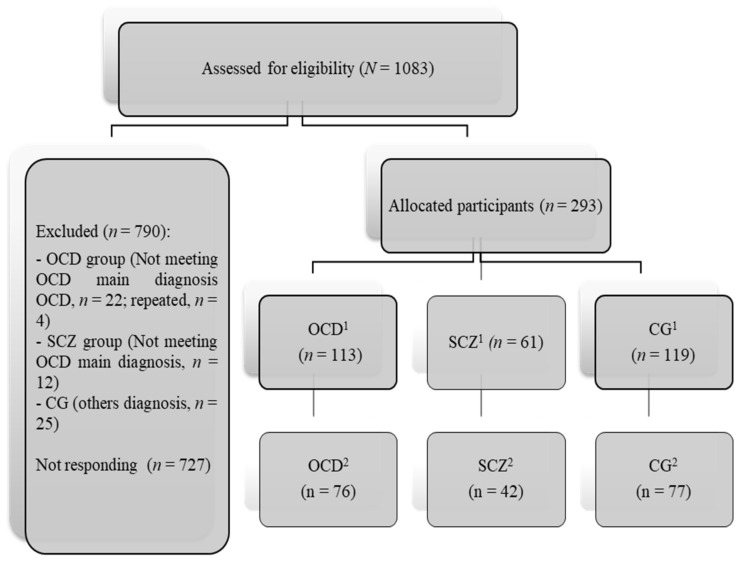
Background: The main aim was to examine changes in coping strategies, anxiety and depression in obsessive–compulsive and schizophrenia patients during COVID-19, in addition to controlling the influence of intolerance to uncertainty and experiential avoidance. Method: The first time, the study comprised (15–30 April 2020) 293 patients, 113 of whom were diagnosed with obsessive–compulsive disorder, 61 with schizophrenia and 119 healthy controls, aged 13–77 years (M = 37.89, SD = 12.65). The second time (15–30 November), the study comprised 195 participants (85 obsessive–compulsive patients, 42 schizophrenic patiens and 77 healthy controls participants). The evaluation was carried out through an online survey. Results: The clinical groups worsened over time in cognitive coping, anxiety and depression, while the control group only worsened in depression. Intergroup differences in anxiety, depression and coping strategies were maintained, highlighting the use of some maladaptive strategies (avoidance, spiritual) in clinical groups. Experiential avoidance and tolerance for uncertainty mainly affected coping. Conclusions: The duration of COVID-19 not only produced changes in anxiety and depression in clinical groups but also in coping strategies to face this pandemic and its consequences. © 2021 by the authors. Licensee MDPI, Basel, Switzerland.
Overview
CoChat Summary
## TL;DR
This longitudinal online study compared OCD, schizophrenia, and healthy control groups in Spain at two points during COVID-19 (April and November 2020) and found worsening anxiety, depression, and coping in the clinical groups, while controls worsened only in depression. Experiential avoidance and intolerance to uncertainty were linked to coping, especially avoidance coping.
## Key findings
- At T1 (15–30 April 2020), the sample included 293 participants: 113 OCD, 61 schizophrenia, and 119 healthy controls; at T2 (15–30 November 2020), it included 195 participants: 85 OCD, 42 schizophrenia, and 77 healthy controls.
- The clinical groups worsened over time in cognitive coping, anxiety, and depression, while the control group worsened only in depression.
- Group differences persisted across time, with clinical groups showing more maladaptive coping, especially avoidance and spiritual coping; the paper reports significant intergroup, intragroup, and interaction effects for anxiety, depression, and coping strategies, except for intragroup avoidance.
- In the T2 covariance analysis, experiential avoidance affected cognitive coping (p = 0.025), inhibitory uncertainty intolerance influenced social coping (p = 0.012), and experiential avoidance plus uncertainty intolerance influenced avoidance coping (p < 0.001); neither affected spiritual coping.
## Methods
- Design: Two-wave longitudinal study during COVID-19, with assessments in April 2020 and November 2020.
- Sample/data: Spanish participants aged 13–77 years; clinical groups were patients with OCD or schizophrenia, and the comparison group was healthy controls selected to be equivalent in age and sex to the OCD group.
- Main analysis: Online survey using Brief COPE-COPE-28, HADS, BEAQ, and Intolerance of Uncertainty Scale; analyses included chi-square, one-factor ANOVA, repeated-measures ANOVA, Sidak post hoc tests, ANCOVA, Kruskal–Wallis tests, and Pearson correlations.
## Limitations
- The paper states that the study was limited to the Spanish population, used a non-random sample, and relied on an online evaluation, so administration conditions and situational variables could not be controlled.
- The paper also notes high mortality at the time of the second evaluation.
- Evident from the text: the report is based on self-report questionnaires and the second wave had substantial attrition from 293 to 195 participants, which may affect comparability over time.
Model-written summary. Check it against the paper before relying on it.
Integrity signals
Registry
Cites
Statistics
Figures
Verification
Claims the paper makes
5 Valid · 0 Not valid · 2 Not checked · 31 Own results and interpretations
The cited sources support only part of this claim — read each source’s verdict below.
In the paper
“The duration of COVID-19 is a factor associated with increased emotional distress.”
§ Coping Strategies, Anxiety and Depression in OCD and Schizophrenia: Changes during COVID-19 > 1. Introduction
What the sources say
- Partly supportedcites [3] Duan H. Yan L. Ding X. Gan Y. Kohn N. Wu J. Impact of the COVID-19 pandemic on mental health in the general Chinese population: Changes, predictors and psychosocial correlates Psychiatry Res. 2020 293 113396 10.1016/j.psychres.2020.113396 32861096 PMC7431364 sourceExperimental — accuracy not yet measured
The Results (page not provided) show that depression increased between the pandemic peak and remission phases in the Chinese sample. But fear and perceived stress decreased, and the paper does not identify the duration of COVID-19 itself as a predictor of increased emotional distress. (LLM, conf=0.86)
plainstates an association- Asserted: passes — The authors put it forward as true.
- Checkable: passes — It can be checked against evidence.
- Load-bearing: unclear — It is unclear whether the paper’s conclusions depend on it.
- Based: passes — The paper gives a reason why it holds.
- Partly supported
The cited sources support only part of this claim — read each source’s verdict below.
In the paper
“Experiential avoidance has been linked to emotional distress.”
§ Coping Strategies, Anxiety and Depression in OCD and Schizophrenia: Changes during COVID-19 > 1. Introduction
What the sources say
- Supportedcites [17] Seçer I. Ulaş S. An Investigation of the Effect of COVID-19 on OCD in Youth in the Context of Emotional Reactivity, Experiential Avoidance, Depression and Anxiety Int. J. Ment. Health Addict. 2020 1 14 10.1007/s11469-020-00322-z PMC7293436 32837429 source
The Introduction links increased experiential avoidance to anxiety disorders, depression, and other psychological problems. This supports the broad claim that experiential avoidance has been linked to emotional distress; no page number is provided in our copy. (LLM, conf=0.91)
- Could not verifycites [18] Melin K. Skarphedinsson G. Thomsen P.H. Weidle B. Torp N.C. Valderhaug R. Højgaard D.R. Hybel K.A. Nissen J.B. Jensen S. Treatment Gains Are Sustainable in Pediatric Obsessive-Compulsive Disorder: Three-Year Follow-Up From the NordLOTS J. Am. Acad. Child Adolesc. Psychiatry 2020 59 244 253 10.1016/j.jaac.2019.01.010 30768383 sourceExperimental — accuracy not yet measured
The Treatment and Procedures passage describes exposure-based CBT for pediatric OCD, and the Discussion passages report OCD symptom outcomes. Neither addresses a link between experiential avoidance and emotional distress. Searches for that phrase and for an association between avoidance and psychological distress found no supporting passage in our copy. (LLM, conf=0.76)
plainstates an association- Asserted: passes — The authors put it forward as true.
- Checkable: passes — It can be checked against evidence.
- Load-bearing: passes — The paper’s conclusions depend on it.
- Based: passes — The paper gives a reason why it holds.
- Supported
The cited sources support only part of this claim — read each source’s verdict below.
In the paper
“Prevention behaviors (social distancing, hand washing, use of a mask, isolation, among others) can increase the risk of presenting mental illnesses such as anxiety disorders, post-traumatic stress disorder, obsessive compulsive disorder, etc. [4,5,6,7].”
§ Coping Strategies, Anxiety and Depression in OCD and Schizophrenia: Changes during COVID-19 > 1. Introduction
What the sources say
- Partly supportedcites [4] Fiorillo A. Gorwood P. The consequences of the COVID-19 pandemic on mental health and implications for clinical practice Eur. Psychiatry 2020 63 e32 10.1192/j.eurpsy.2020.35 32234102 PMC7156565 sourceExperimental — accuracy not yet measured
The paper’s main text (page not provided) says quarantine, social distancing, and self-isolation can harm mental health, and that prolonged concerns may increase the risk of anxiety, obsessive–compulsive, and trauma-related disorders. It does not identify hand washing or mask use as causes of those disorders, nor does it specifically name post-traumatic stress disorder. (LLM, conf=0.87)
- Partly supportedcites [5] Fontenelle L.F. Miguel E.C. The impact of coronavirus (COVID-19) in the diagnosis and treatment of obsessive-compulsive disorder Depress. Anxiety 2020 37 510 511 10.1002/da.23037 32383802 PMC7267460 sourceExperimental — accuracy not yet measured
In the paper’s discussion of COVID-19 and OCD (passage 1; page not provided), the authors suggest that more people might develop OCD and note that recommended handwashing and avoidance can resemble OCD symptoms. They do not say that prevention behaviors themselves increase the risk of anxiety disorders or PTSD, or discuss mask use as a cause. (LLM, conf=0.86)
- Partly supportedcites [6] Pozza A. Mucci F. Marazziti D. Risk for pathological contamination fears at coronavirus time: Proposal of early intervention and prevention strategies Clin. Neuropsychiatry 2020 17 100 102 10.36131/CN20200214 PMC8629035 34908978 doi:10.36131/cn20200214Experimental — accuracy not yet measured
The Abstract says quarantine procedures and strict hygiene measures can increase relapse risk in people who have recovered from OCD, and discusses contamination fears in other vulnerable groups. It does not establish that prevention behaviors generally increase the risk of anxiety disorders or post-traumatic stress disorder, or identify mask use as a risk factor. (LLM, conf=0.88)
- Partly supportedcites [7] Silva R.M. Shavitt R.G. Costa D.L. Obsessive-compulsive disorder during the COVID-19 pandemic Rev. Bras. Psiquiatr. 2021 43 108 10.1590/1516-4446-2020-1189 32578691 PMC7861183 sourceExperimental — accuracy not yet measured
The main text (page not supplied) says hand-washing recommendations can reinforce beliefs in patients with OCD and that OCD symptoms, including anxiety symptoms, may worsen during the pandemic. It does not say that distancing, masks or isolation increase the risk of developing anxiety disorders or PTSD, nor does it attribute those outcomes to prevention behaviors generally. (LLM, conf=0.84)
plainstates a possible cause- Asserted: passes — The authors put it forward as true.
- Checkable: passes — It can be checked against evidence.
- Load-bearing: passes — The paper’s conclusions depend on it.
- Based: passes — The paper gives a reason why it holds.
- Partly supported
A result the paper reports from its own data — it cites no other source for it, so there is none to check. The quote shows it is in the paper.
In the paper
“The clinical groups worsened over time in cognitive coping, anxiety and depression, while the control group only worsened in depression.”
- Also stated in: § 4. Discussion · plain
“anxiety increased only in the clinical groups”
- Also stated in: § 3.1. Changes in Coping Strategies, Anxiety and Depression · plain
“OCD participants achieved significant changes in cognitive coping (p = 0.005), avoidance coping (p = 0.002), anxiety (p = 0.037) and depression (p < 0.001).”
§ Coping Strategies, Anxiety and Depression in OCD and Schizophrenia: Changes during COVID-19 > Abstract
plainstates a causen = 195- Asserted: passes — The authors put it forward as true.
- Checkable: passes — It can be checked against evidence.
- Load-bearing: passes — The paper’s conclusions depend on it.
- Based: passes — The paper gives a reason why it holds.
- Also stated in: § 4. Discussion · plain
A result the paper reports from its own data — it cites no other source for it, so there is none to check. The quote shows it is in the paper.
In the paper
“Educational level in the CG presented differences in cognitive coping (p = 0.05), cognitive coping being greater in participants with university studies compared to those with primary education.”
§ Coping Strategies, Anxiety and Depression in OCD and Schizophrenia: Changes during COVID-19 > 3. Results > 3.3. Intragroup Comparison Based on Coping Strategies and Clinical and Sociodemographic
plainstates an association- Asserted: passes — The authors put it forward as true.
- Checkable: passes — It can be checked against evidence.
- Load-bearing: unclear — It is unclear whether the paper’s conclusions depend on it.
- Based: passes — The paper gives a reason why it holds.
16 more claims
Create a free account to see all 38 claims and to verify the 1 reference still open.
- Probably not a substantial claim. 4
- It may state two separate claims as one. 11
- The quote only partly states this claim. 2
Self-check
Percentages, sums and reported differences re-computed from the paper’s own numbers.
Each contradiction between two passages listed here was confirmed by an independent check.
Rated major: it would touch a result — a value a result rests on, reported and recomputed p-values on opposite sides of the significance level, two passages that conflict with no sign which is right, or a cited work retracted before this paper was published.
In the paper
§ Coping Strategies, Anxiety and Depression in OCD and Schizophrenia: Changes during COVID-19 > Abstract
“The second time (15–30 November), the study comprised 195 participants (85 obsessive–compulsive patients, 42 schizophrenic patiens and 77 healthy controls participants).”
§ Coping Strategies, Anxiety and Depression in OCD and Schizophrenia: Changes during COVID-19 > Abstract
“the study comprised 195 participants (85 obsessive–compulsive patients, 42 schizophrenic patiens and 77 healthy controls participants).”
Citations
Cites
The Hospital Anxiety and Depression Scale
Zigmond, A. S., & Snaith, R. P. (1983) · Acta Psychiatrica Scandinavica · doi:10.1111/j.1600-0447.1983.tb09716.x · Cited by 47,139 · cited 2×
“It was divided into anxiety (HADS-A) and depression (HADS-D) subscales both containing seven items.”
Depression and quality of life in older persons: A review
Sivertsen, H., Bjørkløf, G. H., Engedal, K., Selbæk, G., & Helvik, A.-S. (2015) · Dementia and Geriatric Cognitive Disorders · doi:10.1159/000437299 · Cited by 14,152
Anxiety and depression in COVID-19 survivors: role of inflammatory and clinical predictors
Mazza, M. G., De Lorenzo, R., Conte, C., Poletti, S., Vai, B., Bollettini, I., Melloni, E. M. T., Furlan, R., Ciceri, F., Rovere-Querini, P., et al. (2020) · Brain, Behavior, and Immunity · doi:10.1016/j.bbi.2020.07.037 · Cited by 1,804 · cited 1×
“Similarly, having suffered from the psychopathological disorder or having relatives with an infected member also influenced an increase in stress, anxiety and depression [22].”
BackgroundFreeston, M. H., Rhéaume, J., Letarte, H., Dugas, M. J., & Ladouceur, R. (1994) · Personality and Individual Differences · doi:10.1016/0191-8869(94)90048-5 · Cited by 1,731
The consequences of the COVID-19 pandemic on mental health and implications for clinical practice
Fiorillo, A., & Gorwood, P. (2020) · European Psychiatry · doi:10.1192/j.eurpsy.2020.35 · Cited by 1,190
Into the unknown: A review and synthesis of contemporary models involving uncertainty
Carleton, R. N. (2016) · Journal of Anxiety Disorders · doi:10.1016/j.janxdis.2016.02.007 · Cited by 1,104 · cited 2×
“This can be defined as the dispositional capacity to withstand the aversive response caused by the perceived absence of key or sufficient information, being sustained by the associated perception of uncertainty [13].”
BackgroundPrevalence of depression during the COVID-19 outbreak: A meta-analysis of community-based studies
Bueno-Notivol, J., Gracia-García, P., Olaya, B., Lasheras, I., López-Antón, R., & Santabárbara, J. (2021) · International Journal of Clinical and Health Psychology · doi:10.1016/j.ijchp.2020.07.007 · Cited by 820 · cited 1×
“Regarding age, we could conclude that younger participants have used more dysfunctional strategies, coping worse with the pandemic, an aspect documented in previous studies [3,29].”
Background(1986) · Virtual Defense Library (Ministerio de Defensa) · Cited by 657
Rettie, H., & Daniels, J. (2021) · American Psychologist · doi:10.1037/amp0000710 · Cited by 526 · cited 3×
“Regarding sex, it was found that the use of social and spiritual coping was higher in women in CG and OCD, coinciding with results of other authors, and thus, they may be more exposed to developing mental health problems during this pandemic [14].”
BackgroundResultInfluentialThe brief experiential avoidance questionnaire: Development and initial validation
Gámez, W., Chmielewski, M., Kotov, R., Ruggero, C., Suzuki, N., & Watson, D. (2014) · Psychological Assessment · doi:10.1037/a0034473 · Cited by 450 · cited 1×
“Brief Experiential Avoidance Questionnaire (BEAQ) [24].”
Cited by
Schizophrenia and the COVID-19 pandemic: A narrative review from the biomedical perspective
Kowalski, K., & Misiak, B. (2023) · Revista de Psiquiatría y Salud Mental · doi:10.1016/j.rpsm.2023.04.002 · Cited by 16
Demaria, F., Pontillo, M., Vincenzo, C. D., Luzio, M. D., & Vicari, S. (2022) · Journal of Clinical Medicine · doi:10.3390/jcm11113191 · Cited by 16
Šagud, M., Janović, M. B., Ćusa, Z. V., Jakšić, N., Krakan, L. B., Begić, D., Grubišin, J., Janović, Š., Jevtović, S., Rajačić, B. K., et al. (2023) · BMC Psychiatry · doi:10.1186/s12888-023-05302-w · Cited by 15
“…of our findings should be limited to lockdown (early) pandemic phase, given than mild improvement in symptoms may occur after re-opening, except for patients with schizophrenia [57], while increase in symptoms of depression was reported in healthy controls between April and November 2020 [39].”
BackgroundChen, S., Sun, X., Zhu, Q., Zhao, Y., Tang, J., & Song, H. (2023) · International Journal of Environmental Research and Public Health · doi:10.3390/ijerph20054376 · Cited by 13
“Compared to the control group, community-dwelling patients with schizophrenia experienced significantly higher scores in HADS-A and HADS-D during the COVID-19 pandemic [16].”
BackgroundHow did the Covid-19 pandemic affect individuals with schizophrenia from Turkey?
Karanci, A. N., İkizer, G., Aldemir, İ. D., Bilgehan, A., & Karagöz, C. (2022) · International Journal of Social Psychiatry · doi:10.1177/00207640221081800 · Cited by 8
“Nevertheless, some of the positive impacts (i.e. not having to leave home during the lockdown or meeting other people) might indeed reflect a tendency to avoid social interactions, as previously observed in individuals with schizophrenia during the pandemic (Rosa-Alcázar et al., 2021).”
ResultMemory Functions in Obsessive–Compulsive Disorder
Gurrieri, R., Gambini, M., Pescini, E., Mastrogiacomo, D., Russomanno, G., & Marazziti, D. (2025) · Brain Sciences · doi:10.3390/brainsci15050492 · Cited by 13
“These findings suggest that OCD patients have significant cognitive impairments in WM that, however, did not differ significantly from those observed in the other two psychiatric groups [84].”
Seyedmirzaei, H., Katebian, S., Pourkand, D., Cattarinussi, G., Sambataro, F., Brambilla, P., & Delvecchio, G. (2023) · Journal of Affective Disorders · doi:10.1016/j.jad.2023.03.087 · Cited by 5
“, 2023) and Spain (Solé et al., 2021; Rosa-Alcázar et al., 2021; Biviá-Roig et al., 2022) were the countries with the most publications in this area.”
BackgroundMethodInfluentialCOVID-19 experience of people with severe mental health conditions and families in South Africa
Brooke‐Sumner, C., Rapiya, B., MYERS, B. J., Petersen, I., Hanlon, C., Repper, J., & Asher, L. (2024) · South African Journal of Psychiatry · doi:10.4102/sajpsychiatry.v30i0.2207 · Cited by 7
“49,50 Its function of being a route to finding meaning and hope, as well as a source of support and social connection, can be a key aspect of recovery.”
BackgroundStuck Inside: How Social Functioning in Schizophrenia Changed During the COVID-19 Pandemic
Minor, K. S., Myers, E. J., Abel, D. B., Mickens, J. L., Ayala, A., Warren, K. K., & Vohs, J. L. (2022) · The Journal of Nervous and Mental Disease · doi:10.1097/nmd.0000000000001558 · Cited by 7
Severity and Changes in OCD Dimensions during COVID-19: A Two-Year Longitudinal Study
Rosa‐Alcázar, Á., Parada-Navas, J. L., García-Hernández, M. D., Pozza, A., Tondi, P., & Alcázar, A. I. R. (2023) · Brain Sciences · doi:10.3390/brainsci13081151 · Cited by 7
“[27] indicated an increase in depressive responses in schizophrenic, OCD patients and health groups, while anxiety increased only in the clinical groups, highlighting the levels of the OCD group in both variables.”
BackgroundSelf-citationSheykhangafshe, F. B., Fathi-Ashtiani, A., Niri, V. S., Otadi, S., & Golezani, H. R. (2023) · Journal of Research and Health · doi:10.32598/jrh.13.1.1922.2 · Cited by 3
Memory in Psychiatric Disorders: A Review
Gurrieri, R., Gambini, M., Russomanno, G., Mucci, F., Carbone, M. G., Sità, G., Pescini, E., Stagi, S., Casucci, A. C., Mastrogiacomo, D., et al. (2025) · Life · doi:10.3390/life15121926 · Cited by 4
“…the ability to update, manipulate, and suppress information [212] Some researchers argue that WM dysfunction in OCD is not primarily due to difficulties in inhibiting intrusive thoughts, but rather to impairments in discarding no-longer-relevant information, leading to cognitive overload [211,213].”
The implications of the COVID-19 pandemic for clinical mental health care
Schuster, A., Alwan, N. A., Callard, F. J., Chen, E. Y. H., Gilbody, S. M., Graham, B. M., Hatch, S. L., Jones, E. Y., Jordan, A., Knapp, M. R. J., et al. (2026) · The Lancet Psychiatry · doi:10.1016/s2215-0366(25)00247-0 · Cited by 2
Sheykhangafshe, F. B., Farahani, H., & Fathi-Ashtiani, A. (2023) · Caspian Journal of Health Research · doi:10.32598/cjhr.8.1.362.1 · Cited by 1
Chen, S., Sun, X., Zhu, Q., Zhao, Y., Tang, J., & Song, H. (2022) · Research Square · doi:10.21203/rs.3.rs-2026091/v1 · Cited by 1
Brooke‐Sumner, C., Rapiya, B., MYERS, B. J., Petersen, I., Hanlon, C., Repper, J., & Asher, L. (2023) · Research Square · doi:10.21203/rs.3.rs-2546391/v1 · Cited by 1
Chen, S., Sun, X., Zhu, Q., Zhao, Y., Tang, J., & Song, H. (2022) · Research Square · doi:10.21203/rs.3.rs-1408832/v1
Auswirkungen der COVID-19-Pandemie auf das Leben von Menschen mit Schizophrenie
Baumann, L. (2023) · PPH · doi:10.1055/a-2038-9839
Santoso, J. D. C. A., Manafe, J. S., Rahmawati, D. T., Gautama, S. M., & Karimah, A. (2023) · Jurnal Psikiatri Surabaya · doi:10.20473/jps.v12i2.42008 · Cited by 1
COVID-19 AND MANIA: A CASE WITH A ONE-YEAR FOLLOW UP
Yılmaz, H. (2024) · Turkish Journal of Psychiatry · doi:10.5080/u27284
Orth, R. D., Savage, C. L. G., Bennett, M. E., & Blanchard, J. J. (2024) · European Archives of Psychiatry and Clinical Neuroscience · doi:10.1007/s00406-024-01777-0
“This contradicts other findings that negative affect worsened during the first six months of the pandemic for people with psychosis [30] and that anxiety increased over the course of COVID-related lockdowns in individuals with SMI, including those with psychosis [28].”
When safety fails: A narrative review on attachment in patients with obsessive-compulsive disorder
Gurrieri, R., DIGIUSEPPE, F. R., Gambini, M., Russomanno, G., Casucci, A. C., & Marazziti, D. (2026) · Journal of Psychiatric Research · doi:10.1016/j.jpsychires.2026.07.023
Metadata
- Authors
- Rosa-Alcázar, Á., Parada-Navas, J. L., García-Hernández, M. D., Martínez-Murillo, S., Olivares-Olivares, P. J., & Rosa-Alcázar, A. I.
- Affiliations
- Department of Psychology, Catholic University of Murcia, 30107 Murcia, Spain
- Universidad de Murcia (ES)
- Department of Personality, Assessment & Psychological Treatment, University of Murcia, 30100 Murcia, Spain
- ORCID
- Venue
- Brain Sciences
- Publisher
- MDPI AG
- Published
- 2021-07-13
- Volume
- 11
- Issue
- 7
- Pages
- 926
- ISSN
- 2076-3425 (ISSN-L)
- PMC
- PMC8305913
- OpenAlex
- W3178717579
- Semantic Scholar
- 6f0c25d929c30fce5e949c524425e86129ea03b3
- Cited by
- 22
- References
- 35
- Citations by year
- 2026: 2 · 2025: 2 · 2024: 3 · 2023: 10 · 2022: 5
- FWCI
- 2.67
- Type
- journal article
- Language
- en
- Open access
- gold
- doi.org
- Licence
- Locations
- Brain Sciences (publishedVersion, cc-by)
- PubMed (publishedVersion)
- PubMed Central (submittedVersion, cc-by)
- DOAJ (DOAJ: Directory of Open Access Journals) (submittedVersion, cc-by-sa)
- RUIdeRA - Institutional University Repository (University of Castilla-La Mancha) (submittedVersion, other-oa)
- Topics
- Social Sciences › Psychology › Clinical Psychology › COVID-19 and Mental Health
- Social Sciences › Psychology › Experimental and Cognitive Psychology › Anxiety, Depression, Psychometrics, Treatment, Cognitive Processes
- Social Sciences › Psychology › Clinical Psychology › Obsessive-Compulsive Spectrum Disorders
- Keywords
- obsessive-compulsive disorder, schizophrenia, coping strategies, anxiety, depression, COVID-19 pandemic, intolerance of uncertainty, experiential avoidance
About these checks
Registry, retraction, Cites and statistics results are computed, not judged, with one exception: a printed reference that no index lists is read once by a model before it counts as a citation error. Claims are extracted by a model and kept only when their quote appears verbatim in the text; each cited source is then checked, with a model’s help, for whether it says what the claim relies on. Those verdicts can be wrong — read the claim’s quote and the cited source before relying on one.
The claim verdicts this report counts are experimental: their accuracy is not yet measured.
A language model drew the claims from the paper on 2026-10-11, under version 3 of the claim definition (model deepseek-v4.1-flash, prompt extract-v3).
A second model labelled each claim on 2026-10-11 (model jev-1.13-20260917, definition revision gold-guideline-v0.2).
Cited sources are checked with a language model’s help (gpt-6-sol).
Statistics and arithmetic are recomputed, not judged.
Confidence bands are shown only for fields calibrated on our annotated test set. None is calibrated yet, so no band is shown.
What counts as a claim ›How we measure confidence ›How we check this ›
Are you an author, or do you see a problem with this page? Request a review
Data sources
Bibliographic data: Semantic Scholar, OpenAlex, Crossref.
Contains information from the Semantic Scholar Academic Graph Datasets, made available under the ODC Attribution License (ODC-BY 1.0).
Semantic Scholar’s data is described in: Kinney, R., et al. (2023). The Semantic Scholar Open Data Platform. arXiv:2301.10140.
