

The Applicability of Acceptance and Commitment Therapy for Obsessive-Compulsive Disorder: A Systematic Review and Meta-Analysis
Open accessThe DOI matches its Crossref record; 59 of the 59 references it cites were found in a registry or an index.
Abstract
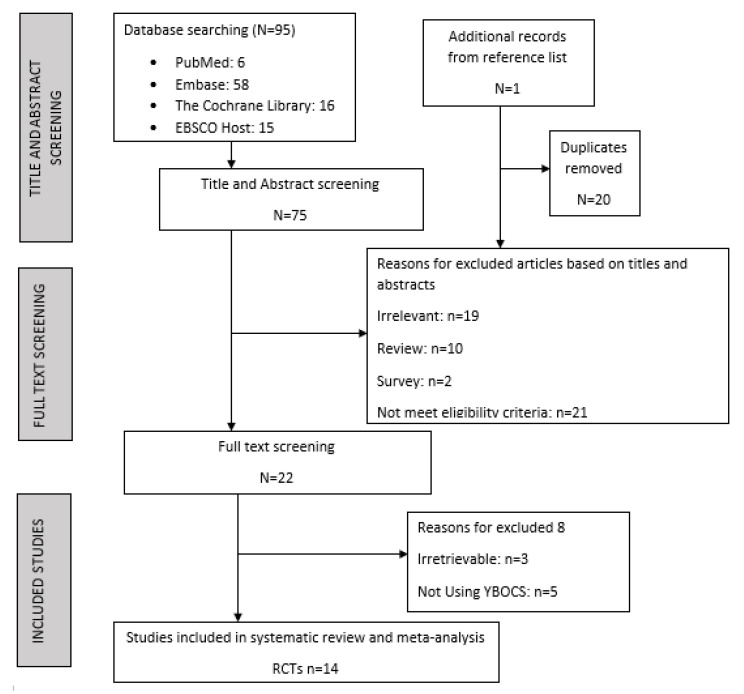
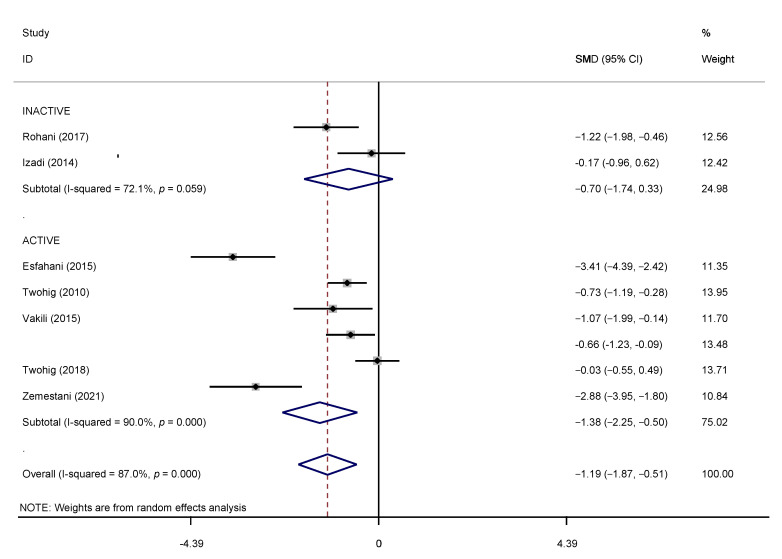
Background: Acceptance and commitment therapy (ACT), a third-generation cognitive behavioral therapy (CBT), has proved its efficacy amidst various mental disorders. A growing body of studies has shown that ACT can improve obsessive-compulsive disorder (OCD) severity in recent years. To assess the effect of ACT on OCD, we carried out a systematic review and meta-analysis to provide a basis for therapists to use different psychological dimensions of ACT for OCD. Methods: PubMed, the Cochrane Library, EMBASE, EBSCO Host, and literature references were searched until May 2021. Randomized controlled trials (RCTs) and other study designs assessing the effect of ACT among adults suffering from OCD were examined. Results: Fourteen studies, including 413 participants, published between 2010 and 2021 were identified. ACT made statistically significant progress in the Yale–Brown Obsessive–Compulsive Scale (YBOCS) compared with control conditions. Conclusion: After reviewing all the ACT studies, we acknowledge the plausibility of ACT in treating OCD and improving its symptoms for the clinical population. ACT can also be an adjunct therapy for other well-established treatments. It also favors targeting psychological inflexibility. Further well-controlled and high-quality RCTs are required for a better conclusion in further studies.
Overview
The claims and statistics of this paper haven’t been checked yet.
Free: it reads the open-access text and checks the first 5 claims that cite a source we can check. Create a free account to check every claim.
Integrity signals
Registry
Cites
Statistics
Figures
Verification
Claims the paper makes
The claims and statistics of this paper haven’t been checked yet.
Free: it reads the open-access text and checks the first 5 claims that cite a source we can check. Create a free account to check every claim.
Claims other papers make about this one
Each is checked against this paper’s own text: does it say what the citing paper says it does?
The source backs part of the claim, not all of it — or backs it for a different population, condition or comparison.
In the citing paper
“In a recent systematic evaluation and meta-analysis study, it was reported that patients diagnosed with OCD, in particular, learned to change their rapport with these symptoms instead of wrestling with intrusive obsessions and compulsions after ACT intervention, and thus recovery was associated with this mediator (Soondrum et al., 2022).”
From Reducing Test Anxiety During the COVID-19 Pandemic: A Comparison of the Effectiveness of Cognitive Behavioral Therapy and Acceptance and Commitment Therapy (2024) · cites this paper as Soondrum et al., 2022
Experimental — accuracy not yet measuredThe cited source says what the claim attributes to it.
In the citing paper
“Although a recent meta-analysis, including a small number of studies, reports the applicability of ACT for OCD [47], it needs to be tested with more extensive RCTs in larger samples.”
From Clinical Advances in Treatment Strategies for Obsessive-compulsive Disorder in Adults (2023) · cites this paper as [47]
Self-check
Percentages, sums and reported differences re-computed from the paper’s own numbers.
The self-check needs the paper’s full text.
Citations
Cites
The Cochrane Collaboration's tool for assessing risk of bias in randomised trials
Higgins, J. P. T., Altman, D. G., Gotzsche, P. C., Juni, P., Moher, D., Oxman, A. D., Savovic, J., Schulz, K. F., Weeks, L., Sterne, J. A. C., et al. (2011) · BMJ · doi:10.1136/bmj.d5928 · Cited by 33,817
Dermyshi, E., Wang, Y., Yan, C., Hong, W., Qiu, G., Gong, X., & Zhang, T. (2017) · Neonatology · doi:10.1159/000454668 · Cited by 24,451
Liberati, A., Altman, D. G., Tetzlaff, J., Mulrow, C., Gotzsche, P. C., Ioannidis, J. P. A., Clarke, M., Devereaux, P. J., Kleijnen, J., & Moher, D. (2009) · BMJ · doi:10.1136/bmj.b2700 · Cited by 17,648
The Yale-Brown Obsessive Compulsive Scale: I. Development, Use, and Reliability
Goodman, W. K. (1989) · Archives of General Psychiatry · doi:10.1001/archpsyc.1989.01810110048007 · Cited by 7,712
Hayes, S. C., Wilson, K. G., Gifford, E. V., Follette, V. M., & Strosahl, K. (1996) · Journal of Consulting and Clinical Psychology · doi:10.1037//0022-006x.64.6.1152 · Cited by 3,595
The epidemiology of obsessive-compulsive disorder in the National Comorbidity Survey Replication
Ruscio, A. M., Stein, D. J., Chiu, W. T., & Kessler, R. C. (2010) · Molecular Psychiatry · doi:10.1038/mp.2008.94 · Cited by 2,771 · cited 1×
“, 2015) [4], which emphasizes the need to develop and promulgate effective treatments [5].”
BackgroundThe global burden of mental disorders: An update from the WHO World Mental Health (WMH) surveys
Kessler, R. C., Aguilar-Gaxiola, S., Alonso, J., Chatterji, S., Lee, S., Ormel, J., Üstün, T. B., & Wang, P. S. (2009) · Epidemiologia e Psichiatria Sociale · doi:10.1017/s1121189x00001421 · Cited by 1,895 · cited 1×
“OCD has an estimated prevalence of approximately 2%, and according to the World Health Organization (WHO), it has been positioned among the 10 most incapacitating illnesses [2].”
BackgroundAbramowitz, J. S., Deacon, B. J., Olatunji, B. O., Wheaton, M. G., Berman, N. C., Losardo, D., Timpano, K. R., McGrath, P. B., Riemann, B. C., Adams, T., et al. (2010) · Psychological Assessment · doi:10.1037/a0018260 · Cited by 848 · cited 1×
“Psychological treatments that use exposure are currently considered the most effective form of treatment for OCD and are associated with a 60–85% reduction in symptoms [8].”
BackgroundEfficacy of the third wave of behavioral therapies: A systematic review and meta- analysis
Öst, L.-G. (2008) · Behaviour Research and Therapy · doi:10.1016/j.brat.2007.12.005 · Cited by 727 · cited 1×
“Third-wave behavioral therapies, such as acceptance and commitment therapy (ACT), have become more popular over the past years [10].”
BackgroundContextual and temporal modulation of extinction: behavioral and biological mechanisms
Bouton, M. E., Westbrook, R. F., Corcoran, K. A., & Maren, S. (2006) · Biological Psychiatry · doi:10.1016/j.biopsych.2005.12.015 · Cited by 671 · cited 1×
“As such, a suppressed response will resurface in the appropriate emotional and environmental context [14,15].”
Background
Research works printed but not linked: 3
- Edition F. Diagnostic and Statistical Manual of Mental Disorders American Psychiatric Association Washington, DC, USA 2013 Volume 21
- Harris R. The House of ACT: Functional Contextualism, ABA and RFT. Book Chapter ACT Made Simple New Harbinger Publications Oakland, CA, USA 2009 1 23 Available online: https://www.pensierocritico.eu/files/ACT_Made_Simple_Dr._Russ_Harris_preface.pdf (accessed on 10 May 2022)
- Baghooli H. Dolatshahi B. Mohammadkhani P. Moshtagh N. Naziri G. Effectiveness of acceptance and commitment therapy in reduction of severity symptoms of patients with obsessive-compulsive disorder Adv. Environ. Biol. 2014 8 2519 2524
Cited by
An Overview of Research on Acceptance and Commitment Therapy
Levin, M. E., Krafft, J., & Twohig, M. P. (2024) · Psychiatric Clinics of North America · doi:10.1016/j.psc.2024.02.007 · Cited by 49
Clinical Advances in Treatment Strategies for Obsessive-compulsive Disorder in Adults
Roh, D., Jang, K. W., & Kim, C.-H. (2023) · Clinical Psychopharmacology and Neuroscience · doi:10.9758/cpn.23.1075 · Cited by 20
“Although a recent meta-analysis, including a small number of studies, reports the applicability of ACT for OCD [47], it needs to be tested with more extensive RCTs in larger samples.”
MethodPeterson, A. L., Moore, B. A., Evans, W. R., Young-McCaughan, S., Blankenship, A. E., Straud, C. L., McLean, C. S., Miller, T. L., Meyer, E. C., & for the STRONG STAR Consortium (2024) · Frontiers in Psychiatry · doi:10.3389/fpsyt.2023.1299532 · Cited by 19
Spencer, S. D., Stiede, J. T., Wiese, A. D., Guzick, A. G., Cervin, M., McKay, D., & Storch, E. A. (2023) · Journal of Obsessive-Compulsive and Related Disorders · doi:10.1016/j.jocrd.2023.100805 · Cited by 18
Wang, D., Lin, B., Xiong, F., Deng, Y., & Zhang, L. (2023) · Journal of Affective Disorders · doi:10.1016/j.jad.2023.08.125 · Cited by 17
Metadata
- Authors
- Soondrum, T., Wang, X., Gao, F., Liu, Q., Fan, J., & Zhu, X.
- Affiliations
- Central South University (CN)
- Corresponding author
- Zhu, Xiongzhao
- Venue
- Brain Sciences
- Publisher
- MDPI AG
- Published
- 2022-05-17
- Volume
- 12
- Issue
- 5
- Pages
- 656
- ISSN
- 2076-3425 (ISSN-L)
- PMC
- PMC9139700
- OpenAlex
- W4280582343
- Cited by
- 36
- References
- 58
- Citations by year
- 2026: 9 · 2025: 10 · 2024: 10 · 2023: 7
- FWCI
- 1.13
- Type
- journal article
- Language
- en
- Open access
- gold
- doi.org
- Licence
- Locations
- Brain Sciences (publishedVersion, cc-by)
- PubMed Central (publishedVersion, cc-by)
- PubMed (publishedVersion)
- DOAJ (DOAJ: Directory of Open Access Journals) (submittedVersion, cc-by-sa)
- Topics
- Social Sciences › Psychology › Clinical Psychology › Obsessive-Compulsive Spectrum Disorders
- Social Sciences › Psychology › Clinical Psychology › Mindfulness and Compassion Interventions
- Social Sciences › Psychology › Experimental and Cognitive Psychology › Anxiety, Depression, Psychometrics, Treatment, Cognitive Processes
- Keywords
- acceptance and commitment therapy, obsessive-compulsive disorder, psychological inflexibility, third-generation cognitive behavioral therapy, adjunctive therapy, Yale-Brown Obsessive Compulsive Scale, treatment efficacy
About these checks
Registry, retraction, Cites and statistics results are computed, not judged, with one exception: a printed reference that no index lists is read once by a model before it counts as a citation error. Claims are extracted by a model and kept only when their quote appears verbatim in the text; each cited source is then checked, with a model’s help, for whether it says what the claim relies on. Those verdicts can be wrong — read the claim’s quote and the cited source before relying on one.
Statistics and arithmetic are recomputed, not judged.
Confidence bands are shown only for fields calibrated on our annotated test set. None is calibrated yet, so no band is shown.
What counts as a claim ›How we measure confidence ›How we check this ›
Are you an author, or do you see a problem with this page? Request a review
How to cite
Cite CoChat for the checks on this page, and the paper for its own findings.
- This page
- CoChat. (2026). Citation check: The Applicability of Acceptance and Commitment Therapy for Obsessive-Compulsive Disorder: A Systematic Review and Meta-Analysis. https://app.cochat.ai/papers/10.3390/brainsci12050656
- The paper
- Soondrum, T., Wang, X., Gao, F., Liu, Q., Fan, J., & Zhu, X. (2022). The Applicability of Acceptance and Commitment Therapy for Obsessive-Compulsive Disorder: A Systematic Review and Meta-Analysis. Brain Sciences. https://doi.org/10.3390/brainsci12050656
Data sources
Bibliographic data: Semantic Scholar, OpenAlex, Crossref.
Contains information from the Semantic Scholar Academic Graph Datasets, made available under the ODC Attribution License (ODC-BY 1.0).
Semantic Scholar’s data is described in: Kinney, R., et al. (2023). The Semantic Scholar Open Data Platform. arXiv:2301.10140.
