

EEG Window Length Evaluation for the Detection of Alzheimer’s Disease over Different Brain Regions
Open accessThe DOI matches its Crossref record; 46 of the 46 references it cites were found in a registry or an index.
Abstract
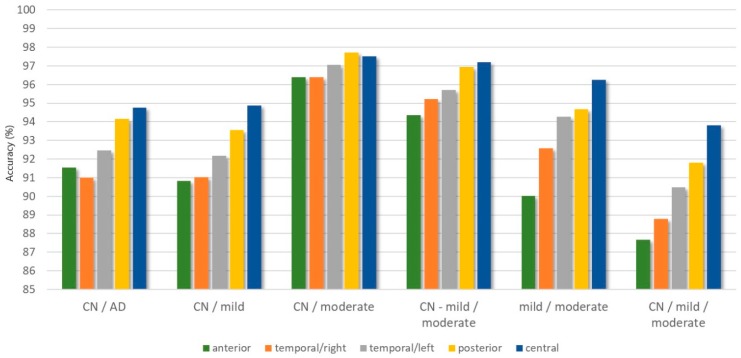
Alzheimer’s Disease (AD) is a neurogenerative disorder and the most common type of dementia with a rapidly increasing world prevalence. In this paper, the ability of several statistical and spectral features to detect AD from electroencephalographic (EEG) recordings is evaluated. For this purpose, clinical EEG recordings from 14 patients with AD (8 with mild AD and 6 with moderate AD) and 10 healthy, age-matched individuals are analyzed. The EEG signals are initially segmented in nonoverlapping epochs of different lengths ranging from 5 s to 12 s. Then, a group of statistical and spectral features calculated for each EEG rhythm (δ, θ, α, β, and γ) are extracted, forming the feature vector that trained and tested a Random Forests classifier. Six classification problems are addressed, including the discrimination from whole-brain dynamics and separately from specific brain regions in order to highlight any alterations of the cortical regions. The results indicated a high accuracy ranging from 88.79% to 96.78% for whole-brain classification. Also, the classification accuracy was higher at the posterior and central regions than at the frontal area and the right side of temporal lobe for all classification problems.
Overview
The claims and statistics of this paper haven’t been checked yet.
Free: it reads the open-access text and checks the first 5 claims that cite a source we can check. Create a free account to check every claim.
Integrity signals
Registry
Cites
Statistics
Figures
Verification
Claims the paper makes
The claims and statistics of this paper haven’t been checked yet.
Free: it reads the open-access text and checks the first 5 claims that cite a source we can check. Create a free account to check every claim.
Claims other papers make about this one
Each is checked against this paper’s own text: does it say what the citing paper says it does?
The source backs part of the claim, not all of it — or backs it for a different population, condition or comparison.
In the citing paper
“For example, Tzimourta et al. used mean, variance, and IQR to classify AD and CN signals with accuracy reported up to 91.8% [41].”
From Alzheimer's Disease and Frontotemporal Dementia: A Robust Classification Method of EEG Signals and a Comparison of Validation Methods (2021) · cites this paper as [41]
Experimental — accuracy not yet measuredThe source backs part of the claim, not all of it — or backs it for a different population, condition or comparison.
In the citing paper
“Both decision trees [30] and random forests [41] implementations are used in the classification of EEG signals for the diagnosis of AD and other dementia types.”
From Alzheimer's Disease and Frontotemporal Dementia: A Robust Classification Method of EEG Signals and a Comparison of Validation Methods (2021) · cites this paper as [41]
Experimental — accuracy not yet measured
Self-check
Percentages, sums and reported differences re-computed from the paper’s own numbers.
The self-check needs the paper’s full text.
Citations
Cites
Breiman, L. (2001) · Machine Learning · doi:10.1023/a:1010933404324 · Cited by 133,538 · cited 3×
“…of the , , , , and bands, Sample entropy (SamplEN) of the δ , θ , α , β , and γ bands, The feature vector of 38 features (8 time-based and 6 × 5 spectral features) for each EEG channel (total 19), including the class attribute (thus, 38 × 19 + 1), was used to train a Random Forests [31] classifier.”
BackgroundMethodInfluentialFolstein, M. F., Folstein, S. E., & McHugh, P. R. (1975) · Journal of Psychiatric Research · doi:10.1016/0022-3956(75)90026-6 · Cited by 88,282
Delorme, A., & Makeig, S. (2004) · Journal of Neuroscience Methods · doi:10.1016/j.jneumeth.2003.10.009 · Cited by 24,371
Hirono, N., Mori, E., Ikejiri, Y., Imamura, T., Shimomura, T., Hashimoto, M., Yamashita, H., & Ikeda, M. (1997) · Brain and nerve · Cited by 21,039
Kok, J. S., Berg, I. J., & Scherder, E. J. A. (2013) · Dementia and Geriatric Cognitive Disorders Extra · doi:10.1159/000353441 · Cited by 20,589
Interrater reliability: The kappa statistic
McHugh, M. L. (2012) · Biochemia Medica · doi:10.11613/bm.2012.031 · Cited by 19,877
Older Adults' Reasons for Using Technology while Aging in Place
Peek, S. T. M., Luijkx, K. G., Rijnaard, M. D., Nieboer, M. E., van der Voort, C. S., Aarts, S., van Hoof, J., Vrijhoef, H. J. M., & Wouters, E. J. M. (2016) · Gerontology · doi:10.1159/000430949 · Cited by 19,690
Sensitivity and False Alarm Rate of a Fall Sensor in Long-Term Fall Detection in the Elderly
Kangas, M., Korpelainen, R., Vikman, I., Nyberg, L., & Jämsä, T. (2015) · Gerontology · doi:10.1159/000362720 · Cited by 18,909
The Clinical Dementia Rating (CDR): Current version and scoring rules
Morris, J. C. (1993) · Neurology · doi:10.1212/wnl.43.11.2412-a · Cited by 9,882
World Alzheimer Report 2018: The state of the art of dementia research: New frontiers
Patterson, C. (2018) · Cited by 1,461
Molecular mechanisms of neurodegeneration in Alzheimer's disease
Crews, L., & Masliah, E. (2010) · Human Molecular Genetics · doi:10.1093/hmg/ddq160 · Cited by 772 · cited 1×
“Patients with AD are characterized with a loss of memory, sleeping problems, mood disorders, and general confusion, which are caused by structural irregularities or damage in the synaptic connections, due to amyloid-β plaques and neurofibrillary tangles [2].”
BackgroundDiagnosis of Alzheimers Disease from EEG Signals: Where Are We Standing?
Dauwels, J., Vialatte, F., & Cichocki, A. (2010) · Current Alzheimer Research · doi:10.2174/156720510792231720 · Cited by 492
Dauwels, J., Vialatte, F., Musha, T., & Cichocki, A. (2010) · NeuroImage · doi:10.1016/j.neuroimage.2009.06.056 · Cited by 394
Ieracitano, C., Mammone, N., Bramanti, A., Hussain, A., & Morabito, F. C. (2019) · Neurocomputing · doi:10.1016/j.neucom.2018.09.071 · Cited by 294
Jacobs, H. I. L., Van Boxtel, M. P. J., Jolles, J., Verhey, F. R. J., & Uylings, H. B. M. (2012) · Neuroscience & Biobehavioral Reviews · doi:10.1016/j.neubiorev.2011.06.009 · Cited by 293
Abásolo, D., Hornero, R., Espino, P., Poza, J., Sánchez, C. I., & de la Rosa, R. (2005) · Clinical Neurophysiology · doi:10.1016/j.clinph.2005.04.001 · Cited by 247
Bakkour, A., Morris, J. C., Wolk, D. A., & Dickerson, B. C. (2013) · NeuroImage · doi:10.1016/j.neuroimage.2013.02.059 · Cited by 244
Ruiz-Gómez, S. J., Gómez, C., Poza, J., Gutiérrez‐Tobal, G. C., Tola-Arribas, M. Á., Cano, M., & Hornero, R. (2018) · Entropy · doi:10.3390/e20010035 · Cited by 173
Non-linear dynamical analysis of the EEG in Alzheimer's disease with optimal embedding dimension
Jeong, J., Kim, S. Y., & Han, S. D. (1998) · Electroencephalography and Clinical Neurophysiology · doi:10.1016/s0013-4694(97)00079-5 · Cited by 143
Frontal Brain Asymmetry and Willingness to Pay
Ramsøy, T. Z., Skov, M., Christensen, M. K., & Stahlhut, C. (2018) · Frontiers in Neuroscience · doi:10.3389/fnins.2018.00138 · Cited by 126
Labate, D., Foresta, F. L., Morabito, G., Palamara, I., & Morabito, F. C. (2013) · IEEE Sensors Journal · doi:10.1109/jsen.2013.2271735 · Cited by 114
Khodayari-Rostamabad, A., Hasey, G., MacCrimmon, D. J., Reilly, J. P., & de Bruin, H. (2010) · Clinical Neurophysiology · doi:10.1016/j.clinph.2010.05.009 · Cited by 103
Kulkarni, N. N., & Bairagi, V. K. (2017) · IETE Journal of Research · doi:10.1080/03772063.2016.1241164 · Cited by 96
Regularized Linear Discriminant Analysis of EEG Features in Dementia Patients
Neto, E., Bießmann, F., Aurlien, H., Nordby, H., & Eichele, T. (2016) · Frontiers in Aging Neuroscience · doi:10.3389/fnagi.2016.00273 · Cited by 91
Characterizing Alzheimer’s Disease Severity via Resting-Awake EEG Amplitude Modulation Analysis
Fraga, F. J., Falk, T. H., Kanda, P. A. M., & Anghinah, R. (2013) · PLoS ONE · doi:10.1371/journal.pone.0072240 · Cited by 81
EEG machine learning for accurate detection of cholinergic intervention and Alzheimer’s disease
Simpraga, S., Alvarez-Jimenez, R., Mansvelder, H. D., van Gerven, J. M. A., Groeneveld, G. J., Poil, S.-S., & Linkenkaer-Hansen, K. (2017) · Scientific Reports · doi:10.1038/s41598-017-06165-4 · Cited by 78
Deng, B., Cai, L., Li, S., Wang, R., Yu, H., Chen, Y., & Wang, J. (2016) · Cognitive Neurodynamics · doi:10.1007/s11571-016-9418-9 · Cited by 76
Liu, H., Zhang, L., Xi, Q., Zhao, X., Wang, F., Wang, X., Men, W., & Lin, Q. (2018) · Frontiers in Neurology · doi:10.3389/fneur.2018.00003 · Cited by 75
Dottori, M., Sedeño, L., Martorell Caro, M., Alifano, F., Hesse, E., Mikulan, E., García, A. M., Ruiz-Tagle, A., Lillo, P., Slachevsky, A., et al. (2017) · Scientific Reports · doi:10.1038/s41598-017-04204-8 · Cited by 73
From here to epilepsy: the risk of seizure in patients with Alzheimer's disease
Nicastro, N., Assal, F., & Seeck, M. (2016) · Epileptic Disorders · doi:10.1684/epd.2016.0808 · Cited by 71
Triggiani, A. I., Bevilacqua, V., Brunetti, A., Lizio, R., Tattoli, G., Cassano, F., Soricelli, A., Ferri, R., Nobili, F., Gesualdo, L., et al. (2017) · Frontiers in Neuroscience · doi:10.3389/fnins.2016.00604 · Cited by 71
Garn, H., Waser, M., Deistler, M., Benke, T., Dal‐Bianco, P., Ransmayr, G. N., Schmidt, H., Sanin, G., Santer, P., Caravias, G., et al. (2014) · Clinical Neurophysiology · doi:10.1016/j.clinph.2014.07.005 · Cited by 68
EEG amplitude modulation analysis for semi-automated diagnosis of Alzheimer’s disease
Falk, T. H., Fraga, F. J., Trambaiolli, L., & Anghinah, R. (2012) · EURASIP Journal on Advances in Signal Processing · doi:10.1186/1687-6180-2012-192 · Cited by 61
Liu, X., Zhang, C., Ji, Z., Ma, Y., Shang, X., Zhang, Q., Zheng, W., Li, X., Gao, J., Wang, R., et al. (2015) · Cognitive Neurodynamics · doi:10.1007/s11571-015-9367-8 · Cited by 57
Diagnosis of Alzheimer's Disease from EEG Signals: Where Are We Standing?
Dauwels, J., Vialatte, F., & Cichocki, A. S. (2010) · Current Alzheimer Research · doi:10.2174/1567210204558652050 · Cited by 56
Analysis of electroencephalographic signals complexity regarding Alzheimer's Disease
Tzimourta, K. D., Afrantou, T., Ioannidis, P., Karatzikou, M., Tzallas, A. T., Giannakeas, N., Astrakas, L. G., Angelidis, P., Glavas, E., Grigoriadis, N., et al. (2019) · Computers & Electrical Engineering · doi:10.1016/j.compeleceng.2019.03.018 · Cited by 52
Self-citationBiomarkers for Alzheimer's Disease Defined by a Novel Brain Functional Network Measure
Song, Z., Deng, B., Wang, J., & Wang, R. (2019) · IEEE Transactions on Biomedical Engineering · doi:10.1109/tbme.2018.2834546 · Cited by 50
Chen, Y., Cai, L., Wang, R., Song, Z., Deng, B., Wang, J., & Yu, H. (2017) · Physica A Statistical Mechanics and its Applications · doi:10.1016/j.physa.2017.08.009 · Cited by 45
Unbiased estimation of permutation entropy in EEG analysis for Alzheimer's disease classification
Tylová, L., Kukal, J., Hubata-Vacek, V., & Vyšata, O. (2017) · Biomedical Signal Processing and Control · doi:10.1016/j.bspc.2017.08.012 · Cited by 44
Coronel, C., Garn, H., Waser, M., Deistler, M., Benke, T., Dal‐Bianco, P., Ransmayr, G. N., Seiler, S., Grossegger, D., & Schmidt, R. (2017) · Entropy · doi:10.3390/e19030130 · Cited by 42
Simons, S., & Abásolo, D. (2017) · Entropy · doi:10.3390/e19030129 · Cited by 37
Spatio-Temporal Fluctuations of Neural Dynamics in Mild Cognitive Impairment and Alzheimer’s Disease
Poza, J., Gómez, C., García, M., Tola-Arribas, M. Á., Carreres, A., Cano, M., & Hornero, R. (2017) · Current Alzheimer Research · doi:10.2174/1567205014666170309115656 · Cited by 29
Waser, M., Garn, H., Schmidt, R., Benke, T., Dal‐Bianco, P., Ransmayr, G. N., Schmidt, H., Seiler, S., Sanin, G., Mayer, F., et al. (2015) · Journal of Neural Transmission · doi:10.1007/s00702-015-1461-x · Cited by 23
Approximate Entropy of EEG Background Activity in Alzheimer's Disease Patients
Abásolo, D., Hornero, R., & Espino, P. (2009) · Surrey Research Insight Open Access (The University of Surrey) · doi:10.1080/10798587.2009.10643051 · Cited by 21
Elman neural network for the early identification of cognitive impairment in Alzheimer�s disease
Bertè, F. (2014) · Functional Neurology · doi:10.11138/fneur/2014.29.1.057 · Cited by 19
Dyakin, V. V., Lucas, J., Dyakina‐Fagnano, N. V., & Posner, E. V. (2017) · Neurology and Neuroscience Research · doi:10.24983/scitemed.nnr.2017.00028 · Cited by 15
Research works printed but not linked: 1
- Duda R.O. Hart P.E. Stork D.G. Pattern Classification 2nd ed. John Wiley and Sons, Inc. New York, NY, USA 2000
Cited by
Early detection of Alzheimer’s disease from EEG signals using Hjorth parameters
Safi, M. S., & Safi, S. M. M. (2021) · Biomedical Signal Processing and Control · doi:10.1016/j.bspc.2020.102338 · Cited by 203
DICE-Net: A Novel Convolution-Transformer Architecture for Alzheimer Detection in EEG Signals
Miltiadous, A., Gionanidis, E., Tzimourta, K. D., Giannakeas, N., & Tzallas, A. T. (2023) · IEEE Access · doi:10.1109/access.2023.3294618 · Cited by 191
Self-citationMiltiadous, A., Tzimourta, K. D., Giannakeas, N., Tsipouras, M. G., Afrantou, T., Ioannidis, P., & Tzallas, A. T. (2021) · Diagnostics · doi:10.3390/diagnostics11081437 · Cited by 160
Self-citationNeuroimaging Modalities in Alzheimer’s Disease: Diagnosis and Clinical Features
Kim, J., Jeong, M., Stiles, W. R., & Choi, H. S. (2022) · International Journal of Molecular Sciences · doi:10.3390/ijms23116079 · Cited by 124
Oltu, B., Akşahin, M. F., & Kibaroğlu, S. (2020) · Biomedical Signal Processing and Control · doi:10.1016/j.bspc.2020.102223 · Cited by 130
Metadata
- Authors
- Tzimourta, K. D., Giannakeas, N., Tzallas, A. T., Astrakas, L. G., Afrantou, T., Ioannidis, P., Grigoriadis, N., Angelidis, P., Tsalikakis, D. G., & Tsipouras, M. G.
- Affiliations
- University of Ioannina (GR)
- Department of Informatics and Telecommunications, School of Informatics and Telecommunications, University of Ioannina, GR47100 Arta, Greece
- Aristotle University of Thessaloniki (GR)
- University of Western Macedonia (GR)
- Corresponding author
- Tsipouras, Markos G.
- ORCID
- Venue
- Brain Sciences
- Publisher
- MDPI AG
- Published
- 2019-04-14
- Volume
- 9
- Issue
- 4
- Pages
- 81
- ISSN
- 2076-3425 (ISSN-L)
- PMC
- PMC6523667
- OpenAlex
- W2938057047
- Cited by
- 79
- References
- 46
- Citations by year
- 2026: 9 · 2025: 19 · 2024: 11 · 2023: 15 · 2022: 10 · 2021: 6 · 2020: 6 · 2019: 3
- FWCI
- 3.63
- Type
- journal article
- Language
- en
- Open access
- gold
- dx.doi.org
- Licence
- Locations
- Brain Sciences (publishedVersion, cc-by)
- Europe PMC (PubMed Central) (publishedVersion, cc-by)
- PubMed Central (publishedVersion, cc-by)
- PubMed (publishedVersion)
- DOAJ (DOAJ: Directory of Open Access Journals) (submittedVersion, cc-by-sa)
- Funders
- European Commission (MIS-5000432)
- State Scholarships Foundation (MIS5000432, ΟΠΣ 5000432)
- European Social Fund (MIS -5000432)
- Topics
- Life Sciences › Neuroscience › Cognitive Neuroscience › EEG and Brain-Computer Interfaces
- Health Sciences › Medicine › Psychiatry and Mental health › Dementia and Cognitive Impairment Research
- Physical Sciences › Computer Science › Artificial Intelligence › Emotion and Mood Recognition
- Keywords
- Alzheimer's disease, statistical features, spectral properties, EEG rhythms, random forest classification, brain region classification, frontal lobe, temporal lobe, dementia detection
About these checks
Registry, retraction, Cites and statistics results are computed, not judged, with one exception: a printed reference that no index lists is read once by a model before it counts as a citation error. Claims are extracted by a model and kept only when their quote appears verbatim in the text; each cited source is then checked, with a model’s help, for whether it says what the claim relies on. Those verdicts can be wrong — read the claim’s quote and the cited source before relying on one.
Statistics and arithmetic are recomputed, not judged.
Confidence bands are shown only for fields calibrated on our annotated test set. None is calibrated yet, so no band is shown.
What counts as a claim ›How we measure confidence ›How we check this ›
Are you an author, or do you see a problem with this page? Request a review
Data sources
Bibliographic data: Semantic Scholar, OpenAlex, Crossref.
Contains information from the Semantic Scholar Academic Graph Datasets, made available under the ODC Attribution License (ODC-BY 1.0).
Semantic Scholar’s data is described in: Kinney, R., et al. (2023). The Semantic Scholar Open Data Platform. arXiv:2301.10140.
