

Reliability of Fronto–Amygdala Coupling during Emotional Face Processing
Open accessThe DOI matches its Crossref record; 39 of the 40 references it cites were found in a registry or an index.
Abstract
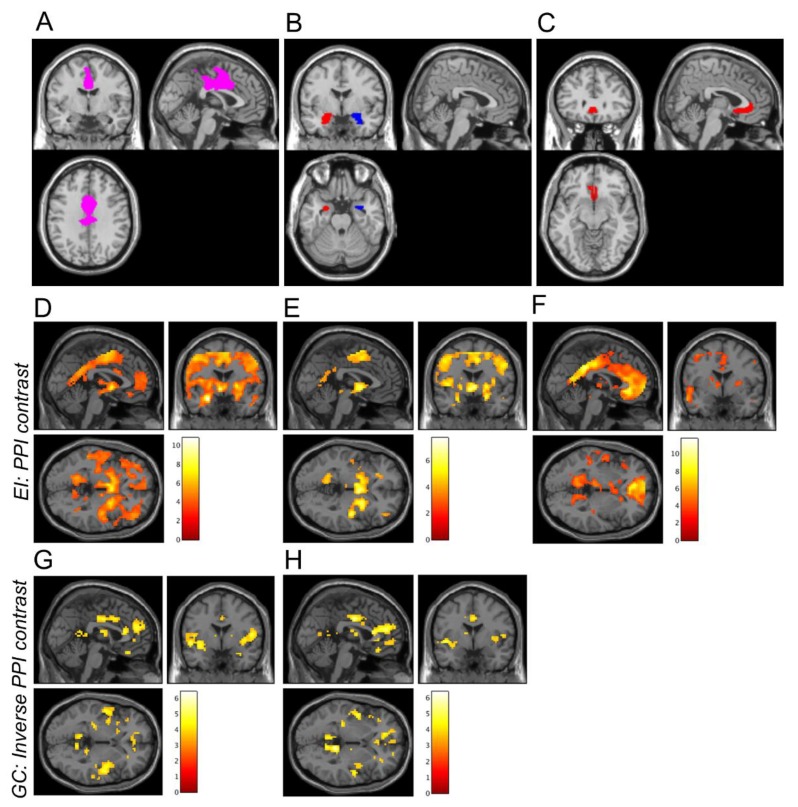
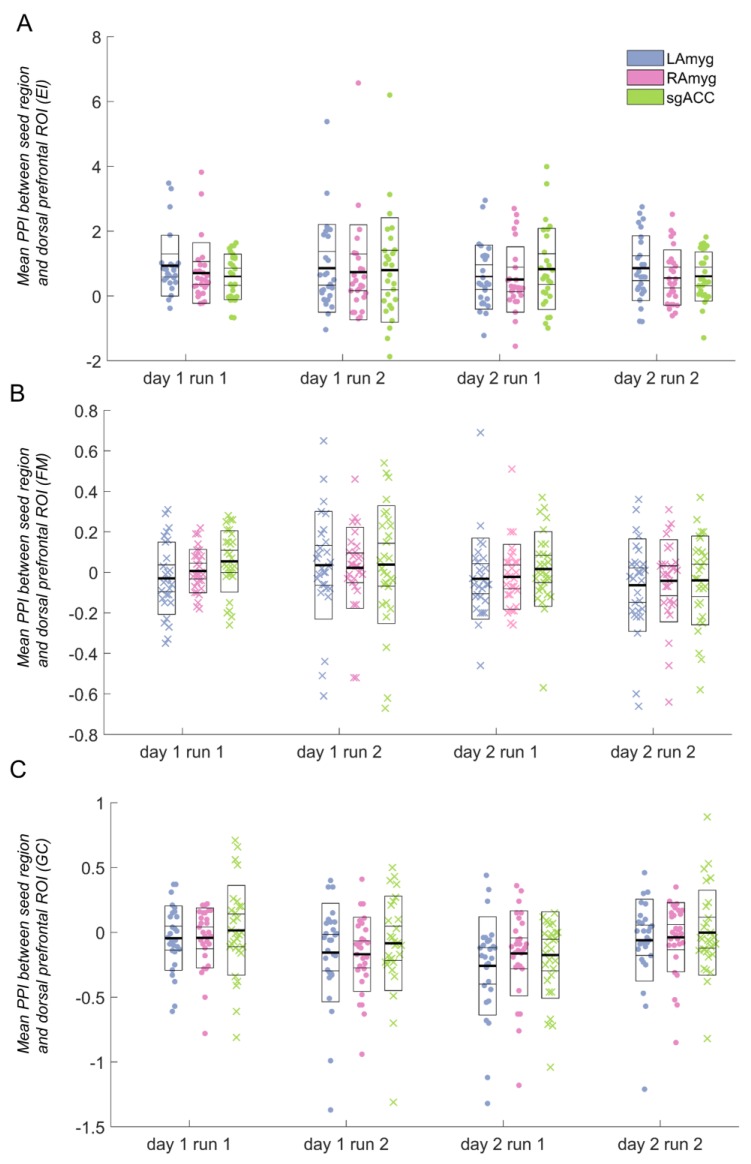
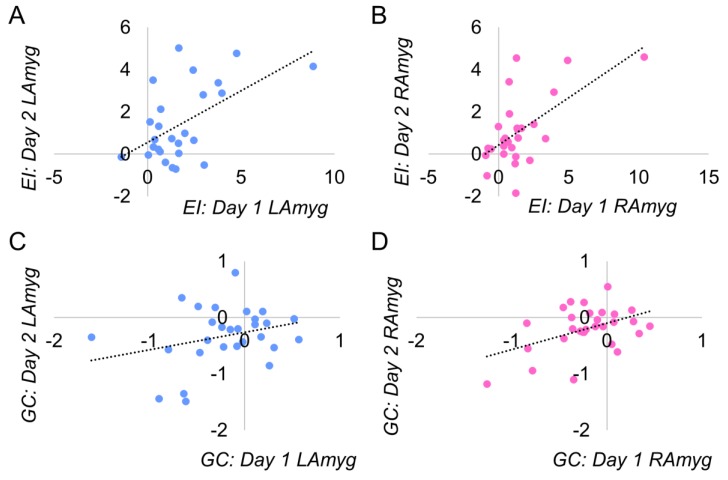
One of the most exciting translational prospects for brain imaging research is the potential use of functional magnetic resonance imaging (fMRI) ‘biomarkers’ to predict an individual’s risk of developing a neuropsychiatric disorder or the likelihood of responding to a particular intervention. This proposal depends critically on reliable measurements at the level of the individual. Several previous studies have reported relatively poor reliability of amygdala activation during emotional face processing, a key putative fMRI ‘biomarker’. However, the reliability of amygdala connectivity measures is much less well understood. Here, we assessed the reliability of task-modulated coupling between three seed regions (left and right amygdala and the subgenual anterior cingulate cortex) and the dorsomedial frontal/cingulate cortex (DMFC), measured using a psychophysiological interaction analysis in 29 healthy individuals scanned approximately two weeks apart. We performed two runs on each day of three different emotional face-processing tasks: emotion identification, emotion matching, and gender classification. We tested both between-day reliability and within-day (between-run) reliability. We found good-to-excellent within-subject reliability of amygdala–DMFC coupling, both between days (in two tasks), and within day (in one task). This suggests that disorder-relevant regional coupling may be sufficiently reliable to be used as a predictor of treatment response or clinical risk in future clinical studies.
Overview
The claims and statistics of this paper haven’t been checked yet.
Free: it reads the open-access text and checks the first 5 claims that cite a source we can check. Create a free account to check every claim.
Integrity signals
Registry
Cites
Statistics
Figures
Verification
Claims the paper makes
The claims and statistics of this paper haven’t been checked yet.
Free: it reads the open-access text and checks the first 5 claims that cite a source we can check. Create a free account to check every claim.
Claims other papers make about this one
Each is checked against this paper’s own text: does it say what the citing paper says it does?
The cited source says what the claim attributes to it.
In the citing paper
“Discrepancies may in part be due to examination of activation rather than patterns of functional connectivity between limbic and prefrontal regions, which may serve as a more reliable biomarker (Nord et al., 2019).”
From Changes in functional connectivity with cognitive behavioral therapy for social anxiety disorder predict outcomes at follow-up (2020) · cites this paper as Nord et al., 2019
Self-check
Percentages, sums and reported differences re-computed from the paper’s own numbers.
The self-check needs the paper’s full text.
Citations
Cites
Intraclass correlations: Uses in assessing rater reliability.
Shrout, P. E., & Fleiss, J. L. (1979) · Psychological Bulletin · doi:10.1037/0033-2909.86.2.420 · Cited by 24,532 · cited 1×
“We employed a two-way mixed effects ICC [31], defined as:”
Method(1998) · The Journal of Clinical Psychiatry · Cited by 19,139
(1998) · PubMed · Cited by 10,216
Emotional processing in anterior cingulate and medial prefrontal cortex
Etkin, A., Egner, T., & Kalisch, R. (2011) · Trends in Cognitive Sciences · doi:10.1016/j.tics.2010.11.004 · Cited by 3,059 · cited 3×
“There is substantial evidence suggesting that anxiety-related processes, in fact, reflect a bidirectional modulation between amygdala and medial prefrontal circuitry, in particular the DMFC [16,17], which itself has been shown to be overactive in pathological anxiety [18].”
BackgroundSerotonin transporter genetic variation and the response of the human amygdala.
Hariri, A. R., Mattay, V. S., Tessitore, A., Kolachana, B., Fera, F., Goldman, D., Egan, M. F., & Weinberger, D. R. (2002) · Science · doi:10.1126/science.1071829 · Cited by 2,340 · cited 2×
“For the FM task [24], there was no significant (p < 0.”
BackgroundMethodThe Intraclass Correlation Coefficient as a Measure of Reliability
Bartko, J. J. (1966) · Psychological Reports · doi:10.2466/pr0.1966.19.1.3 · Cited by 2,299 · cited 2×
“to within-subjects variance [30] (an ICC = 1.”
BackgroundThe Resting Brain: Unconstrained yet Reliable
Shehzad, Z., Kelly, A. M. C., Reiss, P. T., Gee, D. G., Gotimer, K., Uddin, L. Q., Lee, S. H., Margulies, D. S., Roy, A. K., Biswal, B. B., et al. (2009) · Cerebral Cortex · doi:10.1093/cercor/bhn256 · Cited by 908
Tools of the trade: psychophysiological interactions and functional connectivity
O’Reilly, J. X., Woolrich, M. W., Behrens, T. E. J., Smith, S. M., & Johansen-Berg, H. (2012) · Social Cognitive and Affective Neuroscience · doi:10.1093/scan/nss055 · Cited by 765 · cited 5×
“Therefore, PPI analysis can reveal which voxels in the brain exhibit different covariation with the seed region as a function of task condition [28] (in our study: for GC and EI, faces > fixation cross; for FM, faces > shapes).”
BackgroundMethodInfluentialMini International Neuropsychiatric Interview
Lecrubier, Y., Sheehan, D. V., Weiller, E., Amorim, P., Bonora, I., Sheehan, K. H., Janavs, J., & Dunbar, G. C. (2013) · PsycTESTS Dataset · doi:10.1037/t18597-000 · Cited by 720
How reliable are the results from functional magnetic resonance imaging?
Bennett, C. M., & Miller, M. B. (2010) · Annals of the New York Academy of Sciences · doi:10.1111/j.1749-6632.2010.05446.x · Cited by 577 · cited 2×
“The ICC enabled us to quantify the stability of measurement across each fMRI session [29] and is usually interpreted as a ratio of between-subjects”
Background
Research works printed but not linked: 1
- Fleiss J.L. Reliability of measurement The Design and Analysis of Clinical Experiments John Wiley & Sons Hoboken, NJ, USA 1986 1 32
Cited by
Structural and resting state functional connectivity beyond the cortex
Harrison, O. K., Guell, X., Klein-Flügge, M. C., & Barry, R. L. (2021) · NeuroImage · doi:10.1016/j.neuroimage.2021.118379 · Cited by 51
Norbury, A., Rutter, S., Collins, A. B., Costi, S., Jha, M. K., Horn, S. R. G.-V., Kautz, M. M., Corniquel, M. B., Collins, K. A., Glasgow, A. M., et al. (2021) · Neuropsychopharmacology · doi:10.1038/s41386-021-01104-4 · Cited by 48
Westgarth, M. M. P., Hogan, C., Neumann, D. L., & Shum, D. (2021) · Social Cognitive and Affective Neuroscience · doi:10.1093/scan/nsab017 · Cited by 44
Anxiety and amygdala connectivity during movie-watching
Kirk, P. A., Robinson, O. J., & Skipper, J. I. (2022) · Neuropsychologia · doi:10.1016/j.neuropsychologia.2022.108194 · Cited by 23
Self-citationSandman, C. F., Young, K. S., Burklund, L. J., Saxbe, D. E., Lieberman, M. D., & Craske, M. G. (2020) · Behaviour Research and Therapy · doi:10.1016/j.brat.2020.103612 · Cited by 22
“Discrepancies may in part be due to examination of activation rather than patterns of functional connectivity between limbic and pre-frontal regions, which may serve as a more reliable biomarker (Nord et al., 2019).”
BackgroundMcDermott, T. J., Kirlić, N., Akeman, E., Touthang, J., Cosgrove, K. T., DeVille, D. C., Clausen, A. N., White, E. J., Kuplicki, R., & Aupperle, R. L. (2020) · NeuroImage · doi:10.1016/j.neuroimage.2020.117077 · Cited by 21
Amygdala fMRI—A Critical Appraisal of the Extant Literature
Varkevisser, T., Geuze, E., & van Honk, J. (2024) · Neuroscience Insights · doi:10.1177/26331055241270591 · Cited by 22
“Finally, 1 study by Nord et al. 168 showed that amygdala’s PPI with the DMPFC during emotion provocation exhibited good test-retest reliability at the intra-subject level (ie, most ICC’s close to or above 0.59).”
BackgroundInfluentialPredicting Response to Brain Stimulation in Depression: a Roadmap for Biomarker Discovery
Nord, C. L. (2021) · Current Behavioral Neuroscience Reports · doi:10.1007/s40473-021-00226-9 · Cited by 17
Self-citationAnxiety Shapes Amygdala-Prefrontal Dynamics During Movie Watching
Kirk, P. A., Holmes, A. J., & Robinson, O. J. (2022) · Biological Psychiatry Global Open Science · doi:10.1016/j.bpsgos.2022.03.009 · Cited by 19
Self-citationMartynova, O., Tetereva, A., Balaev, V. V., Portnova, G. V., Ushakov, V., & Ivanitsky, A. M. (2020) · International Journal of Psychophysiology · doi:10.1016/j.ijpsycho.2020.01.002 · Cited by 18
Asymmetry of amygdala resting-state functional connectivity in healthy human brain
Tetereva, A., Balaev, V. V., Kartashov, S., Ushakov, V., Ivanitsky, A. M., & Martynova, O. (2019) · Neuroreport · doi:10.1097/wnr.0000000000001353 · Cited by 15
Jamieson, A. J., Harrison, B. J., & Davey, C. G. (2021) · Psychological Medicine · doi:10.1017/s0033291721002567 · Cited by 16
Lukow, P. B., Lowther, M., Pike, A. C., Yamamori, Y., Chavanne, A. V., Gormley, S., Aylward, J., McCloud, T., Goble, T., Rodriguez-Sanchez, J., et al. (2024) · Journal of Psychopharmacology · doi:10.1177/02698811241286773 · Cited by 3
“Our primary analysis was done in R 4.2.2., adapting the same analysis approach as that taken in the publications we aimed to replicate (Nord et al., 2017, 2019).”
BackgroundMethodInfluentialSelf-citationInternal reliability of blame-related functional MRI measures in major depressive disorder
Fennema, D., O’Daly, O., Barker, G. J., Moll, J., & Zahn, R. (2021) · NeuroImage Clinical · doi:10.1016/j.nicl.2021.102901 · Cited by 4
“Our observation that it is possible to have robust activation at the group-level despite weak consistency at the individual level is in line with previous reports (Di and Biswal, 2017; Infantolino et al., 2018; McDermott et al., 2020; Smith et al., 2016).”
ResultLukow, P. B., Lowther, M., Pike, A. C., Yamamori, Y., Chavanne, A. V., Gormley, S., Aylward, J., Vera, C. E., McCloud, T. L., Goble, T., et al. (2025) · Journal of Affective Disorders · doi:10.1016/j.jad.2025.120682 · Cited by 2
Self-citationDi, X., Zhang, L., Zhang, Z., & Biswal, B. B. (2024) · Physics of Life Reviews · doi:10.1016/j.plrev.2024.08.011 · Cited by 1
Velazquez, J. M. (2021) · Deep Blue (University of Michigan) · doi:10.7302/1343
Using Movies to Probe the Neurobiology of Anxiety
Kirk, P. A. (2023) · UCL Discovery (University College London) · Cited by 1
Chang, S. (2024) · UCL Discovery (University College London)
Metadata
- Authors
- Nord, C., Gray, A., Robinson, O., & Roiser, J.
- Affiliations
- MRC Cognition and Brain Sciences Unit (GB)
- University College London (GB)
- Corresponding author
- Roiser, Jonathan
- Venue
- Brain Sciences
- Publisher
- MDPI AG
- Published
- 2019-04-19
- Volume
- 9
- Issue
- 4
- Pages
- 89
- ISSN
- 2076-3425 (ISSN-L)
- PMC
- PMC6523743
- OpenAlex
- W2936730843
- Cited by
- 17
- References
- 40
- Citations by year
- 2025: 1 · 2024: 3 · 2022: 2 · 2021: 6 · 2020: 3 · 2019: 2
- FWCI
- 1.89
- Type
- journal article
- Language
- en
- Open access
- gold
- dx.doi.org
- Licence
- Locations
- Brain Sciences (publishedVersion, cc-by)
- Europe PMC (PubMed Central) (publishedVersion, cc-by)
- PubMed Central (publishedVersion, cc-by)
- PubMed (publishedVersion)
- DOAJ (DOAJ: Directory of Open Access Journals) (submittedVersion, cc-by-sa)
- UCL Discovery (University College London) (submittedVersion)
- Apollo (University of Cambridge) (submittedVersion, cc-by)
- Apollo (cc-by)
- Funders
- Wellcome Trust (101798/Z/13/Z)
- Medical Research Council (MR/R020817/1, SUAG/006/RG91365)
- Topics
- Life Sciences › Neuroscience › Cognitive Neuroscience › Functional Brain Connectivity Studies
- Life Sciences › Neuroscience › Cognitive Neuroscience › Neural and Behavioral Psychology Studies
- Life Sciences › Neuroscience › Cognitive Neuroscience › Face Recognition and Perception
- Keywords
- amygdala, emotional face processing, functional connectivity, psychophysiological interaction, subgenual anterior cingulate cortex, dorsomedial frontal cortex, inter-day reliability, fMRI biomarkers, treatment response prediction, neuropsychiatric disorders
About these checks
Registry, retraction, Cites and statistics results are computed, not judged, with one exception: a printed reference that no index lists is read once by a model before it counts as a citation error. Claims are extracted by a model and kept only when their quote appears verbatim in the text; each cited source is then checked, with a model’s help, for whether it says what the claim relies on. Those verdicts can be wrong — read the claim’s quote and the cited source before relying on one.
Statistics and arithmetic are recomputed, not judged.
Confidence bands are shown only for fields calibrated on our annotated test set. None is calibrated yet, so no band is shown.
What counts as a claim ›How we measure confidence ›How we check this ›
Are you an author, or do you see a problem with this page? Request a review
Data sources
Bibliographic data: Semantic Scholar, OpenAlex, Crossref.
Contains information from the Semantic Scholar Academic Graph Datasets, made available under the ODC Attribution License (ODC-BY 1.0).
Semantic Scholar’s data is described in: Kinney, R., et al. (2023). The Semantic Scholar Open Data Platform. arXiv:2301.10140.
