

The DOI matches its Crossref record; 1 of the 87 references it cites were found in a registry or an index, and 86 are not checked yet.
The Impact of Generative AI Use on Graduate Students’ Research Competence: The Mediating Role of Critical Thinking and the Moderating Role of Research Self-Efficacy
Open accessAbstract
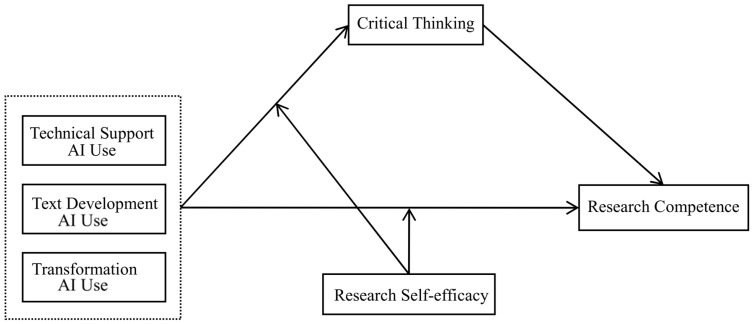
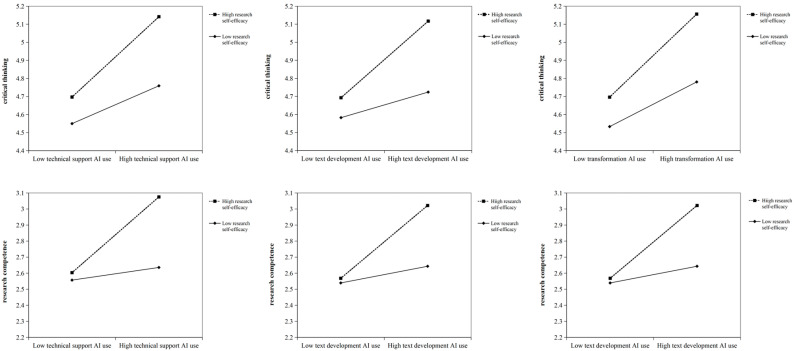
With the development of the digital intelligence era, generative AI is being widely used in scientific research, and its impact on graduate students’ research competence has attracted much attention from the academic community. Based on cognitive distribution theory and self-efficacy theory, this study classifies AI applications into three levels from basic to advanced—technical support AI use, text development AI use, and transformation AI use—explores their effects on graduate students’ research competence, and examines the mediating effect of critical thinking and the moderating effect of research self-efficacy. The results of the empirical analysis show that all three types of AI use behaviors are significantly correlated with research competence, with the strongest correlation for text development type and the weakest for technical support type. In the relationship between the three types of AI use behaviors and research competence, critical thinking plays a significant positive mediating role, and research self-efficacy plays a significant moderating role. Universities and tutors should guide students to focus on higher-order AI use behaviors in the text development and transformation categories, promoting the use of critical thinking to avoid technology misuse and improving research self-efficacy to help students accumulate confidence and support their research.
Overview
The claims and statistics of this paper haven’t been checked yet.
Run the check — free, no account needed. It reads the open-access text and checks the sources it cites.
Integrity signals
Registry
Cites
Statistics
Figures
Verification
Claims the paper makes
The claims and statistics of this paper haven’t been checked yet.
Run the check — free, no account needed. It reads the open-access text and checks the sources it cites.
Claims other papers make about this one
Each is checked against this paper’s own text: does it say what the citing paper says it does?
The cited source says what the claim attributes to it.
In the citing paper
“Studies on pedagogical partnerships, research competence, and writing support indicate that the educational value of GenAI depends on whether students remain the active agents of meaning making rather than outsourcing that role to the system (Wang & Zhang, 2026; Zhu & Yang, 2026).”
From Generative AI, Cognitive Offloading, and Learner Agency in Higher Education: A Scoping Review (2026) · cites this paper as Zhu & Yang, 2026
The cited source says what the claim attributes to it.
In the citing paper
“These findings are especially important because they show that self-regulation in GenAI environments is not limited to effort management or planning; it also includes epistemic monitoring, verification, and the ability to resist the automatic acceptance of plausible AI output.”
From Generative AI, Cognitive Offloading, and Learner Agency in Higher Education: A Scoping Review (2026) · cites this paper as Zhu & Yang, 2026
Self-check
Percentages, sums and reported differences re-computed from the paper’s own numbers.
The self-check needs the paper’s full text.
Citations
Cites
Structural equation modeling in practice: A review and recommended two-step approach
Anderson, J. C., & Gerbing, D. W. (1988) · Psychological Bulletin · doi:10.1037/0033-2909.103.3.411 · Cited by 41,941
Pls-Sem: indeed a silver bullet
Hair, J. F., Ringle, C. M., & Sarstedt, M. (2011) · Journal of Marketing Theory and Practice · doi:10.2753/mtp1069-6679190202 · Cited by 21,631
Beyond Baron and Kenny: Statistical Mediation Analysis in the New Millennium
Hayes, A. F. (2009) · Communication Monographs · doi:10.1080/03637750903310360 · Cited by 9,757
Best Practices in Quantitative Methods
Osborne, J. W. (2008) · Sage eBooks · doi:10.4135/9781412995627 · Cited by 1,093
Li, H., Zhang, R., Lee, Y.-C., Kraut, R. E., & Mohr, D. C. (2023) · npj Digital Medicine · doi:10.1038/s41746-023-00979-5 · Cited by 598
Hassani, H., & Silva, E. S. (2023) · Big Data and Cognitive Computing · doi:10.3390/bdcc7020062 · Cited by 401
Liu, M., Zhang, L. J., & Biebricher, C. (2023) · Computers & Education · doi:10.1016/j.compedu.2023.104977 · Cited by 399
Factor Structures of Three Measures of Research Self-Efficacy
Forester, M., Kahn, J. H., & Hesson-McInnis, M. S. (2004) · Journal of Career Assessment · doi:10.1177/1069072703257719 · Cited by 206
Shahzad, M. F., Xu, S., & Zahid, H. (2025) · Education and Information Technologies · doi:10.1007/s10639-024-12949-9 · Cited by 204
Lingard, L. (2023) · Perspectives on Medical Education · doi:10.5334/pme.1072 · Cited by 150
Cited by
Sorted by citations
Generative AI, Cognitive Offloading, and Learner Agency in Higher Education: A Scoping Review
Wang, G., Wang, W., Yang, D., & Ren, J. (2026) · Behavioral Sciences · doi:10.3390/bs16071150 · Cited by 20
“These constructs help organize why GenAI may serve as a scaffold for some learners and as a source of dependence for others, although the heterogeneous evidence base does not support a formal ranking of their causal importance (Xu et al., 2025; Zhu & Yang, 2026; C. Zhou & Wang, 2026).”
InfluentialMarin-Rodriguez, W., de Salinas, F. D. M. G. T., Ramírez, E. T. S., & Girón, E. C. A. (2026) · Iberoamerican Journal of Science Measurement and Communication · doi:10.47909/ijsmc.372 · Cited by 1
Gao, L., Sun, Y., & Khan, S. U. (2026) · Frontiers in Psychology · doi:10.3389/fpsyg.2026.1847369 · Cited by 1
Yan, Z., Fang, Z., & Zou, W. (2026) · Frontiers in Psychology · doi:10.3389/fpsyg.2026.1939286 · Cited by 1
AGUITE, A., Jr. (2026) · Research Square · doi:10.21203/rs.3.rs-9565332/v1
Metadata
- Authors
- Zhu, H., & Yang, S.
- Affiliations
- Normal College, Shihezi University, Shihezi 832003, China
- Venue
- Behavioral Sciences
- Publisher
- MDPI AG
- Published
- 2026-02-21
- Volume
- 16
- Issue
- 2
- Pages
- 304
- ISSN
- 2076-328X (ISSN-L)
- PMC
- PMC12937814
- OpenAlex
- W7130933570
- Cited by
- 13
- References
- 79
- Citations by year
- 2026: 13
- FWCI
- 108.95
- Type
- journal article
- Language
- en
- Open access
- gold
- doi.org
- Licence
- Locations
- Behavioral Sciences (publishedVersion, cc-by)
- PubMed (publishedVersion)
- PubMed Central (publishedVersion, cc-by)
- DOAJ (DOAJ: Directory of Open Access Journals) (submittedVersion)
- Topics
- Social Sciences › Education › Artificial Intelligence in Education
- Social Sciences › Education › Doctoral Education Challenges and Solutions
- Health Sciences › Medicine › Health Informatics › Artificial Intelligence in Healthcare and Education
- Keywords
- generative AI, graduate students, research skills, critical thinking, research self-efficacy, cognitive load theory, self-efficacy theory, textual development, technology misuse
About these checks
Registry, retraction, Cites and statistics results are computed, not judged, with one exception: a printed reference that no index lists is read once by a model before it counts as a citation error. Claims are extracted by a model and kept only when their quote appears verbatim in the text; each cited source is then checked, with a model’s help, for whether it says what the claim relies on. Those verdicts can be wrong — read the claim’s quote and the cited source before relying on one.
Statistics and arithmetic are recomputed, not judged.
Confidence bands are shown only for fields calibrated on our annotated test set. None is calibrated yet, so no band is shown.
What counts as a claim ›How we measure confidence ›How we check this ›
Are you an author, or do you see a problem with this page? Request a review
How to cite
Cite CoChat for the checks on this page, and the paper for its own findings.
- This page
- CoChat. (2026). Citation check: The Impact of Generative AI Use on Graduate Students’ Research Competence: The Mediating Role of Critical Thinking and the Moderating Role of Research Self-Efficacy. https://app.cochat.ai/papers/10.3390/bs16020304
- The paper
- Zhu, H., & Yang, S. (2026). The Impact of Generative AI Use on Graduate Students’ Research Competence: The Mediating Role of Critical Thinking and the Moderating Role of Research Self-Efficacy. Behavioral Sciences. https://doi.org/10.3390/bs16020304
