

The DOI matches its Crossref record; 77 of the 77 references it cites were found in a registry or an index.
Coordinated Interpersonal Behaviour in Collective Dance Improvisation: The Aesthetics of Kinaesthetic Togetherness
Open accessAbstract
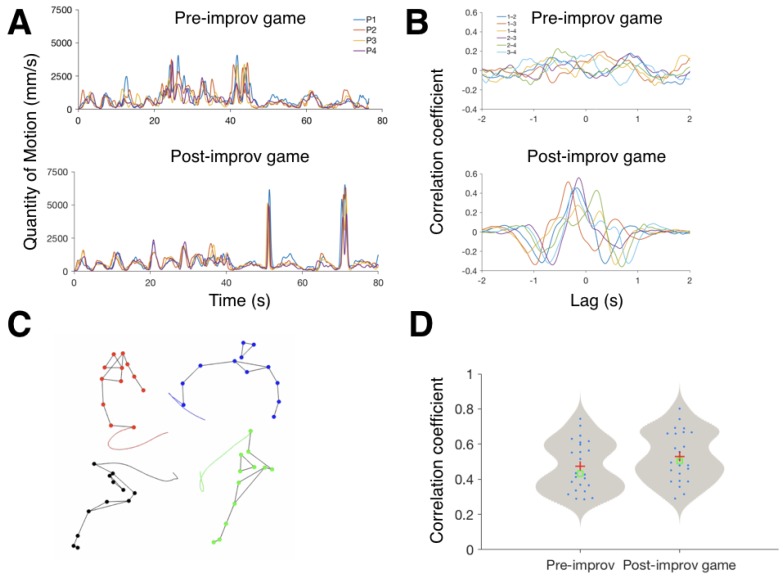
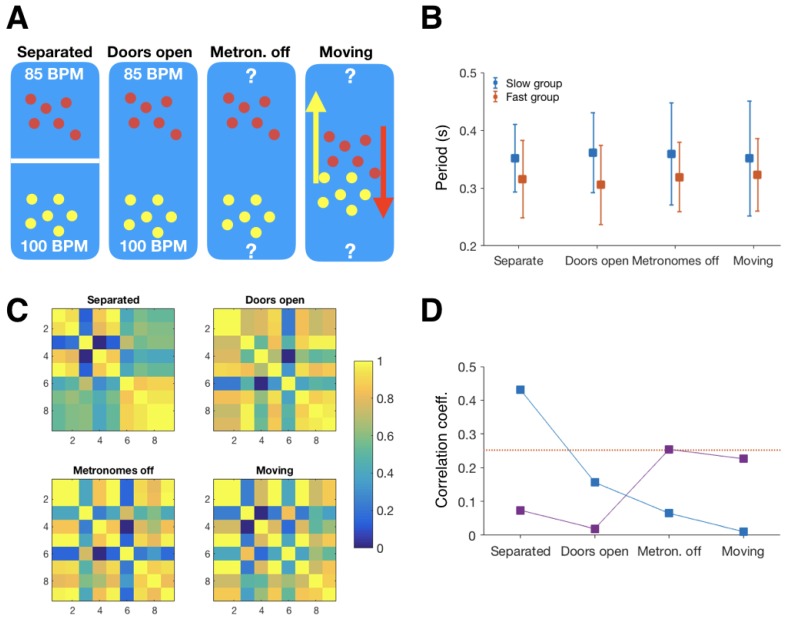
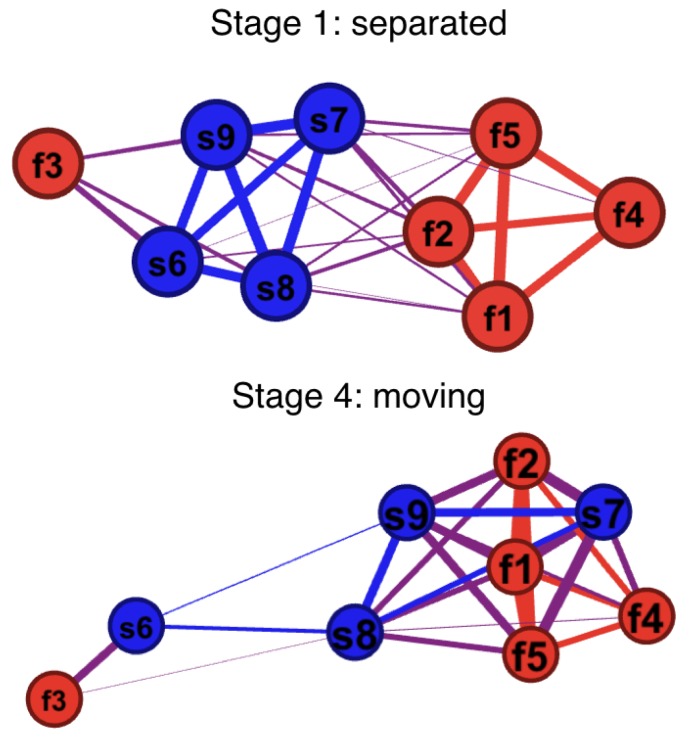
Collective dance improvisation (e.g., traditional and social dancing, contact improvisation) is a participatory, relational and embodied art form which eschews standard concepts in aesthetics. We present our ongoing research into the mechanisms underlying the lived experience of “togetherness” associated with such practices. Togetherness in collective dance improvisation is kinaesthetic (based on movement and its perception), and so can be simultaneously addressed from the perspective of the performers and the spectators, and be measured. We utilise these multiple levels of description: the first-person, phenomenological level of personal experiences, the third-person description of brain and body activity, and the level of interpersonal dynamics. Here, we describe two of our protocols: a four-person mirror game and a ‘rhythm battle’ dance improvisation score. Using an interpersonal closeness measure after the practice, we correlate subjective sense of individual/group connectedness and observed levels of in-group temporal synchronization. We propose that kinaesthetic togetherness, or interpersonal resonance, is integral to the aesthetic pleasure of the participants and spectators, and that embodied feeling of togetherness might play a role more generally in aesthetic experience in the performing arts.
Overview
The claims and statistics of this paper haven’t been checked yet.
Run the check — free, no account needed. It reads the open-access text and checks the sources it cites.
Integrity signals
Registry
Cites
Statistics
Figures
Verification
Claims the paper makes
The claims and statistics of this paper haven’t been checked yet.
Run the check — free, no account needed. It reads the open-access text and checks the sources it cites.
Claims other papers make about this one
Each is checked against this paper’s own text: does it say what the citing paper says it does?
The cited source says what the claim attributes to it.
In the citing paper
“These studies point out that interpersonal movement synchrony plays an important role in subjective experiences and aesthetic appreciation.”
From Heart Rate Variability Synchronizes When Non-experts Vocalize Together (2020) · cites this paper as Himberg et al., 2018
Self-check
Percentages, sums and reported differences re-computed from the paper’s own numbers.
The self-check needs the paper’s full text.
Citations
Cites
The Ecological Approach to Visual Perception: Classic Edition
Gibson, J. J. (2014) · doi:10.4324/9781315740218 · Cited by 12,132
The detection of disease clustering and a generalized regression approach.
Mantel, N. (1967) · PubMed · doi:10.1111/jbi.14281 · Cited by 11,504
(1999) · Cited by 7,995
Social psychology of intergroup relations
Tajfel, H. (1982) · Annual Review of Psychology · doi:10.1146/annurev.ps.33.020182.000245 · Cited by 7,949
The faculty of language: what is it, who has it, and how did it evolve?
Hauser, M. D., Chomsky, N., & Fitch, W. T. (2002) · Science · doi:10.1126/science.298.5598.1569 · Cited by 5,189
Inclusion of Other in the Self Scale and the structure of interpersonal closeness.
Aron, A., Aron, E. N., & Smollan, D. (1992) · Journal of Personality and Social Psychology · doi:10.1037/0022-3514.63.4.596 · Cited by 5,157
(1980) · Medical Entomology and Zoology · Cited by 4,712
Wiltermuth, S. S., & Heath, C. (2009) · Psychological Science · doi:10.1111/j.1467-9280.2008.02253.x · Cited by 1,717
Suits, B. (1978) · University of Toronto Press eBooks · doi:10.3138/9781487574338 · Cited by 1,560
(1996) · Journal of Consciousness Studies · Cited by 1,338
Research works printed but not linked: 5
- Novack, C.J. (1990). Sharing the Dance: Contact Improvisation and American Culture, University of Wisconsin Press.
- Kant, I., and Meredith, J.C. (2007). Critique of Judgement, Oxford University Press.
- Amighi, J.K. (1999). The Meaning of Movement: Developmental and Clinical Perspectives of the Kestenberg Movement Profile, Brunner-Routledge.
- 1994, The Mindreading System: New directions for research, Cah. Psychol. Cogn. Curr. Psychol. Cogn., 13, 724
- Maturana, H.R., and Varela, F.J. (1991). Autopoiesis and Cognition: The Realization of the Living, Springer Science & Business Media.
Cited by
Loving and knowing: reflections for an engaged epistemology
Jaegher, H. D. (2019) · Phenomenology and the Cognitive Sciences · doi:10.1007/s11097-019-09634-5 · Cited by 155
Agres, K., Schaefer, R., Volk, A., van Hooren, S., Holzapfel, A., Bella, S. D., Müller, M., de Witte, M., Herremans, D., Ramírez, R., et al. (2021) · Music & Science · doi:10.1177/2059204321997709 · Cited by 113
The sense of agency in joint action: An integrative review
Loehr, J. D. (2022) · Psychonomic Bulletin & Review · doi:10.3758/s13423-021-02051-3 · Cited by 87
Interactive expertise in solo and joint musical performance
Høffding, S., & Satne, G. (2019) · Synthese · doi:10.1007/s11229-019-02339-x · Cited by 71
How and why people synchronize: An integrated perspective
daSilva, E. B., & Wood, A. (2025) · Personality and Social Psychology Review · doi:10.1177/10888683241252036 · Cited by 56
The Body Speaks: Using the Mirror Game to Link Attachment and Non-verbal Behavior
Feniger‐Schaal, R., Hart, Y., Lotan, N., Koren‐Karie, N., & Noy, L. (2018) · Frontiers in Psychology · doi:10.3389/fpsyg.2018.01560 · Cited by 50
Interpersonal Coordination in Schizophrenia: A Scoping Review of the Literature
Dean, D. J., Scott, J., & Park, S. (2021) · Schizophrenia Bulletin · doi:10.1093/schbul/sbab072 · Cited by 48
Christensen, J. F., Vartanian, M., Sancho-Escanero, L., Khorsandi, S., Yazdi, S. H. N., Farahi, F., Borhani, K., & Gomila, A. (2021) · Frontiers in Psychology · doi:10.3389/fpsyg.2020.588948 · Cited by 42
Bégel, V., Bachrach, A., Bella, S. D., Laroche, J., Clément, S., Riquet, A., & Dellacherie, D. (2021) · The Cerebellum · doi:10.1007/s12311-021-01291-2 · Cited by 40
Self-citationSchiavio, A., Gesbert, V., Reybrouck, M., Hauw, D., & Parncutt, R. (2019) · Frontiers in Psychology · doi:10.3389/fpsyg.2019.01542 · Cited by 38
Social and nonlinear dynamics unite: musical group synchrony
Demos, A. P., & Palmėr, C. (2023) · Trends in Cognitive Sciences · doi:10.1016/j.tics.2023.05.005 · Cited by 35
The dynamics of musical participation
Schiavio, A., Maes, P., & van der Schyff, D. (2021) · Musicae Scientiae · doi:10.1177/1029864920988319 · Cited by 33
It Takes Two: Interpersonal Neural Synchrony Is Increased after Musical Interaction
Khalil, A. K., Musacchia, G., & Iversen, J. R. (2022) · Brain Sciences · doi:10.3390/brainsci12030409 · Cited by 33
Synchrony in Old Age: Playing the Mirror Game Improves Cognitive Performance
Keisari, S., Feniger‐Schaal, R., Palgi, Y., Golland, Y., Gesser‐Edelsburg, A., & Ben‐David, B. M. (2020) · Clinical Gerontologist · doi:10.1080/07317115.2020.1799131 · Cited by 30
Dynamics in interbrain synchronization while playing a piano duet
Lender, A., Perdikis, D., Gruber, W. R., Lindenberger, U., & Müller, V. (2023) · Annals of the New York Academy of Sciences · doi:10.1111/nyas.15072 · Cited by 29
Resonance as a Design Strategy for AI and Social Robots
Lomas, D., Lin, A., Dikker, S., Förster, D., Lupetti, M. L., Huisman, G., Habekost, J., Beardow, C., Pandey, P., Ahmad, N., et al. (2022) · Frontiers in Neurorobotics · doi:10.3389/fnbot.2022.850489 · Cited by 29
Heart Rate Variability Synchronizes When Non-experts Vocalize Together
Ruiz-Blais, S., Orini, M., & Chew, E. (2020) · Frontiers in Physiology · doi:10.3389/fphys.2020.00762 · Cited by 25
“Subjective experiences of togetherness have been previously studied in the context of dance (Himberg et al., 2018) and synchronized movement (Noy et al.”
BackgroundEffects of Improvisational Dance Movement Therapy on Balance and Cognition in Parkinson’s Disease
Fisher, M., Kuhlmann, N., Moulin, H., Sack, J., Lazuk, T., & Gold, I. (2020) · Physical & Occupational Therapy In Geriatrics · doi:10.1080/02703181.2020.1765943 · Cited by 25
Dance and stress regulation: A multidisciplinary narrative review
Klaperski, S., Skinner, J., Opacka‐Juffry, J., & Pfeffer, K. (2025) · Psychology of sport and exercise · doi:10.1016/j.psychsport.2025.102823 · Cited by 24
Movement Synchrony in the Mirror Game
Feniger‐Schaal, R., Schönherr, D., Altmann, U., & Strauss, B. M. (2020) · Journal of Nonverbal Behavior · doi:10.1007/s10919-020-00341-3 · Cited by 23
Positive emotions foster spontaneous synchronisation in a group movement improvisation task
Smykovskyi, A., Bieńkiewicz, M. M. N., Pla, S., Janaqi, S., & Bardy, B. G. (2022) · Frontiers in Human Neuroscience · doi:10.3389/fnhum.2022.944241 · Cited by 22
Laroche, J., Bachrach, A., & Noy, L. (2024) · BMC Neuroscience · doi:10.1186/s12868-024-00874-z · Cited by 21
Self-citationThe Micro-Genesis of Interpersonal Synergy. Insights from Improvised Dance Duets
Kimmel, M. (2021) · Ecological Psychology · doi:10.1080/10407413.2021.1908142 · Cited by 20
Cultural Niche Construction as a Framework for Reorienting Human−Environment Relations
Nagatsu, M., Kaaronen, R. O., Salmela, M., & MacLeod, M. (2023) · Topics in Cognitive Science · doi:10.1111/tops.12674 · Cited by 19
Togetherness in musical interaction
Bishop, L. (2024) · Routledge Open Research · doi:10.12688/routledgeopenres.18202.1 · Cited by 17
Hollett, T., Peng, X., & Land, S. M. (2021) · Journal of the Learning Sciences · doi:10.1080/10508406.2021.2003801 · Cited by 17
Orlandi, A., & Candidi, M. (2025) · iScience · doi:10.1016/j.isci.2025.112365 · Cited by 16
Shared Diminished Reality: A New VR Framework for the Study of Embodied Intersubjectivity
Vuarnesson, L., Zamplaras, D., Laroche, J., Dumit, J., Lutes, C., Bachrach, A., & Garnier, F. (2021) · Frontiers in Virtual Reality · doi:10.3389/frvir.2021.646930 · Cited by 16
Self-citationZhou, Z., Christensen, J., Cummings, J. A., & Loehr, J. D. (2023) · Consciousness and Cognition · doi:10.1016/j.concog.2023.103521 · Cited by 15
Socializing Sensorimotor Contingencies
Lübbert, A., Göschl, F., Krause, H., Schneider, T. R., Maÿe, A., & Engel, A. K. (2021) · Frontiers in Human Neuroscience · doi:10.3389/fnhum.2021.624610 · Cited by 15
Creative Togetherness. A Joint-Methods Analysis of Collaborative Artistic Performance
Gesbert, V., Hauw, D., Kempf, A., Blauth, A., & Schiavio, A. (2022) · Frontiers in Psychology · doi:10.3389/fpsyg.2022.835340 · Cited by 14
Learning Music From Each Other: Synchronization, Turn-taking, or Imitation?
Schiavio, A., Stupacher, J., Parncutt, R., & Timmers, R. (2020) · Music Perception An Interdisciplinary Journal · doi:10.1525/mp.2020.37.5.403 · Cited by 14
A distributed model of collective creativity in free play
Kalaydjian, J., Laroche, J., Noy, L., & Bachrach, A. (2022) · Frontiers in Education · doi:10.3389/feduc.2022.902251 · Cited by 13
Self-citationTseng, C., Cheng, M., Matout, H., Fujita, K., Kitamura, Y., Shioiri, S., Ho, I., & Bachrach, A. (2021) · Japanese Psychological Research · doi:10.1111/jpr.12330 · Cited by 11
Self-citation[Re]moving Bodies – A Shared Diminished Reality Installation for Exploring Relational Movement
Laroche, J., Vuarnesson, L., Endaltseva, A., Dumit, J., & Bachrach, A. (2021) · Frontiers in Psychology · doi:10.3389/fpsyg.2021.539596 · Cited by 11
Self-citationD’Amario, S., Ternström, S., Goebl, W., & Bishop, L. (2023) · Frontiers in Psychology · doi:10.3389/fpsyg.2023.1220904 · Cited by 10
Introduction to the special issue on physics of mind
Schoeller, F. (2019) · Physics of Life Reviews · doi:10.1016/j.plrev.2019.11.007 · Cited by 10
Nelson, L., Laroche, J., de Figueiredo, N. M., Fiadeiro, J., Dumit, J., & Bachrach, A. (2024) · BMC Neuroscience · doi:10.1186/s12868-024-00907-7 · Cited by 10
Self-citationWhitehead, P., Jaegher, H. D., Santana, I., Todd, R. M., & Blain‐Moraes, S. (2024) · Frontiers in Psychology · doi:10.3389/fpsyg.2024.1465595 · Cited by 9
Zhang, Y., & Ma, H. (2025) · Frontiers in Psychology · doi:10.3389/fpsyg.2025.1733911 · Cited by 9
Toward an Emotional Individual Motor Signature
Lozano-Goupil, J., Bardy, B. G., & Marín, L. (2021) · Frontiers in Psychology · doi:10.3389/fpsyg.2021.647704 · Cited by 8
RETRACTED: Modern social dance teaching approaches: Studying creative and communicative components
Wang, Z. (2021) · Thinking Skills and Creativity · doi:10.1016/j.tsc.2021.100974 · Cited by 7
RetractedSpatial Design Considerations for Interactive Audio in Virtual Reality
Deacon, T., & Barthet, M. (2022) · Human-computer interaction series · doi:10.1007/978-3-031-04021-4_6 · Cited by 7
Gesbert, V., & Hauw, D. (2019) · Frontiers in Psychology · doi:10.3389/fpsyg.2019.01093 · Cited by 7
Effects of Mirror and Metronome Use on Spontaneous Dance Movements
Brown, D. D., Bosga, J., & Meulenbroek, R. G. J. (2020) · Motor Control · doi:10.1123/mc.2020-0012 · Cited by 5
Brown, D. D., & Meulenbroek, R. G. J. (2022) · Journal of Dance Medicine & Science · doi:10.12678/1089-313x.061522d · Cited by 5
Bawangbian as a Posthuman Cultural Performance of the Bai Nationality Dance
Zeng, Y., & Chantamala, O. (2025) · Journal of Posthumanism · doi:10.63332/joph.v5i4.1236 · Cited by 4
Bläsing, B. E. (2023) · Oxford University Press eBooks · doi:10.1093/oso/9780192896254.003.0003 · Cited by 4
Processual and Experiential Design in Wearable Music Workshopping
Thorn, S. D., Willcox, H., & Wei, S. X. (2020) · International Conference on Movement and Computing (MOCO) · doi:10.1145/3401956.3404235 · Cited by 4
Bishop, L., & Keller, P. E. (2022) · Oxford University Press eBooks · doi:10.1093/oxfordhb/9780190058869.013.21 · Cited by 4
Moving together with you: Bodily expression of attachment
Feniger‐Schaal, R., & Koren‐Karie, N. (2022) · The Arts in Psychotherapy · doi:10.1016/j.aip.2022.101950 · Cited by 4
Dvir, T., Rabinowitch, T.-C., & Elefant, C. (2024) · PLoS ONE · doi:10.1371/journal.pone.0307956 · Cited by 3
Thorn, S. D., & Willcox, H. (2022) · Wearable Technologies · doi:10.1017/wtc.2021.19 · Cited by 3
Laroche, J., Himberg, T., & Bachrach, A. (2023) · Oxford University Press eBooks · doi:10.1093/oso/9780192896254.003.0019 · Cited by 3
Self-citationLuokkahuonevuorovaikutusta ja kehollista taidekasvatusta lukion musiikintunnilla
Paalanen, J. (2020) · AFinLA-e Soveltavan kielitieteen tutkimuksia · doi:10.30660/afinla.84386 · Cited by 3
Goebl, W., & Bishop, L. (2023) · Oxford University Press eBooks · doi:10.1093/oso/9780192896254.003.0018 · Cited by 2
An essay on the dimensions of generative dance
Leitao, A. M. D. S., & Alves, M. J. (2024) · International Journal of Performance Arts and Digital Media · doi:10.1080/14794713.2024.2357826 · Cited by 2
Self-reported experiences of togetherness in classical music ensembles
D’Amario, S., & Bishop, L. (2025) · Psychology of Music · doi:10.1177/03057356251381808 · Cited by 2
Samsonov, V. A., Kovalenko, A. N., Kastyro, I. V., Lazareva, L., Kalmykov, I. K., Elizbaryan, I., & Popadyuk, V. I. (2026) · The European Physical Journal Special Topics · doi:10.1140/epjs/s11734-026-02177-2 · Cited by 2
Pandya, S. P. (2024) · Journal of Dance Education · doi:10.1080/15290824.2023.2283023 · Cited by 2
Designing Dance into Qualitative Research
Springborg, C. (2020) · Palgrave studies in business, arts and humanities · doi:10.1007/978-3-030-33069-9_3 · Cited by 2
Bovet, A. (2023) · Human Studies · doi:10.1007/s10746-023-09679-1 · Cited by 1
Operations Management: Manage with Insight – Lead with Foresight
Madi, K. (2025) · European Journal of Business and Innovation Research · doi:10.37745/ejbir.2013/vol13n34161 · Cited by 1
Tueg, S., Hashoul, J., & Hod, Y. (2025) · Journal of the Learning Sciences · doi:10.1080/10508406.2025.2509216 · Cited by 1
Dvir, T., Elefant, C., & Rabinowitch, T.-C. (2025) · Journal of Autism and Developmental Disorders · doi:10.1007/s10803-025-06949-y · Cited by 1
Ramos, Y. E., do Rosário, R. S., Gehres, A. D. F., Alves, M. J., Leitão, A. M., Accioly, C. B. D. C., Wachowicz, F., Santana, I., & Miranda, J. G. V. (2026) · Chaos Solitons & Fractals · doi:10.1016/j.chaos.2026.118081 · Cited by 1
Music and dementia care: Future directions for research and innovation
Clements-Cortés, A., Bryan, A. D., Faber, S. E. M., Forde, L., Hepdoğan, D., Wang, Z., Fang, M. L., Munteanu, C., Polden, M., Mudd, T., et al. (2026) · Journal of Alzheimer s Disease Reports · doi:10.1177/25424823251415163 · Cited by 1
Performative Togetherness in networked music–dance performance
Serdar, B., Tidemann, A., & Jensenius, A. R. (2026) · International Journal of Performance Arts and Digital Media · doi:10.1080/14794713.2026.2657654 · Cited by 1
Generative Dance: Interplaying to Compose Collectively
Leitao, A. M. D. S., Severino, R., & Alves, M. J. (2026) · Journal of Dance Education · doi:10.1080/15290824.2025.2565760 · Cited by 1
Getting synchronised in the mirror game: an exploratory study
Feniger‐Schaal, R., & Warzager, D. (2019) · Body Movement and Dance in Psychotherapy · doi:10.1080/17432979.2019.1694071 · Cited by 1
Movement synchrony as a topic of empirical social interaction research
Stevanovic, M., & Himberg, T. (2021) · Pragmatics & beyond. New series · doi:10.1075/pbns.326.15ste · Cited by 1
Self-citationSchiavio, A., Gesbert, V., Reybrouck, M., Hauw, D., & Parncutt, R. (2022) · Déméter · doi:10.54563/demeter.861 · Cited by 1
Move with whom? A framework for analyzing collaboration within embodied learning activities
Rosenbaum, L. F. (2023) · Learning Environments Research · doi:10.1007/s10984-023-09483-9 · Cited by 1
La psychothérapie à la lumière des neurosciences
Thurin, J.-M., Thurin, M., Journet, F., Guillou, H. L., Narzabal, M.-M., Bonneton, S., Surjous, L., & Botbol, M. (2024) · L Évolution Psychiatrique · doi:10.1016/j.evopsy.2024.08.002 · Cited by 1
Music and mirroring : how music affects the mirror game
Buchkowski, M. (2018) · Jyväskylä University Digital Archive (University of Jyväskylä) · Cited by 1
Self-citationPerceptions sociales du « Ma » et de « l’être ensemble »
Tseng, C., Cheng, M., Matout, H., Fujita, K., Kitamura, Y., Shioiri, S., & Bachrach, A. (2021) · Techniques & culture · doi:10.4000/tc.16619
Self-citationSigner à l’unisson : ce que révèlent les « slogans pour l’œil »
Blondel, M., & Schmitt, P. (2022) · Cahiers de littérature orale · doi:10.4000/clo.11575
Wittmann, M. (2023) · Oxford University Press eBooks · doi:10.1093/oso/9780192896254.003.0035
From Intersubjectivity to Atmosphere
Gratier, M. (2025) · Oxford University Press eBooks · doi:10.1093/oso/9780192865373.003.0008
The Application of Virtual Reality (VR) in the Contemporary Dance Work “Sabitah Eternity”
Prakasa, M. A. D., Novalinda, S., & Sukri, A. (2024) · MELAYU ARTS AND PERFORMANCE JOURNAL · doi:10.26887/mapj.v7i1.4803
Gaze and Movement Coordination Scaffold the Perception of Joint ImprovisationPreprint
Speranza, T. B., & Ramenzoni, V. C. (2025) · SSRN Electronic Journal · doi:10.2139/ssrn.7115584
Exploring Effects of Group and Partnership Dynamics in Dance on Mental and Physical Health
(2025) · Frontiers research topics · doi:10.3389/978-2-8325-7045-6
Zhang, Y. (2025) · Global Review of Humanities Arts and Society · doi:10.63802/grhas.v1.i5.139
Chasing cozy : tanssijan mukavuus tanssiteoksen lähtökohtana
Leinonen, I. (2025) · Theseus (Ammattikorkeakoulujen)
Kuvataide osana liikeimprovisaatiotyöskentelyä tanssin harrastekentällä
Paukamainen, I. (2025) · Theseus (Ammattikorkeakoulujen)
Zapin pecah dua belas dance: movement structure and educational values in the Riau Malay culture
Puteri, W. T., & Gitawirya, N. Y. (2026) · INTEGRATION Journal of Multidisciplinary Studies · doi:10.65881/integration.v1i1.19
A Framework for Interpersonal Synergy Research—Contexts, Theories, and Methods
Kimmel, M. (2026) · Adaptive Behavior · doi:10.1177/10597123261429301
Wolf, T., Bevilacqua, F. P., Dauvet-Diakhaté, H., & Canonne, C. (2026) · Acta Psychologica · doi:10.1016/j.actpsy.2026.106792
Emergent Entrainment and Predictive Dynamics in Bio-Inspired Spiking Neural NetworksPreprint
Manriquez, R., Kotz, S. A., Ravignani, A., & de Boer, B. (2026) · bioRxiv (Cold Spring Harbor Laboratory) · doi:10.64898/2026.05.18.725874
Group synchrony and pain: investigating the interplay between social bonding and affective states
Ayache, J., Laroche, J., Caraminot, O., Pistre, C., Pla, S., Bieńkiewicz, M. M. N., & Bardy, B. G. (2026) · Proceedings of the Royal Society B Biological Sciences · doi:10.1098/rspb.2026.0814
Self-citationInvestigating Connection-Building Strategies Used by Contact Improvisation Dancers
Łucznik, K., & Zubek, J. (2026) · Human Arenas · doi:10.1007/s42087-026-00683-2
Improvisation and Dance Creation
Martins, S. A. (2026) · Global perspectives in applied sport and performance psychology. · doi:10.1007/978-3-032-24615-8_8
Amplitude without phase: interpersonal movement coordination grades inter-brain couplingPreprint
Tasnim, N., Delauder, R. M., Aychman, M. M., Moore, Z., Gahagan, M., Purevtugs, J., Newpol, J., Frank, R., Grizzell, G., Nobriga, G., et al. (2026) · bioRxiv (Cold Spring Harbor Laboratory) · doi:10.64898/2026.09.09.750441
Joint Agency and Co-creativity in Shared Diminished Reality
Vuarnesson, L., Laroche, J., & Bachrach, A. (2026) · SN Computer Science · doi:10.1007/s42979-026-05346-1
Self-citation
Metadata
- Authors
- Himberg, T., Laroche, J., Bigé, R., Buchkowski, M., & Bachrach, A.
- Affiliations
- Université Paris 8 (FR)
- Université Paris Sciences et Lettres (FR)
- Centre National de la Recherche Scientifique (FR)
- Corresponding author
- Bachrach, Asaf
- Venue
- Behavioral Sciences
- Publisher
- MDPI AG
- Published
- 2018-02-09
- Volume
- 8
- Issue
- 2
- Pages
- 23
- ISSN
- 2076-328X (ISSN-L)
- PMC
- PMC5836006
- OpenAlex
- W2794439841
- Cited by
- 85
- References
- 77
- Citations by year
- 2026: 12 · 2025: 8 · 2024: 9 · 2023: 12 · 2022: 13 · 2021: 15 · 2020: 9 · 2019: 6 · 2018: 1
- FWCI
- 10.49
- Type
- journal article
- Language
- en
- Open access
- gold
- doi.org
- Licence
- Locations
- Behavioral Sciences (publishedVersion, cc-by)
- Europe PMC (PubMed Central) (publishedVersion, cc-by)
- PubMed Central (publishedVersion, cc-by)
- PubMed (publishedVersion)
- HAL (submittedVersion, other-oa)
- Aaltodoc (Aalto University) (submittedVersion, cc-by)
- DOAJ (DOAJ: Directory of Open Access Journals) (submittedVersion, cc-by-sa)
- Funders
- Agence Nationale de la Recherche (ANR-10-LABX-0080, ANR-10)
- Topics
- Social Sciences › Psychology › Social Psychology › Action Observation and Synchronization
- Social Sciences › Arts and Humanities › Visual Arts and Performing Arts › Diversity and Impact of Dance
- Life Sciences › Neuroscience › Cognitive Neuroscience › Aesthetic Perception and Analysis
- Keywords
- aesthetic experience, embodied experience, interpersonal synchrony, temporal synchronization, relationship closeness, mirror game, contact improvisation, social dance, phenomenology
About these checks
Registry, retraction, Cites and statistics results are computed, not judged, with one exception: a printed reference that no index lists is read once by a model before it counts as a citation error. Claims are extracted by a model and kept only when their quote appears verbatim in the text; each cited source is then checked, with a model’s help, for whether it says what the claim relies on. Those verdicts can be wrong — read the claim’s quote and the cited source before relying on one.
Statistics and arithmetic are recomputed, not judged.
Confidence bands are shown only for fields calibrated on our annotated test set. None is calibrated yet, so no band is shown.
What counts as a claim ›How we measure confidence ›How we check this ›
Are you an author, or do you see a problem with this page? Request a review
Data sources
Bibliographic data: Semantic Scholar, OpenAlex, Crossref.
Contains information from the Semantic Scholar Academic Graph Datasets, made available under the ODC Attribution License (ODC-BY 1.0).
Semantic Scholar’s data is described in: Kinney, R., et al. (2023). The Semantic Scholar Open Data Platform. arXiv:2301.10140.
