

The DOI matches its Crossref record; 77 of the 77 references it cites were found in a registry or an index.
Coordinated Interpersonal Behaviour in Collective Dance Improvisation: The Aesthetics of Kinaesthetic Togetherness
Open accessAbstract
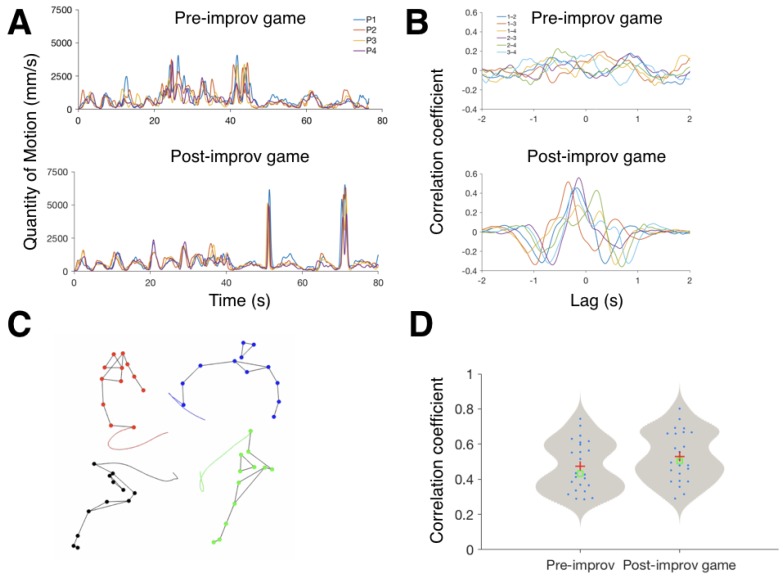
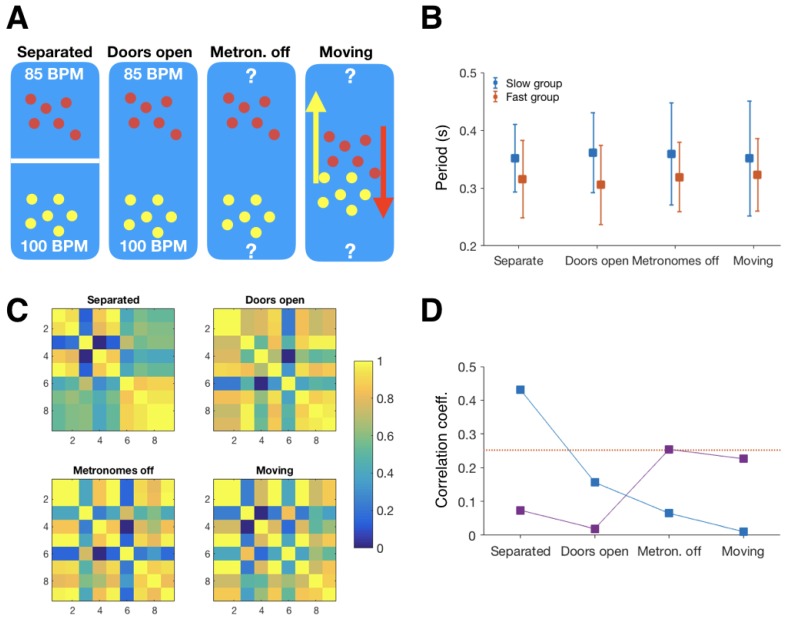
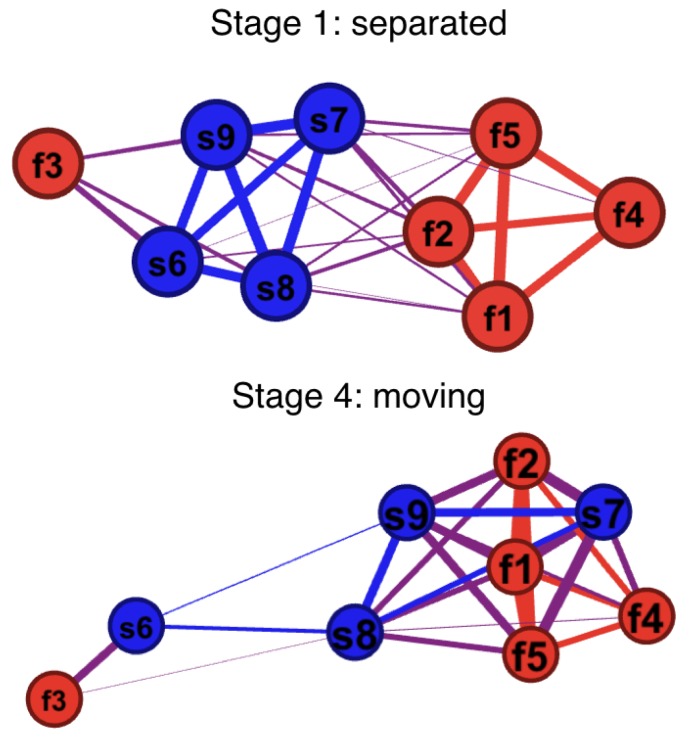
Collective dance improvisation (e.g., traditional and social dancing, contact improvisation) is a participatory, relational and embodied art form which eschews standard concepts in aesthetics. We present our ongoing research into the mechanisms underlying the lived experience of “togetherness” associated with such practices. Togetherness in collective dance improvisation is kinaesthetic (based on movement and its perception), and so can be simultaneously addressed from the perspective of the performers and the spectators, and be measured. We utilise these multiple levels of description: the first-person, phenomenological level of personal experiences, the third-person description of brain and body activity, and the level of interpersonal dynamics. Here, we describe two of our protocols: a four-person mirror game and a ‘rhythm battle’ dance improvisation score. Using an interpersonal closeness measure after the practice, we correlate subjective sense of individual/group connectedness and observed levels of in-group temporal synchronization. We propose that kinaesthetic togetherness, or interpersonal resonance, is integral to the aesthetic pleasure of the participants and spectators, and that embodied feeling of togetherness might play a role more generally in aesthetic experience in the performing arts.
Overview
The claims and statistics of this paper haven’t been checked yet.
Run the check — free, no account needed. It reads the open-access text and checks the sources it cites.
Integrity signals
Registry
Cites
Statistics
Figures
Verification
Claims the paper makes
The claims and statistics of this paper haven’t been checked yet.
Run the check — free, no account needed. It reads the open-access text and checks the sources it cites.
Claims other papers make about this one
Each is checked against this paper’s own text: does it say what the citing paper says it does?
The cited source says what the claim attributes to it.
In the citing paper
“These studies point out that interpersonal movement synchrony plays an important role in subjective experiences and aesthetic appreciation.”
From Heart Rate Variability Synchronizes When Non-experts Vocalize Together (2020) · cites this paper as Himberg et al., 2018
Self-check
Percentages, sums and reported differences re-computed from the paper’s own numbers.
The self-check needs the paper’s full text.
Citations
Cites
The Ecological Approach to Visual Perception: Classic Edition
Gibson, J. J. (2014) · doi:10.4324/9781315740218 · Cited by 12,132
The detection of disease clustering and a generalized regression approach.
Mantel, N. (1967) · PubMed · doi:10.1111/jbi.14281 · Cited by 11,504
(1999) · Cited by 7,995
Social psychology of intergroup relations
Tajfel, H. (1982) · Annual Review of Psychology · doi:10.1146/annurev.ps.33.020182.000245 · Cited by 7,949
The faculty of language: what is it, who has it, and how did it evolve?
Hauser, M. D., Chomsky, N., & Fitch, W. T. (2002) · Science · doi:10.1126/science.298.5598.1569 · Cited by 5,189
Inclusion of Other in the Self Scale and the structure of interpersonal closeness.
Aron, A., Aron, E. N., & Smollan, D. (1992) · Journal of Personality and Social Psychology · doi:10.1037/0022-3514.63.4.596 · Cited by 5,157
(1980) · Medical Entomology and Zoology · Cited by 4,712
Wiltermuth, S. S., & Heath, C. (2009) · Psychological Science · doi:10.1111/j.1467-9280.2008.02253.x · Cited by 1,717
Suits, B. (1978) · University of Toronto Press eBooks · doi:10.3138/9781487574338 · Cited by 1,560
(1996) · Journal of Consciousness Studies · Cited by 1,338
It's All in the Timing: Interpersonal Synchrony Increases Affiliation
Hove, M. J., & Risen, J. L. (2009) · Social Cognition · doi:10.1521/soco.2009.27.6.949 · Cited by 1,334
Shapiro, L. A. (2010) · Cited by 1,017
Can social interaction constitute social cognition?
De Jaegher, H., Di Paolo, E., & Gallagher, S. (2010) · Trends in Cognitive Sciences · doi:10.1016/j.tics.2010.06.009 · Cited by 911
Enactive intersubjectivity: Participatory sense-making and mutual incorporation
Fuchs, T. A. E., & Jaegher, H. D. (2009) · Phenomenology and the Cognitive Sciences · doi:10.1007/s11097-009-9136-4 · Cited by 904
The Ecological Approach to Visual Perception: Classic Edition
Gibson, J. J. (2014) · Cited by 896
Stern, D. N. (2010) · Oxford University Press eBooks · doi:10.1093/med:psych/9780199586066.001.0001 · Cited by 726
Mutual interpersonal postural constraints are involved in cooperative conversation.
Shockley, K., Santana, M.-V., & Fowler, C. A. (2003) · Journal of Experimental Psychology: Human Perception and Performance · doi:10.1037/0096-1523.29.2.326 · Cited by 681
Brain basis of human social interaction: from concepts to brain imaging
Hari, R., & Kujala, M. V. (2009) · Physiological Reviews · doi:10.1152/physrev.00041.2007 · Cited by 638
Manning, E. (2012) · Duke University Press eBooks · doi:10.1215/9780822395829 · Cited by 559
Let’s Dance Together: Synchrony, Shared Intentionality and Cooperation
Reddish, P., Fischer, R., & Bulbulia, J. (2013) · PLoS ONE · doi:10.1371/journal.pone.0071182 · Cited by 556
The Art of Conversation Is Coordination
Richardson, D. C., Dale, R. A. C., & Kirkham, N. Z. (2007) · Psychological Science · doi:10.1111/j.1467-9280.2007.01914.x · Cited by 510
Follow you, follow me: continuous mutual prediction and adaptation in joint tapping
Konvalinka, I., Vuust, P., Roepstorff, A., & Frith, C. D. (2010) · Quarterly Journal of Experimental Psychology · doi:10.1080/17470218.2010.497843 · Cited by 421
Interpersonal body and neural synchronization as a marker of implicit social interaction
Yun, K., Watanabe, K., & Shimojo, S. (2012) · Scientific Reports · doi:10.1038/srep00959 · Cited by 401
Shapiro, L. (2010) · Routledge eBooks · doi:10.4324/9780203850664 · Cited by 350
The practice of mind: Theory, simulation or primary interaction?
Gallagher, S. (2001) · Cited by 343
Silent disco: dancing in synchrony leads to elevated pain thresholds and social closeness
Tarr, B., Launay, J., & Dunbar, R. I. M. (2016) · Evolution and Human Behavior · doi:10.1016/j.evolhumbehav.2016.02.004 · Cited by 341
The mirror game as a paradigm for studying the dynamics of two people improvising motion together
Noy, L., Dekel, E., & Alon, U. S. (2011) · Proceedings of the National Academy of Sciences · doi:10.1073/pnas.1108155108 · Cited by 331
Terpsichore in Sneakers: Post-Modern Dance
Kohn, B., & Banes, S. (1980) · The Antioch Review · doi:10.2307/4638306 · Cited by 290
Fusaroli, R., & Tylén, K. (2015) · Cognitive Science · doi:10.1111/cogs.12251 · Cited by 272
Sympathy, Simulation, and the Impartial Spectator
Gordon, R. M. (1995) · Ethics · doi:10.1086/293750 · Cited by 272
Always More Than One: Individuation's Dance
Manning, E. (2013) · Project Muse (Johns Hopkins University) · Cited by 258
Space–time coordination dynamics in basketball: Part 2. The interaction between the two teams
Bourbousson, J., Sève, C., & McGarry, T. (2010) · Journal of Sports Sciences · doi:10.1080/02640410903503640 · Cited by 246
Unintended interpersonal co-ordination: “can we march to the beat of our own drum?”
Issartel, J., Marín, L., & Cadopi, M. (2006) · Neuroscience Letters · doi:10.1016/j.neulet.2006.09.086 · Cited by 213
Perceptual interactions in a minimalist virtual environment
Auvray, M., Lenay, C., & Stewart, J. R. (2008) · New Ideas in Psychology · doi:10.1016/j.newideapsych.2007.12.002 · Cited by 201
Proprioception as an Aesthetic Sense
Montero, B. G. (2006) · Journal of Aesthetics and Art Criticism · doi:10.1111/j.0021-8529.2006.00244.x · Cited by 197
Bourbousson, J., Sève, C., & McGarry, T. (2010) · Journal of Sports Sciences · doi:10.1080/02640410903503632 · Cited by 190
Synchronous brain activity across individuals underlies shared psychological perspectives
Lahnakoski, J. M., Glerean, E., Jääskeläinen, I. P., Hyönä, J., Hari, R., Sams, M., & Nummenmaa, L. (2014) · NeuroImage · doi:10.1016/j.neuroimage.2014.06.022 · Cited by 180
Interpersonal coordination and ball dynamics in futsal (indoor football)
Travassos, B. F. R., Araújo, D., Vilar, L., & McGarry, T. (2011) · Human Movement Science · doi:10.1016/j.humov.2011.04.003 · Cited by 169
Manning, E. (2016) · Duke University Press eBooks · doi:10.2307/j.ctv111jhg1 · Cited by 161
Golland, Y., Arzouan, Y., & Levit-Binnun, N. (2015) · PLOS ONE · doi:10.1371/journal.pone.0125804 · Cited by 152 · cited 1×
“Concerning the collective aspect of aesthetic experience, a number of recent scientific studies on music and film reception have explored the effect of collective spectating on individual emotional or aesthetic experience [9].”
BackgroundBeing in the zone: physiological markers of togetherness in joint improvisation
Noy, L., Levit-Binun, N., & Golland, Y. (2015) · Frontiers in Human Neuroscience · doi:10.3389/fnhum.2015.00187 · Cited by 148
Generativity within language and other cognitive domains
Bloom, P. (1994) · Cognition · doi:10.1016/0010-0277(94)90014-0 · Cited by 140
You, Me, and We: The Sharing of Emotional Experiences
Zahavi, D. (2015) · Research at the University of Copenhagen (University of Copenhagen) · Cited by 139
Froese, T., Iizuka, H., & Ikegami, T. (2014) · Scientific Reports · doi:10.1038/srep03672 · Cited by 138
Manning, E. (2016) · Cited by 137
Sympathy, Simulation, and the impartial Spectator
Gordon, R. M. (1996) · The MIT Press eBooks · doi:10.7551/mitpress/4621.003.0015 · Cited by 131
Interpersonal Coordination and Performance in Social Systems
Araújo, D., Ramos, J., & Lopes, R. J. (2016) · Routledge eBooks · doi:10.4324/9781315700304 · Cited by 127
Egermann, H., Sutherland, M. E., Grewe, O., Nagel, F., Kopiez, R., & ALTENMÜLLER, E. O. (2011) · Musicae Scientiae · doi:10.1177/1029864911399497 · Cited by 119
Biasutti, M. (2017) · Frontiers in Psychology · doi:10.3389/fpsyg.2017.00911 · Cited by 111
Vicary, S., Sperling, M., von Zimmermann, J., Richardson, D. C., & Orgs, G. (2017) · PLOS ONE · doi:10.1371/journal.pone.0180101 · Cited by 102
Musical choices during group free improvisation: A qualitative psychological investigation
Wilson, G., & MacDonald, R. (2015) · Psychology of Music · doi:10.1177/0305735615606527 · Cited by 94
How does it really feel to act together? Shared emotions and the phenomenology of we-agency
Salmela, M., & Nagatsu, M. (2016) · Phenomenology and the Cognitive Sciences · doi:10.1007/s11097-016-9465-z · Cited by 83
The Choreography of Group Affiliation
von Zimmermann, J., Vicary, S., Sperling, M., Orgs, G., & Richardson, D. C. (2018) · Topics in Cognitive Science · doi:10.1111/tops.12320 · Cited by 73 · cited 1×
“Recently, this question about links between synchronisation and pro-sociality, was posed about groups [80].”
BackgroundNguyen, C. T. (2016) · Human Kinetics eBooks · doi:10.1080/00948705.2016.1261643 · Cited by 72
Laroche, J., Berardi, A. M., & Brangier, É. (2014) · Frontiers in Psychology · doi:10.3389/fpsyg.2014.01180 · Cited by 71
Self-citationEffects on Inter-Personal Memory of Dancing in Time with Others
Woolhouse, M. H., Tidhar, D., & Cross, I. R. M. (2016) · Frontiers in Psychology · doi:10.3389/fpsyg.2016.00167 · Cited by 64
Inter-group entrainment in Afro-Brazilian Congado ritual
Lucas, G., Clayton, M. R. L., & Leante, L. (2011) · Empirical Musicology Review · doi:10.18061/1811/51203 · Cited by 52
The Improvisation Studies Reader
(2014) · Routledge eBooks · doi:10.4324/9780203083741 · Cited by 48
Group behaviour and interpersonal synchronization to electronic dance music
Solberg, R. T., & Jensenius, A. R. (2017) · Musicae Scientiae · doi:10.1177/1029864917712345 · Cited by 47
Himberg, T., & Thompson Marc, R. (2011) · Dance Research · doi:10.3366/drs.2011.0022 · Cited by 44
Self-citationWould you like to play together? Adults’ attachment and the mirror game
Feniger‐Schaal, R., Noy, L., Hart, Y., Koren‐Karie, N., Mayo, A., & Alon, U. S. (2015) · Attachment & Human Development · doi:10.1080/14616734.2015.1109677 · Cited by 42
Using minimal human-computer interfaces for studying the interactive development of social awareness
Froese, T., Iizuka, H., & Ikegami, T. (2014) · Frontiers in Psychology · doi:10.3389/fpsyg.2014.01061 · Cited by 39
Pleasurable and Intersubjectively Embodied Experiences of Electronic Dance Music
Solberg, R. T., & Jensenius, A. R. (2017) · Empirical Musicology Review · doi:10.18061/emr.v11i3-4.5023 · Cited by 39
Stevanovic, M., Himberg, T., Niinisalo, M., Kahri, M., Peräkylä, A., Sams, M. E., & Hari, R. (2017) · Research on Language and Social Interaction · doi:10.1080/08351813.2017.1262130 · Cited by 31
Self-citationThe acquisition of socio-motor improvisation in the mirror game
Gueugnon, M., Salesse, R. N., Coste, A., Zhao, Z., Bardy, B. G., & Marín, L. (2015) · Human Movement Science · doi:10.1016/j.humov.2015.12.005 · Cited by 30
Word-by-word entrainment of speech rhythm during joint story building
Himberg, T., Hirvenkari, L., Mandel, A., & Hari, R. (2015) · Frontiers in Psychology · doi:10.3389/fpsyg.2015.00797 · Cited by 27
Self-citationHow do Co-agents Actively Regulate their Collective Behavior States?
Bourbousson, J., & Fortes-Bourbousson, M. (2016) · Frontiers in Psychology · doi:10.3389/fpsyg.2016.01732 · Cited by 26
Methods for measuring audience reactions
Stevens, C., Glass, R., Shubert, E., Chen, J., & Winskel, H. (2007) · Cited by 23
Laroche, J., & Kaddouch, I. (2014) · Journal of Pedagogy / Pedagogický casopis · doi:10.2478/jped-2014-0002 · Cited by 19
Self-citationHimberg, T. (2014) · Apollo (University of Cambridge) · doi:10.17863/cam.15930 · Cited by 19
Self-citationSolberg, R. T., & Jensenius, A. R. (2017) · Empirical Musicology Review · doi:10.18061/emr.v11i3-4 · Cited by 14
On Context Dependence of Behavioral Variability in Inter-Personal Coordination.
Oullier, O., de Guzman, G. C., Jantzen, K. J., & Kelso, J. A. S. (2003) · Cited by 14
L’improvisation comme processus d’individuation
Béthune, C. (2009) · Critical Studies in Improvisation / Études critiques en improvisation · doi:10.21083/csieci.v5i1.991 · Cited by 9
How, Rather Than What Type of, Music Increases Empathy
Rabinowitch, T.-C. (2015) · Empirical Musicology Review · doi:10.18061/emr.v10i1-2.4572 · Cited by 8
Spectating Myriam Gourfink’s Dances; Transdisciplinary Explorations
Joufflineau, C., & Bachrach, A. (2016) · Springer eBooks · doi:10.1007/978-3-319-46233-2_7 · Cited by 6
Self-citationPatterns of entrainment: Being out of sync, in sync, and in between
Himberg, T., & Spiro, N. (2013) · Cited by 2
Self-citation
Research works printed but not linked: 5
- Novack, C.J. (1990). Sharing the Dance: Contact Improvisation and American Culture, University of Wisconsin Press.
- Kant, I., and Meredith, J.C. (2007). Critique of Judgement, Oxford University Press.
- Amighi, J.K. (1999). The Meaning of Movement: Developmental and Clinical Perspectives of the Kestenberg Movement Profile, Brunner-Routledge.
- 1994, The Mindreading System: New directions for research, Cah. Psychol. Cogn. Curr. Psychol. Cogn., 13, 724
- Maturana, H.R., and Varela, F.J. (1991). Autopoiesis and Cognition: The Realization of the Living, Springer Science & Business Media.
Cited by
Loving and knowing: reflections for an engaged epistemology
Jaegher, H. D. (2019) · Phenomenology and the Cognitive Sciences · doi:10.1007/s11097-019-09634-5 · Cited by 155
Agres, K., Schaefer, R., Volk, A., van Hooren, S., Holzapfel, A., Bella, S. D., Müller, M., de Witte, M., Herremans, D., Ramírez, R., et al. (2021) · Music & Science · doi:10.1177/2059204321997709 · Cited by 113
The sense of agency in joint action: An integrative review
Loehr, J. D. (2022) · Psychonomic Bulletin & Review · doi:10.3758/s13423-021-02051-3 · Cited by 87
Interactive expertise in solo and joint musical performance
Høffding, S., & Satne, G. (2019) · Synthese · doi:10.1007/s11229-019-02339-x · Cited by 71
How and why people synchronize: An integrated perspective
daSilva, E. B., & Wood, A. (2025) · Personality and Social Psychology Review · doi:10.1177/10888683241252036 · Cited by 56
Metadata
- Authors
- Himberg, T., Laroche, J., Bigé, R., Buchkowski, M., & Bachrach, A.
- Affiliations
- Université Paris 8 (FR)
- Université Paris Sciences et Lettres (FR)
- Centre National de la Recherche Scientifique (FR)
- Corresponding author
- Bachrach, Asaf
- Venue
- Behavioral Sciences
- Publisher
- MDPI AG
- Published
- 2018-02-09
- Volume
- 8
- Issue
- 2
- Pages
- 23
- ISSN
- 2076-328X (ISSN-L)
- PMC
- PMC5836006
- OpenAlex
- W2794439841
- Cited by
- 85
- References
- 77
- Citations by year
- 2026: 12 · 2025: 8 · 2024: 9 · 2023: 12 · 2022: 13 · 2021: 15 · 2020: 9 · 2019: 6 · 2018: 1
- FWCI
- 10.49
- Type
- journal article
- Language
- en
- Open access
- gold
- doi.org
- Licence
- Locations
- Behavioral Sciences (publishedVersion, cc-by)
- Europe PMC (PubMed Central) (publishedVersion, cc-by)
- PubMed Central (publishedVersion, cc-by)
- PubMed (publishedVersion)
- HAL (submittedVersion, other-oa)
- Aaltodoc (Aalto University) (submittedVersion, cc-by)
- DOAJ (DOAJ: Directory of Open Access Journals) (submittedVersion, cc-by-sa)
- Funders
- Agence Nationale de la Recherche (ANR-10-LABX-0080, ANR-10)
- Topics
- Social Sciences › Psychology › Social Psychology › Action Observation and Synchronization
- Social Sciences › Arts and Humanities › Visual Arts and Performing Arts › Diversity and Impact of Dance
- Life Sciences › Neuroscience › Cognitive Neuroscience › Aesthetic Perception and Analysis
- Keywords
- aesthetic experience, embodied experience, interpersonal synchrony, temporal synchronization, relationship closeness, mirror game, contact improvisation, social dance, phenomenology
About these checks
Registry, retraction, Cites and statistics results are computed, not judged, with one exception: a printed reference that no index lists is read once by a model before it counts as a citation error. Claims are extracted by a model and kept only when their quote appears verbatim in the text; each cited source is then checked, with a model’s help, for whether it says what the claim relies on. Those verdicts can be wrong — read the claim’s quote and the cited source before relying on one.
Statistics and arithmetic are recomputed, not judged.
Confidence bands are shown only for fields calibrated on our annotated test set. None is calibrated yet, so no band is shown.
What counts as a claim ›How we measure confidence ›How we check this ›
Are you an author, or do you see a problem with this page? Request a review
Data sources
Bibliographic data: Semantic Scholar, OpenAlex, Crossref.
Contains information from the Semantic Scholar Academic Graph Datasets, made available under the ODC Attribution License (ODC-BY 1.0).
Semantic Scholar’s data is described in: Kinney, R., et al. (2023). The Semantic Scholar Open Data Platform. arXiv:2301.10140.
