

Design Science and Co-Designing of Hybrid Workplaces
Open accessThe DOI matches its Crossref record; 28 of the 30 references it cites were found in a registry or an index.
Abstract
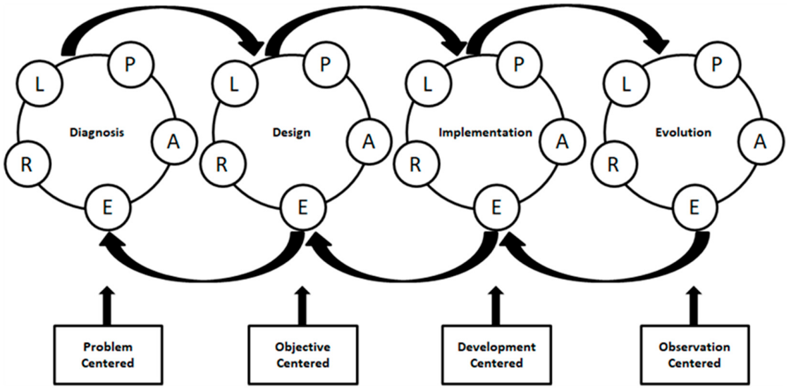
Background: Future places for learning and working are digitally and physically integrated hybrid environments. The archetypical context of learning is the classroom, and context of working is the office; especially in knowledge work. New information and communication technologies enable the spatial reconfiguration of work opening possibilities for work to take place across multiple locations. This paper aims to explore how the conceptual framework of design-science research in Information Systems can be applied when the design object is a hybrid working environment. Methods: The case study method as a qualitative approach was chosen; because it involves an empirical investigation of a particular contemporary phenomenon within its real life context using multiple sources of evidence. The empirical analysis of two hybrid working environments is based on Action Design Research (ADR)-entry points; where one analyzes two case studies stage by stage. By analyzing various stages in both case studies; one can identify co-designing challenges of hybrid working environments. Results: The results present four recommendations for co-designing of hybrid working environments. The use of hybrid working environment; the design of spatial solution; the identification of iterative processes; and the user experiences of presence and distance are significant. The Entry Point Analysis-tool can be used and further developed in analyzing and developing hybrid working environments. Conclusion: The results contribute to the tradition of usability studies. The usability briefing approach can be further developed by identifying the iterative processes inside the linear project management models. Additionally, design science research can find new insights from identification of the large stakeholder iterations more precisely.
Overview
The claims and statistics of this paper haven’t been checked yet.
Free: it reads the open-access text and checks the first 5 claims that cite a source we can check. Create a free account to check every claim.
Integrity signals
Registry
Cites
Statistics
Figures

Verification
Claims the paper makes
The claims and statistics of this paper haven’t been checked yet.
Free: it reads the open-access text and checks the first 5 claims that cite a source we can check. Create a free account to check every claim.
Claims other papers make about this one
Each is checked against this paper’s own text: does it say what the citing paper says it does?
The source backs part of the claim, not all of it — or backs it for a different population, condition or comparison.
In the citing paper
“Research on adaptative design aligned with user profiles shows increased response speed and precision [5,7,8,18,22].”
From The Impact of User Interface and Experience (UI/UX) Design on Visual Ergonomics: A Technical Approach for Reducing Human Error in Industrial Settings (2026) · cites this paper as [18]
Experimental — accuracy not yet measuredThe cited source says what the claim attributes to it.
In the citing paper
“Meanwhile, studies such as [2,7,1315,18,19,22,26,30,31] present users operating in structured work environments or performing complex functional tasks, whether in factories, hospitals, assembly plants, construction or technical training.”
From The Impact of User Interface and Experience (UI/UX) Design on Visual Ergonomics: A Technical Approach for Reducing Human Error in Industrial Settings (2026) · cites this paper as [18]
The check wasn’t confident either way, so it gives no verdict — never disputed.
In the citing paper
“Sectors such as healthcare and technical education require simplicity and easy navigation to lower cognitive load [13,16,18,26,29].”
From The Impact of User Interface and Experience (UI/UX) Design on Visual Ergonomics: A Technical Approach for Reducing Human Error in Industrial Settings (2026) · cites this paper as [18]
Experimental — accuracy not yet measuredThe check wasn’t confident either way, so it gives no verdict — never disputed.
In the citing paper
“Even in systems with partially ergonomic designs [13,17,18,28], incomplete implementation translates into errors caused by visual ambiguity, redundant task execution, or misinterpretation.”
From The Impact of User Interface and Experience (UI/UX) Design on Visual Ergonomics: A Technical Approach for Reducing Human Error in Industrial Settings (2026) · cites this paper as [18]
Experimental — accuracy not yet measured
Self-check
Percentages, sums and reported differences re-computed from the paper’s own numbers.
The self-check needs the paper’s full text.
Citations
Cites
Design Science in Information Systems Research1
Hevner, A. R., March, S. T., Park, J., & Ram, S. (2004) · MIS Quarterly · doi:10.2307/25148625 · Cited by 10,707 · cited 3×
“[28] states that two paradigms, the behavioral and design science, are base on Information System (IS) science, which is at t e intersection of people, organizations, an technology.”
BackgroundInfluentialDesign science in information systems research
(2004) · Journal of the Association for Information Systems · doi:10.5555/2017212.2017217 · Cited by 8,254
Yin, R. K. (2009). Case study research: Design and methods (4th Ed.). Thousand Oaks, CA: Sage.
Aberdeen, T. (2013) · The Canadian Journal of Action Research · doi:10.33524/cjar.v14i1.73 · Cited by 3,250
Taking the Load Off a Learner's Mind: Instructional Design for Complex Learning
van Merrienboer, J. J. G., Kirschner, P. A., & Kester, L. (2003) · Educational Psychologist · doi:10.1207/s15326985ep3801_2 · Cited by 857 · cited 1×
“[9] have noted a similar concept called authentic learning, where real life tasks are the driving force of the learning.”
BackgroundBlueprints for complex learning: The 4C/ID-model
van Merriënboer, J. J. G., Clark, R. E., & de Croock, M. B. M. (2002) · Educational Technology Research and Development · doi:10.1007/bf02504993 · Cited by 708
A systematic literature review on synchronous hybrid learning: gaps identified
Raes, A., Detienne, L., Windey, I., & Depaepe, F. (2020) · Learning Environments Research · doi:10.1007/s10984-019-09303-z · Cited by 600 · cited 2×
“Changes in educational practice are driving the emergence of hybrid learning environments [3].”
BackgroundAuthentic Learning Environments
Herrington, J., Reeves, T. C., & Oliver, R. (2014) · Handbook of Research on Educational Communications and Technology · doi:10.1007/978-1-4614-3185-5_32 · Cited by 460
Hybrid workspace: re-spatialisations of work, organisation and management
Halford, S. (2005) · New Technology, Work and Employment · doi:10.1111/j.1468-005x.2005.00141.x · Cited by 362 · cited 4×
“Halford, S. Hybrid workspace: Re-spatialisations of work, organisation and management.”
BackgroundResultInfluentialAuthentic Learning Environments in Higher Education
(2006) · IGI Global eBooks · doi:10.4018/978-1-59140-594-8 · Cited by 249 · cited 2×
“Herrington and Herrington [8] introduced authentic learning, which is a similar concept to project-based learning, where the idea is how knowledge is used in real life and providing activities reminiscent of activities in practice.”
BackgroundTriangulation in Qualitative Research: Issues of Conceptual Clarity and Purpose
Knafl, K. A., & Breitmayer, B. J. (1991) · Qualitative Nursing Research: A Contemporary Dialogue · doi:10.4135/9781483349015.n26 · Cited by 246 · cited 1×
“Triangulation [30] was used to complement the data and to find new information, in other words, to get additional pieces to the overall picture of hybrid working environments.”
MethodPedagogical perspectives on the relationships between higher education and working life
Tynjälä, P., Välimaa, J., & Sarja, A. (2003) · Higher Education · doi:10.1023/a:1024761820500 · Cited by 219 · cited 2×
“[7] identified a hybrid form of learning when learners worked collaboratively while using project-based learning.”
BackgroundAn elaborated action design research process model
Mullarkey, M. T., & Hevner, A. R. (2019) · European Journal of Information Systems · doi:10.1080/0960085x.2018.1451811 · Cited by 208 · cited 7×
“of physical environments, Fronczek-Munter [5] has introduced a usability briefing model that describes the development cycles of space, whereas Mullarkey and Hevner [1] have introduced an ADR process model based on the Information System field.”
BackgroundMethodInfluentialOrganization versus Space: The Paradoxical Geographies of the Digital Economy
Moriset, B., & Malecki, E. J. (2008) · Geography Compass · doi:10.1111/j.1749-8198.2008.00203.x · Cited by 153 · cited 1×
“Later, co-working was defined as creative cities or districts, where two interlinked tendencies are embedded together [19].”
BackgroundFlexibility in use: Switching behaviour and satisfaction in activity-based work environments
Hoendervanger, J. G., Been, I. D., Yperen, N. W. V., Mobach, M. P., & Albers, C. J. (2016) · Journal of Corporate Real Estate · doi:10.1108/jcre-10-2015-0033 · Cited by 153
Zitter, I., & Hoeve, A. (2012) · OECD education working papers · doi:10.1787/5k97785xwdvf-en · Cited by 127 · cited 2×
“The Organization for Economic Co-operation and Development (OECD) [15] presented Education Working Papers in 2012, where they applied the same model for different cases like technology, hospitality, and sports.”
MethodLearning style, sense of community and learning effectiveness in hybrid learning environment
Chen, B. H., & Chiou, H. (2012) · Interactive Learning Environments · doi:10.1080/10494820.2012.680971 · Cited by 113 · cited 2×
“Chen, B.H.; Chiou, H.-H. Learning style, sense of community and learning effectiveness in hybrid learning environment.”
ResultDesigning Hybrid Learning Spaces in Higher Education
Hilli, C., Nørgård, R. T., & Aaen, J. H. (2019) · Dansk Universitetspædagogisk Tidsskrift · doi:10.7146/dut.v14i27.112644 · Cited by 101 · cited 2×
“[23] present a hybrid pedagogy as a methodological approach for interlinked practices and processes.”
BackgroundHybrid learning environments by data-driven augmented reality
Sonntag, D., Albuquerque, G., Magnor, M. A., & Bodensiek, O. (2019) · Procedia Manufacturing · doi:10.1016/j.promfg.2019.03.006 · Cited by 48
Collaborative Spaces and Coworking as Hybrid Workspaces: Friends or Foes of Learning and Innovation?
Marchegiani, L., & Arcese, G. (2017) · Springer eBooks · doi:10.1007/978-3-319-62467-9_4 · Cited by 47 · cited 3×
“Marchegiani and Arcese [20] addressed collaborative spaces and co-working as hybrid workspace in their work and concluded it to be effective in the context of a collaborative and sharing economy.”
BackgroundInfluentialTask-Based Team Learning with ICT, Design and Development of New Learning
van Weert, T. J., & Pilot, A. (2003) · Education and Information Technologies · doi:10.1023/a:1024562515675 · Cited by 44 · cited 2×
“One of the trends was to integrate Information and Communication Technology (ICT) in real life tasks or projects according to van Weert and Pilot [10], which has continued to this day.”
BackgroundHybrid environments for universities
Ninnemann, K., Liedtke, B., den Heijer, A. C., Gothe, K., Loidl-Reisch, C., Nenonen, S. P., Nestler, J., Tieva, Å., & Wallenborg, C. (2020) · Waxmann Verlag GmbH eBooks · doi:10.31244/9783830991793 · Cited by 41 · cited 1×
“This has been influenced by a number of different benefits [2,3].”
BackgroundSelf-citationZitter, I., Kinkhorst, G., Simons, R., & ten Cate, O. (2009) · Computers in Human Behavior · doi:10.1016/j.chb.2009.01.001 · Cited by 24 · cited 1×
“[12] introduced a descriptive model of learning environment.”
BackgroundThe role of professional objects in technology-enhanced learning environments in higher education
Zitter, I., de Bruijn, E., Simons, R., & ten Cate, O. (2010) · Interactive Learning Environments · doi:10.1080/10494821003790863 · Cited by 21
Zitter, I., & Hoeve, A. (2012) · Cited by 20
Architecture for Collaborative Learning Activities in Hybrid Learning Environments
Kloos, C. D., Maroto, D., Leony, D., Rueda, J. J. G., & Ibáñez, M. B. (2012) · JUCS - Journal of Universal Computer Science · doi:10.3217/jucs-018-15-2187 · Cited by 14 · cited 1×
“’s [17] study was aimed at system architecture and usability of a proof-of-concept for hybrid learning environments.”
BackgroundUSEframe - a Framework to understand and map usability research
Lindahl, G., Blakstad, S. H., Hansen, G. K., & Nenonen, S. P. (2011) · Chalmers Publication Library (Chalmers University of Technology) · Cited by 11
Self-citationUsability: managing facilities for social outcomes
Alexander, K., Hansen, G. K., Blakstad, S. H., Nenonen, S. P., Jensen, P. A., & Lindahl, G. (2013) · doi:10.13140/2.1.3807.5527 · Cited by 8
Self-citationThe Latest in Immersive Telepresence to Support Shared Engineering Education
Pope, N., Apiola, M.-V., Salmento, H., Islam, A. K. M. N., Lahti, M., & Sutinen, E. (2020) · IEEE Frontiers in Education Conference (FIE) · doi:10.1109/fie44824.2020.9274106 · Cited by 8 · cited 1×
“Novel technologies enable the spatial reconfiguration of work giving possibilities to work in multiple locations [6].”
BackgroundSelf-citation
Research works printed but not linked: 4
- Fronczek-Munter, A. Usability Briefing-A Process Model for Healthcare Facilities, Proceedings of CIB Facilities Management Conference 2014: Joint CIB W070, W111 and W118 Conference, Copenhagen, Denmark, 21 May 2014; Polyteknisk Boghandel og Forlag: Lyngby, Denmark, 2014; pp. 266-279.
- Goodyear, P.; Jones, C.; Asensio, M.; Hodgson, V.; Steeples, C. Effective networked learning in higher education: Notes and guidelines. Retrieved May 2001, 17, 2006.
- Gandini, A. The Rise of Coworking Spaces: A Literature Review, Ephemera: Theory and Politics in Organization. 2015, 15, 1, 193-205. Available online: https://air.unimi.it/retrieve/handle/2434/618721/1152525/Ephemera_ASN.pdf (accessed on 19 March 2021).
- Jensen, P.A.; Alexander, K.; Fronczek-Munter, A. Towards an Agenda for User Oriented Research in the Built Environment. In Nordic Conference on Construction Economics and Organisation: Shaping the Construction/Siciety Nexus; Danish Building Research Institute, Aalborg University: Aalborg, Denmark, 2011; pp. 55-56.
Cited by
The COVID-19 Pandemic and the Future of Working Spaces
Mariotti, I., Marino, M. D., & Bednář, P. (2022) · Routledge eBooks · doi:10.4324/9781003181163 · Cited by 96
Iqbal, K. M. J., Khalid, F., & Barykin, S. (2021) · Advances in educational technologies and instructional design book series · doi:10.4018/978-1-7998-8327-2.ch003 · Cited by 74
The Great Resignation: An Argument for Hybrid Leadership
Hopkins, D. J. C., & Figaro, D. K. A. (2021) · International Journal of Business and Management Research · doi:10.37391/ijbmr.090402 · Cited by 51
Barnes, K., Vione, K. C., & Kotera, Y. (2024) · SN Business & Economics · doi:10.1007/s43546-024-00651-4 · Cited by 43
“…amongst employees also meant organizations began to review the need for costly office space, with 47% of organizations intending to reduce it moving forward (Kaplan 2020); as well as rethink the purpose of remaining office space in a hybrid workplace environment (Lahti and Nenonen 2021).”
Navigating Tensions in the Organizational Change Process towards Hybrid Workspace
Hasbi, M. M., & van Marrewijk, A. H. (2024) · Journal of Change Management · doi:10.1080/14697017.2024.2379253 · Cited by 23
“Accordingly, research into this transition has examined planning (Fayard et al., 2021; Jemine et al., 2020), implementation (Lahti & Nenonen, 2021), and employees’ responses to the change (Bosch-Sijtsema et al., 2010; Halford, 2005; Hislop & Axtell, 2009).”
Metadata
- Authors
- Lahti, M., & Nenonen, S.
- Affiliations
- University of Turku (FI)
- Tampere University (FI)
- Corresponding author
- Lahti, Marko
- Venue
- Buildings
- Publisher
- MDPI AG
- Published
- 2021-03-20
- Volume
- 11
- Issue
- 3
- Pages
- 129
- ISSN
- 2075-5309 (ISSN-L)
- OpenAlex
- W3135984478
- Cited by
- 18
- References
- 30
- Citations by year
- 2026: 1 · 2025: 5 · 2024: 5 · 2022: 3 · 2021: 3
- FWCI
- 2.69
- Type
- journal article
- Language
- en
- Open access
- gold
- doi.org
- Licence
- Locations
- Buildings (publishedVersion, cc-by)
- UTUPub (University of Turku) (submittedVersion)
- DOAJ (DOAJ: Directory of Open Access Journals) (submittedVersion, cc-by-sa)
- Tampere University Institutional Repository (Tampere University) (submittedVersion, cc-by)
- Topics
- Physical Sciences › Engineering › Architecture › Facilities and Workplace Management
- Social Sciences › Business, Management and Accounting › Management Information Systems › Information Systems Theories and Implementation
- Physical Sciences › Computer Science › Human-Computer Interaction › Usability and User Interface Design
- Keywords
- hybrid workplace, co-design, design science research, action design research, spatial design, knowledge work, information and communication technologies, usability, project management model
About these checks
Registry, retraction, Cites and statistics results are computed, not judged, with one exception: a printed reference that no index lists is read once by a model before it counts as a citation error. Claims are extracted by a model and kept only when their quote appears verbatim in the text; each cited source is then checked, with a model’s help, for whether it says what the claim relies on. Those verdicts can be wrong — read the claim’s quote and the cited source before relying on one.
Statistics and arithmetic are recomputed, not judged.
Confidence bands are shown only for fields calibrated on our annotated test set. None is calibrated yet, so no band is shown.
What counts as a claim ›How we measure confidence ›How we check this ›
Are you an author, or do you see a problem with this page? Request a review
Data sources
Bibliographic data: Semantic Scholar, OpenAlex, Crossref.
Contains information from the Semantic Scholar Academic Graph Datasets, made available under the ODC Attribution License (ODC-BY 1.0).
Semantic Scholar’s data is described in: Kinney, R., et al. (2023). The Semantic Scholar Open Data Platform. arXiv:2301.10140.
