

Study on Mix Proportion Design Based on Strength and Sulfate Resistance of 100% Recycled Aggregate Concrete
Open accessThe DOI matches its Crossref record; 42 of the 42 references it cites were found in a registry or an index; none of the 26 sources its claims cite is checked for support yet.
Abstract
This paper presents the mechanical properties of 100% recycled aggregate concrete (RAC), and the results and analysis of the dry–wet cycle accelerated sulfate attack test. The results show that recycled concrete aggregate (RCA) can replace the coarse and fine aggregate. The recycled clay brick aggregate (RCBA) is not suitable for use as a coarse aggregate because the water absorption exceeds the standard. RCA replaces the coarse aggregate; and RCBA returns the fine aggregate to prepare 100% recycled concrete aggregate (RAC). The water–cement ratio is the most significant factor affecting the compressive strength of 100% RAC. The results of the mechanical properties analysis show that the compressive strength of RAC is less than that of NAC, and the difference in compressive strength between 100% RAC and NAC decreases with age. The splitting tensile strength of 100% RAC was slightly higher than that of NAC except for 7 d. The results of the dry–wet cycle accelerated sulfate attack test showed that the performance of 100% RAC was lower than that of NAC under the dry–wet process and sulfate attack coupling. Still, the loss rate was less than 5%, which met the standard resistance to the dry–wet cycle accelerating the sulfate attack.
Overview
CoChat Summary
TL;DR
The paper designs 100% recycled aggregate concrete using recycled concrete coarse aggregate and recycled clay brick fine aggregate, with an orthogonal mix-proportion study. It finds water-cement ratio dominates compressive strength, 100% RAC has lower compressive strength than NAC but acceptable sulfate resistance under dry-wet cycling, with ettringite expansion explaining durability loss.
Key findings
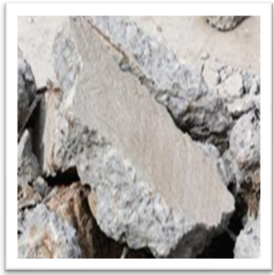
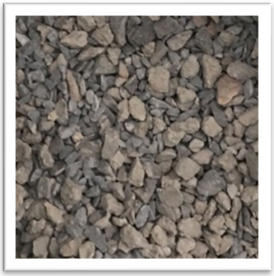
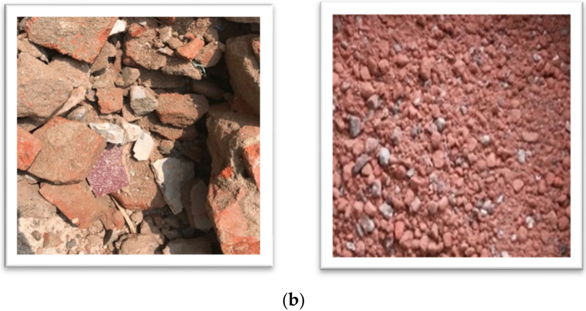
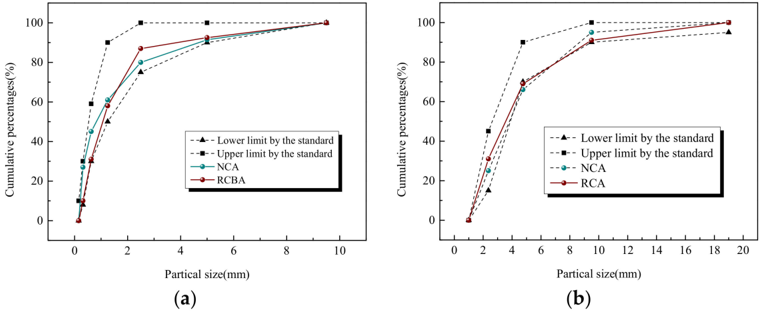
- Recycled concrete aggregate (RCA) can replace coarse aggregate, but recycled clay brick aggregate (RCBA) is unsuitable as coarse aggregate because its water absorption exceeds the standard; RCBA is used as fine aggregate to prepare 100% RAC. Aggregate tests reported RCA coarse apparent density 2483 kg/m³, crushing index 12.49%, water absorption 3.05%; RCBA coarse 2264 kg/m³, 24.3%, 16.46%, and RCBA fine water absorption 18.50%.
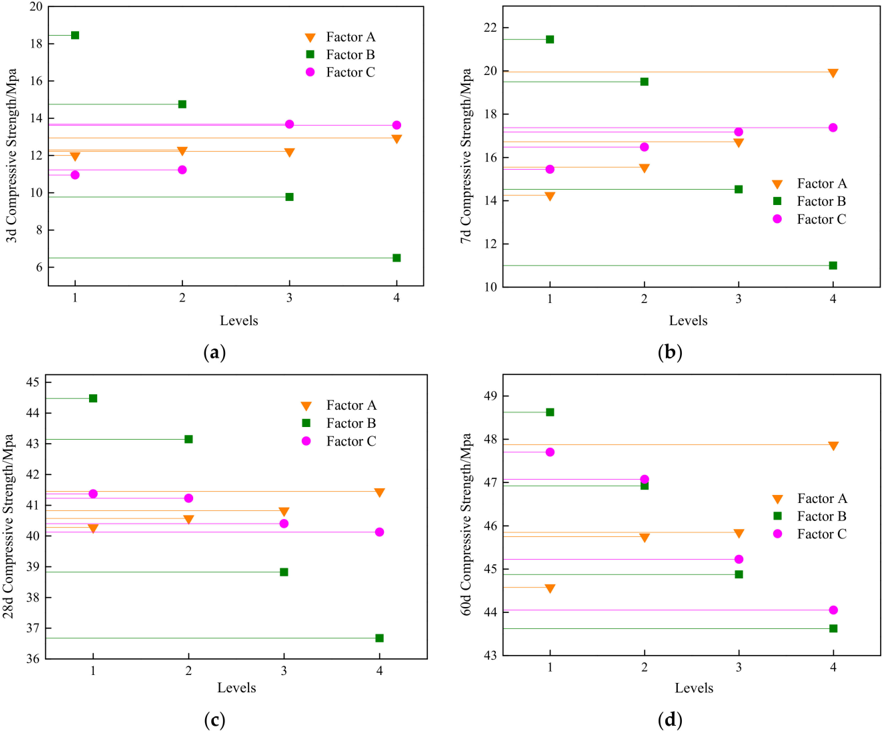
- Water-cement ratio is the most significant factor affecting compressive strength of 100% RAC; variance analysis showed significance for 3 d, 7 d, and 28 d (Sig. 0.001, 0.010, 0.005), but not for 60 d (Sig. 0.057). Cementitious material content and curing temperature were not significant. The selected mix was cement 465, water 162, RCA 921, RCBA 630, water reducer 24 kg/m³, with water-cement ratio 0.35 and curing temperature 50 °C (high-temperature curing reduced to 6 h).
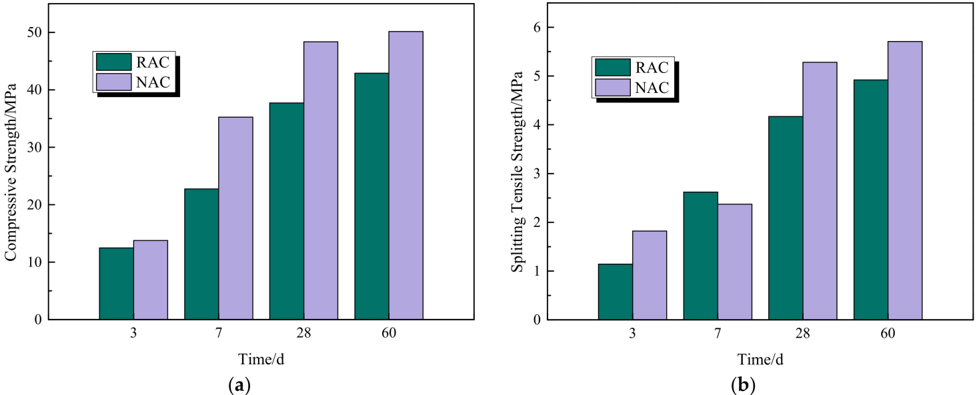
- Compressive strength of 100% RAC was lower than NAC: differences were 9.37% at 3 d, 35.51% at 7 d, 21.96% at 28 d, and 14.49% at 60 d. Splitting tensile strength of 100% RAC was slightly higher than NAC except at 7 d; reported differences were 59.64% at 3 d, 9.54% at 7 d, 26.62% at 28 d, and 16.06% at 60 d.
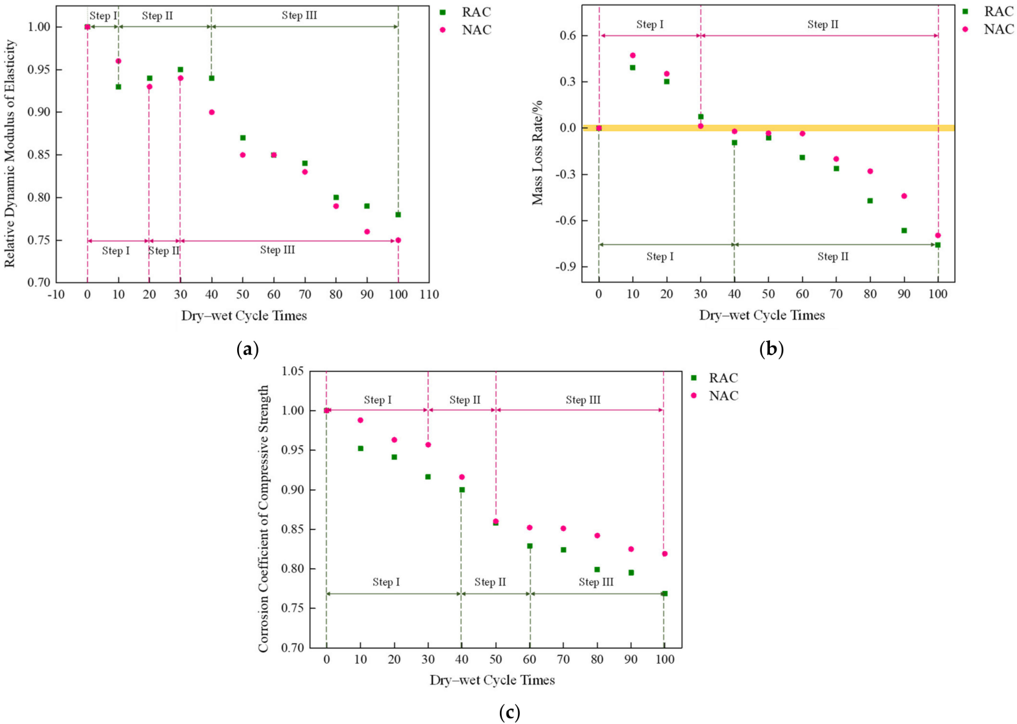
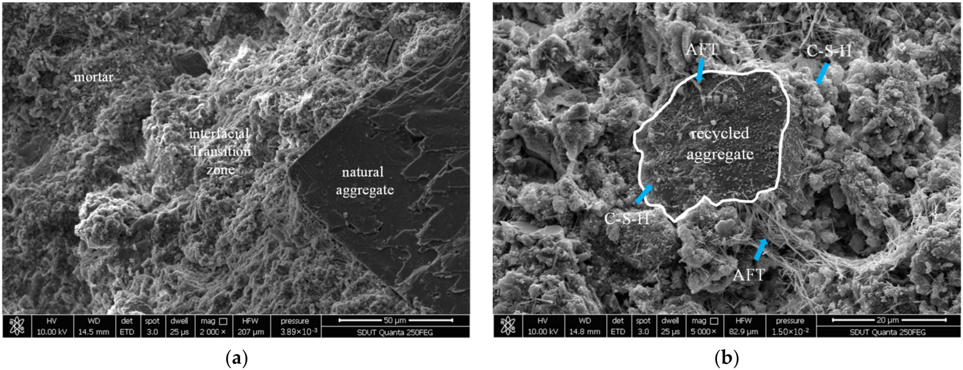
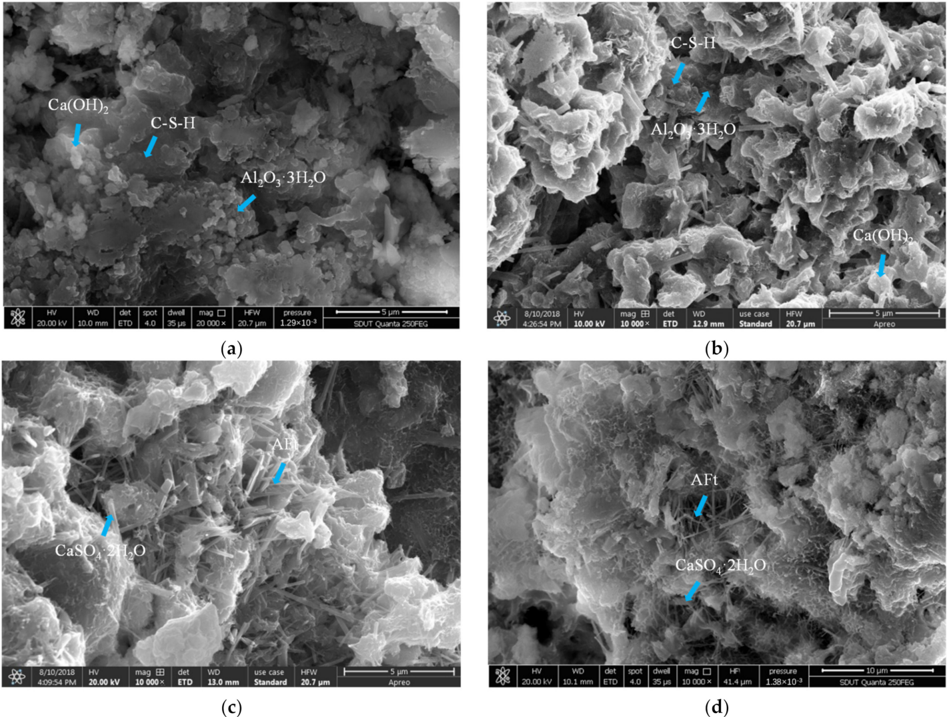
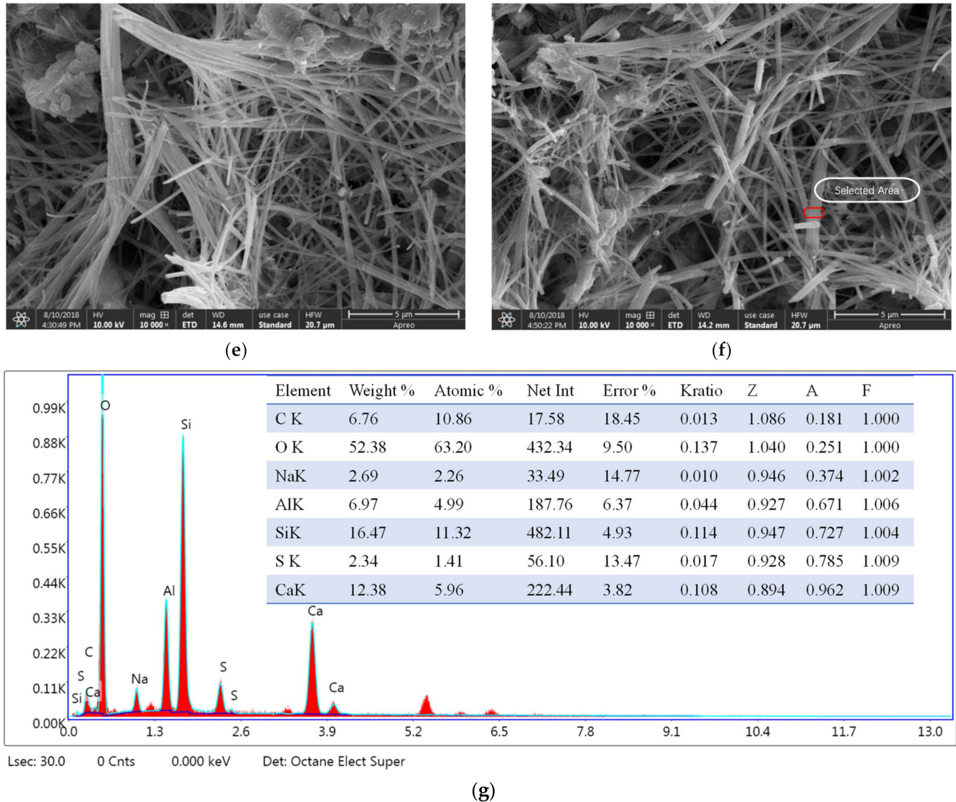
- Under dry-wet cycle accelerated sulfate attack, 100% RAC performed worse than NAC, but mass loss after 100 cycles was less than 5%, meeting the standard. The compressive strength corrosion resistance coefficient followed a two-stage model for RAC versus a three-stage model for NAC; SEM/EDS indicated ettringite expansion as a main cause of deterioration.
Methods
- Orthogonal test design with three factors and four levels: cementitious material content 15–30% of aggregate mass, water-cement ratio 0.35–0.5, and curing temperature 40–55 °C; 16 groups tested for compressive strength at 3, 7, 28, and 60 d, with range analysis and variance analysis using IBM SPSS Statistics R26.0.0.0.
- Materials and specimens: 42.5 silicate cement; natural coarse gravel 10–20 mm and river sand with fineness modulus 2.7; RCA from demolished waste concrete and RCBA from waste clay brick, both from Zibo, China; two-stage crushing; water reducer at 0.5% of cementitious material. Compressive and splitting tensile specimens were 150 mm cubes, sulfate specimens were 100 mm cubes, and five blocks per age were used for compressive strength.
- Sulfate resistance test followed GB/T50082-2009: specimens immersed in 5% sodium sulfate solution for 48 h, dried at 80 ± 5 °C, cycled up to 100 times over 300 d; measured relative dynamic elastic modulus, mass loss, and compressive strength corrosion resistance coefficient, with SEM/EDS micro-analysis.
Limitations
- Paper-stated: range analysis has significant errors, low reliability, and lacks a statistical basis, so variance analysis was added; sulfate resistance research is complex with many influencing factors and controversial conclusions; RCBA original strength is unknown; construction waste sources and composition are uncertain and classification recycling is costly.
- Evident from the text: materials came from a single source (Zibo, China), and the accelerated 5% sodium sulfate plus dry-wet cycling differs from natural sulfate exposure—the authors note a 10-year natural sulfate study reached a different conclusion. The 60-d water-cement ratio effect was not statistically significant (Sig. 0.057).
Model-written summary. Check it against the paper before relying on it.
Integrity signals
Registry
Cites
Statistics
Figures
Verification
Claims the paper makes
0 Valid · 5 Not valid · 24 Not checked · 86 Own results and interpretations
A result the paper reports from its own data — it cites no other source for it, so there is none to check. The quote shows it is in the paper.
In the paper
“The sig. value of C, curing temperature, on the compressive strength of each age is more significant than 0.05, indicating that this index is not a prominent factor affecting the compressive strength of concrete.”
§ Study on Mix Proportion Design Based on Strength and Sulfate Resistance of 100% Recycled Aggregate Concrete > 3.2.2. Variance Analysis of Test Results
hedged- Asserted: passes — The authors put it forward as true.
- Checkable: passes — It can be checked against evidence.
- Load-bearing: passes — The paper’s conclusions depend on it.
- Based: passes — The paper gives a reason why it holds.
A result the paper reports from its own data — it cites no other source for it, so there is none to check. The quote shows it is in the paper.
In the paper
“The water-cement ratio is the most significant factor affecting the compressive strength of 100% RAC.”
- Also stated in: § 3.2.1. Range Analysis of Test Results · boosted
“Comprehensive 3-60-d compressive strength range analysis results: B, water-cement ratio, tremendously influences each age.”
§ Study on Mix Proportion Design Based on Strength and Sulfate Resistance of 100% Recycled Aggregate Concrete > Abstract
boostedstates a cause- Asserted: passes — The authors put it forward as true.
- Checkable: passes — It can be checked against evidence.
- Load-bearing: passes — The paper’s conclusions depend on it.
- Based: passes — The paper gives a reason why it holds.
- Also stated in: § 3.2.1. Range Analysis of Test Results · boosted
A result the paper states — it cites no source for it, so there is none to check. The quote shows it is in the paper.
In the paper
“The dynamic elastic modulus of the whole three steps of RAC is greater than that of ordinary concrete”
§ Study on Mix Proportion Design Based on Strength and Sulfate Resistance of 100% Recycled Aggregate Concrete > 3.4. Results of Sulfate Resistance Test
plainstates an association- Asserted: passes — The authors put it forward as true.
- Checkable: passes — It can be checked against evidence.
- Load-bearing: unclear — It is unclear whether the paper’s conclusions depend on it.
- Based: passes — The paper gives a reason why it holds.
A result the paper reports from its own data — it cites no other source for it, so there is none to check. The quote shows it is in the paper.
In the paper
“The more cementitious materials used, the higher the compressive strength of the concrete.”
§ Study on Mix Proportion Design Based on Strength and Sulfate Resistance of 100% Recycled Aggregate Concrete > 3.2.1. Range Analysis of Test Results
plainstates a cause- Asserted: passes — The authors put it forward as true.
- Checkable: passes — It can be checked against evidence.
- Load-bearing: passes — The paper’s conclusions depend on it.
- Based: passes — The paper gives a reason why it holds.
A result the paper states — it cites no source for it, so there is none to check. The quote shows it is in the paper.
In the paper
“Compared with standard concrete, the initial dynamic elastic modulus of total RAC decreases more rapidly.”
§ Study on Mix Proportion Design Based on Strength and Sulfate Resistance of 100% Recycled Aggregate Concrete > 3.4. Results of Sulfate Resistance Test
plainstates a cause- Asserted: passes — The authors put it forward as true.
- Checkable: passes — It can be checked against evidence.
- Load-bearing: passes — The paper’s conclusions depend on it.
- Based: passes — The paper gives a reason why it holds.
43 more claims
Create a free account to see all 115 claims and to verify the 25 references still open.
- It may state two separate claims as one. 44
- The quote only partly states this claim. 3
- Probably not a substantial claim. 24
Self-check
Percentages, sums and reported differences re-computed from the paper’s own numbers.
Each contradiction between two passages listed here was confirmed by an independent check.
Rated major: it would touch a result — a value a result rests on, reported and recomputed p-values on opposite sides of the significance level, two passages that conflict with no sign which is right, or a cited work retracted before this paper was published.
In the paper
§ Study on Mix Proportion Design Based on Strength and Sulfate Resistance of 100% Recycled Aggregate Concrete > 3.4. Results of Sulfate Resistance Test
“For the RAC compressive strength corrosion resistance coefficient, 0-40 dry-wet cycles is the first stage, 40-60 cycles is the second stage, and 60-100 dry-wet cycles is the third stage.”
§ Study on Mix Proportion Design Based on Strength and Sulfate Resistance of 100% Recycled Aggregate Concrete > 1.
“| RAC | Stable decline segment Rapid descent segment | C N = 0.0022N + 0.9859 C N = 0.0035N + 1.0398 | 0.9892 0.9889 | N ≤ 40, N ≥ 70 40 < N < 70 |”
Rated major: it would touch a result — a value a result rests on, reported and recomputed p-values on opposite sides of the significance level, two passages that conflict with no sign which is right, or a cited work retracted before this paper was published.
In the paper
§ Study on Mix Proportion Design Based on Strength and Sulfate Resistance of 100% Recycled Aggregate Concrete > 2.2. Optimum Mix Design
“The cement dosage range is 15-30% of the aggregate mass”
§ Study on Mix Proportion Design Based on Strength and Sulfate Resistance of 100% Recycled Aggregate Concrete > 1.
“| 13 | 600 | 210 | 630 | 921 | 3 | 55 |”
Rated minor: it would not touch a result — a value no result rests on, a p-value that stays on the same side of the significance level, or a conflict that is clerical, resolved elsewhere in the paper, or outside its own findings.
In the paper
§ Study on Mix Proportion Design Based on Strength and Sulfate Resistance of 100% Recycled Aggregate Concrete > 3.3. Mechanical Properties Evaluation of 100% RAC
“The splitting tensile strength of the total recycled aggregate is slightly larger than that of ordinary concrete, except for seven days”
§ Study on Mix Proportion Design Based on Strength and Sulfate Resistance of 100% Recycled Aggregate Concrete > 1.
“the splitting tensile strength decreased by 26.62% compared with NAC with the same mix ratio.”
Rated minor: it would not touch a result — a value no result rests on, a p-value that stays on the same side of the significance level, or a conflict that is clerical, resolved elsewhere in the paper, or outside its own findings.
In the paper
§ Study on Mix Proportion Design Based on Strength and Sulfate Resistance of 100% Recycled Aggregate Concrete > 3.3. Mechanical Properties Evaluation of 100% RAC
“The difference in the compressive strength between RAC and NAC gradually decreases”
§ Study on Mix Proportion Design Based on Strength and Sulfate Resistance of 100% Recycled Aggregate Concrete > 3.3. Mechanical Properties Evaluation of 100% RAC
“The 3-d difference is 9.37%, the 7-d difference is 35.51%, the 28-d difference is 21.96%, and the 60-d difference is 14.49%.”
Citations
Cites
Etxeberria, M., Vázquez, E., Marí, A., & Barra, M. (2007) · Cement and Concrete Research · doi:10.1016/j.cemconres.2007.02.002 · Cited by 1,774
Performance enhancement of recycled concrete aggregate – A review
Shi, C., Li, Y., Zhang, J., Li, W., Chong, L., & Xie, Z. (2016) · Journal of Cleaner Production · doi:10.1016/j.jclepro.2015.08.057 · Cited by 1,157
A Comprehensive Review on Recycled Aggregate and Recycled Aggregate Concrete
Wang, B., Yan, L., Fu, Q., & Kasal, B. (2021) · Resources, Conservation and Recycling · doi:10.1016/j.resconrec.2021.105565 · Cited by 999
Poon, C. S., Shui, Z. H., Lam, L., Fok, H., & Kou, S. C. (2004) · Cement and Concrete Research · doi:10.1016/s0008-8846(03)00186-8 · Cited by 915
Properties of concrete made with recycled aggregate from partially hydrated old concrete
Katz, A. (2003) · Cement and Concrete Research · doi:10.1016/s0008-8846(02)01033-5 · Cited by 865
Durability of recycled aggregate concrete – A review
Guo, H., Shi, C., Guan, X., Zhu, J., Ding, Y., Ling, T.-C., Zhang, H., & Wang, Y. (2018) · Cement and Concrete Composites · doi:10.1016/j.cemconcomp.2018.03.008 · Cited by 829
Properties of concrete incorporating fine recycled aggregate
Khatib, J. M. (2005) · Cement and Concrete Research · doi:10.1016/j.cemconres.2004.06.017 · Cited by 737
Kisku, N., Joshi, H., Ansari, M., Panda, S. K., Nayak, S., & Dutta, S. C. (2017) · Construction and Building Materials · doi:10.1016/j.conbuildmat.2016.11.029 · Cited by 712
Durability of recycled aggregate concrete
Thomas, C., Setién, J., Polanco, J. A., Alaejos, P., & Sánchez de Juan, M. (2013) · Construction and Building Materials · doi:10.1016/j.conbuildmat.2012.11.106 · Cited by 703
Treatments for the Improvement of Recycled Aggregate
Katz, A. (2004) · Journal of Materials in Civil Engineering · doi:10.1061/(asce)0899-1561(2004)16:6(597 · Cited by 546
Enhancing mechanical and durability properties of recycled aggregate concrete
Dimitriou, G., Savva, P., & Petrou, M. F. (2018) · Construction and Building Materials · doi:10.1016/j.conbuildmat.2017.09.137 · Cited by 540
Mechanical properties of brick aggregate concrete
Cachim, P. B. (2008) · Construction and Building Materials · doi:10.1016/j.conbuildmat.2008.07.023 · Cited by 497
Strength and durability of concrete containing recycled concrete aggregates
Thomas, J., Thaickavil, N. N., & Wilson, P. M. (2018) · Journal of Building Engineering · doi:10.1016/j.jobe.2018.05.007 · Cited by 445
Pedro, D., de Brito, J., & Evangelista, L. (2017) · Construction and Building Materials · doi:10.1016/j.conbuildmat.2017.07.215 · Cited by 361
Fresh-state performance of recycled aggregate concrete: A review
Silva, R. V., de Brito, J., & Dhir, R. K. (2018) · Construction and Building Materials · doi:10.1016/j.conbuildmat.2018.05.149 · Cited by 284
Martín-Morales, M., Zamorano, M., Ruiz-Moyano, A., & Valverde-Espinosa, I. (2011) · Construction and Building Materials · doi:10.1016/j.conbuildmat.2010.07.012 · Cited by 233
Investigation of concrete exposed to dual sulfate attack
Nehdi, M. L., Suleiman, A. R., & Soliman, A. M. (2014) · Cement and Concrete Research · doi:10.1016/j.cemconres.2014.06.002 · Cited by 230
Recent advances in artificial aggregate production
Ren, P., Ling, T.-C., & Mo, K. H. (2021) · Journal of Cleaner Production · doi:10.1016/j.jclepro.2020.125215 · Cited by 206
Effective utilization and recycling of mixed recycled aggregates for a greener environment
Zhang, L. W., Sojobi, A. O., Kodur, V. K. R., & Liew, K. M. (2019) · Journal of Cleaner Production · doi:10.1016/j.jclepro.2019.07.075 · Cited by 199
Self-citationEffect of ground fly ash and ground bagasse ash on the durability of recycled aggregate concrete
Somna, R., Jaturapitakkul, C., & Amde, A. M. (2012) · Cement and Concrete Composites · doi:10.1016/j.cemconcomp.2012.03.003 · Cited by 167
Permeability of recycled aggregate concrete containing fly ash and clay brick waste
Zong, L., Fei, Z., & Zhang, S. (2014) · Journal of Cleaner Production · doi:10.1016/j.jclepro.2014.02.040 · Cited by 159
Failure characteristics of self-compacting concretes made with recycled aggregates
Gesoğlu, M., Güneyisi, E., Öz, H. Ö., Taha, I., & Yasemin, M. T. (2015) · Construction and Building Materials · doi:10.1016/j.conbuildmat.2015.08.036 · Cited by 153
Kazmi, S. M. S., Munir, M. J., Wu, Y.-F., Patnaikuni, I., Zhou, Y., & Xing, F. (2020) · Cold Regions Science and Technology · doi:10.1016/j.coldregions.2020.103126 · Cited by 133
Durability and shrinkage performance of concrete made with coarse multi-recycled concrete aggregates
Silva, S., Evangelista, L., & de Brito, J. (2021) · Construction and Building Materials · doi:10.1016/j.conbuildmat.2020.121645 · Cited by 130
Yue, G., Ma, Z., Liu, M., Liang, C., & Ba, G. (2020) · Construction and Building Materials · doi:10.1016/j.conbuildmat.2020.118419 · Cited by 128
Dang, J., & Zhao, J. S. (2019) · Construction and Building Materials · doi:10.1016/j.conbuildmat.2019.116757 · Cited by 98
Xie, F., Li, J., Zhao, G., Zhou, P., & Zheng, H. (2020) · Construction and Building Materials · doi:10.1016/j.conbuildmat.2020.119144 · Cited by 91
Behavior of flax FRP tube encased recycled aggregate concrete with clay brick aggregate
Yan, B., Huang, L., Yan, L., Gao, C., & Kasal, B. (2017) · Construction and Building Materials · doi:10.1016/j.conbuildmat.2017.01.046 · Cited by 84
Hwang, J. P., Shim, H. B., Lim, S., & Ann, K. Y. (2013) · KSCE Journal of Civil Engineering · doi:10.1007/s12205-013-1245-5 · Cited by 83
Sulfate attack resistance of recycled aggregate concrete with NaOH-solution-treated crumb rubber
Li, Y., Yang, X., Lou, P., Wang, R., Li, Y., & Si, Z. (2021) · Construction and Building Materials · doi:10.1016/j.conbuildmat.2021.123044 · Cited by 81
Ren, J., Zhao, H., Li, Z., Zhao, Z., Xu, Y., Cheng, Y., Wang, M., Chen, J., & Wang, J. (2022) · Journal of Building Engineering · doi:10.1016/j.jobe.2022.104049 · Cited by 78
Xu, F., Wang, S., Li, T., Liu, B., Zhao, N., & Liu, K. (2021) · Construction and Building Materials · doi:10.1016/j.conbuildmat.2020.121273 · Cited by 73
Performance of recycled concretes exposed to sulphate soil for 10 years
Zega, C. J., Coelho Dos Santos, G. S., Villagrán-Zaccardi, Y. A., & Di Maio, A. A. (2016) · Construction and Building Materials · doi:10.1016/j.conbuildmat.2015.11.025 · Cited by 57
Li, L. G., Zhuo, Z. Y., Kwan, A. K. H., Zhang, T. S., & Lu, D. G. (2020) · Powder Technology · doi:10.1016/j.powtec.2020.03.050 · Cited by 53
Bond behavior between recycled coarse aggregate concrete and steel bar after salt-frost cycles
Su, T., Wu, J., Gui-xin, Y., & Zou, Z. (2019) · Construction and Building Materials · doi:10.1016/j.conbuildmat.2019.07.301 · Cited by 47
Structural Performance of Reinforced Concrete Beams Incorporating Cathode-Ray Tube (CRT) Glass Waste
Bawab, J., Khatib, J., Jahami, A., ElKordi, A. A., & Ghorbel, E. (2021) · Buildings · doi:10.3390/buildings11020067 · Cited by 44
Su, T., Wang, T., Wang, C., & Yi, H. (2021) · Journal of Building Engineering · doi:10.1016/j.jobe.2021.103568 · Cited by 41
Structural Assessment of Reinforced Concrete Beams Incorporating Waste Plastic Straws
Khatib, J., Jahami, A., ElKordi, A. A., Abdelgader, H. S., & Sonebi, M. (2020) · Environments · doi:10.3390/environments7110096 · Cited by 37
Investigating mechanical characteristics of aggregate structure for road materials
Ren, J., & Yin, C. (2022) · International Journal of Pavement Engineering · doi:10.1080/10298436.2020.1748189 · Cited by 34
Metakaolin modified recycled aggregate concrete containing recycled steel fibers
Younis, K. H. (2021) · Materials Today Proceedings · doi:10.1016/j.matpr.2021.01.120 · Cited by 24
Bedoya, M. A., & Tobón, J. I. (2022) · Case Studies in Construction Materials · doi:10.1016/j.cscm.2022.e01192 · Cited by 5
Habeeb, M. M., Younis, K. H., Jirjees, F. F., Maruf, S. M., & Ibrahim, T. K. (2022) · Materials Today: Proceedings · doi:10.1016/j.matpr.2022.02.389 · Cited by 4
Research works printed but not linked: 6
- Rola, E.-N.; Mu'Tasim, A.J.; Yasser, H.; Ma'En, A.-J. Behavior of light-gauge steel beams filled with recycled concrete. Mag. Civ. Eng. 2021, 101, 10102.
- GB/T 50081-2002; Standard for Test Methods of Concrete Physical and Mechanical Properties. China Architecture & Building Press: Beijing, China, 2003. (In Chinese)
- GB/T 50082-2009; Standard for Test Methods of Long-Term Performance and Durability of Ordinary Concrete. Architecture & Building Press: Beijing, China, 2009. (In Chinese)
- GB/T14685-2011; Pebble and Crushed Stone for Construction. Standards Press of China: Beijing, China, 2011. (In Chinese)
- GB/T25177-2010; Recycled Coarse Aggregate for Concrete. Standards Press of China: Beijing, China, 2010. (In Chinese)
- GB/T25176-2010; Recycled Fine Aggregate for Concrete and Mortar. Standards Press of China: Beijing, China, 2010. (In Chinese)
Cited by
Wattanapanich, C., Imjai, T., Sridhar, R. K., Garcia, R., & Thomas, B. S. (2024) · Engineered Science · doi:10.30919/es1191 · Cited by 39
Influence of Variotropy on the Change in Concrete Strength under the Impact of Wet–Dry Cycles
Beskopylny, A. N., Stel’makh, S. A., Shcherban’, E. M., Маилян, Л. Р., Meskhi, B., Chernil'nik, A. A., El'shaeva, D. M., & Pogrebnyak, A. (2023) · Applied Sciences · doi:10.3390/app13031745 · Cited by 19
Evaluating Properties and Applications of Innovative Recycled Aggregate Concrete
Sahani, K., Kunwar, A., Dhakal, P., Kunwar, A., Sahani, S. K., Pandey, B. K., & Pandey, D. (2025) · Engineering Reports · doi:10.1002/eng2.70251 · Cited by 18
Hussain, F., Omran, A. R., & Soliman, N. (2024) · Construction and Building Materials · doi:10.1016/j.conbuildmat.2024.135916 · Cited by 11
Current Knowledge and Pending Research on Sulfate Resistance of Recycled Aggregate Concrete
Santillán, L. R., Zega, C. J., & Irassar, E. F. (2024) · Sustainability · doi:10.3390/su16031310 · Cited by 9
Metadata
- Authors
- Li, H., Liu, J., Chu, F., & Zhang, L.
- Affiliations
- Shandong University of Technology (CN)
- Corresponding author
- Zhang, Lu
- Venue
- Buildings
- Publisher
- MDPI AG
- Published
- 2022-09-16
- Volume
- 12
- Issue
- 9
- Pages
- 1467
- ISSN
- 2075-5309 (ISSN-L)
- OpenAlex
- W4296312124
- Cited by
- 13
- References
- 42
- Citations by year
- 2026: 3 · 2025: 4 · 2024: 4 · 2023: 1 · 2022: 1
- FWCI
- 0.97
- Type
- journal article
- Language
- en
- Open access
- gold
- doi.org
- Licence
- Locations
- Buildings (publishedVersion, cc-by)
- DOAJ (DOAJ: Directory of Open Access Journals) (submittedVersion)
- Funders
- Postdoctoral Research Foundation of China (2019M662437)
- Topics
- Physical Sciences › Engineering › Building and Construction › Recycled Aggregate Concrete Performance
- Physical Sciences › Engineering › Civil and Structural Engineering › Concrete and Cement Materials Research
- Physical Sciences › Engineering › Building and Construction › Materials Engineering and Processing
- Keywords
- recycled aggregate concrete, concrete mix design, sulfate resistance, compressive strength, splitting tensile strength, water-cement ratio, water absorption, recycled concrete aggregate
About these checks
Registry, retraction, Cites and statistics results are computed, not judged, with one exception: a printed reference that no index lists is read once by a model before it counts as a citation error. Claims are extracted by a model and kept only when their quote appears verbatim in the text; each cited source is then checked, with a model’s help, for whether it says what the claim relies on. Those verdicts can be wrong — read the claim’s quote and the cited source before relying on one.
A language model drew the claims from the paper on 2026-11-27, under version 3 of the claim definition (model deepseek-v4.1-flash, prompt extract-v3).
A second model labelled each claim on 2026-11-27 (model jev-1.13-20260917, definition revision gold-guideline-v0.2).
Statistics and arithmetic are recomputed, not judged.
Confidence bands are shown only for fields calibrated on our annotated test set. None is calibrated yet, so no band is shown.
What counts as a claim ›How we measure confidence ›How we check this ›
Are you an author, or do you see a problem with this page? Request a review
Data sources
Bibliographic data: Semantic Scholar, OpenAlex, Crossref.
Contains information from the Semantic Scholar Academic Graph Datasets, made available under the ODC Attribution License (ODC-BY 1.0).
Semantic Scholar’s data is described in: Kinney, R., et al. (2023). The Semantic Scholar Open Data Platform. arXiv:2301.10140.
