

Investigating the Use of ChatGPT for the Scheduling of Construction Projects
Open accessThe DOI matches its Crossref record; 30 of the 30 references it cites were found in a registry or an index.
Abstract
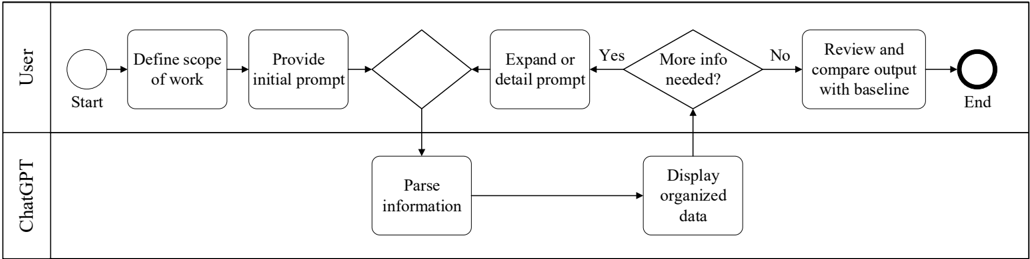
Generative Pre-Trained Transformer (GPT) language models such as ChatGPT have the potential to revolutionize the construction industry by automating repetitive and time-consuming tasks. This paper presents a study in which ChatGPT was used to generate a construction schedule for a simple construction project. The output from ChatGPT was evaluated by a pool of participants that provided feedback regarding their overall interaction experience and the quality of the output. The results show that ChatGPT can generate a coherent schedule that follows a logical approach to fulfill the requirements of the scope indicated. The participants had an overall positive interaction experience and indicated the potential of such a tool in automating many preliminary and time-consuming tasks. However, the technology still has limitations, and further development is needed before it can be widely adopted in the industry. Overall, this study highlights the advantages of using large language models and Natural Language Processing (NLP) techniques in the construction industry and the need for further research.
Overview
The claims and statistics of this paper haven’t been checked yet.
Free: it reads the open-access text and checks the first 5 claims that cite a source we can check. Create a free account to check every claim.
Integrity signals
Registry
Cites
Statistics
Figures
Verification
Claims the paper makes
The claims and statistics of this paper haven’t been checked yet.
Free: it reads the open-access text and checks the first 5 claims that cite a source we can check. Create a free account to check every claim.
Claims other papers make about this one
Each is checked against this paper’s own text: does it say what the citing paper says it does?
The source backs part of the claim, not all of it — or backs it for a different population, condition or comparison.
In the citing paper
“Prompt sensitivity is another limitation”
From A review of LLMs and their applications in the architecture, engineering and construction industry (2025) · cites this paper as Prieto et al. (2023)
Experimental — accuracy not yet measuredThe cited source says what the claim attributes to it.
In the citing paper
“Key limitations exhibited include omitting important steps, proposing tasks that were not needed, and missing details of the process like the curing time needed for materials, indicating lack of construction-specific knowledge and raising concerns regarding reliability and accuracy, especially in complex real-world scheduling tasks.”
From A review of LLMs and their applications in the architecture, engineering and construction industry (2025) · cites this paper as Prieto et al. (2023)
Self-check
Percentages, sums and reported differences re-computed from the paper’s own numbers.
The self-check needs the paper’s full text.
Citations
Cites
BERT: Pre-training of Deep Bidirectional Transformers for Language Understanding
Devlin, J., Chang, M.-W., Lee, K., & Toutanova, K. (2018) · arXiv · doi:10.48550/arxiv.1810.04805 · Cited by 73,173 · cited 1×
“BERT was first introduced by Google in 2018 [13] and has been the state-of-the-art for many of the NLP models developed afterward.”
MethodExploring the Limits of Transfer Learning with a Unified Text-to-Text Transformer
Raffel, C., Shazeer, N., Roberts, A., Lee, K., Narang, S., Matena, M., Zhou, Y., Li, W., & Liu, P. J. (2019) · arXiv · doi:10.48550/arxiv.1910.10683 · Cited by 31,859 · cited 1×
“T5 was introduced by Google in 2020 [17].”
BackgroundLanguage Models are Few-Shot Learners
Brown, T. B., Mann, B., Ryder, N., Subbiah, M., Kaplan, J., Dhariwal, P., Neelakantan, A., Shyam, P., Sastry, G., Askell, A., et al. (2020) · arXiv · doi:10.48550/arxiv.2005.14165 · Cited by 23,372 · cited 5×
“Floridi and Chiriatti [12] studied the scope, limits and consequences of the GPT-3 model and how society will have to get used to not being able to tell if a text was written by a human or an AI.”
BackgroundInfluentialGPT-3: Its Nature, Scope, Limits, and Consequences
Floridi, L., & Chiriatti, M. (2020) · Minds and Machines · doi:10.1007/s11023-020-09548-1 · Cited by 2,519
Chowdhary, K. R. (2020) · Fundamentals of Artificial Intelligence · doi:10.1007/978-81-322-3972-7_19 · Cited by 1,002
Fundamentals of Artificial Intelligence
Chowdhary, K. R. (2020) · doi:10.1007/978-81-322-3972-7 · Cited by 392
Tixier, A. J.-P., Hallowell, M. R., Rajagopalan, B., & Bowman, D. (2016) · Automation in Construction · doi:10.1016/j.autcon.2015.11.001 · Cited by 333
Korngiebel, D. M., & Mooney, S. D. (2021) · npj Digital Medicine · doi:10.1038/s41746-021-00464-x · Cited by 259
Integrating semantic NLP and logic reasoning into a unified system for fully-automated code checking
Zhang, J., & El-Gohary, N. M. (2017) · Automation in Construction · doi:10.1016/j.autcon.2016.08.027 · Cited by 255
Naseem, U., Razzak, I., Khan, S. K., & Prasad, M. (2021) · ACM Transactions on Asian and Low-Resource Language Information Processing · doi:10.1145/3434237 · Cited by 194 · cited 1×
“Within the field of NLP, research has been focused on developing Large Language representation Models (LLM) that expand the applicability of NLP to more detailed human language understanding tasks such as translation, text classification, and holding conversations [11,12].”
Method
Research works printed but not linked: 1
- 18. Y. Jung, A. Fouad, M. Golparver-Fard, A systematic review on the requirements on BIM maturity and formal representation of sequencing knowledge for automated construction scheduling, in: Proceedings of the 38th International Conference of CIB, Luxembourg, 2021: pp. 429-436. https://itc.scix.net/paper/w78-2021-paper-043 (accessed January 13, 2023).
Cited by
Items 201–276 of 276
Barakat, O., & Farissi, N. E. (2024) · Lecture notes in business information processing · doi:10.1007/978-3-031-76365-6_21 · Cited by 1
Automated Virtual Earthquake Reconnaissance Reporting Using Natural Language Processing
Zhou, G., & Mosalam, K. M. (2025) · Natural Hazards Review · doi:10.1061/nhrefo.nheng-2256 · Cited by 1
Jeon, K., Lee, G., Kim, Y., Kim, Y., & Lee, J.-H. (2024) · SSRN Electronic Journal · doi:10.2139/ssrn.4776682
Best Practices for Retaining Customers in FinTech
Arnone, G. (2024) · Contributions to finance and accounting · doi:10.1007/978-3-031-55536-7_7
Time analysis of a Megaproject, how to verify the duration of the Construction Phase
Bakke, C., & Johansen, A. (2024) · Procedia Computer Science · doi:10.1016/j.procs.2024.06.216
Automated Construction Specifications Digitalization for Efficient Compliance Checking on Sites
Choi, J., Kim, J., & Chi, S. (2024) · Creative Construction Conference (CCC) · doi:10.3311/ccc2024-072
A KG-LLM-Based Product2inspection Mapping Approach for Module Prefabrication
Dong, Q., Li, X., Chen, T., & Chengke, W. (2025) · International Conference on Construction and Real Estate Management (ICCREM) · doi:10.1061/9780784485910.066
Using Generative Artificial Intelligence to Aid Classroom Retention
Pruitt, J. R., Delmond, A. R., Mehlhorn, S. A., & Watson, D. L. (2025) · Applied Economics Teaching Resources · doi:10.71162/aetr.264881
“Regardless of faculty perceptions, industries are already adopting various forms of AI (Kumar et al. 2021; Carvalho and Ivanov 2024; Prieto, Mengiste, and de Soto 2023), necessitating the need for faculty to consider how to introduce students to this technology in an ethical manner consistent with…”
Student Experience with AI-Assisted Situational Analysis in Construction Management
Daggubati, S. C. (2025) · Springer eBooks · doi:10.1007/978-981-96-6001-8_5 · Cited by 1
إستخدام الذكاء الإصطناعي في تخطيط و إدارة الجداول الزمنية لمشروعات البناء
Mohammed, A. M., Fattah, A. S. A., & Reda, R. M. (2025) · Engineering Research Journal · doi:10.21608/erj.2025.340205.1147
Evaluating the Performance of Large Language Model on Structural Defect Assessment
Zhang, Y. J., & Su, R. K. L. (2025) · Lecture notes in civil engineering · doi:10.1007/978-981-96-4698-2_3
Zhao, X., Mehta, A., Sethi, F., Gue, B., Mei, Q., & Wu, L. (2025) · International Symposium on Automation and Robotics in Construction (ISARC) · doi:10.22260/isarc2025/0088
OR for Everyone: Solving OR Problems as Non-experts with Generative AI
Maurischat, J., Bogs, S., Walther, G., & Kirchhof, O. (2025) · Lecture notes in operations research · doi:10.1007/978-3-031-92575-7_18
Carrara, J. M., dos Santos, L. R., Borges, M. M., Barbosa, M. T. G., & de Oliveira, A. R. (2025) · IOP Conference Series Earth and Environmental Science · doi:10.1088/1755-1315/1536/1/012015
RESEARCH TREND ON CHATBOT IN CONSTRUCTION: A BIBLIOMETRIC ANALYSIS
Ismail, F., Ariffin, N. H. L. T., Mustaffa, N. E., Shukery, N. M., & Kamaruddin, T. (2025) · Journal of Information System and Technology Management · doi:10.35631/jistm.1040001
UnionPromptNER serves as a union prompting method to bridge few-shot named entity recognition
Tian, W., Xu, S., Wang, Y., Li, H., & Zhu, H. (2025) · Scientific Reports · doi:10.1038/s41598-025-30822-8
“Prieto et al. 5 conducted a study in which ChatGPT was used to generate a construction schedule for a simple construction project.”
Zhao, L., Mbachu, J., Liu, L., & Zhang, R. (2025) · Science Progress · doi:10.1177/00368504251393791
“Notably, Prieto et al. 46 used GPT in schedule planning for construction projects.”
Chen, L., Yan, S., Guo, Q., Sun, J., Cheng, F., Liu, Z., Xiao, W., Wang, M., Wang, H., & Zhao, X. (2025) · ASCE International Conference on Computing in Civil Engineering (i3CE) · doi:10.1061/9780784486115.014
Leveraging Large Language Models to Assist Bridge Element Visual Inspections
Topçu, O. K., Yuan, C., & Lee, H. F. (2025) · ASCE International Conference on Computing in Civil Engineering (i3CE) · doi:10.1061/9780784486115.013
Ma, R., Shen, Q., Lou, P., & Wang, M. (2025) · ASCE International Conference on Computing in Civil Engineering (i3CE) · doi:10.1061/9780784486115.012
Development of a Framework for Generative AI-Based Safety Management via Prompt Engineering
Park, S., Jung, K., Kim, N., & Jeon, J. (2025) · ASCE International Conference on Computing in Civil Engineering (i3CE) · doi:10.1061/9780784486139.078
Garfias Rodas, J. B., & Gutierrez Li, H. A. (2024) · Repositorio Académico UPC (Universidad Peruana de Ciencias Aplicadas)
Teimert, E. (2024) · KTH Publication Database DiVA (KTH Royal Institute of Technology) · Cited by 4
Webb, K., Becker, W., Freire-Gormaly, M., & Liang, R. (2023) · TSpace (University of Toronto)
Luo, R. (2025) · MacSphere (McMaster University) · doi:10.71548/11515
Artificial Intelligence in Project Scheduling Management: A Systematic Literature Review
Khan, M. F. (2025) · Osuva (University of Vaasa) · Cited by 11
Fernandes de Oliveira, D. (2024) · Mspace (University of Manitoba) · Cited by 2
Harnessing Artificial Intelligence for Project Management Efficiency
Tyrberg, O., & Adenmark, T. (2024) · Lund University Publications Student Papers (Lund University) · Cited by 2
Sadeghi, B. (2024) · UWM Digital Commons (University of Wisconsin–Milwaukee)
Tekoäly maanalaisten rakennushankkeiden aikataulutuksessa
Takala, P. (2025) · Aaltodoc (Aalto University)
Desenvolupament amb ajuda de ChatGPT d’una eina amb Excel VBA per al seguiment d’hàbits personals
Martínez Marco, D. (2024) · UPCommons institutional repository (Universitat Politècnica de Catalunya)
Loeffler, J. (2024) · URN-Resolver at the German National Library (German National Library)
Feasibility Study of Scheduling in Matrix Production Systems Using Large Language Models
Tiruvallur Devendar, R. (2025) · Diva portal (Dalarna University Library)
Yang, Z., & Wu, P. (2025) · arXiv (Cornell University) · doi:10.48550/arxiv.2508.15820 · Cited by 1
Digital Transformation Process in the Construction sector and the Role of Artificial Intelligence
Yoşumaz, İ. (2025) · International Journal of Management and Data Analytics · doi:10.68485/ijmada.2025590
Implementing AI to Improve the Efficiency of BIM-Based Construction Schedules
Jaff, L., & Güven, G. (2025) · Lecture notes in civil engineering · doi:10.1007/978-3-031-97697-1_26
İnşaat teknik şartnamelerindeki kusurların NLP kullanarak tespiti ve sınıflandırılması
Madenli, Ö. (2025) · OpenMETU (Middle East Technical University)
Mertiri, S. (2025) · Diva portal (Dalarna University Library)
Analysis of generative artificial intelligence (GEN AI) for risk management in project management
Arias Prieto, A. S., Rojas Ruiz, J. C., & Yanquen, J. C. (2023) · Minerva Digital Library (Universidad EAN)
Ray, U., Park, J., Alvarez, L., & Kim, N. (2026) · ASCE International Conference on Computing in Civil Engineering (i3CE) · doi:10.1061/9780784486443.086
Wen, Y., Luo, P., Wang, M., Agata, M., Xiao, L., & Brilakis, I. (2026) · ASCE International Conference on Computing in Civil Engineering (i3CE) · doi:10.1061/9780784486436.052
Ray, U., Chang, S., & Park, J. (2025) · doi:10.22260/crc-csce-2025/0169
Utilising ChatGPT and Google Bard as AI Experts to Assess Smart Building Services
Shahrabani, M. M. N., & Apanavičienė, R. (2026) · Advances in Science, Technology & Innovation/Advances in science, technology & innovation · doi:10.1007/978-3-031-99036-6_17
Automatically Transforming Virtual RealitySimulations into Project Schedules
Katsimpalis, E., Adey, B. T., & Haas, C. T. (2026) · Journal of Construction Engineering and Management · doi:10.1061/jcemd4.coeng-17813
Namburi, V. L. (2026) · SAE technical papers on CD-ROM/SAE technical paper series · doi:10.4271/2026-01-5023
Jäkel, J., Heinlein, E., Sengupta, J., Kim, H., & Klemt-Albert, K. (2026) · Buildings · doi:10.3390/buildings16071395
Attwa, M. (2026) · SSRN Electronic Journal · doi:10.2139/ssrn.6572624
Evolving text-based technologies for intelligent construction project management
Golmoradi, M., Banihashemi, S., Rezaali, M., & Wild, H. (2026) · Automation in Construction · doi:10.1016/j.autcon.2026.107012
BHGPT: Multiple AI Models for Built Heritage Knowledge Retrieval
Cui, C. D. L., Yan, W., Fioravanti, A., & Currà, E. (2026) · Rivista Tema · doi:10.36253/tema-16962
Girgin, S., Fruchter, R., & Fischer, M. A. (2026) · Journal of Computing in Civil Engineering · doi:10.1061/jccee5.cpeng-7023
Toward trustworthy engineering information extraction using retrieval-augmented generation
Shen, J., Zhu, H., & Zhang, B. (2026) · Knowledge-Based Systems · doi:10.1016/j.knosys.2026.116418 · Cited by 1
Tehisaru kasutuselevõtul vajalikud komplementaarsed tegurid Eesti ehitusvaldkonna ettevõtete näitel
Moorats, I. (2026) · DSpace repository (University of Tartu)
Cassandro, J., Hagedorn, P., Sigalov, K., Mirarchi, C., Pavan, A., & König, M. (2026) · SSRN Electronic Journal · doi:10.2139/ssrn.6989042
A Graph-RAG Framework for Natural Language Interaction with Dynamic Construction Project Graphs
Heidary, M. S., Shen, X., Mousavi, M., Barati, K., & Linke, J. (2026) · International Symposium on Automation and Robotics in Construction (ISARC) · doi:10.22260/isarc2026/0254
McDonough, A. F. (2026) · Journal of Asian Scientific Research · doi:10.55493/5003.v16i3.6068
Liu, C., Yang, Y., Wang, X., & Yang, X. (2026) · Journal of Urban Planning and Development · doi:10.1061/jupddm.upeng-6247
Dialectical systems framework for LLM applications in intelligent construction and operation
Xu, X., & Li, Z. (2026) · Automation in Construction · doi:10.1016/j.autcon.2026.107186
Salawudeen, A. A., Adebayo, R. A., & Ogundipe, O. B. (2026) · International journal of latest research in engineering and technology. · doi:10.56581/ijlret.12.07.01-20
Multi-objective job scheduling optimization in flexible job shops using dedicated GenAI system
Chen, T., & Lin, C. (2026) · The International Journal of Advanced Manufacturing Technology · doi:10.1007/s00170-026-18927-4
Large Language and Vision Models for Construction Workflows: A Literature Review
Erfani, A., Mansouri, A., & Naghdi, M. (2026) · ASCE Construction Research Congress (CRC) · doi:10.1061/9780784486962.041
Murtha, M., Mohamed, M., & Trisch, E. (2026) · ASCE Construction Research Congress (CRC) · doi:10.1061/9780784486962.043
Alsehaimi, A., Qadir, S., & Almujibah, H. (2026) · Engineering Construction & Architectural Management · doi:10.1108/ecam-04-2026-0701
Liu, J. (2026) · International Conference on Machine Learning and Intelligent Computing · doi:10.1145/3829441.3829613
“…(IP) methods utilize static assumptions about the project prior to them occurring, thereby resulting in a very rigid schedule and limiting the speed of response to dynamic disturbances (e.g., materials being delivered late; equipment failing) causing substantial delays and cost overruns [1-2].”
Reliability of LLM-generated Optimization: A Critical Review of Models, Algorithms, and DecisionsPreprint
Lian, J. J. (2026) · SSRN Electronic Journal · doi:10.2139/ssrn.7513738
de Abreu, V. V. S., Pellanda, P. C., Miceli, G., & Duarte, J. C. (2026) · Encontro Nacional de Tecnologia do Ambiente Construído · doi:10.46421/entac.v21i1.8332
“A integração de NLP e BIM tem potencial para automatizar extração e interpretação de dados de documentos e modelos, reduzindo trabalho repetitivo [43]; modelos de linguagem têm sido avaliados para gerar cronogramas em projetos simples, mostrando coerência na saída, mas exigindo aprimoramentos [36].”
Shi, M., Liang, M., & Hwang, B. (2026) · Journal of Management in Engineering · doi:10.1061/jmenea.meeng-7659
Oga, T. (2026) · Intelligent infrastructure and construction · doi:10.3390/iic2040015
Benchmarking Large Language Models on Production BIM Workflows Using Agentic Automation
Abdelsalam, M., Ashmawi, A., & Nguyen, P. H. D. (2026) · Buildings · doi:10.3390/buildings16214183
Projektowanie belki wspornikowej z wykorzystaniem sztucznej inteligencji
Lacki, P., & Derlatka, A. (2026) · Inżynier Budownictwa · doi:10.68502/ib.2026.05.15
“Próby wykorzystania zapytań języka natural-nego przeprowadzono w następujących dziedzinach inżynierii lądowej: pobiera-nie podzbiorów modeli BIM w projektach budowlanych [18], zarządzanie energią w budynkach [19] i harmonogramowanie projektów budowlanych [20].”
Manamperi, S. K., Peng, W., & Zhang, G. (. (2026) · Automation in Construction · doi:10.1016/j.autcon.2026.107320
Zhao, X., Mehta, A., Sethi, F., Gue, B., Mei, Q., & Wu, L. (2026) · arXiv (Cornell University) · doi:10.48550/arxiv.2610.36433
Taheri, H., & Samadi, M. (2026) · World Journal of Engineering and Technology · doi:10.4236/wjet.2026.144057
Lee, J.-W., 김태림, Chang, S., & Kang, K. (2026) · Journal of Management in Engineering · doi:10.1061/jmenea.meeng-7902
Ersöz, A. B., McHenry, J., Kovalchuk, Y., Barrett, E., & Khanie, M. S. (2026) · arXiv (Cornell University) · doi:10.48550/arxiv.2611.02286
Bodaghi, H., Roshan, M. M. G., & Nejad, M. A. S. (2026) · Journal of Resource Management and Decision Engineering · doi:10.61838/kman.jrmde.451
The Opportunities and Challenges of Multimodal GenAI in the Construction Industry: A Brief Review
Sun, M., Zhao, R., & Xue, F. (2026) · Lecture notes in operations research · doi:10.1007/978-981-92-0505-9_25 · Cited by 2
Metadata
- Authors
- Prieto, S. A., Mengiste, E. T., & García de Soto, B.
- Affiliations
- New York University Abu Dhabi (AE)
- S.M.A.R.T. Construction Research Group, Division of Engineering, New York University Abu Dhabi (NYUAD), Experimental Research Building, Saadiyat Island, Abu Dhabi P.O. Box 129188, United Arab Emirates
- Corresponding author
- Prieto, Samuel A.
- Venue
- Buildings
- Publisher
- MDPI AG
- Published
- 2023-03-24
- Volume
- 13
- Issue
- 4
- Pages
- 857
- ISSN
- 2075-5309 (ISSN-L)
- OpenAlex
- W4360847209
- Semantic Scholar
- 58b98ccd256f1ebe8551faa6798cfbfc80c490a5
- Cited by
- 229
- References
- 24
- Citations by year
- 2026: 50 · 2025: 71 · 2024: 72 · 2023: 36
- FWCI
- 27.50
- Type
- journal article
- Language
- en
- Open access
- gold
- doi.org
- Licence
- Locations
- Buildings (publishedVersion, cc-by)
- arXiv (Cornell University) (submittedVersion, cc-by-nc-nd)
- DOAJ (DOAJ: Directory of Open Access Journals) (submittedVersion, cc-by-sa)
- arXiv (Cornell University)
- Funders
- New York University Abu Dhabi (G1104, CG001)
- York University
- Tamkeen (CG001, G1104)
- Topics
- Physical Sciences › Engineering › Building and Construction › BIM and Construction Integration
- Physical Sciences › Computer Science › Artificial Intelligence › Artificial Intelligence Applications
- Social Sciences › Decision Sciences › Management Science and Operations Research › Construction Project Management and Performance
- Keywords
- ChatGPT, large language models, construction scheduling, schedule generation, user evaluation, interaction experience, output quality
About these checks
Registry, retraction, Cites and statistics results are computed, not judged, with one exception: a printed reference that no index lists is read once by a model before it counts as a citation error. Claims are extracted by a model and kept only when their quote appears verbatim in the text; each cited source is then checked, with a model’s help, for whether it says what the claim relies on. Those verdicts can be wrong — read the claim’s quote and the cited source before relying on one.
Statistics and arithmetic are recomputed, not judged.
Confidence bands are shown only for fields calibrated on our annotated test set. None is calibrated yet, so no band is shown.
What counts as a claim ›How we measure confidence ›How we check this ›
Are you an author, or do you see a problem with this page? Request a review
Data sources
Bibliographic data: Semantic Scholar, OpenAlex, Crossref.
Contains information from the Semantic Scholar Academic Graph Datasets, made available under the ODC Attribution License (ODC-BY 1.0).
Semantic Scholar’s data is described in: Kinney, R., et al. (2023). The Semantic Scholar Open Data Platform. arXiv:2301.10140.
