

A Novel Type of Blood Biomarker: Distinct Changes of Cytokine-Induced STAT Phosphorylation in Blood T Cells Between Colorectal Cancer Patients and Healthy Individuals
Open accessThe DOI matches its Crossref record; 28 of the 28 references it cites were found in a registry or an index.
Abstract
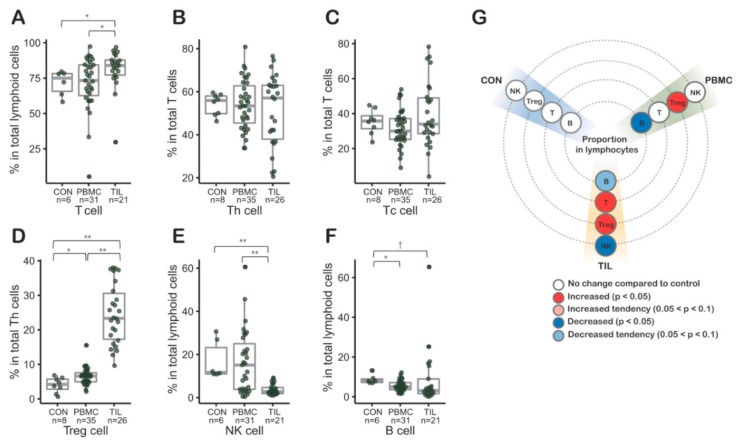
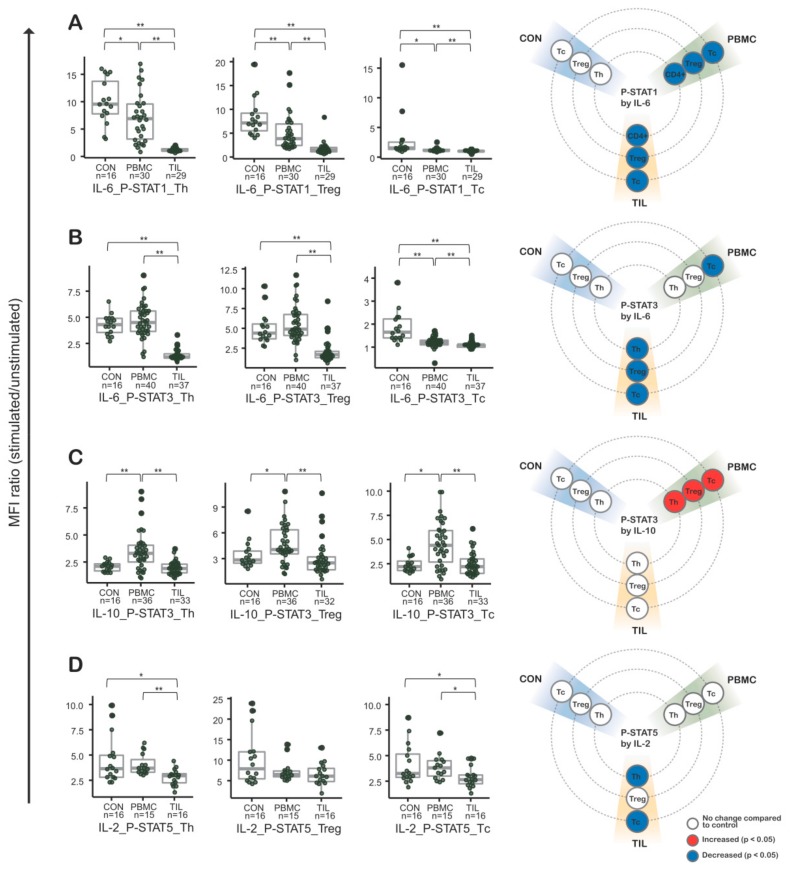
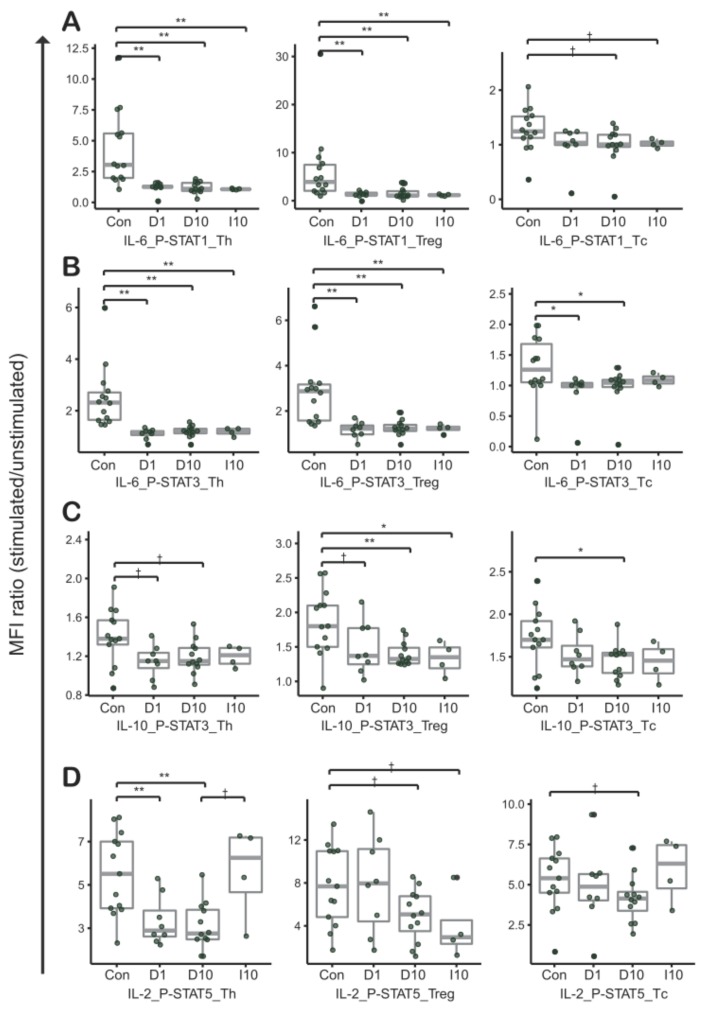
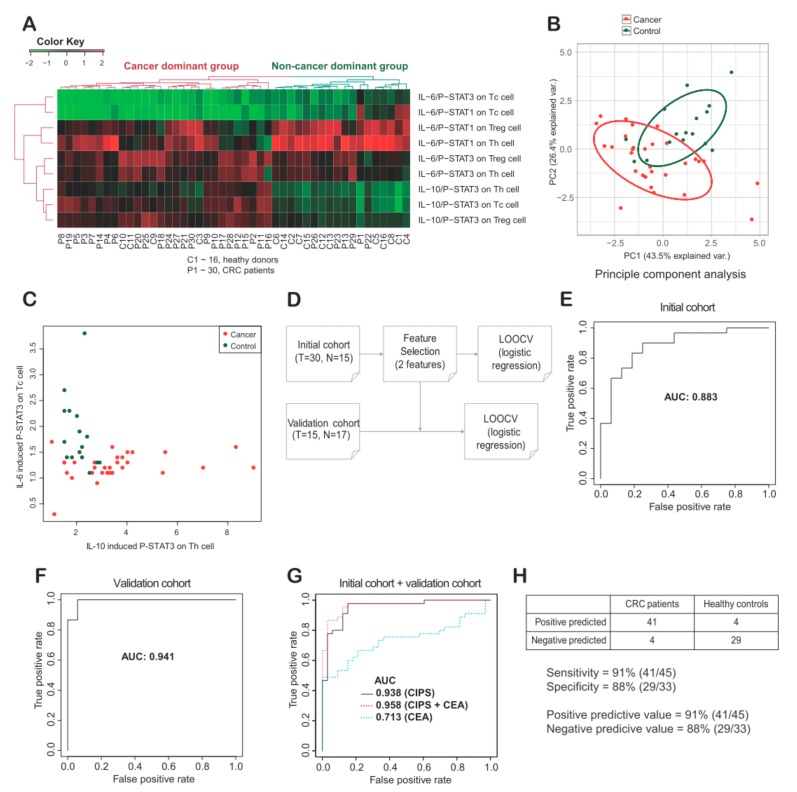
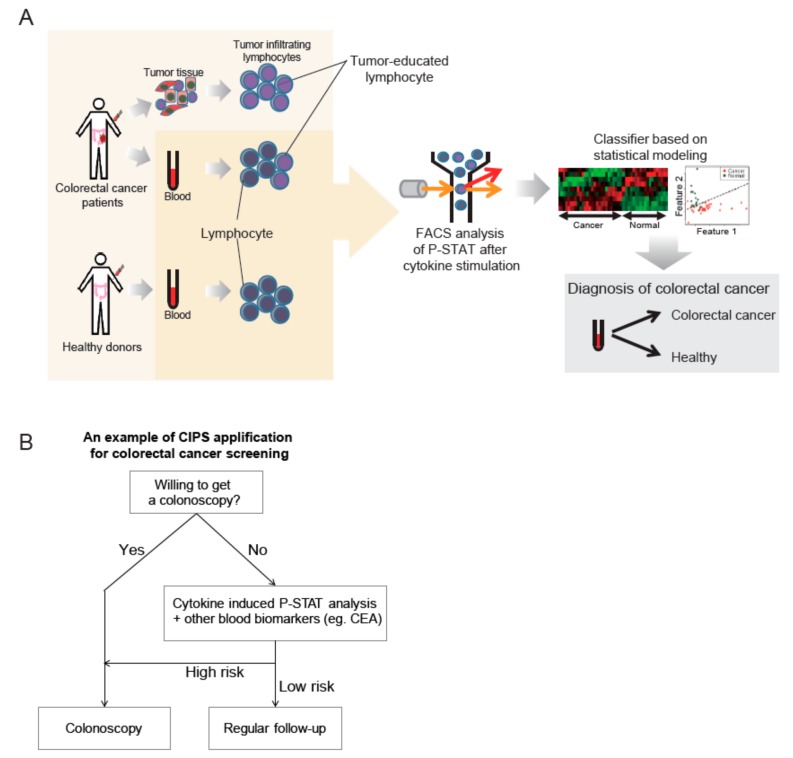
Background: Colorectal cancer (CRC) is one of the leading causes of cancer-related deaths worldwide. Although early diagnosis and treatment is the most successful strategy for improving patient survival, feasible and sensitive blood biomarkers for CRC screening remain elusive. Methods: Sixty-five CRC patients and thirty-three healthy individuals were enrolled. Peripheral blood (PB) and tumor tissues from CRC patients, and PB from healthy individuals were subjected to immunophenotyping and phospho-flow analysis of cytokine-induced phosphorylated STAT (CIPS). Logistic regression was used as a classifier that separates CRC patients from healthy individuals. Results: The proportion of regulatory T cells was increased in PB from CRC patients compared to PB from healthy individuals (p < 0.05). Interestingly, peripheral T cells share several cytokine-induced phosphorylated STAT (CIPS) signatures with T cells from CRC tumor-sites. Additionally, a classifier was made using two signatures distinct between T cells from CRC patients and T cells from healthy individuals. The AUCs (area under curves) of the classifier were 0.88 in initial cohort and 0.94 in the additional validation cohort. Overall AUC was 0.94 with sensitivity of 91% and specificity of 88%. Conclusion: This study highlights that immune cell signatures in peripheral blood could offer a new type of biomarker for CRC screening.
Overview
The claims and statistics of this paper haven’t been checked yet.
Free: it reads the open-access text and checks the first 5 claims that cite a source we can check. Create a free account to check every claim.
Integrity signals
Registry
Cites
Statistics
Figures
Verification
Claims the paper makes
The claims and statistics of this paper haven’t been checked yet.
Free: it reads the open-access text and checks the first 5 claims that cite a source we can check. Create a free account to check every claim.
Self-check
Percentages, sums and reported differences re-computed from the paper’s own numbers.
The self-check needs the paper’s full text.
Citations
Cites
R: A Language and Environment for Statistical Computing
R Core Team (2025) · doi:10.32614/r.manuals · Cited by 352,181
Classification and Regression by randomForest
Liaw, A. I., & Wiener, M. C. (2007) · Cited by 18,594
Interleukin-10 and the Interleukin-10 Receptor
Moore, K. W., de Waal Malefyt, R., Coffman, R. L., & O'Garra, A. (2001) · Annual Review of Immunology · doi:10.1146/annurev.immunol.19.1.683 · Cited by 6,737 · cited 1×
“IL-10 is an immunosuppressive cytokine produced by variable immune cells, especially Treg cells [22], which are rich in TILs in our study.”
BackgroundDetection of Circulating Tumor DNA in Early- and Late-Stage Human Malignancies
Bettegowda, C., Sausen, M., Leary, R. J., Kinde, I., Wang, Y., Agrawal, N., Bartlett, B. R., Wang, H., Luber, B., Alani, R. M., et al. (2014) · Science Translational Medicine · doi:10.1126/scitranslmed.3007094 · Cited by 5,067
ROCR: visualizing classifier performance in R
Sing, T., Sander, O., Beerenwinkel, N., & Lengauer, T. (2005) · Bioinformatics · doi:10.1093/bioinformatics/bti623 · Cited by 3,200 · cited 1×
“The receiver operating characteristic (ROC) curve was plotted, and the area under curve (AUC) was calculated using the ROCR package [26].”
MethodZhou, L., Ivanov, I. I., Spolski, R., Min, R., Shenderov, K., Egawa, T., Levy, D. E., Leonard, W. J., & Littman, D. R. (2007) · Nature Immunology · doi:10.1038/ni1488 · Cited by 2,141 · cited 1×
“reported that the effect of IL-6 on Th cells depends on STAT3, which is related to Th17 cell differentiation [21].”
Backgroundgplots: Various R Programming Tools for Plotting Data
Warnes, G. R., Bolker, B., Bonebakker, L., Gentleman, R., Huber, W., Liaw, A., Lumley, T., Maechler, M., Magnusson, A., Moeller, S., et al. (2005) · CRAN: Contributed Packages · doi:10.32614/cran.package.gplots · Cited by 1,228
Best, M. G., Sol, N., Kooi, I., Tannous, J., Westerman, B. A., Rustenburg, F., Schellen, P., Verschueren, H., Post, E., Koster, J., et al. (2015) · Cancer Cell · doi:10.1016/j.ccell.2015.09.018 · Cited by 916 · cited 2×
“Recently, mRNA profiling of tumor-educated platelets (TEP) from cancer patients was suggested as a promising strategy for early detection, with good sensitivity and specificity [9].”
BackgroundCirculating tumour cells in cancer patients: challenges and perspectives
Pantel, K., & Alix-Panabières, C. (2010) · Trends in Molecular Medicine · doi:10.1016/j.molmed.2010.07.001 · Cited by 815 · cited 1×
“Specific strategies included signal detection of circulating tumor cells (CTC), circulating tumor DNA (ctDNA), or exosomes [7,8].”
BackgroundCirculating Tumor DNA as a Liquid Biopsy for Cancer
Heitzer, E., Ulz, P., & Geigl, J. B. (2015) · Clinical Chemistry · doi:10.1373/clinchem.2014.222679 · Cited by 767 · cited 1×
“In addition, there remain significant economic barriers, owing to testing costs [12].”
Background
Cited by
Kartikasari, A. E. R., Huertas, C. S., Mitchell, A., & Plebanski, M. (2021) · Frontiers in Oncology · doi:10.3389/fonc.2021.692142 · Cited by 343
JAK-STAT Signalling Pathway in Cancer
Brooks, A. J., & Putoczki, T. (2020) · Cancers · doi:10.3390/cancers12071971 · Cited by 189
“STAT3 signalling in CD103+ conventional dendritic cells also provides an important immunosuppressive function via IL-10 activation.”
BackgroundInfluentialPotential therapeutic effects of curcumin mediated by JAK/STAT signaling pathway: A review
Ashrafizadeh, M., Rafiei, H., Mohammadinejad, R., Afshar, E. G., Farkhondeh, T., & Samarghandian, S. (2020) · Phytotherapy Research · doi:10.1002/ptr.6642 · Cited by 128
Tangeretin: a mechanistic review of its pharmacological and therapeutic effects
Ashrafizadeh, M., Ahmadi, Z., Mohammadinejad, R., & Afshar, E. G. (2020) · Journal of Basic and Clinical Physiology and Pharmacology · doi:10.1515/jbcpp-2019-0191 · Cited by 95
Dutta, N., Lillehoj, P. B., Estrela, P., & Dutta, G. (2021) · Biosensors · doi:10.3390/bios11030094 · Cited by 77
“showed the similarity between the STAT phosphorylation pattern induced by the regulatory T cell-subset (Treg) specific cytokine milieu between colorectal cancer tumor-microenvironment and peripheral blood [15].”
BackgroundCytokine and Cancer Biomarkers Detection: The Dawn of Electrochemical Paper-Based Biosensor
Loo, S. W., & Pui, T. S. (2020) · Sensors · doi:10.3390/s20071854 · Cited by 63
“A dysregulation in cytokine levels has been correlated with the onset of several types of cancer such as gastric cancer and colorectal cancer, thus its role exhibits promising quality as cancer biomarker to support diagnosis [12,13].”
BackgroundA Snapshot of The Tumor Microenvironment in Colorectal Cancer: The Liquid Biopsy
Herrera, M., Galindo-Pumariño, C., García‐Barberán, V., & Peña, C. (2019) · International Journal of Molecular Sciences · doi:10.3390/ijms20236016 · Cited by 50
“In CRC patients, the proportion of Treg cells in the Th cells subgroup is greater in peripheral blood mononuclear cells than in healthy controls [183].”
BackgroundLncRNA, a novel target biomolecule, is involved in the progression of colorectal cancer.
Sun, W., Ren, S., Li, R., Zhang, Q., & Song, H. (2019) · PubMed Central · Cited by 28
Electrochemical microfluidic paper-based analytical devices for tumor marker detection
Yuan, Y., Liu, B., Wang, T., Li, N., Zhang, Z., & Zhang, H. (2022) · TrAC Trends in Analytical Chemistry · doi:10.1016/j.trac.2022.116816 · Cited by 21
Influence of Long Non-Coding RNA in the Regulation of Cancer Stem Cell Signaling Pathways
Sonawala, K., Ramalingam, S., & Sellamuthu, I. (2022) · Cells · doi:10.3390/cells11213492 · Cited by 19
Progress and Outlook on Electrochemical Sensing of Lung Cancer Biomarkers
Zheng, R., Wu, A., Li, J., Tang, Z., Zhang, J., Zhang, M., & Wei, Z. (2024) · Molecules · doi:10.3390/molecules29133156 · Cited by 17
“This necessitates interdisciplinary efforts across biomedical, mechanical, and computer engineering for developing next-generation smart integrated biosensing devices for early cancer screening.”
BackgroundToney, N. J., Schlom, J., & Donahue, R. N. (2023) · Journal of Experimental & Clinical Cancer Research · doi:10.1186/s13046-023-02802-1 · Cited by 15
“Signaling differences have also been noted in peripheral and intratumoral T cells from colorectal cancer (CRC) patients [46].”
BackgroundLiquid Biopsy in Pre-Metastatic Niche: From Molecular Mechanism to Clinical Application
Liu, Z., Kong, Y., Dang, Q., Weng, S., Zheng, Y., Ren, Y., Lv, J., Li, N., Han, Y., & Han, X. (2022) · Frontiers in Immunology · doi:10.3389/fimmu.2022.958360 · Cited by 16
Chang-qin, L., & Li, J. (2024) · Critical Reviews in Oncology/Hematology · doi:10.1016/j.critrevonc.2024.104543 · Cited by 14
Ye, Z., Song, G., Liang, J., Yi, S., Gao, Y., & Jiang, H. (2023) · BMC Cancer · doi:10.1186/s12885-023-10922-2 · Cited by 8
“healthy populations with a sensitivity of 91% and specificity of 88% [10].”
BackgroundAdvances in Early Detection of Colorectal Cancer: A Focus on Non-invasive Biomarkers
Kadmiri, N. E. (2021) · Current Drug Targets · doi:10.2174/1389450122666210303100048 · Cited by 4
Involvement and Therapeutic Implication of JAK-STAT Pathway in Cancer
Rehman, A., Khan, N. A., Rashid, G., Tamanna, S., Jindal, R., Seth, N., Bashir, B., Mushtaq, G., Salman, M., & Parveen, S. (2025) · Springer eBooks · doi:10.1007/978-981-96-2763-9_8 · Cited by 5
Cell Signaling Pathways in Cancer
AlSaihati, H., Al-Toub, M., Sharaf, H. I., Singh, M., Ansari, M. N., & Saeedan, A. S. (2023) · BENTHAM SCIENCE PUBLISHERS eBooks · doi:10.2174/9789815080384123010009 · Cited by 2
Metadata
- Authors
- Yun, J. W., Lee, S., Kim, H. M., Chun, S., Engleman, E. G., Kim, H. C., & Kang, E.-S.
- Affiliations
- Samsung Medical Center (KR)
- Seoul National University (KR)
- Samsung (South Korea) (KR)
- Chonnam National University (KR)
- Stanford University (US)
- Corresponding author
- Kim, Hee Cheol
- Kang, Eun-Suk
- Venue
- Cancers
- Publisher
- MDPI AG
- Published
- 2019-08-12
- Volume
- 11
- Issue
- 8
- Pages
- 1157
- ISSN
- 2072-6694 (ISSN-L)
- PMC
- PMC6721561
- OpenAlex
- W2967234356
- Cited by
- 18
- References
- 28
- Citations by year
- 2025: 1 · 2024: 2 · 2023: 3 · 2022: 3 · 2021: 3 · 2020: 4 · 2019: 2
- FWCI
- 1.25
- Type
- journal article
- Language
- en
- Open access
- gold
- dx.doi.org
- Licence
- Locations
- Cancers (publishedVersion, cc-by)
- PubMed Central (publishedVersion, cc-by)
- PubMed (publishedVersion)
- DOAJ (DOAJ: Directory of Open Access Journals) (submittedVersion, cc-by-sa)
- Funders
- Global Ph.D. Fellowship (NRF-2016H1A2A1907938)
- Topics
- Life Sciences › Immunology and Microbiology › Immunology › Cytokine Signaling Pathways and Interactions
- Life Sciences › Immunology and Microbiology › Immunology › T-cell and B-cell Immunology
- Health Sciences › Medicine › Oncology › Cancer Immunotherapy and Biomarkers
- Keywords
- colorectal cancer, blood biomarkers, STAT phosphorylation, regulatory T cells, peripheral blood T cells, tumor-infiltrating T cells, cancer screening, immune cell signatures
About these checks
Registry, retraction, Cites and statistics results are computed, not judged, with one exception: a printed reference that no index lists is read once by a model before it counts as a citation error. Claims are extracted by a model and kept only when their quote appears verbatim in the text; each cited source is then checked, with a model’s help, for whether it says what the claim relies on. Those verdicts can be wrong — read the claim’s quote and the cited source before relying on one.
Statistics and arithmetic are recomputed, not judged.
Confidence bands are shown only for fields calibrated on our annotated test set. None is calibrated yet, so no band is shown.
What counts as a claim ›How we measure confidence ›How we check this ›
Are you an author, or do you see a problem with this page? Request a review
Data sources
Bibliographic data: Semantic Scholar, OpenAlex, Crossref.
Contains information from the Semantic Scholar Academic Graph Datasets, made available under the ODC Attribution License (ODC-BY 1.0).
Semantic Scholar’s data is described in: Kinney, R., et al. (2023). The Semantic Scholar Open Data Platform. arXiv:2301.10140.
