

The DOI matches its Crossref record; 160 of the 175 references it cites were found in a registry or an index.
p21 in Cancer Research
Open accessAbstract
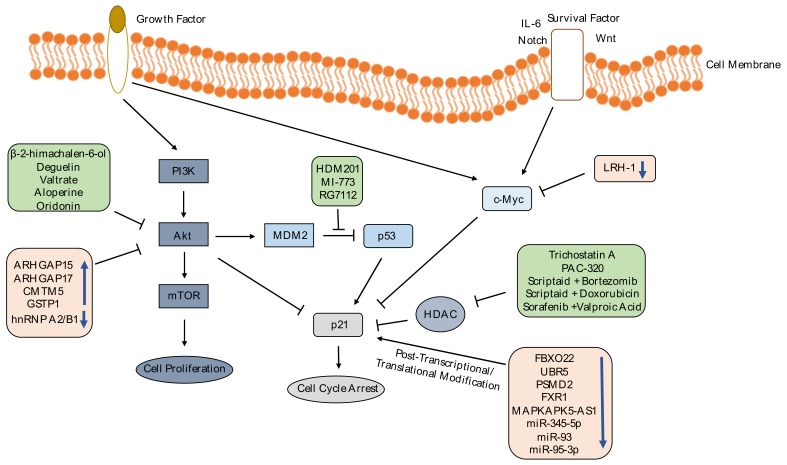
p21 functions as a cell cycle inhibitor and anti-proliferative effector in normal cells, and is dysregulated in some cancers. Earlier observations on p21 knockout models emphasized the role of this protein in cell cycle arrest under the p53 transcription factor activity. Although tumor-suppressor function of p21 is the most studied aspect of this protein in cancer, the role of p21 in phenotypic plasticity and its oncogenic/anti-apoptotic function, depending on p21 subcellular localization and p53 status, have been under scrutiny recently. Basic science and translational studies use precision gene editing to manipulate p21 itself, and proteins that interact with it; these studies have led to regulatory/functional/drug sensitivity discoveries as well as therapeutic approaches in cancer field. In this review, we will focus on targeting p21 in cancer research and its potential in providing novel therapies.
Overview
The claims and statistics of this paper haven’t been checked yet.
Run the check — free, no account needed. It reads the open-access text and checks the sources it cites.
Integrity signals
Registry
Cites
Statistics
Figures
Verification
Claims the paper makes
The claims and statistics of this paper haven’t been checked yet.
Run the check — free, no account needed. It reads the open-access text and checks the sources it cites.
Claims other papers make about this one
Each is checked against this paper’s own text: does it say what the citing paper says it does?
The source backs part of the claim, not all of it — or backs it for a different population, condition or comparison.
In the citing paper
“Of note, 38-50% of human cancers carry inactivating alterations in TP53 (ref. 132 ) , 48-80% in CDKN2A 133 and 14% in CIP1 (ref. 134 ) , while 15-20% and up to 8% harbour oncogenic mutations in RAS and BRAF , respectively 135,136 .”
From Senescence and cancer — role and therapeutic opportunities (2022) · cites this paper as [134]
Experimental — accuracy not yet measured
Self-check
Percentages, sums and reported differences re-computed from the paper’s own numbers.
The self-check needs the paper’s full text.
Citations
Cites
1 retracted
MicroRNA-93 promotes cell proliferation by directly targeting P21 in osteosarcoma cells
He, Y., & Yu, B. (2017) · Experimental and Therapeutic Medicine · doi:10.3892/etm.2017.4204 · Cited by 29
RetractedGenome engineering using the CRISPR-Cas9 system
Ran, F. A., Hsu, P. D., Wright, J., Agarwala, V., Scott, D. A., & Zhang, F. (2013) · Nature Protocols · doi:10.1038/nprot.2013.143 · Cited by 11,133
Comprehensive molecular characterization of human colon and rectal cancer
The Cancer Genome Atlas Network (2012) · Nature · doi:10.1038/nature11252 · Cited by 8,499
WAF1, a potential mediator of p53 tumor suppression
El-Deiry, W. S., Tokino, T., Velculescu, V. E., Levy, D. B., Parsons, R., Trent, J. M., Lin, D., Mercer, W. E., Kinzler, K. W., & Vogelstein, B. (1993) · Cell · doi:10.1016/0092-8674(93)90500-p · Cited by 8,321
The p21 Cdk-interacting protein Cip1 is a potent inhibitor of G1 cyclin-dependent kinases.
Wade Harper, J. (1993) · Cell · doi:10.1016/0092-8674(93)90499-g · Cited by 5,651
Massagué, J. (2008) · Cell · doi:10.1016/j.cell.2008.07.001 · Cited by 3,907
The emerging role of lncRNAs in cancer
Huarte, M. (2015) · Nature Medicine · doi:10.1038/nm.3981 · Cited by 2,712
p21 in cancer: Intricate networks and multiple activities
Abbas, T., & Dutta, A. (2009) · Nature Reviews Cancer · doi:10.1038/nrc2657 · Cited by 2,712
Cepharanthine potently enhances the sensitivity of anticancer agents in K562 cells
Ikeda, R., Che, X., Yamaguchi, T., Ushiyama, M., Zheng, C., Okumura, H., Takeda, Y., Shibayama, Y., Nakamura, K. T., Jeung, H., et al. (2005) · Cancer Science · doi:10.1111/j.1349-7006.2005.00057.x · Cited by 2,268
A Large Intergenic Noncoding RNA Induced by p53 Mediates Global Gene Repression in the p53 Response
Huarte, M., Guttman, M., Feldser, D., Garber, M., Koziol, M. J., Kenzelmann-Broz, D., Khalil, A. M., Zuk, O., Amit, I., Rabani, M., et al. (2010) · Cell · doi:10.1016/j.cell.2010.06.040 · Cited by 2,053
Cited by
Sorted by citations
Matthews, H. K., Bertoli, C., & de Bruin, R. A. M. (2022) · Nature Reviews Molecular Cell Biology · doi:10.1038/s41580-021-00404-3 · Cited by 1,506
Senescence and cancer — role and therapeutic opportunities
Schmitt, C. A., Wang, B., & Demaria, M. (2022) · Nature Reviews Clinical Oncology · doi:10.1038/s41571-022-00668-4 · Cited by 794
Signaling Pathways in Cancer: Therapeutic Targets, Combinatorial Treatments, and New Developments
Yip, H. Y. K., & Papa, A. (2021) · Cells · doi:10.3390/cells10030659 · Cited by 341
P16INK4A—More Than a Senescence Marker
Safwan‐Zaiter, H., Wagner, N., & Wagner, K. (2022) · Life · doi:10.3390/life12091332 · Cited by 204
TGF-β signaling: critical nexus of fibrogenesis and cancer
Giarratana, A. O., Prendergast, C. M., Salvatore, M. M., & Capaccione, K. M. (2024) · Journal of Translational Medicine · doi:10.1186/s12967-024-05411-4 · Cited by 180
Metadata
- Authors
- Shamloo, B., & Usluer, S.
- Affiliations
- University of Utah (US)
- Medical University of Graz (AT)
- Corresponding author
- Shamloo, Bahar
- Venue
- Cancers
- Publisher
- MDPI AG
- Published
- 2019-08-14
- Volume
- 11
- Issue
- 8
- Pages
- 1178
- ISSN
- 2072-6694 (ISSN-L)
- PMC
- PMC6721478
- OpenAlex
- W2968190332
- Cited by
- 336
- References
- 175
- Citations by year
- 2026: 18 · 2025: 47 · 2024: 63 · 2023: 65 · 2022: 52 · 2021: 56 · 2020: 31 · 2019: 3
- FWCI
- 3.41
- Type
- journal article
- Language
- en
- Open access
- gold
- doi.org
- Licence
- Locations
- Cancers (publishedVersion, cc-by)
- PubMed Central (publishedVersion, cc-by)
- PubMed (publishedVersion)
- DOAJ (DOAJ: Directory of Open Access Journals) (submittedVersion, cc-by-sa)
- Topics
- Health Sciences › Medicine › Oncology › Cancer-related Molecular Pathways
- Life Sciences › Biochemistry, Genetics and Molecular Biology › Molecular Biology › PI3K/AKT/mTOR signaling in cancer
- Life Sciences › Biochemistry, Genetics and Molecular Biology › Molecular Biology › Ubiquitin and proteasome pathways
- Keywords
- p21, cell cycle inhibitors, p53, tumor suppression, phenotypic plasticity, oncogenic function, anti-apoptotic effects, subcellular localization, genome editing, cancer therapy, drug sensitivity
About these checks
Registry, retraction, Cites and statistics results are computed, not judged, with one exception: a printed reference that no index lists is read once by a model before it counts as a citation error. Claims are extracted by a model and kept only when their quote appears verbatim in the text; each cited source is then checked, with a model’s help, for whether it says what the claim relies on. Those verdicts can be wrong — read the claim’s quote and the cited source before relying on one.
Statistics and arithmetic are recomputed, not judged.
Confidence bands are shown only for fields calibrated on our annotated test set. None is calibrated yet, so no band is shown.
What counts as a claim ›How we measure confidence ›How we check this ›
Are you an author, or do you see a problem with this page? Request a review
