

Regulation of Src Family Kinases during Colorectal Cancer Development and Its Clinical Implications
Open accessThe DOI matches its Crossref record; 211 of the 215 references it cites were found in a registry or an index.
Abstract
Src family kinases (SFKs) are non-receptor kinases that play a critical role in the pathogenesis of colorectal cancer (CRC). The expression and activity of SFKs are upregulated in patients with CRC. Activation of SFKs promotes CRC cell proliferation, metastases to other organs and chemoresistance, as well as the formation of cancer stem cells (CSCs). The enhanced expression level of Src is associated with decreased survival in patients with CRC. Src-mediated regulation of CRC progression involves various membrane receptors, modulators, and suppressors, which regulate Src activation and its downstream targets through various mechanisms. This review provides an overview of the current understanding of the correlations between Src and CRC progression, with a special focus on cancer cell proliferation, invasion, metastasis and chemoresistance, and formation of CSCs. Additionally, this review discusses preclinical and clinical strategies to improve the therapeutic efficacy of drugs targeting Src for treating patients with CRC.
Overview
The claims and statistics of this paper haven’t been checked yet.
Free: it reads the open-access text and checks the first 5 claims that cite a source we can check. Create a free account to check every claim.
Integrity signals
Registry
Cites
Statistics
Figures
Verification
Claims the paper makes
The claims and statistics of this paper haven’t been checked yet.
Free: it reads the open-access text and checks the first 5 claims that cite a source we can check. Create a free account to check every claim.
Claims other papers make about this one
Each is checked against this paper’s own text: does it say what the citing paper says it does?
The source backs part of the claim, not all of it — or backs it for a different population, condition or comparison.
In the citing paper
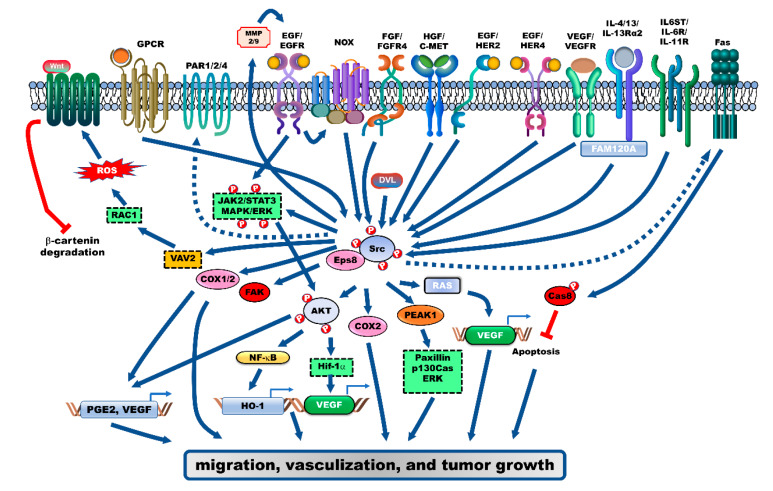
“In response signaling from a variety of RTKs (including EGFR, HER2, HER4, PDGFR, VEGFR, FGFR4, GPCR, C-MET, IL-4/IL13/IL-13Rα2, IL-6ST/IL-6R/IL-11R), SRC has been reported to mediate diverse cell signaling pathways including RAS/MAPK (proliferation), PI3K/AKT (survival), FAK (adhesion/migration/EMT), and STAT3 (angiogenesis) [17, 49, 50].”
From An integrative gene expression signature analysis identifies CMS4 KRAS-mutated colorectal cancers sensitive to combined MEK and SRC targeted therapy (2022) · cites this paper as [50]
Experimental — accuracy not yet measured
Self-check
Percentages, sums and reported differences re-computed from the paper’s own numbers.
The self-check needs the paper’s full text.
Citations
Cites
Items 201–211 of 211
Role of paxillin in colorectal carcinoma and its relationship to clinicopathological features
Hongfang, Y., Quanwen, Z., Xin, W., Li, T., Yuanlian, W., Yucun, L., & Zhu, J. (2014) · Chinese Medical Journal · doi:10.3760/cma.j.issn.0366-6999.20121360 · Cited by 13 · cited 1×
“One study reported that the expression of PXN is upregulated in 65% of patients with CRC, and that PXN expression is closely correlated with the recurrence of CRC [84].”
BackgroundFerrand, A. (2006) · World Journal of Gastroenterology · doi:10.3748/wjg.v12.i12.1859 · Cited by 10
Abe, H., Mochizuki, S., Ohara, K., Ueno, M., Ochiai, H., Kitagawa, Y., Hino, O., Sato, H., & Okada, Y. (2013) · American Journal Of Pathology · doi:10.1016/j.ajpath.2013.07.011 · Cited by 10 · cited 1×
“The v-Src-activated PI3K/AKT and ERK1/2 signaling pathways induce ADAM28 expression, which is correlated with the survival and progression of cancer [91].”
BackgroundRegulation of RPTP α–c‐Src signalling pathway by miR‐218
Lai, X., Chen, Q., Zhu, C., Deng, R., Zhao, X., Chen, C., Wang, Y., Yu, J., & Huang, J. J. (2015) · FEBS Journal · doi:10.1111/febs.13314 · Cited by 10
Modulation of Cell Adhesion Molecules in Various Epithelial Cell Lines after Treatment with PP2
Calcagno, A. M., Fostel, J. M., Orchekowski, R. P., Alston, J. T., Mattes, W. B., Siahaan, T. J., & Ware, J. A. (2005) · Molecular Pharmaceutics · doi:10.1021/mp0499003 · Cited by 9 · cited 2×
“expression of E-cadherin and α-catenin, which promotes strong cell–cell adhesion and morphological changes [124,125].”
BackgroundMicro RNA ‐137‐mediated Src oncogenic signaling promotes cancer progression
Kokuda, R., Watanabe, R., Okuzaki, D., Akamatsu, H., & Oneyama, C. (2018) · Genes to Cells · doi:10.1111/gtc.12610 · Cited by 9
Sim, J. J., Park, M., Baek, J., Lee, H., Jeong, K., & Kim, H. M. (2018) · Anticancer Research · doi:10.21873/anticanres.12772 · Cited by 9 · cited 1×
“The treatment combination of capecitabine and lactate calcium salt (LCS), which is used to treat calcium deficiencies, markedly decreases the expression of Src and suppresses survival and tumor growth in vivo, when compared to the individual treatment [206].”
BackgroundCommon therapeutic target for both cancer and obesity
Chang, Y. (2017) · World Journal of Biological Chemistry · doi:10.4331/wjbc.v8.i2.102 · Cited by 8 · cited 1×
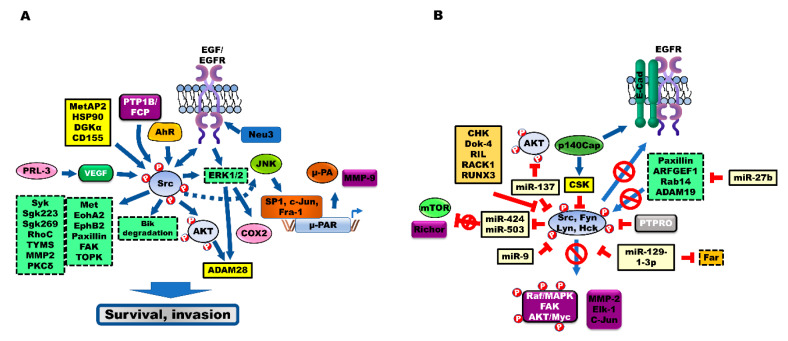
“MetAP2 is reported to be a therapeutic target for cancer and obesity [65,66].”
BackgroundWhite, M. F., Kahn, C. R., Werth, D. K., & Pastan, I. H. (1984) · Journal of Cellular Biochemistry · doi:10.1002/jcb.240260305 · Cited by 7 · cited 1×
“The purification of v-Src (pp60src) from Rous sarcoma virus (RSV), which activates the insulin receptor, led to the identification of various Src family kinases (SFKs) [1,2], such as Src, Fyn, Yes, Yrk, Fgr, Hck, Blk, lymphocyte-specific protein tyrosine kinase (Lck), and Lyn.”
BackgroundJung, J., Choi, S. C., Lee, H. N., Han, G.-Y., & Kim, C. (2016) · Tissue Engineering and Regenerative Medicine · doi:10.1007/s13770-016-9053-x · Cited by 2 · cited 1×
“The loss of c-Yes in the CD133+ subpopulation induces cell differentiation, and decreases cell proliferation and tumorsphere formation, by suppressing Nanog expression [180].”
BackgroundGuo, Y.-S., WEN, X., Rui, X., & Townsend, C. M. (2001) · Gastroenterology · doi:10.1016/s0016-5085(08)82517-6 · Cited by 1
Cited by
Poh, A. R., & Ernst, M. (2023) · Oncogene · doi:10.1038/s41388-023-02701-x · Cited by 60
Kharkar, P. S. (2020) · Journal of Medicinal Chemistry · doi:10.1021/acs.jmedchem.0c01336 · Cited by 51
Pathogenic nsSNPs that increase the risks of cancers among the Orang Asli and Malays
Khoruddin, N. A., Noorizhab, M. N. F., Teh, L. K., Yusof, F. Z. M., & Salleh, M. Z. (2021) · Scientific Reports · doi:10.1038/s41598-021-95618-y · Cited by 34
Src Family Tyrosine Kinases in Intestinal Homeostasis, Regeneration and Tumorigenesis
Sirvent, A., Mevizou, R., Naim, D., Lafitte, M., & Roche, S. (2020) · Cancers · doi:10.3390/cancers12082014 · Cited by 35
Zhang, W., Pan, R., Lu, M., Zhang, Q., Lin, Z., Qin, Y., Wang, Z., Gong, S., Lin, H., Chong, S., et al. (2021) · Oncogene · doi:10.1038/s41388-021-02029-4 · Cited by 36
Metadata
- Authors
- Jin, W.
- Affiliations
- Gachon University (KR)
- Corresponding author
- Jin, Wook
- ORCID
- Jin, Wook
- Venue
- Cancers
- Publisher
- MDPI AG
- Published
- 2020-05-23
- Volume
- 12
- Issue
- 5
- Pages
- 1339
- ISSN
- 2072-6694 (ISSN-L)
- PMC
- PMC7281431
- OpenAlex
- W3026270876
- Cited by
- 86
- References
- 215
- Citations by year
- 2026: 9 · 2025: 10 · 2024: 13 · 2023: 20 · 2022: 16 · 2021: 11 · 2020: 6
- FWCI
- 2.03
- Type
- journal article
- Language
- en
- Open access
- gold
- dx.doi.org
- Licence
- Locations
- Cancers (publishedVersion, cc-by)
- PubMed Central (publishedVersion, cc-by)
- PubMed (publishedVersion)
- DOAJ (DOAJ: Directory of Open Access Journals) (submittedVersion, cc-by-sa)
- Funders
- National Research Foundation of Korea (2020R1A2C1012484)
- Topics
- Life Sciences › Biochemistry, Genetics and Molecular Biology › Cancer Research › Cancer Mechanisms and Therapy
- Life Sciences › Biochemistry, Genetics and Molecular Biology › Molecular Biology › Protein Kinase Regulation and GTPase Signaling
- Health Sciences › Medicine › Oncology › Cancer Cells and Metastasis
- Keywords
- Src family kinases, colorectal cancer, tumor progression, cell proliferation, metastasis, chemoresistance, cancer stem cells, Src kinase inhibitor, non-receptor tyrosine kinase, patient survival
About these checks
Registry, retraction, Cites and statistics results are computed, not judged, with one exception: a printed reference that no index lists is read once by a model before it counts as a citation error. Claims are extracted by a model and kept only when their quote appears verbatim in the text; each cited source is then checked, with a model’s help, for whether it says what the claim relies on. Those verdicts can be wrong — read the claim’s quote and the cited source before relying on one.
Statistics and arithmetic are recomputed, not judged.
Confidence bands are shown only for fields calibrated on our annotated test set. None is calibrated yet, so no band is shown.
What counts as a claim ›How we measure confidence ›How we check this ›
Are you an author, or do you see a problem with this page? Request a review
Data sources
Bibliographic data: Semantic Scholar, OpenAlex, Crossref.
Contains information from the Semantic Scholar Academic Graph Datasets, made available under the ODC Attribution License (ODC-BY 1.0).
Semantic Scholar’s data is described in: Kinney, R., et al. (2023). The Semantic Scholar Open Data Platform. arXiv:2301.10140.
