

Perspectives on Hypoxia Signaling in Tumor Stroma
Open accessThe DOI matches its Crossref record; 189 of the 189 references it cites were found in a registry or an index.
Abstract
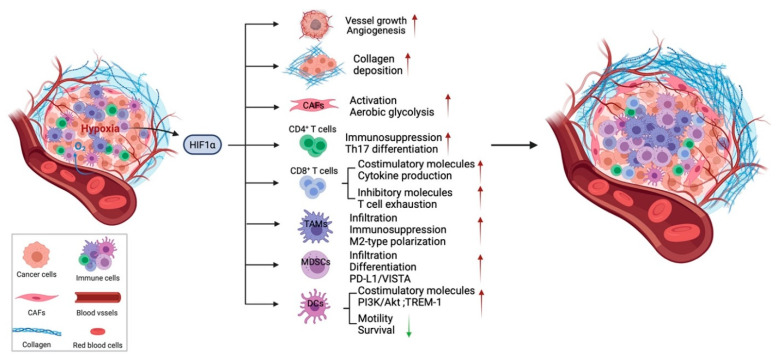
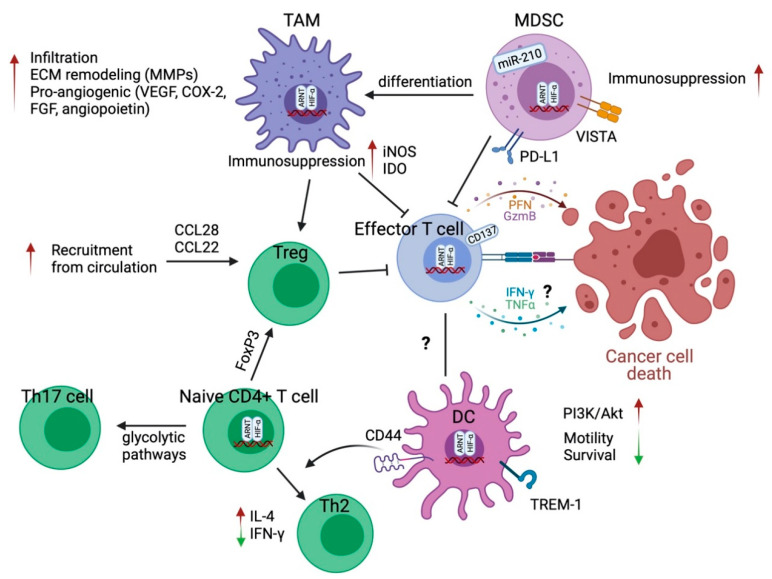
Hypoxia is a well-known characteristic of solid tumors that contributes to tumor progression and metastasis. Oxygen deprivation due to high demand of proliferating cancer cells and standard of care therapies induce hypoxia. Hypoxia signaling, mainly mediated by the hypoxia-inducible transcription factor (HIF) family, results in tumor cell migration, proliferation, metabolic changes, and resistance to therapy. Additionally, the hypoxic tumor microenvironment impacts multiple cellular and non-cellular compartments in the tumor stroma, including disordered tumor vasculature, homeostasis of ECM. Hypoxia also has a multifaceted and often contradictory influence on immune cell function, which contributes to an immunosuppressive environment. Here, we review the important function of HIF in tumor stromal components and summarize current clinical trials targeting hypoxia. We provide an overview of hypoxia signaling in tumor stroma that might help address some of the challenges associated with hypoxia-targeted therapies.
Overview
The claims and statistics of this paper haven’t been checked yet.
Free: it reads the open-access text and checks the first 5 claims that cite a source we can check. Create a free account to check every claim.
Integrity signals
Registry
Cites
Statistics
Figures
Verification
Claims the paper makes
The claims and statistics of this paper haven’t been checked yet.
Free: it reads the open-access text and checks the first 5 claims that cite a source we can check. Create a free account to check every claim.
Claims other papers make about this one
Each is checked against this paper’s own text: does it say what the citing paper says it does?
The source backs part of the claim, not all of it — or backs it for a different population, condition or comparison.
In the citing paper
“Furthermore, hypoxia promotes self-renewal by activation of Wnt and Notch signaling pathways and embryonic stem cell transcription factors, and it modulates differentiation of tumor cells and tumor-associated stromal cells [86,87,88].”
From Mechanisms and Strategies to Overcome Drug Resistance in Colorectal Cancer (2025) · cites this paper as [88]
Experimental — accuracy not yet measured
Self-check
Percentages, sums and reported differences re-computed from the paper’s own numbers.
The self-check needs the paper’s full text.
Citations
Cites
2 retracted
Gilkes, D. M., Bajpai, S., Chaturvedi, P., Wirtz, D., & Semenza, G. L. (2013) · Journal of Biological Chemistry · doi:10.1074/jbc.m112.442939 · Cited by 467
RetractedProcollagen lysyl hydroxylase 2 is essential for hypoxia-induced breast cancer metastasis
Gilkes, D. M., Bajpai, S., Wong, C. C., Chaturvedi, P., Hubbi, M. E., Wirtz, D., & Semenza, G. L. (2013) · Molecular Cancer Research · doi:10.1158/1541-7786.mcr-12-0629 · Cited by 252
RetractedMolecular Mechanisms of Stress-Responsive Changes in Collagen and Elastin Networks in Skin
Aziz, J., Shezali, H., Radzi, Z., Yahya, N. A., Abu Kassim, N. H., Czernuszka, J., & Rahman, M. T. (2016) · Skin Pharmacology and Physiology · doi:10.1159/000447017 · Cited by 7,323
Bettelli, E., Carrier, Y., Gao, W., Korn, T., Strom, T. B., Oukka, M., Weiner, H. L., & Kuchroo, V. K. (2006) · Nature · doi:10.1038/nature04753 · Cited by 6,992
Oncology meets immunology: the cancer-immunity cycle.
Chen, D. S., & Mellman, I. (2013) · Immunity · doi:10.1016/j.immuni.2013.07.012 · Cited by 6,929
Myeloid-derived-suppressor cells as regulators of the immune system
Gabrilovich, D. I., & Nagaraj, S. (2009) · Nature Reviews Immunology · doi:10.1038/nri2506 · Cited by 6,753
Normalization of Tumor Vasculature: An Emerging Concept in Antiangiogenic Therapy
Jain, R. K. (2005) · Science · doi:10.1126/science.1104819 · Cited by 5,527
Targeting Hypoxia-Inducible Factors for the Treatment of Anemia in Chronic Kidney Disease Patients
Locatelli, F., Fishbane, S., Block, G. A., & Macdougall, I. C. (2017) · American Journal of Nephrology · doi:10.1159/000455166 · Cited by 4,813
The biology and function of fibroblasts in cancer
Kalluri, R. (2016) · Nature Reviews Cancer · doi:10.1038/nrc.2016.73 · Cited by 4,366
The extracellular matrix at a glance
Frantz, C., Stewart, K. M., & Weaver, V. M. (2010) · Journal of Cell Science · doi:10.1242/jcs.023820 · Cited by 4,334
Cited by
Zi, Y., Yang, K., He, J., Wu, Z., Liu, J., & Zhang, W. (2022) · Advanced Drug Delivery Reviews · doi:10.1016/j.addr.2022.114449 · Cited by 268
Cancer-Associated Fibroblasts in the Hypoxic Tumor Microenvironment
Kim, I., Choi, S., Yoo, S., Lee, M., & Kim, I. (2022) · Cancers · doi:10.3390/cancers14143321 · Cited by 118
“CAFs are prominent component of the tumor microenvironment and are regulated under hypoxia by both HIF dependent and independent mechanisms [26,38].”
BackgroundThe impact of hypoxia on immune state in cancer
Mortezaee, K., & Majidpoor, J. (2021) · Life Sciences · doi:10.1016/j.lfs.2021.120057 · Cited by 107
Mechanisms and Strategies to Overcome Drug Resistance in Colorectal Cancer
Haynes, J., & Manogaran, P. (2025) · International Journal of Molecular Sciences · doi:10.3390/ijms26051988 · Cited by 82
“Furthermore, hypoxia promotes self-renewal by activation of Wnt and Notch signaling pathways and embryonic stem cell transcription factors, and it modulates differentiation of tumor cells and tumor-associated stromal cells [86–88].”
Tumour hypoxia in driving genomic instability and tumour evolution
Suvac, A., Ashton, J., & Bristow, R. G. (2025) · Nature reviews. Cancer · doi:10.1038/s41568-024-00781-9 · Cited by 142
“The tumour microenvironment consists of multiple cell types (immune cells, stromal cells and endothelial cells) and may vary within normoxic versus hypoxic compartments 286 .”
Qiao, X., Xue, L., Huang, H., Dai, X., Chen, Y., & Ding, H. (2022) · Journal of Nanobiotechnology · doi:10.1186/s12951-022-01398-6 · Cited by 61
Hypoxia signaling and metastatic progression
Schito, L., & Rey-Keim, S. (2023) · Seminars in Cancer Biology · doi:10.1016/j.semcancer.2023.11.001 · Cited by 37
Dewhirst, M. W., Oleson, J. R., Kirkpatrick, J. P., & Secomb, T. W. (2022) · Cancers · doi:10.3390/cancers14071701 · Cited by 30
Navigating the Immune Maze: Pioneering Strategies for Unshackling Cancer Immunotherapy Resistance
Yao, L., Wang, Q., & Ma, W. (2023) · Cancers · doi:10.3390/cancers15245857 · Cited by 32
“Hypoxia-triggered signaling pathways further deepen the TME’s suppressive nature [45,86].”
BackgroundYang, L., Zhao, S., Liu, X., Zhang, Y., Zhao, S., Fang, X., & Zhang, J. (2025) · Journal of Translational Medicine · doi:10.1186/s12967-025-06794-8 · Cited by 31
“Hypoxia, a hallmark of solid tumors, exerts profound effects on both cancer and stromal cells [9].”
Self-citationZhong, Y.-L., Wang, P.-Q., Hao, D.-L., Sui, F., Zhang, F., & Li, B. (2023) · World Journal of Gastrointestinal Oncology · doi:10.4251/wjgo.v15.i1.36 · Cited by 25
Bhattacharya, R., Brown, J. S., Gatenby, R. A., & Ibrahim‐Hashim, A. (2024) · Seminars in Cancer Biology · doi:10.1016/j.semcancer.2024.06.003 · Cited by 29
Chigozie, V. U. (2026) · Clinical and Experimental Medicine · doi:10.1007/s10238-026-02092-9 · Cited by 27
“Recent evidence indicates that this reciprocal interaction is especially pronounced under acidic and hypoxic conditions, contributing to tumor aggressiveness and stromal reprogramming [112].”
Biomaterial-Based Responsive Nanomedicines for Targeting Solid Tumor Microenvironments
Avgoustakis, K., & Angelopoulou, A. (2024) · Pharmaceutics · doi:10.3390/pharmaceutics16020179 · Cited by 26
“This is because its role in hypoxia mechanisms and in responsive therapeutic nanomedicine has been extensively reviewed [170–172].”
BackgroundLu, D., Liu, R., Zhou, Y., Zhang, Z., Jiang, X., Xu, J., Su, A., & Hu, Z. (2022) · Cellular Signalling · doi:10.1016/j.cellsig.2022.110500 · Cited by 22
Garemilla, S. S. S., Gampa, S. C., & Garimella, S. V. (2025) · Medical Oncology · doi:10.1007/s12032-025-02754-w · Cited by 23
“For instance, hypoxia can induce the transformation of normal fibroblasts into CAFs, which secrete factors that promote tumor growth, angiogenesis, and ECM remodeling [45].”
Li, Z., Jiang, Q., Yang, Q., Zhou, Y., & Wang, J. (2025) · Cancer Biology & Therapy · doi:10.1080/15384047.2025.2546219 · Cited by 19
“One of the key features of the tumor microenvironment is hypoxia, 5,6 which is known to promote tumor aggressiveness by enhancing processes, 7,8 such as epithelial-mesenchymal transition (EMT), invasion, and metastasis.”
Simón, L., Sanhueza, S., Gaete‐Ramírez, B., Varas‐Godoy, M., & Quest, A. F. G. (2022) · Frontiers in Oncology · doi:10.3389/fonc.2022.897205 · Cited by 21
Adding recombinant AAVs to the cancer therapeutics mix
Mulcrone, P. L., Herzog, R. W., & Xiao, W. (2022) · Molecular Therapy — Oncolytics · doi:10.1016/j.omto.2022.09.009 · Cited by 13
The reactive stroma response regulates the immune landscape in prostate cancer
Thomas, R., Jerome, J. M., Krieger, K. L., Ashraf, N., & Rowley, D. R. (2024) · Journal of Translational Genetics and Genomics · doi:10.20517/jtgg.2024.15 · Cited by 14
Payload Delivery: Engineering Immune Cells to Disrupt the Tumour Microenvironment
Fowler, D. W., Nattress, C. B., Southern, A., Barisa, M., & Fisher, J. P. H. (2021) · Cancers · doi:10.3390/cancers13236000 · Cited by 13
“Disorganised cell growth, metabolism, and vascularisation contribute to reduced oxygen availability within tumours, ultimately leading to increased levels of reactive oxygen species—namely hydrogen peroxide (H2O2)—and a state of oxidative stress within the TME that thwarts anti-tumour immunity [36].”
BackgroundYang, J., Kato, R., & Choi, J. H. (2025) · Nanoscale · doi:10.1039/d5nr01067e · Cited by 10
Polymer Nanoparticles in Medical Applications—Future Directions
Zawidlak-Węgrzyńska, B., & Rydz, J. (2026) · Nanomaterials · doi:10.3390/nano16100630 · Cited by 12
“However, their reliance on a single pathological cue limits specificity in heterogeneous disease microenvironments, such as solid tumors, where multiple overlapping signals (e.g., acidic pH, hypoxia, elevated ROS, and enzymatic activity) coexist with substantial spatial variability [104].”
Zhang, L., Xu, C., Wang, S., Ge, Q., Wang, X., Xiao, P., & Yao, Q. (2022) · Frontiers in Genetics · doi:10.3389/fgene.2022.1054152 · Cited by 11
“tissue stiffness in ECM also makes blood vessels collapse and lead to hypoxia, which promotes the survival and proliferation phenotype of tumor cells and reduces drug releases (Zhang et al., 2021).”
BackgroundMastrogiovanni, M., Donnadieu, E., Pathak, R., & Bartolo, V. D. (2024) · Biology · doi:10.3390/biology13110860 · Cited by 10
“As we have summarized in this review, adhesion cues and chemokine signaling are key both for regulating proper immune cell trafficking in the tumor niche and for establishing effective crosstalk in the TME, thus ultimately achieving anti-tumor cytotoxicity.”
A Hypoxia-Related Long Non-Coding RNAs Signature Associated With Prognosis in Lower-Grade Glioma
Feng, Q., Qian, C., & Fan, S. (2021) · Frontiers in Oncology · doi:10.3389/fonc.2021.771512 · Cited by 8
“Hypoxia adaption, mainly mediated by the hypoxia-inducible factor (HIF) family, can promote tumor progression, treatment resistance, and poor prognosis in multiple malignancies (9).”
BackgroundCaggia, S., Johnston, A., Walunj, D. T., Moore, A. R., Peer, B. H., Everett, R. W., Oyelere, A. K., & Khan, S. A. (2024) · Cancers · doi:10.3390/cancers16020296 · Cited by 6
“Additionally, the cell cytotoxicity of the chemotherapeutic agents and/or hypoxia could potentially activate “escape” mechanisms, leading to cancer cell dissemination and metastases [44–46].”
BackgroundDigital quantitative tissue image analysis of hypoxia in resected pancreatic ductal adenocarcinomas
Siddiqui, I. F. S., Bilkey, J., McKee, T. D., Serra, S., Pintilie, M., Do, T., Xu, J., Tsao, M., Gallinger, S., Hill, R. P., et al. (2022) · Frontiers in Oncology · doi:10.3389/fonc.2022.926497 · Cited by 3
“Further, given the emerging contributions of cancer-associated stromal cells to tumor biology and clinical behavior, we wanted a method that would be able to confidently differentiate between tumor epithelial and stromal cellular compartments (15, 16).”
MethodQin, Y., Zhang, X., Chen, Y., Zhang, W., Du, S., & Chen, R. (2023) · Journal of Neurological Surgery Part A Central European Neurosurgery · doi:10.1055/a-2070-3715 · Cited by 4
MCT4 mediates hypoxia-induced extracellular lactate release from IPF fibroblasts
Nho, R. S., Nielsen, L., Roberts, J., Diep, S., Taylor, A., Hager, K., Yengo, R., Rosas, L., Farkas, L., Prasad, J. M. N., et al. (2026) · American Journal of Respiratory Cell and Molecular Biology · doi:10.1093/ajrcmb/aanag015 · Cited by 2
Sheikh, S. M., Hussain, U., Meshram, S. S., Yadav, H., Deshmukh, A. D., Dhakare, S. P., Belgamwar, V. S., & Prasad, S. K. (2026) · Pathology - Research and Practice · doi:10.1016/j.prp.2026.156579 · Cited by 2
Unmasking cancer’s silent saboteurs: T regulatory cells as therapeutic targets in immunotherapy
Khudeir, J. F., & Elkord, E. (2025) · Expert Review of Clinical Immunology · doi:10.1080/1744666x.2025.2585521 · Cited by 2
“Additional translational obstacles also include the challenge of delivering modulatory drugs deep into the solid tumor, as physical barriers such as dense stroma, abnormal vasculature, and hypoxia can limit drug penetration and consequently bioavailability [207,208].”
Development of a near-infrared fluorescent probe for the selective detection of severe hypoxia
Kasai, T., Fujita, K., Komatsu, T., Ueno, T., Kojima, R., Hanaoka, K., & Urano, Y. (2025) · RSC Chemical Biology · doi:10.1039/d4cb00243a · Cited by 1
Khorsandi, K., Ghorayeb, L. E., VanNoy, E. L., & Haydar, D. (2026) · Frontiers in Immunology · doi:10.3389/fimmu.2026.1788956 · Cited by 1
“Concurrently, tumor-derived metabolites such as lactate, adenosine, and kynurenine accumulate in the microenvironment and further skew macrophages toward M2-like states by inhibiting glycolysis-dependent in fl ammatory responses and promoting oxidative metabolism (52).”
Sigdel, I., Ofori‐Kwafo, A., Mamun, E. A., Tiwari, A. K., & Tang, Y. (2025) · Bioengineering & Translational Medicine · doi:10.1002/btm2.70090 · Cited by 1
“18 HIFs are composed of oxygen-sensitive sub-units HIF-α (HIF-1 α , HIF-2 α , and HIF-3 α ) and constituently express HIF-1 β subunits.”
Qiao, X., Xue, M. L., Huang, H., Dai, X., Chen, Y., & Ding, H. (2022) · Figshare · doi:10.6084/m9.figshare.19586872
Morawska, I., Pasicz, K., & Cieszanowski, A. (2026) · International Journal of Colorectal Disease · doi:10.1007/s00384-026-05108-8
“…SICP/TLEI values likely reflect a desmo-plastic, collagen-rich stroma that limits drug diffusion and oxygen penetration, creating hypoxic microdomains that stabilize HIF-1α and activate downstream pathways promoting angiogenesis, metabolic adaptation, and epithelial–mesenchymal transition [27–29].”
Hu, P., Lei, J., Du, S., Zeng, S., Hua, P., Zhou, H., & Wei, F. (2026) · Systematic Reviews · doi:10.1186/s13643-026-03183-0
Zhou, D., Wang, D., Zhang, S., Li, M., Liu, H., Li, M., & Chen, Y. (2026) · Journal of Drug Delivery Science and Technology · doi:10.1016/j.jddst.2026.108939
Ding, L., Staskiewicz, A., Kao, J., & Wang, X. (2026) · Frontiers in Pharmacology · doi:10.3389/fphar.2026.1960752
“Exposure to these approaches promotes the recruitment and polarization of pro-tumorigenic immune subsets, such as regulatory T cells (Tregs), myeloid-derived suppressor cells (MDSCs), and M2-like tumor-associated macrophages (TAMS) (Zhang et al., 2026; Becherini et al., 2023; Wang et al., 2024).”
Serilmez, M., Şen, S., Özkan, B. N., Yasasever, C. T., Karaman, Ş., Güler, E. M., & Oğuz, H. (2026) · International Journal of Molecular Sciences · doi:10.3390/ijms272210068
Metadata
- Authors
- Zhang, Y., Coleman, M., & Brekken, R. A.
- Affiliations
- The University of Texas Southwestern Medical Center (US)
- Corresponding author
- Brekken, Rolf A.
- Venue
- Cancers
- Publisher
- MDPI AG
- Published
- 2021-06-20
- Volume
- 13
- Issue
- 12
- Pages
- 3070
- ISSN
- 2072-6694 (ISSN-L)
- PMC
- PMC8234221
- OpenAlex
- W3174016551
- Cited by
- 39
- References
- 189
- Citations by year
- 2026: 8 · 2025: 8 · 2024: 5 · 2023: 5 · 2022: 10 · 2021: 3
- FWCI
- 0.69
- Type
- journal article
- Language
- en
- Open access
- gold
- doi.org
- Licence
- Locations
- Cancers (publishedVersion, cc-by)
- PubMed Central (publishedVersion, cc-by)
- PubMed (publishedVersion)
- DOAJ (DOAJ: Directory of Open Access Journals) (submittedVersion, cc-by-sa)
- Funders
- National Institutes of Health (U54 CA210181 (Project 2); R01 CA243577)
- Topics
- Life Sciences › Biochemistry, Genetics and Molecular Biology › Cancer Research › Cancer, Hypoxia, and Metabolism
- Life Sciences › Biochemistry, Genetics and Molecular Biology › Molecular Biology › Angiogenesis and VEGF in Cancer
- Health Sciences › Medicine › Oncology › Cancer Cells and Metastasis
- Keywords
- tumor hypoxia, hypoxia signaling, hypoxia-inducible factor, tumor stroma, tumor microenvironment, tumor vasculature, extracellular matrix, tumor immune microenvironment, immunosuppression, treatment resistance, hypoxia-targeted therapy, tumor progression, metastasis
About these checks
Registry, retraction, Cites and statistics results are computed, not judged, with one exception: a printed reference that no index lists is read once by a model before it counts as a citation error. Claims are extracted by a model and kept only when their quote appears verbatim in the text; each cited source is then checked, with a model’s help, for whether it says what the claim relies on. Those verdicts can be wrong — read the claim’s quote and the cited source before relying on one.
Statistics and arithmetic are recomputed, not judged.
Confidence bands are shown only for fields calibrated on our annotated test set. None is calibrated yet, so no band is shown.
What counts as a claim ›How we measure confidence ›How we check this ›
Are you an author, or do you see a problem with this page? Request a review
Data sources
Bibliographic data: Semantic Scholar, OpenAlex, Crossref.
Contains information from the Semantic Scholar Academic Graph Datasets, made available under the ODC Attribution License (ODC-BY 1.0).
Semantic Scholar’s data is described in: Kinney, R., et al. (2023). The Semantic Scholar Open Data Platform. arXiv:2301.10140.
