

Prognostic Value of KRAS Mutations in Colorectal Cancer Patients
Open accessThe DOI matches its Crossref record; 31 of the 32 references it cites were found in a registry or an index.
Abstract
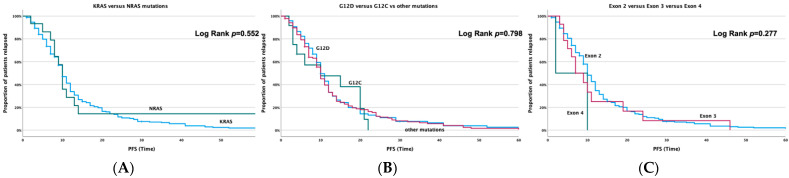
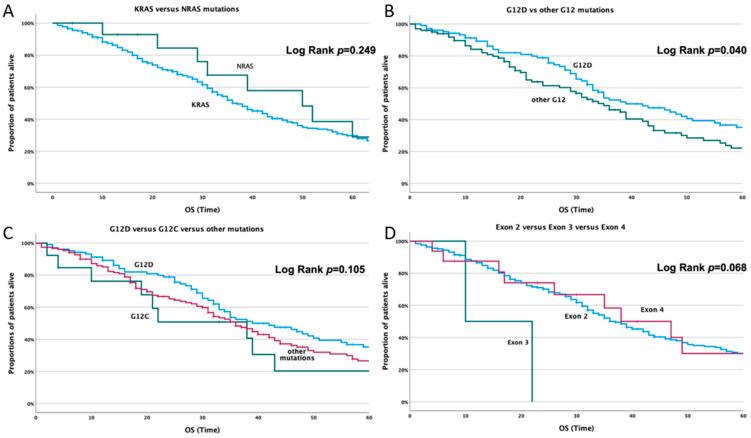
Colorectal cancer (CRC) remains a major public health issue. The detection of parameters that affect CRC prognosis is of great significance. KRAS mutations, play a crucial role in tumorigenesis with a strong predictive value. KRAS-mutated stage-IV CRC patients gain no benefit of the anti-EGFR therapy. The KRAS G12C mutation subtype is under investigation for treatment regimens. The present study aimed to detect various RAS mutations in a cohort of 578 RAS-mutated CRC patients; 49% of them had de novo metastatic disease; 60% were male; 71.4% had left-sided tumors; and 94.6% had a good performance status. KRAS mutations were detected in 93.2% of patients, with KRAS G12D being the most common subtype (30.1%). KRAS mutations presented shorter progression-free (PFS) and overall survival (OS), compared with NRAS mutations, although not significantly (PFS: 13.8 vs. 18.5 months; p = 0.552; OS: 53.1 vs. 60.9 months; p = 0.249). KRAS G12D mutations presented better OS rates (p = 0.04). KRAS G12C mutation, even though not significantly, presented worse PFS and OS rates. KRAS exon 3 and 4 mutations presented different PFS and OS rates, although these were not significant. Concluding, KRAS G12D and G12C mutations lead to better and worst prognosis, respectively. Further studies are warranted to validate such findings and their possible therapeutic implication.
Overview
The claims and statistics of this paper haven’t been checked yet.
Free: it reads the open-access text and checks the first 5 claims that cite a source we can check. Create a free account to check every claim.
Integrity signals
Registry
Cites
Statistics
Figures
Verification
Claims the paper makes
The claims and statistics of this paper haven’t been checked yet.
Free: it reads the open-access text and checks the first 5 claims that cite a source we can check. Create a free account to check every claim.
Claims other papers make about this one
Each is checked against this paper’s own text: does it say what the citing paper says it does?
The check wasn’t confident either way, so it gives no verdict — never disputed.
In the citing paper
“KRAS G12C mutations occur in 3% to 4% of colorectal cancer cases and are associated with poor prognosis (1, 2).”
From Efficacy and Safety of Adagrasib plus Cetuximab in Patients with KRAS G12C-Mutated Metastatic Colorectal Cancer (2024) · cites this paper as [2]
Experimental — accuracy not yet measuredIn the citing paper
“KRAS G12C mutations occur in 3% to 4% of colorectal cancer cases and are associated with poor prognosis (1, 2).”
From Efficacy and Safety of Adagrasib plus Cetuximab in Patients with KRAS G12C-Mutated Metastatic Colorectal Cancer (2024) · cites this paper as [2]
Self-check
Percentages, sums and reported differences re-computed from the paper’s own numbers.
The self-check needs the paper’s full text.
Citations
Cites
Comprehensive molecular characterization of human colon and rectal cancer
The Cancer Genome Atlas Network (2012) · Nature · doi:10.1038/nature11252 · Cited by 8,499
Vogelstein, B., Papadopoulos, N., Velculescu, V. E., Zhou, S., Diaz, L. A., & Kinzler, K. W. (2013) · Science · doi:10.1126/science.1235122 · Cited by 7,863 · cited 2×
“On the ay to the transfor ation fro anor al colon epithelial cells to cancer cells, KRAS utations occur, leading to the transfor ation fro a small to a large adenoma [14].”
BackgroundDe Roock, W., Claes, B., Bernasconi, D., De Schutter, J., Biesmans, B., Fountzilas, G., Kalogeras, K. T., Kotoula, V., Papamichael, D., Laurent-Puig, P., et al. (2010) · The Lancet Oncology · doi:10.1016/s1470-2045(10)70130-3 · Cited by 2,144 · cited 1×
“KRAS mutations are detected in about 40% of CRC patients (stage II-IV) [17] and their role as negative predictive factors for the use of anti-EGFR therapy has been proven [18].”
BackgroundCo-occurring genomic alterations in non-small-cell lung cancer biology and therapy
Skoulidis, F., & Heymach, J. V. (2019) · Nature Reviews Cancer · doi:10.1038/s41568-019-0179-8 · Cited by 1,019 · cited 1×
“Studies in non-small cell lung cancer have shown distinct biologic behavior and prognosis in KRAS/LKB1-, KRAS/TP53- or KRAS/p16-mutated tumors [28].”
BackgroundThe Chromosomal Instability Pathway in Colon Cancer
Pino, M. S., & Chung, D. C. (2010) · Gastroenterology · doi:10.1053/j.gastro.2009.12.065 · Cited by 932 · cited 2×
“Kirsten rat sarcoma viral oncogene homolog (KRAS) mutation follows, leading to larger adenomas [3,4].”
BackgroundKirsten ras mutations in patients with colorectal cancer: the ‘RASCAL II’ study
Andreyev, H. J. N., Norman, A. R., Cunningham, D., Oates, J., Dix, B. R., Iacopetta, B. J., Young, J., Walsh, T., Ward, R., Hawkins, N., et al. (2001) · British Journal of Cancer · doi:10.1054/bjoc.2001.1964 · Cited by 872 · cited 2×
“KRAS mutations are detected in about 40% of CRC patients (stage II-IV) [17] and their role as negative predictive factors for the use of anti-EGFR therapy has been proven [18].”
BackgroundKRAS-IRF2 axis drives immune suppression and immune therapy resistance in colorectal cancer
Liao, W., Overman, M. J., Boutin, A. T., Shang, X., Zhao, D., Dey, P., Li, J., Wang, G., Lan, Z., Li, J., et al. (2019) · Cancer Cell · doi:10.1016/j.ccell.2019.02.008 · Cited by 617 · cited 1×
“KRAS G12C mutation is the first mutation that has been targeted therapeutically, whereas KRAS G12D mutation seems to be an inhibitory factor for an effective immune response to the tumor [27].”
BackgroundSepulveda, A. R., Hamilton, S. R., Allegra, C. J., Grody, W., Cushman-Vokoun, A. M., Funkhouser, W. K., Kopetz, S. E., Lieu, C., Lindor, N. M., Minsky, B. D., et al. (2017) · Journal of Clinical Oncology · doi:10.1200/jco.2016.71.9807 · Cited by 360 · cited 1×
“Identifying RAS mutation status is necessary for all stage IV CRC patients, because only those with RAS wild-type status benefit from antiEGFR treatment, according to the 2017 ASCO/AMP/CAP guidelines [7].”
MethodSouglakos, J., Philips, J., Wang, R., Marwah, S., Silver, M., Tzardi, M., Silver, J., Ogino, S., Hooshmand, S., Kwak, E., et al. (2009) · British Journal of Cancer · doi:10.1038/sj.bjc.6605164 · Cited by 310 · cited 1×
“The DNA extraction method used has been previously described [10].”
MethodSelf-citationColorectal cancer carcinogenesis: a review of mechanisms
Tariq, K., Tariq, K., Ghias, K., & Ghias, K. (2016) · Cancer Biology & Medicine · doi:10.20892/j.issn.2095-3941.2015.0103 · Cited by 304
Cited by
Trifluridine–tipiracil and bevacizumab in refractory metastatic colorectal cancer
Prager, G. W., Taieb, J., Fakih, M., Ciardiello, F., Van Cutsem, E., Elez, E., Cruz, F. M., Wyrwicz, L., Stroyakovskiy, D., Pápai, Z., et al. (2023) · New England Journal of Medicine · doi:10.1056/nejmoa2214963 · Cited by 467
Yaeger, R., Uboha, N. V., Pelster, M. S., Bekaii-Saab, T. S., Barve, M., Saltzman, J., Sabari, J. K., Peguero, J. A., Paulson, A. S., Jänne, P. A., et al. (2024) · Cancer Discovery · doi:10.1158/2159-8290.cd-24-0217 · Cited by 139
“KRAS G12C mutations occur in 3% to 4% of colorectal cancer cases and are associated with poor prognosis (1, 2).”
BackgroundUnveiling the role of KRAS in tumor immune microenvironment
Xu, M., Zhao, X., Wen, T., & Qu, X. (2024) · Biomedicine & Pharmacotherapy · doi:10.1016/j.biopha.2023.116058 · Cited by 102
Gharib, E., & Robichaud, G. A. (2024) · International Journal of Molecular Sciences · doi:10.3390/ijms25179463 · Cited by 65
Targeting KRAS in Colorectal Cancer: A Bench to Bedside Review
Bteich, F., Mohammadi, M., Li, T., Bhat, M. A., Sofianidi, A. A., Wei, N., & Kuang, C. (2023) · International Journal of Molecular Sciences · doi:10.3390/ijms241512030 · Cited by 36
“While KRAS G12C was the first isoform to be directly targeted in CRC, G12D constitutes the most common type of KRAS mutation in CRC, affecting approximately one third of KRAS-mutated CRC patients (Figure 1) [142].”
BackgroundUtility of Stool-Based Tests for Colorectal Cancer Detection: A Comprehensive Review
Gómez-Molina, R., Suárez, M., Martínez, R., Chilet, M., Bauçà, J. M., & Mateo, J. (2024) · Healthcare · doi:10.3390/healthcare12161645 · Cited by 36
“For example, KRAS mutation is found in 30–40% of CRC tumors [63,64], so it makes fecal DNA test a promising tool for screening and early detection of this disease [19].”
Circular RNAs in the KRAS pathway: Emerging players in cancer progression
Hussain, M. S., Moglad, E. H. O., Afzal, M., Bansal, P., Kaur, H., Deorari, M., Ali, H., Shahwan, M. J., Almalki, W. H., Kazmi, I. A., et al. (2024) · Pathology - Research and Practice · doi:10.1016/j.prp.2024.155259 · Cited by 24
Connecting the dots: LncRNAs in the KRAS pathway and cancer
Maqbool, M., Hussain, M. S., Bisht, A. S., Kumari, A., Kamran, A., Sultana, A., Kumar, R., Khan, Y., & Gupta, G. (2024) · Pathology - Research and Practice · doi:10.1016/j.prp.2024.155570 · Cited by 19
Heidrich, I., Rautmann, C., Ly, C., Khatri, R., Kött, J., Geidel, G., Rünger, A., Andreas, A., Hansen, I., Abeck, F., et al. (2025) · Journal of Experimental & Clinical Cancer Research · doi:10.1186/s13046-025-03457-w · Cited by 21
“While KRAS mutations are less frequent in melanoma compared to colorectal or pancreatic cancers, their impact on progression and therapy resistance is increasingly recognized [15].”
An updated overview of K-RAS G12C inhibitors in advanced stage non-small cell lung cancer
Tenekeci, A. K., Unal, A. A., Ceylan, F., & Sendur, M. A. N. (2024) · Future Oncology · doi:10.1080/14796694.2024.2407280 · Cited by 19
Liu, J., Zhang, J., Lv, Y., & Su, X. (2023) · Sensors and Actuators B Chemical · doi:10.1016/j.snb.2023.134693 · Cited by 15
Caughey, B. A., & Strickler, J. H. (2023) · Drugs · doi:10.1007/s40265-023-01980-8 · Cited by 18
“Of these, KRAS G12C may confer a relatively worse prognosis in metastatic CRC compared with other KRAS variants [25], while KRAS G12D may be associated with a relatively favorable prognosis [23].”
Potency and Safety of KRAS G12C Inhibitors in Solid Tumors: A Systematic Review
Zaitouni, S. E., Laraqui, A., Boustany, Y., Benmokhtar, S., Annaz, H. E., Abi, R., Tagajdid, M. R., Kochri, S. E., Bouaiti, E. A., Amine, I. L., et al. (2025) · Clinical Medicine Insights Oncology · doi:10.1177/11795549251331759 · Cited by 14
“Adagrasib was tested in 213 patients with NSCLC 33,34,46 which demonstrated a slightly more consistent ORR of 42.9% to 45%, median follow-up was ranged between 12.9 and 19.6 months, DCR was 79.5%, DOR was about 8.5 to 16.4 months, PFS ranged from 6.5 to 11.1 months, and OS was 12.6 months to 23.4 months, suggesting th…”
InfluentialMessaritakis, I., Koulouridi, A., Boukla, E., Sfakianaki, M., Vogiatzoglou, K., Karagianni, M., Gouvas, N., Tsiaoussis, J., Xynos, E., Athanasakis, E., et al. (2022) · Cancers · doi:10.3390/cancers14184407 · Cited by 12
Self-citationKyrochristou, I. D., Lianos, G. D., Kyrochristou, G. D., Anagnostopoulos, G. C., Bali, C. D., Boussios, S., Mitsis, M. C., Schizas, D., & Vlachos, K. (2025) · Biomedicines · doi:10.3390/biomedicines13082038 · Cited by 21
“Moreover, they were associated with poorer OS and PFS, with the median PFS being re-ported around 28 months (95% CI, 22.206–33.794 months) for KRAS wild-type patients, while for patients with KRAS mutations, the PFS is reported about 19 months (95% CI, 15.678–22.322 months) [47–50].”
InfluentialAssessment of KRASG12C inhibitors for colorectal cancer
Piazza, G. A., Chandrasekaran, P., Maxuitenko, Y. Y., & Budhwani, K. I. (2024) · Frontiers in Oncology · doi:10.3389/fonc.2024.1412435 · Cited by 11
Colorectal adenosquamous carcinoma: genomic profiling of a rare histotype of colorectal cancer
Angerilli, V., Parente, P., Businello, G., Vanoli, A., Paudice, M., Perrone, G., Munari, G., Govoni, I., Neri, G., Rebellato, E., et al. (2023) · Archiv für Pathologische Anatomie und Physiologie und für Klinische Medicin · doi:10.1007/s00428-023-03517-6 · Cited by 9
“While some studies showed no prognostic role of KRAS mutations, others demonstrated an association with shorter diseasefree survival (DSF) and overall survival (OS) and with liver metastases [12].”
ResultMultilevel Heterogeneity of Colorectal Cancer Liver Metastasis
Chen, H., Zhai, C., Xu, X., Wang, H., Han, W., & Shen, J. (2023) · Cancers · doi:10.3390/cancers16010059 · Cited by 10
Alsolme, E., Alqahtani, S. A., Fagih, M., Barakeh, D. H., Sharma, N. K., Mangul, S., Robinson, H. A., Fathaddin, A., Hauser, C. A. E., & Abedalthagafi, M. (2023) · Diagnostics · doi:10.3390/diagnostics13182993 · Cited by 8
“G12D mutations appear to lead to better overall survival (OS) rates than other KRAS mutations such as KRAS-G12C among CRC patients [44].”
BackgroundAgüera-Sánchez, A., Ros, E. P., Martínez‐Martínez, I., & García-Molina, F. (2026) · Journal of Personalized Medicine · doi:10.3390/jpm16010048 · Cited by 11
“%) were significantly correlated with better overall survival ( p = 0.04) compared to other G12 mutations [93].”
InfluentialManirakiza, F., Rutaganda, E., Yamada, H., Iwashita, Y., Rugwizangoga, B., Seminega, B., Dusabejambo, V., Ntakirutimana, G., Ruhangaza, D., Uwineza, A., et al. (2023) · Current Issues in Molecular Biology · doi:10.3390/cimb45050277 · Cited by 10
“In other studies, either Gly12Asp [73,74] or Gly12Val [71,75] were the most common KRAS mutations.”
BackgroundResultInfluentialKLK10 promotes the progression of KRAS mutant colorectal cancer via PAR1‐PDK1‐AKT signaling pathway
Wu, K., Wu, B., Yan, K., Ding, Q., & Miao, Z. (2023) · Cell Biology International · doi:10.1002/cbin.12113 · Cited by 7
“However, up to now, the only Food and Drug Administration ‐ approved KRAS inhibitor, sotorasib, is used for treating lung cancers with KRAS ‐ G12C mutation, while the dominant KRAS mutations in CRC are G12D, G12V, and G13D (Koulouridi et al., 2022).”
BackgroundInfluentialDifferential Response and Resistance to KRAS-Targeted Therapy
Liu, Z., Lenz, H., Yu, J., & Zhang, L. (2025) · Molecular Carcinogenesis · doi:10.1002/mc.23908 · Cited by 7
“[10 – 12], and are associated with a worse prognosis [13 – 15].”
Basso, M., Signorelli, C., Calegari, M. A., Lucchetti, J., Zurlo, I. V., Dell’Aquila, E., Arrivi, G., Zoratto, F., Santamaria, F., Saltarelli, R., et al. (2024) · Targeted Oncology · doi:10.1007/s11523-024-01050-3 · Cited by 6
“The percentage of patients with no RAS mutation (WT) is 46.3% and is in line with literature data [21] and with patients treated in the first-line.”
InfluentialClevenger, A. J., Collier, C. A., Gorley, J. P. M., Colijn, S., McFarlin, M. K., Solberg, S. C., Kopetz, S., Stratman, A. N., & Raghavan, S. A. (2024) · Molecular Cancer Research · doi:10.1158/1541-7786.mcr-24-0624 · Cited by 10
Prognostic gene expression profile of colorectal cancer
Saadh, M. J., Allela, O. Q. B., Kareem, R. A., Baldaniya, L., Ballal, S., Vashishth, R., Parmar, M., Sameer, H. N., Hamad, A. K., Athab, Z. H., et al. (2025) · Gene · doi:10.1016/j.gene.2025.149433 · Cited by 6
Österlund, E., Ristimaki, A. P., Nunes, L., Kytölä, S. I., Aho, S., Heervä, E., Uutela, A., Lehtomäki, K., Stedt, H., Halonen, P., et al. (2025) · BJC Reports · doi:10.1038/s44276-025-00188-5 · Cited by 5
“KRAS mt are found in 32 – 50% of metastatic colorectal cancer (mCRC) patients (Table S1) [4 – 15] and in 36% – 48% in mixed CRC cohorts (Table S2) [16 – 20].”
The Evolving Role of Genomics in Colorectal Cancer
Berner, A., & Murugaesu, N. (2024) · Clinical Oncology · doi:10.1016/j.clon.2024.10.033 · Cited by 6
“Variants in KRAS carry differing prognoses [17], and more recently, the presence of speci fi c variants have begun to in fl uence therapy.”
Ochman, B., Kot, A., Mielcarska, S., Kula, A., Dawidowicz, M., Koszewska, D., Hudy, D., Szrot, M., Piecuch, J., Waniczek, D., et al. (2024) · Current Issues in Molecular Biology · doi:10.3390/cimb46120814 · Cited by 6
Evolution of structure-guided drug design strategies targeting mutations in codon 12 of KRAS
Dorandish, S., Bhayekar, K., Singh, A., Kushwaha, N. D., Malin, E., Serafimovski, S., Kelm, J. M., Gavande, N. S., & Lakkaniga, N. R. (2025) · RSC Medicinal Chemistry · doi:10.1039/d5md00169b · Cited by 7
Rossetti, M., Stanca, S., Frate, R. D., Bartoli, F., Marciano, A., Esposito, E., Fantoni, A., Erba, A. P., Lippolis, P. V., & Faviana, P. (2023) · Diagnostics · doi:10.3390/diagnostics13203199 · Cited by 5
“This dynamic relationship between cancer and FAP has substantial diagnostic and therapeutic implications.”
BackgroundIntegrated Decision-Making in the Treatment of Colon-Rectal Cancer: The Case of KRAS-Mutated Tumors
Cherri, S., Melocchi, L., Gandolfi, L., Rossi, G., & Zaniboni, A. (2023) · Life · doi:10.3390/life13020395 · Cited by 5
Structure–activity relationships of KRAS-G12D inhibitors for pancreatic cancer
Suyal, C., Mangala, S. S., Kishore, A., & Kini, S. G. (2025) · Drug Discovery Today · doi:10.1016/j.drudis.2025.104396 · Cited by 7
Ochman, B., Kot, A., Mielcarska, S., Kula, A., Dawidowicz, M., Hudy, D., Szrot, M., Piecuch, J., Waniczek, D., Czuba, Z. P., et al. (2025) · International Journal of Molecular Sciences · doi:10.3390/ijms26146735 · Cited by 5
“KRAS mutations are most frequently localized to exon 2, particularly at codons 12 and 13, while alterations in exons 3 and 4 are considerably less common [69,70].”
Lin, C., Shen, M., Chen, W. T., & Yang, C. (2023) · Journal of Personalized Medicine · doi:10.3390/jpm13071051 · Cited by 4
“In terms of the prognostic value of KRAS mutation in colorectal cancer, the results from previous studies are also heterogeneous, suggesting that different mutation variants of KRAS confer distinct prognoses on the overall survival of colorectal cancer patients [6,7].”
ResultMaki, H., Ayabe, R. I., Haddad, A., Nishioka, Y., Newhook, T. E., Cao, H. S. T., Chun, Y. S., Tzeng, C.-W. D., & Vauthey, J. (2025) · Annals of Surgical Oncology · doi:10.1245/s10434-024-16822-4 · Cited by 4
“4,8,9 10–17 An initial evaluation of 165 patients from Memorial Sloan Kettering Cancer Center suggested that exon 3 mutations are associated with reduced disease-specific survival, whereas exon 4 mutations are associated with more favorable outcomes.”
Erlotinib Treatment in Colorectal Cancer Suppresses Autophagy Based on KRAS Mutation
Siegman, A., Shaykevich, A., Chae, D., Silverman, I., Goel, S., & Maitra, R. (2024) · Current Issues in Molecular Biology · doi:10.3390/cimb46070447 · Cited by 7
“This is consistent with reports demonstrating that the KRAS mutation modulates an important signaling pathway, increasing viability in CRC [36].”
ResultMoretto, R., Rossini, D., Murgioni, S., Ciracì, P., Nasca, V., Germani, M. M., Calegari, M. A., Vetere, G., Intini, R., Taravella, A., et al. (2024) · JCO Precision Oncology · doi:10.1200/po.24.00329 · Cited by 5
“27,28 Moreover, as expected, no difference in the ef fi cacy of triplet/bev versus doublets/bev was observed according to KRASG12D mutational status.”
Jiang, Y., Jenjob, R., Ryu, D., Shen, Z., & Yang, S. (2025) · Acta Pharmaceutica Sinica B · doi:10.1016/j.apsb.2025.06.024 · Cited by 2
“However, the prognostic value of KRAS mutations, particularly in metastatic CRC, remains controversial 49 .”
Fathima, N., Verma, K., Subramanyam, P. V., Mukherjee, N., Tanwar, N., Jayaraman, S., Rangan, S., Mahanti, S., Saha, P., Javle, V., et al. (2024) · Cancer Research Statistics and Treatment · doi:10.4103/crst.crst_30_24 · Cited by 2
Zuo, X., Long, W., Lin, K., & Jia, G. (2025) · Frontiers in Immunology · doi:10.3389/fimmu.2025.1583327 · Cited by 2
“In the face of CRC, the main dilemma in the current treatment fi eld is how to improve the effectiveness of treatment, reduce side effects, and achieve personalized medicine (5).”
Association of G12D mutation in the KRAS gene with HPV and EBV in gastrointestinal cancer tissues
Hamidi, V., Shiadeh, A. E., Tabarraei, A., Nikoo, H. R., Sadeghi, F., Kamrani, G., Yahyapour, Y., & Moradi, A. (2024) · Journal of International Medical Research · doi:10.1177/03000605241302302 · Cited by 2
Parente, P., Angerilli, V., Grillo, F., Ambrosio, M. R., Petrelli, F., Gasparello, J., Antoci, F., Pilozzi, E., Scarpino, S., Adotti, F., et al. (2025) · Cancers · doi:10.3390/cancers17172721 · Cited by 1
“First of all, we confirmed an overall KRAS mutation frequency of approximately 47%, in line with data reported in the Literature [7], and association with the male sex, recto-sigmoidal localization, low-grade, higher pT stage, and MMRp/MSS profile [24].”
InfluentialDevanahally, S., & Dubey, S. (2026) · Cancer Pathogenesis and Therapy · doi:10.1016/j.cpt.2026.02.001 · Cited by 2
The impact of K-Ras Gly12 mutants on homeostasis and tumorigenesis in the colonic epithelium
Yang, M. H., Sheth, S., Shui, B., Grabski, I. N., Park, S. S., Galán‐Cobo, A., Irizarry, R. A., Heymach, J. V., Dow, L. E., & Haigis, K. M. (2026) · Oncogene · doi:10.1038/s41388-026-03771-3 · Cited by 1
Zhang, X., Ma, H., He, Y., He, W., Chen, N., Li, Y., Zhong, W., Wu, G. S., Zhou, X., Hua, H., et al. (2024) · Therapeutic Advances in Medical Oncology · doi:10.1177/17588359231225035 · Cited by 2
Genetic Profiling and Survival Outcomes in Romanian Colorectal Cancer Patients
Vesa, A., Maghiar, O. A., Pop, O. L., Boros, M., Paşcalău, A. V., Molnar, O., & Maghiar, A. M. (2024) · Cureus · doi:10.7759/cureus.62390 · Cited by 1
“Numerous studies have underscored the unfavorable prognosis of CRC patients harboring KRAS mutations [5].”
BackgroundOchman, B., Limanówka, P., Mielcarska, S., Kula, A., Dawidowicz, M., Wagner, W., Hudy, D., Szrot, M., Piecuch, J., Piecuch, J., et al. (2024) · Current Issues in Molecular Biology · doi:10.3390/cimb46090609 · Cited by 3
“Mutations in exons 3 and 4 are less frequently encountered [34,35].”
BackgroundSrivastav, J., Lehman, M. E., Evans, J. K., Paluri, R. K., & Lima, C. M. S. P. R. (2025) · Frontiers in Oncology · doi:10.3389/fonc.2025.1621412 · Cited by 1
Kumar, R., Fatima, Z., Kumar, P., Kumar, P., Chauhan, B. S., & Srikris, S. (2024) · Research Square · doi:10.21203/rs.3.rs-3826385/v1 · Cited by 2
Cancer cell metabolism and colorectal cancer survival: a role for Warburg-subtypes?
Offermans, K. (2023) · Research Publications (Maastricht University) · doi:10.26481/dis.20230413ko
Akdur, P. Ö., Çiledağ, N., SAVRAN, B., & Duran, A. O. (2023) · Journal of Health Sciences and Medicine · doi:10.32322/jhsm.1341618
Is the transverse colon the new right?—similarities in EGFR drug response and prognosis
Cameselle‐García, S., & Montés, A. F. (2024) · Journal of Gastrointestinal Oncology · doi:10.21037/jgo-24-272
KRAS, APC, and TP53 mutations define opposing immune archetypes in stage III colorectal cancerPreprint
Chaiboonchoe, A., Tanjak, P., Suwatthanarak, T., Thanormjit, K., Acharayothin, O., Vorasan, N., Sakamula, R., Likhityungyuen, T., Suktitipat, B., Korphaisarn, K., et al. (2025) · Research Square · doi:10.21203/rs.3.rs-7903094/v1
KRAS ‐ G12C : The neglected biomarker to detect patients with MUTYH ‐associated polyposis
Medeiros, A. B. D., dos Santos, G. O., da Rocha, J. C. C., Aguiar, S., Silva, V. S. E., Berardinelli, G. N., Antoniazzi, A. P., Reis, R. M., Carraro, D. M., & Torrezan, G. T. (2025) · International Journal of Cancer · doi:10.1002/ijc.70281
“26,27 In our cohort, 46.1% While KRAS somatic analysis is routinely performed in CRC using targeted NGS panels or comprehensive genomic profiles due to its prognostic and predictive relevance for KRAS-G12C targeted therapies, 28,29 the use of KRAS-G12C as a MAP biomarker remains neglected.”
InfluentialJazieh, K., Tsai, J., Solomon, S. R., Zhu, M., Pedersen, K. S., Fernández-Zapico, M. E., & Xie, H. (2025) · Targeted Oncology · doi:10.1007/s11523-025-01191-z
DNA methylation biomarkers in colorectal cancer
Jafari, M., Addoum, B., Chaoui, I., Benbacer, L., Baba, W., Oukabli, M., Ali, A. A., Njoumi, N., Bouchantouf, S. M., Bounaim, A., et al. (2025) · Elsevier eBooks · doi:10.1016/b978-0-443-30225-1.00046-4
Frisch, A., Martin, E., Cannon, T. L., Wadlow, R. C., Raghavan, S., Sen, T., & Karim, N. A. (2026) · Current Oncology · doi:10.3390/curroncol33030148
“[51].”
Üveges, E., Gaál, A., Szakács, G., Bakos, É., Streli, C., Kregsamer, P., Baranyi, M., Hegedűs, B., & Szoboszlai, N. (2026) · Biological Trace Element Research · doi:10.1007/s12011-026-05171-w
Liu, C., & Wang, Y. (2026) · International Journal of Surgical Pathology · doi:10.1177/10668969261457880
Yang, R., Zhang, W., Lan, J., Li, W., Hong, Z., Chi, J., Peng, J., Li, C., & Wu, X. (2026) · Frontiers in Surgery · doi:10.3389/fsurg.2026.1853947
Nasrytdinov, T. S., Kaidarova, D., Israilova, V., Khaidarov, S., Nurgaliyeva, B., Izmailova, S., Rapilbekova, G., Рабандияров, М. Р., Абдыгалык, Б. А., Aidarov, A., et al. (2026) · Genes · doi:10.3390/genes17080907
Smagulova, K. K., Khaidarov, S., Kaidarova, D., Макимбетов, Э. К., & Turkpenova, I. (2026) · Evrazijskij žurnal zdravoohraneniâ. · doi:10.54890/1694-8882-2026-2-133
Metadata
- Authors
- Koulouridi, A., Karagianni, M., Messaritakis, I., Sfakianaki, M., Voutsina, A., Trypaki, M., Bachlitzanaki, M., Koustas, E., Karamouzis, M. V., Ntavatzikos, A., Koumarianou, A., Androulakis, N., Mavroudis, D., Tzardi, M., & Souglakos, J.
- Affiliations
- University of Crete (GR)
- The General Hospital of Heraklion "Venizeleio-Pananio" (GR)
- National and Kapodistrian University of Athens (GR)
- Laboratory of Translational Oncology, Medical School, University of Crete, 70013 Heraklion, Greece
- Corresponding author
- Messaritakis, Ippokratis
- Souglakos, John
- ORCID
- Venue
- Cancers
- Publisher
- MDPI AG
- Published
- 2022-07-07
- Volume
- 14
- Issue
- 14
- Pages
- 3320
- ISSN
- 2072-6694 (ISSN-L)
- PMC
- PMC9313302
- OpenAlex
- W4284894231
- Cited by
- 63
- References
- 32
- Citations by year
- 2026: 9 · 2025: 18 · 2024: 21 · 2023: 14 · 2022: 1
- FWCI
- 5.65
- Type
- journal article
- Language
- en
- Open access
- gold
- doi.org
- Licence
- Locations
- Cancers (publishedVersion, cc-by)
- PubMed Central (publishedVersion, cc-by)
- PubMed (publishedVersion)
- DOAJ (DOAJ: Directory of Open Access Journals) (submittedVersion)
- Funders
- Gastrointestinal Research Study Group
- Topics
- Health Sciences › Medicine › Oncology › Colorectal Cancer Treatments and Studies
- Health Sciences › Medicine › Pathology and Forensic Medicine › Genetic factors in colorectal cancer
- Health Sciences › Medicine › Oncology › Colorectal Cancer Surgical Treatments
- Keywords
- KRAS mutation, colorectal cancer, prognostic value, KRAS G12D, KRAS G12C, NRAS mutation, progression-free survival, overall survival, metastatic colorectal cancer, anti-EGFR therapy
About these checks
Registry, retraction, Cites and statistics results are computed, not judged, with one exception: a printed reference that no index lists is read once by a model before it counts as a citation error. Claims are extracted by a model and kept only when their quote appears verbatim in the text; each cited source is then checked, with a model’s help, for whether it says what the claim relies on. Those verdicts can be wrong — read the claim’s quote and the cited source before relying on one.
Statistics and arithmetic are recomputed, not judged.
Confidence bands are shown only for fields calibrated on our annotated test set. None is calibrated yet, so no band is shown.
What counts as a claim ›How we measure confidence ›How we check this ›
Are you an author, or do you see a problem with this page? Request a review
Data sources
Bibliographic data: Semantic Scholar, OpenAlex, Crossref.
Contains information from the Semantic Scholar Academic Graph Datasets, made available under the ODC Attribution License (ODC-BY 1.0).
Semantic Scholar’s data is described in: Kinney, R., et al. (2023). The Semantic Scholar Open Data Platform. arXiv:2301.10140.
