

Prognostic Value of KRAS Mutations in Colorectal Cancer Patients
Open accessThe DOI matches its Crossref record; 31 of the 32 references it cites were found in a registry or an index.
Abstract
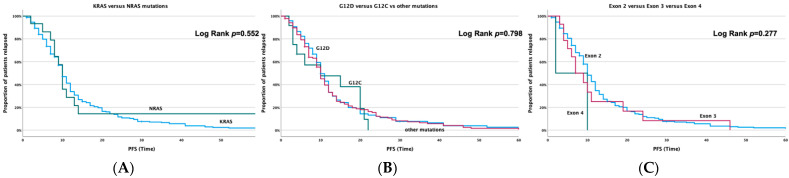
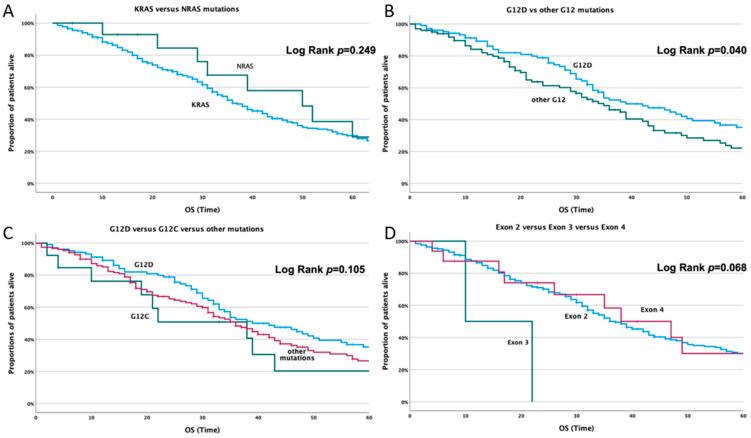
Colorectal cancer (CRC) remains a major public health issue. The detection of parameters that affect CRC prognosis is of great significance. KRAS mutations, play a crucial role in tumorigenesis with a strong predictive value. KRAS-mutated stage-IV CRC patients gain no benefit of the anti-EGFR therapy. The KRAS G12C mutation subtype is under investigation for treatment regimens. The present study aimed to detect various RAS mutations in a cohort of 578 RAS-mutated CRC patients; 49% of them had de novo metastatic disease; 60% were male; 71.4% had left-sided tumors; and 94.6% had a good performance status. KRAS mutations were detected in 93.2% of patients, with KRAS G12D being the most common subtype (30.1%). KRAS mutations presented shorter progression-free (PFS) and overall survival (OS), compared with NRAS mutations, although not significantly (PFS: 13.8 vs. 18.5 months; p = 0.552; OS: 53.1 vs. 60.9 months; p = 0.249). KRAS G12D mutations presented better OS rates (p = 0.04). KRAS G12C mutation, even though not significantly, presented worse PFS and OS rates. KRAS exon 3 and 4 mutations presented different PFS and OS rates, although these were not significant. Concluding, KRAS G12D and G12C mutations lead to better and worst prognosis, respectively. Further studies are warranted to validate such findings and their possible therapeutic implication.
Overview
The claims and statistics of this paper haven’t been checked yet.
Free: it reads the open-access text and checks the first 5 claims that cite a source we can check. Create a free account to check every claim.
Integrity signals
Registry
Cites
Statistics
Figures
Verification
Claims the paper makes
The claims and statistics of this paper haven’t been checked yet.
Free: it reads the open-access text and checks the first 5 claims that cite a source we can check. Create a free account to check every claim.
Claims other papers make about this one
Each is checked against this paper’s own text: does it say what the citing paper says it does?
The check wasn’t confident either way, so it gives no verdict — never disputed.
In the citing paper
“KRAS G12C mutations occur in 3% to 4% of colorectal cancer cases and are associated with poor prognosis (1, 2).”
From Efficacy and Safety of Adagrasib plus Cetuximab in Patients with KRAS G12C-Mutated Metastatic Colorectal Cancer (2024) · cites this paper as [2]
Experimental — accuracy not yet measuredIn the citing paper
“KRAS G12C mutations occur in 3% to 4% of colorectal cancer cases and are associated with poor prognosis (1, 2).”
From Efficacy and Safety of Adagrasib plus Cetuximab in Patients with KRAS G12C-Mutated Metastatic Colorectal Cancer (2024) · cites this paper as [2]
Self-check
Percentages, sums and reported differences re-computed from the paper’s own numbers.
The self-check needs the paper’s full text.
Citations
Cites
Comprehensive molecular characterization of human colon and rectal cancer
The Cancer Genome Atlas Network (2012) · Nature · doi:10.1038/nature11252 · Cited by 8,499
Vogelstein, B., Papadopoulos, N., Velculescu, V. E., Zhou, S., Diaz, L. A., & Kinzler, K. W. (2013) · Science · doi:10.1126/science.1235122 · Cited by 7,863 · cited 2×
“On the ay to the transfor ation fro anor al colon epithelial cells to cancer cells, KRAS utations occur, leading to the transfor ation fro a small to a large adenoma [14].”
BackgroundDe Roock, W., Claes, B., Bernasconi, D., De Schutter, J., Biesmans, B., Fountzilas, G., Kalogeras, K. T., Kotoula, V., Papamichael, D., Laurent-Puig, P., et al. (2010) · The Lancet Oncology · doi:10.1016/s1470-2045(10)70130-3 · Cited by 2,144 · cited 1×
“KRAS mutations are detected in about 40% of CRC patients (stage II-IV) [17] and their role as negative predictive factors for the use of anti-EGFR therapy has been proven [18].”
BackgroundCo-occurring genomic alterations in non-small-cell lung cancer biology and therapy
Skoulidis, F., & Heymach, J. V. (2019) · Nature Reviews Cancer · doi:10.1038/s41568-019-0179-8 · Cited by 1,019 · cited 1×
“Studies in non-small cell lung cancer have shown distinct biologic behavior and prognosis in KRAS/LKB1-, KRAS/TP53- or KRAS/p16-mutated tumors [28].”
BackgroundThe Chromosomal Instability Pathway in Colon Cancer
Pino, M. S., & Chung, D. C. (2010) · Gastroenterology · doi:10.1053/j.gastro.2009.12.065 · Cited by 932 · cited 2×
“Kirsten rat sarcoma viral oncogene homolog (KRAS) mutation follows, leading to larger adenomas [3,4].”
BackgroundKirsten ras mutations in patients with colorectal cancer: the ‘RASCAL II’ study
Andreyev, H. J. N., Norman, A. R., Cunningham, D., Oates, J., Dix, B. R., Iacopetta, B. J., Young, J., Walsh, T., Ward, R., Hawkins, N., et al. (2001) · British Journal of Cancer · doi:10.1054/bjoc.2001.1964 · Cited by 872 · cited 2×
“KRAS mutations are detected in about 40% of CRC patients (stage II-IV) [17] and their role as negative predictive factors for the use of anti-EGFR therapy has been proven [18].”
BackgroundKRAS-IRF2 axis drives immune suppression and immune therapy resistance in colorectal cancer
Liao, W., Overman, M. J., Boutin, A. T., Shang, X., Zhao, D., Dey, P., Li, J., Wang, G., Lan, Z., Li, J., et al. (2019) · Cancer Cell · doi:10.1016/j.ccell.2019.02.008 · Cited by 617 · cited 1×
“KRAS G12C mutation is the first mutation that has been targeted therapeutically, whereas KRAS G12D mutation seems to be an inhibitory factor for an effective immune response to the tumor [27].”
BackgroundSepulveda, A. R., Hamilton, S. R., Allegra, C. J., Grody, W., Cushman-Vokoun, A. M., Funkhouser, W. K., Kopetz, S. E., Lieu, C., Lindor, N. M., Minsky, B. D., et al. (2017) · Journal of Clinical Oncology · doi:10.1200/jco.2016.71.9807 · Cited by 360 · cited 1×
“Identifying RAS mutation status is necessary for all stage IV CRC patients, because only those with RAS wild-type status benefit from antiEGFR treatment, according to the 2017 ASCO/AMP/CAP guidelines [7].”
MethodSouglakos, J., Philips, J., Wang, R., Marwah, S., Silver, M., Tzardi, M., Silver, J., Ogino, S., Hooshmand, S., Kwak, E., et al. (2009) · British Journal of Cancer · doi:10.1038/sj.bjc.6605164 · Cited by 310 · cited 1×
“The DNA extraction method used has been previously described [10].”
MethodSelf-citationColorectal cancer carcinogenesis: a review of mechanisms
Tariq, K., Tariq, K., Ghias, K., & Ghias, K. (2016) · Cancer Biology & Medicine · doi:10.20892/j.issn.2095-3941.2015.0103 · Cited by 304
Cited by
Trifluridine–tipiracil and bevacizumab in refractory metastatic colorectal cancer
Prager, G. W., Taieb, J., Fakih, M., Ciardiello, F., Van Cutsem, E., Elez, E., Cruz, F. M., Wyrwicz, L., Stroyakovskiy, D., Pápai, Z., et al. (2023) · New England Journal of Medicine · doi:10.1056/nejmoa2214963 · Cited by 467
Yaeger, R., Uboha, N. V., Pelster, M. S., Bekaii-Saab, T. S., Barve, M., Saltzman, J., Sabari, J. K., Peguero, J. A., Paulson, A. S., Jänne, P. A., et al. (2024) · Cancer Discovery · doi:10.1158/2159-8290.cd-24-0217 · Cited by 139
“KRAS G12C mutations occur in 3% to 4% of colorectal cancer cases and are associated with poor prognosis (1, 2).”
BackgroundUnveiling the role of KRAS in tumor immune microenvironment
Xu, M., Zhao, X., Wen, T., & Qu, X. (2024) · Biomedicine & Pharmacotherapy · doi:10.1016/j.biopha.2023.116058 · Cited by 102
Gharib, E., & Robichaud, G. A. (2024) · International Journal of Molecular Sciences · doi:10.3390/ijms25179463 · Cited by 65
Targeting KRAS in Colorectal Cancer: A Bench to Bedside Review
Bteich, F., Mohammadi, M., Li, T., Bhat, M. A., Sofianidi, A. A., Wei, N., & Kuang, C. (2023) · International Journal of Molecular Sciences · doi:10.3390/ijms241512030 · Cited by 36
“While KRAS G12C was the first isoform to be directly targeted in CRC, G12D constitutes the most common type of KRAS mutation in CRC, affecting approximately one third of KRAS-mutated CRC patients (Figure 1) [142].”
Background
Metadata
- Authors
- Koulouridi, A., Karagianni, M., Messaritakis, I., Sfakianaki, M., Voutsina, A., Trypaki, M., Bachlitzanaki, M., Koustas, E., Karamouzis, M. V., Ntavatzikos, A., Koumarianou, A., Androulakis, N., Mavroudis, D., Tzardi, M., & Souglakos, J.
- Affiliations
- University of Crete (GR)
- The General Hospital of Heraklion "Venizeleio-Pananio" (GR)
- National and Kapodistrian University of Athens (GR)
- Laboratory of Translational Oncology, Medical School, University of Crete, 70013 Heraklion, Greece
- Corresponding author
- Messaritakis, Ippokratis
- Souglakos, John
- ORCID
- Venue
- Cancers
- Publisher
- MDPI AG
- Published
- 2022-07-07
- Volume
- 14
- Issue
- 14
- Pages
- 3320
- ISSN
- 2072-6694 (ISSN-L)
- PMC
- PMC9313302
- OpenAlex
- W4284894231
- Cited by
- 63
- References
- 32
- Citations by year
- 2026: 9 · 2025: 18 · 2024: 21 · 2023: 14 · 2022: 1
- FWCI
- 5.65
- Type
- journal article
- Language
- en
- Open access
- gold
- doi.org
- Licence
- Locations
- Cancers (publishedVersion, cc-by)
- PubMed Central (publishedVersion, cc-by)
- PubMed (publishedVersion)
- DOAJ (DOAJ: Directory of Open Access Journals) (submittedVersion)
- Funders
- Gastrointestinal Research Study Group
- Topics
- Health Sciences › Medicine › Oncology › Colorectal Cancer Treatments and Studies
- Health Sciences › Medicine › Pathology and Forensic Medicine › Genetic factors in colorectal cancer
- Health Sciences › Medicine › Oncology › Colorectal Cancer Surgical Treatments
- Keywords
- KRAS mutation, colorectal cancer, prognostic value, KRAS G12D, KRAS G12C, NRAS mutation, progression-free survival, overall survival, metastatic colorectal cancer, anti-EGFR therapy
About these checks
Registry, retraction, Cites and statistics results are computed, not judged, with one exception: a printed reference that no index lists is read once by a model before it counts as a citation error. Claims are extracted by a model and kept only when their quote appears verbatim in the text; each cited source is then checked, with a model’s help, for whether it says what the claim relies on. Those verdicts can be wrong — read the claim’s quote and the cited source before relying on one.
Statistics and arithmetic are recomputed, not judged.
Confidence bands are shown only for fields calibrated on our annotated test set. None is calibrated yet, so no band is shown.
What counts as a claim ›How we measure confidence ›How we check this ›
Are you an author, or do you see a problem with this page? Request a review
Data sources
Bibliographic data: Semantic Scholar, OpenAlex, Crossref.
Contains information from the Semantic Scholar Academic Graph Datasets, made available under the ODC Attribution License (ODC-BY 1.0).
Semantic Scholar’s data is described in: Kinney, R., et al. (2023). The Semantic Scholar Open Data Platform. arXiv:2301.10140.
