

The DOI matches its Crossref record; 19 of the 19 references it cites were found in a registry or an index.
Role of p53 in Cell Death and Human Cancers
Abstract
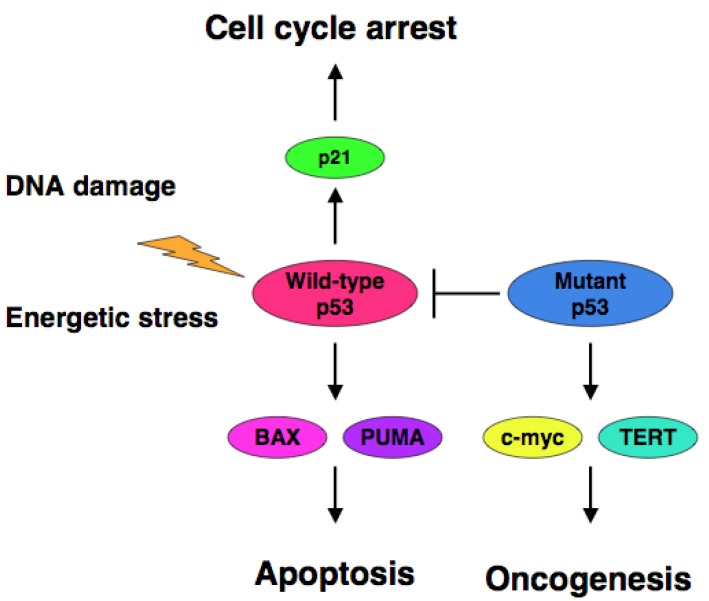
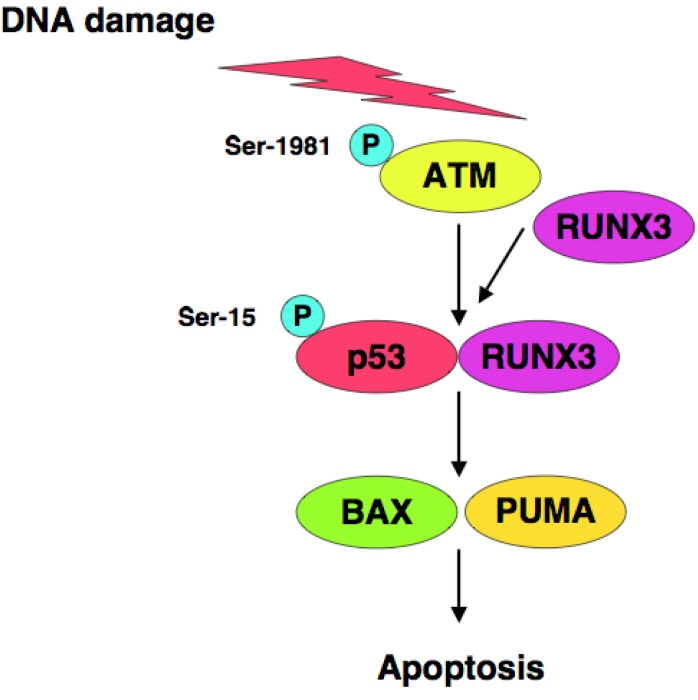
p53 is a nuclear transcription factor with a pro-apoptotic function. Since over 50% of human cancers carry loss of function mutations in p53 gene, p53 has been considered to be one of the classical type tumor suppressors. Mutant p53 acts as the dominant-negative inhibitor toward wild-type p53. Indeed, mutant p53 has an oncogenic potential. In some cases, malignant cancer cells bearing p53 mutations display a chemo-resistant phenotype. In response to a variety of cellular stresses such as DNA damage, p53 is induced to accumulate in cell nucleus to exert its pro-apoptotic function. Activated p53 promotes cell cycle arrest to allow DNA repair and/or apoptosis to prevent the propagation of cells with serious DNA damage through the transactivation of its target genes implicated in the induction of cell cycle arrest and/or apoptosis. Thus, the DNA-binding activity of p53 is tightly linked to its tumor suppressive function. In the present review article, we describe the regulatory mechanisms of p53 and also p53-mediated therapeutic strategies to cure malignant cancers.
Overview
The claims and statistics of this paper haven’t been checked yet.
Run the check — free, no account needed. It reads the open-access text and checks the sources it cites.
Integrity signals
Registry
Cites
Statistics
Figures
Verification
Claims the paper makes
The claims and statistics of this paper haven’t been checked yet.
Run the check — free, no account needed. It reads the open-access text and checks the sources it cites.
Claims other papers make about this one
Each is checked against this paper’s own text: does it say what the citing paper says it does?
The source backs part of the claim, not all of it — or backs it for a different population, condition or comparison.
In the citing paper
“Several studies have pointed out that release of cytochrome c in the cytosol requires an ROS-mediated destabilized mitochondrial membrane.72−75”
From Facile and Green Synthesis of Novel Fluorescent Carbon Quantum Dots and Their Silver Heterostructure: An In Vitro Anticancer Activity and Imaging on Colorectal Carcinoma (2023) · cites this paper as [73]
Experimental — accuracy not yet measured
Self-check
Percentages, sums and reported differences re-computed from the paper’s own numbers.
The self-check needs the paper’s full text.
Citations
Cites
Vogelstein, B., Lane, D., & Levine, A. J. (2000) · Nature · doi:10.1038/35042675 · Cited by 6,607
In Vivo Activation of the p53 Pathway by Small-Molecule Antagonists of MDM2
Vassilev, L. T., Vu, B. T., Graves, B., Carvajal, D., Podlaski, F., Filipovic, Z., Kong, N., Kammlott, U., Lukacs, C., Klein, C., et al. (2004) · Science · doi:10.1126/science.1092472 · Cited by 4,661
Mice deficient for p53 are developmentally normal but susceptible to spontaneous tumours
Donehower, L. A., Harvey, M., Slagle, B. L., McArthur, M. J., Montgomery, C. A., Butel, J. S., & Bradley, A. (1992) · Nature · doi:10.1038/356215a0 · Cited by 4,649
Mdm2 promotes the rapid degradation of p53
Haupt, Y., Maya, R., Kazaz, A., & Oren, M. (1997) · Nature · doi:10.1038/387296a0 · Cited by 4,506
Regulation of p53 stability by Mdm2
Kubbutat, M. H. G., Jones, S. N., & Vousden, K. H. (1997) · Nature · doi:10.1038/387299a0 · Cited by 3,312 · cited 3×
“RING-finger type E3 ubiquitin protein ligase MDM2 (murine double minute 2) largely catalyzes this process [6-8].”
BackgroundNoxa, a BH3-Only Member of the Bcl-2 Family and Candidate Mediator of p53-Induced Apoptosis
Oda, E., Ohki, R., Murasawa, H., Nemoto, J., Shibue, T., Yamashita, T., Tokino, T., Taniguchi, T., & Tanaka, †. N. (2000) · Science · doi:10.1126/science.288.5468.1053 · Cited by 2,112
Definition of a consensus binding site for p53
El-Deiry, W. S., Kern, S. E., Pietenpol, J. A., Kinzler, K. W., & Vogelstein, B. (1992) · Nature Genetics · doi:10.1038/ng0492-45 · Cited by 1,985
Oncoprotein MDM2 is a ubiquitin ligase E3 for tumor suppressor p53
Honda, R., Tanaka, H., & Yasuda, H. (1997) · FEBS Letters · doi:10.1016/s0014-5793(97)01480-4 · Cited by 1,951
DNA damage activates p53 through a phosphorylation–acetylation cascade
Sakaguchi, K., Herrera, J. E., Saito, S., Miki, T., Bustin, M., Vassilev, A., Anderson, C. W., & Appella, E. (1998) · Genes & Development · doi:10.1101/gad.12.18.2831 · Cited by 1,204
Restoration of the tumor suppressor function to mutant p53 by a low-molecular-weight compound
Bykov, V. J. N., Issaeva, N., Shilov, A., Hultcrantz, M., Pugacheva, E., Chumakov, P., Bergman, J., Wiman, K. G., & Selivanova, G. (2002) · Nature Medicine · doi:10.1038/nm0302-282 · Cited by 1,067
Research works printed but not linked: 115
- Elledge, 1996, Cell cycle checkpoints: Preventing an identity crisis, Science, 274, 1664, 10.1126/science.274.5293.1664 · DOI
- Sionov, 1999, The cellular response to p53: The decision between life and death, Oncogene, 18, 6145, 10.1038/sj.onc.1203130 · DOI
- Prives, 1999, The p53 pathway, J. Pathol., 187, 112, 10.1002/(SICI)1096-9896(199901)187:1<112::AID-PATH250>3.0.CO;2-3 · DOI
- Vousden, 2002, Live of let die: The cell's response to p53, Nat. Rev. Cancer, 2, 594, 10.1038/nrc864 · DOI
- Lacroix, 2006, p53 and breast cancer, an update, Endocr. Relat. Cancer, 13, 293, 10.1677/erc.1.01172 · DOI
- 2003, The role of p53 in chemosensitivity and radiosensitivity, Oncogene, 22, 7486, 10.1038/sj.onc.1206949 · DOI
- Baker, 1989, Chromosome 17 deletions and p53 gene mutations in colorectal carcinomas, Science, 244, 217, 10.1126/science.2649981 · DOI
- Nigro, 1989, Mutations in the p53 gene occur in diverse human tumour types, Nature, 342, 705, 10.1038/342705a0 · DOI
- Takahashi, 1989, p53: A frequent target for genetic abnormalities in lung cancer, Science, 246, 491, 10.1126/science.2554494 · DOI
- Kelman, 1989, Rearrangements in the p53 gene in Philadelphia chromosome positive chronic myelogenous leukemia, Blood, 74, 2318, 10.1182/blood.V74.7.2318.2318 · DOI
- Vogelstein, 1990, Cancer. A deadly inheritance, Nature, 348, 681, 10.1038/348681a0 · DOI
- Hollstein, 1990, Frequent mutation of the p53 gene in human esophageal cancer, Proc. Natl. Acad. Sci. USA, 87, 9958, 10.1073/pnas.87.24.9958 · DOI
- Hollstein, 1991, p53 mutations in human cancers, Science, 253, 49, 10.1126/science.1905840 · DOI · Paper page
- Vogan, 1993, Absence of p53 gene mutations in primary neuroblastomas, Cancer Res., 53, 5269
- Pietenpol, 1994, Sequence-specific transcriptional activation is essential for growth suppression by p53, Proc. Natl. Acad. Sci. USA, 91, 1998, 10.1073/pnas.91.6.1998 · DOI
- Herskowitz, 1987, Functional inactivation of genes by dominant negative mutations, Nature, 329, 219, 10.1038/329219a0 · DOI
- Crawford, 1984, The cellular protein p53 in human tumours, Mol. Biol. Med., 2, 261
- Cattoretti, 1986, P53 expression in breast cancer, Int. J. Cancer, 41, 178, 10.1002/ijc.2910410204 · DOI
- Chen, 1990, Genetic mechanisms of tumor suppression by the human p53 gene, Science, 250, 1576, 10.1126/science.2274789 · DOI
- Vogelstein, 1992, p53 function and dysfunction, Cell, 70, 523, 10.1016/0092-8674(92)90421-8 · DOI
- Velculescu, 1996, Biological and clinical importance of the p53 tumor suppressor gene, Clin. Chem., 42, 858, 10.1093/clinchem/42.6.858 · DOI
- Zhu, 1998, Identification of a novel p53 functional domain that is necessary for mediating apoptosis, J. Biol. Chem., 273, 13030, 10.1074/jbc.273.21.13030 · DOI
- Venot, 1999, Definition of a p53 transactivation function-deficient mutant and characterization of two independent p53 transactivation subdomains, Oncogene, 18, 2405, 10.1038/sj.onc.1202539 · DOI
- Fabbro, 2003, Regulation of tumor suppressors by nuclear-cytoplasmic shuttling, Exp. Cell. Res., 282, 59, 10.1016/S0014-4827(02)00019-8 · DOI
- Kim, 2000, Truncated form of importin alpha identified in breast cancer cell inhibits nuclear import of p53, J. Biol. Chem., 275, 23139, 10.1074/jbc.M909256199 · DOI
- Kau, 2003, A chemical genetic screen identifies inhibitors of regulated nuclear export of a Forkhead transcription factor in PTEN-deficient tumor cells, Cancer Cell, 4, 463, 10.1016/S1535-6108(03)00303-9 · DOI
- Stommel, 1999, A leucine-rich nuclear export signal in the p53 tetramerization domain: Regulation of subcellular localization and p53 activity by NES masking, EMBO J., 18, 1660, 10.1093/emboj/18.6.1660 · DOI · Paper page
- Brooks, 2007, Mechanistic studies of MDM2-mediated ubiquitination in p53 regulation, J. Biol. Chem., 282, 22804, 10.1074/jbc.M700961200 · DOI
- Walker, 1996, Identification of a novel p53 functional domain that is necessary for efficient growth suppression, Proc. Natl. Acad. Sci. USA, 93, 15335, 10.1073/pnas.93.26.15335 · DOI
- Baptiste, 2002, The proline-rich domain of p53 is required for cooperation with anti-neoplastic agents to promote apoptosis of tumor cells, Oncogene, 21, 9, 10.1038/sj.onc.1205015 · DOI
- Joerger, 2007, Structure-function-rescue: the diverse nature of common p53 cancer mutants, Oncogene, 26, 2226, 10.1038/sj.onc.1210291 · DOI
- Chin, 1992, Modulation of activity of the promoter of the human MDR1 gene by Ras and p53, Science, 255, 459, 10.1126/science.1346476 · DOI
- Cadwell, 2001, The effects of wild-type p53 tumor suppressor activity and mutant p53 gain-of-function on cell growth, Gene, 277, 15, 10.1016/S0378-1119(01)00696-5 · DOI
- Deb, 1992, Modulation of cellular and viral promoters by mutant human p53 proteins found in tumor cells, J. Virol., 66, 6164, 10.1128/jvi.66.10.6164-6170.1992 · DOI
- Dittmer, 1993, Gain of function mutations in p53, Nat. Genet., 4, 42, 10.1038/ng0593-42 · DOI · Paper page
- Subler, 1996, Transcriptional activation of the human epidermal growth factor receptor promoter by human p53, Mol. Cell. Biol., 16, 6009, 10.1128/MCB.16.11.6009 · DOI
- Frazier, 1998, Activation of c-myc gene expression by tumor-derived p53 mutants requires a discrete C-terminal domain, Mol. Cell. Biol., 18, 3735, 10.1128/MCB.18.7.3735 · DOI
- Lanyi, 1998, Gain of function' phenotype of tumor-derived mutant p53 requires the oligomerization/nonsequence-specific nucleic acid-binding domain, Oncogene, 16, 3169, 10.1038/sj.onc.1201857 · DOI
- Scian, 2004, Tumor-derived p53 mutants induce oncogenesis by transactivating growth-promoting genes, Oncogene, 23, 4430, 10.1038/sj.onc.1207553 · DOI
- Lomax, 1997, Two functional assays employed to detect an unusual mutation in the oligomerisation domain of p53 in a Li- Fraumeni like family, Oncogene, 14, 1869, 10.1038/sj.onc.1201133 · DOI
- Lomax, 1998, Characterization of p53 oligomerization domain mutations isolated from Li-Fraumeni and Li-Fraumeni like family members, Oncogene, 17, 643, 10.1038/sj.onc.1201974 · DOI
- DiGiammarino, 2002, A novel mechanism of tumorigenesis involving pH-dependent destabilization of a mutant p53 tetramer, Nat. Struct. Biol., 9, 12, 10.1038/nsb730 · DOI
- Nakamura, 2007, Functional characterization of a new p53 mutant generated by homozygous deletion in a neuroblastoma cell line, Biochem. Biophys. Res. Commun., 354, 892, 10.1016/j.bbrc.2007.01.057 · DOI
- Francke, 1987, Molecular analysis and chromosomal mapping of amplified genes isolated from a transformed mouse 3T3 cell line, Somat. Cell Mol. Genet., 13, 235, 10.1007/BF01535205 · DOI
- Fakharzadeh, 1991, Tumorigenic potential associated with enhanced expression of a gene that is amplified in a mouse tumor cell line, EMBO J., 10, 1565, 10.1002/j.1460-2075.1991.tb07676.x · DOI · Paper page
- Rodriguez, 2000, Multiple C-terminal lysine residues target p53 for ubiquitin-proteasome-mediated degradation, Mol. Cell. Biol., 20, 8458, 10.1128/MCB.20.22.8458-8467.2000 · DOI
- Lai, 2001, Human mdm2 mediates multiple mono- ubiquitination of p53 by a mechanism requiring enzyme isomerization, J. Biol. Chem., 276, 31357, 10.1074/jbc.M011517200 · DOI
- Maki, 1996, In vivo ubiquitination and proteasome-mediated degradation of p53(1), Cancer Res., 56, 2649
- Kulikov, 2010, Mdm2 facilitates the association of p53 with the proteasome, Proc. Natl. Acad. Sci. USA, 107, 10038, 10.1073/pnas.0911716107 · DOI · Paper page
- Grossman, 2003, Polyubiquitination of p53 by a ubiquitin ligase activity of p300, Science, 300, 342, 10.1126/science.1080386 · DOI
- Shi, 2009, CBP and p300 are cytoplasmic E4 polyubiquitin ligases for p53, Proc. Natl. Acad. Sci. USA, 106, 16275, 10.1073/pnas.0904305106 · DOI
- Leng, 2003, Pirh2, a p53-induced ubiquitin-protein ligase, promotes p53 degradation, Cell, 112, 779, 10.1016/S0092-8674(03)00193-4 · DOI
- Dornan, 2004, The ubiquitin ligase COP1 is a critical negative regulator of p53, Nature, 429, 86, 10.1038/nature02514 · DOI
- Dornan, 2004, COP1, the negative regulator of p53, is overexpressed in breast and ovarian adenocarcinomas, Cancer Res., 64, 7226, 10.1158/0008-5472.CAN-04-2601 · DOI
- Li, 2002, Deubiquitination of p53 by HAUSP is an important pathway for p53 stabilization, Nature, 416, 648, 10.1038/nature737 · DOI
- Moll, 1995, Wild-type p53 protein undergoes cytoplasmic sequestration in undifferentiated neuroblastomas but not in differentiated tumors, Proc. Natl. Acad. Sci. USA, 92, 4407, 10.1073/pnas.92.10.4407 · DOI
- Ostermeyer, 1996, Cytoplasmically sequestered wild- type p53 protein in neuroblastoma is relocated to the nucleus by a C-terminal peptide, Proc. Natl. Acad. Sci. USA, 93, 15190, 10.1073/pnas.93.26.15190 · DOI
- Yamamoto, 2007, Oxidative stress induces p53- dependent apoptosis in hepatoblastoma cell through its nuclear translocation, Genes Cells, 12, 461, 10.1111/j.1365-2443.2007.01065.x · DOI
- Becker, 2007, Hyperubiquitylation of wild-type p53 contributes to cytoplasmic sequestration in neuroblastoma, Cell Death. Differ., 14, 1350, 10.1038/sj.cdd.4402126 · DOI
- Nikolaev, 2003, Parc: A cytoplasmic anchor for p53, Cell, 112, 29, 10.1016/S0092-8674(02)01255-2 · DOI
- Mihara, 2003, p53 has a direct apoptogenic role at the mitochondria, Mol. Cell, 11, 577, 10.1016/S1097-2765(03)00050-9 · DOI
- Tokino, 1993, WAF1, a potential mediator of p53 tumor suppression, Cell, 75, 817, 10.1016/0092-8674(93)90500-P · DOI · Paper page
- Harper, 1993, The p21 Cdk-interacting protein Cip1 is a potent inhibitor of G1 cyclin-dependent kinases, Cell, 75, 805, 10.1016/0092-8674(93)90499-G · DOI · Paper page
- Xiong, 1993, p21 is a universal inhibitor of cyclin kinases, Nature, 366, 701, 10.1038/366701a0 · DOI
- Noda, 1994, Cloning of senescent cell-derived inhibitors of DNA synthesis using an expression screen, Exp. Cell Res., 211, 90, 10.1006/excr.1994.1063 · DOI · Paper page
- Hermeking, 1997, 14-3-3 sigma is a p53-regulated inhibitor of G2/M progression, Mol. Cell, 1, 3, 10.1016/S1097-2765(00)80002-7 · DOI · Paper page
- Yang, 2003, 14-3-3 sigma positively regulates p53 and suppresses tumor growth, Mol. Cell. Biol., 23, 7096, 10.1128/MCB.23.20.7096-7107.2003 · DOI
- Ohki, 2000, Reprimo, a new candidate mediator of the p53-mediated cell cycle arrest at the G2 phase, J. Biol. Chem., 275, 22627, 10.1074/jbc.C000235200 · DOI
- Tanaka, 2000, A ribonucleotide reductase gene involved in a p53-dependent cell-cycle checkpoint for DNA damage, Nature, 404, 42, 10.1038/35003506 · DOI · Paper page
- Barak, 1993, mdm2 expression is induced by wild type p53 activity, EMBO J., 12, 461, 10.1002/j.1460-2075.1993.tb05678.x · DOI · Paper page
- Selvakumaran, 1994, Immediate early up-regulation of bax expression by p53 but not TGF beta 1: A paradigm for distinct apoptotic pathways, Oncogene, 9, 1791
- Green, 2006, At the gates of death, Cancer Cell, 9, 328, 10.1016/j.ccr.2006.05.004 · DOI
- Oda, 2000, p53AIP1, a potential mediator of p53- dependent apoptosis, and its regulation by Ser-46-phosphorylated p53, Cell, 102, 849, 10.1016/S0092-8674(00)00073-8 · DOI
- Matsuda, 2002, p53AIP1 regulates the mitochondrial apoptotic pathway, Cancer Res., 62, 2883
- Seo, 2003, The molecular mechanism of Noxa-induced mitochondrial dysfunction in p53-mediated cell death, J. Biol. Chem., 278, 48292, 10.1074/jbc.M308785200 · DOI
- Yu, 2001, PUMA induces the rapid apoptosis of colorectal cancer cells, Mol. Cell, 7, 673, 10.1016/S1097-2765(01)00213-1 · DOI
- Nakano, 2001, PUMA, a novel proapoptotic gene, is induced by p53, Mol. Cell, 7, 683, 10.1016/S1097-2765(01)00214-3 · DOI · Paper page
- Jeffers, 2003, Puma is an essential mediator of p53-dependent and - independent apoptotic pathways, Cancer Cell, 4, 321, 10.1016/S1535-6108(03)00244-7 · DOI
- Piette, 1997, Mdm2: keeping p53 under control, Oncogene, 15, 1001, 10.1038/sj.onc.1201432 · DOI
- Haneda, 2004, Protein phosphatase 1, but not protein phosphatase 2A, dephosphorylates DNA-damaging stress-induced phospho-serine 15 of p53, FEBS Lett., 567, 171, 10.1016/j.febslet.2004.04.066 · DOI
- Li, 2007, A specific PP2A regulatory subunit, B56gamma, mediates DNA damage-induced dephosphorylation of p53 at Thr55, EMBO J., 26, 402, 10.1038/sj.emboj.7601519 · DOI
- Khanna, 1998, ATM associates with and phosphorylates p53: Mapping the region of interaction, Nat. Genet., 20, 398, 10.1038/3882 · DOI
- Goudelock, 2003, Regulatory interactions between the checkpoint kinase Chk1 and the proteins of the DNA-dependent protein kinase complex, J. Biol. Chem., 278, 29940, 10.1074/jbc.M301765200 · DOI
- Shieh, 1999, DNA damage-inducible phosphorylation of p53 at N-terminal sites including a novel site, Ser20, requires tetramerization, EMBO J., 18, 1815, 10.1093/emboj/18.7.1815 · DOI
- Craig, 2003, Allosteric effects mediate CHK2 phosphorylation of the p53 transactivation domain, EMBO Rep., 4, 787, 10.1038/sj.embor.embor901 · DOI
- Xie, 2001, Reactive oxygen species-induced phosphorylation of p53 on serine 20 is mediated in part by polo-like kinase-3, J. Biol. Chem., 276, 36194, 10.1074/jbc.M104157200 · DOI
- Cecchinelli, 2002, Homeodomain-interacting protein kinase-2 phosphorylates p53 at Ser 46 and mediates apoptosis, Nat. Cell Biol., 4, 11, 10.1038/ncb714 · DOI
- Yoshida, 2006, Protein kinase C delta regulates Ser46 phosphorylation of p53 tumor suppressor in the apoptotic response to DNA damage, J. Biol. Chem., 281, 5734, 10.1074/jbc.M512074200 · DOI
- Herrmann, 1991, Association of casein kinase II with immunopurified p53, Oncogene, 6, 877
- Delphin, 1997, The in vitro phosphorylation of p53 by calcium-dependent protein kinase C--characterization of a protein-kinase-C- binding site on p53, Eur. J. Biochem., 245, 684, 10.1111/j.1432-1033.1997.t01-1-00684.x · DOI
- Hupp, 1992, Regulation of the specific DNA binding function of p53, Cell, 71, 875, 10.1016/0092-8674(92)90562-Q · DOI
- Friend, 1994, p53: A glimpse at the puppet behind the shadow play, Science, 265, 334, 10.1126/science.8023155 · DOI
- Ando, 2004, Polo-like kinase 1 (Plk1) inhibits p53 function by physical interaction and phosphorylation, J. Biol. Chem., 279, 25549, 10.1074/jbc.M314182200 · DOI
- Shikama, 1999, A novel cofactor for p300 that regulates the p53 response, Mol. Cell, 4, 365, 10.1016/S1097-2765(00)80338-X · DOI
- Yuan, 1999, Role for p300 in stabilization of p53 in the response to DNA damage, J. Biol. Chem., 274, 1883, 10.1074/jbc.274.4.1883 · DOI
- Michishita, 2005, Evolutionarily conserved and nonconserved cellular localizations and functions of human SIRT proteins, Mol. Biol. Cell, 16, 4623, 10.1091/mbc.e05-01-0033 · DOI · Paper page
- Kawai, 2001, Dual role of p300 in the regulation of p53 stability, J. Biol. Chem., 276, 45928, 10.1074/jbc.M107770200 · DOI
- Ferguson, 2000, High frequency of hypermethylation at the 14-3-3 sigma locus leads to gene silencing in breast cancer, Proc. Natl. Acad. Sci. USA, 97, 6049, 10.1073/pnas.100566997 · DOI
- Suzuki, 2000, Inactivation of the 14-3-3 sigma gene is associated with 5′ CpG island hypermethylation in human cancers, Cancer Res., 60, 4353
- Iwata, 2000, Frequent hypermethylation of CpG islands and loss of expression of the 14-3-3 sigma gene in human hepatocellular carcinoma, Oncogene, 19, 5298, 10.1038/sj.onc.1203898 · DOI
- Iwabuchi, 1994, Two cellular proteins that bind to wild-type but not mutant p53, Proc. Natl. Acad. Sci. USA, 91, 6098, 10.1073/pnas.91.13.6098 · DOI
- Iwabuchi, 1998, Stimulation of p53-mediated transcriptional activation by the p53-binding proteins, 53BP1 and 53BP2, J. Biol. Chem., 273, 26061, 10.1074/jbc.273.40.26061 · DOI
- Rappold, 2001, Tumor suppressor p53 binding protein 1 (53BP1) is involved in DNA damage-signaling pathways, J. Cell Biol., 153, 613, 10.1083/jcb.153.3.613 · DOI
- Ozaki, 2000, NFBD1/KIAA0170 is a novel nuclear transcriptional transactivator with BRCT domain, DNA Cell Biol., 19, 475, 10.1089/10445490050128403 · DOI
- Lou, 2003, MDC1 is coupled to activated CHK2 in mammalian DNA damage response pathways, Nature, 421, 957, 10.1038/nature01447 · DOI
- Lou, 2006, MDC1 maintains genomic stability by participating in the amplification of ATM-dependent DNA damage signals, Mol. Cell, 21, 187, 10.1016/j.molcel.2005.11.025 · DOI
- Nakanishi, 2007, NFBD1/MDC1 associates with p53 and regulates its function at the crossroad between cell survival and death in response to DNA damage, J. Biol. Chem., 282, 22993, 10.1074/jbc.M611412200 · DOI
- Ito, 2008, RUNX genes in development and cancer: regulation of viral gene expression and the discovery of RUNX family genes, Adv. Cancer Res., 99, 33, 10.1016/S0065-230X(07)99002-8 · DOI · Paper page
- Li, 2002, Causal relationship between the loss of RUNX3 expression and gastric cancer, Cell, 109, 113, 10.1016/S0092-8674(02)00690-6 · DOI
- Yamada, 2010, RUNX3 modulates DNA damage- mediated phosphorylation of tumor suppressor p53 at Ser-15 and acts as a co-activator for p53, J. Biol. Chem., 285, 16693, 10.1074/jbc.M109.055525 · DOI
- Yin, 2002, p53 Stability and activity is regulated by Mdm2-mediated induction of alternative p53 translation products, Nat. Cell Biol., 4, 462, 10.1038/ncb801 · DOI
- Bourdon, 2007, p53 Family isoforms, Curr. Pharm. Biotechnol., 8, 332, 10.2174/138920107783018444 · DOI
- Fisher, 1994, Apoptosis in cancer therapy: crossing the threshold, Cell, 78, 539, 10.1016/0092-8674(94)90518-5 · DOI
- Azmi, 2011, MI-219-zinc combination: a new paradigm in MDM2 inhibitor-based therapy, Oncogene, 30, 117, 10.1038/onc.2010.403 · DOI
- Vitali, 2008, Activation of p53-dependent responses in tumor cells treated with a PARC-interacting peptide, Biochem. Biophys. Res. Commun., 368, 350, 10.1016/j.bbrc.2008.01.093 · DOI
Cited by
Sorted by citations
Samuel, S., Varghese, E., Kubatka, P., Triggle, C., & Büsselberg, D. (2019) · Biomolecules · doi:10.3390/biom9120846 · Cited by 81
Mishra, S., das, K., Chatterjee, S., Sahoo, P., Kundu, S., Pal, M., Bhaumik, A., & Ghosh, C. K. (2023) · ACS Omega · doi:10.1021/acsomega.2c04964 · Cited by 65
Hendrickson, P. G., Luo, Y., Kohlmann, W., Schiffman, J., Maese, L., Bishop, A. J., Lloyd, S., Kokeny, K. E., Hitchcock, Y. J., Poppe, M. M., et al. (2020) · Cancer Medicine · doi:10.1002/cam4.3427 · Cited by 64
Vodicka, P., Andera, L., Opattova, A., & Vodickova, L. (2021) · Cancers · doi:10.3390/cancers13030479 · Cited by 39
MDM2 inhibition in the treatment of glioblastoma: From concept to clinical investigation
Pellot Ortiz, K. I., Rechberger, J. S., Nonnenbroich, L. F., Daniels, D. J., & Sarkaria, J. N. (2023) · Biomedicines · doi:10.3390/biomedicines11071879 · Cited by 30
Metadata
- Authors
- Ozaki, T., & Nakagawara, A.
- Venue
- Cancers
- Publisher
- MDPI AG
- Published
- 2011-03-03
- Volume
- 3
- Issue
- 1
- Pages
- 994-1013
- ISSN
- 2072-6694
- PMC
- PMC3756401
- Cited by
- 650
- References
- 19
- Language
- en
About these checks
Registry, retraction, Cites and statistics results are computed, not judged, with one exception: a printed reference that no index lists is read once by a model before it counts as a citation error. Claims are extracted by a model and kept only when their quote appears verbatim in the text; each cited source is then checked, with a model’s help, for whether it says what the claim relies on. Those verdicts can be wrong — read the claim’s quote and the cited source before relying on one.
Statistics and arithmetic are recomputed, not judged.
Confidence bands are shown only for fields calibrated on our annotated test set. None is calibrated yet, so no band is shown.
What counts as a claim ›How we measure confidence ›How we check this ›
Are you an author, or do you see a problem with this page? Request a review
