

The DOI matches its Crossref record; 230 of the 233 references it cites were found in a registry or an index.
Selection of Nucleic Acid Aptamers Targeting Tumor Cell-Surface Protein Biomarkers
Open accessAbstract
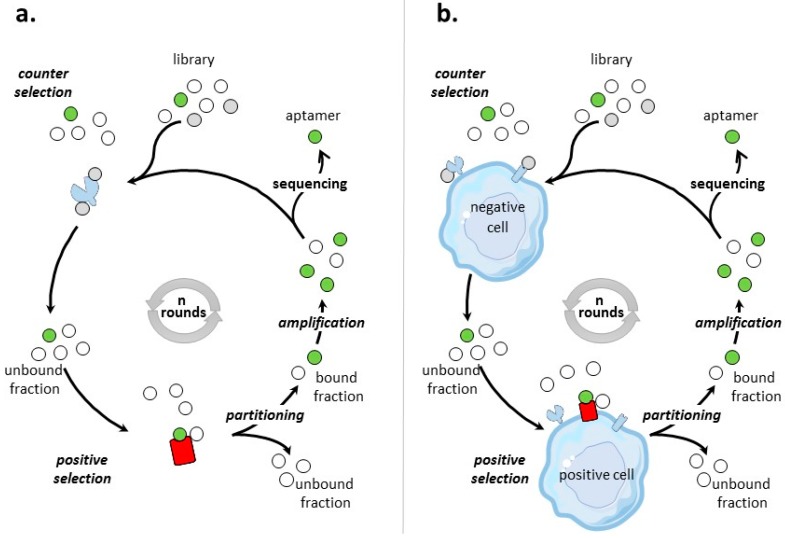
Aptamers are nucleic acids referred to as chemical antibodies as they bind to their specific targets with high affinity and selectivity. They are selected via an iterative process known as ‘selective evolution of ligands by exponential enrichment’ (SELEX). Aptamers have been developed against numerous cancer targets and among them, many tumor cell-membrane protein biomarkers. The identification of aptamers targeting cell-surface proteins has mainly been performed by two different strategies: protein- and cell-based SELEX, when the targets used for selection were proteins and cells, respectively. This review aims to update the literature on aptamers targeting tumor cell surface protein biomarkers, highlighting potentials, pitfalls of protein- and cell-based selection processes and applications of such selected molecules. Aptamers as promising agents for diagnosis and therapeutic approaches in oncology are documented, as well as aptamers in clinical development.
Overview
The claims and statistics of this paper haven’t been checked yet.
Run the check — free, no account needed. It reads the open-access text and checks the sources it cites.
Integrity signals
Registry
Cites
Statistics
Figures
Verification
Claims the paper makes
The claims and statistics of this paper haven’t been checked yet.
Run the check — free, no account needed. It reads the open-access text and checks the sources it cites.
Claims other papers make about this one
Each is checked against this paper’s own text: does it say what the citing paper says it does?
The source backs part of the claim, not all of it — or backs it for a different population, condition or comparison.
In the citing paper
“In addition, surface modification enables ligand, antibodies, or aptamer active targeting of specific cancer cell markers, which further improves selectivity [32].”
From Advances in green-synthesized magnetic nanoparticles for targeted cancer therapy: mechanisms, applications, and future perspectives (2026) · cites this paper as [32]
Experimental — accuracy not yet measuredIn the citing paper
“Nucleic acid aptamers are single-stranded oligonucleotides (ssDNA or ssRNA), which can be folded into a unique tertiary structure to identify its target.237”
From Smart nanoparticles for cancer therapy (2023) · cites this paper as [237]
Self-check
Percentages, sums and reported differences re-computed from the paper’s own numbers.
The self-check needs the paper’s full text.
Citations
Cites
Tuerk, C., & Gold, L. (1990) · Science · doi:10.1126/science.2200121 · Cited by 10,421
In vitro selection of RNA molecules that bind specific ligands
Ellington, A. D., & Szostak, J. W. (1990) · Nature · doi:10.1038/346818a0 · Cited by 9,845
Aptamers as targeted therapeutics: current potential and challenges
Zhou, J., & Rossi, J. J. (2016) · Nature Reviews Drug Discovery · doi:10.1038/nrd.2016.199 · Cited by 2,285
Ceccarelli, M., Barthel, F. P., Malta, T. M., Sabedot, T. S., Salama, S. R., Murray, B. A., Morozova, O., Newton, Y., Radenbaugh, A., Pagnotta, S. M., et al. (2016) · Cell · doi:10.1016/j.cell.2015.12.028 · Cited by 2,210
Aptamer-Based Multiplexed Proteomic Technology for Biomarker Discovery
Gold, L., Ayers, D., Bertino, J., Bock, C., Bock, A., Brody, E. N., Carter, J., Dalby, A. B., Eaton, B. E., Fitzwater, T., et al. (2010) · PLoS ONE · doi:10.1371/journal.pone.0015004 · Cited by 1,754
Targeted nanoparticle-aptamer bioconjugates for cancer chemotherapy in vivo
Farokhzad, O. C., Cheng, J., Teply, B. A., Sherifi, I., Jon, S., Kantoff, P. W., Richie, J. P., & Langer, R. (2006) · Proceedings of the National Academy of Sciences · doi:10.1073/pnas.0601755103 · Cited by 1,667
Aptamers evolved from live cells as effective molecular probes for cancer study
Shangguan, D., Li, Y., Tang, Z., Cao, Z. C., Chen, H. W., Mallikaratchy, P. R., Sefah, K., Yang, C. J., & Tan, W. (2006) · Proceedings of the National Academy of Sciences · doi:10.1073/pnas.0602615103 · Cited by 1,519
Emerging landscape of oncogenic signatures across human cancers
Ciriello, G., Miller, M. L., Aksoy, B. A., Şenbabaoğlu, Y., Schultz, N. D., & Sander, C. (2013) · Nature Genetics · doi:10.1038/ng.2762 · Cited by 1,401
Selection in vitro of an RNA enzyme that specifically cleaves single-stranded DNA
Robertson, D. L., & Joyce, G. F. (1990) · Nature · doi:10.1038/344467a0 · Cited by 1,331
Cell type–specific delivery of siRNAs with aptamer-siRNA chimeras
McNamara, J. O., Andrechek, E. R., Wang, Y., Viles, K. D., Rempel, R. E., Gilboa, E., Sullenger, B. A., & Giangrande, P. H. (2006) · Nature Biotechnology · doi:10.1038/nbt1223 · Cited by 1,020
Cited by
Sorted by citations
Smart nanoparticles for cancer therapy
Sun, L., Liu, H., Ye, Y., Lei, Y., Islam, R., Tan, S., Tong, R., Miao, Y.-B., & Cai, L. (2023) · Signal Transduction and Targeted Therapy · doi:10.1038/s41392-023-01642-x · Cited by 1,073
Aptamer-Based Detection of Circulating Targets for Precision Medicine
Wu, L., Wang, Y., Xu, X., Liu, Y., Lin, B., Zhang, M., Zhang, J., Wan, S., Yang, C. J., & Tan, W. (2021) · Chemical Reviews · doi:10.1021/acs.chemrev.0c01140 · Cited by 706
Recent Advances in Aptamer Discovery and Applications
Zhang, Y., Lai, B. S., & Juhas, M. (2019) · Molecules · doi:10.3390/molecules24050941 · Cited by 689
Wang, T., Chen, C., Larcher, L. M., Barrero, R. A., & Veedu, R. N. (2018) · Biotechnology Advances · doi:10.1016/j.biotechadv.2018.11.001 · Cited by 538
Perspective on the Future Role of Aptamers in Analytical Chemistry
Wu, Y., Belmonte, I., Sykes, K. S., Xiao, Y., & White, R. J. (2019) · Analytical Chemistry · doi:10.1021/acs.analchem.9b03853 · Cited by 173
Metadata
- Authors
- Mercier, M.-C., Dontenwill, M., & Choulier, L.
- Affiliations
- Centre National de la Recherche Scientifique (FR)
- Corresponding author
- Choulier, Laurence
- Venue
- Cancers
- Publisher
- MDPI AG
- Published
- 2017-06-21
- Volume
- 9
- Issue
- 6
- Pages
- 69
- ISSN
- 2072-6694 (ISSN-L)
- PMC
- PMC5483888
- OpenAlex
- W2721117256
- Cited by
- 113
- References
- 233
- Citations by year
- 2026: 7 · 2025: 8 · 2024: 8 · 2023: 17 · 2022: 7 · 2021: 11 · 2020: 15 · 2019: 15 · 2018: 20 · 2017: 5
- FWCI
- 1.41
- Type
- journal article
- Language
- en
- Open access
- gold
- doi.org
- Licence
- Locations
- Cancers (publishedVersion, cc-by)
- Europe PMC (PubMed Central) (publishedVersion, other-oa)
- PubMed Central (publishedVersion, cc-by)
- PubMed (publishedVersion)
- HAL (submittedVersion, other-oa)
- Funders
- Agence Nationale de la Recherche (ANR-10-SATT-0001)
- Topics
- Life Sciences › Biochemistry, Genetics and Molecular Biology › Molecular Biology › Advanced biosensing and bioanalysis techniques
- Life Sciences › Biochemistry, Genetics and Molecular Biology › Molecular Biology › RNA Interference and Gene Delivery
- Life Sciences › Biochemistry, Genetics and Molecular Biology › Molecular Biology › DNA and Nucleic Acid Chemistry
- Keywords
- aptamers, SELEX, cancer diagnosis, cancer therapeutics
About these checks
Registry, retraction, Cites and statistics results are computed, not judged, with one exception: a printed reference that no index lists is read once by a model before it counts as a citation error. Claims are extracted by a model and kept only when their quote appears verbatim in the text; each cited source is then checked, with a model’s help, for whether it says what the claim relies on. Those verdicts can be wrong — read the claim’s quote and the cited source before relying on one.
Statistics and arithmetic are recomputed, not judged.
Confidence bands are shown only for fields calibrated on our annotated test set. None is calibrated yet, so no band is shown.
What counts as a claim ›How we measure confidence ›How we check this ›
Are you an author, or do you see a problem with this page? Request a review
