

Metal-Supported Biochar Catalysts for Sustainable Biorefinery, Electrocatalysis, and Energy Storage Applications: A Review
Open accessThe DOI matches its Crossref record; 208 of the 209 references it cites were found in a registry or an index.
Abstract
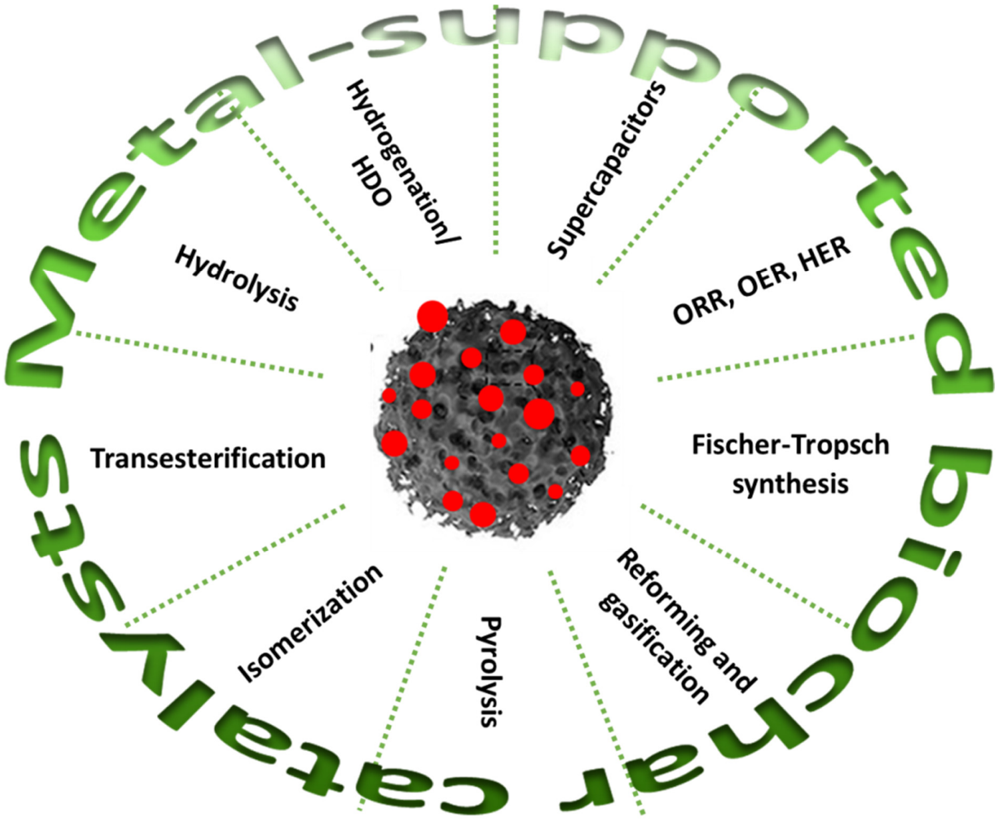
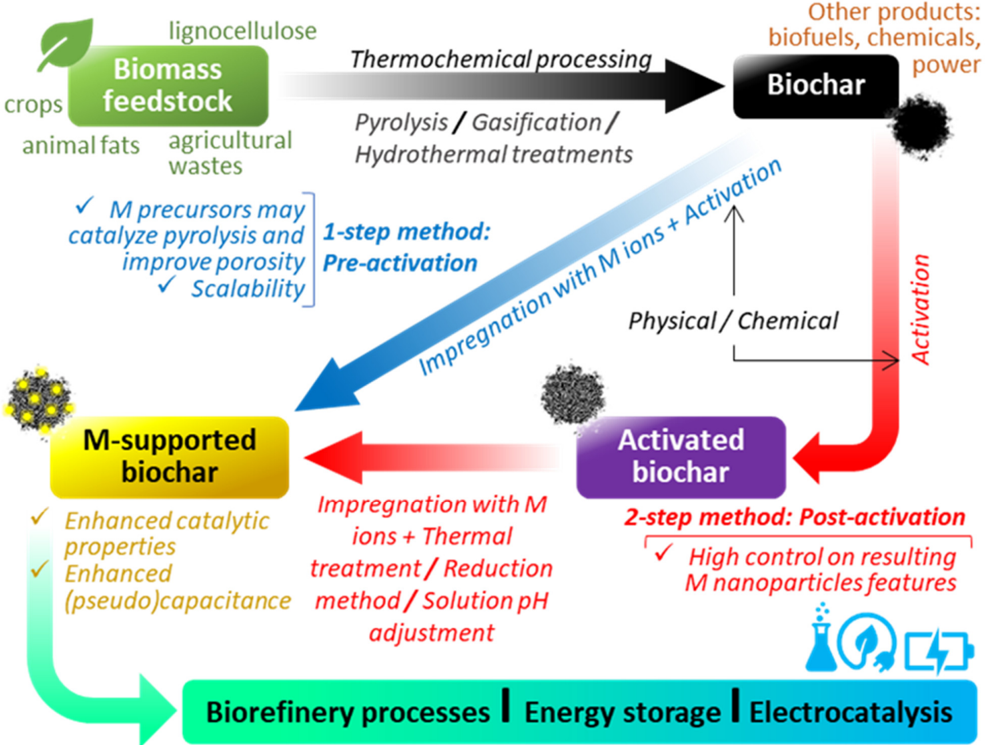
Biochar (BCH) is a carbon-based bio-material produced from thermochemical conversion of biomass. Several activation or functionalization methods are usually used to improve physicochemical and functional properties of BCHs. In the context of green and sustainable future development, activated and functionalized biochars with abundant surface functional groups and large surface area can act as effective catalysts or catalyst supports for chemical transformation of a range of bioproducts in biorefineries. Above the well-known BCH applications, their use as adsorbents to remove pollutants are the mostly discussed, although their potential as catalysts or catalyst supports for advanced (electro)catalytic processes has not been comprehensively explored. In this review, the production/activation/functionalization of metal-supported biochar (M-BCH) are scrutinized, giving special emphasis to the metal-functionalized biochar-based (electro)catalysts as promising catalysts for bioenergy and bioproducts production. Their performance in the fields of biorefinery processes, and energy storage and conversion as electrode materials for oxygen and hydrogen evolutions, oxygen reduction, and supercapacitors, are also reviewed and discussed.
Overview
The claims and statistics of this paper haven’t been checked yet.
Free: it reads the open-access text and checks the first 5 claims that cite a source we can check. Create a free account to check every claim.
Integrity signals
Registry
Cites
Statistics
Figures
Verification
Claims the paper makes
The claims and statistics of this paper haven’t been checked yet.
Free: it reads the open-access text and checks the first 5 claims that cite a source we can check. Create a free account to check every claim.
Claims other papers make about this one
Each is checked against this paper’s own text: does it say what the citing paper says it does?
The source backs part of the claim, not all of it — or backs it for a different population, condition or comparison.
In the citing paper
“High ash and high temperature biochars favor chemical catalysis due to the presence of alkali minerals as well as high conductivity (Ramos et al. 2022).”
From Role of biochar toward carbon neutrality (2023) · cites this paper as Ramos et al. 2022
Experimental — accuracy not yet measured
Self-check
Percentages, sums and reported differences re-computed from the paper’s own numbers.
The self-check needs the paper’s full text.
Citations
Cites
Application of biochar for the removal of pollutants from aqueous solutions
Tan, X., Liu, Y., Zeng, G., Wang, X., Hu, X., Gu, Y., & Yang, Z. (2015) · Chemosphere · doi:10.1016/j.chemosphere.2014.12.058 · Cited by 2,081
Non‐Noble Metal‐based Carbon Composites in Hydrogen Evolution Reaction: Fundamentals to Applications
Wang, J., Xu, F., Jin, H., Chen, Y., & Wang, Y. (2017) · Advanced Materials · doi:10.1002/adma.201605838 · Cited by 1,769
Development of biochar-based functional materials: toward a sustainable platform carbon material
Liu, W.-J., Jiang, H., & Yu, H.-Q. (2015) · Chemical Reviews · doi:10.1021/acs.chemrev.5b00195 · Cited by 1,754
Weber, K., & Quicker, P. (2018) · Fuel · doi:10.1016/j.fuel.2017.12.054 · Cited by 1,522
A mini review of NiFe-based materials as highly active oxygen evolution reaction electrocatalysts
Gong, M., & Dai, H. (2015) · Nano Research · doi:10.1007/s12274-014-0591-z · Cited by 1,440
Heterostructures for Electrochemical Hydrogen Evolution Reaction: A Review
Zhao, G., Rui, K., Dou, S. X., & Sun, W. (2018) · Advanced Functional Materials · doi:10.1002/adfm.201803291 · Cited by 1,422
Yang, H. B., Miao, J., Hung, S.-F., Chen, J., Tao, H. B., Wang, X., Zhang, L., Chen, R., Gao, J., Chen, H. M., et al. (2016) · Science Advances · doi:10.1126/sciadv.1501122 · Cited by 1,333
Production and utilization of biochar: A review
Cha, J. S., Park, S. H., Jung, S.-C., Ryu, C., Jeon, J.-K., Shin, M.-C., & Park, Y.-K. (2016) · Journal of Industrial and Engineering Chemistry · doi:10.1016/j.jiec.2016.06.002 · Cited by 1,293
Characterization of biochar from fast pyrolysis and gasification systems
Brewer, C. E., Schmidt‐Rohr, K., Satrio, J. A., & Brown, R. C. (2009) · Environmental Progress & Sustainable Energy · doi:10.1002/ep.10378 · Cited by 833
Environmental application of biochar: Current status and perspectives
Oliveira, F. R., Patel, A. K., Jaisi, D. P., Adhikari, S., Lu, H., & Khanal, S. K. (2017) · Bioresource Technology · doi:10.1016/j.biortech.2017.08.122 · Cited by 802
Research works printed but not linked: 4
- Liu, 2016, Facile and Sustainable Synthesis of Co3O4@ hollow-carbon-fiber for a binder-free supercapacitor electrode, Chem. Select, 1, 6469
- Lee, 2019, Bio-derived Co2P nanoparticles supported on nitrogen-doped carbon as promising oxygen reduction reaction electrocatalyst for anion exchange membrane fuel cells, Small, 15, 8
- Araujo, 2018, Co3O4 nanoparticles anchored on selectively oxidized graphene flakes as bifunctional electrocatalysts for oxygen reactions, Chem. Select, 3, 10064
- Lin, 2020, Ammonium nitrate-assisted low-temperature synthesis of Co, Co2P@CoP embedded in biomass-derived carbons as efficient electrocatalysts for hydrogen and oxygen evolution reaction, Chem. Select, 5, 7338
Cited by
Role of biochar toward carbon neutrality
Wang, L., Deng, J., Yang, X., Hou, R., & Hou, D. (2023) · Carbon Research · doi:10.1007/s44246-023-00035-7 · Cited by 195
Yameen, M. Z., Naqvi, S. R., Juchelková, D., & Khan, M. N. A. (2024) · Biochar · doi:10.1007/s42773-024-00316-3 · Cited by 186
Mustafa, F. S., & Aziz, K. H. H. (2022) · Process Safety and Environmental Protection · doi:10.1016/j.psep.2022.12.030 · Cited by 152
Metal–organic frameworks for next-generation energy storage devices; a systematic review
Sandhu, Z. A., Raza, M. A., Awwad, N. S., Ibrahium, H. A., Farwa, U., Ashraf, S., Dildar, A., Fatima, E., Ashraf, S., & Ali, F. H. M. (2024) · Materials Advances · doi:10.1039/d3ma00822c · Cited by 156
“54 The capacity of MOFs to preserve their initial long-range organized structure in a certain chemical environment is referred to as stability.”
BackgroundSantos, D. C. B. D., Evaristo, R. B. W., Dutra, R. C., Suarez, P. A. Z., Silveira, E. A., & Ghesti, G. F. (2025) · Sustainability · doi:10.3390/su17062685 · Cited by 108
Liu, L., Sun, P., Chen, Y., Li, X., & Zheng, X. (2023) · Chemosphere · doi:10.1016/j.chemosphere.2023.138796 · Cited by 75
Manickavasagam, G., He, C. H., Lin, K. A., Saaid, M., & Oh, W. (2024) · Environmental Research · doi:10.1016/j.envres.2024.118919 · Cited by 73
Recent experimental advances on the utilization of biochar as a tar reforming catalyst: A review
Frainetti, A. J., & Klinghoffer, N. B. (2022) · International Journal of Hydrogen Energy · doi:10.1016/j.ijhydene.2022.11.127 · Cited by 71
Advancements in modified biochar production techniques and soil application: a critical review
Fakhar, A. Z., Canatoy, R. C., Galgo, S. J. C., Rafique, M., & Sarfraz, R. (2025) · Fuel · doi:10.1016/j.fuel.2025.135745 · Cited by 69
Velusamy, K., Isabel, J. B., Periyasamy, S., Thiruvenkadam, A., Ravikumar, H., Gupta, S. K., & López‐Maldonado, E. A. (2024) · Journal of the Taiwan Institute of Chemical Engineers · doi:10.1016/j.jtice.2024.105732 · Cited by 74
Ye, P., Guo, B., Qin, H., Wang, C., Liu, Y., Chen, Y., Bian, P., Lü, D., Wang, L., Zhao, W., et al. (2025) · Biochar · doi:10.1007/s42773-024-00423-1 · Cited by 61
“Moreover, different activation methods enable the production of BC with various functionalized carbon and mineral structures (Ramos et al. 2022).”
Emerging trends in role and significance of biochar in gaseous biofuels production
Sirohi, R., Vivekanand, V., Pandey, A. K., Tarafdar, A., Awasthi, M. K., Shakya, A., Kim, S., Sim, S. J., Tuan, H. A., & Pandey, A. (2023) · Environmental Technology & Innovation · doi:10.1016/j.eti.2023.103100 · Cited by 49
Marques, I. S., Jarrais, B., Ramos, R., Abdelkader-Fernández, V. K., Yaremchenko, A. A., Freire, C., Fernandes, D. M., & Peixoto, A. F. (2023) · Catalysis Today · doi:10.1016/j.cattod.2023.114080 · Cited by 49
Self-citationHuang, P., Zhou, W., Jin, K., Wang, Y., Qian, J., Liu, L., Peng, H., Wu, J., Hu, J., Wang, M., et al. (2022) · ACS Sustainable Chemistry & Engineering · doi:10.1021/acssuschemeng.2c05804 · Cited by 50
Nanobiochar: Soil and plant interactions and their implications for sustainable agriculture
Brar, B., Saharan, B. S., Seth, C. S., Kamboj, A., Surekha, Bala, K., Rajput, V. D., Minkina, T., Wong, M. H., Kumar, D., et al. (2024) · Biocatalysis and Agricultural Biotechnology · doi:10.1016/j.bcab.2024.103077 · Cited by 46
Li, J., Wang, T., Hao, T., Yao, X., Xu, K., & Liu, J. (2025) · Energy · doi:10.1016/j.energy.2025.134734 · Cited by 43
Zhang, C., Li, H., Yang, X. H., Tan, X., Wan, C., & Liu, X. (2022) · Journal of Environmental Management · doi:10.1016/j.jenvman.2022.116445 · Cited by 42
Tyula, Y. A., Moradi, P., & Nikoorazm, M. (2023) · ChemistrySelect · doi:10.1002/slct.202301674 · Cited by 37
Metal biosorption onto non-living algae: a critical review on metal recovery from wastewater
Carreira, A. R. F., Passos, H., & Coutinho, J. A. P. (2023) · Green Chemistry · doi:10.1039/d3gc01993d · Cited by 39
Engineering biochar-supported nickel catalysts for efficient CO2 methanation
Frainetti, A. J., & Klinghoffer, N. B. (2024) · Biomass and Bioenergy · doi:10.1016/j.biombioe.2024.107179 · Cited by 35
Chen, W., Shi, X., Yu, P., Wang, Y., Li, J., Wang, Y., Gong, C., Dong, C., Gao, S., Xu, L., et al. (2025) · Fuel · doi:10.1016/j.fuel.2025.136372 · Cited by 32
Nganda, A., Srivastava, P., Lamba, B. Y., Pandey, A., & Kumar, M. (2023) · Environmental Research · doi:10.1016/j.envres.2023.116284 · Cited by 29
Khlifi, M. A., Hassan, W. H., Kadhum, A. A. H., Boujelbene, M., Almehizia, A. A., Diab, M. A., El‐Sabban, H. A., Atamurotov, F., & Abduvokhidov, A. (2025) · Journal of Water Process Engineering · doi:10.1016/j.jwpe.2025.107111 · Cited by 27
Evaluation of the algal-derived biochar as an anode modifier in microbial fuel cells
Kumar, A., Sharma, K., Pandit, S., Mathuriya, A. S., & Prasad, R. (2023) · Bioresource Technology Reports · doi:10.1016/j.biteb.2023.101414 · Cited by 33
Pstrowska, K., Łużny, R., Fałtynowicz, H., Jaroszewska, K., Postawa, K., Pyshyev, S., & Witek‐Krowiak, A. (2024) · Chemistry & Chemical Technology · doi:10.23939/chcht18.02.211 · Cited by 26
High performance metal-free N/S-doped biochars towards oxygen reduction reaction
Matos, R., Fernandes, A. J. S., Abdelkader-Fernández, V. K., Peixoto, A. F., & Fernandes, D. M. (2024) · Biomass and Bioenergy · doi:10.1016/j.biombioe.2024.107523 · Cited by 25
Self-citationZhang, Z., Cheng, Q., Shan, C., Jiang, Y., Kong, G., Zhang, G., Gopakumar, S. T., Shi, S., Zhang, X., & Han, L. (2024) · Journal of Analytical and Applied Pyrolysis · doi:10.1016/j.jaap.2024.106492 · Cited by 23
Progress on Separation and Hydrothermal Carbonization of Rice Husk Toward Environmental Applications
Abe, H., Nakayasu, Y., Haga, K., & Watanabe, M. (2023) · Global Challenges · doi:10.1002/gch2.202300112 · Cited by 23
Chutia, G. P., & Phukan, K. (2024) · Industrial Crops and Products · doi:10.1016/j.indcrop.2024.118578 · Cited by 22
Snoussi, Y., Sifaoui, I., Garah, M. E., Khalil, A. M., Piñero, J. E., Jouini, M., Ammar, S., Lorenzo‐Morales, J., & Chehimi, M. M. (2022) · Waste Management · doi:10.1016/j.wasman.2022.11.006 · Cited by 24
Jagadale, M., Sarangi, P. K., Jose, N., Ray, D. P., Jadhav, M., Shrivastava, P., Nagesh Kumar, T., Debnath, S., & Shakyawar, D. B. (2025) · Journal of the Taiwan Institute of Chemical Engineers · doi:10.1016/j.jtice.2025.106232 · Cited by 22
Zhao, X., Sun, J., Yao, W., Fang, Y., Xue, L., Yu, J., Hu, R., Sun, J., & Jiang, X. (2025) · International Journal of Biological Macromolecules · doi:10.1016/j.ijbiomac.2025.140840 · Cited by 21
Nambyaruveettil, S., Ali, L., Beg, M. B., Khaleel, A. A., & Altarawneh, M. (2025) · Materials Science and Engineering B · doi:10.1016/j.mseb.2025.118566 · Cited by 19
Sidorenko, A. Y., Kurban, Y. M., Peixoto, A. F., Ли-Жуланов, Н. С., Sánchez‐Velandia, J. E., Aho, A., Warna, J. P., Gu, Y., Volcho, K. P., Salakhutdinov, N. F., et al. (2022) · Applied Catalysis A General · doi:10.1016/j.apcata.2022.118967 · Cited by 18
Self-citationAwadakkam, S., Chaudhary, V., Borugadda, V. B., & Dalai, A. K. (2025) · Fuel · doi:10.1016/j.fuel.2025.135062 · Cited by 20
Javanmard, A., Zuki, F. M., Daud, W. M. A. W., & Patah, M. F. A. (2025) · Process Safety and Environmental Protection · doi:10.1016/j.psep.2025.107643 · Cited by 17
Functionalized biochar catalysts: Advancing green chemistry in synthesis of O- and N-heterocycles
Khan, N., Gupta, A., Ahamad, S., Hussain, M. K., Khan, M. U., & Siddiqui, Z. N. (2025) · Environmental Research · doi:10.1016/j.envres.2025.122136 · Cited by 17
Carbon Dioxide Methanation Enabled by Biochar-Nanocatalyst Composite Materials: A Mini-Review
Tang, M., Gamal, A., Bhakta, A. K., Jlassi, K., Abdullah, A. M., & Chehimi, M. M. (2024) · Catalysts · doi:10.3390/catal14020155 · Cited by 13
“Nanocatalyst-modified biochar has raised immense interest owing to its efficiency to catalyze organic synthesis [25], biofuel production [26], electrochemical processes and energy storage [27], and depollution, to name but a few applications [28].”
BackgroundMatos, R., Marques, I. S., Fernandes, A. J. S., Abdelkader-Fernández, V. K., Peixoto, A. F., & Fernandes, D. M. (2025) · International Journal of Hydrogen Energy · doi:10.1016/j.ijhydene.2025.05.167 · Cited by 13
Self-citationGiannakopoulos, S., Vakros, J., Dracopoulos, V., Manariotis, I. D., Mantzavinos, D., & Lianos, P. (2022) · Journal of Cleaner Production · doi:10.1016/j.jclepro.2022.134456 · Cited by 13
Novel Biogenic Synthesis of Pd/TiO@BC as an electrocatalytic and possible energy storage materials
Khasim, S., Dastager, S. G., Alahmdi, M. I., Hamdalla, T. A., Panneerselvam, C., & Makandar, M. B. (2023) · Ceramics International · doi:10.1016/j.ceramint.2023.01.182 · Cited by 14
Activated biochars as sustainable and effective supports for hydrogenations
Taghavi, S., Ghedini, E., Peurla, M., Cruciani, G., Menegazzo, F., Murzin, D. Y., & Signoretto, M. (2023) · Carbon Trends · doi:10.1016/j.cartre.2023.100316 · Cited by 13
Next generation biochar–hydrogel composite for contaminant sequestration
Chame, S., Mayilswamy, N., & Kandasubramanian, B. (2025) · Clean Technologies and Environmental Policy · doi:10.1007/s10098-025-03176-y · Cited by 13
“These manganese ferrite-doped biochar composites significantly enhance the elimination of heavy metal ions (Ramos et al. 2022).”
Veisi, H. H., Karimi, B., Heydari, M., & Luque, R. (2023) · Green Chemistry · doi:10.1039/d3gc01415k · Cited by 12
Organic and Metal–Organic Polymer-Based Catalysts—Enfant Terrible Companions or Good Assistants?
Králik, M., Koóš, P., Markovič, M., & Lopatka, P. (2024) · Molecules · doi:10.3390/molecules29194623 · Cited by 12
Biochar-Based Materials for Catalytic CO2 Valorization
Zomorodbakhsh, S., Dias, L. D., Calvete, M. J. F., Peixoto, A. F., Carrilho, R. M. B., & Pereira, M. M. (2025) · Catalysts · doi:10.3390/catal15060568 · Cited by 12
Self-citationMatos, R., Marques, I. S., Fernandes, A. J. S., Peixoto, A. F., & Fernandes, D. M. (2025) · Biomass and Bioenergy · doi:10.1016/j.biombioe.2025.108463 · Cited by 11
Self-citationThirumal, V., Yuvakkumar, R., Kumar, P. S., Rangasamy, G., Ravi, G., Isacfranklin, M., Velauthapillai, D., Thambidurai, M., & Nguyen, H. D. (2022) · Fuel · doi:10.1016/j.fuel.2022.125532 · Cited by 11
Yukhymchuk, A., Жукова, Д., Prybora, N., Stolyarchuk, N. V., Bondarchuk, O. B., Yankovych, H., & Melnyk, I. (2024) · ACS ES&T Water · doi:10.1021/acsestwater.4c00241 · Cited by 11
Naseem, K., Tahir, A., Khan, A. S., Qin, F., Usman, M., Karamat, S., & Al-Salihi, M. (2024) · Materials Today Communications · doi:10.1016/j.mtcomm.2024.108764 · Cited by 11
Verdida, R. A., Caparanga, A. R., & Chang, C.-T. (2023) · Catalysts · doi:10.3390/catal13020388 · Cited by 9
Nikolopoulos, I., Kordouli, E., Mourgkogiannis, N., Karapanagioti, H. K., Lycourghiotis, A., & Kordulis, C. (2023) · Catalysts · doi:10.3390/catal13061004 · Cited by 9
“Ramos (2022) and co-workers have presented an extensive review of the field [20].”
BackgroundCellulose-based carbon nanotubes array with lawn-like 3D architecture for oxygen reduction reaction
Tang, S., Yang, H. M., Yang, J., Zheng, X., Qiao, Y., Yang, G., Liang, Z., & Feng, Z. (2024) · The Science of The Total Environment · doi:10.1016/j.scitotenv.2024.169943 · Cited by 8
Frainetti, A. J., Cullen, J., & Klinghoffer, N. B. (2025) · Biomass and Bioenergy · doi:10.1016/j.biombioe.2025.108645 · Cited by 7
Cong, Q., Jia, R., Zhou, J., Li, L., & Gao, P. (2026) · Chemical Engineering Journal · doi:10.1016/j.cej.2026.173562 · Cited by 8
Zomorodbakhsh, S., Gonzalez, A. C. S., Cruz, I. G., Piccirillo, G., Maria, T. M. R., Marques, I. S., Peixoto, A. F., Gil, J. M., Ferreira, F., & Carrilho, R. M. B. (2024) · Advanced Sustainable Systems · doi:10.1002/adsu.202400431 · Cited by 7
Self-citationKapoor, R. T., Rafatullah, M., Tajarudin, H. A., Siddiqui, M. R., & Alam, M. (2023) · Sustainability · doi:10.3390/su152115266 · Cited by 8
Water–Energy–Carbon Nexus: Biochar-Based Catalysts via Waste Valorization for Sustainable Catalysis
Nabwey, H. A., & Tony, M. A. (2026) · Catalysts · doi:10.3390/catal16030267 · Cited by 6
“Metal-free heteroatom-doped biochars, as well as biochar-supported transition metal catalysts (e.g., Fe, Co, Ni), have demonstrated com-https petitive activity and superior durability compared to conventional carbon black supports, particularly under alkaline conditions [67,68].”
Pereira, C. R., Fernandes, D. M., Peixoto, A. F., Nunes, M., Jarrais, B., Kuźniarska‐Biernacka, I., & Freire, C. (2024) · Wiley eBooks · doi:10.1002/9781119870647.ch13 · Cited by 12
Self-citationLatif, S., & Khan, Z. U. H. (2024) · Engineering Science and Technology an International Journal · doi:10.1016/j.jestch.2024.101714 · Cited by 6
Zou, Z., Yan, C., Chen, N., Zou, Y., Yang, M., Cheng, H., & Ke, H. (2025) · ACS Sustainable Chemistry & Engineering · doi:10.1021/acssuschemeng.5c03056 · Cited by 5
Rabah, M., Ali, L., Raza, M., Inayat, A., & Altarawneh, M. (2026) · Energy & Fuels · doi:10.1021/acs.energyfuels.5c04985 · Cited by 6
Biochar for energy storage applications
Sobri, S., & Haris, N. I. N. (2024) · Elsevier eBooks · doi:10.1016/b978-0-443-15403-4.00008-3 · Cited by 6
Matos, R., Manuel, J. V., Fernandes, A. J. S., Abdelkader-Fernández, V. K., Peixoto, A. F., & Fernandes, D. M. (2024) · Catalysts · doi:10.3390/catal14120951 · Cited by 4
Self-citationAwogbemi, O., & Desai, D. A. (2025) · Engineering Reports · doi:10.1002/eng2.70440 · Cited by 4
Costa, J. M., & Forster‐Carneiro, T. (2026) · ACS Engineering Au · doi:10.1021/acsengineeringau.5c00107 · Cited by 4
Regeneration, recycling, and disposal of spent biochars
Mpeta, M., Wenga, T., Marondedze, A. K., & Sadondo, P. (2025) · Elsevier eBooks · doi:10.1016/b978-0-323-99889-5.00020-7 · Cited by 5
Ivantsov, M. I., Krysanova, K. O., Grabchak, A. A., & Kulikova, M. V. (2023) · Solid Fuel Chemistry · doi:10.3103/s0361521923060010 · Cited by 4
Biochar-Based Metallic Nanoparticle Catalysts and Their Applications
Al-Najar, B. T., El‐Qanni, A., Hasan, A. M., Pintea, S., Soran, L., & Bououdina, M. (2024) · Sustainable materials and technology · doi:10.1007/978-981-97-6544-7_6 · Cited by 4
Zhang, Q.-Y., Xu, G., Qi, H.-Y., Chen, X.-X., Wang, H., & Cui, X. (2025) · Separations · doi:10.3390/separations12090229 · Cited by 3
“Biochar, derived from the pyrolysis of agricultural residues or sewage sludge, has emerged as a promising alternative due to its multi-scale porosity, high specific surface area, and abundant oxygen-containing functional groups [20,21] .”
Le, N. L., Nguyen, T. N. T., Le, N. N. B., Nam, P. T., Kumar, S., & Cao, X. T. (2025) · New Journal of Chemistry · doi:10.1039/d4nj04066j · Cited by 3
Chestnut Waste-Derived Fe-Based Photocatalyst for Diclofenac Degradation
Guagliano, M., Bahamonde, A., Bellotto, M. P., Cristiani, C., Finocchio, E., Gascó, A., Muelas-Ramos, V., Jiménez-Bautista, K., Ríos, C. D. L., & Hermosilla, D. (2025) · C – Journal of Carbon Research · doi:10.3390/c11020038 · Cited by 3
“Accordingly, biochar, being the by-product of bio-energy production [17,18], is gaining a lot of attention.”
Green synthesis of CaO-modified sulfonated biochar via ball milling method
Pratiwi, S., Hauli, L., Mansur, D., Sisca, V., & Budiman, A. T. (2025) · Vacuum · doi:10.1016/j.vacuum.2025.114795 · Cited by 3
Rañoa, M. E. R., Villanueva, M. L., Laxamana, J. R. P., Necesito, H. G. G., & Tongol, B. J. V. (2024) · Advances in Natural Sciences Nanoscience and Nanotechnology · doi:10.1088/2043-6262/ad3de0 · Cited by 3
Macedo, J. C. A., Shirinkar, M., Landers, R., & Rosa, A. H. (2025) · Biomass · doi:10.3390/biomass5020029 · Cited by 3
Yadav, K., Rout, P. K., Srivastava, S., & Chanotiya, C. S. (2026) · Chemical Communications · doi:10.1039/d6cc00973e · Cited by 2
Xinmin, W., Shengming, Z., Wang, B., Gao, M., Yibo, P., Ruishen, Z., & Jiawei, L. (2026) · Journal of Analytical and Applied Pyrolysis · doi:10.1016/j.jaap.2026.107907 · Cited by 3
Emerging Trends, Opportunities and Bottlenecks in Metal-based Advanced Oxidation Processes
Aziz, K. H. H., & Mustafa, F. S. (2026) · Royal Society of Chemistry eBooks · doi:10.1039/9781837675937-00553 · Cited by 2
Sobekwa, A. G., Mojapelo, N. A., Visser, E. D., Seroka, N. S., & Khotseng, L. E. (2025) · ChemistryOpen · doi:10.1002/open.202500025 · Cited by 2
Biochar-Based Catalysts for Electrochemical Utilization
Singh, M., Taggar, S., Chauhan, M., Garg, P., Kumar, R., Kaur, G., & Chaudhary, G. R. (2024) · Sustainable materials and technology · doi:10.1007/978-981-97-6544-7_10 · Cited by 2
Yu, H., Lee, S. Y., Ahn, Y., Song, H., & Cho, D.-W. (2026) · Journal of environmental chemical engineering · doi:10.1016/j.jece.2026.123119 · Cited by 1
Ebrahim, M., Mahmoud, M., Ashour, F. H., Ibrahim, O. A. B., & Khashaba, N. H. (2026) · RSC Advances · doi:10.1039/d6ra05362a · Cited by 1
Biochar in Catalysis and Biotransformation
Sobha, K., Jayanthi, J. L., Kavitha, G., & Anantha, R. (2023) · Materials horizons · doi:10.1007/978-981-99-5239-7_2 · Cited by 1
Microstructural Engineering for Bioenergy Production
Başlayıcı, S., & Demirçivi, P. (2024) · Wiley eBooks · doi:10.1002/9781394204816.ch7 · Cited by 1
Steam Reforming of Isobutanol on Biochar-Supported Ni–Co Catalysts
Osipov, A. K., Kulikova, M. V., Kuz’min, A. E., Kulikov, A. B., Vladimirov, A. A., & Локтев, А. С. (2023) · Russian Journal of Applied Chemistry · doi:10.1134/s1070427223040134
Evaristo, R. B. W., Dutra, R. C., Suarez, P. A. Z., Ghesti, G. F., & Silveira, E. A. (2024) · Preprints.org · doi:10.20944/preprints202404.0916.v1
Steam Reforming of Isobutanol on Biochar-Supported Ni–Co Catalysts
Osipov, A. K., Kulikova, M. V., Kuz’min, A. E., Kulikov, A. B., Vladimirov, A. A., & Локтев, А. С. (2023) · Russian Journal of Applied Chemistry · doi:10.31857/s0044461823040138
Ivantsov, M. I., Krysanova, K. O., Grabchak, A. A., & Kulikova, M. V. (2023) · Химия твердого топлива · doi:10.31857/s0023117723060026
Sindhu, M., Singh, A., Kumar, Y. P., Vishwakarma, N., Wani, A. H., & Sharma, A. K. (2025) · Nanostructure science and technology · doi:10.1007/978-3-031-75247-6_8 · Cited by 2
Harnessing biochar for sustainable catalysis in environmental applications
Meili, L., Brandão, R. J., & GOMES, T. L. C. (2025) · Elsevier eBooks · doi:10.1016/b978-0-323-99889-5.00005-0
Ayeni, A. O., Alagbe, E. E., Elehinafe, F. B., & Agboola, O. (2025) · Elsevier eBooks · doi:10.1016/b978-0-443-29291-0.00012-0 · Cited by 1
Biorefinery Catalysts: Current Scenario and Future Developments
Neto, F. S., dos Santos, K. M., Salamba, M. Q., da Silva, J. L., Filho, J. R. D. M., Silva, L. D. C., & dos Santos, J. C. S. (2025) · Advances in sustainability science and technology · doi:10.1007/978-981-96-5198-6_9
Alwan, B. A. M. A., Alharbi, R. M., Ansari, K. B., Mesfer, M. K. A., Elkhaleefa, A. M., Shah, M., Danish, M., & Sahlabji, T. (2025) · Fuel · doi:10.1016/j.fuel.2025.137014
Smart chemistry of advance enzyme immobilization
dos Santos, J. C. S., & Kanjila, J. (2025) · Elsevier eBooks · doi:10.1016/b978-0-443-27475-6.00013-9
Iron-Based Catalysts Supported on Sporopollenin Exine Capsules for Green Heterogenous Catalysis
Malik, W. (2025) · Queen Mary Research Online (Queen Mary University of London) · Cited by 1
Unoka, E. C., Iyasele, J. U., Uwidia, I. E., Lobb, K., & Nnaji, N. J. N. (2026) · Journal of Molecular Graphics and Modelling · doi:10.1016/j.jmgm.2026.109358
Pyrolysis of waste for fuels and biochar production
Kawale, H. D. (2026) · Elsevier eBooks · doi:10.1016/b978-0-443-40600-3.00003-x
MacDonald, J. (2026) · cIRcle (University of British Columbia) · doi:10.14288/1.0452436
Metadata
- Authors
- Ramos, R., Abdelkader-Fernández, V. K., Matos, R., Peixoto, A. F., & Fernandes, D. M.
- Affiliations
- Universidade do Porto (PT)
- Corresponding author
- Peixoto, Andreia F.
- Fernandes, Diana M.
- Venue
- Catalysts
- Publisher
- MDPI AG
- Published
- 2022-02-09
- Volume
- 12
- Issue
- 2
- Pages
- 207
- ISSN
- 2073-4344 (ISSN-L)
- OpenAlex
- W4210967669
- Cited by
- 118
- References
- 209
- Citations by year
- 2026: 33 · 2025: 32 · 2024: 24 · 2023: 21 · 2022: 8
- FWCI
- 6.17
- Type
- journal article
- Language
- en
- Open access
- gold
- dx.doi.org
- Licence
- Locations
- Catalysts (publishedVersion, cc-by)
- DOAJ (DOAJ: Directory of Open Access Journals) (submittedVersion, cc-by-sa)
- Funders
- Fundação para a Ciência e Tecnologia (PTDC/BII-BIO/30884/2017, UIDB/50006/2020)
- Topics
- Physical Sciences › Energy › Fuel Technology › Thermochemical Biomass Conversion Processes
- Physical Sciences › Energy › Renewable Energy, Sustainability and the Environment › Electrocatalysts for Energy Conversion
- Physical Sciences › Chemical Engineering › Catalysis › Catalysis for Biomass Conversion
- Keywords
- biochar, biochar activation, biochar functionalization, biomass thermochemical conversion, biorefinery, electrocatalysis, oxygen evolution reaction, hydrogen evolution reaction, oxygen reduction reaction, supercapacitors, energy storage, electrode materials, pollutant adsorption, bioenergy
About these checks
Registry, retraction, Cites and statistics results are computed, not judged, with one exception: a printed reference that no index lists is read once by a model before it counts as a citation error. Claims are extracted by a model and kept only when their quote appears verbatim in the text; each cited source is then checked, with a model’s help, for whether it says what the claim relies on. Those verdicts can be wrong — read the claim’s quote and the cited source before relying on one.
Statistics and arithmetic are recomputed, not judged.
Confidence bands are shown only for fields calibrated on our annotated test set. None is calibrated yet, so no band is shown.
What counts as a claim ›How we measure confidence ›How we check this ›
Are you an author, or do you see a problem with this page? Request a review
Data sources
Bibliographic data: Semantic Scholar, OpenAlex, Crossref.
Contains information from the Semantic Scholar Academic Graph Datasets, made available under the ODC Attribution License (ODC-BY 1.0).
Semantic Scholar’s data is described in: Kinney, R., et al. (2023). The Semantic Scholar Open Data Platform. arXiv:2301.10140.
