

Graphene Oxide Synthesis, Properties and Characterization Techniques: A Comprehensive Review
Open accessThe DOI matches its Crossref record; 98 of the 99 references it cites were found in a registry or an index.
Abstract
The unique properties of graphene oxide (GO) have attracted the attention of the research community and cost-effective routes for its production are studied. The type and percentage of the oxygen groups that decorate a GO sheet are dependent on the synthesis path, and this path specifies the carbon content of the sheet. The chemical reduction of GO results in reduced graphene oxide (rGO) while the removal of the oxygen groups is also achievable with thermal processes (tpGO). This review article introduces the reader to the carbon allotropes, provides information about graphene which is the backbone of GO and focuses on GO synthesis and properties. The last part covers some characterization techniques of GO (XRD, FTIR, AFM, SEM-EDS, N2 porosimetry and UV-Vis) with a view to the fundamental principles of each technique. Some critical aspects arise for GO synthesized and characterized from our group.
Overview
The claims and statistics of this paper haven’t been checked yet.
Free: it reads the open-access text and checks the first 5 claims that cite a source we can check. Create a free account to check every claim.
Integrity signals
Registry
Cites
Statistics
Figures



Verification
Claims the paper makes
The claims and statistics of this paper haven’t been checked yet.
Free: it reads the open-access text and checks the first 5 claims that cite a source we can check. Create a free account to check every claim.
Claims other papers make about this one
Each is checked against this paper’s own text: does it say what the citing paper says it does?
The cited source doesn’t support the claim as written.
In the citing paper
“As can be observed, the thermal reduction of functional oxygen groups only started at calcination temperatures up to 600 °C [49].”
From Influence of boron doping level and calcination temperature on hydrogen evolution reaction in acid medium of metal-free graphene aerogels (2023) · cites this paper as [49]
Checked by a reasoning model — may be wrong.
Experimental — accuracy not yet measured
Self-check
Percentages, sums and reported differences re-computed from the paper’s own numbers.
The self-check needs the paper’s full text.
Citations
Cites
Electric Field Effect in Atomically Thin Carbon Films
Novoselov, K. S., Geim, A. K., Morozov, S. V., Jiang, D., Zhang, Y., Dubonos, S. V., Grigorieva, I. V., & Firsov, A. A. (2004) · Science · doi:10.1126/science.1102896 · Cited by 66,834 · cited 1×
“In the beginning, Peierls and Landau stated that 1D or 2D crystalline materials cannot sustain their structure when the temperature rise [24,25]; hereafter, in 1947, Wallace first wrote about the structure and the unusual semi-metallic character of graphene [26], but it was Geim and Novoselov in 2004 who isolated and…”
BackgroundPreparation of Graphitic Oxide
Hummers, W. S., & Offeman, R. E. (1958) · Journal of the American Chemical Society · doi:10.1021/ja01539a017 · Cited by 29,920 · cited 1×
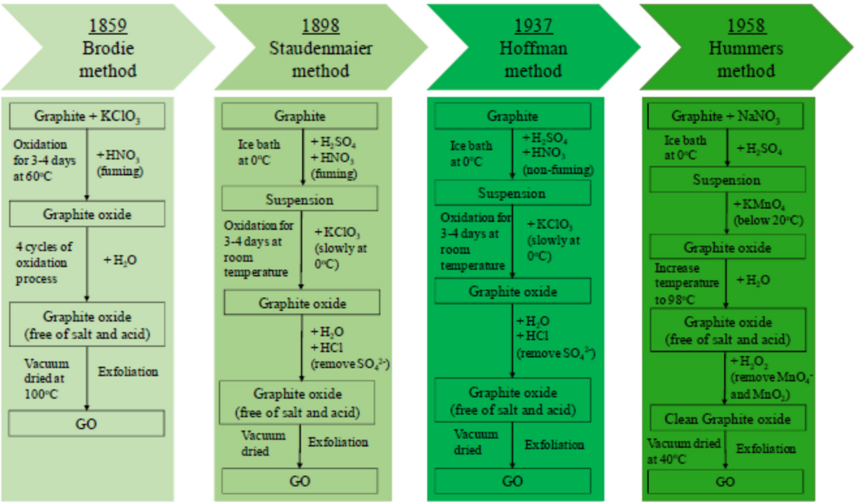
“Staudenmaier presented a less tricky and dangerous methodology for GO formation in 1898 [48], but it was Hummers and Offeman in 1958 who synthesized GO in such a way that adopted by the community and is widely used nowadays (Figure 4) [49].”
Improved Synthesis of Graphene Oxide
Marcano, D. C., Kosynkin, D. V., Berlin, J. M., Sinitskii, A., Sun, Z., Slesarev, A., Alemany, L. B., Lu, W., & Tour, J. M. (2010) · ACS Nano · doi:10.1021/nn1006368 · Cited by 11,989 · cited 4×
“requires H2SO4, KMnO4, H2O and H2O2 for for ation, here sulfuric acid is the concentrated acidic ediu that intercalates the graphite and expands it up to 300 times, and potassium permanganate, which is stronger than potassium chlorate, is the oxidant (as Mn2O7 and/or MnO3) [54].”
BackgroundInfluentialRoll-to-roll production of 30-inch graphene films for transparent electrodes
Bae, S., Kim, H., Lee, Y., Xu, X., Park, J.-S., Zheng, Y., Balakrishnan, J., Lei, T., Ri Kim, H., Song, Y. I., et al. (2010) · Nature Nanotechnology · doi:10.1038/nnano.2010.132 · Cited by 8,136 · cited 3×
“have attempted the production of a 30 ́ ́graphene film and nowadays large single-layered graphenes are synthesized to pioneer laboratories [43].”
BackgroundInfluentialThe reduction of graphene oxide
Pei, S., & Cheng, H.-M. (2012) · Carbon · doi:10.1016/j.carbon.2011.11.010 · Cited by 5,164 · cited 1×
“Reduction is the GO reaction that has the most obvious signs as the solution color turns from yellowish to black due to the restoration of the sp2 network [61].”
BackgroundWallace, P. R. (1947) · Physical Review · doi:10.1103/physrev.71.622 · Cited by 5,055 · cited 2×
“In the beginning, Peierls and Landau stated that 1D or 2D crystalline materials cannot sustain their structure when the temperature rise [24,25]; hereafter, in 1947, Wallace first wrote about the structure and the unusual semi-metallic character of graphene [26], but it was Geim and Novoselov in 2004 who isolated and…”
BackgroundUnimpeded Permeation of Water Through Helium-Leak–Tight Graphene-Based Membranes
Nair, R. R., Wu, H. A., Jayaram, P. N., Grigorieva, I. V., & Geim, A. K. (2012) · Science · doi:10.1126/science.1211694 · Cited by 3,073 · cited 1×
“An anhydrous GO membrane with thickness ~500 nm that was synthesized by Geim’s group in 2012 showed fast permeation of water molecules but complete impermeability to other liquids and gases [69].”
MethodMechanical properties of graphene and graphene-based nanocomposites
Papageorgiou, D. G., Kinloch, I. A., & Young, R. J. (2017) · Progress in Materials Science · doi:10.1016/j.pmatsci.2017.07.004 · Cited by 2,579 · cited 7×
“Unavoidably, all solid/powder GO samples contain more or less intercalated water [35,55,56] The exact chemical structure of GO cannot be specified due to the irregular density of the defects and the oxygen groups.”
BackgroundInfluentialAn improved Hummers method for eco-friendly synthesis of graphene oxide
Chen, J., Yao, B., Li, C., & Shi, G. (2013) · Carbon · doi:10.1016/j.carbon.2013.07.055 · Cited by 2,342 · cited 3×
“The two characteristic absorptions in GO occur at ~230 nm and ~300 nm, where the former results from the π→π* transitions in the aromatic C=C bonds and the latter, which is less energetic, from the n→π* transitions in the C=O bonds [56].”
BackgroundVerfahren zur Darstellung der Graphitsäure
Staudenmaier, L. (1898) · Berichte der deutschen chemischen Gesellschaft · doi:10.1002/cber.18980310237 · Cited by 2,032
Research works printed but not linked: 5
- Landau, 1937, Zur theorie der phase numwandlungen II, Phys. Z. Sowjetunion, 11, 26
- Schafhaeutl, 1840, On the combination of carbon with silicon and iron, and other metals, forming the different species of cast iron, steel, and malleable iron, Philos. Mag., 16, 570
- Charpy, 1909, Sur la formation de l’oxyde graphitique et la d’efnition du graphite, C. R. Hebd. Seances Acad. Sci., 148, 920
- Boehm, H.P., Clauss, A., Fischer, G., and Hofmann, U. (1962). Proceedings of the Fifth Conference on Carbon, Pergamon Press.
- Sotomayor, 2018, Characterization of micro/mesoporous materials by physisorption: Concepts and case studies, Acc. Mater. Surf. Res., 3, 34
Cited by
Tamang, S., Rai, S., Bhujel, R., Bhattacharyya, N. K., Swain, B. P., & Biswas, J. (2023) · Journal of Alloys and Compounds · doi:10.1016/j.jallcom.2023.169588 · Cited by 345
Lin, H., Buerki‐Thurnherr, T., Kaur, J., Wick, P., Pelin, M., Tubaro, A., Carniel, F. C., Tretiach, M., Emmanuel Flahaut, B., Iglesias, D., et al. (2024) · ACS Nano · doi:10.1021/acsnano.3c09699 · Cited by 146
Recent advances in energy storage with graphene oxide for supercapacitor technology
Mousavi, S. M., Hashemi, S. A., Kalashgrani, M. Y., Gholami, A., Binazadeh, M., Chiang, W., & Rahman, M. M. (2023) · Sustainable Energy & Fuels · doi:10.1039/d3se00867c · Cited by 90
Mechanism of polymer composite-based nanomaterial for biomedical applications
Solangi, N. H., Karri, R. R., Mubarak, N. M., & Mazari, S. A. (2023) · Advanced Industrial and Engineering Polymer Research · doi:10.1016/j.aiepr.2023.09.002 · Cited by 80
Unlocking the potential of 2D nanomaterials for sustainable intelligent packaging
Jafarzadeh, S., Nooshkam, M., Qazanfarzadeh, Z., Oladzadabbasabadi, N., Strachowski, P., Rabiee, N., Shirvanimoghaddam, K., Abdollahi, M., & Naebe, M. (2024) · Chemical Engineering Journal · doi:10.1016/j.cej.2024.151711 · Cited by 75
Gonçalves, M. G., Costa, V. O., Martinez, A. H. G., Régnier, B. M., Gomes, G. C. B., Zarbin, A. J. G., & Orth, E. S. (2024) · Frontiers in Carbon · doi:10.3389/frcrb.2024.1393077 · Cited by 61
Li, C., Li, F., Wang, K., Wang, Q., Liu, H., Sun, X., & Xie, D. H. (2022) · Inorganic Chemistry Communications · doi:10.1016/j.inoche.2023.110965 · Cited by 45
Gautam, S., Sidhu, J. S., & Verma, M. (2025) · Carbon Trends · doi:10.1016/j.cartre.2025.100499 · Cited by 34
Microbial Fuel Cell Performance Boost through the Use of Graphene and Its Modifications—Review
Starowicz, A., Zieliński, M., Rusanowska, P., & Dębowski, M. (2023) · Energies · doi:10.3390/en16020576 · Cited by 29
Tolkou, A. K., Trikkaliotis, D. G., Kyzas, G. Z., Katsoyiannis, I. A., & Deliyanni, E. A. (2023) · Sustainability · doi:10.3390/su15021179 · Cited by 26
Self-citationMalesic-Eleftheriadou, N., Trikkaliotis, D. G., Εvgenidou, Ε., Kyzas, G. Z., Bikiaris, D. Ν., & Lambropoulou, D. A. (2023) · Journal of Molecular Liquids · doi:10.1016/j.molliq.2023.122673 · Cited by 24
Self-citationGraphene Oxide: Preparation and Medical Research
Huang, X., Zhao, W., Khalilov, F., & Xu, N. (2025) · Materials · doi:10.3390/ma18122855 · Cited by 27
“This method not only provides a stable way for the large-scale and controllable synthesis of graphene oxide but also lays an important foundation for the further application of GO in many fields such as structural regulation, surface functionalization, and biomedicine [51–53].”
Efficient adsorptive removal of Co2+ from aqueous solution using graphene oxide
Zhuang, S., & Wang, J. (2023) · Environmental Science and Pollution Research · doi:10.1007/s11356-023-29374-z · Cited by 20
“Furthermore, analysis of GO's C 1s confirms the existence of hydroxyl, carboxyl, epoxy, carbonyl, and other functional groups in the oxidized graphene (Tien et al. 2011; Trikkaliotis et al. 2021; Ren et al. 2010).”
BackgroundΕvgenidou, Ε., Vasilopoulou, K., Ioannidou, E., Koronaiou, L.-A., Nannou, C. I., Trikkaliotis, D. G., Bikiaris, D. Ν., Kyzas, G. Z., & Lambropoulou, D. A. (2023) · Journal of Photochemistry and Photobiology A Chemistry · doi:10.1016/j.jphotochem.2023.114628 · Cited by 17
Self-citationKleut, D. N., & Prekodravac, J. R. (2025) · Processes · doi:10.3390/pr14010013 · Cited by 21
“These structure–property correlations emphasize that GO should not be regarded as a single material, but rather as a diverse family of materials whose properties can be engineered through careful control of synthesis parameters and post-treatment strategies [32,39,40].”
Botella, R., Piñeiro‐García, A., Semetey, V., & Lefèvre, G. (2022) · Materials Letters · doi:10.1016/j.matlet.2022.132352 · Cited by 17
“The signal found on Az around 1793 cm -1 can be associated to the C=O bond stretching of carboxylic acid groups [12-14] since they are perpendicular to the sheet plane [15] and as 1732 and 1713 cm -1 bands are assigned to carbonyls C=O”
BackgroundAbedi, R., Darband, G. B., Oveisi, A. R., Daliran, S., Fathollahi, A., & García, H. (2025) · Coordination Chemistry Reviews · doi:10.1016/j.ccr.2025.217371 · Cited by 19
Ramesh, P., Pitchaimani, J., Amalraj, S., & Koutavarapu, R. (2022) · Diamond and Related Materials · doi:10.1016/j.diamond.2022.109140 · Cited by 16
Tian, Q., She, Y., Zhu, Y., Dai, D., Shi, M., Chu, W., Cai, T., Tsai, H., Li, H., Jiang, N., et al. (2023) · Sensors · doi:10.3390/s23052870 · Cited by 16
Yadav, D., Sahu, L. R., Rana, M., & Ingole, P. G. (2025) · Chemical Engineering Journal · doi:10.1016/j.cej.2025.168836 · Cited by 16
Adugna, A. G., Assegie, A. A., & Alemu, M. A. (2025) · Carbon Trends · doi:10.1016/j.cartre.2025.100581 · Cited by 16
Graphene Oxide Enhanced Cisplatin Cytotoxic Effect in Glioblastoma and Cervical Cancer
Kregielewski, K., Frączek, W., & Grodzik, M. (2023) · Molecules · doi:10.3390/molecules28176253 · Cited by 17
“For example, GO synthesized using chemical methods has some structural differences from GO prepared by a thermal method [12].”
MethodMathioudakis, G. N., Visvini, G. A., Sygellou, L., Βeobide, A. S., & Voyiatzis, G. A. (2025) · Nanomaterials · doi:10.3390/nano15130980 · Cited by 17
“Extensive research has already been conducted on the synthesis, deposition, and characterization of GO-containing films to optimize their performance [21,22].”
Tolkou, A. K., Rada, E. C., Torretta, V., Xanthopoulou, M., Kyzas, G. Z., & Katsoyiannis, I. A. (2023) · C – Journal of Carbon Research · doi:10.3390/c9010010 · Cited by 15
“Oxidation of graphite leads to the eventual formation of graphene oxide (GO), which contains a large amount of reactive oxygen due to the presence of epoxy, carboxyl, and hydroxyl groups [34].”
BackgroundMethodInfluentialSelf-citationGraphene-based versus alumina supports on CO2 methanation using lanthanum-promoted nickel catalysts
Méndez-Mateos, D., Barrio, V. L., Requies, J., & Gil-Calvo, M. (2023) · Environmental Science and Pollution Research · doi:10.1007/s11356-023-26324-7 · Cited by 14
Philip, R. S., Aparna, N., & Mathew, M. (2024) · Composites Part A Applied Science and Manufacturing · doi:10.1016/j.compositesa.2024.108620 · Cited by 14
Two-dimensional materials-based cathodes for high-performance microbial fuel cells
Diguna, L. J., Dewi, R. T. K., Haposan, T., Simanjuntak, F. S. H., Arramel, A., Christwardana, M., & Birowosuto, M. D. (2025) · International Journal of Hydrogen Energy · doi:10.1016/j.ijhydene.2025.01.432 · Cited by 14
Facile preparation of a MXene–graphene oxide membrane and its voltage-gated ion transport behavior
Ouyang, H., Hong, X., Zhou, Z., Xu, P., Tang, H., Ma, Z., Wang, Z., Liao, X., & He, L. M. (2022) · Physical Chemistry Chemical Physics · doi:10.1039/d2cp03867f · Cited by 12
Advances of Functional Two-Dimensional Nanomaterials in the Treatment of Oral Diseases
Xu, Z., Meng, R., Wang, Y., Sun, Y., Qiao, J., Yao, Y., & Peng, Q. (2025) · Bioengineering · doi:10.3390/bioengineering12101021 · Cited by 12
Liu, Y., Guo, Q., Li, Y., Du, X., Chen, S., Wang, Z., Chong, H., & Lin, M. (2025) · Journal of environmental chemical engineering · doi:10.1016/j.jece.2025.116589 · Cited by 12
Vijina, C., Majitha, K. P., & Shima, P. D. (2023) · Environmental Science and Pollution Research · doi:10.1007/s11356-023-29115-2 · Cited by 12
“Additionally, GO and RGO can be synthesized on a large scale from low-cost reactants (Trikkaliotis et al. 2021).”
BackgroundCencerrero, J., Sánchez, P., de Lucas-Consuegra, A., de la Osa, A. R., & Romero, A. (2023) · Heliyon · doi:10.1016/j.heliyon.2023.e20748 · Cited by 11
“As can be observed, the thermal reduction of functional oxygen groups only started at calcination temperatures up to 600 ◦ C [49].”
BackgroundSulaksono, H. L. S., Annisa, A., Ruslami, R., Mufeeduzzaman, M., Panatarani, C., Hermawan, W., Ekawardhani, S., & Joni, I. M. (2024) · International Journal of Nanomedicine · doi:10.2147/ijn.s455940 · Cited by 14
“117 As a result, GO has been predominantly used in biomedical applications such as tissue engineering, cancer therapy, drug delivery, gene delivery, and biosensing, 108,118–120 as illustrated in Figure 2.”
BackgroundGraphene oxide-coated Ag-TiO2 hybrid nanocomposites for superior photocatalytic activity
Kaur, D., Singh, K., Reynolds, W. T., & Pal, B. (2023) · Environmental Science and Pollution Research · doi:10.1007/s11356-023-29301-2 · Cited by 11
“The UV–visible absorbance spectra of GO showed characteristic peak at 227 nm which results from π → π* transitions because of the aromatic C = C bonds (Trikkaliotis et al. 2021) and TiO2 shows characteristic signal at 327 nm, respectively (Fig.”
BackgroundLyu, Z., Liu, W., & Chi, Z. (2023) · Environmental Science and Pollution Research · doi:10.1007/s11356-023-26147-6 · Cited by 10
Magalhães‐Ghiotto, G. A. V., Guilherme, M. R., Natal, J. P. S., Diório, A., Rinaldi, A. W., Gomes, R. G., & Bergamasco, R. (2023) · Environmental Nanotechnology Monitoring & Management · doi:10.1016/j.enmm.2023.100877 · Cited by 17
Eliwa, A. A. (2023) · Journal of Inorganic and Organometallic Polymers and Materials · doi:10.1007/s10904-023-02872-w · Cited by 9
Xenodochidis, C., Hristova‐Panusheva, K., Kamenska, T., Santhosh, P. B., Petrov, T. S., Stoychev, L. I., Genova, J., & Krasteva, N. A. (2024) · Molecules · doi:10.3390/molecules29235650 · Cited by 11
“PEGylation of the nanosized GO (nGO) was performed by simultaneous reduction and modification in a water bath overnight at 70 ◦ C using mPEG-NH 2 (Abbexa Ltd., Cambridge, UK) as previously described [20].”
Parthenidis, P., Maroulas, K. N., Εvgenidou, Ε., Kyzas, G. Z., & Lambropoulou, D. A. (2025) · Journal of Water Process Engineering · doi:10.1016/j.jwpe.2025.107824 · Cited by 9
Self-citationA Comprehensive Study of the Macro-Scale Performance of Graphene Oxide Enhanced Low Carbon Concrete
Ginigaddara, T., Devapura, P., Vimonsatit, V., Booy, M., Mendis, P. A., & Satsangi, R. (2025) · Construction Materials · doi:10.3390/constrmater5030047 · Cited by 16
Contemporary updates on bioremediation applications of graphene and its composites
Verma, N., Eswari, S., Mahapatra, C., & Mutra, J. K. R. (2023) · Environmental Science and Pollution Research · doi:10.1007/s11356-023-26225-9 · Cited by 9
Ali, A. H., Abdo, S. M., & Dakroury, G. A. R. S. (2023) · Environmental Science and Pollution Research · doi:10.1007/s11356-023-26485-5 · Cited by 9
Srikanth, A., & Bolleddu, V. (2023) · Applied Physics A · doi:10.1007/s00339-023-06607-z · Cited by 9
Banasiak, A. I., Racki, A., Małek, M., & Chlanda, A. (2022) · Materials · doi:10.3390/ma15155306 · Cited by 8
Segovia-Sandoval, S. J., Mendoza‐Mendoza, E., Jacobo‐Azuara, A., Jiménez-López, B. A., & Hernández‐Arteaga, A. C. (2023) · Environmental Science and Pollution Research · doi:10.1007/s11356-023-27731-6 · Cited by 9
“Besides, the wavy graphene layer possesses vacancies and impurities and imports Eg at the Fermi level, which is required for electronic applications (Trikkaliotis et al. 2021).”
Hybrid Alginate–Graphene Composites: Biochemical Features and Biomedical Potential
Kudzin, M. H., Kaczmarek, A., Mrozińska, Z., Hernández, C., Piekarska, K., Woźniak, K., Juszczak, M., & Król, P. (2025) · Marine Drugs · doi:10.3390/md23080323 · Cited by 10
Poimenova, I. A., Zhukova, E. Y., Ovseenko, S. T., Saratovsky, N. S., Kiryukhin, I. K., Ratova, D.-M. V., Filatov, D., Alekseeva, A. M., Smirnova, S. V., Proskurnin, М. А., et al. (2026) · Analytica Chimica Acta · doi:10.1016/j.aca.2026.345140 · Cited by 9
Enkovaara, L. F. M., Carrión-Vilches, F. J., Avilés, M., & Bermúdez, M.-D. (2023) · eXPRESS Polymer Letters · doi:10.3144/expresspolymlett.2023.18 · Cited by 7
Unlocking the dual-detection potential of Nd 2 NiZrO 6 @GO electrodes for paracetamol and dopamine
Mahesh, G., Sirisha, S., Siddamallappa, N. G., Selvaraj, M., Assiri, M. A., Nandini, S., Shivamurthy, S. A., Jaiprakash, N. K. M., Mallu, P., & Shadakshari, S. (2025) · Journal of Materials Chemistry B · doi:10.1039/d5tb01105a · Cited by 7
Advances in one-step functionalization of graphene oxide during electrochemical graphite exfoliation
Ali, I., Oskin, P. V., Dyachkova, T. P., Imanova, G. T., Kovaleva, A. A., Dmitrieva, E. D., Alferov, S. V., Kurniawan, T. A., & Messali, M. (2025) · Journal of Materials Science · doi:10.1007/s10853-025-11177-x · Cited by 6
“At present, a wide range of chemical [27–30] and physicochemical [29–37] methods for producing GO are known.”
Graphene oxide-based materials as proton-conducting membranes for electrochemical applications
Moonnee, I., Ahmad, M. S., Inomata, Y., Kiatkittipong, W., & Kida, T. (2024) · Nanoscale · doi:10.1039/d4nr02992e · Cited by 7
Philip, R. S., Narayanankutty, A., & Mathew, M. (2024) · Zeitschrift für Physikalische Chemie · doi:10.1515/zpch-2024-0777 · Cited by 6
Graphene oxide-based bio nanocomposites for hyperthermia-driven anticancer therapy
Mashayekhi, M., Amjad, F., Najafi, F., Moradbeygi, F., Nasiri, M. R., Farsani, N. K., Tajik, M., Fatemipayam, N., Khodadadi, B., Farmani, A. R., et al. (2025) · Materials Chemistry and Physics · doi:10.1016/j.matchemphys.2025.131588 · Cited by 5
Anitha, J. S., Murugadoss, G., Venkatesh, N., Ragu, R., & Jeronsia, J. E. (2026) · Diamond and Related Materials · doi:10.1016/j.diamond.2026.113324 · Cited by 4
Mujamammi, W. M., Aldbas, H. A., Alshehri, S. H., & Awad, M. A. (2026) · Green Processing and Synthesis · doi:10.1515/gps-2025-0113 · Cited by 4
Luo, Y., Qian, Z., Cui, J., Bi, R., & Zhang, L. (2024) · ACS Applied Materials & Interfaces · doi:10.1021/acsami.4c12719 · Cited by 4
Henriques, B., Ferreira, N., Kocijan, M., Vukšić, M., Ünlü, B., Türk, S., Özacar, M., & Gonçalves, G. (2024) · Royal Society of Chemistry eBooks · doi:10.1039/9781837671663-00126 · Cited by 3
Detection of Melatonin with Sensors Modified Using Different Graphene-Based Materials
Trifan, A. G., & Apetrei, C. (2026) · Applied Sciences · doi:10.3390/app16020924 · Cited by 3
Insights into Neutral vs. Deprotonated Phenol Adsorption on Graphene Oxide
Halili, J., Xhaxhiu, K., Isak, N., Sadiku, M., Reka, A. A., Farruku, M., & Бериша, А. (2026) · Condensed Matter · doi:10.3390/condmat11010006 · Cited by 3
“GOx is a versatile nanomaterial known for its high surface area, abundant functional groups, and remarkable adsorption properties [12–15].”
Muharja, M., Khotimah, H., Sari, D. A. D., Rohmah, I. P. N., Fadilah, S. N., Wijaya, C., & Satrio, D. (2026) · Case Studies in Chemical and Environmental Engineering · doi:10.1016/j.cscee.2026.101346 · Cited by 3
A Sensitive Epinephrine Sensor Based on Photochemically Synthesized Gold Nanoparticles
Metin, E., BATIBAY, G. S., Aydın, M., & Arsu, N. (2025) · Chemosensors · doi:10.3390/chemosensors13070229 · Cited by 3
Synthesis and Characterization of rGO Using a Combination Hummers Method and Hydrothermal Reduction
Pardede, M. L., Jonathan, N., Irawan, R., Nugroho, A., & Susanti, R. F. (2025) · Jurnal Kimia Sains dan Aplikasi · doi:10.14710/jksa.28.7.396-404 · Cited by 4
Cyanide removal by graphene-type oxidized biochar: kinetic study and adsorption isotherms
Yannick, D. D., Zoungranan, Y., Dobi-Brice, K. K., Ekou, L., & Ekou, T. (2024) · World Journal of Advanced Research and Reviews · doi:10.30574/wjarr.2024.22.1.1075 · Cited by 4
“We also observe on the diffractogram of BGp and BOGp, the appearance of an intense peak (at 2θ ≈ 26.03°) characteristic of graphitic carbon [19] and peaks at 2θ ≈ 10° and 2θ ≈ 43° on the diffractogram of BGpO characteristic of oxidized graphitic carbon [19].”
InfluentialUtilization of graphene and rGO membranes for water and wastewater treatments
Chatterjee, D., & Sivashanmugam, K. (2024) · Physical Sciences Reviews · doi:10.1515/psr-2023-0046 · Cited by 4
Mondlane-Junior, S., Yaque, Y., Vigil, A., Suárez‐Ruíz, I., Sierra, U., Granda, M., dos Muchangos, A. C., Mercado, A., & Álvarez, P. (2025) · International Journal of Coal Geology · doi:10.1016/j.coal.2025.104773 · Cited by 2
Krishnan, S., & Prasad, A. S. (2025) · Brazilian Journal of Physics · doi:10.1007/s13538-025-01857-z · Cited by 2
Karbalaee, Z., Rahaie, M., & Shokri, E. (2025) · Microchimica Acta · doi:10.1007/s00604-025-07746-1 · Cited by 2
“Graphene oxide (GO) and Magnetic GO (MGO) were synthesized with modified Hummers method and chemi - cal coprecipitation method, respectively [35, 36 ].”
Corrosion Protective Coating Based on Chemically Cross-Linked Particles of Few-Layer Graphene
Vozniakovskii, A., Voznyakovskii, А. P., Neverovskaya, A. Y., Podlozhnyuk, N., Викторович, К. С., & Auchynnikau, Y. V. (2025) · Nanomaterials · doi:10.3390/nano15241841 · Cited by 2
“OH and -COOH, at the edges of their graphene sheets [32,33].”
Sailo, L., & Singh, N. M. (2025) · JOM · doi:10.1007/s11837-025-08018-2 · Cited by 2
Tadvi, D. P., Katariya, H. N., Nayak, M. G., & Gurjar, K. (2026) · Catalysis Letters · doi:10.1007/s10562-025-05274-4 · Cited by 2
Graphene Oxide: Designing a Functional Smarter Material for Advanced Biomedicine
Ménard‐Moyon, C., Nishina, Y., & Bianco, A. (2026) · Accounts of Materials Research · doi:10.1021/accountsmr.5c00362 · Cited by 2
Rawat, V., Gairola, V., Kar, K. K., Gupta, R., & Chamoli, P. (2026) · Emergent Materials · doi:10.1007/s42247-026-01341-7 · Cited by 6
Hemmedi, I., Bitri, N., Mezyen, M., Bargaoui, I., & Ménard, J. (2026) · ACS Omega · doi:10.1021/acsomega.5c13546 · Cited by 2
Senturk, O., & Palabiyik, M. (2024) · Journal of Materials Engineering and Performance · doi:10.1007/s11665-024-09262-4 · Cited by 2
An Overview of Emerging 2D Nanomaterials: General Synthesis Methods and Properties
Anusuyadevi, P. R., Pranavi, S., Shaw, R. N. R., Mádai, E., Kumar, D. J. P., Gonugunta, P., Taheri, P., & Mol, J. M. C. (2025) · Royal Society of Chemistry eBooks · doi:10.1039/9781837675838-00001 · Cited by 2
Polymer Nanocomposites Based on Graphene and Graphene Oxide
Takara, E. A., Jofre, C. F., Piguillem, S. V., Scala‐Benuzzi, M. L., Raba, J., Bertolino, F. A., Pereira, S. V., & Messina, G. A. (2024) · doi:10.1002/9783527837021.ch12 · Cited by 2
Basit, A., Ahmad, M. R., Yunas, K., Arshad, M. I., Jamil, Y., & Anwar, H. (2025) · Elsevier eBooks · doi:10.1016/b978-0-323-88662-8.00008-5 · Cited by 1
Kasana, P. K., Pandey, A., & Mohanty, T. (2025) · Applied Physics A · doi:10.1007/s00339-025-09133-2 · Cited by 1
Vozniakovskii, A., Voznyakovskii, А. P., Neverovskaya, A. Y., Podlozhnyuk, N., Викторович, К. С., & Auchynnikau, E. (2025) · Materials · doi:10.3390/ma18235429 · Cited by 1
“Graphene nanosheet edges have various surface groups [31,32].”
Kulla, L., AMEDA, A., Jakubec, P., Baraj, B., Shehu, A., Cenolli, S., Broli, N., Vasjari, M., & Otyepka, M. (2026) · Sensing and Bio-Sensing Research · doi:10.1016/j.sbsr.2026.100992 · Cited by 2
Impact of Compaction and Thermal Annealing on the Low-Temperature Heat Capacity of Graphene Oxide
Krivchikov, A. I., Jezowski, A., Barabashko, M. S., Dolbin, A. V., Vinnikov, N. A., Cherednychenko, S. V., Horbatenko, Y. V., Korolyuk, O. A., Bezkrovnyi, O. S., Hurova, D. E., et al. (2025) · Nanoscale and Microscale Thermophysical Engineering · doi:10.1080/15567265.2026.2635099 · Cited by 1
“Such sensitivity reflects the layered, quasi-two-dimensional structure and high in-plane stiffness of GO [17, 18], which give rise to an anisotropic mechanical response under compression.”
InfluentialLgaz, H. (2026) · Materials · doi:10.3390/ma19061080 · Cited by 1
“This major decomposition step is attributed to the thermal degradation of labile oxygen-containing functional groups, including hydroxyl, epoxide, and carboxyl groups [41,42].”
Computational Study on the Membrane Separation Mechanism of Actinide Ions by Graphene Oxide
Lan, Y., Zhu, L., Tao, W., Sun, X., Fu, Z., Lv, J., Yang, S., Huang, K. R., Jiang, K., & Zhang, S. (2026) · ACS Omega · doi:10.1021/acsomega.5c13035 · Cited by 1
Liu, Y., Tang, H., Dong, Z., Wang, Y., & Li, Y. (2026) · Polymer Engineering and Science · doi:10.1002/pen.70564 · Cited by 1
Carbon-based nanomaterials for nervous tissue engineering
Tite, T., Balescu, L. M., Popa, A.-C., & Stan, G. E. (2023) · Elsevier eBooks · doi:10.1016/b978-0-323-90554-1.00007-0 · Cited by 1
Stokes, K., Sun, Y., Zhang, H., Passaretti, P., White, H. J., & Oppenheimer, P. G. (2024) · Carbon Trends · doi:10.1016/j.cartre.2024.100343 · Cited by 3
Role of Graphene-related 2D Nanomaterials in Antimicrobial Potentials: An Overview
Mahmoud, A. E. D., Sultan, N. S., & Abdel‐Fattah, T. M. (2024) · Advanced carbon journal. · doi:10.62184/acj.jacj1000202424 · Cited by 1
Pastushok, O., Kivijärvi, L., Fedorovskaya, E. O., Haukka, M., & Repo, E. (2022) · SSRN Electronic Journal · doi:10.2139/ssrn.4163034
Novel nanocomposites: relationship between microstructure-properties and tribological behavior
Enkovaara, L. F. M. (2023) · Digital Repository (Polytechnic University of Cartagena) · doi:10.31428/10317/12234
Mechanical Characterization of Graphene Nanoparticles
Ahmed, A. (2023) · Smart nanomaterials technology · doi:10.1007/978-981-99-2352-6_3
Graphene-based Nanocomposites for Sensing
Alghazzawi, W. (2023) · Royal Society of Chemistry eBooks · doi:10.1039/bk9781837671847-00047
Magnetic graphene oxide in analytical science
Sontakke, A. D., Tiwari, S., & Purkait, M. K. (2024) · Comprehensive analytical chemistry · doi:10.1016/bs.coac.2024.04.001
Effects of Peroxide and Persulfate Oxidizing Agents on the Texture of Graphene Oxide
Mahdavi, Y., & Zamani, M. (2024) · Materials chemistry horizons. · doi:10.61186/mch.2024.1057
Graphene Oxide in Water Treatment From Adsorption to Photocatalysis
Das, H. S., Mishra, S. K., & Roymahapatra, G. (2024) · Advances in chemical and materials engineering book series · doi:10.4018/979-8-3693-8257-8.ch005
Hummers ve Askorbik Asit ile Kimyasal İndirgenme Metotlarında Döngüsel Yaklaşım
Yılmaz, E., Bektaş, E., Bhuiyan, M. R. A., & Korucu, H. (2024) · Fırat Üniversitesi Mühendislik Bilimleri Dergisi · doi:10.35234/fumbd.1393163
Activated Graphene Oxide for Removal of Methylene Blue from Aqueous Solutions
Raveena, L. A. L., Viraji, H. A., Rathnayake, S. I., & Sitinamaluwa, H. S. (2024) · Moratuwa Engineering Research Conference (MERCon) · doi:10.1109/mercon63886.2024.10688886
INCORPORAÇÃO DE ÓXIDO DE GRAFENO EM ARGAMASSA: ÁNALISE DA RESISTÊNCIA MECÂNICA À COMPRESSÃO
Soares, M. A., Almeida, M. P., & Fagundes, F. (2024) · Revista Multidisciplinar do Nordeste Mineiro · doi:10.61164/rmnm.v12i2.3041
Suhaimi, M. A. H., Taniselass, S., Arshad, M. K. M., Gopinath, S. C. B., Fathil, M. F. M., & Ramli, M. M. (2025) · Microchemical Journal · doi:10.1016/j.microc.2025.112887
RetractedEnhanced Synthesis Method for Graphene Oxide
Azira, N., Idris, M., Halin, D. S. C., Darus, M., & Yunos, N. F. M. (2025) · Springer proceedings in physics · doi:10.1007/978-981-96-2871-1_41
Introduction to Reduced Graphene Oxide
Li, J., Salleh, N. A., Ahmad, N., Alshoaibi, A. A., Kheawhom, S., & Mohamad, A. A. (2025) · SpringerBriefs in materials · doi:10.1007/978-981-96-4930-3_1
Metadata
- Authors
- Trikkaliotis, D. G., Christoforidis, A. K., Mitropoulos, A. C., & Kyzas, G. Z.
- Affiliations
- International Hellenic University (GR)
- Department of Chemistry, International Hellenic University, GR-65404 Kavala, Greece
- Corresponding author
- Kyzas, George Z.
- ORCID
- Kyzas, George Z.
- Venue
- ChemEngineering
- Publisher
- MDPI AG
- Published
- 2021-09-17
- Volume
- 5
- Issue
- 3
- Pages
- 64
- ISSN
- 2305-7084 (ISSN-L)
- OpenAlex
- W3199973348
- Cited by
- 135
- References
- 99
- Citations by year
- 2026: 41 · 2025: 39 · 2024: 22 · 2023: 28 · 2022: 5
- FWCI
- 4.18
- Type
- journal article
- Language
- en
- Open access
- gold
- doi.org
- Licence
- Locations
- ChemEngineering (publishedVersion, cc-by)
- DOAJ (DOAJ: Directory of Open Access Journals) (submittedVersion, cc-by-sa)
- Topics
- Physical Sciences › Materials Science › Materials Chemistry › Graphene research and applications
- Physical Sciences › Engineering › Biomedical Engineering › Graphene and Nanomaterials Applications
- Physical Sciences › Materials Science › Materials Chemistry › Graphite, nuclear technology, radiation studies
- Keywords
- graphene oxide, graphene oxide synthesis, reduced graphene oxide, thermal exfoliation, oxygen-containing functional groups, carbon allotropes, graphene, characterization techniques, X-ray diffraction, FTIR spectroscopy, atomic force microscopy, SEM-EDS, UV-Vis spectroscopy
About these checks
Registry, retraction, Cites and statistics results are computed, not judged, with one exception: a printed reference that no index lists is read once by a model before it counts as a citation error. Claims are extracted by a model and kept only when their quote appears verbatim in the text; each cited source is then checked, with a model’s help, for whether it says what the claim relies on. Those verdicts can be wrong — read the claim’s quote and the cited source before relying on one.
Statistics and arithmetic are recomputed, not judged.
Confidence bands are shown only for fields calibrated on our annotated test set. None is calibrated yet, so no band is shown.
What counts as a claim ›How we measure confidence ›How we check this ›
Are you an author, or do you see a problem with this page? Request a review
Data sources
Bibliographic data: Semantic Scholar, OpenAlex, Crossref.
Contains information from the Semantic Scholar Academic Graph Datasets, made available under the ODC Attribution License (ODC-BY 1.0).
Semantic Scholar’s data is described in: Kinney, R., et al. (2023). The Semantic Scholar Open Data Platform. arXiv:2301.10140.
