

Graphene Oxide Synthesis, Properties and Characterization Techniques: A Comprehensive Review
Open accessThe DOI matches its Crossref record; 98 of the 99 references it cites were found in a registry or an index.
Abstract
The unique properties of graphene oxide (GO) have attracted the attention of the research community and cost-effective routes for its production are studied. The type and percentage of the oxygen groups that decorate a GO sheet are dependent on the synthesis path, and this path specifies the carbon content of the sheet. The chemical reduction of GO results in reduced graphene oxide (rGO) while the removal of the oxygen groups is also achievable with thermal processes (tpGO). This review article introduces the reader to the carbon allotropes, provides information about graphene which is the backbone of GO and focuses on GO synthesis and properties. The last part covers some characterization techniques of GO (XRD, FTIR, AFM, SEM-EDS, N2 porosimetry and UV-Vis) with a view to the fundamental principles of each technique. Some critical aspects arise for GO synthesized and characterized from our group.
Overview
The claims and statistics of this paper haven’t been checked yet.
Free: it reads the open-access text and checks the first 5 claims that cite a source we can check. Create a free account to check every claim.
Integrity signals
Registry
Cites
Statistics
Figures



Verification
Claims the paper makes
The claims and statistics of this paper haven’t been checked yet.
Free: it reads the open-access text and checks the first 5 claims that cite a source we can check. Create a free account to check every claim.
Claims other papers make about this one
Each is checked against this paper’s own text: does it say what the citing paper says it does?
The cited source doesn’t support the claim as written.
In the citing paper
“As can be observed, the thermal reduction of functional oxygen groups only started at calcination temperatures up to 600 °C [49].”
From Influence of boron doping level and calcination temperature on hydrogen evolution reaction in acid medium of metal-free graphene aerogels (2023) · cites this paper as [49]
Checked by a reasoning model — may be wrong.
Experimental — accuracy not yet measured
Self-check
Percentages, sums and reported differences re-computed from the paper’s own numbers.
The self-check needs the paper’s full text.
Citations
Cites
Electric Field Effect in Atomically Thin Carbon Films
Novoselov, K. S., Geim, A. K., Morozov, S. V., Jiang, D., Zhang, Y., Dubonos, S. V., Grigorieva, I. V., & Firsov, A. A. (2004) · Science · doi:10.1126/science.1102896 · Cited by 66,834 · cited 1×
“In the beginning, Peierls and Landau stated that 1D or 2D crystalline materials cannot sustain their structure when the temperature rise [24,25]; hereafter, in 1947, Wallace first wrote about the structure and the unusual semi-metallic character of graphene [26], but it was Geim and Novoselov in 2004 who isolated and…”
BackgroundPreparation of Graphitic Oxide
Hummers, W. S., & Offeman, R. E. (1958) · Journal of the American Chemical Society · doi:10.1021/ja01539a017 · Cited by 29,920 · cited 1×
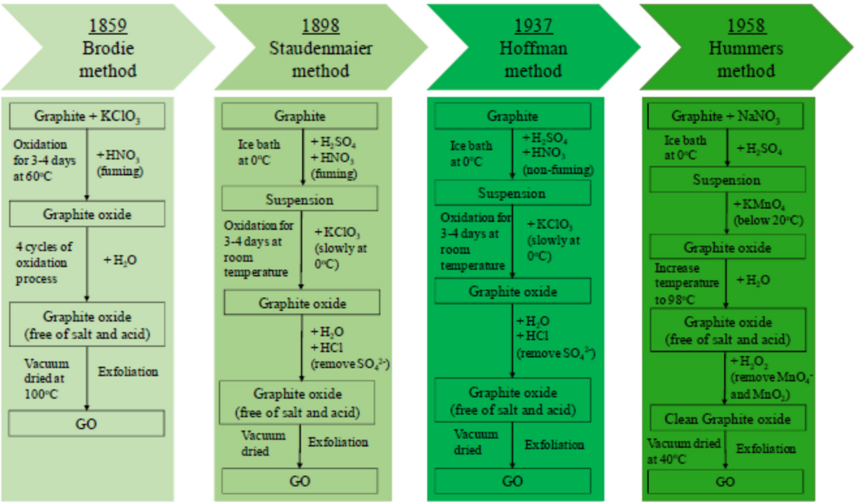
“Staudenmaier presented a less tricky and dangerous methodology for GO formation in 1898 [48], but it was Hummers and Offeman in 1958 who synthesized GO in such a way that adopted by the community and is widely used nowadays (Figure 4) [49].”
Improved Synthesis of Graphene Oxide
Marcano, D. C., Kosynkin, D. V., Berlin, J. M., Sinitskii, A., Sun, Z., Slesarev, A., Alemany, L. B., Lu, W., & Tour, J. M. (2010) · ACS Nano · doi:10.1021/nn1006368 · Cited by 11,989 · cited 4×
“requires H2SO4, KMnO4, H2O and H2O2 for for ation, here sulfuric acid is the concentrated acidic ediu that intercalates the graphite and expands it up to 300 times, and potassium permanganate, which is stronger than potassium chlorate, is the oxidant (as Mn2O7 and/or MnO3) [54].”
BackgroundInfluentialRoll-to-roll production of 30-inch graphene films for transparent electrodes
Bae, S., Kim, H., Lee, Y., Xu, X., Park, J.-S., Zheng, Y., Balakrishnan, J., Lei, T., Ri Kim, H., Song, Y. I., et al. (2010) · Nature Nanotechnology · doi:10.1038/nnano.2010.132 · Cited by 8,136 · cited 3×
“have attempted the production of a 30 ́ ́graphene film and nowadays large single-layered graphenes are synthesized to pioneer laboratories [43].”
BackgroundInfluentialThe reduction of graphene oxide
Pei, S., & Cheng, H.-M. (2012) · Carbon · doi:10.1016/j.carbon.2011.11.010 · Cited by 5,164 · cited 1×
“Reduction is the GO reaction that has the most obvious signs as the solution color turns from yellowish to black due to the restoration of the sp2 network [61].”
BackgroundWallace, P. R. (1947) · Physical Review · doi:10.1103/physrev.71.622 · Cited by 5,055 · cited 2×
“In the beginning, Peierls and Landau stated that 1D or 2D crystalline materials cannot sustain their structure when the temperature rise [24,25]; hereafter, in 1947, Wallace first wrote about the structure and the unusual semi-metallic character of graphene [26], but it was Geim and Novoselov in 2004 who isolated and…”
BackgroundUnimpeded Permeation of Water Through Helium-Leak–Tight Graphene-Based Membranes
Nair, R. R., Wu, H. A., Jayaram, P. N., Grigorieva, I. V., & Geim, A. K. (2012) · Science · doi:10.1126/science.1211694 · Cited by 3,073 · cited 1×
“An anhydrous GO membrane with thickness ~500 nm that was synthesized by Geim’s group in 2012 showed fast permeation of water molecules but complete impermeability to other liquids and gases [69].”
MethodMechanical properties of graphene and graphene-based nanocomposites
Papageorgiou, D. G., Kinloch, I. A., & Young, R. J. (2017) · Progress in Materials Science · doi:10.1016/j.pmatsci.2017.07.004 · Cited by 2,579 · cited 7×
“Unavoidably, all solid/powder GO samples contain more or less intercalated water [35,55,56] The exact chemical structure of GO cannot be specified due to the irregular density of the defects and the oxygen groups.”
BackgroundInfluentialAn improved Hummers method for eco-friendly synthesis of graphene oxide
Chen, J., Yao, B., Li, C., & Shi, G. (2013) · Carbon · doi:10.1016/j.carbon.2013.07.055 · Cited by 2,342 · cited 3×
“The two characteristic absorptions in GO occur at ~230 nm and ~300 nm, where the former results from the π→π* transitions in the aromatic C=C bonds and the latter, which is less energetic, from the n→π* transitions in the C=O bonds [56].”
BackgroundVerfahren zur Darstellung der Graphitsäure
Staudenmaier, L. (1898) · Berichte der deutschen chemischen Gesellschaft · doi:10.1002/cber.18980310237 · Cited by 2,032
Research works printed but not linked: 5
- Landau, 1937, Zur theorie der phase numwandlungen II, Phys. Z. Sowjetunion, 11, 26
- Schafhaeutl, 1840, On the combination of carbon with silicon and iron, and other metals, forming the different species of cast iron, steel, and malleable iron, Philos. Mag., 16, 570
- Charpy, 1909, Sur la formation de l’oxyde graphitique et la d’efnition du graphite, C. R. Hebd. Seances Acad. Sci., 148, 920
- Boehm, H.P., Clauss, A., Fischer, G., and Hofmann, U. (1962). Proceedings of the Fifth Conference on Carbon, Pergamon Press.
- Sotomayor, 2018, Characterization of micro/mesoporous materials by physisorption: Concepts and case studies, Acc. Mater. Surf. Res., 3, 34
Cited by
Items 101–135 of 135
Adsorption of nuclides (Cs, Sr, Co, U, and Tc) by various adsorbents
Wang, J. (2025) · Elsevier eBooks · doi:10.1016/b978-0-443-26706-2.00003-6
Suhaimi, M. A. H., Taniselass, S., Arshad, M. K. M., Gopinath, S. C. B., Fathil, M. F. M., Ramli, M. M., & Hasan, I. (2025) · Critical Reviews in Analytical Chemistry · doi:10.1080/10408347.2025.2525201
In silico assessment of CNTs, GQDs and GO as modulators of amyloid-β aggregation
El‐Sayed, N. M., & Refaat, A. (2025) · Next Materials · doi:10.1016/j.nxmate.2025.101375
Xie, R., Liu, S., Wang, Q., Zhang, Y., & Wang, Z. (2025) · International Conference on Optoelectronic Science and Materials (ICOSM) · doi:10.1117/12.3091491
Bal, M., Tontuş, M. İ., & Tümer, M. (2025) · Journal of Materials Engineering and Performance · doi:10.1007/s11665-025-13101-5
“When the SEM micrographs of the GO material (Figure S10) are examined, a characteristic layered structure is observed, where the gaps between the layers are wider than those of the original graphite material (Ref 50, 51).”
Mathur, A., & Sundaramurthy, S. K. (2025) · Journal of Materials Science Materials in Electronics · doi:10.1007/s10854-025-16467-3
Khairy, Y. (2026) · Journal of Materials Science Materials in Electronics · doi:10.1007/s10854-025-16535-8
“Moreover, rGO’s delocalized π-electron system endows PVA composites with remarkable third-order nonlinear optical susceptibility ( χ (3) ), making them promising for optical limiting, all-optical switching, and ultrafast photonic modulation [18].”
Development of a Novel Free Chlorine Sensor based on Graphene Oxide and PEDOT:PSS
Syamsu, I., Hermida, I. D. P., Shobih, Purnawati, D., Kurniawan, E. D., Sudrajat, N., Sugandi, G., Wijayanto, Y. N., & Wiranto, G. (2025) · International Conference on Radar, Antenna, Microwave, Electronics, and Telecommunications (ICRAMET) · doi:10.1109/icramet67419.2025.11350002
“Meanwhile, the existence of these functional groups confirms that the pristine graphite has successfully been transformed into GO [15].”
Percolation-induced thermo-rheological transitions in biobased graphene nanoplatelet nanofluids
Saka, A. A., Abor, T. K., Okafor, A. C., & Okoronkwo, M. U. (2026) · Colloids and Surfaces A Physicochemical and Engineering Aspects · doi:10.1016/j.colsurfa.2026.140543
Valarmathy, C., & Sudhaparimala, S. (2026) · Sustainable Chemistry One World · doi:10.1016/j.scowo.2026.100233
Al-Otaibi, S. J., Bakry, A. M., El-Sherif, L. S., Hassaballa, S., Amin, K. S., & G.Ibrahim, M. (2026) · Open Physics · doi:10.1515/phys-2025-0292
Reduced Graphene Oxide-Based Electrochemical Sensors to Detect Rhodamine B Molecules: A Review
Lu, X., Guan, W., Ghosh, M., Chakraborthy, A., Maulik, G., Alahi, M. E. E., & Nag, A. (2026) · IEEE Sensors Journal · doi:10.1109/jsen.2026.3692965
“The synthesis and reduction of GO are highly sensitive to laboratory conditions, often leading to variations in oxygen-group density, defect concentration, and electrical conductivity between batches [119].”
Suheal, A., Jagatheeshwaran, M. S., Ramesh, P., & Sudha, N. (2026) · ChemistrySelect · doi:10.1002/slct.202505551
Allam, V., Chinthagumpala, K., & Vandrangi, S. K. (2025) · Graphene and 2D Materials · doi:10.1007/s41127-026-00108-5
“A prominent peak appears at 2θ = 11.1°, corresponding to the (001) plane and yielding an interlayer spacing (d-spacing) of approximately 0.87 nm [28].”
InfluentialBassi, A., Gusain, M., Singh, L., Tannarana, M., Deepeka, & Jain, H. (2026) · Discover Chemical Engineering · doi:10.1007/s43938-026-00132-0
“GO retains the hexagonal carbon lattice of graphene, but with oxidation it is stripped of defects, vacancies and sp 3 hybridized carbons that disrupt the conjugation and affect its electronic and optical properties [131].”
Alzharani, A. Y., Ramesh, P., Rex, K., Bahattab, M. A., Alqahtani, M. H. M., Abaalkheel, I., Almater, A., & Koyyad, G. (2026) · Topics in Catalysis · doi:10.1007/s11244-026-02320-2
Otaru, A. J., & Baba, I. A. (2026) · Materials Chemistry and Physics · doi:10.1016/j.matchemphys.2026.132877
Sharma, N., Thakur, S., Sharma, S., Simran, S., Gupta, N. K., & Prakash, J. (2026) · FlatChem · doi:10.1016/j.flatc.2026.101088
Kayani, Z. N., Fatima, I., & Nazli, H. (2026) · Ceramics International · doi:10.1016/j.ceramint.2026.06.442
Alsulami, A. H. (2026) · ACS Omega · doi:10.1021/acsomega.6c04098
Ni–rGO NANO-SENSOR FOR PESTICIDE DETECTION IN FOOD SAMPLES
Kulla, L., AMEDA, A., & Vasjari, M. (2026) · Albanian Journal of Natural and Technical Sciences · doi:10.67537/ajnts3103029
Talha, E.-S., Eman Hamza, O., El-Morsy, A., Ahmed, E. S., Attia, A. M., & Shafik, A. L. (2026) · Next Materials · doi:10.1016/j.nxmate.2026.102908
Ashiq, B., Khan, M. R., Ali, R. S., & Huang, D. (2026) · Nano-Horizons Journal of Nanosciences and Nanotechnologies · doi:10.25159/3005-2602/21752
Redefining Endodontic Materials: The Role of Graphene Oxide – A Narrative Review
Sreekumar, M., Kumar, P., Shetty, S., & Gowri, S. (2026) · Clinical Dentistry · doi:10.33882/clinicaldent.15.42662
Devapura, P., Ginigaddara, T., Hearn, K. N., & Mendis, P. (2026) · Construction Materials · doi:10.3390/constrmater6040045
“Graphene oxide (GO), with its exceptionally high surface area (often exceeding 200 m 2 /g), abundant oxygenated functional groups, and strong affinity for water molecules [1], has emerged as a promising nanomaterial for enhancing the performance of cementitious composites.”
Evolution of the Surface Composition of Graphene Oxide Films During Laser-Induced Reduction
Marchezi, P. E., Maragkaki, S., Michael, A., Hawash, Z. M., Ericsson, L. K. E., Savva, K., Zając, M., Stratakis, E. I., & Moons, E. (2026) · Physchem · doi:10.3390/physchem6030052
Graphene Oxide Based Ternary Nanocomposites for Wastewater Treatment
Sharma, P., Kumari, K., Majumder, S., Sharma, P., & Kumari, S. (2026) · ChemistrySelect · doi:10.1002/slct.74126
Tunable Band-Gap Engineering in Graphene-Channel FETs via Hydrogenated Graphene Oxide
Bhattacharyya, S., Seth, S., Karmakar, S., Saha, P., & Kundu, S. K. (2026) · Lecture notes in networks and systems · doi:10.1007/978-3-032-27441-0_13
Khuntey, B., Suryavanshi, S., Kumar, R., Singh, A., Rai, A., Singh, M., & Rai, V. K. (2026) · ChemistrySelect · doi:10.1002/slct.74205
Prasad, G., Tamang, S., Biswas, J., Jha, S. K., & Bhattacharyya, N. K. (2026) · Next Materials · doi:10.1016/j.nxmate.2026.103285
Supramolecular chemistry of graphene and its supercapacitors application
Ani, A. N., Jahan, M., Hossain, M. K., Chowdhury, F. I., Rahman, M. R., & Namakka, M. (2026) · Advances in chemical pollution, environmental management and protection · doi:10.1016/bs.apmp.2026.02.008
Wyk, A. E. V., Mishra, J., Babafemi, A. J., & Combrinck, R. (2026) · Next Materials · doi:10.1016/j.nxmate.2026.103642
Ismail, W., Ramadan, A. G., El-khair, F. A., Elsheikh, A. E., Abdelfatah, M., & El‐Shaer, A. (2026) · Scientific Reports · doi:10.1038/s41598-026-71031-1 · Cited by 1
Synthesis of Ga@GO core-shell by bath sonication with enhanced photothermal conversion
Hassan, R. S., Gomaa, M., Salah, A., & Fattah, G. A. (2026) · Diamond and Related Materials · doi:10.1016/j.diamond.2026.114228
Ahmed, A. F., Abdulwahab, G. H., & Rashid, S. M. (2026) · Macromolecular Symposia · doi:10.1002/masy.70494
Metadata
- Authors
- Trikkaliotis, D. G., Christoforidis, A. K., Mitropoulos, A. C., & Kyzas, G. Z.
- Affiliations
- International Hellenic University (GR)
- Department of Chemistry, International Hellenic University, GR-65404 Kavala, Greece
- Corresponding author
- Kyzas, George Z.
- ORCID
- Kyzas, George Z.
- Venue
- ChemEngineering
- Publisher
- MDPI AG
- Published
- 2021-09-17
- Volume
- 5
- Issue
- 3
- Pages
- 64
- ISSN
- 2305-7084 (ISSN-L)
- OpenAlex
- W3199973348
- Cited by
- 135
- References
- 99
- Citations by year
- 2026: 41 · 2025: 39 · 2024: 22 · 2023: 28 · 2022: 5
- FWCI
- 4.18
- Type
- journal article
- Language
- en
- Open access
- gold
- doi.org
- Licence
- Locations
- ChemEngineering (publishedVersion, cc-by)
- DOAJ (DOAJ: Directory of Open Access Journals) (submittedVersion, cc-by-sa)
- Topics
- Physical Sciences › Materials Science › Materials Chemistry › Graphene research and applications
- Physical Sciences › Engineering › Biomedical Engineering › Graphene and Nanomaterials Applications
- Physical Sciences › Materials Science › Materials Chemistry › Graphite, nuclear technology, radiation studies
- Keywords
- graphene oxide, graphene oxide synthesis, reduced graphene oxide, thermal exfoliation, oxygen-containing functional groups, carbon allotropes, graphene, characterization techniques, X-ray diffraction, FTIR spectroscopy, atomic force microscopy, SEM-EDS, UV-Vis spectroscopy
About these checks
Registry, retraction, Cites and statistics results are computed, not judged, with one exception: a printed reference that no index lists is read once by a model before it counts as a citation error. Claims are extracted by a model and kept only when their quote appears verbatim in the text; each cited source is then checked, with a model’s help, for whether it says what the claim relies on. Those verdicts can be wrong — read the claim’s quote and the cited source before relying on one.
Statistics and arithmetic are recomputed, not judged.
Confidence bands are shown only for fields calibrated on our annotated test set. None is calibrated yet, so no band is shown.
What counts as a claim ›How we measure confidence ›How we check this ›
Are you an author, or do you see a problem with this page? Request a review
Data sources
Bibliographic data: Semantic Scholar, OpenAlex, Crossref.
Contains information from the Semantic Scholar Academic Graph Datasets, made available under the ODC Attribution License (ODC-BY 1.0).
Semantic Scholar’s data is described in: Kinney, R., et al. (2023). The Semantic Scholar Open Data Platform. arXiv:2301.10140.
