

High-Latitude Dinosaur Nesting Strategies during the Latest Cretaceous in North-Eastern Russia
Open accessThe DOI matches its Crossref record; 68 of the 68 references it cites were found in a registry or an index; none of the 75 sources its claims cite is checked for support yet.
Abstract
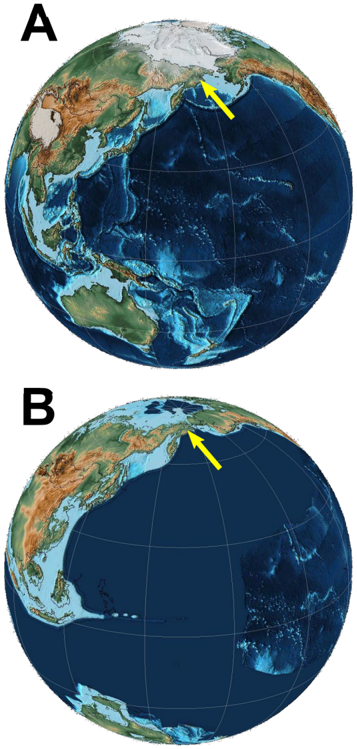
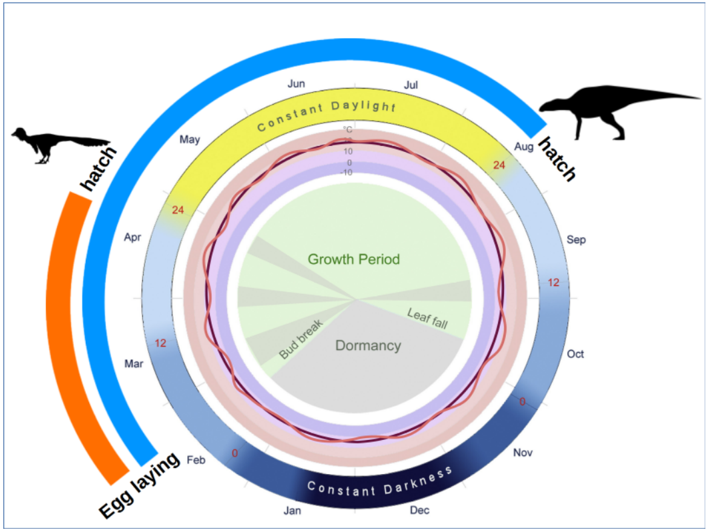
Dinosaur eggshell fragments attributed to the oofamilies Spheroolithidae and Prismatoolithidae and recovered from the latest Cretaceous Kakanaut Formation of North-eastern Russia (Chukotka) constitute one of the northernmost records of dinosaur reproductive behaviors. The high palaeolatitude of the locality (~75° N), as well as the cool near-polar climate, where summer temperatures only averaged 20 °C during the warmest month, dark near-freezing winters and egg incubation that could have lasted several months, raise questions about dinosaur reproductive strategies, particularly in terms of the timing of egg laying. In order to investigate seasonal aspects of Kakanaut dinosaur reproductions, carbonate from eggshell fragments have been analyzed for their oxygen and carbon isotope compositions, along with the oxygen and carbon isotope compositions of apatite phosphate and structural carbonate of associated theropod, hadrosaur and ankylosaur teeth as well as lepisosteid fish scales. Stable oxygen and carbon isotope compositions of eggshells from the Kakanaut Formation together with those of associated adult dinosaur teeth and fish scales reveal differences in mineralization timing between eggshells and teeth and show that eggs were laid at the very beginning of spring when snowmelt drained from nearby highlands. We propose that Kakanaut dinosaurs laid their eggs at the very beginning of spring in order to accommodate an incubation period that lasted several months. This timing would also benefit from mild temperatures and increasing food availability when the eggs hatch, allowing the hatchlings to grow large enough to survive the next winter or perhaps follow adult animals in their migration southwards.
Overview
CoChat Summary
TL;DR
Stable oxygen and carbon isotopes from latest Cretaceous Kakanaut eggshells and associated teeth and fish scales indicate that high-latitude dinosaurs laid eggs at the very beginning of spring, when snowmelt-fed waters and early spring foliage were available. This timing would have allowed a several-month incubation and hatchlings to grow before the next polar winter or to migrate south.
Key findings
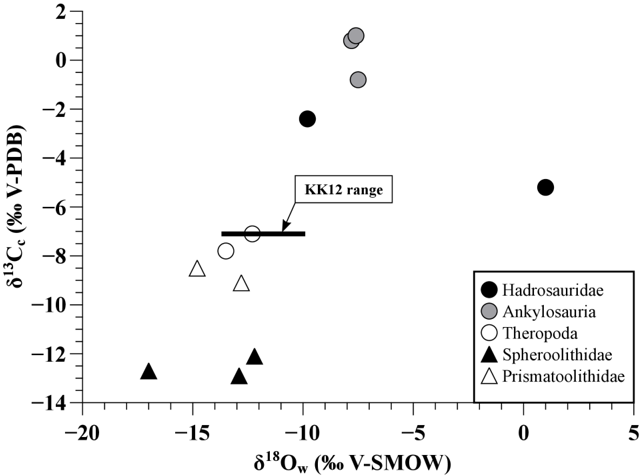
- Eggshell calcite from Spheroolithidae and Prismatoolithidae yielded estimated environmental water δ¹⁸O_w values of −17.0‰ to −12.2‰, interpreted as winter waters from snowmelt; the authors conclude eggs were laid at the very beginning of spring.
- Eggshell δ¹³C_c values are lower than those of corresponding teeth: hadrosaurid Spheroolithidae range from −12.9‰ to −12.1‰ and theropod Prismatoolithidae from −9.1‰ to −8.5‰, while tooth apatite carbonate ranges from −7.8‰ to −7.1‰ for theropods, −5.2‰ to −2.4‰ for hadrosaurids, and −0.8‰ to +1.0‰ for ankylosaurids, suggesting consumption of lower-δ¹³C early spring foliage.
- The Kakanaut area was at ~75°N; CLAMP estimates give a mean annual air temperature of 12.2 ± 2.0°C and warmest-month mean of 20.6 ± 2.5°C, while lepisosteid fish scales (δ¹⁸O_p = 14.2‰) indicate mineralization from local water δ¹⁸O_w = −8.2‰ at about 17°C, consistent with warm-season growth.
- The authors propose that early spring egg laying accommodated an incubation period lasting several months and allowed hatchlings to benefit from mild temperatures and increasing food availability, growing large enough to survive the next winter or to migrate southwards.
Methods
- Sampled from a single highly fossiliferous lens in the Kakanaut Formation, Koryak Upland, north-eastern Russia: two hadrosaurid, three ankylosaurid, and two theropod teeth; three spheroolithid and two prismatoolithid eggshell fragments; and three lepisosteid fish scales.
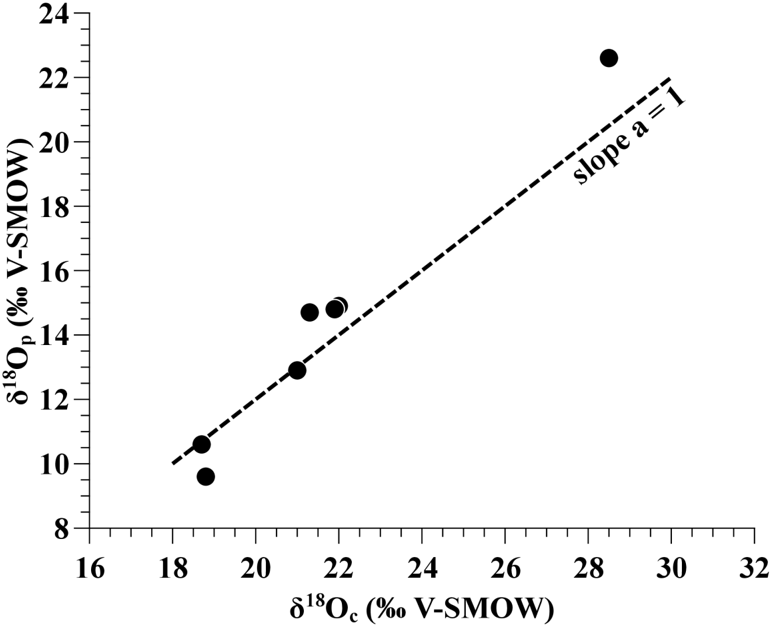
- Measured stable oxygen and carbon isotope compositions of apatite phosphate (δ¹⁸O_p), apatite structural carbonate (δ¹³C_c, δ¹⁸O_c), and eggshell calcite using wet chemistry and mass spectrometry; calculated environmental water δ¹⁸O_w using bird apatite phosphate-water and eggshell calcite-water fractionation equations.
- Assessed diagenesis via phosphate-carbonate oxygen isotope correlation, apatite carbonate content, and lack of correlation between eggshell carbon and oxygen isotopes, then interpreted results against published CLAMP climate estimates.
Limitations
- The paper states that the exact age of the Kakanaut Formation is still debated, either early late Maastrichtian or late Campanian–early Maastrichtian.
- The paper states that the anomalously high δ¹⁸O_p value of hadrosaurid tooth KK06 (δ¹⁸O_w = +1.0‰) needs further study beyond the scope of the paper; the authors only speculate about migration or time spent in more arid, inland, lower-latitude, or highland areas.
- Evident from the text: the isotope interpretation rests on a small number of specimens from a single fossiliferous lens, and nesting/incubation methods are inferred rather than directly observed; incubation duration estimates cited vary from a few weeks to up to six months, so the timing argument depends on those assumed durations.
Model-written summary. Check it against the paper before relying on it.
Integrity signals
Registry
Cites
Statistics
Figures
Verification
Claims the paper makes
0 Valid · 0 Not valid · 42 Not checked · 27 Own results and interpretations
A result the paper reports from its own data — it cites no other source for it, so there is none to check. The quote shows it is in the paper.
In the paper
“Stable oxygen and carbon isotope compositions of eggshells from the Kakanaut Formation together with those of associated adult dinosaur teeth and fish scales reveal differences in mineralization timing between eggshells and teeth”
§ High-Latitude Dinosaur Nesting Strategies during the Latest Cretaceous in North-Eastern Russia > Abstract
plainstates an association- Asserted: passes — The authors put it forward as true.
- Checkable: passes — It can be checked against evidence.
- Load-bearing: passes — The paper’s conclusions depend on it.
- Based: passes — The paper gives a reason why it holds.
A result the paper reports from its own data — it cites no other source for it, so there is none to check. The quote shows it is in the paper.
In the paper
“while tooth apatite carbonate values are also ordered with theropods having δ 13 C c values ranging from -7.8‰ to -7.1‰, hadrosaurids ranging from -5.2‰ to -2.4‰ and ankylosaurids from -0.8‰ to +1.0‰.”
§ High-Latitude Dinosaur Nesting Strategies during the Latest Cretaceous in North-Eastern Russia > 3. Results
plainstates an association- Asserted: passes — The authors put it forward as true.
- Checkable: passes — It can be checked against evidence.
- Load-bearing: unclear — It is unclear whether the paper’s conclusions depend on it.
- Based: passes — The paper gives a reason why it holds.
None of the sources cited for this claim have been checked yet.
In the paper
“The relative amount of carbonate in dinosaur apatites estimated from the measured CO 2 peak intensity of the mass spectrometer ranges from 4.4 Wt% (weight percent) to 8.6 Wt% (Table 1), within the expected range of 2-13 Wt% measured in extant vertebrates [51][52][53].”
§ High-Latitude Dinosaur Nesting Strategies during the Latest Cretaceous in North-Eastern Russia > 4.1. Primary Preservation of the Carbon and Oxygen Isotope Compositions of Tooth Apatite and Eggshell Calcite
What the sources say
- Not checked yetcites [51] Mills, A., Ed.; Elsevier: Amsterdam, The Netherlands, 1967; pp. 247-277.
- Not checked yetcites [52] Rink, W.J.; Schwarcz, H.P. Tests for Diagenesis in Tooth Enamel: ESR Dating Signals and Carbonate Contents. J. Archaeol. Sci. 1995, 22, 251-255. [CrossRef] source
- Not checked yetcites [53] Vennemann, T.W.; Hegner, E.; Cliff, G.; Benz, G.W. Isotopic Composition of Recent Shark Teeth as a Proxy for Environmental Conditions. Geochim. Cosmochim. Acta 2001, 65, 1583-1599. [CrossRef] source
hedged- Asserted: passes — The authors put it forward as true.
- Checkable: passes — It can be checked against evidence.
- Load-bearing: passes — The paper’s conclusions depend on it.
- Based: passes — The paper gives a reason why it holds.
A result the paper reports from its own data — it cites no other source for it, so there is none to check. The quote shows it is in the paper.
In the paper
“measured eggshell δ 13 C c values are lower than those of the teeth of corresponding taxa (Figure 3)”
§ High-Latitude Dinosaur Nesting Strategies during the Latest Cretaceous in North-Eastern Russia > 4.2. Environmental Conditions in the Kakanaut Area during the Latest Cretaceous
plain- Asserted: passes — The authors put it forward as true.
- Checkable: passes — It can be checked against evidence.
- Load-bearing: passes — The paper’s conclusions depend on it.
- Based: passes — The paper gives a reason why it holds.
A result the paper reports from its own data — it cites no other source for it, so there is none to check. The quote shows it is in the paper.
In the paper
“Interestingly, the average local environmental water δ 18 O w value estimated from the δ 18 O p values of dinosaur phosphates has a similar value of -8.2 ± 4.7‰ (N = 7).”
§ High-Latitude Dinosaur Nesting Strategies during the Latest Cretaceous in North-Eastern Russia > 4.2. Environmental Conditions in the Kakanaut Area during the Latest Cretaceous
hedgedn = 7- Asserted: passes — The authors put it forward as true.
- Checkable: passes — It can be checked against evidence.
- Load-bearing: passes — The paper’s conclusions depend on it.
- Based: passes — The paper gives a reason why it holds.
34 more claims
Create a free account to see all 69 claims and to verify the 75 references still open.
- It may state two separate claims as one. 24
- Probably not a substantial claim. 6
Self-check
Percentages, sums and reported differences re-computed from the paper’s own numbers.
Each contradiction between two passages listed here was confirmed by an independent check.
Rated minor: it would not touch a result — a value no result rests on, a p-value that stays on the same side of the significance level, or a conflict that is clerical, resolved elsewhere in the paper, or outside its own findings.
In the paper
§ High-Latitude Dinosaur Nesting Strategies during the Latest Cretaceous in North-Eastern Russia > 5. Conclusions
“superimposed on the summary graphic of the annual cycle of light, temperature and phenology in the early Maastrichtian at 76° N published by Herman et al. [69].”
§ High-Latitude Dinosaur Nesting Strategies during the Latest Cretaceous in North-Eastern Russia > References
“69. Varricchio, D.J.; Kundrát, M.; Hogan, J. An Intermediate Incubation Period and Primitive Brooding in a Theropod Dinosaur. Sci. Rep. 2018, 8, 12454. [CrossRef]”
Citations
Cites
Stable isotopes in precipitation
Dansgaard, W. (1964) · Tellus · doi:10.1111/j.2153-3490.1964.tb00181.x · Cited by 8,369
Carbon Isotope Discrimination and Photosynthesis
Farquhar, G. D., Ehleringer, J. R., & Hubick, K. T. (1989) · Annual Review of Plant Physiology and Plant Molecular Biology · doi:10.1146/annurev.pp.40.060189.002443 · Cited by 7,063
Phanerozoic polar wander, palaeogeography and dynamics
Torsvik, T. H., Van der Voo, R., Preeden, U., Mac Niocaill, C., Steinberger, B., Doubrovine, P. V., van Hinsbergen, D. J. J., Domeier, M., Gaina, C., Tohver, E., et al. (2012) · Earth-Science Reviews · doi:10.1016/j.earscirev.2012.06.007 · Cited by 1,445
Longinelli, A. (1984) · Geochimica et Cosmochimica Acta · doi:10.1016/0016-7037(84)90259-x · Cited by 1,041
Koch, P. L., Tuross, N., & Fogel, M. L. (1997) · Journal of Archaeological Science · doi:10.1006/jasc.1996.0126 · Cited by 957
Structural and chemical organization of teeth
Miles, A. (1967) · Academic Press eBooks · Cited by 869
Evolutionary and Ecological Aspects of Photosynthetic Pathway Variation
Ehleringer, J. R., & Monson, R. K. (1993) · Annual Review of Ecology and Systematics · doi:10.1146/annurev.ecolsys.24.1.411 · Cited by 836
Predicting animal δ18O: Accounting for diet and physiological adaptation
Kohn, M. J. (1996) · Geochimica et Cosmochimica Acta · doi:10.1016/s0016-7037(96)00240-2 · Cited by 683
Carbon isotope fractionation between diet, breath CO2, and bioapatite in different mammals
Passey, B. H., Robinson, T. F., Ayliffe, L. K., Cerling, T. E., Sponheimer, M., Dearing, M. D., Roeder, B. L., & Ehleringer, J. R. (2005) · Journal of Archaeological Science · doi:10.1016/j.jas.2005.03.015 · Cited by 576
Iacumin, P., Bocherens, H., Mariotti, A., & Longinelli, A. (1996) · Earth and Planetary Science Letters · doi:10.1016/0012-821x(96)00093-3 · Cited by 515
Hut, G. (1987) · Cited by 482
PALEOMAP PaleoAtlas for GPlates and the PaleoData Plotter Program
Scotese, C. R. (2016) · doi:10.13140/rg.2.2.34367.00166 · Cited by 404
Revised phosphate-water isotopic temperature scale
Longinelli, A., & Nuti, S. (1973) · Earth and Planetary Science Letters · doi:10.1016/0012-821x(73)90088-5 · Cited by 390
Oxygen isotope partitioning between phosphate and carbonate in mammalian apatite
Daniel Bryant, J., Koch, P. L., Froelich, P. N., Showers, W. J., & Genna, B. J. (1996) · Geochimica et Cosmochimica Acta · doi:10.1016/s0016-7037(96)00308-0 · Cited by 353
The Early Origins of Terrestrial C4 Photosynthesis
Tipple, B. J., & Pagani, M. (2007) · Annual Review of Earth and Planetary Sciences · doi:10.1146/annurev.earth.35.031306.140150 · Cited by 284
Global Taxonomic Diversity of Living Reptiles
Pincheira-Donoso, D., Bauer, A. M., Meiri, S., & Uetz, P. (2013) · PLoS ONE · doi:10.1371/journal.pone.0059741 · Cited by 209
Erickson, G. M. (1996) · Proceedings of the National Academy of Sciences · doi:10.1073/pnas.93.25.14623 · Cited by 187
Lécuyer, C., Grandjean, P., O'Neil, J. R., Cappetta, H., & Martineau, F. (1993) · Palaeogeography, Palaeoclimatology, Palaeoecology · doi:10.1016/0031-0182(93)90085-w · Cited by 184
Self-citationIsotopic composition of recent shark teeth as a proxy for environmental conditions
Vennemann, T. W., Hegner, E., Cliff, G., & Benz, G. W. (2001) · Geochimica et Cosmochimica Acta · doi:10.1016/s0016-7037(00)00629-3 · Cited by 179
The Late Cretaceous environment of the Arctic: A quantitative reassessment based on plant fossils
Spicer, R. A., & Herman, A. B. (2010) · Palaeogeography, Palaeoclimatology, Palaeoecology · doi:10.1016/j.palaeo.2010.02.025 · Cited by 179
Self-citationLécuyer, C., Amiot, R., Touzeau, A., & Trotter, J. (2013) · Chemical Geology · doi:10.1016/j.chemgeo.2013.03.008 · Cited by 163
Self-citationLécuyer, C., Bogey, C., Garcia, J.-P., Grandjean, P., Barrat, J.-A., Floquet, M., Bardet, N., & Pereda-Superbiola, X. (2003) · Palaeogeography, Palaeoclimatology, Palaeoecology · doi:10.1016/s0031-0182(03)00261-x · Cited by 95
Self-citationOxygen Isotope Analysis of Phosphate
Lécuyer, C. (2004) · Elsevier eBooks · doi:10.1016/b978-044451114-0/50024-7 · Cited by 79
Self-citationSeasonal Variations in the Isotope Ratios of Carbon in Maple Leaves and Other Plants
Lowdon, J. A., & Dyck, W. (1974) · Canadian Journal of Earth Sciences · doi:10.1139/e74-007 · Cited by 76
Fricke, H. C., Rogers, R. R., Backlund, R., Dwyer, C. N., & Echt, S. (2008) · Palaeogeography, Palaeoclimatology, Palaeoecology · doi:10.1016/j.palaeo.2008.03.030 · Cited by 72
Tests for Diagenesis in Tooth Enamel: ESR Dating Signals and Carbonate Contents
Rink, W. J., & Schwarcz, H. P. (1995) · Journal of Archaeological Science · doi:10.1006/jasc.1995.0026 · Cited by 70
Lécuyer, C., Balter, V., Martineau, F., Fourel, F., Bernard, A., Amiot, R., Gardien, V., Otero, O., Legendre, S., Panczer, G., et al. (2010) · Geochimica et Cosmochimica Acta · doi:10.1016/j.gca.2009.12.024 · Cited by 67
Self-citationClimatic constraints on the biogeographic history of Mesozoic dinosaurs
Chiarenza, A. A., Mannion, P. D., Farnsworth, A., Carrano, M. T., & Varela, S. (2022) · Current Biology · doi:10.1016/j.cub.2021.11.061 · Cited by 65
Fricke, H. C., & Pearson, D. A. (2008) · Paleobiology · doi:10.1666/08020.1 · Cited by 65
The last polar dinosaurs: high diversity of latest Cretaceous arctic dinosaurs in Russia
Godefroit, P., Golovneva, L., Shchepetov, S., Garcia, G., & Alekseev, P. (2009) · Naturwissenschaften · doi:10.1007/s00114-008-0499-0 · Cited by 60
Self-citationErickson, G. M., Zelenitsky, D. K., Kay, D. I., & Norell, M. A. (2017) · Proceedings of the National Academy of Sciences · doi:10.1073/pnas.1613716114 · Cited by 60
Straight, W. H., Barrick, R. E., & Eberth, D. A. (2004) · Palaeogeography, Palaeoclimatology, Palaeoecology · doi:10.1016/j.palaeo.2004.01.006 · Cited by 60
Polar dinosaurs on parade: a review of dinosaur migration
Bell, P. R., & Snively, E. (2008) · Alcheringa: An Australasian Journal of Palaeontology · doi:10.1080/03115510802096101 · Cited by 59
Angst, D., Lécuyer, C., Amiot, R., Buffetaut, É., Fourel, F., Martineau, F., Legendre, S., Abourachid, A., & Herrel, A. (2014) · Die Naturwissenschaften · doi:10.1007/s00114-014-1158-2 · Cited by 59
Self-citationStanton Thomas, K. J., & Carlson, S. J. (2004) · Palaeogeography, Palaeoclimatology, Palaeoecology · doi:10.1016/j.palaeo.2004.01.007 · Cited by 57
Dinosaurs of Darkness: In Search of the Lost Polar World
Rich, T. H., & Vickers-Rich, P. (2020) · Indiana University Press eBooks · doi:10.2307/j.ctvt9k68h · Cited by 47
Bi, S., Amiot, R., Peyre de Fabrègues, C., Pittman, M., Lamanna, M. C., Yu, Y., Yu, C., Yang, T., Zhang, S., Zhao, Q., et al. (2021) · Science Bulletin · doi:10.1016/j.scib.2020.12.018 · Cited by 43
Self-citationThe Relation between Latitude and Breeding Seasons in Birds
Baker., J. R. (1939) · Proceedings of the Zoological Society of London · doi:10.1111/j.1096-3642.1939.tb00042.x · Cited by 43
Nesting at extreme polar latitudes by non-avian dinosaurs
Druckenmiller, P. S., Erickson, G. M., Brinkman, D., Brown, C. M., & Eberle, J. J. (2021) · Current Biology · doi:10.1016/j.cub.2021.05.041 · Cited by 40
Handbook of Stable Isotope Analytical techniques
Kerstel, E. R. T. (2004) · Elsevier eBooks · Cited by 39
Herman, A. B., Spicer, R. A., & Spicer, T. E. V. (2016) · Palaeogeography, Palaeoclimatology, Palaeoecology · doi:10.1016/j.palaeo.2015.09.041 · Cited by 36
Self-citationAn Intermediate Incubation Period and Primitive Brooding in a Theropod Dinosaur
Varricchio, D. J., Kundrát, M., & Hogan, J. D. (2018) · Scientific Reports · doi:10.1038/s41598-018-30085-6 · Cited by 31
Seasonal and canopy height variation in n-alkanes and their carbon isotopes in a temperate forest
Suh, Y. J., & Diefendorf, A. F. (2018) · Organic Geochemistry · doi:10.1016/j.orggeochem.2017.10.015 · Cited by 28
Great Horned Owl (Bubo virginianus)
Artuso, C., Houston, C. S., Smith, D. G., & Rohner, C. (2022) · Cornell Lab of Ornithology eBooks · doi:10.2173/bow.grhowl.01.1 · Cited by 27
Zhan, L., Chen, J., Li, L., & Xin, P. (2019) · Agricultural and Forest Meteorology · doi:10.1016/j.agrformet.2019.107624 · Cited by 25
δ 18 O‐derived incubation temperatures of oviraptorosaur eggs
Amiot, R., Wang, X., Wang, S., Lécuyer, C., Mazin, J., Mo, J., Flandrois, J., Fourel, F., Wang, X., Xu, X., et al. (2017) · Palaeontology · doi:10.1111/pala.12311 · Cited by 24
Self-citationTanaka, K., Zelenitsky, D. K., Therrien, F., & Kobayashi, Y. (2018) · Scientific Reports · doi:10.1038/s41598-018-21386-x · Cited by 23
GOEDERT, J., AMIOT, R., BOUDAD, L., BUFFETAUT, E., FOUREL, F., GODEFROIT, P., KUSUHASHI, N., SUTEETHORN, V., TONG, H., WATABE, M., et al. (2016) · Palaios · doi:10.2110/palo.2015.018 · Cited by 22
Self-citationNew insights into the thermal regime and hydrodynamics of the early Late Cretaceous Arctic
Spicer, R., Valdes, P., Hughes, A., Yang, J., Spicer, T., Herman, A., & Farnsworth, A. (2020) · Geological Magazine · doi:10.1017/s0016756819000463 · Cited by 22
Self-citationLazzerini, N., Lécuyer, C., Amiot, R., Angst, D., Buffetaut, E., Fourel, F., Daux, V., Betancort, J. F., Flandrois, J.-P., Marco, A. S., et al. (2016) · The Science of Nature · doi:10.1007/s00114-016-1404-x · Cited by 20
Self-citationLanglois, C., Simon, L., & Lécuyer, C. (2003) · Isotopes in Environmental and Health Studies · doi:10.1080/10256010310001621146 · Cited by 20
Self-citationOxygen isotope fractionation between bird bone phosphate and drinking water
Amiot, R., Angst, D., Legendre, S., Buffetaut, E., Fourel, F., Adolfssen, J., André, A., Bojar, A. V., Canoville, A., Barral, A., et al. (2017) · The Science of Nature · doi:10.1007/s00114-017-1468-2 · Cited by 18
Self-citationMetcalfe, J. Z. (2021) · PeerJ · doi:10.7717/peerj.12167 · Cited by 17
The first juvenile dromaeosaurid (Dinosauria: Theropoda) from Arctic Alaska
Chiarenza, A. A., Fiorillo, A. R., Tykoski, R. S., McCarthy, P. J., Flaig, P. P., & Contreras, D. L. (2020) · PLOS ONE · doi:10.1371/journal.pone.0235078 · Cited by 16
Love, J. W. (2004) · The Southwestern Naturalist · doi:10.1894/0038-4909(2004)049<0018:agaros>2.0.co;2 · Cited by 16
Diagenesis of dinosaur eggshell from the Gobi Desert, Mongolia
Graf, J., Tabor, N. J., Ferguson, K., Winkler, D. A., Lee, Y.-N., May, S., & Jacobs, L. L. (2018) · Palaeogeography, Palaeoclimatology, Palaeoecology · doi:10.1016/j.palaeo.2017.11.011 · Cited by 15
Carbon and oxygen isotope variability among foraminifera and ostracod carbonated shells
Fourel, F., Martineau, F., Toth, E., Görög, A., Escarguel, G., & Lécuyer, C. (2015) · Studia Iuridica Lublinensia (Uniwersytet Marii Curie-Skłodowskiej w Lublinie) · doi:10.17951/aaa.2015.70.133 · Cited by 15
Self-citationBald Eagle (Haliaeetus leucocephalus)
Buehler, D. A. (2022) · Birds of the World · doi:10.2173/bow.baleag.02 · Cited by 14
Incubation times of dinosaur eggs via embryonic metabolism
Lee, S. A. (2016) · Physical Review E · doi:10.1103/physreve.94.022402 · Cited by 14
Water on Earth: Physicochemical and Biological Properties
Lécuyer, C. (2013) · doi:10.1002/9781118574928 · Cited by 14
Self-citationGolovneva, L. B., & Shchepetov, S. V. (2010) · Palaeobotany · doi:10.31111/palaeobotany/2010.1.96 · Cited by 14
Self-citationDomingo, L., Barroso-Barcenilla, F., & Cambra-Moo, O. (2015) · PLOS ONE · doi:10.1371/journal.pone.0119968 · Cited by 13
Alaska Dinosaurs: An Ancient Arctic World
Fiorillo, A. R. (2018) · doi:10.1201/b22215 · Cited by 13
Zolina, А. А., Golovneva, L. B., & Spicer, R. A. (2020) · Palaeogeography, Palaeoclimatology, Palaeoecology · doi:10.1016/j.palaeo.2020.109997 · Cited by 12
Self-citationFossil plants from the Vysokorechenskaya Formation (the Upper Cretaceous, Korayk Upland)
Golovneva, L. B., & Gnilovskaya, A. A. (2015) · Palaeobotany · doi:10.31111/palaeobotany/2015.6.36 · Cited by 9
Self-citationShczepetov, S. V., & Herman, A. B. (2017) · Stratigraphy and Geological Correlation · doi:10.1134/s0869593817040050 · Cited by 5
Self-citation(2016) · doi:10.3969/j.issn.1673-9736.2016.04.05
Self-citation(2011)
Research works printed but not linked: 3
- Benkman, C.W. White-winged Crossbill (Loxia leucoptera), version 1.0. In Birds of the World; Sly, N.D., Ed.; Cornell Lab of Ornithology: Ithaca, NY, USA, 2020. [CrossRef]
- Carpenter, K. Eggs, Nests, and Baby Dinosaurs: A Look at Dinosaur Reproduction; Indiana University Press: Bloomington, IN, USA; Indianapolis, IN, USA, 1999.
- Mills, A., Ed.; Elsevier: Amsterdam, The Netherlands, 1967; pp. 247-277.
Cited by
The macroecology of Mesozoic dinosaurs
Chiarenza, A. A. (2024) · Biology Letters · doi:10.1098/rsbl.2024.0392 · Cited by 14
Choi, S., Paik, I., Kim, H., Kim, Y., Zhang, S., Park, Y., & Lee, S. K. (2026) · Papers in Palaeontology · doi:10.1002/spp2.70084 · Cited by 2
Bert, H., Balter, V., Vinçon‐Laugier, A., Hernandez, J., Mathon, O., Goedert, J., Amiot, R., Lécuyer, C., Cubo, J., Woodward, H. N., et al. (2026) · SSRN Electronic Journal · doi:10.2139/ssrn.7635721
Self-citationTanaka, K., Novas, F. E., Manabe, M., Sakata, C., Marsà, J. A. G., & Zelenitsky, D. K. (2026) · Royal Society Open Science · doi:10.1098/rsos.260333
Metadata
- Authors
- Amiot, R., Golovneva, L. B., Godefroit, P., Goedert, J., Garcia, G., Lécuyer, C., Fourel, F., Herman, A. B., & Spicer, R. A.
- Affiliations
- École Normale Supérieure de Lyon (FR)
- Russian Academy of Sciences (RU)
- Institute of Natural Sciences (BE)
- Centre National de la Recherche Scientifique (FR)
- Lyon 1 Université (FR)
- Chinese Academy of Sciences (CN)
- Corresponding author
- Amiot, Romain
- ORCID
- Venue
- Diversity
- Publisher
- MDPI AG
- Published
- 2023-04-17
- Volume
- 15
- Issue
- 4
- Pages
- 565
- ISSN
- 1424-2818 (ISSN-L)
- OpenAlex
- W4366188882
- Semantic Scholar
- 0f229c677f805d9386feae9580e6eaf0f6718143
- Cited by
- 4
- References
- 68
- Citations by year
- 2026: 3 · 2024: 1
- FWCI
- 0.62
- Type
- journal article
- Language
- en
- Open access
- gold
- doi.org
- Licence
- Locations
- Diversity (publishedVersion, cc-by)
- Open Research Online - ORO (The Open University) (acceptedVersion)
- HAL (submittedVersion, cc-by)
- DOAJ (DOAJ: Directory of Open Access Journals) (submittedVersion)
- Funders
- CNRS INSU program Interrvie (BR/175/A2/Chicxulub)
- Brain.be project (BR/175/A2/Chicxulub)
- Topics
- Physical Sciences › Earth and Planetary Sciences › Paleontology › Paleontology and Evolutionary Biology
- Physical Sciences › Earth and Planetary Sciences › Paleontology › Paleontology and Stratigraphy of Fossils
- Physical Sciences › Earth and Planetary Sciences › Paleontology › Evolution and Paleontology Studies
- Keywords
- eggshell, Late Cretaceous, laying date, seasonal reproduction, oxygen isotopes, carbon isotopes, theropod teeth, hadrosaurids, ankylosaurs, egg incubation, mineralization timing, Chukotka
About these checks
Registry, retraction, Cites and statistics results are computed, not judged, with one exception: a printed reference that no index lists is read once by a model before it counts as a citation error. Claims are extracted by a model and kept only when their quote appears verbatim in the text; each cited source is then checked, with a model’s help, for whether it says what the claim relies on. Those verdicts can be wrong — read the claim’s quote and the cited source before relying on one.
A language model drew the claims from the paper on 2026-11-23, under version 3 of the claim definition (model deepseek-v4.1-flash, prompt extract-v3).
A second model labelled each claim on 2026-11-23 (model jev-1.13-20260917, definition revision gold-guideline-v0.2).
Statistics and arithmetic are recomputed, not judged.
Confidence bands are shown only for fields calibrated on our annotated test set. None is calibrated yet, so no band is shown.
What counts as a claim ›How we measure confidence ›How we check this ›
Are you an author, or do you see a problem with this page? Request a review
Data sources
Bibliographic data: Semantic Scholar, OpenAlex, Crossref.
Contains information from the Semantic Scholar Academic Graph Datasets, made available under the ODC Attribution License (ODC-BY 1.0).
Semantic Scholar’s data is described in: Kinney, R., et al. (2023). The Semantic Scholar Open Data Platform. arXiv:2301.10140.
