

The DOI matches its Crossref record; 386 of the 386 references it cites were found in a registry or an index.
Balancing the Oral Redox State: Endogenous and Exogenous Sources of Reactive Oxygen Species and the Antioxidant Role of Lamiaceae and Asteraceae
Open accessAbstract
Background/Objectives: Oral health is a complex concept involving physical, psychological, emotional, and social components. A key factor in maintaining oral tissue integrity is redox balance, which is disrupted by oxidative stress (OS) through an imbalance between reactive oxygen species (ROS) and antioxidant defenses. This study examines the contribution of endogenous and exogenous sources to OS and explores the therapeutic potential of medicinal plants from the Asteraceae and Lamiaceae families in restoring redox homeostasis and improving oral health. Methods: A literature review was conducted, analyzing the role of OS in oral diseases and the antioxidant mechanisms of selected Asteraceae species. Special attention was given to their phytochemical contents—polyphenols, flavonoids, and essential oils—and their biological relevance to oral health. Results: OS plays a critical role in the onset and progression of oral conditions such as caries, periodontitis, gingivitis, aphthous ulcers, abscesses, precancerous lesions, and oral cancers. ROS and reactive nitrogen species (RNS) cause inflammation, tissue breakdown, and salivary gland dysfunction. Asteraceae plants like Matricaria chamomilla, Calendula officinalis, Cichorium intybus, Taraxacum officinale, Arctium lappa, Achillea millefolium, and Solidago virgaurea demonstrate notable antioxidant, anti-inflammatory, and antimicrobial properties that help counteract OS and support oral homeostasis. Conclusions: Asteraceae and Lamiaceae species show high therapeutic potential in addressing OS-related oral disorders. Their bioactive compounds aid in restoring redox balance and protecting oral tissues. These findings support the integration of phytotherapeutic agents into oral healthcare and call for further clinical validation of plant-based strategies for disease prevention and management.
Overview
The claims and statistics of this paper haven’t been checked yet.
Run the check — free, no account needed. It reads the open-access text and checks the sources it cites.
Integrity signals
Registry
Cites
Statistics
Figures
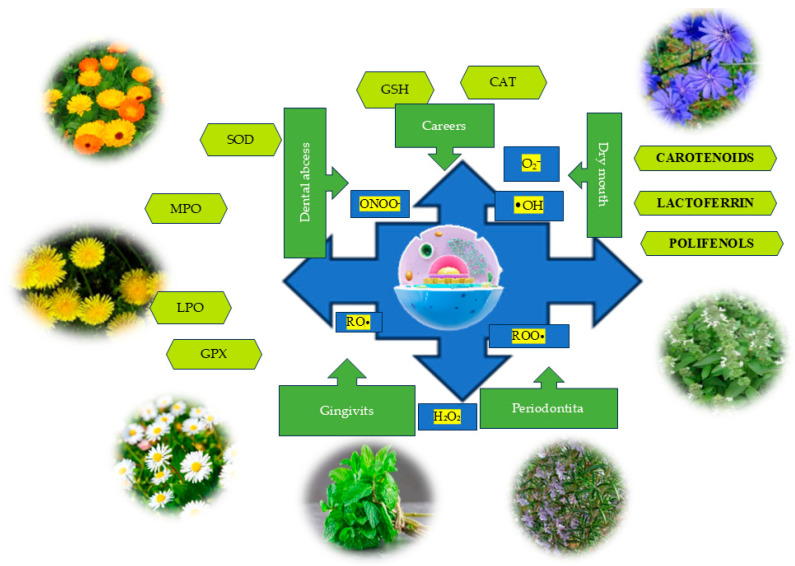
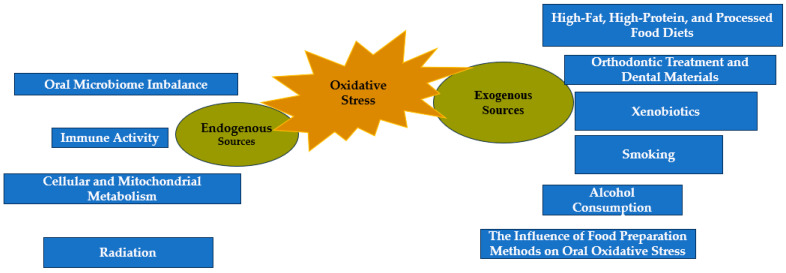
Verification
Claims the paper makes
The claims and statistics of this paper haven’t been checked yet.
Run the check — free, no account needed. It reads the open-access text and checks the sources it cites.
Claims other papers make about this one
Each is checked against this paper’s own text: does it say what the citing paper says it does?
The source backs part of the claim, not all of it — or backs it for a different population, condition or comparison.
In the citing paper
“Berberine reaches high local concentrations there before absorption and, being broadly antibacterial, can act on that community [107].”
From Berberine-Drug Interactions: Mechanisms, Clinical Relevance and Risk Stratification-A Narrative Review (2026) · cites this paper as [107]
Experimental — accuracy not yet measuredThe source backs part of the claim, not all of it — or backs it for a different population, condition or comparison.
In the citing paper
“The oral compartment, where berberine reaches its highest concentrations of all, is unexamined and belongs in the same program [103,104,105,106,107,108].”
From Berberine-Drug Interactions: Mechanisms, Clinical Relevance and Risk Stratification-A Narrative Review (2026) · cites this paper as [107]
Experimental — accuracy not yet measuredThe check wasn’t confident either way, so it gives no verdict — never disputed.
In the citing paper
“No study has yet measured the disposition of a co-administered drug before and after berberine while characterizing the microbiota in the same subjects, which is what would move Axis 4 from candidate to demonstrated.”
From Berberine-Drug Interactions: Mechanisms, Clinical Relevance and Risk Stratification-A Narrative Review (2026) · cites this paper as [107]
Experimental — accuracy not yet measured
Self-check
Percentages, sums and reported differences re-computed from the paper’s own numbers.
The self-check needs the paper’s full text.
Citations
Cites
1 retracted
Gunasekaran, S., Nayagam, A. A. J., & Natarajan, R. (2020) · Clinical Phytoscience · doi:10.1186/s40816-020-00215-7 · Cited by 31
RetractedFree radicals and antioxidants in normal physiological functions and human disease
Valko, M., Leibfritz, D., Moncol, J., Cronin, M. T. D., Mazur, M., & Telser, J. (2007) · The International Journal of Biochemistry & Cell Biology · doi:10.1016/j.biocel.2006.07.001 · Cited by 14,269
Free Radicals in Biology and Medicine
Halliwell, B., & Gutteridge, J. M. C. (2015) · doi:10.1093/acprof:oso/9780198717478.001.0001 · Cited by 8,990
Ayala, A., Muñoz, M., & Argüelles, S. (2014) · Oxidative Medicine and Cellular Longevity · doi:10.1155/2014/360438 · Cited by 6,837
Free radicals, metals and antioxidants in oxidative stress-induced cancer
Valko, M., Rhodes, C. J., Moncol, J., Izakovic, M., & Mazur, M. (2006) · Chemico-Biological Interactions · doi:10.1016/j.cbi.2005.12.009 · Cited by 6,680
Panche, A. N., Diwan, A. D., & Chandra, S. (2016) · Journal of Nutritional Science · doi:10.1017/jns.2016.41 · Cited by 5,953
Oxidative Stress: Harms and Benefits for Human Health
Pizzino, G., Irrera, N., Cucinotta, M., Pallio, G., Mannino, F., Arcoraci, V., Squadrito, F., Altavilla, D., & Bitto, A. (2017) · Oxidative Medicine and Cellular Longevity · doi:10.1155/2017/8416763 · Cited by 4,837
Oral diseases: a global public health challenge
Peres, M. A., Macpherson, L. M. D., Weyant, R. J., Daly, B., Venturelli, R., Mathur, M. R., Listl, S., Celeste, R. K., Guarnizo-Herreño, C. C., Kearns, C., et al. (2019) · The Lancet · doi:10.1016/s0140-6736(19)31146-8 · Cited by 4,054
Oxidative stress, aging, and diseases
Liguori, I., Russo, G., Curcio, F., Bulli, G., Aran, L., Della-Morte, D., Gargiulo, G., Testa, G., Cacciatore, F., Bonaduce, D., et al. (2018) · Clinical Interventions in Aging · doi:10.2147/cia.s158513 · Cited by 3,979
Rayman, M. P. (2012) · The Lancet · doi:10.1016/s0140-6736(11)61452-9 · Cited by 3,563
Research works printed but not linked: 15
- Bahrim, 2013, Phenolics composition and their biochemical stability confirmation by in vitro, gastrointestinal conditions simulation, for a new functional fermented beverage based on sprouted buckwheat, Rom, Biotechnol. Lett., 18, 8832
- Huda, 2012, Trace elements and oxidative strss markers in saliva of subjects with amalgam fillings, J. Bangh. Coll. Dent., 24, 63
- Daokar, 2016, Assessment of Oxidative Stress Induced by Various Restorative Materials: An In Vivo Biochemical Study, J. Int. Oral Health, 8, 670
- Rai, 2006, Salivary lipid peroxidation product malonaldehyde in various dental diseases, World J. Med. Sci., 1, 100
- Han, Y., Wang, X., Zhang, Y., and Ding, Y. (2023). NLRP3 inflammasome activity and periodontal disease pathogenesis–A comprehensive review. J. Oral Microbiol., 15.
- Mancini, 2023, Oxidative Stress and Inflammation in Osteoporosis, Antioxidants, 12, 642
- 2020, Glutathione Peroxidase in Health and Diseases. Glutathione System and Oxidative Stress in Health and Disease, IntechOpen, 49, 1
- Narang, 2019, Estimation of salivary uric acid in dental caries: A biochemical study, J. Adv. Med. Dent. Scie. Res., 7, 106
- (2022). Chapter 6—Plant polyphenols as potent antioxidants: Highlighting the mechanism of antioxidant activity and synthesis/development of some polyphenol conjugates. Studies in Natural Products Chemistry, Elsevier.
- Rahimullah, 2019, Phytochemical and antibacterial screening of Cichorium intybus seeds used in traditional medicine systems of Pakistan, Int. J. Basic Med. Pharmacol., 8, 2049
- Upadhayay, V.K., Pandey, D., Singh, S.P., and Gohat, T. (2021). Chicory (Cichorium intybus): An ethnomedicinal plant with broad-spectrum medicinal properties. Plant Secondary Metabolites for Human Health, Discovery Publishing House Pvt. Ltd.. Chapter 12.
- Kumar, 2024, Plant polyphenols, terpenes, and terpenoids in oral health: A comprehensive review, J. Med. Plants Res., 18, 123
- Tewari, 2015, Phytochemical, anti-oxidant and antidepressant evaluation of Ocimum basilicum enuiflorum kilimandscharicum grown in India, J. Biol. Active Prod. Nat., 5, 120
- Souza, 2017, Evaluation of basil extract (Ocimum basilicum) on oxidative, antigenotoxic and anti-inflammatory effects in human leukocytes cell cultures exposed to challenging agents, Brazil J. Pharm. Sci., 53, e15098
- 2015, Review of ethnobotanical, phytochemical, and pharmacological study of Thymus serpyllum L., Evid. Based Complement. Alternat. Med., 2015, 101978
Cited by
Sorted by citations
Mechanistic and Therapeutic Insights into Nrf2-Mediated Redox Regulation in Periodontitis
Wada, S., Nakano, H., Sawai, Y., Yamauchi, Y., Hasumoto, M., Mitate, E., & Demura, N. (2026) · Antioxidants · doi:10.3390/antiox15010072 · Cited by 8
Dumitru, C. N., Dumitru, A. O., Popa, G. V., Marcu, T., Ursu, M., Nechita, A., & Matei, N. M. (2026) · Dentistry Journal · doi:10.3390/dj14050289 · Cited by 6
“…critical role in modulating the severity of periodontal tissue destruction and its systemic consequences; both endogenous and exogenous sources of ROS contribute to this redox imbalance, and plant-derived antioxidants have been proposed as adjunctive modulators of the oral inflammatory milieu [50].”
Self-citationDumitru, C. N., Vizireanu, C., Bahrim, G. E., Dinică, R. M., Lupoae, M., Dumitru, A. O., & Gurau, T. V. (2025) · Beverages · doi:10.3390/beverages11040104 · Cited by 5
Self-citationXu, M., Li, G., Tian, J., Xie, F., Zuo, J., Hu, J., Yin, K., & Wang, W. (2026) · Frontiers in Cellular and Infection Microbiology · doi:10.3389/fcimb.2025.1738047 · Cited by 5
Dumitru, C. N., Marcu, T., Dumitru, A. O., Tudor, S. S., Ferțu, I. D., Elisei, A.-M., & Goroftei, L. (2026) · Pharmaceuticals · doi:10.3390/ph19081313 · Cited by 2
“Berberine reaches high local concentrations there before absorption and, being broadly antibacterial, can act on that community [107].”
Self-citationPeriodontal Health and Total Antioxidant Capacity for Jordanian Smokers at Dental Teaching Clinic
Mortadi, N. A., Al-Qudah, K. M., Alshatrat, S. M., Alzoubi, K. H., & Mahafdeh, R. (2025) · International Journal of Dentistry · doi:10.1155/ijod/3075190 · Cited by 2
Matanaq, H. R., Mohammadzadeh, A., Sheykhsaran, E., Abbasi, A., Jafari-Sales, A., Rasizadeh, R., & Baghi, H. B. (2026) · Future Virology · doi:10.1080/17460794.2026.2635310 · Cited by 1
Dumitru, C. N., Dumitru, A. O., Marcu, T., Earar, K., Matei, N. M., & Buzia, O. D. (2026) · Pharmaceutics · doi:10.3390/pharmaceutics18081011 · Cited by 1
Self-citationRarinca, V., Ionescu, C., Visternicu, M., Ciobica, A., Vlasie, I., Trifan, A. V., Burlui, V., Miler, A. A., Luca, A., Novac, O., et al. (2026) · Frontiers in Dental Medicine · doi:10.3389/fdmed.2026.1931973 · Cited by 1
Mulaudzi, M. L., Ndhlala, A. R., Makola, R. T., & Masoko, P. (2026) · South African Journal of Botany · doi:10.1016/j.sajb.2026.08.054 · Cited by 1
Mutagenicity and carcinogenicity of African medicinal plants: an update
Akhigbe, R. E., Ashonibare, V. J., Akorede, B. A., & Akhigbe, T. M. (2026) · Elsevier eBooks · doi:10.1016/b978-0-443-45179-9.00003-3
Chen, S., Tang, T., Junhong, Y., Liu, B. Y., Wang, D., Lin, D., Yang, X., Li, P., Zhang, W., & Zhang, N. (2026) · Frontiers in Pharmacology · doi:10.3389/fphar.2026.1787487
Khan, M. A., & Younus, H. (2026) · Biology · doi:10.3390/biology15120928
Geranium robertianum L. in Oral Health: From Phytochemical Profile to Therapeutic Potential
Feher, A., Bora, L., Ungureanu, D., Danciu, C., Dinu, Ş., Avram, Ș., Dehelean, C. A., & Popovici, R. A. (2026) · Dentistry Journal · doi:10.3390/dj14080505
Oxidative stress: mechanisms, implications and emerging therapeutic strategies
Namratha, B., Martis, G. J., Sushma, S., Hakkimane, S. S., & Gaonkar, S. L. (2026) · Advances in Redox Research · doi:10.1016/j.arres.2026.100191
Tiber, P. M., Delibalta, B., & Atlıhan, İ. (2026) · European Journal of Biology · doi:10.26650/eurjbiol.2026.1877983
Amin, A., Thalib, A. M., Thalib, B., Azizah, A. D., & Toripuji, Z. T. (2026) · Makassar Dental Journal
Dumitru, C. N., Marcu, T., Dumitru, A. O., & Matei, M. N. (2026) · Pharmaceuticals · doi:10.3390/ph19101661
Self-citationAliberti, A., Coppola, N., Gasparro, R., Trosino, O., Sammartino, J. C., & Sammartino, G. (2026) · Frontiers in Oral Health · doi:10.3389/froh.2026.1976898
Metadata
- Authors
- Dumitru, C. N., Mariana, L., Budacu, C. C., Mitea, G., Radu, M. D., Dumitru, A. O., Lupoae, A., Tatu, A., & Topor, G.
- Affiliations
- "Dunarea de Jos" University of Galati (RO)
- Department of Pharmaceutical Sciences, Faculty of Medicine and Pharmacy, “Dunărea de Jos” University, 800010 Galati, Romania
- Grigore T. Popa University of Medicine and Pharmacy (RO)
- Ovidius University (RO)
- Emergency Clinical Hospital “St. Apostle Andrew”, 800010 Galati, Romania
- Corresponding author
- Budacu, Cristian Constantin
- ORCID
- Venue
- Dentistry Journal
- Publisher
- MDPI AG
- Published
- 2025-05-21
- Volume
- 13
- Issue
- 5
- Pages
- 222
- ISSN
- 2304-6767 (ISSN-L)
- PMC
- PMC12110304
- OpenAlex
- W4410564845
- Cited by
- 17
- References
- 381
- Citations by year
- 2026: 15 · 2025: 2
- FWCI
- 2.89
- Type
- journal article
- Language
- en
- Open access
- gold
- doi.org
- Licence
- Locations
- Dentistry Journal (publishedVersion, cc-by)
- PubMed Central (publishedVersion, cc-by)
- PubMed (publishedVersion)
- DOAJ (DOAJ: Directory of Open Access Journals) (submittedVersion, cc-by-sa)
- Topics
- Health Sciences › Dentistry › Periodontics › Oral microbiology and periodontitis research
- Life Sciences › Agricultural and Biological Sciences › Plant Science › Medicinal Plant Research
- Health Sciences › Medicine › Biochemistry (medical) › Phytochemicals and Antioxidant Activities
- Keywords
- oxidative stress, reactive oxygen species, reactive nitrogen species, antioxidant activity, medicinal plants, Asteraceae, Lamiaceae, oral health, periodontitis, dental caries, gingivitis, recurrent aphthous stomatitis, oral cancer, polyphenols, flavonoids, essential oils, herbal medicine, chamomile, Calendula officinalis, chicory, Taraxacum officinale, Arctium lappa, yarrow, Solidago virgaurea, anti-inflammatory activity, antimicrobial activity
About these checks
Registry, retraction, Cites and statistics results are computed, not judged, with one exception: a printed reference that no index lists is read once by a model before it counts as a citation error. Claims are extracted by a model and kept only when their quote appears verbatim in the text; each cited source is then checked, with a model’s help, for whether it says what the claim relies on. Those verdicts can be wrong — read the claim’s quote and the cited source before relying on one.
Statistics and arithmetic are recomputed, not judged.
Confidence bands are shown only for fields calibrated on our annotated test set. None is calibrated yet, so no band is shown.
What counts as a claim ›How we measure confidence ›How we check this ›
Are you an author, or do you see a problem with this page? Request a review
