

Extrusive Luxation Injuries in Young Patients: A Retrospective Study with 5-Year Follow-Up
Open accessThe DOI matches its Crossref record; 52 of the 58 references it cites were found in a registry or an index, and 1 are not checked yet; 5 of the 84 sources its claims cite were checked for support.
Abstract
(1) Background: The purpose of this study was to analyze the influence of the chosen diagnostic and therapeutic approach (repositioning and splinting methods) on the risk, frequency and timing of the onset of pulp canal obliteration and pulp necrosis following extrusive luxation in young patients with permanent dentition. (2) Methods: From an initial sample of 50 subjects affected by extrusive luxation, were selected the clinical data of 13 patients presenting extrusive luxation but no other type of injury to the dental hard tissue. All teeth were examined according to a standardized protocol. Follow-up examinations were performed at regular intervals for 5 years. Statistical associations between pulp consequences and several covariates were assessed using the Mann-Whitney test and Fisher's exact test. (3) Results: Among the 13 studied teeth, only 1 healed completely, whereas 9 showed pulp obliteration and 3 developed pulp necrosis. No tooth with obliteration developed pulp necrosis. The average time to treatment was 11.9 h. The treatment approaches used were manual repositioning, orthodontic repositioning and stabilization splinting. "Time to treatment" was the only covariate that showed a weak statistical association with the onset of pulp consequences. (4) Conclusions: There is still uncertainty over the most appropriate therapeutic approach to adopt in young patients with extrusive luxation injuries, particularly for repositioning of the injured tooth. Extruded teeth should be treated as soon as possible after the traumatic event. This study highlighted the value of orthodontic repositioning of the extruded tooth, which does not seem to aggravate the conditions of the dental pulp. In addition, the study confirmed that prophylactic endodontic treatment is not appropriate for immature teeth affected by extrusive luxation injuries, given the extreme rarity of pulp necrosis in teeth already affected by pulp obliteration.
Verified 2026-11-22 · 1 reference not checked yet
Overview
CoChat Summary
## TL;DR
This retrospective study followed 13 extruded permanent incisors in 10 patients aged 8–16 years for 5 years to assess pulp canal obliteration (PCO), pulp necrosis (PN), and related factors. Most teeth developed PCO or PN, and the paper concludes that earlier treatment and manual repositioning are preferred, while orthodontic repositioning did not appear to worsen pulp outcomes.
## Key findings
- Among the 13 analyzed teeth, 9 showed PCO, 3 developed PN, and 1 healed physiologically; no tooth with PCO developed PN during follow-up.
- The average time to treatment was 11.9 h; time to treatment was the only covariate with a weak statistical association with pulp consequences (p = 0.060).
- Severity of extrusion was not significantly associated with pulp consequences (p = 0.634), and type of splinting was not significantly associated with pulp consequences (p = 0.345).
- PCO was observed in 7 immature and 2 mature teeth; PN occurred in 1 open-apex and 2 closed-apex teeth.
## Methods
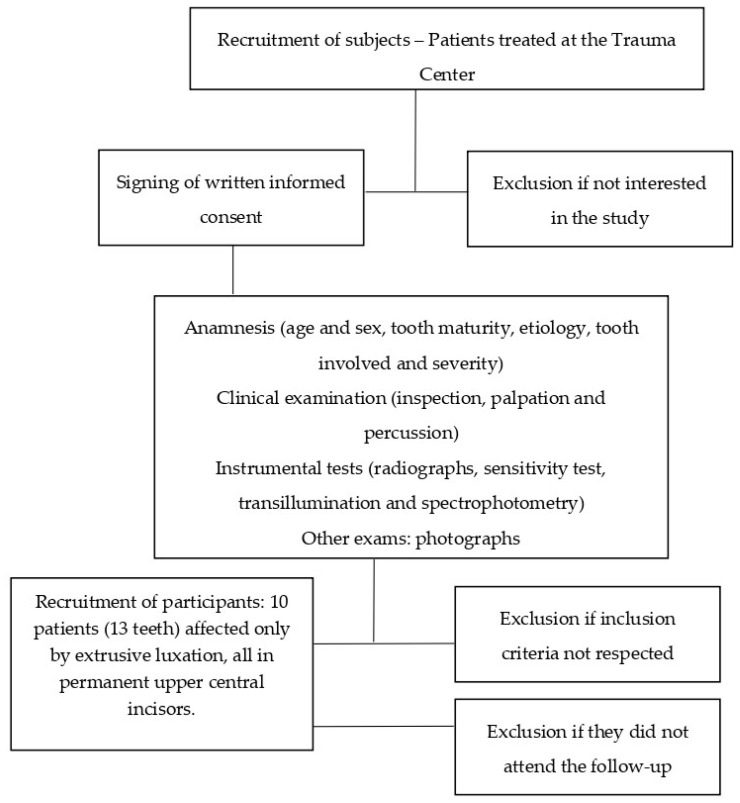
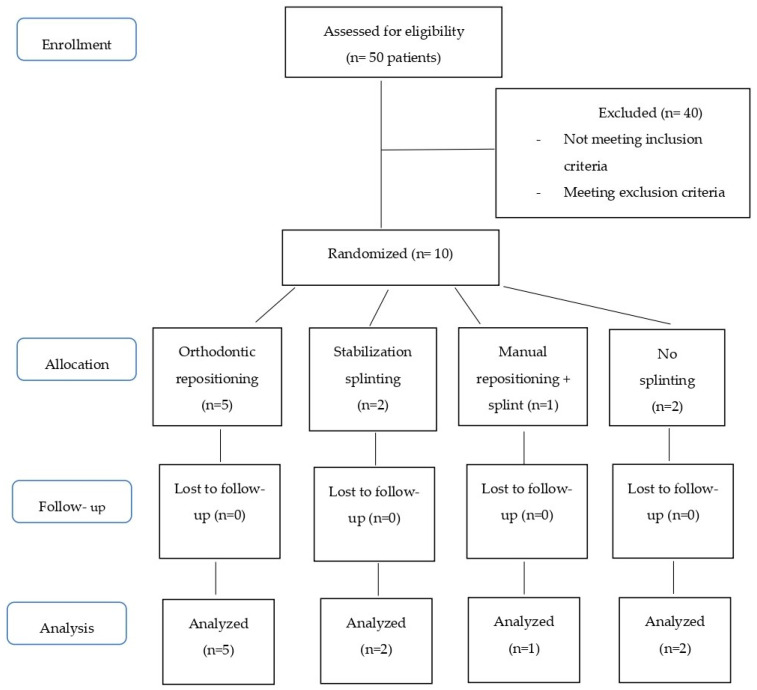
- Retrospective observational study at the Dental Traumatology Centre, University of Cagliari, using records from 50 patients treated between 2008 and 2015; strict criteria yielded 10 patients / 13 teeth with isolated extrusive luxation of permanent incisors and at least 5 years of follow-up.
- Data collected included age, sex, etiology, tooth involved, extrusion severity, time to treatment, root apex maturity, treatment type, pulp sensitivity, radiographs, and crown color changes; follow-up occurred at 2 weeks, 4 weeks, 6–8 weeks, 6 months, 1 year, and annually for 5 years.
- Associations between pulp consequences and covariates were tested with Mann–Whitney tests and Fisher exact tests (significance set at p < 0.05).
## Limitations
- The paper explicitly notes the small sample size and says that not all variables could be analyzed statistically.
- The study is retrospective and from a single center with only 13 teeth, which the text makes evident as a limitation (inferred from the design and sample size).
- The authors state that the scarcity of extrusion-specific literature and limited evidence on management mean the findings should be interpreted cautiously; they also call for a larger sample and future meta-analyses.
Model-written summary. Check it against the paper before relying on it.
Integrity signals
Registry
Cites
Statistics
Figures
Verification
Claims the paper makes
4 Valid · 1 Not valid · 42 Not checked · 52 Own results and interpretations
The sources with a verdict support this claim; the rest weren’t checked yet, have no full text we could read, or their verdicts aren’t rated yet.
In the paper
“since they can arise weeks, months or years after the trauma, long-term follow-up is essential [11,13,14]”
§ Extrusive Luxation Injuries in Young Patients: A Retrospective Study with 5-Year Follow-Up > 1. Introduction
What the sources say
- Supportedcites [11] Bourguignon C. Cohenca N. Lauridsen E. Flores M.T. O’Connell A.C. Day P.F. Tsilingaridis G. Abbott P.V. Fouad A. Hicks L. International Association of Dental Traumatology guidelines for the management of traumatic dental injuries: 1. Fractures and luxations Dent. Traumatol. 2020 36 314 330 10.1111/edt.12578 32475015 source
The ‘Follow-ups and detection of post-traumatic complications’ section says follow-ups are mandatory and identifies pulp and periodontal complications to monitor. The treatment tables schedule checks after weeks and months, then yearly for at least five years, supporting the need for long-term follow-up, although the paper does not state the onset window in those exact words (page numbers unavailable). (LLM, conf=0.86)
- Not checked — no full text of the sourcecites [13] Andreasen F.M. Pedersen B.V. Prognosis of luxated permanent teeth--the development of pulp necrosis Endod. Dent. Traumatol. 1985 1 207 220 10.1111/j.1600-9657.1985.tb00583.x 3867505 source
- Not checked — no full text of the sourcecites [14] Hecová H. Tzigkounakis V. Merglova V. Netolický J. A retrospective study of 889 injured permanent teeth Dent. Traumatol. 2010 26 466 475 10.1111/j.1600-9657.2010.00924.x 20946344 source
plainstates a cause- Asserted: passes — The authors put it forward as true.
- Checkable: passes — It can be checked against evidence.
- Load-bearing: passes — The paper’s conclusions depend on it.
- Based: passes — The paper gives a reason why it holds.
- Supported
The cited sources support only part of this claim — read each source’s verdict below.
In the paper
“PN, when it arises after an extrusion injury, often occurs within the first year of the traumatic event [13,18].”
§ Extrusive Luxation Injuries in Young Patients: A Retrospective Study with 5-Year Follow-Up > 4. Discussion > 4.2. Onset Times and Frequency of PN and PCO with Respect to the Severity of the Extrusion
What the sources say
- Not checked — no full text of the sourcecites [13] Andreasen F.M. Pedersen B.V. Prognosis of luxated permanent teeth--the development of pulp necrosis Endod. Dent. Traumatol. 1985 1 207 220 10.1111/j.1600-9657.1985.tb00583.x 3867505 source
- Partly supportedcites [18] Lin S. Pilosof N. Karawani M. Wigler R. Kaufman A.Y. Teich S.T. Occurrence and timing of complications following traumatic dental injuries: A retrospective study in a dental trauma department J. Clin. Exp. Dent. 2016 8 e429 e436 10.4317/jced.53022 27703612 PMC5045691 sourceExperimental — accuracy not yet measured
The Discussion says that most pulp necrosis in the study occurred within the first year after trauma. It does not give that timing specifically for extrusion injuries, so the claim applies a general finding to a narrower injury type. (LLM, conf=0.85)
plainstates an association- Asserted: passes — The authors put it forward as true.
- Checkable: passes — It can be checked against evidence.
- Load-bearing: unclear — It is unclear whether the paper’s conclusions depend on it.
- Based: passes — The paper gives a reason why it holds.
A result the paper reports from its own data — it cites no other source for it, so there is none to check. The quote shows it is in the paper.
In the paper
“No statistically significant association was found between the severity of the extrusion and the PCs (p = 0.634; Table 1).”
§ Extrusive Luxation Injuries in Young Patients: A Retrospective Study with 5-Year Follow-Up > 3. Results > 3.2. Severity of the Extrusion
plain- Asserted: passes — The authors put it forward as true.
- Checkable: passes — It can be checked against evidence.
- Load-bearing: unclear — It is unclear whether the paper’s conclusions depend on it.
- Based: passes — The paper gives a reason why it holds.
A result the paper reports from its own data — it cites no other source for it, so there is none to check. The quote shows it is in the paper.
In the paper
“No tooth with obliteration developed pulp necrosis.”
§ Extrusive Luxation Injuries in Young Patients: A Retrospective Study with 5-Year Follow-Up > Abstract (1) Background: The purpose of this study was to analyze the influence of the chosen diagnostic and therapeutic approach (repositioning and splinting methods) on the risk, frequency and timing of the onset of pulp canal obliteration and pulp necrosis following extrusive luxation in young patients with permanent dentition. (2) Methods: From an initial sample of 50 subjects affected by extrusive luxation, were selected the clinical data of 13 patients presenting extrusive luxation but no other type of injury to the dental hard tissue. All teeth were examined according to a standardized protocol. Follow-up examinations were performed at regular intervals for 5 years. Statistical associations between pulp consequences and several covariates were assessed using the Mann–Whitney test and Fisher’s exact test. (3) Results: Among the 13 studied teeth, only 1 healed completely, whereas 9 showed pulp obliteration and 3 developed pulp necrosis. No tooth with obliteration developed pulp necrosis. The average time to treatment was 11.9 h. The treatment approaches used were manual repositioning, orthodontic repositioning and stabilization splinting. “Time to treatment” was the only covariate that showed a weak statistical association with the onset of pulp consequences. (4) Conclusions: There is still uncertainty over the most appropriate therapeutic approach to adopt in young patients with extrusive luxation injuries, particularly for repositioning of the injured tooth. Extruded teeth should be treated as soon as possible after the traumatic event. This study highlighted the value of orthodontic repositioning of the extruded tooth, which does not seem to aggravate the conditions of the dental pulp. In addition, the study confirmed that prophylactic endodontic treatment is not appropriate for immature teeth affected by extrusive luxation injuries, given the extreme rarity of pulp necrosis in teeth already affected by pulp obliteration.
plainn = 13- Asserted: passes — The authors put it forward as true.
- Checkable: passes — It can be checked against evidence.
- Load-bearing: passes — The paper’s conclusions depend on it.
- Based: passes — The paper gives a reason why it holds.
A result the paper reports from its own data — it cites no other source for it, so there is none to check. The quote shows it is in the paper.
In the paper
“The average time to treatment was 11.9 h.”
- Also stated in: § 3.3. Time to Treatment · plain
“The average time to treatment in this sample (calculated considering the 10 patients) was 11.9 h.”
§ Extrusive Luxation Injuries in Young Patients: A Retrospective Study with 5-Year Follow-Up > Abstract (1) Background: The purpose of this study was to analyze the influence of the chosen diagnostic and therapeutic approach (repositioning and splinting methods) on the risk, frequency and timing of the onset of pulp canal obliteration and pulp necrosis following extrusive luxation in young patients with permanent dentition. (2) Methods: From an initial sample of 50 subjects affected by extrusive luxation, were selected the clinical data of 13 patients presenting extrusive luxation but no other type of injury to the dental hard tissue. All teeth were examined according to a standardized protocol. Follow-up examinations were performed at regular intervals for 5 years. Statistical associations between pulp consequences and several covariates were assessed using the Mann–Whitney test and Fisher’s exact test. (3) Results: Among the 13 studied teeth, only 1 healed completely, whereas 9 showed pulp obliteration and 3 developed pulp necrosis. No tooth with obliteration developed pulp necrosis. The average time to treatment was 11.9 h. The treatment approaches used were manual repositioning, orthodontic repositioning and stabilization splinting. “Time to treatment” was the only covariate that showed a weak statistical association with the onset of pulp consequences. (4) Conclusions: There is still uncertainty over the most appropriate therapeutic approach to adopt in young patients with extrusive luxation injuries, particularly for repositioning of the injured tooth. Extruded teeth should be treated as soon as possible after the traumatic event. This study highlighted the value of orthodontic repositioning of the extruded tooth, which does not seem to aggravate the conditions of the dental pulp. In addition, the study confirmed that prophylactic endodontic treatment is not appropriate for immature teeth affected by extrusive luxation injuries, given the extreme rarity of pulp necrosis in teeth already affected by pulp obliteration.
plainn = 10- Asserted: passes — The authors put it forward as true.
- Checkable: passes — It can be checked against evidence.
- Load-bearing: unclear — It is unclear whether the paper’s conclusions depend on it.
- Based: passes — The paper gives a reason why it holds.
- Rests on an assumption not shown here.
- Also stated in: § 3.3. Time to Treatment · plain
25 more claims
Create a free account to see all 99 claims and to verify the 10 references still open.
- Probably not a substantial claim. 34
- It may state two separate claims as one. 44
Self-check
Percentages, sums and reported differences re-computed from the paper’s own numbers.
Each contradiction between two passages listed here was confirmed by an independent check.
Rated minor: it would not touch a result — a value no result rests on, a p-value that stays on the same side of the significance level, or a conflict that is clerical, resolved elsewhere in the paper, or outside its own findings.
In the paper
§ Extrusive Luxation Injuries in Young Patients: A Retrospective Study with 5-Year Follow-Up > Abstract
“From an initial sample of 50 subjects affected by extrusive luxation, were selected the clinical data of 13 patients presenting extrusive luxation but no other type of injury to the dental hard tissue.”
§ Extrusive Luxation Injuries in Young Patients: A Retrospective Study with 5-Year Follow-Up > 2. Materials and Methods
“Application of these strict criteria yielded a final sample of 10 patients (5 males and 5 females), with a total of 13 teeth, all permanent upper central incisors, affected only by extrusive luxation.”
Rated minor: it would not touch a result — a value no result rests on, a p-value that stays on the same side of the significance level, or a conflict that is clerical, resolved elsewhere in the paper, or outside its own findings.
In the paper
§ Extrusive Luxation Injuries in Young Patients: A Retrospective Study with 5-Year Follow-Up > Abstract
“Among the 13 studied teeth, only 1 healed completely, whereas 9 showed pulp obliteration and 3 developed pulp necrosis.”
§ Extrusive Luxation Injuries in Young Patients: A Retrospective Study with 5-Year Follow-Up > 2. Materials and Methods
“Application of these strict criteria yielded a final sample of 10 patients (5 males and 5 females), with a total of 13 teeth, all permanent upper central incisors, affected only by extrusive luxation.”
Citations
Cites
Landis, J. R., & Koch, G. G. (1977) · Biometrics · doi:10.2307/2529786 · Cited by 4,332 · cited 1×
“The kappa test was run to evaluate the level of agreement between these experts, and it was found to be “moderate” (Landis and Koch, 1977) [26].”
MethodAge Variation of Formation Stages for Ten Permanent Teeth
Moorrees, C. F. A., Fanning, E. A., & Hunt, E. E. (1963) · Journal of Dental Research · doi:10.1177/00220345630420062701 · Cited by 2,215 · cited 2×
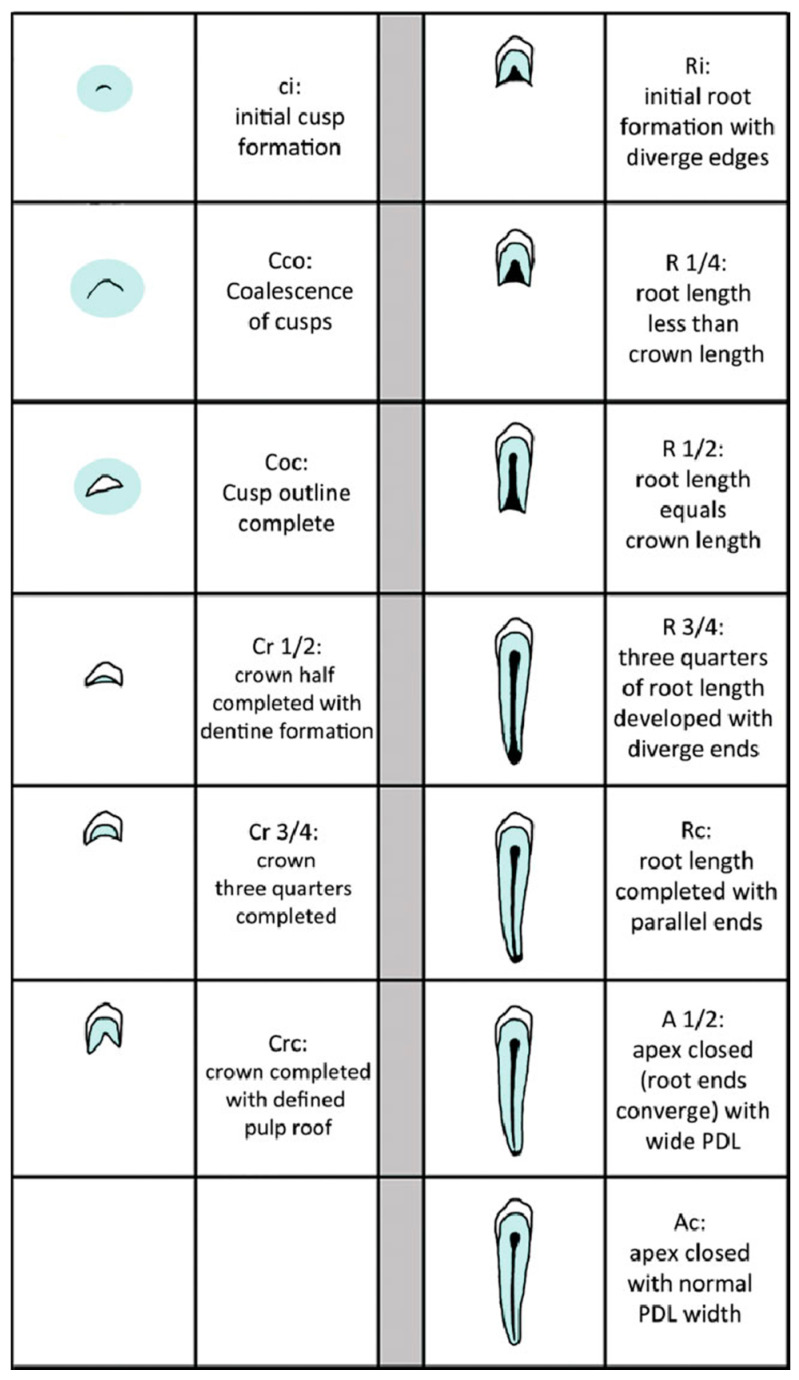
“The stage of root development at the time of injury was established using the classification system introduced by Moorrees [30].”
MethodTextbook and Color Atlas of Traumatic Injuries to the Teeth
J.O. Andreasen, F. M. A. O. L. A., & Aas, A.-L. M. (2008) · Den norske tannlegeforenings Tidende · doi:10.56373/2008-1-28 · Cited by 831
Bourguignon, C., Cohenca, N., Lauridsen, E., Flores, M. T., O'Connell, A. C., Day, P. F., Tsilingaridis, G., Abbott, P. V., Fouad, A. F., Hicks, L., et al. (2020) · Dental Traumatology · doi:10.1111/edt.12578 · Cited by 803 · cited 9×
“Radiographically, the apical and lateral parts of the socket appear empty [11] and, overall, the periodontal ligament space is enlarged [5,6].”
BackgroundMethodInfluentialDiAngelis, A. J., Andreasen, J. O., Ebeleseder, K. A., Kenny, D. J., Trope, M., Sigurdsson, A., Andersson, L., Bourguignon, C., Flores, M. T., Hicks, M. L., et al. (2012) · Dental Traumatology · doi:10.1111/j.1600-9657.2011.01103.x · Cited by 597
Etiology and pathogenesis of traumatic dental injuries A clinical study of 1,298 cases
ANDREASEN, J. O. (1970) · European Journal of Oral Sciences · doi:10.1111/j.1600-0722.1970.tb02080.x · Cited by 562
Prognosis of luxated permanent teeth--the development of pulp necrosis
Andreasen, F. M., & Pedersen, B. V. (1985) · Dental Traumatology · doi:10.1111/j.1600-9657.1985.tb00583.x · Cited by 419 · cited 6×
“This should be followed by long-term monitoring of the tooth [11,13,14].”
BackgroundInfluentialPulp canal obliteration: An endodontic diagnosis and treatment challenge
McCabe, P. S., & Dummer, P. M. H. (2012) · International Endodontic Journal · doi:10.1111/j.1365-2591.2011.01963.x · Cited by 403 · cited 2×
“The development of PN following PCO is uncommon (reported in between 1 and 27% of cases) [48].”
BackgroundAndreasen, J. O., Andreasen, F. M., Skeie, A., Hjørting‐Hansen, E., & Schwartz, O. (2002) · Dental Traumatology · doi:10.1034/j.1600-9657.2002.00079.x · Cited by 354
Flores, M. T., Andersson, L., Andreasen, J. O., Bakland, L. K., Malmgren, B., Barnett, F., Bourguignon, C., DiAngelis, A., Hicks, L., Sigurdsson, A., et al. (2007) · Dental Traumatology · doi:10.1111/j.1600-9657.2007.00592.x · Cited by 351
Cited by
Hu, S., Wang, S., He, Q., Li, D., Xin, L., Xu, C., Zhu, X., Li, M., Cannon, R. D., Ji, P., et al. (2023) · Advanced Science · doi:10.1002/advs.202206450 · Cited by 50
Use of Orthodontic Methods in the Treatment of Dental Luxations: A Scoping Review
Spinas, E., Pipi, L., Mezzena, S., & Giannetti, L. (2021) · Dentistry Journal · doi:10.3390/dj9020018 · Cited by 27
Self-citationRoot Fracture and Extrusive Luxation in Primary Teeth and Their Management: A Case Report
Giorgio, G. D., Zumbo, G., Saccucci, M., Luzzi, V., Ierardo, G., Biagi, R., & Bossù, M. (2021) · Dentistry Journal · doi:10.3390/dj9090107 · Cited by 13
Abreu, M. G. L., Fernandes, T. D. O., Antunes, L. S., Antunes, L. A. A., & Maia, L. C. (2024) · Brazilian Oral Research · doi:10.1590/1807-3107bor-2024.vol38.0092 · Cited by 17
Bardini, G., Musu, D., Mezzena, S., Dettori, C., & Cotti, E. (2021) · Dentistry Journal · doi:10.3390/dj9040039 · Cited by 8
Self-citation
Metadata
- Authors
- Spinas, E., Pipi, L., & Dettori, C.
- Affiliations
- University of Cagliari (IT)
- Corresponding author
- Pipi, Laura
- Venue
- Dentistry Journal
- Publisher
- MDPI AG
- Published
- 2020-12-16
- Volume
- 8
- Issue
- 4
- Pages
- 136
- ISSN
- 2304-6767 (ISSN-L)
- PMC
- PMC7765625
- OpenAlex
- W3113345538
- Cited by
- 15
- References
- 58
- Citations by year
- 2026: 1 · 2025: 4 · 2024: 2 · 2023: 2 · 2022: 2 · 2021: 4
- FWCI
- 1.87
- Type
- journal article
- Language
- en
- Open access
- gold
- doi.org
- Licence
- Locations
- Dentistry Journal (publishedVersion, cc-by)
- PubMed Central (publishedVersion, cc-by)
- PubMed (publishedVersion)
- DOAJ (DOAJ: Directory of Open Access Journals) (submittedVersion, cc-by-sa)
- UNICA IRIS Institutional Research Information System (University of Cagliari) (submittedVersion, other-oa)
- Topics
- Health Sciences › Dentistry › General Dentistry › Dental Trauma and Treatments
- Health Sciences › Medicine › Surgery › Facial Trauma and Fracture Management
- Health Sciences › Dentistry › Oral Surgery › Endodontics and Root Canal Treatments
- Keywords
- extrusive luxation, dental trauma, pulp canal obliteration, pulp necrosis, manual repositioning, time to treatment, immature permanent teeth, endodontic treatment, young patients
About these checks
Registry, retraction, Cites and statistics results are computed, not judged, with one exception: a printed reference that no index lists is read once by a model before it counts as a citation error. Claims are extracted by a model and kept only when their quote appears verbatim in the text; each cited source is then checked, with a model’s help, for whether it says what the claim relies on. Those verdicts can be wrong — read the claim’s quote and the cited source before relying on one.
The claim verdicts this report counts are experimental: their accuracy is not yet measured.
A language model drew the claims from the paper on 2026-10-10, under version 3 of the claim definition (model deepseek-v4.1-flash, prompt extract-v3).
A second model labelled each claim on 2026-10-10 (model jev-1.13-20260917, definition revision gold-guideline-v0.2).
Cited sources are checked with a language model’s help (gpt-6-sol).
Statistics and arithmetic are recomputed, not judged.
Confidence bands are shown only for fields calibrated on our annotated test set. None is calibrated yet, so no band is shown.
What counts as a claim ›How we measure confidence ›How we check this ›
Are you an author, or do you see a problem with this page? Request a review
Data sources
Bibliographic data: Semantic Scholar, OpenAlex, Crossref.
Contains information from the Semantic Scholar Academic Graph Datasets, made available under the ODC Attribution License (ODC-BY 1.0).
Semantic Scholar’s data is described in: Kinney, R., et al. (2023). The Semantic Scholar Open Data Platform. arXiv:2301.10140.
