

A Secure and Robust Image Hashing Scheme Using Gaussian Pyramids
Open accessThe DOI matches its Crossref record; 31 of the 32 references it cites were found in a registry or an index; 2 of the 7 sources its claims cite were checked for support.
Abstract
Image hash is an alternative to cryptographic hash functions for checking integrity of digital images. Compared to cryptographic hash functions, an image hash or a Perceptual Hash Function (PHF) is resilient to content preserving distortions and sensitive to malicious tampering. In this paper, a robust and secure image hashing technique using a Gaussian pyramid is proposed. A Gaussian pyramid decomposes an image into different resolution levels which can be utilized to obtain robust and compact hash features. These stable features have been utilized in the proposed work to construct a secure and robust image hash. The proposed scheme uses Laplacian of Gaussian (LOG) and disk filters to filter the low-resolution Gaussian decomposed image. The filtered images are then subtracted and their difference is used as a hash. To make the hash secure, a key is introduced before feature extraction, thus making the entire feature space random. The proposed hashing scheme has been evaluated through a number of experiments involving cases of non-malicious distortions and malicious tampering. Experimental results reveal that the proposed hashing scheme is robust against non-malicious distortions and is sensitive to detect minute malicious tampering. Moreover, False Positive Probability (FPP) and False Negative Probability (FNP) results demonstrate the effectiveness of the proposed scheme when compared to state-of-the-art image hashing algorithms proposed in the literature.
Overview
CoChat Summary
TL;DR
The paper proposes a secure, robust image hashing scheme based on a 4-level Gaussian pyramid, using key-generated noise for security and LOG/disk filter differences for compact hash generation. Experiments report robustness to non-malicious distortions and sensitivity to tampering smaller than 1% of image area, with low false positive and false negative probabilities.
Key findings
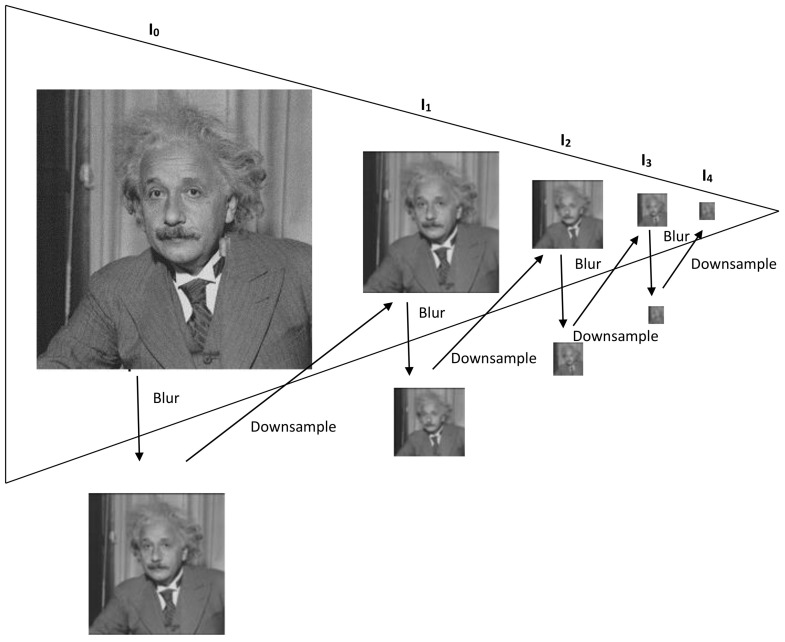
- A 4-level Gaussian pyramid on a 256×256 image produces a 16×16 hash with 256 entries; hash size is 2304 bits (288 bytes) for noise parameter α between 0 and 1, and 320 bytes for α between 1.5 and 3.
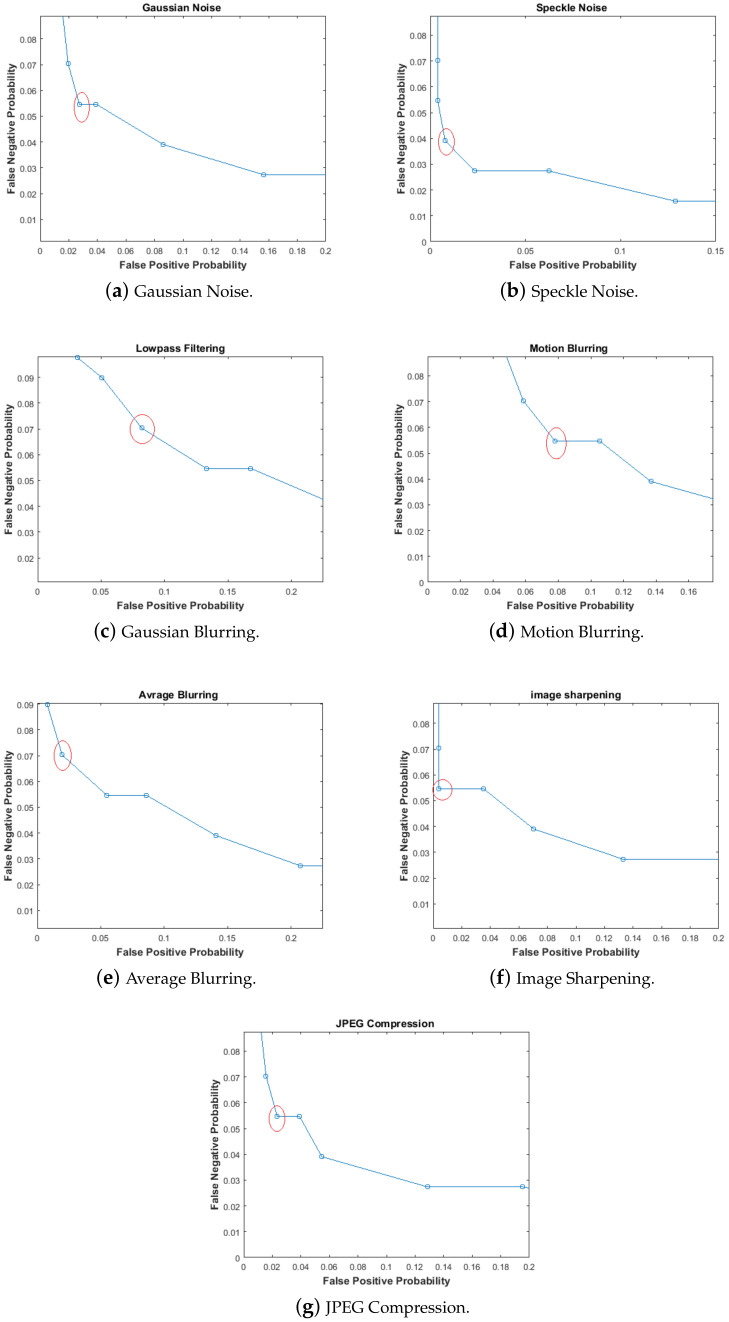
- The maximum \(d_{\max}\) for non-malicious distortions is 13.5, while the minimum \(d_{\max}\) for tampering is 20, giving a threshold range of 14–19 to separate the two; at threshold \(T_h=20\), FPP is 0.03, and FNP becomes zero when threshold is greater than 15.
- Key-dependent noise makes the hash sensitive to the secret key: using two different keys on the same image with noise value 2 gives \(d_{\max}=95\), and across 1000 keys on the Baboon image the maximum and minimum changes in \(d_{\max}\) were 264 and 81.
- The key space is reported as \(10^{90}\), approximately \(2^{299}\), which the authors state is high enough to resist brute-force attacks.
Methods
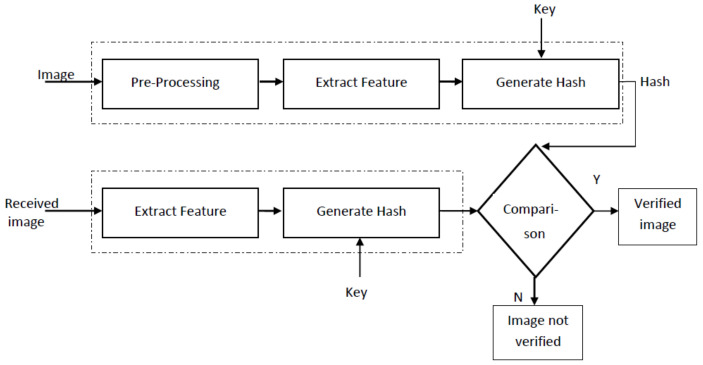
- The scheme converts the input to grayscale, resizes to 256×256, adds a key-generated noisy image using TD-ERCS and skew tent map PRNG, applies 4-level Gaussian pyramid decomposition, filters the fourth level with a LOG filter (\(\sigma=0.5\), 5×5 window) and a disk filter (radius 2), and subtracts the filtered images to form the hash.
- Verification computes the difference matrix between the received image hash and the original hash, comparing each element against a threshold \(T_h\) to localize tampering.
- Evaluation used test images including Einstein, Cameraman, Flower, Joker, Girl, and Baboon, with tampered areas less than 1% of total image area, and non-malicious distortions including Gaussian noise, speckle noise, motion blurring, average blurring, image sharpening, and JPEG compression; analysis used \(d_{\max}\), threshold selection, FPP/FNP, ROC curves, key sensitivity, and key space.
Limitations
- The paper does not present a dedicated limitations section. It states that choosing a suitable threshold is still a research challenge, that there is always a trade-off between robustness and discriminative capability, and that no benchmark has been defined for image hashing schemes.
- The text notes that in the compared state-of-the-art papers, tampering was greater than in the proposed scheme’s tests, and that those papers did not show non-malicious distortion results separately but used cumulative effects to find FNP and FPP.
- Evident from the text: evaluation is limited to a small set of named test images, tampered areas are all less than 1% of image area, and threshold/filter parameters were selected empirically through experimentation rather than derived analytically.
Model-written summary. Check it against the paper before relying on it.
Integrity signals
Registry
Cites
Statistics
Figures





Verification
Claims the paper makes
1 Valid · 0 Not valid · 4 Not checked · 69 Own results and interpretations
A result the paper reports from its own data — it cites no other source for it, so there is none to check. The quote shows it is in the paper.
In the paper
“These results reveal that the proposed scheme has low FNN at low FNP.”
§ A Secure and Robust Image Hashing Scheme Using Gaussian Pyramids > 5. Experimental Evaluation > 5.3. Receiver Operating Characteristics (ROC) Curves
plainstates an association- Asserted: passes — The authors put it forward as true.
- Checkable: passes — It can be checked against evidence.
- Load-bearing: passes — The paper’s conclusions depend on it.
- Based: passes — The paper gives a reason why it holds.
A result the paper reports from its own data — it cites no other source for it, so there is none to check. The quote shows it is in the paper.
In the paper
“For all the cases, the value of FNP becomes zero when the value of threshold is greater than 15.”
§ A Secure and Robust Image Hashing Scheme Using Gaussian Pyramids > 5. Experimental Evaluation > 5.3. Receiver Operating Characteristics (ROC) Curves
plain- Asserted: passes — The authors put it forward as true.
- Checkable: passes — It can be checked against evidence.
- Load-bearing: passes — The paper’s conclusions depend on it.
- Based: passes — The paper gives a reason why it holds.
A result the paper reports from its own data — it cites no other source for it, so there is none to check. The quote shows it is in the paper.
In the paper
“Experimental results reveal that the proposed hashing scheme is robust against non-malicious distortions and is sensitive to detect minute malicious tampering.”
- Also stated in: § 1. Introduction · plain
“In this paper, a new image hashing scheme is proposed that generates a compact image hash having the ability to detect minute level tampering, offers high robustness to non-malicious distortions and is also secure.”
§ A Secure and Robust Image Hashing Scheme Using Gaussian Pyramids > Abstract
plainstates a cause- Asserted: passes — The authors put it forward as true.
- Checkable: passes — It can be checked against evidence.
- Load-bearing: passes — The paper’s conclusions depend on it.
- Based: passes — The paper gives a reason why it holds.
- Also stated in: § 1. Introduction · plain
A result the paper reports from its own data — it cites no other source for it, so there is none to check. The quote shows it is in the paper.
In the paper
“Experimental results reveal that the proposed hashing scheme is robust against non-malicious distortions and is sensitive to detect minute malicious tampering.”
- Also stated in: § 1. Introduction · boosted
“In this paper, a new image hashing scheme is proposed that generates a compact image hash having the ability to detect minute level tampering, offers high robustness to non-malicious distortions and is also secure.”
§ A Secure and Robust Image Hashing Scheme Using Gaussian Pyramids > Abstract
boosted- Asserted: passes — The authors put it forward as true.
- Checkable: passes — It can be checked against evidence.
- Load-bearing: passes — The paper’s conclusions depend on it.
- Based: passes — The paper gives a reason why it holds.
- Also stated in: § 1. Introduction · boosted
A result the paper reports from its own data — it cites no other source for it, so there is none to check. The quote shows it is in the paper.
In the paper
“Moreover, False Positive Probability (FPP) and False Negative Probability (FNP) results demonstrate the effectiveness of the proposed scheme when compared to state-of-the-art image hashing algorithms proposed in the literature.”
§ A Secure and Robust Image Hashing Scheme Using Gaussian Pyramids > Abstract
boostedstates a cause- Asserted: passes — The authors put it forward as true.
- Checkable: passes — It can be checked against evidence.
- Load-bearing: passes — The paper’s conclusions depend on it.
- Based: passes — The paper gives a reason why it holds.
45 more claims
Create a free account to see all 74 claims and every source verdict.
- It may state two separate claims as one. 20
- Probably not a substantial claim. 7
Self-check
Percentages, sums and reported differences re-computed from the paper’s own numbers.
Each contradiction between two passages listed here was confirmed by an independent check.
Rated minor: it would not touch a result — a value no result rests on, a p-value that stays on the same side of the significance level, or a conflict that is clerical, resolved elsewhere in the paper, or outside its own findings.
In the paper
§ A Secure and Robust Image Hashing Scheme Using Gaussian Pyramids > 4. The Proposed Scheme > 4.1. Hash Generation Module
“The image I1 is then filtered using LOG and disk filters.”
§ A Secure and Robust Image Hashing Scheme Using Gaussian Pyramids > 4. The Proposed Scheme
“To further reduce hash size, disk and LOG filters are applied to the top level of the pyramid to obtain two different matrices.”
Citations
Cites
Distinctive Image Features from Scale-Invariant Keypoints
Lowe, D. G. (2004) · International Journal of Computer Vision · doi:10.1023/b:visi.0000029664.99615.94 · Cited by 55,589 · cited 1×
“Although pyramid decomposition has been widely used in image compression [8], computer vision [9], etc.”
MethodThe Laplacian pyramid as a compact image code
Burt, P., & Adelson, E. (1983) · IEEE Transactions on Communications · doi:10.1109/tcom.1983.1095851 · Cited by 6,077 · cited 1×
“Although pyramid decomposition has been widely used in image compression [8], computer vision [9], etc.”
MethodRobust and secure image hashing
Swaminathan, A., Mao, Y., & Wu, M. (2006) · IEEE Transactions on Information Forensics and Security · doi:10.1109/tifs.2006.873601 · Cited by 552 · cited 2×
“In Table 5, FPP and FNP of the proposed scheme is compared with some state-of-the-art schemes [10,17,23,24,28,29] in image hashing.”
MethodPerceptual Image Hashing Via Feature Points: Performance Evaluation and Tradeoffs
Monga, V., & Evans, B. L. (2006) · IEEE Transactions on Image Processing · doi:10.1109/tip.2006.881948 · Cited by 363 · cited 2×
“The tampered area considered in this paper is small when compared with other papers, for example, [28].”
MethodResultRobust and Secure Image Hashing via Non-Negative Matrix Factorizations
Monga, V., & Mihcak, M. K. (2007) · IEEE Transactions on Information Forensics and Security · doi:10.1109/tifs.2007.902670 · Cited by 295 · cited 1×
“Monga and Mihcak [14] construct an image hash using the idea of non-negative matrix factorization (NMF).”
MethodRobust Perceptual Image Hashing Based on Ring Partition and NMF
Tang, Z., Zhang, X., & Zhang, S. (2014) · IEEE Transactions on Knowledge and Data Engineering · doi:10.1109/tkde.2013.45 · Cited by 198 · cited 1×
“[12] proposed an image hashing algorithm using ring partition and non-negative matrix factorization (NMF).”
MethodA secure and robust hash-based scheme for image authentication
Ahmed, F., Siyal, M. Y., & Uddin Abbas, V. (2010) · Signal Processing · doi:10.1016/j.sigpro.2009.05.024 · Cited by 189 · cited 7×
“If hash is generated without employing a secret key, then an attacker could launch hash collision attacks to defeat the basic purpose of image authentication [7].”
BackgroundInfluentialSelf-citationA secure image encryption scheme based on chaotic maps and affine transformation
Ahmad, J., & Hwang, S. O. (2016) · Multimedia Tools and Applications · doi:10.1007/s11042-015-2973-y · Cited by 177 · cited 5×
“Using xn, yn and zn, the noisy image is generated using the following pseudo-random number generator (PRNG) equation: PRNG = (xn + xy + zn) mod(256) (9) TD-ERCS and Skew tent maps initial parameters are initialized to generate a noisy image having the same dimension as that of the input image.”
MethodInfluentialSelf-citationContent-based image copy detection
Kim, C. (2003) · Signal Processing Image Communication · doi:10.1016/s0923-5965(02)00130-3 · Cited by 165 · cited 1×
“In Table 5, FPP and FNP of the proposed scheme is compared with some state-of-the-art schemes [10,17,23,24,28,29] in image hashing.”
MethodEfficient image encryption with block shuffling and chaotic map
Tang, Z., Zhang, X., & Lan, W. (2014) · Multimedia Tools and Applications · doi:10.1007/s11042-014-1861-1 · Cited by 110 · cited 1×
“In order to achieve this property, Tangent Delay Ellipse Reflecting Cavity Map System (TD-ERCS) [25,26] and Skew tent map [27] have been introduced in the proposed scheme.”
MethodPerceptual image hashing based on virtual watermark detection
Khelifi, F., & Jiang, J. (2010) · IEEE Transactions on Image Processing · doi:10.1109/tip.2009.2038637 · Cited by 107 · cited 2×
“Khelif and Jiang [24] proposed a robust and secure hashing algorithm based on virtual watermark detector.”
BackgroundMethodHistogram-based image hashing scheme robust against geometric deformations
Xiang, S., Kim, H.-J., & Huang, J. (2007) · Proceedings of the 9th workshop on Multimedia & security - MM&Sec '07 · doi:10.1145/1288869.1288886 · Cited by 97 · cited 1×
“[16] constructed a histogram based image hashing scheme.”
MethodDetection of Image Region Duplication Forgery Using Model with Circle Block
Wang, J., Liu, G., Li, H., Dai, Y., & Wang, Z. (2009) · International Conference on Multimedia Information Networking and Security · doi:10.1109/mines.2009.142 · Cited by 90 · cited 1×
“[22] proposed a robust hashing scheme for detection of region duplication forgery.”
BackgroundOuyang, J., Coatrieux, G., & Shu, H. (2015) · Digital Signal Processing · doi:10.1016/j.dsp.2015.03.006 · Cited by 78 · cited 1×
“[11] used Quaternion Discrete Fourier Transforms (QDFT) and Log polar Transform to generate hash for color images.”
MethodImage authentication based on robust image hashing with geometric correction
Karsh, R. K., Saikia, A., & Laskar, R. H. (2018) · Multimedia Tools and Applications · doi:10.1007/s11042-018-5799-6 · Cited by 55
Keyed Hash Function Using Hyper Chaotic System with Time-Varying Parameters Perturbation
Liu, H., Kadir, A., & Liu, J. (2019) · IEEE Access · doi:10.1109/access.2019.2896661 · Cited by 47 · cited 1×
“This key space is high enough to resist brute force attacks and is comparable to state-of-the-art text hashing schemes, for example, [30,31] .”
BackgroundRobust Image Hashing Based Efficient Authentication for Smart Industrial Environment
Sajjad, M., Haq, I., Lloret, J., Ding, W.-P., & Muhammad, K. (2019) · IEEE Transactions on Industrial Informatics · doi:10.1109/tii.2019.2921652 · Cited by 46
Image hashing with color vector angle
Tang, Z., Li, X., Zhang, X., Zhang, S., & Dai, Y. (2018) · Neurocomputing · doi:10.1016/j.neucom.2018.04.057 · Cited by 38 · cited 1×
“in [18] use the idea of Color Vector Angle (CVA) to generate image hash.”
MethodRobust image hashing with embedding vector variance of LLE
Tang, Z., Ruan, L., Qin, C., Zhang, X., & Yu, C. (2015) · Digital Signal Processing · doi:10.1016/j.dsp.2015.05.002 · Cited by 33 · cited 1×
“Zhenjun and Linlin [15] proposed a three-step hashing method to achieve a desirable balance between discrimination and robustness using a technique which they refer to as Local Linear Embedding (LLE).”
MethodPseudo-random number generator based on TD-ERCS chaos and its statistic characteristics analysis
Li-Yuan, S., Li-Ling, C., Ke-Hui, S., et al. (2005) · Acta Physica Sinica · doi:10.7498/aps.54.4031 · Cited by 32 · cited 6×
“Mathematically, TD-ERCS is written as [25]: xn = − 2kn−1yn−1+xn−1(μ(2)−k(2)n−1) μ(2)+k(2)n−1 yn = kn−1(xn − xn−1) + yn−1, n = 1, 2, 3.”
MethodInfluentialSecure and Robust Two-Phase Image Authentication
Tabatabaei, S. A. H., Ur‐Rehman, O., Zivic, N. S., & Ruland, C. (2015) · IEEE Transactions on Multimedia · doi:10.1109/tmm.2015.2432672 · Cited by 31 · cited 1×
“[13] introduced a two-stage robust content-based image authentication scheme using Approximate Message Authentication Codes (AMACs).”
MethodAn audio encryption based on synchronization of robust BAM FCNNs with time delays
Kalpana, M., Ratnavelu, K., & Balasubramaniam, P. (2018) · Multimedia Tools and Applications · doi:10.1007/s11042-018-6373-y · Cited by 29
Ding, W., Xie, Y., & Wang, Y. (2018) · Multimedia Tools and Applications · doi:10.1007/s11042-018-5732-z · Cited by 16 · cited 1×
“A number of tools are easily available through which tampering of digital media can be done very effectively [4,5].”
BackgroundRobust Image Authentication in the Presence of Noise
Zivic, N. S. (2015) · Springer eBooks · doi:10.1007/978-3-319-13156-6 · Cited by 14 · cited 1×
“To obtain hash of an image, spatial or transform domain features are extracted from the image and used to generate its hash [6].”
MethodPerceptual image hash for tampering detection using Zernike moments
Zhao, Y. Q., & Wei, W. (2010) · IEEE International Conference on Progress in Informatics and Computing · doi:10.1109/pic.2010.5687938 · Cited by 14 · cited 1×
“Zhao and Wei [19] use rotation invariance of magnitudes and corrected phases of zernike moments to generate image hash.”
BackgroundPerceptual image hashing using SVD based Noise Resistant Local Binary Pattern
Abbas, S. Q., Ahmed, F., Zivic, N., & Ur-Rehman, O. (2016) · 2016 8th International Congress on Ultra Modern Telecommunications and Control Systems and Workshops (ICUMT) · doi:10.1109/icumt.2016.7765393 · Cited by 14 · cited 2×
“[17] have also proposed a histogram-based image hashing scheme using Noise Resistant Local Binary Pattern (NRLBP) for achieving robustness and discrimination capabilities.”
MethodSelf-citationGeometrically robust video hashing based on ST-PCT for video copy detection
Tang, W., Wo, Y., & Han, G. (2019) · Multimedia Tools and Applications · doi:10.1007/s11042-019-7513-8 · Cited by 14
A perceptual image hashing algorithm for hybrid document security
Eskenazi, S., Bodin, B., Gomez-Kramer, P., & Ogier, J.-M. (2017) · 2017 14th IAPR International Conference on Document Analysis and Recognition (ICDAR) · doi:10.1109/icdar.2017.126 · Cited by 10 · cited 1×
“In Table 5, FPP and FNP of the proposed scheme is compared with some state-of-the-art schemes [10,17,23,24,28,29] in image hashing.”
MethodSHAH: Hash Function Based on Irregularly Decimated Chaotic Map
Todorova, M., Stoyanov, B., Szczypiorski, K., & Kordov, K. (2018) · International Journal of Electronics and Telecommunications · doi:10.24425/123546 · Cited by 9
SEAKER: A Tool for Fast Digital Forensic Triage
Gentry, E., McIntyre, R., Soltys, M., et al. (2019) · Lecture notes in networks and systems · doi:10.1007/978-3-030-12385-7_87 · Cited by 5 · cited 1×
“A number of tools are easily available through which tampering of digital media can be done very effectively [4,5].”
BackgroundA Self-Synchronized Image Hash Algorithm
Wu, D., & Niu, X. (2010) · doi:10.1109/cmc.2010.233 · Cited by 3 · cited 1×
“Wu and Niu [20] have proposed an image hashing technique using features extracted by using the Scale Invariant Feature Transform (SIFT).”
Method
Cited by
A Lightweight Chaos-Based Medical Image Encryption Scheme Using Random Shuffling and XOR Operations
Masood, F., Driss, M., Boulila, W., Ahmad, J., Rehman, S. U., Jan, S. U., Qayyum, A., & Buchanan, W. J. (2022) · Wireless Personal Communications · doi:10.1007/s11277-021-08584-z · Cited by 175
Self-citationChaos-Based Confusion and Diffusion of Image Pixels Using Dynamic Substitution
Qayyum, A., Ahmad, J., Boulila, W., Rubaiee, S., Arshad, Masood, F., Khan, F., & Buchanan, W. J. (2020) · IEEE Access · doi:10.1109/access.2020.3012912 · Cited by 111
Self-citationDNA and Plaintext Dependent Chaotic Visual Selective Image Encryption
Khan, J. S., Boulila, W., Ahmad, J., Rubaiee, S., Rehman, A. U., Alroobaea, R., & Buchanan, W. J. (2020) · IEEE Access · doi:10.1109/access.2020.3020917 · Cited by 94
“Mathematically, a Gaussian map can be computed as follows [33]–[35]: here a and b denote different control parameters.”
BackgroundSelf-citationEfficient Hashing Method Using 2D-2D PCA for Image Copy Detection
Liang, X., Tang, Z., Huang, Z., Zhang, X., & Zhang, S. (2023) · IEEE Transactions on Knowledge and Data Engineering · doi:10.1109/tkde.2021.3131188 · Cited by 77
“Iram et al. [22] used Gaussian pyramid and random noise to construct a hashing method.”
MethodMasood, F., Boulila, W., Ahmad, J., Arshad, Sankar, S., Rubaiee, S., & Buchanan, W. J. (2020) · Remote Sensing · doi:10.3390/rs12111893 · Cited by 62
“The three fundamental security laws are confidentiality, integrity, and authentication, which is generally known as the CIA triad [4].”
BackgroundSelf-citation
Metadata
- Authors
- Bashir, I., Ahmed, F., Ahmad, J., Boulila, W., & Alharbi, N.
- Affiliations
- HITEC University (PK)
- Edinburgh Napier University (GB)
- Taibah University (SA)
- Corresponding author
- Boulila, Wadii
- Venue
- Entropy
- Publisher
- MDPI AG
- Published
- 2019-11-19
- Volume
- 21
- Issue
- 11
- Pages
- 1132
- ISSN
- 1099-4300 (ISSN-L)
- PMC
- PMC7514477
- OpenAlex
- W2991005505
- Cited by
- 20
- References
- 32
- Citations by year
- 2024: 3 · 2023: 3 · 2022: 3 · 2021: 7 · 2020: 4
- FWCI
- 1.57
- Type
- journal article
- Language
- en
- Open access
- gold
- dx.doi.org
- Licence
- Locations
- Entropy (publishedVersion, cc-by)
- PubMed Central (publishedVersion, cc-by)
- HAL (submittedVersion)
- DOAJ (DOAJ: Directory of Open Access Journals) (submittedVersion, cc-by-sa)
- Edinburgh Napier Research Repository (Edinburgh Napier University) (submittedVersion, cc-by)
- Topics
- Physical Sciences › Computer Science › Computer Vision and Pattern Recognition › Advanced Steganography and Watermarking Techniques
- Physical Sciences › Computer Science › Computer Vision and Pattern Recognition › Chaos-based Image/Signal Encryption
- Physical Sciences › Computer Science › Computer Vision and Pattern Recognition › Digital Media Forensic Detection
- Keywords
- image hashing, Gaussian pyramid, Laplacian of Gaussian, disk filter, image integrity verification, tamper detection
About these checks
Registry, retraction, Cites and statistics results are computed, not judged, with one exception: a printed reference that no index lists is read once by a model before it counts as a citation error. Claims are extracted by a model and kept only when their quote appears verbatim in the text; each cited source is then checked, with a model’s help, for whether it says what the claim relies on. Those verdicts can be wrong — read the claim’s quote and the cited source before relying on one.
The claim verdicts this report counts are experimental: their accuracy is not yet measured.
A language model drew the claims from the paper on 2026-10-10, under version 3 of the claim definition (model deepseek-v4.1-flash, prompt extract-v3).
A second model labelled each claim on 2026-10-10 (model jev-1.13-20260917, definition revision gold-guideline-v0.2).
Statistics and arithmetic are recomputed, not judged.
Confidence bands are shown only for fields calibrated on our annotated test set. None is calibrated yet, so no band is shown.
What counts as a claim ›How we measure confidence ›How we check this ›
Are you an author, or do you see a problem with this page? Request a review
Data sources
Bibliographic data: Semantic Scholar, OpenAlex, Crossref.
Contains information from the Semantic Scholar Academic Graph Datasets, made available under the ODC Attribution License (ODC-BY 1.0).
Semantic Scholar’s data is described in: Kinney, R., et al. (2023). The Semantic Scholar Open Data Platform. arXiv:2301.10140.
