

The DOI matches its Crossref record; 68 of the 70 references it cites were found in a registry or an index.
Project-Based Learning (PBL) as an Experiential Pedagogical Methodology in Engineering Education: A Review of the Literature
Open accessAbstract
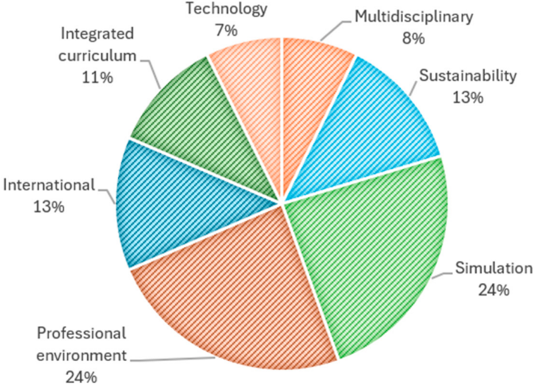
This systematic literature review explores how the implementation of project-based-learning (PBL) as an experiential pedagogical methodology in engineering education contributes to the development of real-world skills among students. The methodology applied was the PRISMA protocol with searches in two databases in a 24 year timeframe. The research reviewed 54 pieces to explore the contribution of PBL to seven pillars of a holistic pedagogical model comprising the following categories: technology, an integrated curriculum, an international focus, sustainability, a multidisciplinary focus, simulation, and professional environments. Varied PBL developments across these pillars reveal challenges, including aligning with real-world complexities and promoting interdisciplinary integration. Despite obstacles, PBL in engineering shows promise for enhancing students’ skills and channeling the added value of a holistic pedagogical model, despite significant differences in the number of experiences associated with each category. Limitations include restricted article access, emphasizing the need for open science promotion.
Overview
The claims and statistics of this paper haven’t been checked yet.
Free: it reads the open-access text and checks the first 5 claims that cite a source we can check. Create a free account to check every claim.
Integrity signals
Registry
Cites
Statistics
Figures



Verification
Claims the paper makes
The claims and statistics of this paper haven’t been checked yet.
Free: it reads the open-access text and checks the first 5 claims that cite a source we can check. Create a free account to check every claim.
Claims other papers make about this one
Each is checked against this paper’s own text: does it say what the citing paper says it does?
The source backs part of the claim, not all of it — or backs it for a different population, condition or comparison.
In the citing paper
“Despite these high-stakes implications, traditional instruction in Building Water Supply and Drainage Engineering has tended to emphasize technical calculations, design procedures, and code interpretation, with relatively limited attention to ethical responsibility, human-centered considerations, and system-level sustainability tradeoffs [17,21].”
From Integrating Sustainability and Ethical Responsibility into Building Water Supply and Drainage Engineering Education: A CDIO-Based Curriculum Reform (2026) · cites this paper as [17]
Experimental — accuracy not yet measuredThe source backs part of the claim, not all of it — or backs it for a different population, condition or comparison.
In the citing paper
“This finding aligns with prior research showing that project-based learning and CDIO-oriented curriculum design can effectively enhance professional responsibility and sustainability-related competencies when authentic engineering problems are used as learning contexts [13,17,34].”
From Integrating Sustainability and Ethical Responsibility into Building Water Supply and Drainage Engineering Education: A CDIO-Based Curriculum Reform (2026) · cites this paper as [17]
Experimental — accuracy not yet measuredThe source backs part of the claim, not all of it — or backs it for a different population, condition or comparison.
In the citing paper
“These approaches emphasize constructive alignment among learning outcomes, teaching activities, and assessment methods, while promoting active and experiential learning through project-based and design-oriented pedagogies [8,9,16,17].”
From Integrating Sustainability and Ethical Responsibility into Building Water Supply and Drainage Engineering Education: A CDIO-Based Curriculum Reform (2026) · cites this paper as [17]
Experimental — accuracy not yet measured
Self-check
Percentages, sums and reported differences re-computed from the paper’s own numbers.
The self-check needs the paper’s full text.
Citations
Cites
Web of Science (WoS) and Scopus: The Titans of Bibliographic Information in Today’s Academic World
Pranckutė, R. (2021) · Publications · doi:10.3390/publications9010012 · Cited by 2,696 · cited 1×
“Two databases were selected for their relevance in the field of education [23,24] and their worldwide reach as well as their allowing extracted data to be easily stored in CSV format, facilitating subsequent analysis: Web of Science and SCOPUS.”
MethodA review of project-based learning in higher education: Student outcomes and measures
Guo, P., Saab, N., Post, L. S., & Admiraal, W. (2020) · International Journal of Educational Research · doi:10.1016/j.ijer.2020.101586 · Cited by 1,309 · cited 1×
“In 2020, Guo, Saab, Post, and Admiraal [12] reviewed publications related to student outcomes and measures of problem-based learning experiences in higher education, analyzing the measuring tools that researchers used to assess students’ outcomes.”
BackgroundSystematic Literature Reviews in Engineering Education and Other Developing Interdisciplinary Fields
Borrego, M., Foster, M. J., & Froyd, J. E. (2014) · Journal of Engineering Education · doi:10.1002/jee.20038 · Cited by 620 · cited 2×
“The possibility of applying the snowball technique to citation searching was considered to expand our review; that is, we reviewed the works cited by already-identified sources, as suggested by Borrego, Foster, and Froyd [11].”
MethodCompetencies in Education for Sustainable Development: Exploring the Student Teachers’ Views
Cebrián, G., & Junyent, M. (2015) · Sustainability · doi:10.3390/su7032768 · Cited by 496 · cited 1×
“In the 21st century, in a globalized world, the education of future engineering professionals must train students in skills in line with the current reality, as well as in values and attitudes [1].”
BackgroundForms of implementation and challenges of PBL in engineering education: a review of literature
Chen, J., Kolmos, A., & Du, X. (2021) · European Journal of Engineering Education · doi:10.1080/03043797.2020.1718615 · Cited by 408 · cited 1×
“Chen, Kolmos, and Du [10] created a review of the forms of implementation and challenges of PBL in engineering education, differentiating the practice of PBL, the culture, and the individual and institutional level challenges.”
BackgroundLehmann, M., Christensen, P., Du, X., & Thrane, M. (2008) · European Journal of Engineering Education · doi:10.1080/03043790802088566 · Cited by 380 · cited 1×
“Benefiting from students’ intrinsic motivation and ownership of the learning process [8,9], PBL implementation varies from practice to practice, depending on the context, resources, and curriculum design.”
BackgroundPBL and CDIO: complementary models for engineering education development
Edström, K., & Kolmos, A. (2014) · European Journal of Engineering Education · doi:10.1080/03043797.2014.895703 · Cited by 276 · cited 1×
“Benefiting from students’ intrinsic motivation and ownership of the learning process [8,9], PBL implementation varies from practice to practice, depending on the context, resources, and curriculum design.”
BackgroundLand, S. M., & Zembal‐Saul, C. (2003) · Educational Technology Research and Development · doi:10.1007/bf02504544 · Cited by 162 · cited 1×
“…experiences developed in engineering according to the pillars of the holistic pedagogical model described in Figure 1 and connect the theoretical framework of PBL types with various current PBL implementations. framework, projects may demand students to apply and integrate knowledge subjects [18].”
BackgroundLucena, J., & Schneider, J. (2008) · European Journal of Engineering Education · doi:10.1080/03043790802088368 · Cited by 131 · cited 1×
“Technology when the project includes the use of an emerging or advanced technology, such as AI, by the students; Advancements in current technology allow the creation of complex scenarios, including those incorporating artificial intelligence (AI). development [20].”
BackgroundChua, K. J., & Islam, M. (2020) · International Journal of Mechanical Engineering Education · doi:10.1177/0306419019838335 · Cited by 119 · cited 1×
“The of them [42] presented what it In particular, it allowed combining theory and practice, allowing students to apply, in real-world-like situations, the knowledge acquired. called a hybrid project-based learning-flipped design, which requires students to learn by themselves in advance what they…”
BackgroundZhou, C., Kolmos, A., & Nielsen, J. F. D. (2012) · VBN Forskningsportal (Aalborg Universitet) · Cited by 97
Using Problem-based Learning: New Constellations for the 21st Century.
Savin‐Baden, M. (2014) · Worcester Research and Publications (University of Worcester) · Cited by 89
Design sprint in classroom: exploring new active learning tools for project-based learning approach
Ferreira, V. G., & Canedo, E. D. (2019) · Journal of Ambient Intelligence and Humanized Computing · doi:10.1007/s12652-019-01285-3 · Cited by 89 · cited 1×
“Three reviews were also excluded because, again, the holistic pedagogical model was not considered [30].”
BackgroundProject-based learning of advanced CAD/CAE tools in engineering education
Berselli, G., Bilancia, P., & Luzi, L. (2020) · International Journal on Interactive Design and Manufacturing (IJIDeM) · doi:10.1007/s12008-020-00687-4 · Cited by 85 · cited 3×
“The ones that simulated a professional experience [34, 75,76] reported an increase in the kill acquirement perception of the students and faculty.”
BackgroundStrategies for education for sustainable development – Danish and Australian perspectives
Holgaard, J. E., Hadgraft, R. G., Kolmos, A., & Guerra, A. O. P. D. C. (2015) · Journal of Cleaner Production · doi:10.1016/j.jclepro.2015.09.063 · Cited by 83 · cited 1×
“Active methodologies in which the student acquires a leading role in his or her own learning and the teacher adopts the role of guide of learning have been highlighted as an effective way to achieve this transversal training [2].”
BackgroundMulti-Role Project (MRP): A New Project-Based Learning Method for STEM
Warin, B., Talbi, O., Kolski, C., & Hoogstoel, F. (2015) · IEEE Transactions on Education · doi:10.1109/te.2015.2462809 · Cited by 83 · cited 2×
“Five of these studies different subjects of the same sets Three articles [41–43] and three conference papers [44–46] matched this de fi nition in the literature review. of students and created a PBL project that benefitted the learning outcomes of all of them, providing a Five of these studies…”
BackgroundResultImproving Student Engagement With Project-Based Learning: A Case Study in Software Engineering
Morais, P., Ferreira, M. J., & Veloso, B. (2021) · IEEE Revista Iberoamericana de Tecnologias del Aprendizaje · doi:10.1109/rita.2021.3052677 · Cited by 79 · cited 1×
“Pieces describing a basic implementation of the canonical PBL methodology in a different context but also not containing any of the seven categories of the pedagogical model [28,29] were also discarded, totaling 203 works.”
MethodA Multidisciplinary PBL Approach for Teaching Industrial Informatics and Robotics in Engineering
Calvo, I., Cabanes, I., Quesada, J., & Barambones, Ó. (2017) · IEEE Transactions on Education · doi:10.1109/te.2017.2721907 · Cited by 75 · cited 1×
“…of a pedagogical model based on PBL, discussions among the three researchers were initiated regarding the initial themes. examples of reclassified pieces included [35], which changed from multidisciplinary to simulation, or [36], which was determined to be sustainability and not simulation.”
BackgroundDeveloping and Validating a Scale of STEM Project-Based Learning Experience
Wan, Z. H., So, W. M. W., & Zhan, Y. (2020) · Research in Science Education · doi:10.1007/s11165-020-09965-3 · Cited by 75 · cited 1×
“Articles that did not belong to higher education [25] or were not about project-based learning but instead exclusively focused on problem-based learning [26] were excluded.”
BackgroundKhandakar, A. A., Chowdhury, M. E. H., Gonzales, A. S. P., Touati, F., Emadi, N. A., & Ayari, M. A. (2020) · Sustainability · doi:10.3390/su12020480 · Cited by 62 · cited 1×
“The other four pieces [36,57–59] were centered on the environment and renewable energy, with all of them targeting the United Nations’ Sustainable Development Goals.”
BackgroundAriza, J. Á., & Olatunde-Aiyedun, T. G. (2023) · Sustainability · doi:10.3390/su151310275 · Cited by 57
Arias, E., Barba‐Sánchez, V., Carrión, C., & Casado, R. (2018) · Administrative Sciences · doi:10.3390/admsci8040058 · Cited by 52
ABET Engineering Technology Criteria and Competency Based Engineering Education
Earnest, J. (2006) · 2022 IEEE Frontiers in Education Conference (FIE) · doi:10.1109/fie.2005.1612046 · Cited by 42 · cited 2×
“To address the educational needs of contemporary engineers [16], a holistic pedagogical model has been devised to align with recent educational trends, emphasizing experiential learning.”
BackgroundPreparing Sustainable Engineers: A Project-Based Learning Experience in Logistics with Refugee Camps
López, M. J. T., Quintana, P. J. V., Lavado-Anguera, S., & Espinosa-Elvira, M. D. C. (2020) · Sustainability · doi:10.3390/su12124817 · Cited by 36 · cited 1×
“Three of the pieces [54–56] used real operating NGOs to participate as stakeholders for the students.”
BackgroundSelf-citationMäenpää, H., Tarkoma, S., Varjonen, S., & Vihavainen, A. (2015) · ACM Technical Symposium on Computer Science Education (SIGCSE) · doi:10.1145/2676723.2677262 · Cited by 32
Changing Engineering Curriculum in the Globalizing World
Chung, C. (2011) · New Horizons in Education · Cited by 31
THE ONLINE PBL (PROJECT-BASED LEARNING) EDUCATION SYSTEM USING AI (ARTIFICIAL INTELLIGENCE)
Ito, T., Tanaka, M., Shin, M., & Miyazaki, K. (2021) · International Conference on Engineering and Product Design Education (EPDE) · doi:10.35199/epde.2021.19 · Cited by 27 · cited 1×
“Two of them supported learning process with artificial intelligence [37,38], and Two of them supported the learning process with arti fi cial intelligence [37,38], and two included complex technological developments by the students [39,40]. two included complex technological developments by the…”
ResultBratschitsch, E., Casey, A., Bischof, G., & Rubeša, D. (2020) · ASEE Annual Conference & Exposition · doi:10.18260/1-2--2054 · Cited by 24
Problem- and Project-Based Learning in Engineering: A Focus on Electrical Vehicles
Gonzalez-Rubio, R., Khoumsi, A., Dubois, M. R., & Trovão, J. P. F. (2016) · IEEE Vehicle Power and Propulsion Conference (VPPC) · doi:10.1109/vppc.2016.7791756 · Cited by 22
A BLENDED LEARNING EXPERIENCE APPLYING PROJECT-BASED LEARNING IN AN INTERDISCIPLINARY CLASSROOM
de Medeiros, F. P. A., Júnior, P., Bender, M., Menegussi, L., & Curcher, M. (2017) · ICERI proceedings · doi:10.21125/iceri.2017.2364 · Cited by 22 · cited 1×
“The projects included clusters of students from business or design [60], the arts [61], civil engineering and informatics [33], and communication and business [62].”
BackgroundGomez, C. A. S. (2020) · International Journal of Mechanical Engineering Education · doi:10.1177/0306419020950751 · Cited by 21 · cited 1×
“PBL not only helps to improve their academic performance [5] and maintain student attention and engagement [6] but also allows developing technical and non-technical skills that are key to becoming a successful professional [7].”
BackgroundProject-Based Learning versus Cooperative Learning courses in Engineering Students
Fuertes, G., Vargas, M., Soto, I., Witker, K., Peralta, M., & Sabattin, J. (2015) · IEEE Latin America Transactions · doi:10.1109/tla.2015.7350066 · Cited by 19 · cited 4×
“However, those of them that did not [33,77] promoted the tools that students will master, such as CAD software or coding.”
BackgroundInfluentialAn Experience of Project Based Learning in Aerospace Engineering
Castaldi, P., & Mimmo, N. (2019) · IFAC-PapersOnLine · doi:10.1016/j.ifacol.2019.11.290 · Cited by 19 · cited 1×
“The pieces that belonged to this category were [63–74].”
BackgroundMultidiscipline Team Teaching Approach To Enhance Project Based Learning Of Sustainable Design
Burian, S. J., Johnson, W. P., Montague, F., Holt, A., Nielson, J., & David, R. (2020) · ASEE Annual Conference & Exposition · doi:10.18260/1-2--3876 · Cited by 13 · cited 2×
“The other four pieces [36,57–59] were centered on the environment and renewable energy, with all of them targeting the United Nations’ Sustainable Development Goals.”
BackgroundEmployability competences through short-term intensive PBL-events in higher education
Wyke, S., Jensen, A. A., Krogh, L., Ravn, O., & Svidt, K. (2022) · Frontiers in Education · doi:10.3389/feduc.2022.959355 · Cited by 13
Ota, E., & Punyabukkana, P. (2016) · 2022 IEEE Frontiers in Education Conference (FIE) · doi:10.1109/fie.2016.7757389 · Cited by 12 · cited 1×
“The capability of solving global issues became one of learning objectives, and students faced greater team diversity because they needed to work with people with various cultural backgrounds and subject backgrounds [87].”
BackgroundAchieving Scalability in Project Based Learning through a Low-Code platform
Fernandes, J. P., Araújo, R., & Zenha-Rela, M. A. (2020) · doi:10.1145/3422392.3422482 · Cited by 11
Challenges in implementing PBL: Chalmers Formula Student as a case
Kjellberg, M., Adawi, T., & Brolin, K. (2015) · Chalmers Research (Chalmers University of Technology) · Cited by 9
Johnson, B., & Ulseth, R. (2017) · Cornerstone (Minnesota State University, Mankato) · Cited by 9
The PBL projects: where we've been and where we are going
Donnelly, J. F., & Massa, N. M. (2015) · Proceedings of SPIE, the International Society for Optical Engineering/Proceedings of SPIE · doi:10.1117/12.2223219 · Cited by 8
Bratschitsch, E., Casey, A., & Trzesniowski, M. (2020) · ASEE Annual Conference & Exposition · doi:10.18260/1-2--3926 · Cited by 8 · cited 1×
“PBL-integrated curriculum experiences consist of a project that includes di ff erent courses or subjects of the same degree. papers [44–46] matched this definition in the literature review.”
BackgroundDeveloping Real-life Problem-based Learning (PBL) Activities through Partnership with Industry
Mativo, J., Sochacka, N. W., Youngblood, K. M., Brouillard, D., & Walther, J. (2018) · ASEE Annual Conference & Exposition · doi:10.18260/1-2--28148 · Cited by 8 · cited 1×
“These published experiences [78,81,85] centered the aim of the article or paper on the relationship between industry and academia, describing extensively the framework in which the professional practices take place.”
BackgroundMurray, J., Paxson, L. C., Seo, S., & Beattie, M. (2020) · ASEE Annual Conference & Exposition · doi:10.18260/1-2--35206 · Cited by 8 · cited 1×
“The projects included clusters of students from business or design [60], the arts [61], civil engineering and informatics [33], and communication and business [62].”
BackgroundCollaborative Project-Based Learning Capstone for Engineering and Engineering Technology Students
Ritenour, A., Ferguson, C. W., Gardner, P. J., Banther, B., & Ray, J. (2020) · ASEE Annual Conference & Exposition · doi:10.18260/1-2--34300 · Cited by 8
Dong, J., & Chen, P. (2020) · ASEE Annual Conference & Exposition · doi:10.18260/1-2--19914 · Cited by 7
Acharya, S., Bhatt, A. N., Chakrabarti, A., Delhi, V. S. K., Diehl, J. C., Mota, N. J. A., Jurelionis, A., & Subra, R. (2021) · Smart innovation, systems and technologies · doi:10.1007/978-981-16-0119-4_44 · Cited by 7 · cited 1×
“…either the PBL experience was developed by international students, such as Russian and American students [47], Nepali and Bhutanese students [48], Malaysian and Japanese students [49], Portuguese, Thai, and Japanese students [50], and Indian and Swiss students [51], it was focused on…”
BackgroundChiou, R. Y., Fegade, T., Wu, Y., Tseng, T.-L., Mauk, M. G., & Husanu, I. C. (2020) · ASEE Annual Conference & Exposition · doi:10.18260/1-2--35098 · Cited by 7
Nitta, N., Takemura, Y., & Kume, I. (2009) · 2022 IEEE Frontiers in Education Conference (FIE) · doi:10.1109/fie.2009.5350397 · Cited by 5 · cited 1×
“The projects included clusters of students from business or design [60], the arts [61], civil engineering and informatics [33], and communication and business [62].”
BackgroundRamírez, D., & Ramírez, P. (2015) · ASEE Annual Conference and Exposition · doi:10.18260/p.24462 · Cited by 5 · cited 1×
“The other four pieces [36,57–59] were centered on the environment and renewable energy, with all of them targeting the United Nations’ Sustainable Development Goals.”
BackgroundDesign on Project-Based Learning for Analog Circuits
Kataria, D., & Sánchez, G. (2020) · 2022 IEEE Frontiers in Education Conference (FIE) · doi:10.1109/fie44824.2020.9273954 · Cited by 5
Engineering Students Learning Experience through a Unique Global Project-Based Learning
Ghazali, N. E., Mohd‐Yusof, K., Phang, F. A., Arsat, R. S. S., Ahmad, N. A., & Morino, H. (2021) · International Journal of Emerging Technologies in Learning (iJET) · doi:10.3991/ijet.v16i15.24803 · Cited by 5 · cited 1×
“…by international students, such as Russian and American students [47], Nepali and Bhutanese students [48], Malaysian and Japanese students [49], Portuguese, Thai, and Japanese students [50], and Indian and Swiss students [51], it was focused on integrating minority students into the…”
BackgroundSpace Engineering Project Based Learning By Working Real Space Programs
Twiggs, B. (2020) · doi:10.18260/1-2--10474 · Cited by 4
A project based learning experience using NGO projects and a volunteer program abroad
Medina, J. M. L., Archilla, M. Y. B., & Quintana, P. J. V. (2017) · International journal of engineering education · Cited by 4
Ribu, K., & Patel, T. (2018) · NORA - Norwegian Open Research Archives · Cited by 4
VIDAR Lab: A Virtual Network Environment for Project-Based Learning of Undergraduate Students
Karal, L., Rathke, B., & Reichwein, W. (2022) · IEEE German Education Conference (GECon) · doi:10.1109/gecon55699.2022.9942777 · Cited by 4 · cited 1×
“The pieces that belonged to this category were [63–74].”
BackgroundChen, J., Kolmos, A., & Du, X. (2020) · VBN Forskningsportal (Aalborg Universitet) · Cited by 3
Utilizing Transdisciplinary Project-Based Learning in Undergraduate Engineering Education
Davis, L. M., & Caldwell, B. S. (2022) · Advances in transdisciplinary engineering · doi:10.3233/atde220695 · Cited by 3
Idm@ti Network: An innovative proposal for improving teaching and learning in Spanish universities
Salán, N., Cabedo, L., Segarra‐Ciprés, M., Guraya, T., Lopez‐Crespo, P., Sales, D. L., & Gámez‐Pérez, J. (2017) · World Journal on Educational Technology Current Issues · doi:10.18844/wjet.v9i2.711 · Cited by 2 · cited 1×
“The “international focus” orientation of the PBL project [86] not only mimics real-world experiences in the engineering sector but also allows building communities and exposing students to different realities and cultures.”
BackgroundDeshapande, S. S., & Kate, S. (2019) · Journal of Engineering Education/Journal of engineering education transformations/Journal of engineering education transformation · Cited by 2
Murzi, H., Fielding, L., Huerta, M. V., Ortega-Alvarez, J. D., James, M., Katz, A., & Grohs, J. (2022) · IEEE Frontiers in Education Conference (FIE) · doi:10.1109/fie56618.2022.9962395 · Cited by 2
A research program about a short-term PBL approach based on the SDG
Braga, M., d’Escoffier, L. N., & Guerra, A. O. P. D. C. (2022) · doi:10.5821/conference-9788412322262.1173 · Cited by 2
Sanger, P. A., ZIYATDINOVA, J. N., Ivanov, V. G., & Ivanov, G. (2012) · Cited by 1
Enhance Project-based Learning Experience for Undergraduate Students with Wireless Sensor Network
Wang, Y., & Cui, S. (2015) · ASEE Annual Conference and Exposition · doi:10.18260/p.23991 · Cited by 1 · cited 1×
“…learning process with artificial intelligence [37,38], and Two of them supported the learning process with arti fi cial intelligence [37,38], and two included complex technological developments by the students [39,40]. two included complex technological developments by the students [39,40].”
Developing Successful Industrial Interactions In Support Of Project Based Learning: An Organic Model
Walsh, D. (2020) · ASEE Annual Conference & Exposition · doi:10.18260/1-2--5387 · Cited by 1 · cited 2×
“The ones that relied on a real business partner mainly involved in the assessment or the design [77–85] also disclosed the satisfaction of the industry partner.”
BackgroundAN EVALUATION OF BOUNDARY-CROSSING SKILL DEVELOPMENT IN A PROJECT-BASED LEARNING COURSE
Ryser, T., Ulbrich, S., Dey, C., & Ganesh, M. P. (2019) · ICERI proceedings · doi:10.21125/iceri.2019.1416 · Cited by 1 · cited 1×
“…and American students [47], Nepali and Bhutanese students [48], Malaysian and Japanese students [49], Portuguese, Thai, and Japanese students [50], and Indian and Swiss students [51], it was focused on integrating minority students into the teamwork [52], or it featured a multicultural class [53].”
BackgroundGlobal PBL: Cross-cultural educational project for engineering students
Navas, H. V. G., Hasegawa, H., Watanabe, D., Khantachawana, A., & Alves, A. C. (2020) · Zenodo (CERN European Organization for Nuclear Research) · doi:10.5281/zenodo.4815143 · Cited by 1
PBL and society: University-industry collaborative learning
Sandoval-Carvajal, M.-M., Lizano-Madriz, F., Porras-Piedra, E., & Cortés Chavarría, R. (2018) · Repositorio Académico Institucional de la Universidad Nacional · Cited by 1
Research works printed but not linked: 12
- Kolmos, A., Fink, F.K., and Krogh, L. (2004). The Aalborg PBL Model—Progress, Diversity and Challenges, Aalborg University Press.
- Barrows, H.S., and Tamblyn, R.M. (1980). Problem-Based Learning: An Approach to Medical Education, Springer Publishing Company.
- Guerra, A., Ulseth, R., Jonhson, B., and Kolmos, A. (2017, January 18–21). Engineering grand challenges and the attributes of the global engineer. Proceedings of the 45th SEFI Annual Conference, Azores, Portugal.
- Kolb, D.A. (2014). Experiential Learning: Experience as the Source of Learning and Development, FT Press.
- Johnson, B., and Ulseth, R. (March, January 28). Developing the next generation of co-operative engineering education. Proceedings of the International Symposium on Project Approaches in Engineering Education 2018, Brasilia, Brazil.
- Reilly, G., Murphy, M., Nagy, B.V., and Jarvinen, H.-M. (2023, January 11–14). Exploring the Impact of Problem-Based Learning on Student Learning Outcomes: Findings from the PBL South Asia Project. Proceedings of the SEFI 2023—51st Annual Conference of the European Society for Engineering Education: Engineering Education for Sustainability, Dublin, Ireland.
- 2023, Student perception of the application of Project Based Learning as a strategy for Formative Research in Engineering, RISTI-Rev. Iber. Sist. E Tecnol. Inf., 2023, 478
- Vargas, 2020, A Project Based Learning Approach for Teaching Artificial Intelligence to Undergraduate Students, Int. J. Eng. Educ., 36, 1773
- 2021, Building Small Prototypes in a PBL Intervention for Learning Automatic Control Systems, Int. J. Eng. Educ., 37, 1274
- 2022, Collaborative Graphic Simulation Experience Through Project-Based Learning to Develop Spatial Abilities, Int. J. Eng. Educ., 38, 905
- Yusof, 2019, Design and practical experience in power electronics project based learning approach at UKM, Int. J. Innov. Creat. Change, 9, 287
- Giordani, D.S., and Moraes, E.J.C. (July, January 29). A PBL experience to simulate a business environment in a discipline of chemical engineering course. Proceedings of the 43rd Annual SEFI Conference, Orléans, France.
Cited by
Project-Based Learning in business and management education: A scoping review and research agenda
Larsen, I. B. (2025) · The International Journal of Management Education · doi:10.1016/j.ijme.2025.101159 · Cited by 33
The Impact of Project-Based Learning on Students' Collaboration Skills in Secondary Schools
Mustamin, K., Wahdah, W., Intiardy, D., Jumrah, A. M., & Pattiasina, P. J. (2024) · International Journal of Educational Research Excellence (IJERE) · doi:10.55299/ijere.v3i2.740 · Cited by 22
The impact of GPT, experiential learning, and reinforcement methods on complex problem solving
Nieto-Jalil, J. M., Chim, A. I. T., Seuret-Jiménez, D., & Huerta, J. M. M. (2025) · IEEE World Engineering Education Conference (EDUNINE) · doi:10.1109/edunine62377.2025.10981377 · Cited by 20
“It is no longer sufficient to impart theoretical knowledge; today’s students need competencies that enable them to navigate a complex, unpredictable world [1-6].”
Huerta, M., & Requena-García-Cruz, M.-V. (2025) · Education Sciences · doi:10.3390/educsci15091253 · Cited by 22
Transforming Learning Orientations Through STEM Interdisciplinary Project-Based Learning
Seo, S., Orman, D. S. J. V., Beattie, M., Paxson, L. C., & Murray, J. (2024) · Education Sciences · doi:10.3390/educsci14111154 · Cited by 19
Metadata
- Authors
- Lavado-Anguera, S., Velasco-Quintana, P.-J., & Terrón-López, M.-J.
- Affiliations
- Universidad Europea de Madrid (ES)
- School of Architecture, Engineering and Design, Universidad Europea de Madrid, 28670 Villaviciosa de Odón, Madrid, Spain
- Venue
- Education Sciences
- Publisher
- MDPI AG
- Published
- 2024-06-07
- Volume
- 14
- Issue
- 6
- Pages
- 617
- ISSN
- 2227-7102 (ISSN-L)
- OpenAlex
- W4399428882
- Semantic Scholar
- 2ebb1cd401dc2725ec58c324448c3538fe456101
- Cited by
- 152
- References
- 70
- Citations by year
- 2026: 87 · 2025: 58 · 2024: 7
- FWCI
- 190.56
- Type
- journal article
- Language
- en
- Open access
- gold
- doi.org
- Licence
- Locations
- Education Sciences (publishedVersion, cc-by)
- ABACUS. Repositorio de Producción Científica (Universidad Europea) (submittedVersion, cc-by-nc-nd)
- DOAJ (DOAJ: Directory of Open Access Journals) (submittedVersion, cc-by-sa)
- Topics
- Social Sciences › Education › Problem and Project Based Learning
- Social Sciences › Education › Engineering Education and Pedagogy
- Physical Sciences › Engineering › Biomedical Engineering › Biomedical and Engineering Education
- Keywords
- project-based learning, engineering education, experiential learning, interdisciplinary integration, sustainability education, internationalization of education, simulation-based training, professional environment, practical skills, curriculum integration
About these checks
Registry, retraction, Cites and statistics results are computed, not judged, with one exception: a printed reference that no index lists is read once by a model before it counts as a citation error. Claims are extracted by a model and kept only when their quote appears verbatim in the text; each cited source is then checked, with a model’s help, for whether it says what the claim relies on. Those verdicts can be wrong — read the claim’s quote and the cited source before relying on one.
Statistics and arithmetic are recomputed, not judged.
Confidence bands are shown only for fields calibrated on our annotated test set. None is calibrated yet, so no band is shown.
What counts as a claim ›How we measure confidence ›How we check this ›
Are you an author, or do you see a problem with this page? Request a review
Data sources
Bibliographic data: Semantic Scholar, OpenAlex, Crossref.
Contains information from the Semantic Scholar Academic Graph Datasets, made available under the ODC Attribution License (ODC-BY 1.0).
Semantic Scholar’s data is described in: Kinney, R., et al. (2023). The Semantic Scholar Open Data Platform. arXiv:2301.10140.
