

The DOI matches its Crossref record; 68 of the 70 references it cites were found in a registry or an index.
Project-Based Learning (PBL) as an Experiential Pedagogical Methodology in Engineering Education: A Review of the Literature
Open accessAbstract
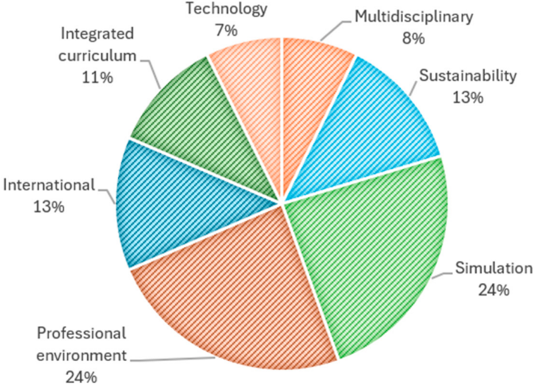
This systematic literature review explores how the implementation of project-based-learning (PBL) as an experiential pedagogical methodology in engineering education contributes to the development of real-world skills among students. The methodology applied was the PRISMA protocol with searches in two databases in a 24 year timeframe. The research reviewed 54 pieces to explore the contribution of PBL to seven pillars of a holistic pedagogical model comprising the following categories: technology, an integrated curriculum, an international focus, sustainability, a multidisciplinary focus, simulation, and professional environments. Varied PBL developments across these pillars reveal challenges, including aligning with real-world complexities and promoting interdisciplinary integration. Despite obstacles, PBL in engineering shows promise for enhancing students’ skills and channeling the added value of a holistic pedagogical model, despite significant differences in the number of experiences associated with each category. Limitations include restricted article access, emphasizing the need for open science promotion.
Overview
The claims and statistics of this paper haven’t been checked yet.
Free: it reads the open-access text and checks the first 5 claims that cite a source we can check. Create a free account to check every claim.
Integrity signals
Registry
Cites
Statistics
Figures



Verification
Claims the paper makes
The claims and statistics of this paper haven’t been checked yet.
Free: it reads the open-access text and checks the first 5 claims that cite a source we can check. Create a free account to check every claim.
Claims other papers make about this one
Each is checked against this paper’s own text: does it say what the citing paper says it does?
The source backs part of the claim, not all of it — or backs it for a different population, condition or comparison.
In the citing paper
“Despite these high-stakes implications, traditional instruction in Building Water Supply and Drainage Engineering has tended to emphasize technical calculations, design procedures, and code interpretation, with relatively limited attention to ethical responsibility, human-centered considerations, and system-level sustainability tradeoffs [17,21].”
From Integrating Sustainability and Ethical Responsibility into Building Water Supply and Drainage Engineering Education: A CDIO-Based Curriculum Reform (2026) · cites this paper as [17]
Experimental — accuracy not yet measuredThe source backs part of the claim, not all of it — or backs it for a different population, condition or comparison.
In the citing paper
“This finding aligns with prior research showing that project-based learning and CDIO-oriented curriculum design can effectively enhance professional responsibility and sustainability-related competencies when authentic engineering problems are used as learning contexts [13,17,34].”
From Integrating Sustainability and Ethical Responsibility into Building Water Supply and Drainage Engineering Education: A CDIO-Based Curriculum Reform (2026) · cites this paper as [17]
Experimental — accuracy not yet measuredThe source backs part of the claim, not all of it — or backs it for a different population, condition or comparison.
In the citing paper
“These approaches emphasize constructive alignment among learning outcomes, teaching activities, and assessment methods, while promoting active and experiential learning through project-based and design-oriented pedagogies [8,9,16,17].”
From Integrating Sustainability and Ethical Responsibility into Building Water Supply and Drainage Engineering Education: A CDIO-Based Curriculum Reform (2026) · cites this paper as [17]
Experimental — accuracy not yet measured
Self-check
Percentages, sums and reported differences re-computed from the paper’s own numbers.
The self-check needs the paper’s full text.
Citations
Cites
Web of Science (WoS) and Scopus: The Titans of Bibliographic Information in Today’s Academic World
Pranckutė, R. (2021) · Publications · doi:10.3390/publications9010012 · Cited by 2,696 · cited 1×
“Two databases were selected for their relevance in the field of education [23,24] and their worldwide reach as well as their allowing extracted data to be easily stored in CSV format, facilitating subsequent analysis: Web of Science and SCOPUS.”
MethodA review of project-based learning in higher education: Student outcomes and measures
Guo, P., Saab, N., Post, L. S., & Admiraal, W. (2020) · International Journal of Educational Research · doi:10.1016/j.ijer.2020.101586 · Cited by 1,309 · cited 1×
“In 2020, Guo, Saab, Post, and Admiraal [12] reviewed publications related to student outcomes and measures of problem-based learning experiences in higher education, analyzing the measuring tools that researchers used to assess students’ outcomes.”
BackgroundSystematic Literature Reviews in Engineering Education and Other Developing Interdisciplinary Fields
Borrego, M., Foster, M. J., & Froyd, J. E. (2014) · Journal of Engineering Education · doi:10.1002/jee.20038 · Cited by 620 · cited 2×
“The possibility of applying the snowball technique to citation searching was considered to expand our review; that is, we reviewed the works cited by already-identified sources, as suggested by Borrego, Foster, and Froyd [11].”
MethodCompetencies in Education for Sustainable Development: Exploring the Student Teachers’ Views
Cebrián, G., & Junyent, M. (2015) · Sustainability · doi:10.3390/su7032768 · Cited by 496 · cited 1×
“In the 21st century, in a globalized world, the education of future engineering professionals must train students in skills in line with the current reality, as well as in values and attitudes [1].”
BackgroundForms of implementation and challenges of PBL in engineering education: a review of literature
Chen, J., Kolmos, A., & Du, X. (2021) · European Journal of Engineering Education · doi:10.1080/03043797.2020.1718615 · Cited by 408 · cited 1×
“Chen, Kolmos, and Du [10] created a review of the forms of implementation and challenges of PBL in engineering education, differentiating the practice of PBL, the culture, and the individual and institutional level challenges.”
BackgroundLehmann, M., Christensen, P., Du, X., & Thrane, M. (2008) · European Journal of Engineering Education · doi:10.1080/03043790802088566 · Cited by 380 · cited 1×
“Benefiting from students’ intrinsic motivation and ownership of the learning process [8,9], PBL implementation varies from practice to practice, depending on the context, resources, and curriculum design.”
BackgroundPBL and CDIO: complementary models for engineering education development
Edström, K., & Kolmos, A. (2014) · European Journal of Engineering Education · doi:10.1080/03043797.2014.895703 · Cited by 276 · cited 1×
“Benefiting from students’ intrinsic motivation and ownership of the learning process [8,9], PBL implementation varies from practice to practice, depending on the context, resources, and curriculum design.”
BackgroundLand, S. M., & Zembal‐Saul, C. (2003) · Educational Technology Research and Development · doi:10.1007/bf02504544 · Cited by 162 · cited 1×
“…experiences developed in engineering according to the pillars of the holistic pedagogical model described in Figure 1 and connect the theoretical framework of PBL types with various current PBL implementations. framework, projects may demand students to apply and integrate knowledge subjects [18].”
BackgroundLucena, J., & Schneider, J. (2008) · European Journal of Engineering Education · doi:10.1080/03043790802088368 · Cited by 131 · cited 1×
“Technology when the project includes the use of an emerging or advanced technology, such as AI, by the students; Advancements in current technology allow the creation of complex scenarios, including those incorporating artificial intelligence (AI). development [20].”
BackgroundChua, K. J., & Islam, M. (2020) · International Journal of Mechanical Engineering Education · doi:10.1177/0306419019838335 · Cited by 119 · cited 1×
“The of them [42] presented what it In particular, it allowed combining theory and practice, allowing students to apply, in real-world-like situations, the knowledge acquired. called a hybrid project-based learning-flipped design, which requires students to learn by themselves in advance what they…”
Background
Research works printed but not linked: 12
- Kolmos, A., Fink, F.K., and Krogh, L. (2004). The Aalborg PBL Model—Progress, Diversity and Challenges, Aalborg University Press.
- Barrows, H.S., and Tamblyn, R.M. (1980). Problem-Based Learning: An Approach to Medical Education, Springer Publishing Company.
- Guerra, A., Ulseth, R., Jonhson, B., and Kolmos, A. (2017, January 18–21). Engineering grand challenges and the attributes of the global engineer. Proceedings of the 45th SEFI Annual Conference, Azores, Portugal.
- Kolb, D.A. (2014). Experiential Learning: Experience as the Source of Learning and Development, FT Press.
- Johnson, B., and Ulseth, R. (March, January 28). Developing the next generation of co-operative engineering education. Proceedings of the International Symposium on Project Approaches in Engineering Education 2018, Brasilia, Brazil.
- Reilly, G., Murphy, M., Nagy, B.V., and Jarvinen, H.-M. (2023, January 11–14). Exploring the Impact of Problem-Based Learning on Student Learning Outcomes: Findings from the PBL South Asia Project. Proceedings of the SEFI 2023—51st Annual Conference of the European Society for Engineering Education: Engineering Education for Sustainability, Dublin, Ireland.
- 2023, Student perception of the application of Project Based Learning as a strategy for Formative Research in Engineering, RISTI-Rev. Iber. Sist. E Tecnol. Inf., 2023, 478
- Vargas, 2020, A Project Based Learning Approach for Teaching Artificial Intelligence to Undergraduate Students, Int. J. Eng. Educ., 36, 1773
- 2021, Building Small Prototypes in a PBL Intervention for Learning Automatic Control Systems, Int. J. Eng. Educ., 37, 1274
- 2022, Collaborative Graphic Simulation Experience Through Project-Based Learning to Develop Spatial Abilities, Int. J. Eng. Educ., 38, 905
- Yusof, 2019, Design and practical experience in power electronics project based learning approach at UKM, Int. J. Innov. Creat. Change, 9, 287
- Giordani, D.S., and Moraes, E.J.C. (July, January 29). A PBL experience to simulate a business environment in a discipline of chemical engineering course. Proceedings of the 43rd Annual SEFI Conference, Orléans, France.
Cited by
Project-Based Learning in business and management education: A scoping review and research agenda
Larsen, I. B. (2025) · The International Journal of Management Education · doi:10.1016/j.ijme.2025.101159 · Cited by 33
The Impact of Project-Based Learning on Students' Collaboration Skills in Secondary Schools
Mustamin, K., Wahdah, W., Intiardy, D., Jumrah, A. M., & Pattiasina, P. J. (2024) · International Journal of Educational Research Excellence (IJERE) · doi:10.55299/ijere.v3i2.740 · Cited by 22
The impact of GPT, experiential learning, and reinforcement methods on complex problem solving
Nieto-Jalil, J. M., Chim, A. I. T., Seuret-Jiménez, D., & Huerta, J. M. M. (2025) · IEEE World Engineering Education Conference (EDUNINE) · doi:10.1109/edunine62377.2025.10981377 · Cited by 20
“It is no longer sufficient to impart theoretical knowledge; today’s students need competencies that enable them to navigate a complex, unpredictable world [1-6].”
Huerta, M., & Requena-García-Cruz, M.-V. (2025) · Education Sciences · doi:10.3390/educsci15091253 · Cited by 22
Transforming Learning Orientations Through STEM Interdisciplinary Project-Based Learning
Seo, S., Orman, D. S. J. V., Beattie, M., Paxson, L. C., & Murray, J. (2024) · Education Sciences · doi:10.3390/educsci14111154 · Cited by 19
Huang, Z., Ismail, I. A., Ghazali, A. H. A., D’Silva, J. L., Abdullah, H. B., & Zhang, Z. (2025) · PLoS ONE · doi:10.1371/journal.pone.0319742 · Cited by 22
“For instance, project-based learning and practice-oriented courses [85] can help students achieve high levels of educational flow, enhancing their professional competencies and confidence in employment.”
-, S. M., & Kittur, J. (2025) · Engineering Education Review · doi:10.54844/eer.2025.0916 · Cited by 14
Information Literacy in Engineering Education
Tripon, C. (2025) · Sustainable development · doi:10.5772/intechopen.1012562 · Cited by 15
Lourenço, A. A., Navarro-Loli, J. S., & Domínguez-Lara, S. (2025) · Sustainability · doi:10.3390/su17146429 · Cited by 14
Garcia, M. B. (2025) · Education Sciences · doi:10.3390/educsci15091150 · Cited by 18
Greening the classroom: Cultivating sustainable futures through English language teaching
Alharbi, M. S. (2026) · Social Sciences & Humanities Open · doi:10.1016/j.ssaho.2026.102491 · Cited by 12
Project-Based Learning at Dracula Digital: A Comparative Perspective from Romania and Brunei
Ling, M., Liu, Y., & Nechita, F. (2024) · Trends in Higher Education · doi:10.3390/higheredu3030043 · Cited by 11
Noguez, J., Gutiérrez, E. O., Neri, L., & Rubio, J. E. (2025) · Frontiers in Education · doi:10.3389/feduc.2025.1541117 · Cited by 10
Rosmayanti, V., Sukmawati, S., Tahir, M., & Ramli, R. (2025) · The Journal of AsiaTEFL · doi:10.18823/asiatefl.2025.22.2.22.486 · Cited by 8
Kruja, A. D., Ndrecaj, V., Çela, A., Morina, F., & Hysa, E. (2025) · Sustainability · doi:10.3390/su17219787 · Cited by 7
ABAS, P. E. (2026) · Education Sciences · doi:10.3390/educsci16010105 · Cited by 6
Navarro-Arcas, A., Llorca-Schenk, J., Jara, C. A., & Gadea, I. S. (2024) · Education Sciences · doi:10.3390/educsci14121305 · Cited by 7
Salhuteru, C. P., Papilaya, P. M., & Muskitta, M. (2025) · Jurnal Penelitian Pendidikan IPA · doi:10.29303/jppipa.v11i1.9632 · Cited by 6
“PjBL involves real-world challenges focused on actual issues or problems, not simulations or artificial scenarios, where the solutions have the potential for real-world application (Lavado-Anguera et al., 2024).”
Ma, H., Li, L., Yun, M., Liu, X., & Yang, S. (2025) · Computer Applications in Engineering Education · doi:10.1002/cae.70047 · Cited by 5
“Using the Ningxia Grassland Monitoring Platform as an case study, the introduction of Internet of Thing (IoT) and machine learning technologies has overcome the limitations of simulation ‐ based verification commonly found in traditional electronic design courses [25, 26].”
堤, 博. (2025) · Education Sciences · doi:10.3390/educsci15070806 · Cited by 7
O’Connor, S. M., Power, J., Blom, N., & Tanner, D. A. (2026) · European Journal of Engineering Education · doi:10.1080/03043797.2026.2618659 · Cited by 7
Evaluating the impact of a project-based learning framework on overall skill development
Pawar, V. S., Desai, G. T., & Borotikar, M. (2026) · Frontiers in Education · doi:10.3389/feduc.2026.1780665 · Cited by 5
Metodologías Activas en la Educación Superior: Estrategias para el Aprendizaje Significativo
Guillén, S. R. G. R., Solórzano-Cobeña, C. M., Prado-Carpio, E. C., Giler-Sánchez, M. A., & Vega-Rivera, E. E. (2025) · doi:10.70171/yw2j4p08 · Cited by 4
Kunkel, M. E., Sauer, A., Isaacs, C., Ganga, T. A. F., Fazan, L. H., & Rorato, E. K. (2025) · Biomimetics · doi:10.3390/biomimetics10060391 · Cited by 4
“…which students are guided by experienced instructors and acquire deeper knowledge by responding to real-world questions, problems, and challenges [58–60], particularly within interdisciplinary fields such as biomimetics, where nature-inspired solutions are applied to complex engineering and…”
Determination of Integrated STEM Teacher Competencies: A Modified Delphi Method
Caner, F., & Ogan‐Bekiroglu, F. (2025) · European Journal of STEM Education · doi:10.20897/ejsteme/16497 · Cited by 4
“…in learning STEM concepts as well as practices and has a role in enhancing students’ abilities to integrate and apply STEM knowledge to solve authentic real-world problems (Azizan and Abu Shamsi, 2022; Dare et al., 2021; Lavado-Anguera et al., 2024; Lestari, 2021; Lin et al., 2021; Yuksel, 2025).”
The CIPP Model for Curriculum Evaluation in Islamic Education
Aristya, S., Zurqoni, Z., & Khojir (2026) · AL-HAYAT Journal of Islamic Education · doi:10.35723/ajie.v10i1.228 · Cited by 4
Erlina, R., Budi, S., Damri, & Ardisal (2024) · JURNAL PENDIDIKAN · doi:10.32585/jp.v33i3.5794 · Cited by 4
Intan, A. S., Fitri, N., Astika, Y. W., & Wismar, T. (2025) · JURNAL IQRA · doi:10.25217/ji.v10i1.5152 · Cited by 4
Pereira, R. B., da Costa, F. R., Costa, L. R., Moraes, L. E. F., Janzen, B., Feitosa, V. M., & Janzen, J. G. (2025) · Education Sciences · doi:10.3390/educsci15081050 · Cited by 3
Almira, H. T., Yamtinah, S., & Masykuri, M. (2025) · Integrated Science Education Journal · doi:10.37251/isej.v6i3.2089 · Cited by 3
Rosas-Cervantes, D., & Ramos, J. (2025) · World Electric Vehicle Journal · doi:10.3390/wevj16100583 · Cited by 3
Sardinha, M., & Leite, M. (2026) · Procedia CIRP · doi:10.1016/j.procir.2026.05.331 · Cited by 4
Corporate Approach in Work-Integrated Learning for Students of Engineering Programs
Karstina, S. G., & Tussupbekova, A. (2025) · International Journal of Learning Teaching and Educational Research · doi:10.26803/ijlter.24.8.12 · Cited by 3
Chen, Y., & Shen, L. S. (2025) · Revista Amazonia Investiga · doi:10.34069/ai/2025.86.02.9 · Cited by 3
“Over the years, PjBL has been applied widely across different disciplines, such as engineering, business and economics, STEM, and language education (Dias-Oliveira et al., 2024; Greenier, 2020; Lavado-Anguera et al., 2024; Seo et al., 2024).”
Zadeh, M. P. (2025) · International Journal of Mechanical Engineering Education · doi:10.1177/03064190251363071 · Cited by 3
Singh, A. (2025) · IGI Global eBooks · doi:10.4018/979-8-3373-4957-2.ch001 · Cited by 2
Song, H., McNeal, K. S., Beckingham, L. E., Solomon, J. T., & Lazar, K. B. (2025) · Environmental Engineering Science · doi:10.1177/15579018251397072 · Cited by 2
“The observed bene fi ts of experiential and case-based approaches are consistent with recent syntheses and discipline-speci fi c evaluations (Fini et al., 2018; Ganesh and Yim, 2024; Lavado-Anguera et al., 2024).”
Validity of a Scale to Measure IC-PBL Learning Outcome in Engineering Education
Lee, Y., Yi, B.-J., Park, H., Lee, H., Yang, J., & Park, Y.-M. (2025) · World Engineering Education Forum - Global Engineering Deans Council (WEEF-GEDC) · doi:10.1109/weef-gedc66748.2025.11256219 · Cited by 2
“…features demonstrate the pedagogical effectiveness of IC-PBL, which goes beyond mere knowledge transfer and enables learners to experientially learn the comprehensive competencies required in the real world, recognize them in themselves, and use them as a basis for continuous self-development [15].”
Developing Science Communication Competence in Initial Teacher Training
Cancell, D. R. F., Molina, O. E., & Gutiérrez‐Ortega, M. (2026) · Education Sciences · doi:10.3390/educsci16010086 · Cited by 2
Alfarraj, Y. F., Abdelhady, G., Ahmed, A., Elaasar, M., & Aguilar, J. J. (2026) · European Journal of STEM Education · doi:10.20897/ejsteme/17774 · Cited by 3
“…limited training and support (Bilski, 2019), constraints related to infrastructure and resources (Rehman, 2023), alignment with real-world complexities, and the facilitation of interdisciplinary integration (Lavado-Anguera et al., 2024) may hinder the effective implementation of such approaches.”
Guo, Y., Chen, L., Lü, D., & Ma, Y. (2025) · International Conference on Educational Technology (ICET) · doi:10.1109/icet67421.2025.11380656 · Cited by 2
“This approach fosters the development of problem-solving skills, team collaboration, and professional competencies, making it particularly valuable in fields such as industrial engineering [1-3].”
Riza, Safriana, S., Winata, I. W., & Ameliah, I. (2024) · Proceedings of Malikussaleh International Conference on Multidisciplinary Studies (MICoMS) · doi:10.29103/micoms.v4i.898 · Cited by 2
“Project-based learning (PBL) and other experiential methods are proven to foster deeper learning and engagement, especially in science subjects (Almulla, 2020; Lavado-Anguera et al., 2024; Yu, 2024).”
Rehiara, R. E., Kawatu, P. J., Rophi, A. H., Megawati, R., & Jesajas, D. R. (2024) · Jurnal Penelitian Pendidikan IPA · doi:10.29303/jppipa.v10i12.9490 · Cited by 2
Chitamba, A., Yearwood, V., Swanepoel, M. J., & Gabriel, M. (2025) · International Journal of Research in Business and Social Science (2147-4478) · doi:10.20525/ijrbs.v14i5.4249 · Cited by 3
Sabil, H., Novferma, N., Huda, N., & Romundza, F. (2025) · Jurnal Ilmiah Ilmu Terapan Universitas Jambi|JIITUJ| · doi:10.22437/jiituj.v9i4.49133 · Cited by 2
Sriariani, N. L. M., Kertih, I. W., & Widiana, I. W. (2026) · Journal of General Education and Humanities · doi:10.58421/gehu.v5i1.1000 · Cited by 2
Huang, T., Wang, T., Zhang, F., Hao, Y., Liang, L., Wang, X., Yao, M., & Yuan, C. (2026) · Sustainability · doi:10.3390/su18041933 · Cited by 1
Yue, J., & Li, C. (2025) · Education Sciences · doi:10.3390/educsci15050574 · Cited by 3
Digital Tech Integration in Industrial Engineer Training via Affordable Academic Tools
Belmonte, L. M., Segura, E., Gómez-Sirvent, J. L., de la Rosa, F. L., Morenas, J. D. L., Fernández‐Caballero, A., & Morales, R. (2025) · Computers · doi:10.3390/computers14120547 · Cited by 1
Uribe, D. F., García-Galán, R., Ortiz‐Marcos, I., & Rodríguez‐Rivero, R. (2025) · Applied Sciences · doi:10.3390/app152312830 · Cited by 2
“These are precisely the types of challenges for which PBL and CBL have demonstrated strong empirical efficacy in engineering contexts [61,62], while collaborative learning supports the social dimension of navigating liminal states [73] and experiential/practice-based learning strengthens the…”
Yao, Z., Xia, D., Sun, X., & Liu, Y. (2025) · International Symposium on Artificial Intelligence for Education (ISAIE) · doi:10.1145/3775073.3775187 · Cited by 1
Pedagogical Transformation Using Large Language Models in a Cybersecurity Course
Ostos, R., Félix, V. G., Mena, L. J., Toral-Cruz, H., Ochoa-Brust, A. M., González, A., Félix, R. A., Pacheco, J. C. R., Flores, V., & Martínez-Peláez, R. (2026) · AI · doi:10.3390/ai7010025 · Cited by 1
“In this framework, cybersecurity problems, such as installing and configuring tools or clarifying technical concepts, should be deliberately presented without step-by-step guidance [69].”
Shah, J. A., Huei, C. J., & Das, S. (2025) · IEEE International Conference on Teaching, Assessment, and Learning for Engineering · doi:10.1109/tale66047.2025.11346654 · Cited by 1
“Lavado-Anguera et al. conducted a comprehensive literature review on PBL in engineering education and found that it significantly enhances student motivation and the acquisition of both technical and transversal skills [8].”
Developing A Podcast Production Guidebook for Communication and Islamic Broadcasting Students
Mughiroh, A. F., Malayati, R. M., Anwari, A., Slamet, M., Islam, A. F. F., Sujatmiko, B., & Zubaidi, A. N. (2025) · MEDIAKITA · doi:10.30762/mediakita.v9i1.2729 · Cited by 1
Hidalgo, B. D. J., Fernández, M., & Maliza-Cruz, W. I. (2025) · Tesla Revista Científica · doi:10.55204/trc.v5i2.e482 · Cited by 1
Jianqiu, W., Jansrisukot, J., & Narjaikaew, P. (2025) · Higher Education Studies · doi:10.5539/hes.v15n4p58 · Cited by 1
“The theoretical foundation aligns with constructivist learning theory, emphasizing active, student-centered learning where learners construct knowledge through authentic tasks and collaboration (Lavado-Anguera et al., 2024).”
De la abstracción a la acción: aprendizaje activo en Ingeniería de Control
González-Cava, J. M., Torres, S., Álvarez, R. H., Castro, A. H., & Pérez, J. A. M. (2025) · Jornadas de Automática · doi:10.17979/ja-cea.2025.46.12142 · Cited by 1
“La metodología ABP permite facilitar la autorregulación del alumnado, proporcionando una estructura clara y manejable que guíe a los estudiantes a lo largo del proyecto hacia la solución final (Lavado-Anguera et al., 2024).”
Ghazali, N. E., Jia, J., Su, E. L. M., Zaini, N., Addi, M. M., & Wu, M. (2025) · Jurnal Kejuruteraan · doi:10.17576/jkukm-2025-37(6)-26 · Cited by 3
JSC Obukhov Plant, S. P., Shcheglov, D. K., ANO DPO NOC VKO «Almaz – Antey» named after acad. V.P. Yefremov, M., FGOOU VO BSTU «VOENMEKH» named after D.F. Ustinov Saint Petersburg, R. F., Fyodorov, D. A., JSC Obukhov Plant, S. P., ANO DPO NOC VKO «Almaz – Antey» named after acad. V.P. Yefremov, M., Savelyev, S. K., FGOOU VO BSTU «VOENMEKH» named after D.F. Ustinov Saint Petersburg, R. F., JSC Obukhov Plant, S. P., et al. (2025) · BULLETIN of Russian Academy of Natural Sciences · doi:10.52531/1682-1696-2025-25-3-111-120 · Cited by 1
Chen, F., Dantes, G. R., Dantes, K. R., & Wahyuni, D. S. (2025) · PPSDP International Journal of Education · doi:10.59175/pijed.v4i2.774 · Cited by 1
“Programmes that already use projector challenge-based modules report fewer difficulties here, because their assessment systems already accept multimodal work (Lavado-Anguera et al., 2024; Malmqvist et al., 2024).”
InfluentialPedagogical Prototype for Teaching Automatic Control Using a DC Motor
Rivera-Goitia, L. R., & González-Jiménez, L. E. (2025) · IEEE International Autumn Meeting on Power, Electronics and Computing (ROPEC) · doi:10.1109/ropec68163.2025.11353980 · Cited by 1
“Similarly, Lavado-Anguera et al. [3] emphasized the benefits of project-based learning (PBL) for student engagement and interdisciplinary development.”
Aprendizaje Basado en Proyectos como estrategias didácticas en la Educación Superior
Quito, F. A. B., Díaz, A. B. E., & Cacuango, R. P. P. (2026) · Prometeo Conocimiento Científico · doi:10.55204/pcc.v6i1.e109 · Cited by 1
Patil, R. Y., & Patil, Y. H. (2026) · IGI Global eBooks · doi:10.4018/979-8-3373-6546-6.ch012 · Cited by 1
Ullum, M. B., Rahmawati, Y., & Amin, F. (2026) · JKTP Jurnal Kajian Teknologi Pendidikan · doi:10.17977/um038v9i22026p179-191 · Cited by 1
Savchenko, A. A., Lyubchyk, L. M., Akhiiezer, О., & Kryvobok, R. (2026) · Continuing Professional Education Theory and Practice · doi:10.28925/2412-0774.2026.2.4 · Cited by 1
Kalisa, P., Hadi, M. Z. P., & Yuliasri, I. (2026) · International Journal of English Learning and Applied Linguistics (IJELAL) · doi:10.21111/ijelal.v6i2.13 · Cited by 1
“Studies on inclusion and equality have also found that PBL can promote culturally responsive teaching and provide more equitable learning experiences (Cheng et al., 2023; Lavado-Anguera et al., 2024; Tierney et al., 2024).”
GADDAFI, S., NASIRU, M., Aminu, A. W., & Isyaku1, A. U. (2026) · Federal University Gusau Faculty of Education Journal · doi:10.64348/zije.2026529 · Cited by 1
Jörges, S., Schmidt, H., Bredebach, S., & Kettmann, C. (2026) · IEEE Annual International Computer Software and Applications Conference (COMPSAC) · doi:10.1109/compsac69091.2026.00208 · Cited by 1
“Approaches like Project-Based Learning [1] and gamification [2] offer solutions to this challenge.”
Nemani, S. (2024) · Current Perspectives in Educational Research · doi:10.46303/cuper.2024.7 · Cited by 1
Mapping Success: A Retrospective Study of Talent Development Trajectories in Chemical Engineering
Desmet, O. A., & Mutukuri, T. T. (2025) · Gifted Child Quarterly · doi:10.1177/00169862241309346 · Cited by 1
“Although the literature emphasizes the importance of hands-on activities and PBL throughout STEM education (Lavado-Anguera et al., 2024; Prabhu et al., 2024), our study suggests that these opportunities may come later in the chemical engineering talent-development process, primarily during…”
Oh, Z. J., Teoh, C. K., Hing, K., Sarip, F. M., Zainal, M. E., Zainol, N. M., Ahmad, S. S., Parunan, S., & Tan, W. C. (2025) · International Journal of Academic Research in Business and Social Sciences · doi:10.6007/ijarbss/v15-i2/24697 · Cited by 1
“These findings reinforce the effectiveness of project-based learning in equipping vocational students with practical entrepreneurial competencies, ultimately leading to higher employability and self-employment rates in Malaysia (Lavado-Anguera et al., 2024).”
Fernández, E. A., Roa-Martín, N.-C., & Leal-Ramírez, I.-F. (2025) · Cultura Educación y Sociedad · doi:10.17981/cultedusoc.16.1.2025.5909 · Cited by 1
“While existing literature highlights positive outcomes in terms of engagement and retention (Lavado-Anguera et al., 2024) and (Ying, 2024), there is limited empirical evidence on how these methodologies directly influence the cognitive processes and experimental competencies required in electronics…”
Student's View on the Role of Project Based Learning in Engineering Technology Education a Review
Servati, S., & Dhanasekaran, P. (2025) · ASEE Northeast Section Meeting · doi:10.18260/1-2-1139-54963
Lestari, E. D., Atmojo, I. R. W., & Daryanto, J. (2025) · JP2M (Jurnal Pendidikan dan Pembelajaran Matematika) · doi:10.29100/jp2m.v11i1.7658
Weak signals of disruptive innovations in traditional business models of academic education
Bąk, J., & Baran, G. (2025) · Nowoczesne Systemy Zarządzania · doi:10.37055/nsz/207073
Ruiz-Sarrio, J. E., Madariaga, C., & Daviu, J. A. A. (2025) · Knowledge · doi:10.3390/knowledge5030016
“Additionally, this integration mirrors authentic engineering teamwork by fostering collaborative problem-solving, and contextualized simulated environments are used as PBL effectively bridging the gap between classroom and professional practice [24].”
Project-Based Experiential Learning of Photovoltaic Systems
Jiao, L. (2025) · ASEE Annual Conference & Exposition · doi:10.18260/1-2--57082
Vicente, S., Atwood, S., DeGoede, K., & Holcombe, R. (2025) · ASEE Annual Conference & Exposition · doi:10.18260/1-2--56505
Engineering Students’ Experience on Project-Based Learning: A phenomenographic investigation
Ibrahim, A., Khan, M. S. H., & Hasan, M. (2025) · International STEM Education Conference (iSTEM-Ed) · doi:10.1109/istem-ed65612.2025.11129327 · Cited by 1
Aprendizaje Basado en Problemas para enseñanza de sistemas de tiempo real con Ada
Aranega, F. C., Barrientos, A., Berenguel, M., Moreno, J. C., & Rodríguez, F. (2025) · Jornadas de Automática · doi:10.17979/ja-cea.2025.46.12236
El-Kebir, H., Ornik, M., & Bentsman, J. (2025) · IFAC-PapersOnLine · doi:10.1016/j.ifacol.2025.08.044
Zare, L., Brunner, F., Santimaria, F., Kerschbaumer, W., & Rauch, E. (2025) · International Conference on Business and Industrial Research (ICBIR) · doi:10.1109/icbir65229.2025.11163362
Peningkatan Semangat Belajar Siswa Sekolah Dasar melalui Pembelajaran Berbasis Proyek
Aprillia, A., & Muthi, I. (2025) · Mutiara Jurnal Penelitian dan Karya Ilmiah · doi:10.59059/mutiara.v3i4.2630
Instructor perspectives on an embedded coding course in the civil engineering curriculum
Kontar, W., & Lane, K. (2025) · ASEE Midwest Section Conference · doi:10.18260/1-2-115-57821
Shifting from homework to project practice in a project-based design course
Lane, K. (2025) · ASEE Midwest Section Conference · doi:10.18260/1-2-1153-57820
Real-world distillation: Integrating a gin production project into a unit operations course
Botía-Aristizábal, M., Mora-Torres, C., Pedraza-Mejía, J. D., Pinto-Rebollo, M., Acuña, O. L., Spedding, G., & Ratkovich, N. (2025) · Case Studies in Chemical and Environmental Engineering · doi:10.1016/j.cscee.2025.101294
Harnessing Project-Based and Experiential Learning for Competency-Driven Education
Ramaila, S. M. (2025) · IGI Global eBooks · doi:10.4018/979-8-3373-3566-7.ch004 · Cited by 4
Salwah, S., Rahmat, M., Mulyani, S., & Ekawati, S. (2025) · International Journal of Learning Teaching and Educational Research · doi:10.26803/ijlter.24.12.5
Purbasari, I., Dzikrulloh, M. H. A., & Ifada, E. N. (2025) · JURNAL PENDIDIKAN IPS · doi:10.37630/jpi.v15i4.3641
Learning Design of Experiments through Project-Based Learning
Molina, E. I. R. (2025) · Annals of DAAAM for ... & proceedings of the ... International DAAAM Symposium · doi:10.2507/36th.daaam.proceedings.019
Power system training module for school education
Furihata, S., & Fujita, G. (2025) · International Universities Power Engineering Conference (UPEC) · doi:10.1109/upec65436.2025.11279823
Suwannatip, R., Sintanakul, K., & Srisomphan, J. (2025) · International Conference on Power, Energy and Innovations (ICPEI) · doi:10.1109/icpei66116.2025.11282791
Toth-pakozdi, R., & Szabó, D. (2025) · International Journal of Automotive Science And Technology · doi:10.30939/ijastech..1757986
Valdiviezo, D. A. C., Ulloa, J. A. L., Barba, M. E. F., Ulloa, H. I. C., & García, E. (2025) · LACCEI International Multi-Conference for Engineering, Education and Technology (LACCEI) · doi:10.18687/laccei2025.1.1.2324
From Engagement to Argument Quality: How PBL Develops Critical Reading in EFL/ESP
Retriansyah, L., & Retriansyah, L. (2025) · Journal of English for Academic and Specific Purposes (JEASP) · doi:10.18860/jeasp.v8i2.38064
Full action methodology on integrated results for engineering education
Olivares, F. J. M., Naranjo, P. G. V., & Torres, T. D. M. (2025) · IEEE Ecuador Technical Chapters Meeting (ETCM) · doi:10.1109/etcm67548.2025.11304353
“These skills are multidisciplinary and integrated to meet the project objectives; similarly, this opportunity seeks to promote the internalization of information from different sources [7]–[10].”
Llopis‐Albert, C. (2025) · REDU Revista de Docencia Universitaria · doi:10.4995/redu.2025.24182
la Varga-Salto, J. M. D., Galindo-Reyes, F. C., González-Varona, J. M., & López‐Paredes, A. (2025) · Dirección y Organización · doi:10.37610/87.707
Educating on IoT and AI: An Automotive-Based Case Study
Cecere, L., Santaniello, D., Strollo, P. G., Troiano, A., & Valentino, C. (2025) · IEEE Frontiers in Education Conference (FIE) · doi:10.1109/fie63693.2025.11328675
“The second phase is structured according to a blended approach that combines project-based learning (Project-Based Learning) [15], cooperative learning [16], and problem-based learning [17].”
Navigating Teamwork Challenges in Project-Based Learning
Prince, B., Baldi, A., Jaiswal, A., & Sapkota, M. (2025) · IEEE Frontiers in Education Conference (FIE) · doi:10.1109/fie63693.2025.11328717
“It is extensively applied in engineering education to cultivate problem analysis, innovation, and teamwork skills [5].”
Metadata
- Authors
- Lavado-Anguera, S., Velasco-Quintana, P.-J., & Terrón-López, M.-J.
- Affiliations
- Universidad Europea de Madrid (ES)
- School of Architecture, Engineering and Design, Universidad Europea de Madrid, 28670 Villaviciosa de Odón, Madrid, Spain
- Venue
- Education Sciences
- Publisher
- MDPI AG
- Published
- 2024-06-07
- Volume
- 14
- Issue
- 6
- Pages
- 617
- ISSN
- 2227-7102 (ISSN-L)
- OpenAlex
- W4399428882
- Semantic Scholar
- 2ebb1cd401dc2725ec58c324448c3538fe456101
- Cited by
- 152
- References
- 70
- Citations by year
- 2026: 87 · 2025: 58 · 2024: 7
- FWCI
- 190.56
- Type
- journal article
- Language
- en
- Open access
- gold
- doi.org
- Licence
- Locations
- Education Sciences (publishedVersion, cc-by)
- ABACUS. Repositorio de Producción Científica (Universidad Europea) (submittedVersion, cc-by-nc-nd)
- DOAJ (DOAJ: Directory of Open Access Journals) (submittedVersion, cc-by-sa)
- Topics
- Social Sciences › Education › Problem and Project Based Learning
- Social Sciences › Education › Engineering Education and Pedagogy
- Physical Sciences › Engineering › Biomedical Engineering › Biomedical and Engineering Education
- Keywords
- project-based learning, engineering education, experiential learning, interdisciplinary integration, sustainability education, internationalization of education, simulation-based training, professional environment, practical skills, curriculum integration
About these checks
Registry, retraction, Cites and statistics results are computed, not judged, with one exception: a printed reference that no index lists is read once by a model before it counts as a citation error. Claims are extracted by a model and kept only when their quote appears verbatim in the text; each cited source is then checked, with a model’s help, for whether it says what the claim relies on. Those verdicts can be wrong — read the claim’s quote and the cited source before relying on one.
Statistics and arithmetic are recomputed, not judged.
Confidence bands are shown only for fields calibrated on our annotated test set. None is calibrated yet, so no band is shown.
What counts as a claim ›How we measure confidence ›How we check this ›
Are you an author, or do you see a problem with this page? Request a review
Data sources
Bibliographic data: Semantic Scholar, OpenAlex, Crossref.
Contains information from the Semantic Scholar Academic Graph Datasets, made available under the ODC Attribution License (ODC-BY 1.0).
Semantic Scholar’s data is described in: Kinney, R., et al. (2023). The Semantic Scholar Open Data Platform. arXiv:2301.10140.
