

An Efficient Backward/Forward Sweep Algorithm for Power Flow Analysis through a Novel Tree-Like Structure for Unbalanced Distribution Networks
Open accessThe DOI matches its Crossref record; 29 of the 29 references it cites were found in a registry or an index.
Abstract
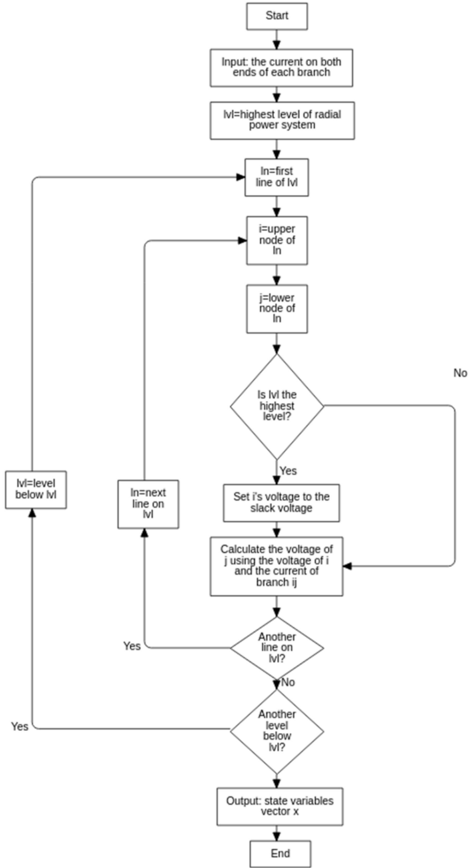
The increase of distributed energy resources (DERs) in low voltage (LV) distribution networks requires the ability to perform an accurate power flow analysis (PFA) in unbalanced systems. The characteristics of a well performing power flow algorithm are the production of accurate results, robustness and quick convergence. The current study proposes an improvement to an already used backward-forward sweep (BFS) power flow algorithm for unbalanced three-phase distribution networks. The proposed power flow algorithm can be implemented in large systems producing accurate results in a small amount of time using as little computational resources as possible. In this version of the algorithm, the network is represented in a tree-like structure, instead of an incidence matrix, avoiding the use of redundant computations and the storing of unnecessary data. An implementation of the method was developed in Python programming language and tested for 3 IEEE feeder test cases (the 4 bus feeder, the 13 bus feeder and the European Low Voltage test feeder), ranging from a low (4) to a very high (907) buses number, while including a wide variety of components witnessed in LV distribution networks.
Overview
The claims and statistics of this paper haven’t been checked yet.
Free: it reads the open-access text and checks the first 5 claims that cite a source we can check. Create a free account to check every claim.
Integrity signals
Registry
Cites
Statistics
Figures
Verification
Claims the paper makes
The claims and statistics of this paper haven’t been checked yet.
Free: it reads the open-access text and checks the first 5 claims that cite a source we can check. Create a free account to check every claim.
Claims other papers make about this one
Each is checked against this paper’s own text: does it say what the citing paper says it does?
The cited source says what the claim attributes to it.
In the citing paper
“Many works of literature have used backward forward sweep algorithm and its improved version (Petridis et al., 2021) for power flow analysis due to its various advantages.”
From Optimal location of electric vehicle charging station and its impact on distribution network: A review (2022) · cites this paper as Petridis et al., 2021
Self-check
Percentages, sums and reported differences re-computed from the paper’s own numbers.
The self-check needs the paper’s full text.
Citations
Cites
Harris, C. R., Millman, K. J., van der Walt, S. J., Gommers, R., Virtanen, P., Cournapeau, D., Wieser, E., Taylor, J., Berg, S., Smith, N. J., et al. (2020) · Nature · doi:10.1038/s41586-020-2649-2 · Cited by 23,826
Harris, C., Millman, K., van der Walt, S., Gommers, R., Virtanen, P., Cournapeau, D., Wieser, E., Taylor, J., Berg, S., Smith, N., et al. (2020) · RePEc: Research Papers in Economics · Cited by 17,844
A direct approach for distribution system load flow solutions
Teng, J.-H. (2003) · IEEE Transactions on Power Delivery · doi:10.1109/tpwrd.2003.813818 · Cited by 1,037
The Conjugate Gradient Method and Trust Regions in Large Scale Optimization
Steihaug, T. (1983) · SIAM Journal on Numerical Analysis · doi:10.1137/0720042 · Cited by 824
van Rossum, G., & Python Dev Team (1999) · Cited by 367
An Improved Backward/Forward Sweep Load Flow Algorithm for Radial Distribution Systems
Chang, G. W., Chu, S. Y., & Wang, H. L. (2007) · IEEE Transactions on Power Systems · doi:10.1109/tpwrs.2007.894848 · Cited by 325
A Linear Three-Phase Load Flow for Power Distribution Systems
Garces, A. (2016) · IEEE Transactions on Power Systems · doi:10.1109/tpwrs.2015.2394296 · Cited by 300
Linear three-phase power flow for unbalanced active distribution networks with PV nodes
Wang, Y., Zhang, N., Li, H., Yang, J., & Kang, C. (2017) · CSEE Journal of Power and Energy Systems · doi:10.17775/cseejpes.2017.00240 · Cited by 106
A Unified Three-Phase Transformer Model for Distribution Load Flow Calculations
Xiao, P., Yu, D. C., & Yan, W. (2006) · IEEE Transactions on Power Systems · doi:10.1109/tpwrs.2005.857847 · Cited by 92
Review of Power System Distribution Network Architecture
Prakash, K., Lallu, A., Islam, F. R., & Mamun, K. A. (2016) · Asia-Pacific World Congress on Computer Science and Engineering (APWC on CSE) · doi:10.1109/apwc-on-cse.2016.030 · Cited by 82
Research works printed but not linked: 3
- Grainger, J.J.; Stevenson, W.D.; Stevenson, W.D. Power System Analysis; McGraw-Hill: New York, NY, USA, 1994.
- Van Rossum, G. Python tutorial, Technical Report CS-R9526, Centrum voor Wiskunde en Informatica (CWI), Amsterdam, May 1995. Available online: https://scholar.google.com/scholar_lookup?title=Python%20Tutorial&author=G.%20van%20Rossum& publication_year=1995 (accessed on 15 November 2020.).
- (2020, November 15). Resources IEEE PES Test Feeder. Available online: https://site.ieee.org/pes-testfeeders/.
Cited by
Ahmad, F., Iqbal, A., Ashraf, I., Marzband, M., & khan, I. (2022) · Energy Reports · doi:10.1016/j.egyr.2022.01.180 · Cited by 533
Ray, S., Kasturi, K., Patnaik, S., & Nayak, M. R. (2023) · Journal of Energy Storage · doi:10.1016/j.est.2023.108672 · Cited by 118
A Review on Distribution System State Estimation Algorithms
Fotopoulou, M. C., Petridis, S., Karachalios, I., & Rakopoulos, D. C. (2022) · Applied Sciences · doi:10.3390/app122111073 · Cited by 80
Self-citationRadhoush, S., Bahramipanah, M., Nehrir, M. H., & Shahooei, Z. (2022) · Sustainability · doi:10.3390/su14052520 · Cited by 54
Sun, P., Wu, R., Wang, H., Li, G., Khalid, M., & Konstantinou, G. S. (2024) · IEEE Transactions on Power Systems · doi:10.1109/tpwrs.2024.3382266 · Cited by 20
Metadata
- Authors
- Petridis, S., Blanas, O., Rakopoulos, D., Stergiopoulos, F., Nikolopoulos, N., & Voutetakis, S.
- Affiliations
- Centre for Research and Technology Hellas (GR)
- Centre for Research and Technology Hellas, Chemical Process and Energy Resources Institute, 6th km Charilaou-Thermi Road, GR-57001 Thermi, Thessaloniki, Greece
- Corresponding author
- Rakopoulos, Dimitrios
- ORCID
- Venue
- Energies
- Publisher
- MDPI AG
- Published
- 2021-02-09
- Volume
- 14
- Issue
- 4
- Pages
- 897
- ISSN
- 1996-1073 (ISSN-L)
- OpenAlex
- W3128634291
- Cited by
- 38
- References
- 29
- Citations by year
- 2026: 2 · 2025: 8 · 2024: 7 · 2023: 6 · 2022: 14 · 2021: 1
- FWCI
- 2.06
- Type
- journal article
- Language
- en
- Open access
- gold
- doi.org
- Licence
- Locations
- Energies (publishedVersion, cc-by)
- RePEc: Research Papers in Economics (submittedVersion)
- DOAJ (DOAJ: Directory of Open Access Journals) (submittedVersion, cc-by-sa)
- Funders
- Horizon 2020 - A single, smart European electricity grid (864360)
- Topics
- Physical Sciences › Engineering › Electrical and Electronic Engineering › Optimal Power Flow Distribution
- Physical Sciences › Engineering › Electrical and Electronic Engineering › Power System Optimization and Stability
- Physical Sciences › Engineering › Electrical and Electronic Engineering › Smart Grid and Power Systems
- Keywords
- power flow analysis, unbalanced distribution systems, distributed energy resources, low-voltage distribution networks, three-phase power flow, IEEE test feeders, computational efficiency
About these checks
Registry, retraction, Cites and statistics results are computed, not judged, with one exception: a printed reference that no index lists is read once by a model before it counts as a citation error. Claims are extracted by a model and kept only when their quote appears verbatim in the text; each cited source is then checked, with a model’s help, for whether it says what the claim relies on. Those verdicts can be wrong — read the claim’s quote and the cited source before relying on one.
Statistics and arithmetic are recomputed, not judged.
Confidence bands are shown only for fields calibrated on our annotated test set. None is calibrated yet, so no band is shown.
What counts as a claim ›How we measure confidence ›How we check this ›
Are you an author, or do you see a problem with this page? Request a review
Data sources
Bibliographic data: Semantic Scholar, OpenAlex, Crossref.
Contains information from the Semantic Scholar Academic Graph Datasets, made available under the ODC Attribution License (ODC-BY 1.0).
Semantic Scholar’s data is described in: Kinney, R., et al. (2023). The Semantic Scholar Open Data Platform. arXiv:2301.10140.
