

An Optimized Solution for Fault Detection and Location in Underground Cables Based on Traveling Waves
Open accessThe DOI matches its Crossref record; 47 of the 48 references it cites were found in a registry or an index.
Abstract
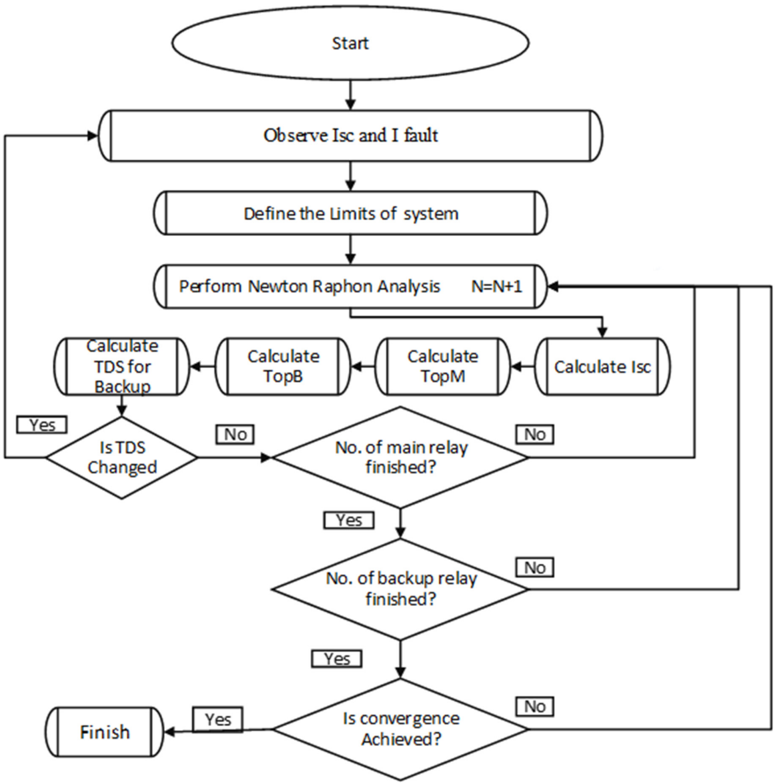
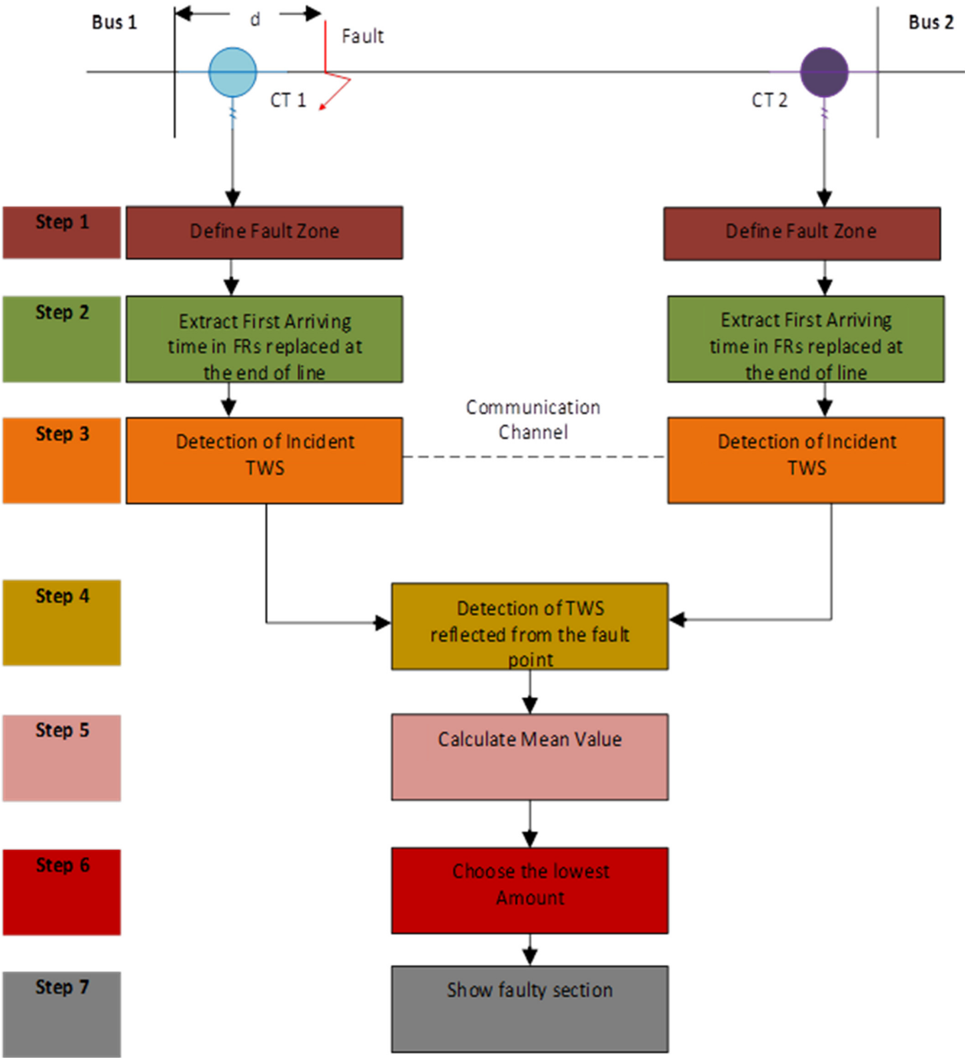
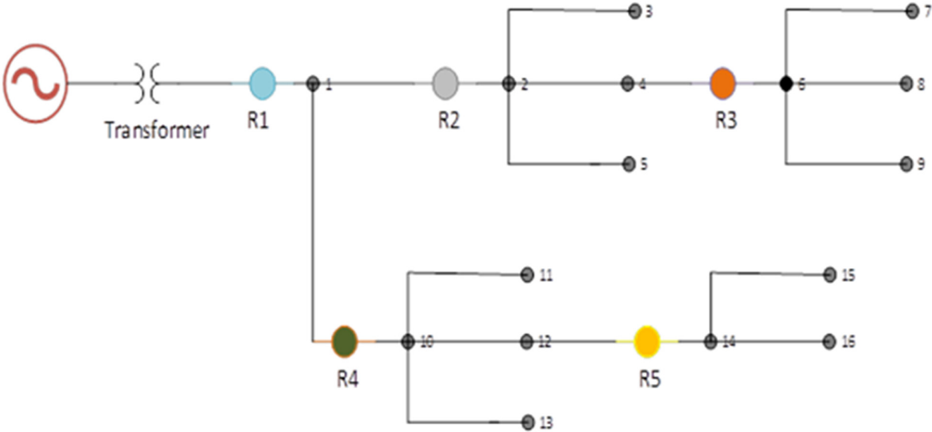
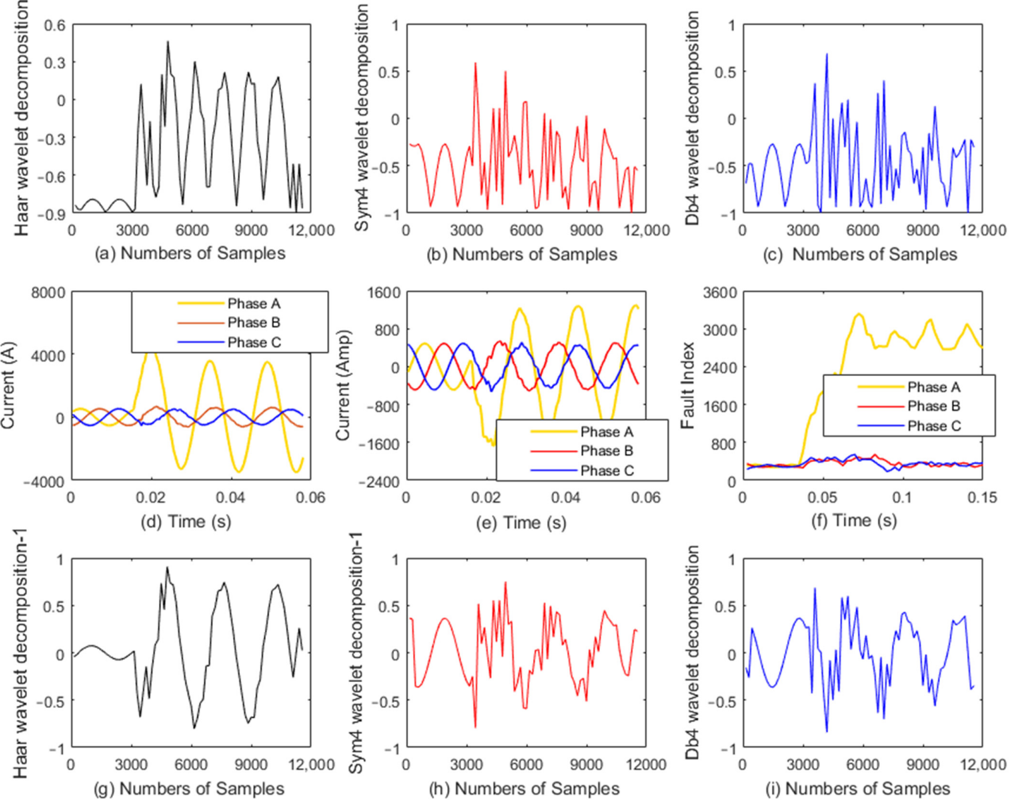
Faults in the power system affect the reliability, safety, and stability. Power-distribution systems are familiar with the different faults that can damage the overall performance of the entire system, from which they need to be effectively cleared. Underground power systems are more complex and require extra accuracy in fault detection and location for optimum fault management. Slow processing and the unavailability of a protection zone for relay coordination are concerns in fault detection and location, as these reduce the performance of power-protection systems. In this regard, this article proposes an optimized solution for a fault detection and location framework for underground cables based on a discrete wavelet transform (DWT). The proposed model supports area detection, the identification of faulty sections, and fault location. To overcome the abovementioned facts, we optimize the relay coordination for the overcurrent and timing relays. The proposed protection zone has two sequential stages for the current and time at which it optimizes the current and time settings of the connected relays through Newton–Raphson analysis (NRA). Moreover, the traveling times for the DWT are modeled, which relate to the protection zone provided by the relay coordination, and the faulty line that is identified as the relay protection is not overlapped. The model was tested for 132 kV/11 kV and 16-node networks for underground cables, and the obtained results show that the proposed model can detect and locate the cable’s faults speedily, as it detects the fault in 0.01 s, and at the accurate location. MATLAB/Simulink (DigSILENT Toolbox) is used to establish the underground network for fault location and detection.
Overview
The claims and statistics of this paper haven’t been checked yet.
Free: it reads the open-access text and checks the first 5 claims that cite a source we can check. Create a free account to check every claim.
Integrity signals
Registry
Cites
Statistics
Figures
Verification
Claims the paper makes
The claims and statistics of this paper haven’t been checked yet.
Free: it reads the open-access text and checks the first 5 claims that cite a source we can check. Create a free account to check every claim.
Claims other papers make about this one
Each is checked against this paper’s own text: does it say what the citing paper says it does?
The check wasn’t confident either way, so it gives no verdict — never disputed.
In the citing paper
“According to numerical findings, this method can locate the ideal global solution more quickly than a traditional GA.”
From A Comprehensive Review on the Role of Artificial Intelligence in Power System Stability, Control, and Protection: Insights and Future Directions (2024) · cites this paper as [117]
Experimental — accuracy not yet measured
Self-check
Percentages, sums and reported differences re-computed from the paper’s own numbers.
The self-check needs the paper’s full text.
Citations
Cites
E-eyes: device-free location-oriented activity identification using fine-grained WiFi signatures
Wang, Y., Liu, J., Chen, Y., Gruteser, M., Yang, J., & Liu, H. (2014) · Proceedings of the 20th annual international conference on Mobile computing and networking · doi:10.1145/2639108.2639143 · Cited by 817
Fault Diagnosis for Electrical Systems and Power Networks: A Review
Furse, C. M., Kafal, M., Razzaghi, R., & Shin, Y.-J. (2021) · IEEE Sensors Journal · doi:10.1109/jsen.2020.2987321 · Cited by 296
Quilty, J., & Adamowski, J. (2018) · Journal of Hydrology · doi:10.1016/j.jhydrol.2018.05.003 · Cited by 245
Li, X., Dysko, A., & Burt, G. M. (2014) · IEEE Transactions on Smart Grid · doi:10.1109/tsg.2014.2320365 · Cited by 205
Mahela, O. P., Khan, B., Alhelou, H. H., & Siano, P. (2020) · IEEE Transactions on Industrial Informatics · doi:10.1109/tii.2020.2971709 · Cited by 189
Aftab, M. A., Hussain, S. M. S., Ali, I., & Ustun, T. S. (2020) · International Journal of Electrical Power & Energy Systems · doi:10.1016/j.ijepes.2019.105410 · Cited by 169
Demonstration of a High Power, Wideband 220-GHz Traveling Wave Amplifier Fabricated by UV-LIGA
Joye, C. D., Kimura, T., Hyttinen, M., Levush, B., Cook, A. M., Calame, J. P., Abe, D. K., Vlasov, A. N., Chernyavskiy, I. A., Nguyen, K. T., et al. (2014) · IEEE Transactions on Electron Devices · doi:10.1109/ted.2014.2300014 · Cited by 158
On the use of continuous-wavelet transform for fault location in distribution power systems
Borghetti, A., Corsi, S., Nucci, C. A., Paolone, M., Peretto, L., & Tinarelli, R. (2006) · International Journal of Electrical Power & Energy Systems · doi:10.1016/j.ijepes.2006.03.001 · Cited by 149
A survey of fault prediction and location methods in electrical energy distribution networks
Dashti, R., Daisy, M., Mirshekali, H., Shaker, H. R., & Aliabadi, M. H. (2021) · Measurement · doi:10.1016/j.measurement.2021.109947 · Cited by 144
Amiruddin, A. A. A. M., Zabiri, H. B., Taqvi, S. A. A., & Tufa, L. D. (2018) · Neural Computing and Applications · doi:10.1007/s00521-018-3911-5 · Cited by 139
Research works printed but not linked: 2
- Mansingh, R.K.R.; Rajesh, R.; Ramasubramani, S.; Ramkumar, G. Underground Cable Fault Detection using Raspberry Pi and Arduino. Int. J. Emerg. Technol. Eng. Res. 2017, 5, 1-5.
- Gowrishankar, M.; Nagaveni, P.; Balakrishnan, P. Transmission line fault detection and classification using discrete wavelet transform and artificial neural network. Middle-East J. Sci. Res. 2016, 24, 1112-1121.
Cited by
Alhamrouni, I., Abdul Kahar, N. H., Salem, M., Swadi, M., Zahroui, Y., Kadhim, D. J., Mohamed, F. A., & Alhuyi Nazari, M. (2024) · Applied Sciences · doi:10.3390/app14146214 · Cited by 217
“A new global tuning method was suggested for fuzzy power system stabilizers to reduce oscillations in a multi-machine power system [117].”
MethodSelf-citationShao, Q., Fan, S., Zhang, Z., Liu, F., Fu, Z., Lv, P., & Mu, Z. (2025) · Energies · doi:10.3390/en18143662 · Cited by 40
Partial Discharge Detection and Defect Location Method in GIS Cable Terminal
Li, S., Song, P., Wei, Z., Li, X., Tang, Q., Meng, Z., Li, J., Li, J., Wang, Y., & Li, J. (2022) · Energies · doi:10.3390/en16010413 · Cited by 24
Rehman, A., Imran-Daud, M., Haider, S. K., Rehman, A. U., Shafiq, M., & Eldin, S. M. (2022) · Symmetry · doi:10.3390/sym14102027 · Cited by 24
Self-citationPrediction of Faults Location and Type in Electrical Cables Using Artificial Neural Network
Moldovan, A.-M., & Buzdugan, M. I. (2023) · Sustainability · doi:10.3390/su15076162 · Cited by 16
Ghaly, A. S. E. (2025) · Eng—Advances in Engineering · doi:10.3390/eng6010004 · Cited by 13
Daisy, M., Aliabadi, M. H., Javadi, S., & Naimi, H. M. (2023) · International Journal of Electrical Power & Energy Systems · doi:10.1016/j.ijepes.2023.109343 · Cited by 13
Elkhrachy, I., Alhamami, A. H., Alyami, S. H., & Alviz-Meza, A. (2023) · Water · doi:10.3390/w15183254 · Cited by 9
Cunha, T. M. O. A., Lopes, G. N., Lessa, L., Davi, M. J. B. B., Oleskovicz, M., & Júnior, J. C. D. M. V. (2025) · IEEE Access · doi:10.1109/access.2025.3583561 · Cited by 5
Determine the Exact Fault Location in Underground Cable: A Systematic Review
S, S., & Marimuthu, R. (2025) · IEEE Access · doi:10.1109/access.2025.3649693 · Cited by 4
“[33].”
Pang, J., Li, J., Xiuru, W., Yunlong, J., & Fei, X. (2025) · Frontiers in Energy Research · doi:10.3389/fenrg.2025.1538033 · Cited by 4
Powerline Fault Detection and Location Tracking with GSM
Sreejith, P. R., M, F. M., Krishnaprasad, V. N., Raphy, J., George, A., & James, J. (2024) · International Conference on Circuit, Power and Computing Technologies · doi:10.1109/iccpct61902.2024.10673361 · Cited by 3
“MATLAB/Simulink with the Dig SILENT Toolbox is employed to simulate the underground network for fault detection and location [8].”
BackgroundMethodHongsong, D., Chuanqian, J., Pingchuan, M., Chen, P., Yuxue, C., & Chenxi, W. (2025) · IEEE International Conference on Electrical Energy Conversion Systems and Control (IEECSC) · doi:10.1109/ieecsc64206.2025.11099649 · Cited by 2
“This method compresses the data by constructing an FP-tree [16] and performs association rule mining on this basis to identify the frequent itemsets that lead to short-circuit faults, thus realizing the detection and diagnosis of cable short-circuit faults.”
Advanced Artificial Intelligence Techniques for Fault Distance Prediction in Optical Fibres
Albawab, O. W. (2025) · International Journal of Electrical and Electronics Research · doi:10.37391/ijeer.130113 · Cited by 2
“Furthermore, OTDRs are utilized to check join misfortune, measure link length, and distinguish flaws in optical links, particularly during beginning establishment [18].”
A new algorithm for fault location in multi-end underground cables using traveling waves
Tariq, R., Alhamrouni, I., Rehman, A. U., Asif, R. M., & Rafique, Z. (2023) · International Journal of Power Electronics and Drive Systems/International Journal of Electrical and Computer Engineering · doi:10.11591/ijpeds.v14.i2.pp1280-1289 · Cited by 1
Self-citationSu, Q., Chen, Z., & Li, W. (2024) · Journal of Physics Conference Series · doi:10.1088/1742-6596/2849/1/012069 · Cited by 1
Optimal circuit breaker allocation strategy in DC transmission-connected systems
Kim, B., & Kim, I. (2024) · Scientific Reports · doi:10.1038/s41598-024-74166-1 · Cited by 1
Research on 10 kV Cable Insulation Detection Method Based on Ground Current Phase Variation
Liu, G., Zhang, Y., Ye, T., Zhang, D., Cao, P., & Che, Y. (2025) · Energies · doi:10.3390/en18133586 · Cited by 1
Advancements in Fault Detection Techniques for Optical Fiber Networks: A Comprehensive Review
Hazim, S. A., & Al-Allaf, A. F. (2025) · Lecture notes in social networks · doi:10.1007/978-3-031-91643-4_10 · Cited by 2
Téllez, A. Á., Jurado, F., Jaramillo, M., & Liu, P. (2026) · Energies · doi:10.3390/en19153567 · Cited by 1
Optical Cable Fault Accurate Location Method Based on VR-GIS
Hou, G., Li, Y., Xiao, Y., Zhou, H., & Zhang, Z. (2023) · International Conference on Electronic Information Engineering and Computer Science (EIECS) · doi:10.1109/eiecs59936.2023.10435514 · Cited by 1
“This paper [4] proposes an optimization scheme of underground cable fault detection and location framework based on discrete wavelet transform (DWT), which can improve fault location accuracy to a certain extent.”
BackgroundOptimal Design Considerations For Over Head Transmission Line (OHTL)
Tariq, R., Alhamrouni, I., Afzal, A., Rehman, A. U., Rafique, Z., & Asif, R. M. (2023) · International Conference on Engineering and Emerging Technologies (ICEET) · doi:10.1109/iceet60227.2023.10526119 · Cited by 1
“The Contractor shall provide the sag and tension calculations for the conductors and the OPGW, clearly stating the design parameters and controlling conditions in accordance with the specifications [14].”
MethodSelf-citationDetermining the Location and Type of Faults in Electrical Cables Using an Artificial Neural Network
Svyatykh, A., Tavarov, S. S., Medvedeva, Y., & Khasanov, J. (2024) · Journal of modern energy research. · doi:10.56947/jmer.v2i2.12 · Cited by 1
A Smart Way of Detecting Underground Cable Fault using a Robot
Kumar, A., Saravana Kumar, R., Selva Kumar, K., & Praveen Kumar, T. (2023) · doi:10.53759/aist/978-9914-9946-4-3_8
Moldovan, A.-M., & Buzdugan, M. I. (2024) · International Conference on Applied and Theoretical Electricity · doi:10.1109/icate62934.2024.10749128
Khumalo, S. A., Mendu, B., & Monchusi, B. B. (2024) · International Conference on Electrical and Computer Engineering Researches (ICECER) · doi:10.1109/icecer62944.2024.10920364
“Tariq, R et al. (2022) examined underwater threats to communication cables and discussed sensor capabilities alongside designs for surveillance networks to protect these cables [11].”
Bakar, A. A., Chai, C. Y., Chin, K. F., Yoong, H. P., Uda, M. N. A., Liau, C. F., Goh, T. K. T., & Diantoro, M. (2024) · Journal of Advanced Research in Applied Sciences and Engineering Technology · doi:10.37934/araset.57.4.199209
Mashiku, S. F., Robandi, I., Fahmi, D., Prakasa, M. A., & Djalal, M. R. (2025) · International Conference on High Voltage Engineering and Power Systems (ICHVEPS) · doi:10.1109/ichveps66913.2025.11351046
“Traditional techniques like the impedance-based method, which relies on voltage and current measurements at one or both cable ends, are simple but suffer from limited precision due to waveform distortions, reflections, and parameter uncertainty[5][6].”
Li, Y. (2026) · International Conference on Testing Technology and Automation Engineering (TTAE) · doi:10.1117/12.3101940
“Paper [3] presents an optimized solution framework based on discrete wavelet transform for fault detection and location in underground cables.”
Error Components Of Traveling Wave Fault Location Complex In Branched Distribution Networks
Khuziashev, R., Minaev, I. A., & Sarychev, D. V. (2026) · IEEE PES International Meeting (PES IM) · doi:10.1109/pesim67009.2026.11438695
Chezhian, V. P., Maheswari, K. U., Venkatesh, D. A., Dharsan, R. D., Guruprasath, K., & Saran, S. (2026) · International Conference on Electronic Systems and Intelligent Computing (ICESIC) · doi:10.1109/icesic67389.2026.11496453
“In [12], a method that utilizes DWT, with the coordination of optimally routed relays and an NRA process for the optimal number of wiring length through an underground cable.”
Kamaruzaman, M. N. A. B., Mohamad, H., Ghazali, M. F., Nasir, M. Y. M., & Majdi, A. M. (2026) · Results in Optics · doi:10.1016/j.rio.2026.101093
Fault Location Method for Overhead Lines Based on Traveling Wave Detection
Yi, J., Xu, P., Lu, X., Liu, S., & Wang, D. (2026) · Journal of Dynamics Monitoring and Diagnostics · doi:10.37965/jdmd.2026.1456
“5 [24, 25].”
Zhao, S., Zhang, Q., Yin, Z., Yesibolati, H., Song, Y., Liu, Z., & Wang, B. (2026) · Sensors · doi:10.3390/s26196192
“It enhances adaptability to wave speed variations and line parameter uncertainty [35,36].”
Spider Web Inspired Optimization Model for Precise Underground Cable Fault LocalizationPreprint
S, S., & R, M. (2026) · Research Square · doi:10.21203/rs.3.rs-11007428/v1
Simulation-Based Ampacity Assessment of Cable Joints Based on Hotspot-Temperature Inversion
Chen, M., Wang, X., Zhang, B., Lin, P., Li, P., Li, Y., & Zou, G. (2026) · Electronics · doi:10.3390/electronics15215140
Metadata
- Authors
- Tariq, R., Alhamrouni, I., Rehman, A. U., Tag Eldin, E., Shafiq, M., Ghamry, N. A., & Hamam, H.
- Affiliations
- University of Kuala Lumpur (MY)
- Government College University, Lahore (PK)
- Faculty of Engineering and Technology, Future University in Egypt, New Cairo 11835, Egypt
- Yeungnam University (KR)
- Cairo University (EG)
- Université de Moncton (CA)
- Corresponding author
- Alhamrouni, Ibrahim
- Rehman, Ateeq Ur
- Shafiq, Muhammad
- Venue
- Energies
- Publisher
- MDPI AG
- Published
- 2022-09-05
- Volume
- 15
- Issue
- 17
- Pages
- 6468
- ISSN
- 1996-1073 (ISSN-L)
- OpenAlex
- W4294833770
- Cited by
- 30
- References
- 48
- Citations by year
- 2026: 5 · 2025: 10 · 2024: 6 · 2023: 7 · 2022: 2
- FWCI
- 2.52
- Type
- journal article
- Language
- en
- Open access
- gold
- doi.org
- Licence
- Locations
- Energies (publishedVersion, cc-by)
- RePEc: Research Papers in Economics (submittedVersion)
- DOAJ (DOAJ: Directory of Open Access Journals) (submittedVersion, cc-by-sa)
- Funders
- Future University Researchers Supporting Project (FUESP-2020/48)
- Topics
- Physical Sciences › Engineering › Control and Systems Engineering › Power Systems Fault Detection
- Physical Sciences › Engineering › Electrical and Electronic Engineering › Electrical Fault Detection and Protection
- Physical Sciences › Engineering › Electrical and Electronic Engineering › Power Quality and Harmonics
- Keywords
- fault detection, fault location, underground cables, traveling waves, discrete wavelet transform, relay coordination, overcurrent relays, protection zones, distribution networks
About these checks
Registry, retraction, Cites and statistics results are computed, not judged, with one exception: a printed reference that no index lists is read once by a model before it counts as a citation error. Claims are extracted by a model and kept only when their quote appears verbatim in the text; each cited source is then checked, with a model’s help, for whether it says what the claim relies on. Those verdicts can be wrong — read the claim’s quote and the cited source before relying on one.
Statistics and arithmetic are recomputed, not judged.
Confidence bands are shown only for fields calibrated on our annotated test set. None is calibrated yet, so no band is shown.
What counts as a claim ›How we measure confidence ›How we check this ›
Are you an author, or do you see a problem with this page? Request a review
Data sources
Bibliographic data: Semantic Scholar, OpenAlex, Crossref.
Contains information from the Semantic Scholar Academic Graph Datasets, made available under the ODC Attribution License (ODC-BY 1.0).
Semantic Scholar’s data is described in: Kinney, R., et al. (2023). The Semantic Scholar Open Data Platform. arXiv:2301.10140.
