

Pediatric Adapted Liking Survey (PALS) with Tailored Nutrition Education Messages: Application to a Middle School Setting
Open accessThe DOI matches its Crossref record; 63 of the 63 references it cites were found in a registry or an index.
Abstract
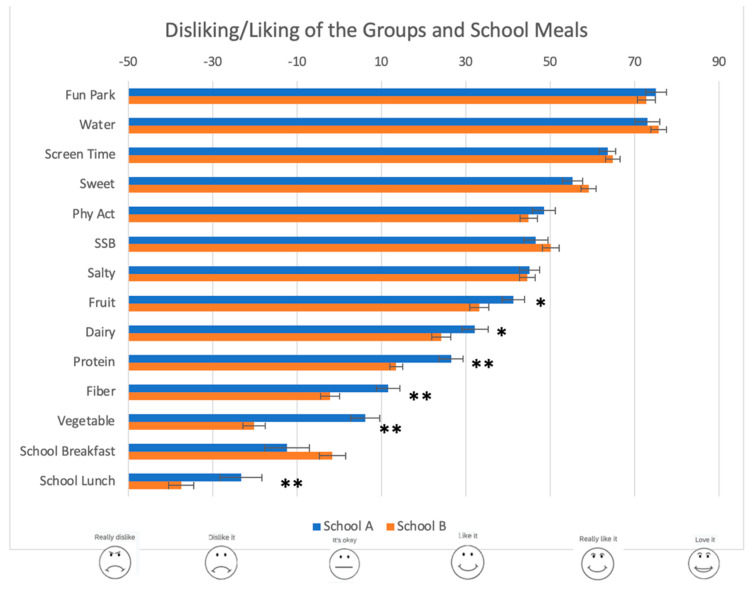
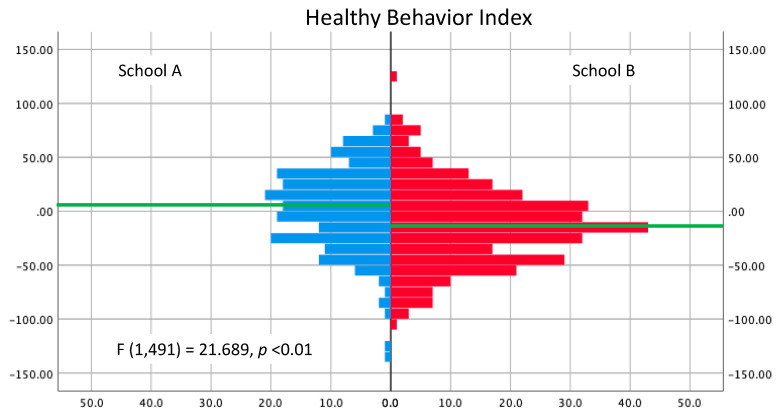
We tested the feasibility of a school-based, liking-based behavioral screener (Pediatric Adapted Liking Survey (PALS)) and message program to motivate healthy diet and activity behaviors. Students, recruited from middle- (n = 195) or low-income (n = 310) schools, online-reported: likes/dislikes of foods/beverages and physical/sedentary activities, scored into healthy behavior indexes (HBI); perceived food insecurity; and sleep indicators. Students received tailored motivating or reinforcing messages (aligned with behavior change theories) and indicated their willingness to improve target behaviors as well as program feasibility (acceptability; usefulness). Although HBIs averaged lower in the lower versus middle-income school, frequencies of food insecurity were similar (39–44% of students). Students in both schools reported sleep concerns (middle-income school—43% reported insufficient hours of sleep/night; low-income school—55% reported excessive daytime sleepiness). Students across both schools confirmed the PALS acceptability (>85% agreement to answering questions quickly and completion without help) and usefulness (≥73% agreed PALS got them thinking about their behaviors) as well as the tailored message acceptability (≥73% reported the messages as helpful; learning new information; wanting to receive more messages) and usefulness (73% reported “liking” to try one behavioral improvement). Neither message type nor response varied significantly by food insecurity or sleep measures. Thus, this program feasibly delivered students acceptable and useful messages to motivate healthier behaviors and identified areas for school-wide health promotion.
Overview
The claims and statistics of this paper haven’t been checked yet.
Free: it reads the open-access text and checks the first 5 claims that cite a source we can check. Create a free account to check every claim.
Integrity signals
Registry
Cites
Statistics
Figures
Verification
Claims the paper makes
The claims and statistics of this paper haven’t been checked yet.
Free: it reads the open-access text and checks the first 5 claims that cite a source we can check. Create a free account to check every claim.
Self-check
Percentages, sums and reported differences re-computed from the paper’s own numbers.
The self-check needs the paper’s full text.
Citations
Cites
The Transtheoretical Model of Health Behavior Change.
Prochaska, J. O., & Velicer, W. F. (1997) · American Journal of Health Promotion · doi:10.4278/0890-1171-12.1.38 · Cited by 7,782
Prevalence of Obesity Among Adults and Youth: United States, 2015-2016.
Hales, C. M., Carroll, M. D., Fryar, C. D., & Ogden, C. L. (2017) · PubMed · Cited by 4,554
How we design feasibility studies
Bowen, D. J., Kreuter, M., Spring, B., Cofta-Woerpel, L., Linnan, L., Weiner, D., Bakken, S., Kaplan, C. P., Squiers, L., Fabrizio, C., et al. (2009) · American Journal of Preventive Medicine · doi:10.1016/j.amepre.2009.02.002 · Cited by 4,021 · cited 1×
“The aim was to assess feasibility, operationalized as the acceptability and usefulness of the program to the children [22], as well as toward the goal of motivating healthier behaviors for obesity prevention and providing usable information for school-based health promotion interventions.”
BackgroundAttitudes and Persuasion: Classic and Contemporary Approaches
Petty, R. E., & Cacioppo, J. T. (1981) · Medical Entomology and Zoology · Cited by 3,368
Paruthi, S., Brooks, L. J., D'Ambrosio, C., Hall, W. A., Kotagal, S., Lloyd, R. M., Malow, B. A., Maski, K., Nichols, C., Quan, S. F., et al. (2016) · Journal of Clinical Sleep Medicine · doi:10.5664/jcsm.6288 · Cited by 837 · cited 1×
“Stakeholders in both school settings also reported interest in evaluating poor sleep habits since most middle schoolers report not meeting recommended hours of sleep [23] and”
BackgroundGuenther, P. M., Kirkpatrick, S. I., Reedy, J., Krebs-Smith, S. M., Buckman, D. W., Dodd, K. W., Casavale, K. O., & Carroll, R. J. (2014) · The Journal of Nutrition · doi:10.3945/jn.113.183079 · Cited by 822 · cited 1×
“The composite index of healthy behaviors (HBI) showed good variability across the sample and acceptable psychometric properties for indexes [54] that are similar to what was previously reported [8].”
ResultStigma Experienced by Children and Adolescents With Obesity
Pont, S. J., Puhl, R., Cook, S. R., Slusser, W., OBESITY, S. O., & THE OBESITY SOCIETY (2017) · Pediatrics · doi:10.1542/peds.2017-3034 · Cited by 676
The ADAPT-ITT Model: A Novel Method of Adapting Evidence-Based HIV Interventions
Wingood, G. M., & DiClemente, R. J. (2008) · JAIDS Journal of Acquired Immune Deficiency Syndromes · doi:10.1097/qai.0b013e3181605df1 · Cited by 664 · cited 5×
“As outlined in the Assessment phase of an ADAPT-ITT model [26]; (Table 1), interviews with school stakeholders and school meal observations lead to the decision to adapt the PALS plus message program used in a clinical setting [7] to meet the needs of the school while retaining the essence of the original program.”
MethodInfluential(2003) · Sleep · doi:10.1093/sleep/26.4.455 · Cited by 588 · cited 6×
“5 hours for 12–14 years) [27]; School B was ≥15 on the summed score across eight items of Pediatric Daytime Sleepiness Scale [24].”
BackgroundMethodInfluentialOgden, C. L., Carroll, M. D., Fakhouri, T. H., Hales, C. M., Fryar, C. D., Li, X., & Freedman, D. S. (2018) · MMWR. Morbidity and Mortality Weekly Report · doi:10.15585/mmwr.mm6706a3 · Cited by 475
Research works printed but not linked: 1
- 38. Lund, A.M. Measuring Usability with the USE Questionnaire. Usability Interface 2001 , 8 , 3-6.
Cited by
Determinants of Preference and Consumption of Healthy Food in Children
Laureati, M. (2022) · Foods · doi:10.3390/foods11020203 · Cited by 28
Chatterjee, P., & Nirgude, A. (2024) · Cureus · doi:10.7759/cureus.53127 · Cited by 26
“…short and long-term intervention periods provided in the chosen research varied from one day [12] to five years [52], with 25 studies [8,10-12, 17 , 19-21 It is important to highlight in the common findings that the effects of interventions tend to diminish over time [8,10,12,14,21,24,25,32,34,38].”
BackgroundMethodResultInfluentialHubert, P. A., Mahoney, M., Huedo-Medina, T. B., Leahey, T. M., & Duffy, V. B. (2021) · Nutrients · doi:10.3390/nu13103366 · Cited by 10
Self-citationUsability Testing an mHealth Program with Tailored Motivational Messages for Early Adolescents
Lin, C. A., Vosburgh, K. L., Roy, D., & Duffy, V. B. (2023) · Nutrients · doi:10.3390/nu15030574 · Cited by 10
Self-citationHubert, P. A., Fiorenti, H., & Duffy, V. B. (2022) · Nutrients · doi:10.3390/nu14194012 · Cited by 7
Self-citationStudent Food Selection Behaviour after Returning to Face-to-Face Classes
Huamán-Romaní, Y.-L., Garrido-Arismendis, J.-J., Agurto-Zapata, J.-F., Juarez-Vera, N.-P., & Benavides, R. A. H. (2022) · International Journal of Innovative Research and Scientific Studies · doi:10.53894/ijirss.v6i1.1059 · Cited by 3
“Discussion University students have been successfully motivated to have a healthier and more nutritious eating behavior [1].”
BackgroundAntwi, J., Harrison, O. A., & Hayatbini, N. (2026) · Journal of Nutrition · doi:10.1016/j.tjnut.2026.101845
Metadata
- Authors
- Hildrey, R., Karner, H., Serrao, J., Lin, C. A., Shanley, E., & Duffy, V. B.
- Affiliations
- University of Connecticut (US)
- Corresponding author
- Duffy, Valerie B.
- Venue
- Foods
- Publisher
- MDPI AG
- Published
- 2021-03-10
- Volume
- 10
- Issue
- 3
- Pages
- 579
- ISSN
- 2304-8158 (ISSN-L)
- PMC
- PMC8001433
- OpenAlex
- W3134663602
- Cited by
- 6
- References
- 63
- Citations by year
- 2024: 1 · 2023: 1 · 2022: 3 · 2021: 1
- FWCI
- 0.96
- Type
- journal article
- Language
- en
- Open access
- gold
- doi.org
- Licence
- Locations
- Foods (publishedVersion, cc-by)
- PubMed Central (publishedVersion, cc-by)
- PubMed (publishedVersion)
- DOAJ (DOAJ: Directory of Open Access Journals) (submittedVersion, cc-by-sa)
- Funders
- National Institute of Food and Agriculture (Hatch project 1001056)
- Topics
- Health Sciences › Nursing › Nutrition and Dietetics › Nutrition, Health and Food Behavior
- Health Sciences › Medicine › Public Health, Environmental and Occupational Health › School Health and Nursing Education
- Health Sciences › Medicine › Public Health, Environmental and Occupational Health › Obesity, Physical Activity, Diet
- Keywords
- food liking, food preferences, junior high school students, food insecurity, sleep, physical activity, sedentary behavior, behaviour change theory, program acceptability, school health promotion, low-income schools
About these checks
Registry, retraction, Cites and statistics results are computed, not judged, with one exception: a printed reference that no index lists is read once by a model before it counts as a citation error. Claims are extracted by a model and kept only when their quote appears verbatim in the text; each cited source is then checked, with a model’s help, for whether it says what the claim relies on. Those verdicts can be wrong — read the claim’s quote and the cited source before relying on one.
Statistics and arithmetic are recomputed, not judged.
Confidence bands are shown only for fields calibrated on our annotated test set. None is calibrated yet, so no band is shown.
What counts as a claim ›How we measure confidence ›How we check this ›
Are you an author, or do you see a problem with this page? Request a review
Data sources
Bibliographic data: Semantic Scholar, OpenAlex, Crossref.
Contains information from the Semantic Scholar Academic Graph Datasets, made available under the ODC Attribution License (ODC-BY 1.0).
Semantic Scholar’s data is described in: Kinney, R., et al. (2023). The Semantic Scholar Open Data Platform. arXiv:2301.10140.
