

The DOI matches its Crossref record; 231 of the 235 references it cites were found in a registry or an index, and 1 are not checked yet.
Exopolysaccharides Produced by Lactic Acid Bacteria: From Biosynthesis to Health-Promoting Properties
Open accessAbstract
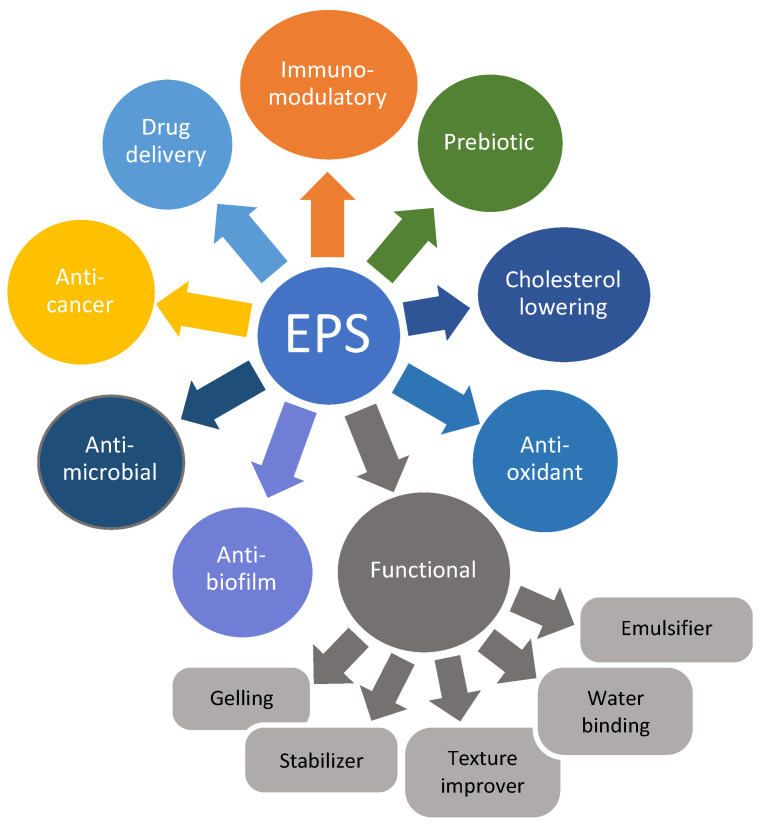
The production of exopolysaccharides (EPS) by lactic acid bacteria (LAB) has attracted particular interest in the food industry. EPS can be considered as natural biothickeners as they are produced in situ by LAB and improve the rheological properties of fermented foods. Moreover, much research has been conducted on the beneficial effects of EPS produced by LAB on modulating the gut microbiome and promoting health. The EPS, which varies widely in composition and structure, may have diverse health effects, such as glycemic control, calcium and magnesium absorption, cholesterol-lowering, anticarcinogenic, immunomodulatory, and antioxidant effects. In this article, the latest advances on structure, biosynthesis, and physicochemical properties of LAB-derived EPS are described in detail. This is followed by a summary of up-to-date methods used to detect, characterize and elucidate the structure of EPS produced by LAB. In addition, current strategies on the use of LAB-produced EPS in food products have been discussed, focusing on beneficial applications in dairy products, gluten-free bakery products, and low-fat meat products, as they positively influence the consistency, stability, and quality of the final product. Highlighting is also placed on reports of health-promoting effects, with particular emphasis on prebiotic, immunomodulatory, antioxidant, cholesterol-lowering, anti-biofilm, antimicrobial, anticancer, and drug-delivery activities.
Overview
The claims and statistics of this paper haven’t been checked yet.
Run the check — free, no account needed. It reads the open-access text and checks the sources it cites.
Integrity signals
Registry
Cites
Statistics
Figures
Verification
Claims the paper makes
The claims and statistics of this paper haven’t been checked yet.
Run the check — free, no account needed. It reads the open-access text and checks the sources it cites.
Claims other papers make about this one
Each is checked against this paper’s own text: does it say what the citing paper says it does?
The source backs part of the claim, not all of it — or backs it for a different population, condition or comparison.
In the citing paper
“Desirable properties of LAB for use as starter cultures and adjunct cultures in dairy products include good acidifying capacity, the ability to contribute to the desired flavor, and the possible production of exopolysaccharides (EPS) to improve texture [14].”
From Lactic Acid Bacteria in Raw-Milk Cheeses: From Starter Cultures to Probiotic Functions (2022) · cites this paper as [14]
Experimental — accuracy not yet measuredThe cited source says what the claim attributes to it.
In the citing paper
“Some LAB species are able to synthesize and excrete extracellular polysaccharides [14,299].”
From Lactic Acid Bacteria in Raw-Milk Cheeses: From Starter Cultures to Probiotic Functions (2022) · cites this paper as [14]
Self-check
Percentages, sums and reported differences re-computed from the paper’s own numbers.
The self-check needs the paper’s full text.
Citations
Cites
Colorimetric Method for Determination of Sugars and Related Substances
DuBois, M., Gilles, K. A., Hamilton, J. K., Rebers, P. A., & Smith, F. (1956) · Analytical Chemistry · doi:10.1021/ac60111a017 · Cited by 52,269
The Carbohydrate-Active EnZymes database (CAZy): an expert resource for Glycogenomics
Cantarel, B. L., Coutinho, P. M., Rancurel, C., Bernard, T., Lombard, V., & Henrissat, B. (2008) · Nucleic Acids Research · doi:10.1093/nar/gkn663 · Cited by 6,108
Zheng, J., Wittouck, S., Salvetti, E., Franz, C. M. A. P., Harris, H. M. B., Mattarelli, P., O’Toole, P. W., Pot, B., Vandamme, P., Walter, J., et al. (2020) · International Journal of Systematic and Evolutionary Microbiology · doi:10.1099/ijsem.0.004107 · Cited by 3,313
Asioli, D., Aschemann-Witzel, J., Caputo, V., Vecchio, R., Annunziata, A., Næs, T., & Varela, P. (2017) · Food Research International · doi:10.1016/j.foodres.2017.07.022 · Cited by 997
Heteropolysaccharides from lactic acid bacteria
Vuyst, L. D., & Degeest, B. (1999) · FEMS Microbiology Reviews · doi:10.1111/j.1574-6976.1999.tb00395.x · Cited by 840
Advances in bacterial exopolysaccharides: from production to Biotechnological applications
Freitas, F., Alves, V. D., & Reis, M. A. M. (2011) · Trends in Biotechnology · doi:10.1016/j.tibtech.2011.03.008 · Cited by 804
Albalasmeh, A. A., Berhe, A. A., & Ghezzehei, T. A. (2013) · Carbohydrate Polymers · doi:10.1016/j.carbpol.2013.04.072 · Cited by 760
Bacterial Exopolysaccharides: Functionality and Prospects
Nwodo, U. U., Green, E., & Okoh, A. I. (2012) · International Journal of Molecular Sciences · doi:10.3390/ijms131114002 · Cited by 706
Polysaccharide Immunomodulators as Therapeutic Agents: Structural Aspects and Biologic Function
Tzianabos, A. O. (2000) · Clinical Microbiology Reviews · doi:10.1128/cmr.13.4.523-533.2000 · Cited by 686
Bacterial exopolysaccharides: biosynthesis pathways and engineering strategies
Schmid, J., Sieber, V., & Rehm, B. H. A. (2015) · Frontiers in Microbiology · doi:10.3389/fmicb.2015.00496 · Cited by 644
Research works printed but not linked: 2
- Ullrich, M. (2009). Bacterial Polysaccharides: Current Innovations and Future Trends, Horizon Scientific Press.
- Abedfar, 2016, Overview of the most important characterization of exopolysaccharides produced by probiotics bacteria and their biological function, J. Environ. Sci. Toxicol. Food Technol., 10, 47
Cited by
Sorted by citations
Lactic Acid Bacteria in Raw-Milk Cheeses: From Starter Cultures to Probiotic Functions
Coelho, M. C., Malcata, F. X., & Silva, C. C. G. (2022) · Foods · doi:10.3390/foods11152276 · Cited by 276
“Some LAB species are able to synthesize and excrete extracellular polysaccharides [14,299].”
Self-citationExopolysaccharides Producing Bacteria: A Review
Netrusov, A. I., Liyaskina, E. V., Kurgaeva, I. V., Liyaskina, A. U., Yang, G., & Ревин, В. В. (2023) · Microorganisms · doi:10.3390/microorganisms11061541 · Cited by 197
Postbiotics: From emerging concept to application
Aggarwal, S., Sabharwal, V., Kaushik, P., Joshi, A., Aayushi, A., & Suri, M. (2022) · Frontiers in Sustainable Food Systems · doi:10.3389/fsufs.2022.887642 · Cited by 199
Gurunathan, S., Pratheep, T., & Kim, J. (2023) · Foods · doi:10.3390/foods13010089 · Cited by 159
Werning, M. L., Hernández-Alcántara, A. M., Ruiz, M. J., Soto, L. P., Dueñas, M. T., López, P., & Frizzo, L. S. (2022) · Foods · doi:10.3390/foods11091284 · Cited by 132
Metadata
- Authors
- Jurášková, D., Ribeiro, S. C., & Silva, C. C. G.
- Affiliations
- Universidade dos Açores (PT)
- Corresponding author
- Silva, Celia C. G.
- Venue
- Foods
- Publisher
- MDPI AG
- Published
- 2022-01-08
- Volume
- 11
- Issue
- 2
- Pages
- 156
- ISSN
- 2304-8158 (ISSN-L)
- PMC
- PMC8774684
- OpenAlex
- W4206529918
- Cited by
- 342
- References
- 235
- Citations by year
- 2026: 87 · 2025: 94 · 2024: 66 · 2023: 70 · 2022: 25
- FWCI
- 5.83
- Type
- journal article
- Language
- en
- Open access
- gold
- doi.org
- Licence
- Locations
- Foods (publishedVersion, cc-by)
- PubMed Central (publishedVersion, cc-by)
- PubMed (publishedVersion)
- DOAJ (DOAJ: Directory of Open Access Journals) (submittedVersion, cc-by-sa)
- Funders
- Fundação para a Ciência e Tecnologia (UIDB/00153/2020, UI/BD/151108/2021)
- Fundo regional para a Ciência e Tecnologia (M3.1.a/F/017/2018)
- Topics
- Life Sciences › Agricultural and Biological Sciences › Food Science › Polysaccharides Composition and Applications
- Life Sciences › Agricultural and Biological Sciences › Food Science › Probiotics and Fermented Foods
- Health Sciences › Nursing › Nutrition and Dietetics › Microbial Metabolites in Food Biotechnology
- Keywords
- exopolysaccharides, lactic acid bacteria, exopolysaccharide biosynthesis, fermented foods, rheological properties, gut microbiota, prebiotics, immunomodulation, antioxidant activity, cholesterol lowering, anticarcinogenic activity, antibiofilm activity, antimicrobial activity, drug delivery, dairy products, gluten-free bakery products, low-fat meat products
About these checks
Registry, retraction, Cites and statistics results are computed, not judged, with one exception: a printed reference that no index lists is read once by a model before it counts as a citation error. Claims are extracted by a model and kept only when their quote appears verbatim in the text; each cited source is then checked, with a model’s help, for whether it says what the claim relies on. Those verdicts can be wrong — read the claim’s quote and the cited source before relying on one.
Statistics and arithmetic are recomputed, not judged.
Confidence bands are shown only for fields calibrated on our annotated test set. None is calibrated yet, so no band is shown.
What counts as a claim ›How we measure confidence ›How we check this ›
Are you an author, or do you see a problem with this page? Request a review
