

Impacts of the Russia-Ukraine War on Global Food Security: Towards More Sustainable and Resilient Food Systems?
Open accessThe DOI matches its Crossref record; 32 of the 34 references it cites were found in a registry or an index, and 2 are not checked yet; 8 of the 105 sources its claims cite were checked for support.
Abstract
As a conflict between two major agricultural powers, the Russia–Ukraine war has various negative socioeconomic impacts that are now being felt internationally and might worsen, notably, for global food security. If the war deepens, the food crisis will worsen, posing a challenge to many countries, especially those that rely on food imports, such as those in the Middle East and North Africa (MENA) region. Simultaneously, the war came at a bad time for global food markets because food prices were already high due to disruptions in the supply chain caused by the COVID-19 pandemic, strong global demand, and poor harvests in some countries. Understanding how conflict-related disruptions in global food and fertilizer markets might affect price and availability is critical for understanding the overall impact on global food security. Further, four months into the war, its implications for food security suggest that this review is timely, urgent, and highly needed. Accordingly, this paper aims to investigate the Russia–Ukraine war’s direct and indirect impact on global food security. The paper highlights that the war resulted in immediate and far-reaching cascading consequences on global food security: Ukrainian exports have stopped, conscription and population displacement have caused labor shortages, access to fertilizers is restricted, and future harvests are uncertain. First, Ukraine’s export capacity has been hampered. Secondly, conscription and population displacement caused labor shortages. Thirdly, access to vital agricultural products such as fertilizers is also constrained. The war may delay spring planting and winter crop harvesting. Further, the war has indirect and cascading effects. Indeed, rising fertilizer costs may reduce their use and crop yields. Moreover, as seen during the 2007–2008 food crisis, export restrictions and speculation are driving up international prices and worsening the situation. Furthermore, the war triggered a panic buying movement at country and individual levels. Finally, the war may jeopardize the implementation of the Sustainable Development Goals (SDGs), notably SDG 1 (No poverty), SDG 2 (Zero hunger), and DG 12 (Responsible consumption and production). However, the consequences of the war on food security are being exacerbated by a variety of underlying rigidities, vulnerabilities, and inefficiencies in global food systems. Accordingly, the transition toward healthy, equitable, and ecologically sustainable food systems must be strengthened by adopting urgent and long-term reforms and policies.
Verified 2026-11-25 · 2 references not checked yet
Overview
CoChat Summary
TL;DR
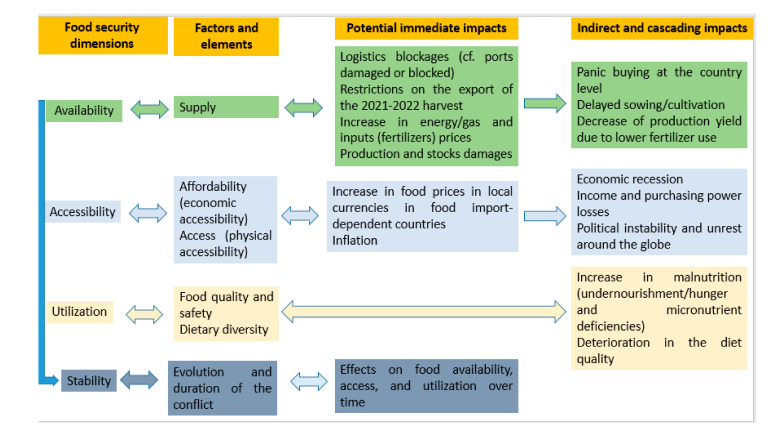
This review argues that the Russia–Ukraine war produced immediate and cascading global food-security impacts through halted Ukrainian exports, labor shortages, fertilizer constraints, export restrictions, speculation, and panic buying. It concludes that the crisis should accelerate, not delay, a transition toward more sustainable and resilient food systems.
Key findings
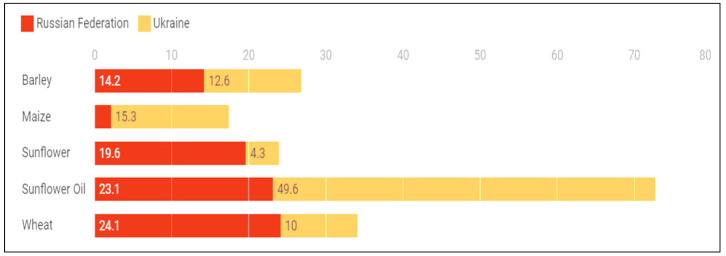
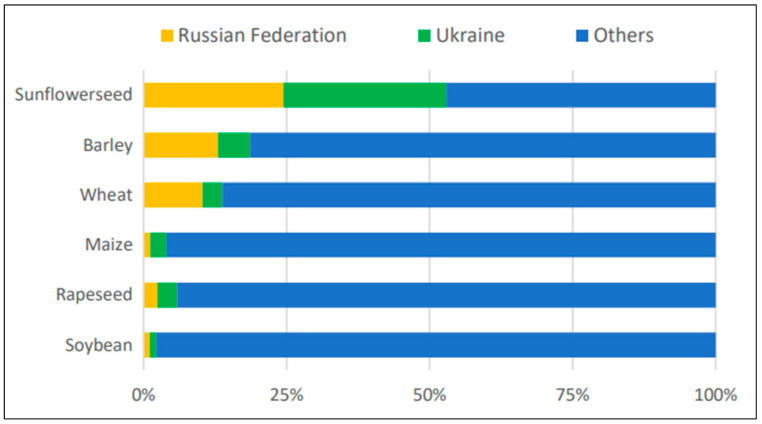
- The war disrupted Ukrainian exports: 95% of Ukrainian grain exports go by sea via Odessa, Mariupol, and Kherson, which suffered significant damage; all Black Sea ports were blocked, and about 300,000 tonnes of Ukrainian wheat contracted by Egypt were stranded. Russia and Ukraine accounted for 72.7% of global trade in sunflower oil and seeds and 34.1% of global wheat trade in 2020, and about 12% of the world’s total caloric commerce.
- Food and fertilizer prices surged: the FAO Food Price Index averaged 170.1 points in March 2022, up 24.9 points (17.1%) from February 2022 and the highest since 1990; wheat and maize prices rose 35% since the war began, while overall food prices increased 5% globally. Fertilizer prices rose 80% during 2021, and urea prices rose two and a half times over 12 months.
- Policy and market reactions worsened the crisis: countries enforcing food export restrictions increased from 3 to 26, covering 40 food items and around 15.68% of total calories traded globally. The WFP estimated acute hunger would grow by 47 million people from a pre-war baseline of 276 million, meaning up to 323 million people could face severe food insecurity by 2022; the World Bank estimated every 1 percentage point rise in food prices pushes 10 million people into severe poverty, and if food costs remained high for a year, global poverty might rise by more than 100 million.
- Vulnerability was concentrated: over 30 countries rely on Russia and Ukraine for at least 30% of wheat imports, and at least 20 rely on them for more than 50%; MENA countries import more than 50% of cereal needs, and Lebanon obtains 80% of its wheat from Ukraine. The war may also delay SDG progress, especially SDG 1, SDG 2, and SDG 12.
Methods
- The paper is based on a review of grey literature, including reports, policy documents/briefs, and working/discussion papers produced in English, French, and Arabic by international organizations, regional organizations, NGOs, consulting firms, international newspapers, and international news platforms.
- The main analysis is a narrative synthesis of the war’s direct and indirect impacts on global food security and agri-food markets; the text does not describe primary data collection, a systematic review protocol, or quantitative modeling.
Limitations
- The paper states that evaluating the consequences of the war on food security is challenging because the entire extent of the war’s effects is not yet clear, and there is considerable uncertainty about medium- to long-term effects.
- Evident from the methods: the review relies on grey literature, reports, policy briefs, newspapers, and news platforms rather than primary data or a systematic search strategy, which limits verifiability and generalizability.
- Evident from the text: the analysis was written four months into the war and discusses rapidly evolving market and policy conditions, so its findings are time-bound.
Model-written summary. Check it against the paper before relying on it.
Integrity signals
Registry
Cites
Statistics
Figures
Verification
Claims the paper makes
4 Valid · 3 Not valid · 90 Not checked · 31 Own results and interpretations
The cited sources support only part of this claim — read each source’s verdict below.
In the paper
“the war may jeopardize the implementation of the Sustainable Development Goals (SDGs), notably SDG 1 (No poverty), SDG 2 (Zero hunger), and DG 12 (Responsible consumption and production).”
- Also stated in: § 2.2. Indirect Impacts of the War on Food Security · hedged
“by creating a global food crisis, the war may jeopardize the SDGs’ implementation, including SDG 1 (No Poverty) and SDG 2 (Zero hunger).”
§ Impacts of the Russia-Ukraine War on Global Food Security: Towards More Sustainable and Resilient Food Systems? > Abstract
What the sources say
- Partly supportedcites [55] Leal Filho W. Brandli L.L. Lange Salvia A. Rayman-Bacchus L. Platje J. COVID-19 and the UN Sustainable Development Goals: Threat to Solidarity or an Opportunity? Sustainability 2020 12 5343 10.3390/su12135343 sourceExperimental — accuracy not yet measured
The Findings and Discussion section says COVID-19 may endanger implementation of the SDGs and identifies impacts on SDG 1 and SDG 2. The cited paper addresses the pandemic, not the war in the citing sentence, and the passages do not establish a threat to SDG 12. (LLM, conf=0.88)
- Not matchedcites [56] The New York Times Ukraine War’s Latest Victim? The Fight Against Climate Change Available online: https://www.nytimes.com/2022/06/26/world/europe/g7-summit-ukraine-war-climate-change.html?referringSource=articleShare (accessed on 27 June 2022)
We searched by its title and found no matching paper.
- Could not verifycites [11] World Bank Commodity Markets Outlook: The Impact of the War in Ukraine on Commodity Markets Available online: https://openknowledge.worldbank.org/bitstream/handle/10986/37223/CMO-April-2022.pdf (accessed on 9 May 2022) sourceExperimental — accuracy not yet measured
The indexed passages are repository material with no section or page labels; they do not address whether the war jeopardizes implementation of SDG 1, SDG 2, or SDG 12. Searches for the Sustainable Development Goals and for poverty, hunger, and responsible consumption found no passage making that connection. (LLM, conf=0.72)
hedgedstates a possible cause- Asserted: passes — The authors put it forward as true.
- Checkable: passes — It can be checked against evidence.
- Load-bearing: passes — The paper’s conclusions depend on it.
- Based: passes — The paper gives a reason why it holds.
- Also stated in: § 2.2. Indirect Impacts of the War on Food Security · hedged
The cited sources that could be checked couldn’t confirm or dispute this claim.
In the paper
“rising metal prices are increasing renewable energy costs, which depend on metals such as aluminum and battery-grade nickel [11].”
§ Impacts of the Russia-Ukraine War on Global Food Security: Towards More Sustainable and Resilient Food Systems? > 2. Overview of the War’s Immediate and Long-Term Impacts > 2.2. Indirect Impacts of the War on Food Security
What the sources say
- Could not verifycites [11] World Bank Commodity Markets Outlook: The Impact of the War in Ukraine on Commodity Markets Available online: https://openknowledge.worldbank.org/bitstream/handle/10986/37223/CMO-April-2022.pdf (accessed on 9 May 2022) sourceExperimental — accuracy not yet measured
The available indexed passages are a repository record and related-publication listings, with no report section or page text addressing renewable-energy costs. Searches for aluminum, battery-grade nickel, and metal-driven clean-energy costs found no passage supporting the attributed claim. (LLM, conf=0.72)
plainstates a cause- Asserted: passes — The authors put it forward as true.
- Checkable: passes — It can be checked against evidence.
- Load-bearing: unclear — It is unclear whether the paper’s conclusions depend on it.
- Based: passes — The paper gives a reason why it holds.
- Could not verify
Every source the paper cites for this claim was checked and supports it.
In the paper
“For example, China, a major producer and supplier of phosphate-based fertilizers, has decided to restrict fertilizer exports from July 2021 through June 2022 to ensure domestic supply [73].”
§ Impacts of the Russia-Ukraine War on Global Food Security: Towards More Sustainable and Resilient Food Systems? > 3. The Impact of the Ukraine Crisis on the Global Agri-Food Markets > 3.3. Impact of the War on the Global Fertilizer Market
What the sources say
- Supportedcites [73] Benton T. Froggatt A. Wellesley L. Grafham O. King R. Morisetti N. Nixey J. Schröder P. The Ukraine War and Threats to Food and Energy Security: Cascading Risks from Rising Prices and Supply Disruptions Chatham House London, UK 2022 source
In “Pre-conflict price rises and volatility,” the paper says China, a major exporter of phosphate-based fertilizers, suspended fertilizer exports from July 2021 until June 2022 to ensure domestic availability. This supports the cited claim’s restriction, timing, and purpose. (LLM, conf=0.93)
plainstates a cause- Asserted: passes — The authors put it forward as true.
- Checkable: passes — It can be checked against evidence.
- Load-bearing: unclear — It is unclear whether the paper’s conclusions depend on it.
- Based: passes — The paper gives a reason why it holds.
- Supported
The cited sources that could be checked couldn’t confirm or dispute this claim.
In the paper
“During the first quarter of 2022, the World Bank’s Fertilizer Price Index climbed over 10% (q/q) to an all-time high in nominal terms [11].”
§ Impacts of the Russia-Ukraine War on Global Food Security: Towards More Sustainable and Resilient Food Systems? > 3. The Impact of the Ukraine Crisis on the Global Agri-Food Markets > 3.3. Impact of the War on the Global Fertilizer Market
What the sources say
- Could not verifycites [11] World Bank Commodity Markets Outlook: The Impact of the War in Ukraine on Commodity Markets Available online: https://openknowledge.worldbank.org/bitstream/handle/10986/37223/CMO-April-2022.pdf (accessed on 9 May 2022) sourceExperimental — accuracy not yet measured
The available indexed copy is an unpaginated repository page. Its report summary discusses commodity-price increases, but not the Fertilizer Price Index. Searches for the index’s first-quarter 2022 change and nominal record found no passage establishing either figure. (LLM, conf=0.76)
plain- Asserted: passes — The authors put it forward as true.
- Checkable: passes — It can be checked against evidence.
- Load-bearing: unclear — It is unclear whether the paper’s conclusions depend on it.
- Based: passes — The paper gives a reason why it holds.
- Could not verify
A result the paper states — it cites no source for it, so there is none to check. The quote shows it is in the paper.
In the paper
“Sunflower oil has been the most immediately affected, with a more than 40% rise since the invasion.”
§ Impacts of the Russia-Ukraine War on Global Food Security: Towards More Sustainable and Resilient Food Systems? > 3. The Impact of the Ukraine Crisis on the Global Agri-Food Markets > 3.2. Impacts of the War on the Global Vegetable Oil Market
plainstates a cause- Asserted: passes — The authors put it forward as true.
- Checkable: passes — It can be checked against evidence.
- Load-bearing: unclear — It is unclear whether the paper’s conclusions depend on it.
- Based: passes — The paper gives a reason why it holds.
55 more claims
Create a free account to see all 128 claims and to verify the 38 references still open.
- It may state two separate claims as one. 64
- Probably not a substantial claim. 4
- Borderline: one of the tests for a substantial claim is unclear. 1
Self-check
Percentages, sums and reported differences re-computed from the paper’s own numbers.
Rated minor: it would not touch a result — a value no result rests on, a p-value that stays on the same side of the significance level, or a conflict that is clerical, resolved elsewhere in the paper, or outside its own findings.
In the paper
“On average, in April 2022, the FFPI fell by 1.2 points (0.8%) from its all-time high in March 2022”
§ Impacts of the Russia-Ukraine War on Global Food Security: Towards More Sustainable and Resilient Food Systems? > 3. The Impact of the Ukraine Crisis on the Global Agri-Food Markets > 3.1. Impact of the War on the Global Cereals Market
Reported 0.8 · recomputed 0.705467
Citations
Cites
Food Security: The Challenge of Feeding 9 Billion People
Godfray, H. C. J., Beddington, J. R., Crute, I. R., Haddad, L., Lawrence, D., Muir, J. F., Pretty, J., Robinson, S., Thomas, S. M., & Toulmin, C. (2010) · Science · doi:10.1126/science.1185383 · Cited by 11,943
Conceptualizing food systems for global environmental change research
Ericksen, P. J. (2008) · Global Environmental Change · doi:10.1016/j.gloenvcha.2007.09.002 · Cited by 1,486
Food system resilience: Defining the concept
Tendall, D. M., Joerin, J., Kopainsky, B., Edwards, P., Shreck, A., Le, Q. B., Kruetli, P., Grant, M., & Six, J. (2015) · Global Food Security · doi:10.1016/j.gfs.2015.08.001 · Cited by 962 · cited 1×
“Therefore, it is essential to reduce these vulnerabilities and mitigate them by developing policies, technologies, practices, and partnerships that increase the resilience of food systems [80,88].”
BackgroundThe top 100 questions of importance to the future of global agriculture
Pretty, J., Sutherland, W. J., Ashby, J., Auburn, J., Baulcombe, D., Bell, M., Bentley, J., Bickersteth, S., Brown, K., Burke, J., et al. (2010) · International Journal of Agricultural Sustainability · doi:10.3763/ijas.2010.0534 · Cited by 539
COVID-19 and the UN Sustainable Development Goals: Threat to Solidarity or an Opportunity?
Leal Filho, W., Brandli, L. L., Lange Salvia, A., Rayman-Bacchus, L., & Platje, J. (2020) · Sustainability · doi:10.3390/su12135343 · Cited by 334 · cited 1×
“As a matter of fact, and as observed during the pandemic [55], the war may have an impact on the progress toward the UN Sustainable Development Goals (SDGs).”
BackgroundRealizing Resilient Food Systems
Schipanski, M. E., MacDonald, G. K., Rosenzweig, S., Chappell, M. J., Bennett, E. M., Kerr, R. B., Blesh, J., Crews, T., Drinkwater, L., Lundgren, J. G., et al. (2016) · BioScience · doi:10.1093/biosci/biw052 · Cited by 281
Sustainable Agri-Food Systems: Environment, Economy, Society, and Policy
El Bilali, H., Strassner, C., & Ben Hassen, T. (2021) · Sustainability · doi:10.3390/su13116260 · Cited by 213
Self-citationHassen, T. B., Bilali, H. E., Allahyari, M. S., Berjan, S., & Fotina, O. V. (2021) · Appetite · doi:10.1016/j.appet.2021.105309 · Cited by 147
Self-citationResilience in a concentrated and consolidated food system
Hendrickson, M. (2015) · Journal of Environmental Studies and Sciences · doi:10.1007/s13412-015-0292-2 · Cited by 124
Act now before Ukraine war plunges millions into malnutrition
Osendarp, S. J. M., Verburg, G., Bhutta, Z. A., Black, R. E., de Pee, S., Fabrizio, C., Headey, D., Heidkamp, R. A., Laborde, D., & Ruel, M. T. (2022) · Nature · doi:10.1038/d41586-022-01076-5 · Cited by 120
Research works printed but not linked: 1
- Wisner B. Blaikie P. Cannon T. Davis I. At Risk: Natural Hazards, People’s Vulnerability and Disasters Routledge London, UK New York, NY, USA 2003
Cited by
Items 301–400 of 734
Egg and Broiler Supply in Malaysia: Issues, Challenges and Recommendations
Jamaludin, M. H., Marsal, C. J., Chowdhury, A. J. K., Harith, Z. T., Ridzwan, R. M., & Abdullah, Z. A. K. (2023) · Halalsphere · doi:10.31436/hs.v3i1.66 · Cited by 11
Systemic risk mitigation in supply chains through network rewiring
Zelbi, G., Ialongo, L. N., & Stefan Thurner, A. (2026) · Scientific Reports · doi:10.1038/s41598-026-42549-1 · Cited by 5
Unilateral economic sanctions and food security
(2023) · doi:10.1108/jitlp-07-2023-0039 · Cited by 5
Ntah, M. N., Nechifor, V., Ferrari, E., Nandelenga, M. W., & Yalew, A. W. (2024) · African Development Review · doi:10.1111/1467-8268.12728 · Cited by 5
First Six Months of War from Ukrainian topic and sentiment analysis
Maathuis, C., & Kerkhof, I. (2023) · European Conference on Social Media · doi:10.34190/ecsm.10.1.1147 · Cited by 9
Zeler, I., Rodríguez-Amat, J. R., & Amir, R. M. (2025) · Energy Policy · doi:10.1016/j.enpol.2025.114592 · Cited by 6
Brewing Mainly from Stale Bread: A Pale Ale Case Study
(2024) · doi:10.3390/beverages10020023 · Cited by 5
Dardona, Z. W., Amane, M., & Boussaa, S. (2025) · Discover Public Health · doi:10.1186/s12982-025-00761-w · Cited by 5
The Impact of the Russian-Ukrainian War on Global Food and Environmental Security
Kapelista, I., Korniyenko, G., Скляр, В. Г., Войціцька, К. М., & Derman, V. (2023) · WSEAS TRANSACTIONS ON ENVIRONMENT AND DEVELOPMENT · doi:10.37394/232015.2023.19.76 · Cited by 10
Ojo, O. O., Oladoyin, O. P., Ekundayo, B. P., et al. (2024) · European Journal of Nutrition & Food Safety · doi:10.9734/ejnfs/2024/v16i31396 · Cited by 4
Meena, V. S., Jat, R. K., Durgude, S. A., Kumar, S., Sohane, R. K., Jha, R. K., Kumar, A., Kumar, U., Kumar, A., Singh, R., et al. (2025) · Frontiers in Sustainable Food Systems · doi:10.3389/fsufs.2025.1564812 · Cited by 6
REMOVED DUE TO POLICY VIOLATIONS
(2023) · doi:10.31219/osf.io/5t7y3 · Cited by 4
The EU's Socio-economic Development Against the Backdrop of the War in Ukraine
Boichenko, K., Ashraf, R. U., Mata, M. N., & Gherghina, Ş. C. (2023) · Central European Economic Journal · doi:10.2478/ceej-2023-0005 · Cited by 5
Αποστολόπουλος, Ν., Goulas, C., Flouros, F., Papadopoulos, G., & Apostolopoulos, S. (2026) · Frontiers in Sustainable Energy Policy · doi:10.3389/fsuep.2026.1755555 · Cited by 10
Dinardo, G., Dahdah, L., Cafarotti, A., Arasi, S., Fierro, V., Pecora, V., Mazzuca, C., Urbani, S., Artesani, M. C., Riccardi, C., et al. (2024) · Nutrients · doi:10.3390/nu16050628 · Cited by 4
Rodrigues, M. M., Viana, D. G., Mendonça, R. S., Capra, G. F., Oliveira, F. C., da Silva, L. F. V., Nogueira, T. A. R., & Regitano, J. B. (2025) · Environment Development and Sustainability · doi:10.1007/s10668-025-06772-6 · Cited by 7
Worku, M. A., Debela, K. L., & Mudde, H. L. M. (2024) · Cogent Business & Management · doi:10.1080/23311975.2024.2389466 · Cited by 7
Umar, U. H. (2024) · Journal of Chinese Economic and Business Studies · doi:10.1080/14765284.2024.2371666 · Cited by 5
Shukla, S., Patil, S. D., Pravin, G., Shukla, S. K., & Khetrapal, R. (2026) · Plant Nano Biology · doi:10.1016/j.plana.2026.100283 · Cited by 10
Kipato, N., Dorward, P., & Clarkson, G. (2023) · Sustainability · doi:10.3390/su151914467 · Cited by 6
A multi-dimensional spatial index for the quantification of food insecurity
Dawood, F., & van Vuuren, J. H. (2023) · Journal of Agriculture and Food Research · doi:10.1016/j.jafr.2023.100768 · Cited by 6
Spatiotemporal modeling of household's food insecurity levels in Ethiopia
Wubetie, H. T., Zewotir, T. T., Mitku, A. A., & Dessie, Z. G. (2024) · Heliyon · doi:10.1016/j.heliyon.2024.e32958 · Cited by 8
Braga, B. B., Brosinsky, A., Foerster, S., Oliveira, G., & Medeiros, P. (2025) · Journal of Soils and Sediments · doi:10.1007/s11368-025-04028-4 · Cited by 9
Contribution of Pluralistic Agriculture Extension Service Provision to Smallholder Farmer Resilience
Odongo, H., Opio, A., Mwesigye, A., & Bariyo, R. (2023) · Journal of Sustainable Development · doi:10.5539/jsd.v16n6p79 · Cited by 7
Prišenk, J., Zidar, N., & Turk, J. (2025) · Foods · doi:10.3390/foods14030415 · Cited by 6
Temporal trends of food insecurity in Chad, 2016–2021
(2023) · doi:10.3389/fsufs.2023.1197228 · Cited by 4
Crop production in Türkiye: trends and driving variables
Rezaei, E. E., Ghazaryan, G., & Yamaç, S. S. (2023) · Environmental Research Communications · doi:10.1088/2515-7620/acbd1e · Cited by 5
Food Security in the Context of the «Perfect Storm» in the Global Economy
Duginets, G., Генералов, О., & Verba, Y. I. (2023) · Business Inform · doi:10.32983/2222-4459-2023-8-6-15 · Cited by 6
Does an Alternative Local Food Network Contribute to Improving Sustainable Food Security?
Perdana, T., Chaerani, D., Hermiatin, F. R., Achmad, A. L. H., & Fridayana, A. (2022) · Sustainability · doi:10.3390/su141811533 · Cited by 9
Significance of Local Livestock Genetic Resources in the Context of Global Food Security –A Review
Barłowska, J., Sawicka-Zugaj, W., Janczarek, I., Kasprzak-Filipek, K., & Chabuz, W. (2025) · Annals of Animal Science · doi:10.2478/aoas-2025-0029 · Cited by 5
Are supply shocks a key driver of global Inflation? Evidence from CPI and GDP deflator analysis
Asab, N. A. (2025) · Research in Globalization · doi:10.1016/j.resglo.2025.100279 · Cited by 16
Underground Food Farms as a Climate-Friendly Alternative Form of Urban Agriculture
Krzeminska, A. E., Zaręba, A. D., Adynkiewicz-Piragas, M., Jia, H., Cruz, M. G. A., & Cordero, L. (2025) · Sustainability · doi:10.3390/su17219392 · Cited by 4
Nabillah, R., Fawzi, N. I., Awuh, H. E., Rijanta, R., Qurani, I. Z., Suwardi, S., & Danapriatna, N. (2025) · Environment Development and Sustainability · doi:10.1007/s10668-025-06756-6 · Cited by 18
Halim, A. H. A., Taufik, M. A., Mahamarowi, N. H., & Ahmad, T. D. A. S. (2024) · IEEE Symposium on Computer Applications & Industrial Electronics (ISCAIE) · doi:10.1109/iscaie61308.2024.10576454 · Cited by 4
Zheng, C., & Jean-Petit, S. (2023) · SAGE Open · doi:10.1177/21582440231181381 · Cited by 5
Hatab, A. A., Krautscheid, L., Elsayied, M., & Amuakwa‐Mensah, F. (2024) · Food Security · doi:10.1007/s12571-024-01470-z · Cited by 4
Aljifri, R. (2024) · Heliyon · doi:10.1016/j.heliyon.2024.e31382 · Cited by 5
Buss, G. P., Carroll, P. A., Griffith, M. A. C., Yang, X., Griffis, J. L., Papkov, G. I., Bauer, S., Jackson, K., & Singh, A. K. (2023) · Agricultural Sciences · doi:10.4236/as.2023.149082 · Cited by 4
The Impact of Various Types of Cultivation on Stream Water Quality in Central Poland
Stępniewski, K., Karger, M., & Łaszewski, M. A. (2023) · Water · doi:10.3390/w16010050 · Cited by 4
Noorali, H., Zaki, Y., Campana, M. E., & Taheri, A. (2025) · GeoJournal · doi:10.1007/s10708-025-11338-0 · Cited by 3
The Russian-Ukrainian War Effects on Global Food Trade: A Review
Ardan, M. C., Marzaman, A. P., & Deni, S. (2023) · Journal of Political Science and International Relations · doi:10.11648/j.jpsir.20230602.14 · Cited by 8
Financial feasibility of selling frozen produce in local and regional markets
Fitzsimmons, J., Lass, D. A., Minifie, K., & Kinchla, A. J. (2023) · Renewable Agriculture and Food Systems · doi:10.1017/s1742170523000236 · Cited by 3
Economic analysis of food self-sufficiency: modeling and application to the case of Israel
Slater, Y., Finkelshtain, I., Troen, A. M., & Kan, I. (2025) · Food Policy · doi:10.1016/j.foodpol.2025.102979 · Cited by 5
Hassen, T. B., Bilali, H. E., & Chatti, C. B. (2024) · Springer eBooks · doi:10.1007/978-3-031-45742-5_2 · Cited by 8
Shupler, M. S., Mwitari, J., O’Keefe, M., Lorenzetti, F., Nabukwangwa, W., Gohole, A., Perros, T., Nix, E., Puzzolo, E., Pope, D. P., et al. (2023) · medRxiv · doi:10.1101/2023.07.09.23292423 · Cited by 3
Sandström, V., Kästner, T., Schwarzmueller, F., & Kummu, M. (2024) · Environmental Research Letters · doi:10.1088/1748-9326/ad5ab3 · Cited by 9
Parental opinions and willingness to pay for organic school meals in Tartu
Kutman, A., Parm, Ü., Tamm, A., & Andreson, H. (2025) · Cogent Food & Agriculture · doi:10.1080/23311932.2025.2546080 · Cited by 3
Sustainable Agriculture and Food Security in India
Singh, S. D., Chaubey, A. K., & Kumar, T. (2024) · Advances in geographical and environmental sciences · doi:10.1007/978-981-97-6706-9_10 · Cited by 3
Kadigi, I. L. (2026) · Discover Sustainability · doi:10.1007/s43621-026-02665-4 · Cited by 5
Yobom, O., & Gallo, J. L. (2024) · Journal of Asian and African Studies · doi:10.1177/00219096231225949 · Cited by 4
Land Carrying Capacity in China: A Perspective on Food Nutritional Demand
Zhang, J., Tan, L., Ai, D., Lun, F., Wang, N., Wu, M., & Hao, J. (2023) · Foods · doi:10.3390/foods12244378 · Cited by 5
Kganyago, M., Tshigoli, P., & Shikwambana, L. (2025) · Applied Geomatics · doi:10.1007/s12518-025-00634-6 · Cited by 4
Facendola, R., Palmisano, G. O., Boni, A. D., Acciani, C., & Roma, R. (2024) · Frontiers in Sustainable Food Systems · doi:10.3389/fsufs.2023.1329090 · Cited by 9
The Influence of Ukraine’s Foreign Grain Trade through Romania on Prices
Sterie, C. M., Petre, I. L., & BOGOS, I. B. (2022) · Commodities · doi:10.3390/commodities1020010 · Cited by 5
Agricultural sector development and elasticity of its links with the food security level
Tatar, M. (2023) · Agricultural and Resource Economics International Scientific E-Journal · doi:10.51599/are.2023.09.04.09 · Cited by 3
Urban Climate Resilience in MENA Region: Opportunities and Challenges of Nature-Based Solutions
Hassen, T. B., & Hageer, Y. (2025) · Springer eBooks · doi:10.1007/978-3-031-34967-6_161 · Cited by 4
Oduor, F., Keding, G. B., Kaindi, D. W. M., Abong, G. O., Thuita, F., & Termote, C. (2024) · CyTA - Journal of Food · doi:10.1080/19476337.2024.2413949 · Cited by 4
The impact of the war on Ukraine's foreign trade
(2024) · doi:10.15407/econindustry2024.01.005 · Cited by 3
Food Security and Armed Conflicts
(2023) · doi:10.2478/raft-2023-0039 · Cited by 3
Mapping municipal food supply: A longitudinal‐spatial case study in Southern Germany
Mager, E., Ritter, M., Sipple, D., & Schanz, H. (2024) · Urban Agriculture & Regional Food Systems · doi:10.1002/uar2.20060 · Cited by 4
Qadach, M., Qadan, E., & Chaleila, W. A. (2025) · Journal of Educational Administration · doi:10.1108/jea-04-2024-0100 · Cited by 3
Metadata
- Authors
- Ben Hassen, T., & El Bilali, H.
- Affiliations
- Program of Policy, Planning, and Development, Department of International Affairs, College of Arts and Sciences, Qatar University, Doha 2713, Qatar
- International Centre for Advanced Mediterranean Agronomic Studies (CIHEAM-Bari), Via Ceglie 9, Valenzano, 70010 Bari, Italy
- ORCID
- Ben Hassen, Tarek
- Venue
- Foods
- Publisher
- MDPI AG
- Published
- 2022-08-02
- Volume
- 11
- Issue
- 15
- Pages
- 2301
- ISSN
- 2304-8158 (ISSN-L)
- PMC
- PMC9368568
- OpenAlex
- W4289524103
- Semantic Scholar
- d244f61d95f0a439305bf59337613abf8af53be6
- Cited by
- 745
- References
- 31
- Citations by year
- 2026: 95 · 2025: 156 · 2024: 240 · 2023: 221 · 2022: 33
- FWCI
- 144.87
- Type
- journal article
- Language
- en
- Open access
- gold
- doi.org
- Licence
- Locations
- Foods (publishedVersion, cc-by)
- PubMed Central (publishedVersion, cc-by)
- PubMed (publishedVersion)
- DOAJ (DOAJ: Directory of Open Access Journals) (submittedVersion, cc-by-sa)
- Figshare (submittedVersion, cc-by)
- Qatar University QSpace (Qatar University) (submittedVersion)
- Funders
- Qatar National Library
- Topics
- Physical Sciences › Environmental Science › Management, Monitoring, Policy and Law › Environmental and Biological Research in Conflict Zones
- Social Sciences › Economics, Econometrics and Finance › Economics and Econometrics › Economics of Agriculture and Food Markets
- Social Sciences › Economics, Econometrics and Finance › Economics and Econometrics › Agriculture Market Analysis Ukraine
- Keywords
- Russian invasion of Ukraine, global food security, food prices, food supply chain disruption, fertilizer market, export controls, labor shortage, population displacement, food speculation, panic buying, Sustainable Development Goals, food system resilience, sustainable food systems
About these checks
Registry, retraction, Cites and statistics results are computed, not judged, with one exception: a printed reference that no index lists is read once by a model before it counts as a citation error. Claims are extracted by a model and kept only when their quote appears verbatim in the text; each cited source is then checked, with a model’s help, for whether it says what the claim relies on. Those verdicts can be wrong — read the claim’s quote and the cited source before relying on one.
The claim verdicts this report counts are experimental: their accuracy is not yet measured.
A language model drew the claims from the paper on 2026-10-11, under version 3 of the claim definition (model deepseek-v4.1-flash, prompt extract-v3).
A second model labelled each claim on 2026-10-11 (model jev-1.13-20260917, definition revision gold-guideline-v0.2).
Cited sources are checked with a language model’s help (gpt-6-sol).
Statistics and arithmetic are recomputed, not judged.
Confidence bands are shown only for fields calibrated on our annotated test set. None is calibrated yet, so no band is shown.
What counts as a claim ›How we measure confidence ›How we check this ›
Are you an author, or do you see a problem with this page? Request a review
Data sources
Bibliographic data: Semantic Scholar, OpenAlex, Crossref.
Contains information from the Semantic Scholar Academic Graph Datasets, made available under the ODC Attribution License (ODC-BY 1.0).
Semantic Scholar’s data is described in: Kinney, R., et al. (2023). The Semantic Scholar Open Data Platform. arXiv:2301.10140.
