

The DOI matches its Crossref record; 115 of the 116 references it cites were found in a registry or an index, and 1 are not checked yet.
Chemical Composition, Bioactivities, and Applications of Spirulina (Limnospira platensis) in Food, Feed, and Medicine
Open accessAbstract
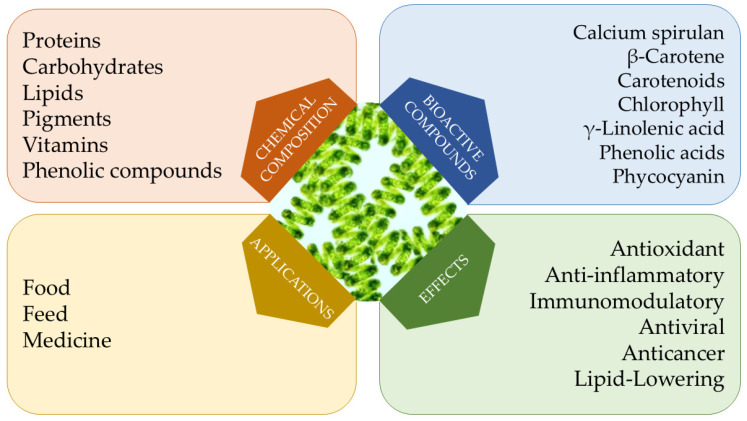
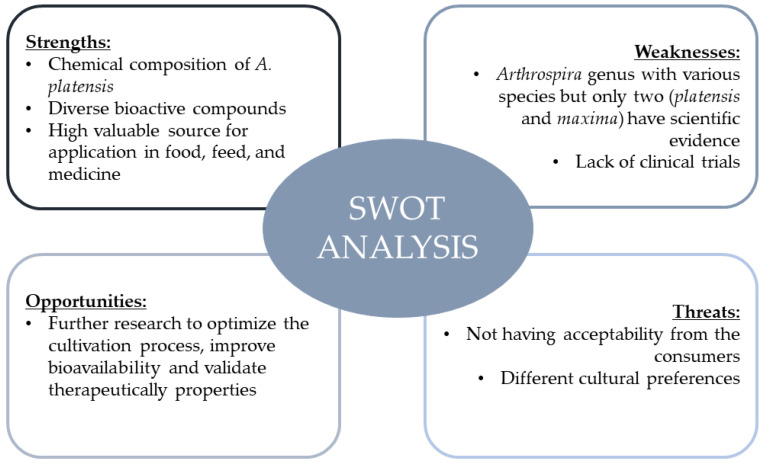
Spirulina (Limnospira platensis) is a microalga recognised for its rich nutritional composition and diverse bioactive compounds, making it a valuable functional food, feed, and therapeutic agent. This review examines spirulina’s chemical composition, including its high levels of protein, essential fatty acids, vitamins, minerals, and bioactive compounds, such as the phycocyanin pigment, polysaccharides, and carotenoids, in food, feed, and medicine. These compounds exhibit various biological activities, including antioxidant, anti-inflammatory, immunomodulatory, antiviral, anticancer, antidiabetic and lipid-lowering effects. Spirulina’s potential to mitigate oxidative stress, enhance immune function, and inhibit tumour growth positions it as a promising candidate for preventing chronic diseases. Additionally, spirulina is gaining interest in the animal feed sector as a promotor of growth performance, improving immune responses and increasing resistance to diseases in livestock, poultry, and aquaculture. Despite its well-documented health benefits, future research is needed to optimize production/cultivation methods, improve its bioavailability, and validate its efficacy (dose–effect relationship) and safety through clinical trials and large-scale human trials. This review underscores the potential of spirulina to address global health and nutrition challenges, supporting its continued application in food, feed, and medicine.
Overview
The claims and statistics of this paper haven’t been checked yet.
Run the check — free, no account needed. It reads the open-access text and checks the sources it cites.
Integrity signals
Registry
Cites
Statistics
Figures
Verification
Claims the paper makes
The claims and statistics of this paper haven’t been checked yet.
Run the check — free, no account needed. It reads the open-access text and checks the sources it cites.
Claims other papers make about this one
Each is checked against this paper’s own text: does it say what the citing paper says it does?
The source backs part of the claim, not all of it — or backs it for a different population, condition or comparison.
In the citing paper
“For instance, Chlorella and Spirulina species are renowned for their complete protein content, providing all essential amino acids in ratios comparable to high-quality animal proteins like eggs and milk [11,12].”
From Microalgae Bioactives for Functional Food Innovation and Health Promotion (2025) · cites this paper as [12]
Experimental — accuracy not yet measured
Self-check
Percentages, sums and reported differences re-computed from the paper’s own numbers.
The self-check needs the paper’s full text.
Citations
Cites
Oxidative Stress: Harms and Benefits for Human Health
Pizzino, G., Irrera, N., Cucinotta, M., Pallio, G., Mannino, F., Arcoraci, V., Squadrito, F., Altavilla, D., & Bitto, A. (2017) · Oxidative Medicine and Cellular Longevity · doi:10.1155/2017/8416763 · Cited by 4,837
The antioxidant, immunomodulatory, and anti-inflammatory activities of Spirulina: An overview
Wu, Q., Liu, L., Miron, A., Klímová, B., Wan, D., & Kuča, K. (2016) · Archives of Toxicology · doi:10.1007/s00204-016-1744-5 · Cited by 655
Microalgae as feed ingredients for livestock production and meat quality: A review
Madeira, M. S., Cardoso, C., Lopes, P. A., Coelho, D., Afonso, C., Bandarra, N. M., & Prates, J. A. M. (2017) · Livestock Science · doi:10.1016/j.livsci.2017.09.020 · Cited by 473
Self-citationPhenolic content and antioxidant capacity in algal food products
Machu, L., Misurcova, L., Vavra Ambrozova, J., Orsavova, J., Mlcek, J., Sochor, J., & Jurikova, T. (2015) · Molecules · doi:10.3390/molecules20011118 · Cited by 437
Phycobiliproteins from cyanobacteria: Chemistry and biotechnological applications
Pagels, F., Guedes, A. C., Amaro, H. M., Kijjoa, A., & Vasconcelos, V. (2019) · Biotechnology Advances · doi:10.1016/j.biotechadv.2019.02.010 · Cited by 426
Hayashi, T., Hayashi, K., Maeda, M., & Kojima, I. (1996) · Journal of Natural Products · doi:10.1021/np960017o · Cited by 422
Kumar, G., Shekh, A., Jakhu, S., Sharma, Y., Kapoor, R., & Sharma, T. R. (2020) · Frontiers in Bioengineering and Biotechnology · doi:10.3389/fbioe.2020.00914 · Cited by 315
Alzate, M. E., Muñoz, R., Rogalla, F., Fdz-Polanco, F., & Pérez-Elvira, S. I. (2012) · Bioresource Technology · doi:10.1016/j.biortech.2012.06.113 · Cited by 304
Nutraceutical properties of phycocyanin
Fernández-Rojas, B., Hernández‐Juárez, J., & Pedraza‐Chaverrí, J. (2014) · Journal of Functional Foods · doi:10.1016/j.jff.2014.10.011 · Cited by 301
Microalgae: a novel ingredient in nutrition
Christaki, E. V., Florou-Paneri, P. C., & Bonos, E. (2011) · International Journal of Food Sciences and Nutrition · doi:10.3109/09637486.2011.582460 · Cited by 298
Research works printed but not linked: 2
- Alyasiri, 2017, In Vitro and In Vivo Antibacterial Activity of Spirulina platensis, Curr. Res. Microbiol. Biotechnol., 5, 1178
- Waheed, 2024, Spirulina as an animal feed and its effect on animal health and productivity, J. Adv. Vet. Res., 14, 342
Cited by
Sorted by citations
Prates, J. A. M. (2025) · Applied Sciences · doi:10.3390/app15116144 · Cited by 70
Self-citationMicroalgae Bioactives for Functional Food Innovation and Health Promotion
Guil-Guerrero, J. L., & Prates, J. A. M. (2025) · Foods · doi:10.3390/foods14122122 · Cited by 47
“For instance, Chlorella and Spirulina species are renowned for their complete protein content, providing all essential amino acids in ratios comparable to high-quality animal proteins like eggs and milk [11,12].”
Self-citationPrates, J. A. M. (2025) · Foods · doi:10.3390/foods14091524 · Cited by 45
Self-citationMusa, M. N., Jirgi, G. M., Zango, Z. U., Isah, M., Abdurrazak, M., Adamu, A. N. D. U. A. L. E. M. T. S. E. H. A. Y. E., Wadi, I. A., Adeleke, A. A., Garba, Z. N., Bello, U., et al. (2025) · Bioresources and Bioprocessing · doi:10.1186/s40643-025-00888-3 · Cited by 43
Subbiah, G., Jena, A., Kalidhas, A. M., Kele, V., Aadiwal, V., Awasthi, K., & Kumar, K. P. (2025) · ACS Food Science & Technology · doi:10.1021/acsfoodscitech.5c00403 · Cited by 29
Metadata
- Authors
- Spínola, M. P., Mendes, A. R., & Prates, J. A. M.
- Affiliations
- University of Lisbon (PT)
- Corresponding author
- Prates, José A. M.
- Venue
- Foods
- Publisher
- MDPI AG
- Published
- 2024-11-17
- Volume
- 13
- Issue
- 22
- Pages
- 3656
- ISSN
- 2304-8158 (ISSN-L)
- PMC
- PMC11593816
- OpenAlex
- W4404469473
- Cited by
- 146
- References
- 114
- Citations by year
- 2026: 78 · 2025: 67 · 2024: 1
- FWCI
- 6.13
- Type
- journal article
- Language
- en
- Open access
- gold
- doi.org
- Licence
- Locations
- Foods (publishedVersion, cc-by)
- PubMed Central (publishedVersion, cc-by)
- PubMed (publishedVersion)
- DOAJ (DOAJ: Directory of Open Access Journals) (submittedVersion)
- Portuguese National Funding Agency for Science, Research and Technology (RCAAP Project by FCT) (submittedVersion, cc-by)
- Funders
- Fundação para a Ciência e a Tecnologia grants (Lisbon, Portugal) (UI/BD/153071/2022, 2022.11690.BD, UIDB/00276/2020, LA/P/0059/2020, UIDB/04129/2020)
- Topics
- Life Sciences › Agricultural and Biological Sciences › Aquatic Science › Seaweed-derived Bioactive Compounds
- Physical Sciences › Energy › Renewable Energy, Sustainability and the Environment › Algal biology and biofuel production
- Life Sciences › Agricultural and Biological Sciences › Food Science › Food Industry and Aquatic Biology
- Keywords
- Spirulina platensis, microalgae, chemical composition, phycocyanin, carotenoids, polysaccharides, essential fatty acids, bioactive compounds, antioxidant activity, anti-inflammatory activity, immunomodulation, anticancer activity, antidiabetic activity, hypolipidemic effect, functional foods, animal feed, livestock, poultry, aquaculture, bioavailability, chronic disease prevention
About these checks
Registry, retraction, Cites and statistics results are computed, not judged, with one exception: a printed reference that no index lists is read once by a model before it counts as a citation error. Claims are extracted by a model and kept only when their quote appears verbatim in the text; each cited source is then checked, with a model’s help, for whether it says what the claim relies on. Those verdicts can be wrong — read the claim’s quote and the cited source before relying on one.
Statistics and arithmetic are recomputed, not judged.
Confidence bands are shown only for fields calibrated on our annotated test set. None is calibrated yet, so no band is shown.
What counts as a claim ›How we measure confidence ›How we check this ›
Are you an author, or do you see a problem with this page? Request a review
