

Myrtus Communis Liquor Byproduct as a Source of Bioactive Compounds
Open accessThe DOI matches its Crossref record; 43 of the 43 references it cites were found in a registry or an index.
Abstract
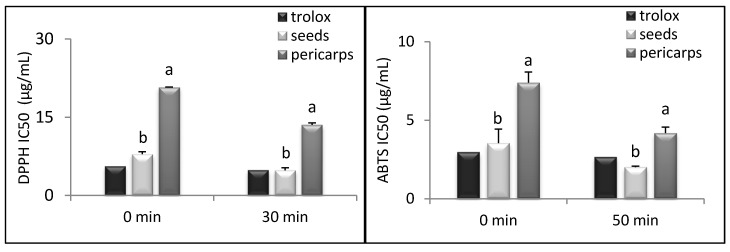
The fatty acid (FA), polyphenol content and evaluation of the antioxidant capacity of exhausted Myrtus communis berries (EMB) resulting from the production of myrtle liqueur were assessed. All parts of the exhausted berries exhibited high concentrations of carbohydrates, proteins, lipids and phenolic compounds. The lipid fraction contained a high amount of poly unsaturated fatty acids (PUFA), mainly represented by linoleic acid (>70%). Of the phenolic acids evaluated by liquid chromatography/mass spectrometry, ellagic acid was the most predominant (>50%), followed by gallic and quinic acids. Quercetin and quercetin3-O-rhamnoside were the most abundant flavonoids. The seed extracts showed a higher antioxidant potential than the pericarp extracts; the same trend was observed for total phenolic compounds evaluated by spectrophotometric assay. The overall high content of bioactive compounds and the high antioxidant potential of this byproduct sustain its suitability for a number of industrial applications, such as a food ingredient in novel foods, an additive in cosmetic formulations or a component of animal feed formulations.
Overview
The claims and statistics of this paper haven’t been checked yet.
Free: it reads the open-access text and checks the first 5 claims that cite a source we can check. Create a free account to check every claim.
Integrity signals
Registry
Cites
Statistics
Figures
Verification
Claims the paper makes
The claims and statistics of this paper haven’t been checked yet.
Free: it reads the open-access text and checks the first 5 claims that cite a source we can check. Create a free account to check every claim.
Claims other papers make about this one
Each is checked against this paper’s own text: does it say what the citing paper says it does?
The source backs part of the claim, not all of it — or backs it for a different population, condition or comparison.
In the citing paper
“However, its pericarps and seeds have high concentrations of linoleic acid, a fatty acid with protective antioxidant activities on the skin that could potentially be used as ingredients in cosmetics. Its characteristics are maintained when its residues are used after hydroalcoholic infusions, thus their viable reuse [9].”
From Innovative Approaches to an Eco-Friendly Cosmetic Industry: A Review of Sustainable Ingredients (2024) · cites this paper as [9]
Experimental — accuracy not yet measuredThe cited source says what the claim attributes to it.
In the citing paper
“For example, the food industry produces organic waste, a known source of phenolic compounds such as flavonoids and phenolic acids, among other various derivatives that would normally be discarded [9].”
From Innovative Approaches to an Eco-Friendly Cosmetic Industry: A Review of Sustainable Ingredients (2024) · cites this paper as [9]
The cited source says what the claim attributes to it.
In the citing paper
“More than 3 million bottles of myrtle ( Myrtus communis ) liquor are produced every year in Sardinia (Italy), and approximately 200,000 tons of waste are discarded annually.”
From Innovative Approaches to an Eco-Friendly Cosmetic Industry: A Review of Sustainable Ingredients (2024) · cites this paper as [9]
The cited source says what the claim attributes to it.
In the citing paper
“Many secondary products can be reevaluated and processed to generate interesting compounds, including cosmetic ingredients [9].”
From Innovative Approaches to an Eco-Friendly Cosmetic Industry: A Review of Sustainable Ingredients (2024) · cites this paper as [9]
The cited source says what the claim attributes to it.
In the citing paper
“Food waste is increasingly being recovered and used to produce high-value compounds.”
From Innovative Approaches to an Eco-Friendly Cosmetic Industry: A Review of Sustainable Ingredients (2024) · cites this paper as [9]
1 more claim about this paper
Create a free account to see every claim other papers make about this one.
Self-check
Percentages, sums and reported differences re-computed from the paper’s own numbers.
The self-check needs the paper’s full text.
Citations
Cites
Van Soest, P. J., Robertson, J. B., & Lewis, B. A. (1991) · Journal of Dairy Science · doi:10.3168/jds.s0022-0302(91)78551-2 · Cited by 28,658 · cited 2×
“The fiber fractions content (neutral detergent fiber, NDF; acid detergent fiber, ADF; and acid detergent lignin, ADL) was determined following the sequential procedure described by Van Soest, Robertson and Lewis [18], using the filter bag equipment of Ankom (Ankom Technology Corp., Fairport, NY, USA).”
MethodUse of a Free Radical Method to Evaluate Antioxidant Activity
Brand-Williams, W., Cuvelier, M. E., & Berset, C. (1995) · LWT - Food Science and Technology · doi:10.1016/s0023-6438(95)80008-5 · Cited by 25,994 · cited 2×
“The DPPH radical scavenging assay was performed according to the method proposed by Brand-Williams, Cuvelier and Berset [24] with some modifications as previously reported by”
MethodBalasundram, N., Sundram, K., & Samman, S. (2006) · Food Chemistry · doi:10.1016/j.foodchem.2005.07.042 · Cited by 3,108 · cited 1×
“For example, it has been repeatedly demonstrated that such byproducts can possess high amounts of phenolic compounds—a large group of secondary metabolites that includes: phenolic acids, flavonoids, anthocyanins, and proanthocyanidins [3].”
BackgroundPlant Polyphenols: Chemical Properties, Biological Activities, and Synthesis
Quideau, S., Deffieux, D., Douat‐Casassus, C., & Pouységu, L. (2011) · Angewandte Chemie International Edition · doi:10.1002/anie.201000044 · Cited by 2,730 · cited 1×
“These metabolites have received a great deal of attention because of their numerous biological properties, such as their anti-mutagenic, cardioprotective, anti-inflammatory, anti-carcinogenic, anti-allergic, antiviral and antioxidant activities [4].”
BackgroundInfluence of fatty acid composition of raw materials on biodiesel properties
Ramos, M. J., Fernández, C. M., Casas, A., Rodríguez, L., & Pérez, Á. (2009) · Bioresource Technology · doi:10.1016/j.biortech.2008.06.039 · Cited by 1,864 · cited 1×
“Values of LA that exceed 50% of total FA are typical of plant oils, such as soybean, sunflower and grape seed oils [39].”
BackgroundKramer, J. K. G., Fellner, V., Dugan, M. E. R., Sauer, F. D., Mossoba, M. M., & Yurawecz, M. P. (1997) · Lipids · doi:10.1007/s11745-997-0156-3 · Cited by 812 · cited 1×
“The FA profiles of seeds, pericarps and whole EMB were determined following the method of Kramer, Fellner, Dugan, Sauer, Mossoba and Yurawecz [22] with some modifications.”
MethodRecent developments in altering the fatty acid composition of ruminant-derived foods
Shingfield, K. J., Bonnet, M., & Scollan, N. D. (2013) · Animal · doi:10.1017/s1751731112001681 · Cited by 500 · cited 1×
“Moreover, the inclusion of lipid sources (with a high proportion of PUFA) in ruminant diets represents a useful strategy to increase the proportion of beneficial FA in meat and milk and their derived products [38].”
BackgroundPolyphenols and agriculture: beneficial effects of proanthocyanidins in forages
Aerts, R. J., Barry, T. N., & McNabb, W. C. (1999) · Agriculture, Ecosystems & Environment · doi:10.1016/s0167-8809(99)00062-6 · Cited by 475 · cited 1×
“The utilization of byproducts rich in polyphenols as feedstuff has also been explored since recent studies into ruminants showed beneficial effects on health conditions [10], protein and lipid ruminal metabolism [11,12] and the immune system [13], as well as an enhancement of milk production and quality [14,15].”
BackgroundBIOLOGICAL FUNCTIONALITY OF ELLAGIC ACID: A REVIEW
VATTEM, D. A., & SHETTY, K. (2005) · Journal of Food Biochemistry · doi:10.1111/j.1745-4514.2005.00031.x · Cited by 313 · cited 2×
“Several papers have investigated the biological properties of ellagic acid, which include antioxidant, antimicrobial, anti-inflammatory and antimutagenic activities, as reviewed in [47].”
BackgroundBeneficial effects of polyphenols on cardiovascular disease
Quiñones, M., Miguel, M., & Aleixandre, A. (2013) · Pharmacological Research · doi:10.1016/j.phrs.2012.10.018 · Cited by 294 · cited 1×
“Furthermore, several epidemiological studies suggest that a diet rich in antioxidants may have a positive impact by increasing the reactive antioxidant potential of an organism and reducing the risk of certain degenerative diseases that originate from deleterious free radical reactions [6].”
Background
Cited by
Correddu, F., Lunesu, M. F., Buffa, G., Atzori, A. S., Nudda, A., Battacone, G., & Pulina, G. (2020) · Animals · doi:10.3390/ani10010131 · Cited by 210
“0004 nd phenolic acids, flavanols, flavonols [49,59]”
BackgroundInfluentialSelf-citationInnovative Approaches to an Eco-Friendly Cosmetic Industry: A Review of Sustainable Ingredients
Sasounian, R., Martinez, R. M., Lopes, A. M., Giarolla, J., Rosado, C., Magalhães, W. V., Velasco, M. V. R., & Baby, A. R. (2024) · Clean Technologies · doi:10.3390/cleantechnol6010011 · Cited by 96
Giampieri, F., Cianciosi, D., & Forbes-Hernández, T. Y. (2020) · Food Frontiers · doi:10.1002/fft2.37 · Cited by 76
Zhao, C., Su, W., Mu, Y., Mu, Y., & Jiang, L. (2021) · Frontiers in Microbiology · doi:10.3389/fmicb.2020.617030 · Cited by 52
“For instance, linoleic acid and stearic acid, which are present in myrtle liqueur (Correddu et al., 2019), Maotai flavor liquor (Cai et al.”
BackgroundDueñas, M., & Estévez, I. G. (2020) · Foods · doi:10.3390/foods9060817 · Cited by 51
Wild berries and related wild small fruits as traditional healthy foods
Aguilera, J. M., & Toledo, T. (2022) · Critical Reviews in Food Science and Nutrition · doi:10.1080/10408398.2022.2156475 · Cited by 64
A review of the biological effects ofMyrtus communis
Dabbaghi, M. M., Fadaei, M. S., Roudi, H. S., Rahimi, V. B., & Askari, V. R. (2023) · Physiological Reports · doi:10.14814/phy2.15770 · Cited by 43
Luca, M. D., Lucchesi, D., Tuberoso, C. I. G., Fernàndez‐Busquets, X., Vassallo, A., Martelli, G., Fadda, A. M., Pucci, L., & Caddeo, C. (2022) · Pharmaceutics · doi:10.3390/pharmaceutics14050910 · Cited by 27
Martínez‐Francés, V., Rivera, D., Obón, C., Alcaraz, F., & Ríos, S. (2021) · Frontiers in Pharmacology · doi:10.3389/fphar.2021.713414 · Cited by 19
Nia, A. E., Malekzadeh, E., Taghipour, S., Tatari, A., & Arshad, Z. G. (2023) · International Journal of Biological Macromolecules · doi:10.1016/j.ijbiomac.2023.126733 · Cited by 20
Herb-Derived Products: Natural Tools to Delay and Counteract Stem Cell Senescence
Abruzzo, P. M., Canaider, S., Pizzuti, V., Pampanella, L., Casadei, R., Facchin, F., & Ventura, C. (2020) · Stem Cells International · doi:10.1155/2020/8827038 · Cited by 21
“It was demonstrated that the exhausted berries of myrtle (bioproducts), resulting from myrtle liquor production, contained a high content of bioactive molecules, such as polyunsaturated fatty acids and phenolic compounds with high antioxidant activity [160].”
BackgroundCvitković, D., Škarica, I., Dragović‐Uzelac, V., & Balbino, S. (2024) · Molecules · doi:10.3390/molecules29081755 · Cited by 21
“…used in the food sector for traditional Italian liqueur production, especially on the island of Sardinia, which has a geographical indication of origin, known as “Mirto di Sardegna” [2], with an annual production of more than three million bottles [5], as well as for flavoring meat and sauces [6].”
BackgroundSnoussi, A., Bouacida, S., Mitić, M., ARSIC, B. B., Koubaier, H. B. H., Chouaibi, M., Janković, S., Zlatanović, I. G., Mrmošanin, J., Stojanović, G., et al. (2022) · Journal of Food Measurement & Characterization · doi:10.1007/s11694-022-01341-1 · Cited by 15
Fadda, A., Montoro, P., D’Urso, G., Ravasio, N., Zaccheria, F., & Sanna, D. (2023) · Antioxidants · doi:10.3390/antiox12010154 · Cited by 11
Dessì, D., Fais, G., Follesa, P., & Sarais, G. (2025) · Antioxidants · doi:10.3390/antiox14010088 · Cited by 12
Detti, C., Nascimento, L. B. D. S., Gori, A., Vanti, G., Amato, G., Nazzaro, F., Ferrini, F., Centritto, M., Bilia, A. R., & Brunetti, C. (2024) · Journal of the Science of Food and Agriculture · doi:10.1002/jsfa.14029 · Cited by 7
The protective effect of Myrtus communis L. against experimental kidney stone in rats
Yılmaz, H., Eki̇nci̇, N., Ömerli, A., Nisari, M., Yay, A., Ülger, H., Karatoprak, G. Ş., Yımaz, S., Ateş, Ş., & Taştan, M. (2022) · Oriental Pharmacy and Experimental Medicine · doi:10.1007/s13596-021-00620-4 · Cited by 5
“communis 70% methanol extract we used in our study was found to be high and it was determined to be compatible with the literature content (Correddu et al. 2019; Cruciani et al. 2019; Siracusa et al. 2019).”
MethodTaibi, A., Mokrani, A., Kadi, A., Bouherour, R., Guermi, N. E. Y., Teffane, M., Arroul, Y., & Richard, T. (2024) · Chemistry & Biodiversity · doi:10.1002/cbdv.202301675 · Cited by 4
“M. communis is found to contain a variety of secondary metabolites including essential oils [11–14], anthocyanins [15, 16], tannins [17], flavonoids[18],andfattyacids[19,20].”
Taibi, A., Mokrani, A., Kadi, A., Bouherour, R., Guermi, N. E. Y., Teffane, M., Arroul, Y., & Richard, T. (2024) · Journal of Applied Research on Medicinal and Aromatic Plants · doi:10.1016/j.jarmap.2024.100577 · Cited by 2
RetractedBiniecka, M., & Wrześniak, M. (2023) · Medycyna Nowożytna · doi:10.4467/12311960mn.23.018.18459 · Cited by 1
Myrtle (Myrtus communis L.) and potential health effects
Bagcilar, S., & Gezer, C. (2020) · DergiPark (Istanbul University)
Abacı, N., & Orhan, İ. E. (2025) · Elsevier eBooks · doi:10.1016/b978-0-443-24860-3.00020-3
Taibi, A., Mokrani, A., Hamitri‐Guerfi, F., Kadi, A., Teffane, M., Arroul, Y., Sobhi, W., Boulekbache‐Makhlouf, L., & Madani, K. (2025) · Food and Feed Research · doi:10.5937/ffr0-57499
From By‐Product to Value: Impact of Spent Myrtle Berries on the Quality of Sheep‐Milk Yoghurt
Carboni, A., Cabizza, R., Urgeghe, P. P., Fancello, F., Pes, M., Dedola, A. S., Zara, S., & CARO, A. D. (2026) · International Journal of Food Science · doi:10.1155/ijfo/1906762
Metadata
- Authors
- Correddu, F., Maldini, M., Addis, R., Petretto, G. L., Palomba, M., Battacone, G., Pulina, G., Nudda, A., & Pintore, G.
- Affiliations
- University of Sassari (IT)
- Corresponding author
- Nudda, Anna
- ORCID
- Venue
- Foods
- Publisher
- MDPI AG
- Published
- 2019-06-30
- Volume
- 8
- Issue
- 7
- Pages
- 237
- ISSN
- 2304-8158 (ISSN-L)
- PMC
- PMC6678195
- OpenAlex
- W2955507877
- Semantic Scholar
- 9cb126729136d4aab7699c3f750863720bcb87d0
- Cited by
- 24
- References
- 43
- Citations by year
- 2026: 1 · 2025: 3 · 2024: 5 · 2023: 4 · 2022: 4 · 2021: 2 · 2020: 5
- FWCI
- 1.65
- Type
- journal article
- Language
- en
- Open access
- gold
- dx.doi.org
- Licence
- Locations
- Foods (publishedVersion, cc-by)
- PubMed Central (publishedVersion, cc-by)
- PubMed (publishedVersion)
- UnissResearch (Università degli Studi di Sassari) (submittedVersion, cc-by)
- DOAJ (DOAJ: Directory of Open Access Journals) (submittedVersion, cc-by-sa)
- Topics
- Health Sciences › Medicine › Biochemistry (medical) › Phytochemicals and Antioxidant Activities
- Health Sciences › Nursing › Nutrition and Dietetics › Pomegranate: compositions and health benefits
- Physical Sciences › Chemistry › Organic Chemistry › Edible Oils Quality and Analysis
- Keywords
- Myrtus communis, myrtle berries, phenolic compounds, ellagic acid, flavonoids, quercetin, quercetin-3-O-rhamnoside, polyunsaturated fatty acids, linoleic acid, antioxidant activity, seed extract, pericarp extract, novel food ingredients, cosmetic additives, animal feed
About these checks
Registry, retraction, Cites and statistics results are computed, not judged, with one exception: a printed reference that no index lists is read once by a model before it counts as a citation error. Claims are extracted by a model and kept only when their quote appears verbatim in the text; each cited source is then checked, with a model’s help, for whether it says what the claim relies on. Those verdicts can be wrong — read the claim’s quote and the cited source before relying on one.
Statistics and arithmetic are recomputed, not judged.
Confidence bands are shown only for fields calibrated on our annotated test set. None is calibrated yet, so no band is shown.
What counts as a claim ›How we measure confidence ›How we check this ›
Are you an author, or do you see a problem with this page? Request a review
Data sources
Bibliographic data: Semantic Scholar, OpenAlex, Crossref.
Contains information from the Semantic Scholar Academic Graph Datasets, made available under the ODC Attribution License (ODC-BY 1.0).
Semantic Scholar’s data is described in: Kinney, R., et al. (2023). The Semantic Scholar Open Data Platform. arXiv:2301.10140.
