

Mesenchymal Stem Cells Loaded in Injectable Alginate Hydrogels Promote Liver Growth and Attenuate Liver Fibrosis in Cirrhotic Rats
Open accessThe DOI matches its Crossref record; 66 of the 66 references it cites were found in a registry or an index.
Abstract
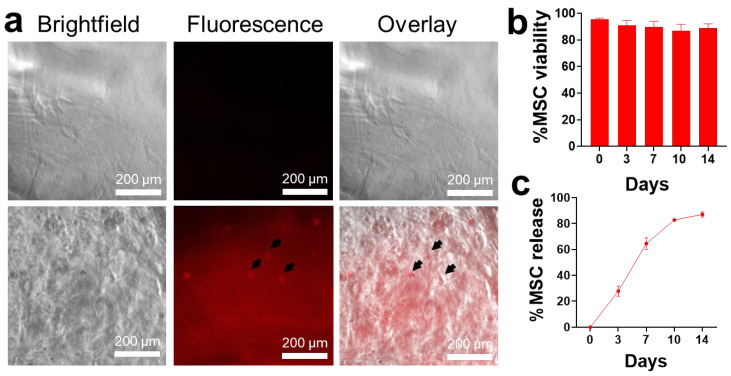
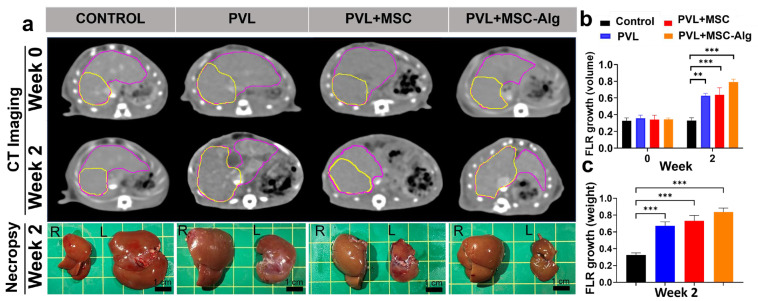
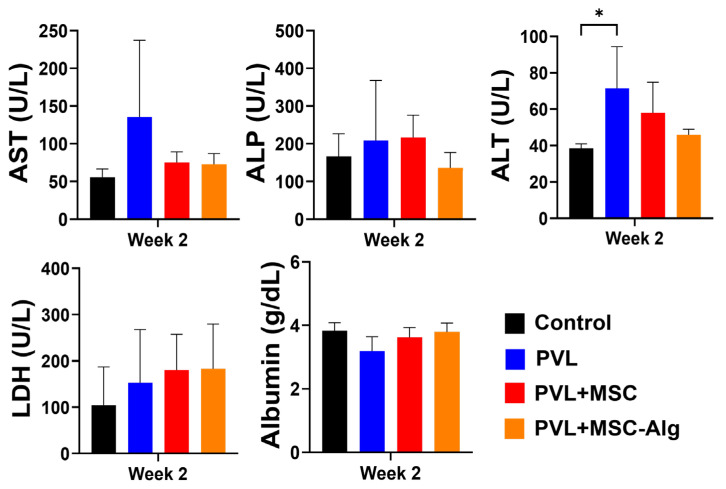
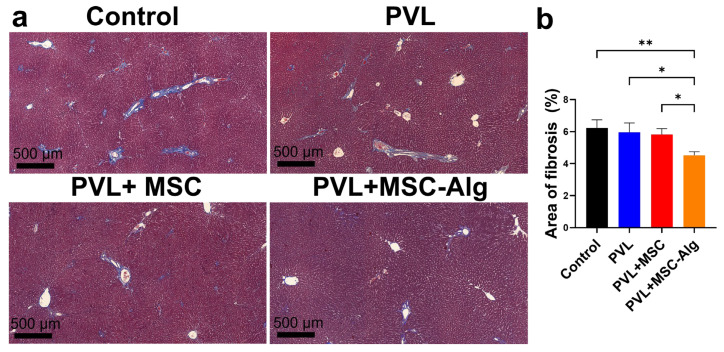
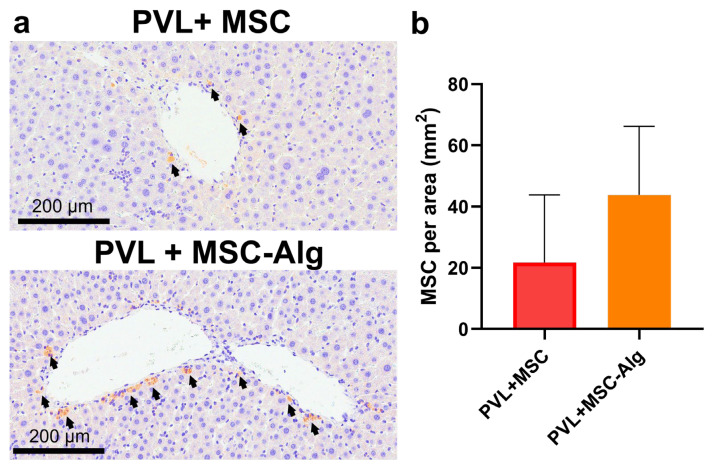
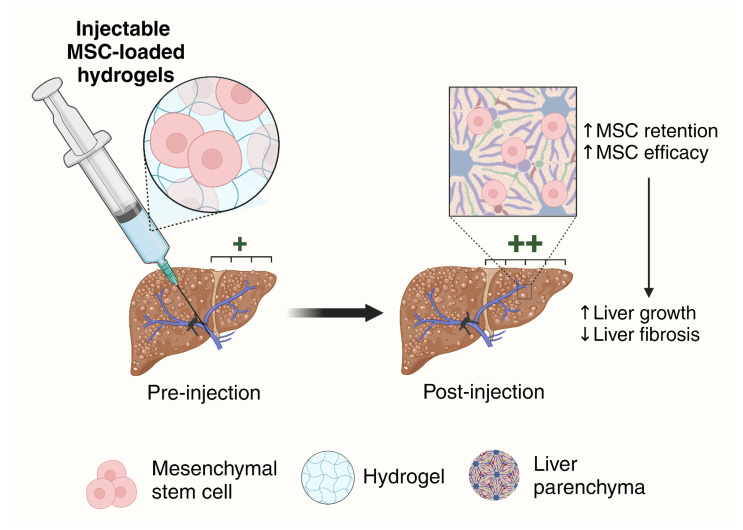
Cirrhosis, a marker of severe liver diseases, limits future liver remnant (FLR) growth, preventing many cancer patients from undergoing surgery. While portal vein blockade (PVB) techniques are used to stimulate liver regeneration, 20–30% of patients still fail to achieve the required growth. Although mesenchymal stem cell (MSC) therapy improves PVB, its efficacy is limited by poor cell retention. To address this, we utilized alginate hydrogels to deliver MSCs and improve their retention. MSCs were loaded in the hydrogel and injected intraportally in cirrhotic rats. Liver volume, weights, enzyme levels, and histology were monitored. Results showed that the hydrogel maintained 89.0 ± 3.0% cell viability and gradually released MSCs for over two weeks. Furthermore, the rats injected with the MSC-loaded hydrogel demonstrated higher liver volumes (FLR ratio of 0.57 ± 0.32) and weights (FLR ratio of 0.84 ± 0.05). The treated rats exhibited more improved liver enzymes (AST: 72.75 ± 14.17 U/L, ALP: 135.67 ± 41.20 U/L, ALT: 46.00 ± 2.94 U/L) and decreased fibrotic areas in the liver (4.52 ± 0.22%) compared to the control group. Histology revealed increased retention when MSCs were delivered with the hydrogel (37.30 ± 16.10 MSCs/mm2) compared to cells alone (21.70 ± 22.10 MSCs/mm2). Overall, the MSC-loaded hydrogels enhanced the growth and reduced the fibrosis of the liver by promoting cell retention and efficacy in cirrhotic rats. This approach holds significant potential for improving outcomes among cancer patients, offering a promising therapeutic strategy for liver regeneration and treatment of liver diseases.
Overview
The claims and statistics of this paper haven’t been checked yet.
Free: it reads the open-access text and checks the first 5 claims that cite a source we can check. Create a free account to check every claim.
Integrity signals
Registry
Cites
Statistics
Figures
Verification
Claims the paper makes
The claims and statistics of this paper haven’t been checked yet.
Free: it reads the open-access text and checks the first 5 claims that cite a source we can check. Create a free account to check every claim.
Claims other papers make about this one
Each is checked against this paper’s own text: does it say what the citing paper says it does?
The cited source says what the claim attributes to it.
In the citing paper
“Various biomaterials, such as alginate hydrogels, have been used to load MSCs, which can greatly improve the efficacy of MSC-based therapy [367].”
From Mechanisms, efficacy, and future perspectives of cellular-based therapies for liver fibrosis/cirrhosis: focusing on mesenchymal stromal cells (2025) · cites this paper as [367]
Self-check
Percentages, sums and reported differences re-computed from the paper’s own numbers.
The self-check needs the paper’s full text.
Citations
Cites
Alginate: Properties and biomedical applications
Lee, K. Y., & Mooney, D. J. (2012) · Progress in Polymer Science · doi:10.1016/j.progpolymsci.2011.06.003 · Cited by 8,095 · cited 1×
“Alginate is a natural polymer that does not degrade to toxic byproducts [19,20], as compared with some synthetic polymers [21,22].”
Sepanlou, S. G., Safiri, S., Bisignano, C., Ikuta, K. S., Merat, S., Saberifiroozi, M., Poustchi, H., Tsoi, D., Colombara, D. V., Abdoli, A., et al. (2020) · The Lancet Gastroenterology & Hepatology · doi:10.1016/s2468-1253(19)30349-8 · Cited by 1,714 · cited 1×
“Cirrhosis is a hallmark of all chronic liver diseases, affecting 122 million people and causing about two million deaths globally [1,2].”
Global epidemiology of cirrhosis — aetiology, trends and predictions
Huang, D. Q., Terrault, N. A., Tacke, F., Gluud, L. L., Arrese, M., Bugianesi, E., & Loomba, R. (2023) · Nature Reviews Gastroenterology & Hepatology · doi:10.1038/s41575-023-00759-2 · Cited by 839 · cited 1×
“Cirrhosis is a hallmark of all chronic liver diseases, affecting 122 million people and causing about two million deaths globally [1,2].”
Lu, P., Ruan, D., Huang, M., Tian, M., Zhu, K., Gan, Z., & Xiao, Z. (2024) · Signal Transduction and Targeted Therapy · doi:10.1038/s41392-024-01852-x · Cited by 667 · cited 1×
“MSCs lose their efficacy due to prolonged exposure to a suboptimal microenvironment and the loss of supporting extracellular matrix (ECM) [16,17].”
Alginates as a useful natural polymer for microencapsulation and therapeutic applications
Goh, C. H., Heng, P. W. S., & Chan, L. W. (2012) · Carbohydrate Polymers · doi:10.1016/j.carbpol.2011.11.012 · Cited by 655 · cited 1×
“Alginate is a natural polymer that does not degrade to toxic byproducts [19,20], as compared with some synthetic polymers [21,22].”
Abasalizadeh, F., Moghaddam, S. V., Alizadeh, E., akbari, E., Kashani, E., Fazljou, S. M. B., Torbati, M., & Akbarzadeh, A. (2020) · Journal of Biological Engineering · doi:10.1186/s13036-020-0227-7 · Cited by 608 · cited 1×
“They can form injectable hydrogels, comprising a three-dimensional network of polymers that contain a large amount of water [23].”
The carbon tetrachloride model in mice
Scholten, D., Trebicka, J., Liedtke, C., & Weiskirchen, R. (2015) · Laboratory Animals · doi:10.1177/0023677215571192 · Cited by 414
Tag, C. G., Sauer-Lehnen, S., Weiskirchen, S., Borkham-Kamphorst, E., Tolba, R. H., Tacke, F., & Weiskirchen, R. (2015) · Journal of Visualized Experiments · doi:10.3791/52438 · Cited by 306
Li, P., Ou, Q., Shi, S., & Shao, C. (2023) · Cellular & Molecular Immunology · doi:10.1038/s41423-023-00998-y · Cited by 250 · cited 1×
“The therapeutic potential of MSCs is largely attributed to their ability to differentiate into hepatocyte-like cells [12] and their capability to produce regenerative growth factors and immunomodulatory cytokines [13,14].”
Animal models of chronic liver diseases
Liu, Y., Meyer, C., Xu, C., Weng, H., Hellerbrand, C., ten Dijke, P., & Dooley, S. (2013) · American Journal of Physiology-Gastrointestinal and Liver Physiology · doi:10.1152/ajpgi.00199.2012 · Cited by 226
Cited by
Choi, S., & Jeong, J. (2026) · International Journal of Molecular Sciences · doi:10.3390/ijms27020619 · Cited by 12
“Preclinical models have demonstrated that hydrogel-based MSC delivery augments anti-inflammatory and antifibrotic effects in liver fibrosis [111,119].”
Magnetic Nanocomposite Hydrogels in Orthopedics: Applications and Perspectives
Shi, S., He, S., Lin, Q., & Sun, S. (2025) · International Journal of Nanomedicine · doi:10.2147/ijn.s539423 · Cited by 10
Chandramouli, A., Babu, R., Gopal, K., Manjari, R. S., Kaliannagounder, V. K., Park, C. H., & Jayakumar, R. (2026) · International Journal of Biological Macromolecules · doi:10.1016/j.ijbiomac.2026.150761 · Cited by 3
Pan, X., Gao, T., & Wang, B. (2025) · Cell & Bioscience · doi:10.1186/s13578-025-01520-9 · Cited by 2
Mesenchymal Stem Cells in Liver Fibrosis: A Dose-Dependent Recovery
Lyundup, A. V., Shagidulin, M. Y., Онищенко, Н. А., Beregovykh, V. V., Крашенинников, М. Е., Venediktov, A. A., Pokidova, K., Nikolskaya, A. O., Kuzmin, E. A., Kostin, A. A., et al. (2025) · Applied Sciences · doi:10.3390/app151910471 · Cited by 2
Bayırlı, A. B., Genç, D., Belgin, E. E., Tekin, L., Bulut, O., Uytun, M., & Sezgin, S. (2026) · Polymers · doi:10.3390/polym18050555 · Cited by 2
“Bolinas et al. re-ported that injectable hydrogels loaded with MSCs are stable for 14 days [51].”
Electrosprayed PLGA Nanoparticles for Dual Drug Delivery: Design, Optimization and Applications
Azimi, B., Ahmadpoor, F., TOZZI, A., Shahraki, A., Maleki, H., Ferrari, P. F., & Danti, S. (2026) · Polymers · doi:10.3390/polym18091133 · Cited by 5
“Nevertheless, recent studies suggest that with appropriate process optimization, electrospray may offer opportunities for cell encapsulation and microcarrier fabrication, representing a potential direction for future research [199,200].”
Tunçer, A., Şahin, E., Ünal, B., & Dirican, A. (2026) · Medicina · doi:10.3390/medicina62020358 · Cited by 1
“In parallel, pharmacological anti-steatotic and antifi-brotic agents targeting metabolic dysfunction-associated steatotic liver disease are under active investigation and may contribute to optimizing hepatic parenchymal quality prior to donation [30,31].”
Alginate-driven nanotherapeutics in liver cancer: design, applications, and future perspectives
Desai, T., Rawat, E., Haswani, N. G., Wahab, S., Alshehri, S. A., & Kapoor, D. U. (2026) · International Journal of Pharmaceutics · doi:10.1016/j.ijpharm.2026.126844 · Cited by 2
Plasma Beta-Hydroxybutyrate and All-Cause Mortality in Patients with Liver Cirrhosis
Chvatal‐Medina, M., Li, Y., Almanza, M. C. T., Post, A., Connelly, M. A., Moshage, H. J., Bakker, S. J. L., de Meijer, V. E., Blokzijl, H., & Dullaart, R. P. F. (2025) · Biomedicines · doi:10.3390/biomedicines13051120 · Cited by 1
“66.7 [59.4, 74.6] 111.5 [97.7, 131.1] 277.2 [182.4, 373.7] 58 [48, 62] 61 [55, 66] 60.00 [55, 65] 0.1 13 (31.7) 15 (34.9) 14 (34.1) 1.0 Alcohol use was slightly lower in the highest BHB tertile.”
InfluentialJin, Y. Z., Kwon, H., Kim, K., Lee, S.-Y., Jun, I., Song, J., & Hwang, G. (2026) · Journal of Clinical Medicine · doi:10.3390/jcm15051906
“Accordingly, integrating pharmacologic modulation with regenerative approaches may represent a future investigational direction rather than an immediate clinical application, potentially contributing to improved graft durability [42,43].”
Bolinas, D. K. M., Barcena, A. J. R., Mishra, A., Bernardino, M. R., Heralde, F. M., Huang, S. Y., & Melancon, M. P. (2026) · Biomedical Microdevices · doi:10.1007/s10544-026-00815-z
“…to establishing a framework for optimizing microcapsule fabrication and for developing Alg-based hydrogel delivery systems platforms with translational potential. and injectability, advantages not achievable when cells are delivered unencapsulated in a vehicle medium alone (Bolinas et al. 2025).”
Self-citationRegulatory roles and translational potential of the Kruppel-like factor family in liver disease
Chen, H., Huang, S., Zhou, Z., Li, J., Peng, Q., & Tu, J. (2026) · iLiver · doi:10.1016/j.iliver.2026.100252
Self-citationAlginate-based biomaterials as versatile carriers for biomedical applications
Adim, S., Afridi, M. F., Baakili, S. E., Fatimi, A., & Bouissane, L. (2026) · Carbohydrate Polymers · doi:10.1016/j.carbpol.2026.125752
Research progress and future trends in advanced biomaterials for the treatment of liver fibrosis
Li, B., Zhu, R., Lv, Y., & Chen, G. (2026) · Biomedical Materials · doi:10.1088/1748-605x/aea1cd
“…deliver MSCs for the treatment of liver fibrosis, and showed that this system effectively maintained MSC survival and retention, promoted long-term engraftment within liver tissue, and significantly improved liver function recovery and anti-fibrotic efficacy through sustained release effects [164].”
Yin, X., Jiao, A., Niu, W., & Li, L. (2026) · International Immunopharmacology · doi:10.1016/j.intimp.2026.117375
Balster, L., Hinna, R. A., Hassan, A., Shiha, G. E.-S., & Lotfy, A. (2026) · Bioengineering · doi:10.3390/bioengineering13101157
“Biomaterial-based delivery may further improve local cell retention and facilitate placement of cells within or adjacent to injured liver tissue [15,16].”
Liu, W., Wang, Y., An, W., Wang, Z., Han, B., Tao, H., 张永利, Gong, F., Wang, X., & Wang, J. (2026) · Cells · doi:10.3390/cells15201884
“In preclinical models of drug-induced liver injury, cirrhosis, and hepatic fibrosis, MSC transplantation has been shown to improve liver function biomarkers, attenuate fibrosis, and stimulate tissue regeneration [59,127,128].”
HALBUTOĞULLARI, Z. S., Korun, Z. E. U., Çelebi, G., Furat, S., DİŞLİ, M., Duruksu, G., & Utkan, T. (2026) · Biomedicines · doi:10.3390/biomedicines14102394
“Furthermore, hydrogel-based MSC administration improved cell retention and therapeutic efficacy, thereby supporting tissue repair and functional recovery [26].”
Biomimetic Medical Engineering of Injectable Hydrogels for Liver Regeneration and Disease Therapy
Han, J., Tang, M., Pang, L., Xia, Y., & Liang, Y. (2026) · Advanced bionics. · doi:10.1016/j.abs.2026.10.002
Metadata
- Authors
- Bolinas, D. K. M., Barcena, A. J. R., Mishra, A., Bernardino, M. R., Lin, V., Heralde, F. M., Chintalapani, G., Fowlkes, N. W., Huang, S. Y., & Melancon, M. P.
- Affiliations
- The University of Texas MD Anderson Cancer Center (US)
- University of the Philippines Manila (PH)
- Corresponding author
- Melancon, Marites P.
- ORCID
- Venue
- Gels
- Publisher
- MDPI AG
- Published
- 2025-03-27
- Volume
- 11
- Issue
- 4
- Pages
- 250
- ISSN
- 2310-2861 (ISSN-L)
- PMC
- PMC12027234
- OpenAlex
- W4408928598
- Cited by
- 20
- References
- 66
- Citations by year
- 2026: 16 · 2025: 4
- FWCI
- 12.85
- Type
- journal article
- Language
- en
- Open access
- gold
- doi.org
- Licence
- Locations
- Gels (publishedVersion, cc-by)
- PubMed Central (publishedVersion, cc-by)
- PubMed (publishedVersion)
- Digital Commons-TMC (Texas Medical Center) (submittedVersion)
- DOAJ (DOAJ: Directory of Open Access Journals) (submittedVersion, cc-by-sa)
- Funders
- National Institutes of Health—National Cancer Institute (P30CA016672, R25 CA-265800-01A1)
- Joint Center for Computational Oncology (JCCO) Pilot Grant (P30CA016672, R25 CA-265800-01A1)
- Department of Science and Technology-Philippine Council for Health Research and Development (P30CA016672, R25 CA-265800-01A1)
- Topics
- Life Sciences › Biochemistry, Genetics and Molecular Biology › Cell Biology › Mesenchymal stem cell research
- Health Sciences › Medicine › Hepatology › Liver physiology and pathology
- Health Sciences › Medicine › Surgery › Tissue Engineering and Regenerative Medicine
- Keywords
- mesenchymal stem cells, alginate hydrogel, liver cirrhosis, liver regeneration, liver fibrosis, cell retention, future liver remnant, liver cancer surgery
About these checks
Registry, retraction, Cites and statistics results are computed, not judged, with one exception: a printed reference that no index lists is read once by a model before it counts as a citation error. Claims are extracted by a model and kept only when their quote appears verbatim in the text; each cited source is then checked, with a model’s help, for whether it says what the claim relies on. Those verdicts can be wrong — read the claim’s quote and the cited source before relying on one.
Statistics and arithmetic are recomputed, not judged.
Confidence bands are shown only for fields calibrated on our annotated test set. None is calibrated yet, so no band is shown.
What counts as a claim ›How we measure confidence ›How we check this ›
Are you an author, or do you see a problem with this page? Request a review
Data sources
Bibliographic data: Semantic Scholar, OpenAlex, Crossref.
Contains information from the Semantic Scholar Academic Graph Datasets, made available under the ODC Attribution License (ODC-BY 1.0).
Semantic Scholar’s data is described in: Kinney, R., et al. (2023). The Semantic Scholar Open Data Platform. arXiv:2301.10140.
